On Corporate Aesthetics and Post-Internet Art

Of all things I’ve seen on the internet lately, I can’t recall any image being so aesthetically pleasing as Julia Fox posing as a real estate agent on a billboard  in Manhattan. This was not because of its situationist appearance, plastered without context to the side of a vape shop on Mott Street, but for the uncanny feeling induced by her clean face framed by corporate-style typographies and logos. Her traits, previously adapted to countless It Girl styles, conform now with a glowy Office Siren look: infused by a frontal white light, framed by a formal blue suit. Spotting a recognizable face where you’d expect to find an unfamiliar stock-image face is paradoxical: stock imagery is made to feel generic, to evoke a popularly shared feeling. But NEON, the marketing team fresh off iconic campaigns for Longlegs and Anora, capture our current obsession for corporate aesthetics in visual culture for Stephen Soderbergh’s Presence in a way that transcends a catchy troll campaign. From PowerPoint slides and muted blue and gray palettes to office uniforms, slogans and business infographics, the internet is currently being flooded with variations of early late 90s/2000s corporate visual elements and stock imagery aesthetics. But why is this happening now?

Julia Fox posing as a real estate agent in a billboard spawned in Manhattan

Single Cover for EQ’s Boytoy. Credits: @estratosfera___

In the 2010s wave of post-internet art, corporate aesthetics were of extreme interest for artists investigating what the internet had become in so little time. Following the brief illusion of the online as an open and free space. The internet, on the cusp of the ‘10s, was facing two possible directions: that of a free zone independent from corporate capitalism, and that of a space owned by a few companies monopolizing online life. Post-internet artists were extremely sensitive to these signs. In 2013 DIS Magazine, a collaborative project between a group of artists and theorists including Lauren Boyle, Solomon Chase, Marco Roso and David Toro, affiliated with other artists like Brad Troemel, Ryan Trecartin and Ian Cheng, launched DISimages, a call to action for artists to create their own series of stock images. Dedicated to “manipulating the codes and trends in stock photography,” DISimages invited artists to create new unexpected compositions that broadened the spectrum of stereotypical stock portraiture. In Mer-life, DIS itself shot a bunch of lifestyle vignettes of people performing casual actions — drinking a Starbucks coffee, fixing a hole in the wall, writing on a laptop — while wearing a mermaid tail. In another series called Future Growth Approximation, Estonian artist Katja Novitskova situated cut outs of animals and stock arrows in white cubes as indicators of economic growth, while Anne de Vries mixed objects of different textures in dadaist compositions, somehow similar to the haptic nature of some AI-images that flood Instagram’s Explore page.

Mer-Life, DIS

Future Growth Approximation, Katja Novitskova

All these pictures were — and are — up for sale on the DIS official website for whoever wants to use them. In the spirit of DISimages, the socially constructed patterns in advertising can be revolutionized by scattering touches of strangeness here and there. With the goal of appealing to the broadest possible market, stock imagery “sanitizes” humanity to the lowest common denominator, packaging what’s only a faded impression of daily human rituals. Because it’s impossible to stage any “risky” variation, it’s often very easy to trace the biases behind these portrayals. Women in their early 30s will be the only ones laughing at their salads, software developers will wear thick glasses and hardly ever look Caucasian, and so on. There’s an uncanny feeling in being able to track which elements originate from which beliefs, an uncanniness resonant within a lot of AI generated imagery. In this sense, DISimages’ attempt to sow chaos feels like an experimental machine learning model being trained on a bespoke database of weird images. Theorist Silvio Lorusso, author of Enterprecariat and What Design Can’t Do, coined the term “Normie Weird” to refer to a certain kind of weirdness pursued by people experimenting with GANs. The images generated by AIs “are weird, sure, but normie-weird” he writes, “they are what you would expect a weird image to look like. Somehow, they reassure us of our notion of weirdness. When everything is weird, nothing truly is.”

The role of stock pictures in the market has been replaced by AI-generated images. You can spot them in the streets and in store windows more and more, retaining a certain strangeness made up of smiles far too white, skins too smooth, unhuman expressions and unnatural colors. Post-internet artist and DIS magazine contributor Daniel Keller calls the increasingly lighthearted incorporation of this kind of aesthetic into everyday life “sloptimism” a tongue-in-cheek repositioning of the content poured for us into the feed. Keller’s term has its roots in other theories like the Dark Forest and the Dead Internet: both basically stating that the online world is a wasteland of bots and AI-generated content, where human gestures have nearly disappeared or driven away by the fear of algorithmic echo chambers. What Keller has observed is that, in the times of attention economy, the rules of advertising have bled into all other aspects of life. He sees sloptimism as the symptom of culture and corporate collapsing into each other. This draws a sharp connection between this era and the one in which early post-internet artists, including him, first operated.

In 2008, Kevin Bewersdorf, co-creator of Spirit Surfers – one of the most popular surf clubs of the early web — inaugurated Maximum Sorrow, a personalised corporate identity, complete with its own website, logo, merch and uniform. The idea for it came from the same experience of web surfing: the practice of blogging about internet ephemera that spread around post-internet artists just before the launch of Web 2.0. In an interview with Rhizome.org, the artist stated that he came up with the idea for the website after seeing how these artists were progressively mastering self-branding practices online. “Many net artists may not be willing to admit it, but what they are really trying to do is to build an empire, to be a brand that offers it all. There is an absurdity to that. Having your own website is like building an unnecessary shrine to yourself. […] I use my signature and various logos to point out the absurdity of this vanity. […] Whether a net artist brands themself with a sparse list of links […] or with logos in a bland grid, they are constructing their own web persona for all to see” he says.

Kevin Bewersdorf’s Maximum Sorrow (2008-2009)

Maximum Sorrow tapped into what Kevin called “corporate spiritualism”, a philosophy he materialized in two projects: an image and text based work called Stock Photography Watermarks As the Presence of God, where he imagines watermarks on stock pictures as divine apparitions of a superior entity, and the text The Four Sacred Logos, where he lists the basic principles of a new online world he describes as The Marketplace. Mirroring Kevin’s practice, 2024 was the year of internet spiritualism and the comeback of medieval iconography: at Sónar, the music and multimedia festival held in Barcelona every year, artistic duo ¥€$Si PERSE and dance company LASADCUM will present CYBERMEDIEVAL, a performance where the terms and conditions of Big Tech companies meet the feudal contracts of medieval times.

Stock Photography Watermarks As the Presence of God (2008), Kevin Bewersdorf

Other artists from the same generation engaged with the “sublime ordinariness” of non-places, the name anthropologist Marc Auge gave to anonymous transitory places, stock imagery and company logos by linking them to a crippling sense of nostalgia where the intimate and the impersonal meet. The artistic practices of DISmag friends Amalia Ulman and Jasper Spicero have been extremely influential for this current second wave of corp-core. Less ironic, their research taps into a specific kind of corporate sincerity. In her 2014 immersive installation The Destruction of Experience, Ulman invited visitors into a space somewhere between a hospital clinic, a church and an office: a maze of white walls, where pharmacy calendars and leftovers from a corporate party stand beside a large company name made of a blue circle and the Nirvana logo. In the background, the humming of Zara Home’s in-store playlist.

The Destruction of Experience (2014), Amalia Ulman

Despite recreating a cold, corporate environment, Ulman’s installation suggests the familiarity of a personal tale. The detachment of the decor blends with the strange feeling of having already visited that space, recalling intimate experiences and the melancholy of a time that will never return: the walls are dull as those of primary school buildings, filled with 70s aseptic decor pieces as a grandparents’ house, and covered in glitter paraphernalia like a preteen secret diary. Jasper Spicero’s films, sculptures and installations work in the same way. His blueish industrial mise-en-scene winks at the intersection of corporate and childhood aesthetics, demonstrating the existence of a visual purity that unites the two. His sculptures of toy birds and mechanical arms merge surgery room furniture and kid’s room decor, evoking family trauma, a hospital visited once, a bleak shopping mall you liked when you were a child. This representation of corporate aesthetics as an aseptic but emotionally charged visual alphabet serves as a bridging experience between the experiences of early internet users and the feelings of the 2020s. Ulman and Spicero were both inspired by the ever-increasing presence of corporations in their intimate worlds, mainly because of platform society’s business model creeping into affective interpersonal relations. Almost 10 years before the first wave of post-internet art, these artists reflected on how interface design was maneuvering the way people related to one another.

Only Starrling Conference Call (2017), Jasper Spicero. Credits: Culture Magazine

Sunset Work Station (2017) Jasper Spicero. Credits: Living Content

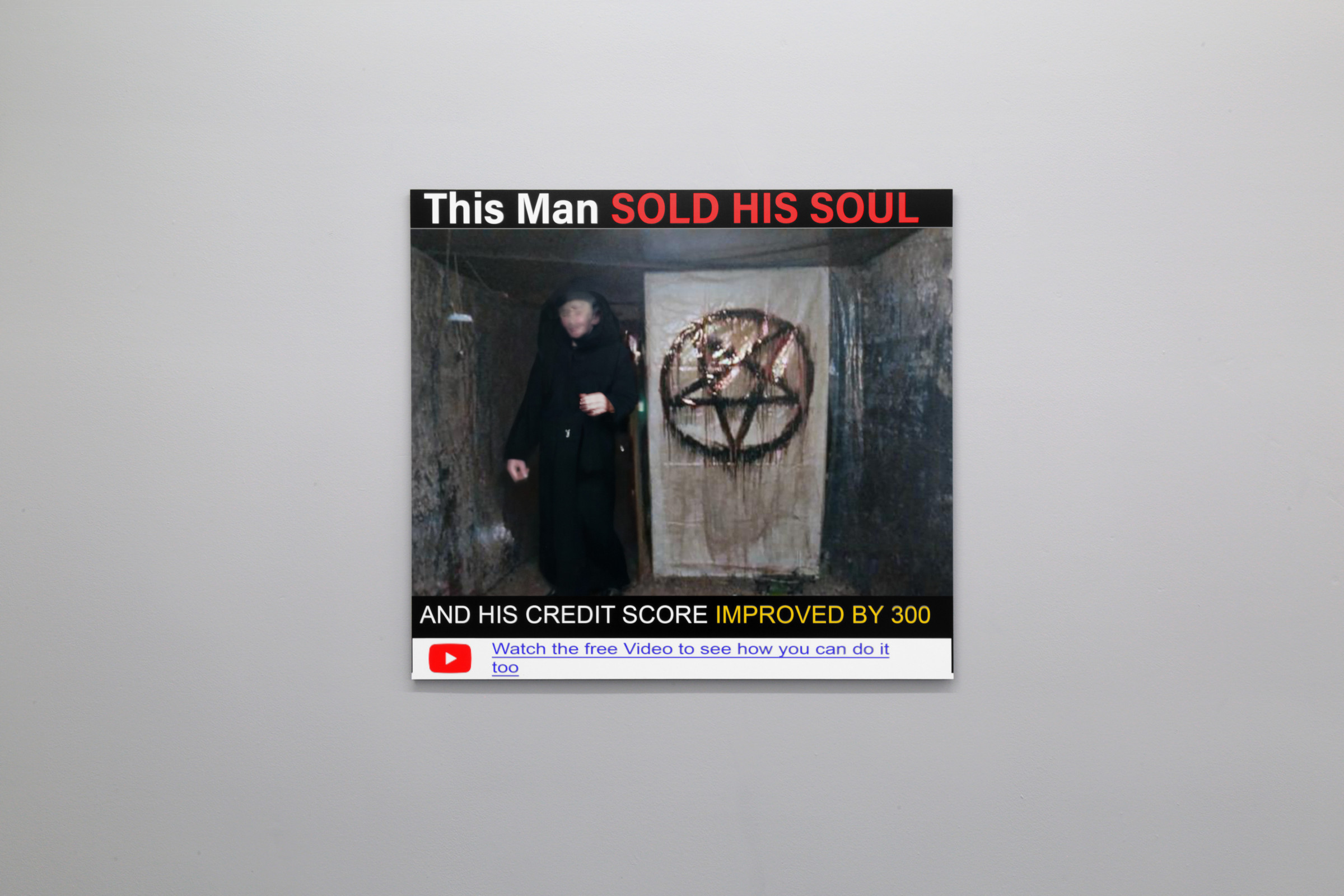
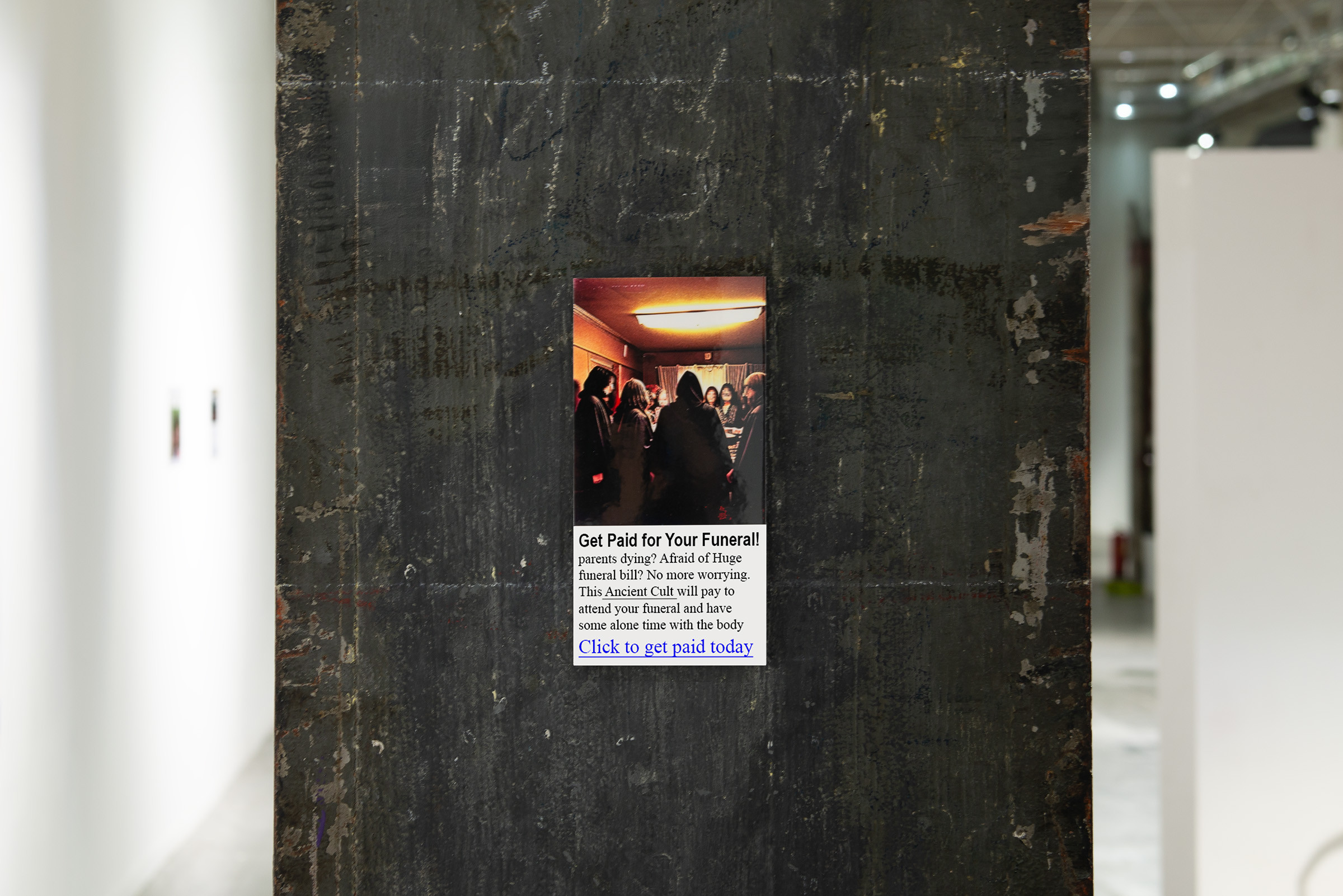
The real difference is that Gen Z were already born within a digital landscape ruled by corporations. Placing all the memories of the early years of their life on the internet, they cannot help but feel nostalgic towards a past that was already compromised. For a new generation of digital native artists, Web 2.0 is filled with innocence and nostalgia in a similar way that Web 1.0 was for post-internet artists. Learning by their practice, emerging artists are sympathizing with the feeling of loss towards their past lives online. Dutch artist Melle Nieling represents this feeling by recreating common tropes in old fashioned spam advertising. His works devirtualizes pop-up banners, emphasizing promises of evading taxes, age-reversal serums or making billions by clicking on a link. In works like Soul (2023) and Funeral (2023), some of these statements take a spiritual turn, presenting clickbait stories of people selling their soul in exchange of points on their credit score, or ancient cults paying for funeral bills. Recalling the terrain of online flash games websites and pirate websites that Gen Z spent its pre-adolescent years, Nieling stages a time when scams online looked like annoying spam banners. When the internet was still naive, digital traps to collect and sell your data had the look of stretched images, funky fonts, hot singles to meet in your surroundings and shiny sports cars to win with a single click.

Gwynethat (2024), Mielle Nieling at Loods 6 during Post Fascism, photo by Vex Noir

London-based artist Gordon Hack also investigates the bond he sees between figurative art and corporate imagery, with his paintings recreating the text overload in security signs, real estate advertising and commercial billboards. By asking an industrial sign making company to produce these ads, Hack fuses his practice with that of an industrial manufacturer, inhabiting the role of a corporate worker having to deal with traditional printing processes, materials, typographies, and colour-matching techniques. In a Warholian act of self-automation, Hack’s works look at manual industrial procedures of image-making, opposed to the way AI is used in advertisement today to create a hyperreal world that looks like ours. By choosing industrial processes like silk-screen printing and stenciling, Hack becomes a man-machine, carefully crafting compositions from existing elements: his gestures uncover advertisement processes, opposed to what happens inside the mysterious black box of an AI.

For early post-internet artists, one of the main spaces to experiment the connection between art and  marketplace was the fashion landscape. In 2024, DIS launched the pop-up store DISown in New York, presenting a series of garments that mocked commodity activism – the kind of activism carried out through slogans on mugs, t-shirts, and visor hats – and the meaning of merchandising itself. Still active as an e-commerce platform, DISown produced pieces such as the Coupon Tee: a T-shirt that functions as a real coupon, with a design inspired by the slack aesthetic of promo code  finder websites. The Utility Shirt 2-Pack in collaboration with Lizzie Fitch – part of an artistic duo with Ryan Trecartin –  draws inspiration from vectorized corporate icons to create a pack of tees that “are ideal for team-building sessions, human resources staff, and barefoot CEO’s”. For the perfect stock photoshoot, the Classics Salad Bowl pairs ideally with a fork, a lighthearted woman in her 30s, and an empty kitchen.

Coupon Tee by DISown. Credits: www.disown.dismagazine.com

Utility Shirt 2-Pack by Lizzie Fitch for DISown (credits)

For digital natives, the relationship between fashion and corporate culture is much more linked to a melancholic look at the idealized work spaces they’ve seen on the screen but never experienced, environments that look so unobtainable in these times of precariousness and work/life imbalance. The tendency toward self-branding, skewered in its infancy by early post-internet artists, has resulted in a perpetual state of presenting oneself as an ever-evolving start-up. Never having worked in a corporate environment, Gen Z loves cosplaying formal work wear that winks at adulthood and power. Office Sirens interpret fashion through the lens of movies like Secretary (2003) and American Psycho (2000), with thick black glasses, blazers, knee-length skirts and classy updos. In the first part of 2023, this trend morphed into a new, slightly more status affirming, form: the Boom Boom Aesthetic, or the desire to look like a flashy company CEO. If post-internet artists used fashion as an undisguised critical tool, Gen Z engages with it by applying numerous layers of post-irony and detachment. Inside the entanglements of the algorithm, it’s difficult to discern a critical action from a viral trend.

Singer AMORE in Office Siren. Credits: @tqamore

singer/model Gabbriette in Office Siren. Credits: @gabbriette          

LinkedIn Graphic of “Boom Boom Aesthetic”. Credits: Max Niederhofer

Office nostalgia creeps out, making us longing for a stable income and a cubicle, LinkedIn profiles become the indispensable tool of every artist and theorist to emerge. To find the roots of today’s obsession with corporate aesthetics, there’s a need to look back at the previous generation and the same angst they felt towards losing a space they considered to be salvific. More than being just a visual trend, there’s a precise reason why corporate aesthetics that captivate Gen Z so closely resemble the works of early post-internet art and artists, who keep leading the way over a decade after their emergence. It’s a cross-generational embrace of the feeling that the online world could be eroded, divided up by corporations in order to build sloptimistic, non-human space for bots to profit off themselves. Post-internet art’s observation of how the internet and the marketplace are entangled has shifted from a critique of self-branding practices to nostalgia for a time when online advertising was much less sophisticated. The real question is whether these attempts to critique reality will stand out within the rules of algorithmic culture. Like a creature with sharp teeth, the algorithm devours every cultural symptom by repetition and commodification: a critique becomes a trend, its origins get blurred until they’re harder and harder to catch. The relationship between the internet and corporations will evolve, but will always remain a part of its core structure, and one of the main interests for artists and researchers investigating online ecology. Can we ever go back to a less corporative online life, and will art uncover how?


Canada Theory – Geo-Political Debates at INC

This internal INC email exchange from early February began with a posting of Max Haiven on his Substack: Is Canada’s premier Carney a warlord? Three fellow Canadians responded: Henry Warwick, Marc Tuters and David Gauthier.

Canada theory has been high on the INC agenda from day one—and well before. After all, INC stands on the shoulders of both German and Canadian media theory. A record number of Canadians and non-Canadian based there are involved in INC projects, either live and work here in NL and in Europe or work and study there, such as a few of our INC former interns. Canada as angle and method  has multiple personal, cultural and intellectual backgrounds (beyond the infamous Grant-Innes-McLuhan-Kroker-Chun lineage).

Please have a look at the Canadas Semiotexte reader from 1994, if you can find it. Michael Freeman classified the book as such: “This anthology redraws Canada as a complex terraincognita of desire and dismay. “Eco-feminism, censorship, and the ‘queerness’ of the True North. Richly eclectic in tone and material, unrelentingly controversial, and very difficult to ignore. It is likely the most novel take on our state of affairs in quite some time.”

A direct reason for this exchange is Trump’s plan to annex Canada as United States’ 51st state and Carney’s speech at the World Economic Forum in Davos on January 20, 2026. Let’s define Canada Theory. /Geert

INC author Henry Warwick, who became a Canadian citizen himself recently, has been based in Toronto for a long time and is teaching there. His response to Max Haiven:

  1. One year ago, there was an upcoming election. At the end of December 2024, going into January 2025, the Conservatives led by Pierre Poilievre were leading Trudeau and the Liberals 45% to 16%, nearly a 30% deficit. This would have led to a MASSIVE Conservative majority.
  2. Trump took office in February and immediately started with his “Canada is the 51st state” and “Governor Trudeau” bullshit. This made Canadians pretty upset.
    3. while Trump is raging on about the 51st State, Poilievre went gushing over how he looks forward to dealing with Trump, and Trump recommends his election. This was “not a good idea”.
  3. Carney comes into the picture – the Liberals decide they have to ditch Trudeau if they have any hope of winning. So they elect Carney as leader and he becomes PM in March 2025. The election happens about a month later and the Liberals win it, but not with a majority govt – they were 3 seats short.
  4. Carney immediately tells Trump to, basically, shut the fuck up and act like an adult, and begins playing hardball, which he has all the skills and background to do.

Poilievre’s collapse was SPECTACULAR. I was convinced we were going to have our own Trump running the place, instead not only did Carney win the election, Poilievre lost his seat in suburban Ottawa. Poilievre went to Alberta (Canada’s version of Texas) and had a guy who had just won his seat that election to resign so he could have it and stay in government. The guy quit and Poilievre won the by election. Canada dodged a bullet.

Is Carney an optimal PM? Hell no. He’s what we call a “Red Tory” – a fiscal conservative, social liberal. I do not align with his ideas or designs.

HOWEVER: we didn’t have a choice of “optimal” candidates – we had the Red Tory/Liberal Carney, the junior league fascist Poilievre, and Jagmeet Singh, the hapless bland and not very popular leader of the NDP. What Happened? A huge portion of the NDP vote went to Carney. The other Red Tories that were looking to vote against Trudeau suddenly didn’t have Trudeau to hate, and recognised Carney as someone they could deal with. Bang: Carney got elected.

Canada is teetering – the American psyop campaign of Alberta separatism is up to 17% in Alberta. Stellantis, GM, and Ford just removed about 8,000 jobs from Ontario (mostly because of tariffs from the USA). Canada is on its own and is desperately looking for allies, as the USA is no longer trustworthy and in many ways is openly hostile to Canadian sovereignty. So, there’s that pressure to deal with as well. (also, the fucking separatists are even stupider than Poilievre. There are 3 major land treaties with first nations that will still apply whether they are separate or not. Ooops.) It’s a total shitshow.

“Carney presents himself as the liberal alternative to Trump’s fascism, but also as a straight-shooting realist from a “middle power” who can’t afford the illusions of the erstwhile “international rules-based order.”

Carney is in office because it was him or Poilievre, i.e. Canadian Trump, only stupider. THAT is why he is PM. Carney is no prize, but he’s light years better than Poilievre – a fool who won’t even get a security clearance. Seriously. He wants to be PM, but doesn’t want to submit to background checks for a security clearance.

The writer in his ideas about Warlordarchy, should read Chinese history and their theory of The Mandate From Heaven.

The mandate creates a predictable dynastic cycle – first there is chaos, and out of chaos come warlords. The warlords or “regional leaders” fight for control, effectively competing to see who would receive the new Mandate of Heaven. Someone does and establishes a new Dynasty. The Dynasty flourishes and then becomes decadent, falling back into chaos, creating new warlords – rinse repeat.

I learned about this in the early 2000s. https://www.files.ethz.ch/isn/104682/2000-01_China_Debates_Future.pdf

China has been anticipating a multipolar geopolitics since the mid 1980s. None of them anticipated Xi consolidating power and walling himself off from criticism. Also, at the time, the demographic bomb had yet to go off, so that didn’t play into their war gaming theory, either. In anycase, Haiven’s crude theory of “Warlordarchy” is simply a weak recapitulation of the Mandate of Heaven.

This doesn’t mean he’s wrong.

Carney is not the problem right now. Yes, Carney is suboptimal. But we’re dealing with actual fascism, and for all his faults he is antifascist, so when it came to choosing a PM in April 2025, Carney was the obvious choice. Right now he’s at 60% approval, and he won with 40%. So, he’s fairly popular with the average Canadian. Stopping Carney from being a neoliberal curse will be the product of the next election, on the one hand, and consistent opposition to his bad policies for the duration.

A number of people are discussing the new economic order as a kind of neofeudalism. I discussed that in my Dissertation esp. with my references to Drahos’s book Information Feudalism: Who Owns the Knowledge Economy? from 2003. Also, his book A Philosophy of Intellectual Property, which was really important to my Diss. Lately a number of people seem to be thinking “Oh, this internet bullshit is all driving to feudalism!” Duh. Drahos was on it over 20 years ago.

Doctorow and Scott and others singing that tune are, with Drahos, more accurate than Haiven – the feudalism we’re skipping into is not land based – it’s information based. The Enclosures ended centuries ago. Deleuze talked about Endocolonialism – that’s much more on point.

At the same time, I am very much in agreement with Haiven’s critical points – they are correct.  The Neoliberal order set us up for the fascism that is following on. I just think he misses important context about Carney. Carney’s not my preferred choice, but given what was happening, he’ll do for now.

Also: Churchill was out of office months after VE day.

best, Henry

===========================
https://kether-music.bandcamp.com
http://www.kether.com

MoneyLab participant Max Haiven responded:

I don’t disagree about the immediate reason why Carney was elected, but I think there’s much more to say here about longer term trends and Canadian political economy and politics. Carney is Bay Street’s man through and through. I don’t think my argument suggests that he is the worst thing in the world. It was intended as a somewhat provocative antidote too the strange and very Canadian euphoria about him.

When faced with the lesser of two evils I refuse to choose, and at risk of being unpopular I’m always going to try and recall that we can and should have leaders and systems that serve the commons and the common good, rather than the rich and powerful. I think when faced with the kind of murderous “realism” that all politicians today cite (both Trump and Carney), it’s more important than ever to show them contempt and insist that we have the capacity to produce a world that meets everyone’s needs and allows us to live in peace and abundance. I refuse the blackmail of realism or pragmatism. Let us build grassroots power to refuse and rebel, and then negotiate, not capitulate to their false spectrum of options in advance! Regrettably the state of movements in Canada and many other places is very weak at the present moment but I don’t think that capacity will improve if we accept their terms.

Canada is indeed in a moment of profound and very dangerous crisis. But I think a crisis is the most important time to fundamentally rethink the purpose of society the economy and the state. The opportunity will not come again for a generation at least. I’m not optimistic that such a rethinking will happen but I feel if I have any responsibility in this mess, it is to try and help provoke it!

This is an interesting point on warlords although I don’t think my admittedly hastily sketched theory is only a warmed over rehashing of the Mandate from Heaven, other way I’m very interested in that. I actually think that the CPC right now looks at the world as precisely the Warlordarchy I am proposing, and in continuity with these older Chinese imperial philosophies. I’m working on something that tries to move us beyond both this Chinese framework and the typical liberal framework that would insist on an antinomy between the warlord and the emperor or  the warlord and the modern state. That theory isn’t exactly ready yet as it still baking in the oven!

All the best, MH

Henry’s response:

I don’t think Trump will invade Taiwan, Greenland, or Canada. I think his next target is Cuba. Many Cubans in the USA are rather right wing (in a kind of knee jerk antipathy to the Cuban govt seen as communist/left wing).  So, a defeat of the Cuban regime would (in Trump et al’s blinkered reality) shore up support in Florida. So, there are possible benefits for the Regime to invading Cuba. Also, Cuba already has an American base on it (Guantanamo Bay) and the east end of Cuba is only 145km from Florida. So, an invasion of Cuba would be comparatively easy. My guess is that Trump is holding back on this, as it is a tall order of military effort, and he uses these adventures to distract / dilute news of the Epstein files.

This particular brand of fascism from the Trump Regime is as embedded in media theory of the attention economy as political economy and psychology, making belligerence a tool of message control and attentional focus.

Taiwan is, from what I’ve been able to gather, not under direct threat, however, it is under more threat in the short term than the long term. This is due to China’s demographic collapse. China is WAY below replacement (IIRC something like 0.9, replacement is 2.1) and its aging population is starting to strain healthcare, pensions, and social safety nets. It’s economic growth plans are kind of cooked by a shrinking workforce. Xi’s govt has made efforts to encourage higher birth rates through two- and three-child policies, but these have largely failed, and China is very much in a population death spiral, like Korea, Japan, Italy, and Germany. I attribute this to shortsighted urbanisation policies combined with an export centred economy. They have to keep wages low to be competitive, so the people of China aren’t as wealthy or well paid as say Norway or USA. The space in urban high rise buildings is limited and expensive, so children became an economic burden. So, if China was to take Taiwan, they would have to do it soon while they still have a surplus of young men.

However, I don’t see an invasion anytime soon for a variety of reasons.

  1. It would take time and it’s too easy to see troop build ups.
  2. Taiwan is 180km from China mainland. China has built some large landing craft/barges, but they are very slow. Let’s say 30kmph. Which is 6 hours from mainland to Taiwan. the moment said barges got half way, Taiwan would send fleets of drones and missiles after them. They would never arrive. And if they did, you’re going to have to deal with #3
  3. China hasn’t been in a proper full scale war in DECADES (vs Vietnam, which ended in 1991). Their leadership has little more battle experience than the kids they’re going to have to draft into dying in this mess.
  4. The core value of Taiwan is chip manufacture. Otherwise, it’s just a largish island full of people. The moment the invasion seems to be succeeding, they will simply evacuate the factories and blow them to smithereens (and probably fly the expensive core components out of the country.)
  5. The moment the Chinese set off to invade Taiwan, ASEAN and similar orgs would get involved. The lifeline of China, oil from the middle east, would be cut off and blockaded. Their economy would collapse, and without the energy they need their war machine would fail, and the country would collapse.

So, I’m not really worried about Taiwan.

 Trump is not going to invade Greenland. He doesn’t have to. The present arrangements are that the USA can put as many bases there as it wants anyway, so security isn’t the issue. The minerals underground are also not an issue. Sure, they are undoubtedly there, but they are also under a couple km of ice. It’s going to take a few centuries for that to melt out. So, no. Trump will declare “a new page in the history of USA/Greenland/Denmark” and say that the USA will multiply the number of bases in a “New accord” with Denmark. Of course there’s no new accord – the USA can already do that under present treaties with Denmark. He comes off looking strong and gets to dodge the bullet of having NATO declare war on the USA.

Same with Canada. If he invades Canada, that will bring NATO against him, and the economy would completely collapse. Sure – M1 tanks would cover Toronto – he would easily win the battle – but he would lose the war.

Frankly, I think the Republicans will have Trump removed from office. Hopefully next month (ides of March) but certainly by Solstice – otherwise it will be an absolute bloodbath at the election in November.

If the Dems sweep House and Senate in November, which is entirely possible, Vance will get impeached and convicted, and then whoever is his VP will become president, and will be on a very short neoliberal leash from the worthless Dem Leadership (Schumer et al – useless bunch of dopes).

more later!

H

Marc Tuters, a Canadian media theorist based in Amsterdam, writes:

Hi Geert,

what I find interesting is less a question of whether Carney is right or wrong, and more how global politics is now being articulated, and where. As an IR diagnosis, Carney’s Davos speech strikes me as quite compelling: weaponized interdependence, the end of comfortable assumptions about a US-led order, and the strategic predicament of middle powers. This was the speech that Europe needed to make and Canada made it.

From what I could see in the thread I don’t really read Max as disputing that analysis so much as reacting to what he fears follows from it — a narrowing of political imagination under the banner of realism.

Where my own ambivalence comes in is precisely Davos as a venue. It’s a space of elite coordination that is structurally anti-democratic, where business and politics collude under the language of “stakeholder capitalism,” a concept that remains dubious even when dressed up in green garments. That makes Carney’s speech important, but also symptomatic: global governance increasingly articulated outside democratic institutions.

I was also struck by Carney’s use of Havel. The point about hollow ideals functioning as rituals of compliance is sharp, but there’s a slippage worth noting. The slogan being mocked (“Workers of the world, unite”) names worker solidarity, not just elite hypocrisy — and Trumpism, in any case, doesn’t really operate through high ideals at all, but through coercion, resentment, and transactional loyalty. That makes the analogy illuminating, but also incomplete.

I’m less interested in judging the characters than in watching the stage shift. Politics is moving out of parliaments and into places like Davos, where it seems like ideas of solidarity and democratic agency are the first things left outside the door.

Best, Marc

David Gauthier, also based in The Netherlands, teaches at the Media & Culture department of Utrecht University:

One small thing that is missing from Henry’s analysis of how Carney got elected is: Québec. The vote in la belle province is what got the guy elected and there are a bunch of people that usually vote Bloc Québécois that voted Liberal, which is really weird. The Parti Québécois (sovereignty  party) is on the rise now (also weird, because they were technically dead) and I wonder what kind of reaction the Québec electorate will have if a new election comes around.

Henry Warwick adds:

Oh, my, for certain – the Bloc voting Liberal was instrumental, for sure – every vote mattered! However, from my research, while the shift in the Bloc toward Carney was crucial, it doesn’t compare with the nearly complete self-immolation of the NDP.

In 2021, the previous election, saw Trudeau’s re-election and the following results in seats:

2021
Liberal 160
Conservative 119
Bloc Québécois 32
New Democratic 25
Green 2

These are the results of the 2025 election that saw Carney win:

2025
Liberal 169
Conservative 144
Bloc Québécois 22
New Democratic 7
Green 1

Clearly, the Bloc lost 10 seats that went to the Liberals – about a 32% shrinkage, which was harsh. The Greens lost 50% (1 seat). The NDP? They lost 18 seats – 72%! Their leader, Jagmeet Singh, lost his seat. They even lost official party status! Yikes! Talk abou taking one for the team. The NDP is in a serious pickle right now. Singh resigned, obviously, and the party is rudderless. However – I think that might all change very soon. Avi Lewis (husband of Naomi Klein) tossed his hat into the ring, and the possibility of his winning NDP leadership has a number of people pretty jazzed – having Naomi Klein in orbit of the PM is a serious asset. That would make things… Very Interesting. We will know in 29 MAR 2026 after the NDP Convention in Winnepeg.

Re: Taiwan, the Dutch INC affiliated researcher  (born in Taiwan), Conny Tzu Lin writes:

China’s best strategy atm is to sabotage within the island. Namely disinformation war, cyber attacks and the manipulation of politicians. The best way is to make a 50+ % of Taiwanese population come to the term that it’s better to ‘keep peace’ and not resist an invasion. The whole effort of the civil movement is not to make this happen.

Marc Tuters responds:

What interests me in this exchange is less a moral sorting of figures (Carney vs. Poilievre, realism vs. resistance) than a shift in where politics is being articulated and legitimized. Read as an IR diagnosis, Carney’s Davos speech is persuasive: weaponized interdependence, the erosion of trust in a US-led order, and the predicament of middle powers. In that sense, it felt like the speech Europe could not quite make for itself — and Canada did.

At the same time, Davos matters here not just as a backdrop but as a symptom. It is a space of elite coordination that is structurally anti-democratic, where politics is reframed as necessity, risk management, and “realism,” often under the language of stakeholder capitalism — a concept that remains dubious even when dressed up in green terms. This raises a different question than whether Carney is right or wrong: what happens to democratic contestation when global governance is increasingly articulated outside democratic institutions?

Carney’s invocation of Václav Havel is telling in this regard. The critique of hollow ideals functioning as rituals of compliance is sharp, but there is a slippage worth noting. The slogan being mocked — “Workers of the world, unite” — names worker solidarity, not merely elite hypocrisy. Moreover, Trumpism does not operate through high ideals at all, but through coercion, resentment, and transactional loyalty. The analogy is illuminating, but incomplete.

David Gauthier responds:

I don’t see Havel’s problematising the shop owner’s putting the slogan “Workers of the world, unite” in front of his window dissing/mocking workers solidarity, but showing that it became an empty / automatic slogan that lost its meaning and that merely functions as a signal of compliance with the regime (which in a sense is exactly not what the slogan means). My reading of Carney’s reference to Havel’s shop owner is that liberal democracies running on financial infrastructures have their empty / automatic slogans (“liberal democracy” perhaps being one? — “we’re open for business” maybe? — how about “we love freetrade” ?!)] that are loosing their meaning and merely function as a (empty) signal of compliance with the USA regime and, perhaps more importantly, its historical ideology (the “beacon of light” of “liberal democracy”, the “we’re open for BIG business,” the “come spend you pension money: we are the number one financial and bond market”, etc.), not just Trump’s non-sense (he is only a small blimp in the USA’s historical ideology).

Easy to see that even here in Europe, people are still going through those rituals reciting these empty slogans, hoping it has the desired effects. Perhaps in Canada, the reaction to the tariffs was so strong that people are at least aware of the sign / slogan and how it became an empty signifier very fast? I can ask my mom, lol. For me, Carney is saying there is no way back when you take the sign off your window. Trump in power or not.]


Identity, Mimesis, and the Escape from the Self: An Interview with Alexander Douglas

On 10 February 2026, I participated in an event at Spui25 where Alexander Douglas gave a talk about the digital self in relation to his latest book, Against Identity: The Wisdom of Escaping the Self. In the book, Douglas draws on three distinct sources—the Zhuangzi, the philosophy of Spinoza, and the theory of René Girard—to argue that the human quest for a fixed and definitive identity can be seen as the fall of humanity. Driven by the ‘romantic lie’ that there is a stable self to be found, we are drawn into rivalry, anxiety, and various pathologies. The path away from this identity regime, Douglas suggests, lies in embracing indeterminacy, ambiguity, uncertainty, and difference.

Thinking through processes of becoming is necessary in our current culture of stasis. On the one hand, we are constantly fed identities, commodities, trends, and viral moments; on the other hand, it is increasingly difficult to attain any of them. There is more choice but less room for human agency. Desires are reproduced at an ever-accelerating pace, yet they are never allowed to run their course, keeping us hooked to their constant flow. Mechanisms that spark transformation—processes of breakdowns and build-ups that chart paths toward unknown horizons—are necessary to explore. This environment underscores the urgency of Douglas’ research into escaping the self.

Intrigued by the book and its quest against identity, I invited Douglas for a written interview. In our exchange, we discuss identity, language, mimesis, affect, and transformation.

Mela Miekus: I would first like to ask you where and how this research began for you. Why did you choose to work with (and against) identity? What is your identity?

Alexander Douglas: My identity, like everyone’s, is a cacophony of echoes of all the figures around me, whom I’ve taken as models to imitate, often unconsciously. The three figures I try to think with in Against Identity—Zhuangzi, Spinoza, and Girard—could be seen as models for various features of myself, although I wasn’t thinking about this while writing. These features are all quite incompatible with each other. Girard exemplifies the sort of dignified scholar I aspired to become when I went into academia. Spinoza echoes a certain intemperate rebellious streak, which I usually regret recognising in myself but sometimes invite. Zhuangzi expresses a bit of gentle chaos and a carefreeness that I occasionally manage successfully to summon. Beyond this, the figures are perhaps screens upon which I project my ancestry. Zhuangzi and Spinoza reflect the Luso-Asian heritage I inherited from my mother, while Girard, although I have no French ancestry, cuts the same sort of suave and erudite figure that my father embodied. Of course, it seems silly to suggest that I was engaged in self-discovery in writing a book called Against Identity: The Wisdom of Escaping the Self, but that isn’t quite what I mean. In the conclusion I propose that we might benefit from converting our search for ourselves into a discovery of the other. I think I went through a bit of that conversion, although there is still a long way to go, and that’s what I was trying to report on in the book. But there is also a story of facing a peculiar kind of loss and grief, which drove much of the thought in this book. I think that through grief I discovered a deeper joy, and I used this book to share some of it.

Mela Miekus: In the first section of the book, you discuss Zhuangzi, the ancient Chinese philosopher to whom we ascribe a compilation of canonical texts within the philosophical tradition of Daoism. Within this section, you pay a lot of attention to language in developing your arguments. I enjoyed how you conceptualise wo versus wu and guide the reader through additional terms such as sang, which beautifully illustrate the different modes of selfing and unselfing. Can you talk me through your process here and the role of language in theorising this section of the book?

Alexander Douglas: The Zhuangzi uses language in a very rich way, and not just to convey what my analytic philosopher colleagues would call “propositional content”. This is made quite explicit, for example in the second chapter where a series of deep questions about language and meaning are asked but not answered:

“But human speech is not just a blowing of air. Speech has something of which it speaks, something it refers to”. Yes, but what it refers to is peculiarly unfixed. So is there really anything it refers to? Or has nothing ever been referred to? You take it to be different from the chirping of baby birds. But is there really any difference between them? Or is there no difference? Is there any dispute, or is there no dispute? Anything demonstrated, or nothing demonstrated? (Brook Ziporyn’s translation)

Clearly it cannot be as simple as looking past the symbols themselves to the meaning—the Zhuangzi leaves it quite mysterious what precisely there is behind the symbols and whether it can really be captured by us. This means that if we want to enter into the spirit of Zhuangzi we have to look carefully at the way it plays with the surface features of language—the part of language that resembles the “chirping of baby birds”—that is, the sounds and the shapes of the symbols. This is extremely difficult with such an ancient text, since we have only partial knowledge of how the original authors would have used the symbols in question and what sounds they might have been associated with. The Pinyin romanisations I use (following convention) spell out the sounds of modern Mandarin, not the language that would have been spoken by the authors of Zhuangzi. I depend entirely on the work of scholars to try to grasp this dimension of Zhuangzi. One thing that can’t be ignored is the number of ways there are to refer to “I” or the self—ji 己, wo 我, wu 吾, zi 自, etc. Meanwhile the characters sometimes placed with these, to indicate an absence or a losing of self—wu 無, sang 喪—have rich philosophical meanings of their own, which mere one-to-one translation can’t convey. It’s not only the words that are different but the way that language is used—for example how one and the same character can be noun, verb, or adjective, or somewhere in between. The whole text appears to be a sort of dance of words. I’m far from understanding this dance, but I wanted to try to get across a little of its sense, even though this meant challenging the reader a bit (and setting myself an extreme challenge when it came to recording the audio version!).

Mela Miekus: Throughout the book, you explore the concept of ‘identitylessness’ through the perspectives of three different philosophers: Zhuangzi, Spinoza, and Girard. While we learn much about how they view identitylessness, I would be curious to hear your own understanding of what our ‘communion in a shared identitylessness’ could look like.

Alexander Douglas: It’s hard to imagine what it would really look like, but we can put away one fear that holds us back. People are often afraid that if we relax our constant activity of self-definition and categorisation then things will melt into a kind of undifferentiated sludge—that we’ll “make a sop of all this solid globe”, as Ulysses warns in Troilus and Cressida. In fact, the purity that people worry about protecting is a myth to begin with. When people become more integrated and open to each other’s influence—more willing to be transformed through their encounters with each other—they don’t lose their unique characteristics at all. The less we all strive to develop our own distinct character and protect it from dilution by foreign influences, the more individually characterful and idiosyncratic we become. We can see this in common experience. The people I’ve found to be most charmingly and recognisably themselves are not those who curate, protect, and insulate their personality. Rather, it’s the people who are most open to changing and learning from others. This is for the same reason that the most cosmopolitan and multicultural places are often the most unmistakably distinctive. So, when trying to visualise what I called “communion in a shared identitylessness”, I think we should expect the unexpected: such a communion might bring out our individuality and all the differences that make us interesting, in a way that individualism could never have done. Uniqueness might be one of those things that vanish when you pursue them directly but emerge in full splendour when you allow yourself to be distracted by something else. So while I can’t say what communion in shared identitylessness would be like, I’d like to suggest that it won’t be homogenous or uniform or bland, which seems to be what those who don’t like this idea fear in it. I would also add that if, as the thinkers I examined suggest, identity gets in the way of love—erecting distinctions as barriers among us and obscuring us behind definite concepts that leave out a great deal—then a condition of shared identitylessness could also be one of pure love.

Mela Miekus: Throughout the book, you show that identity is never born of a true self but of an unconscious mimesis of the models around us. You note that imitation itself is not necessarily the problem, but rather the fact that it happens unconsciously. What about a conscious mimesis? Do you think we are capable of creating space (or a shield) between the identity we imitate in public and the personal “self” that does not have to be led by it?

Alexander Douglas: Yes, I think that it’s better to imitate consciously than unconsciously. One important theme in the book, which I find in all three central figures, is that there is no option of simply withdrawing from mimesis. Imitation—mimesis—is just how our identity forms. Heroic ideas of authenticity and self-determination are just dust we throw up to hide from our fundamentally mimetic, unoriginal nature. Mimesis naturally leads us towards self-deception: the figure we imitate appears to us as a model, not an imitator. Wanting to be like that figure, we are tempted to tell ourselves a story in which we are the original: the genuine article whom others wish to imitate. Realising that everyone is thoroughly mimetic, even our models, can help us to overcome the impulse to tell ourselves these wishful stories. Nevertheless, even if we imitate consciously, fixed models trap us into fixed ways of being and seeing the world. What the book suggests is that we should escape, not from imitation as such, but from the imitation of fixed models—that we should learn to imitate and be influenced in a more fluid, flexible, even fickle way. We should be open to as many mimetic models as possible and always ready to discover new ones—to listen to voices we never thought to listen to before. Nor, as I said, do we need to worry that we’ll lose our unique and distinctive character in doing so. Again, being unique and distinctive is somehow much deeper and richer than being definite or definable by some fixed concept. This is something I learned from watching my father going through the stages of Alzheimer’s disease, learning at every stage that none of the things I took to define him actually defined him and accepting in the end that love reaches deeper than identity. We remain ourselves by transforming; our essence is wandering. This is a truth revealed not by thought but by love, and philosophy, as Raimon Panikkar said, is much more the wisdom of love than the love of wisdom.

Mela Miekus: The third section of the book is committed to the philosophies of twentieth-century French theorist René Girard. Within it, there is a subsection on “Limits of Political Liberation”, and I’m curious about how you navigate Girard’s opinions here. What about the need for political liberation stemming from a direct threat to one’s life or one’s community’s life? Is this a point that surpasses identity?

Alexander Douglas: Yes, definitely. Girard is responding to a particular species of fantasy to which intellectuals are particularly susceptible: the fantasy that liberating us from certain structures, institutions, and prohibitions will remove our deepest sources of frustration and anxiety. Girard warns us that there is no such saving utopia—that the problem lies in what we are, not what we have built. None of that is to say that there is no point in trying to escape from directly harmful oppression. For example, when I discussed Girard’s observation that abolishing private property would not bring about an end to human competitiveness and envy, I noted that it might nevertheless (for all I know) rescue a great many people from material deprivation, and that would be reason enough to pursue it. I wasn’t trying to make a point about private property as such but rather to note that even if liberation from our deepest troubles is impossible, liberation from certain oppressions certainly is possible. We might not be able to escape the frustrations of mimesis, but many people could escape being brutalised, controlled, and exploited to the extent that they currently are. That is very much, as you put it, a point that surpasses identity, except that I think identity-thinking can often get in the way of liberation. For one thing, of course, certain notions of identity are often part of the motivation or at least the justification for brutalisation, control, and exploitation. Moreover, once people define themselves in terms of these notions, moving to a situation in which they make less sense becomes unthinkable: people feel that allowing this would mean ceasing to be what they are. So things don’t change, even when they are horrible. And finally, it is surprisingly easy for a well-meaning project like overthrowing a system of oppression to become a new way for people to identify themselves, and for preserving this identity to become their priority rather than the original motivation. People can even get into the position of avoiding any actual solution to a problem because they have defined themselves in terms of a struggle against that problem. So the situation is difficult but not hopeless: our commitment to our identities makes it hard for us to really help each other, but if we weaken that commitment then many possibilities for social reform open up, even if Girard is right that the image of total liberation is a mirage.

Mela Miekus: Let’s talk about affect as a driver of the self. Your work emphasises the problem with imitation, external models, and the idea of an empty self; empty in the sense that it lacks a stable, inherent core. But for the self to appear “empty”, we would first have to imagine it as autonomous and sovereign; as something with borders that needs to be filled.

Judith Butler, in Precarious Life, argues that the self is always relational and fundamentally precarious, constituted through ties to others that can be undone. An “I” cannot lose a “you” and return unchanged, because that “you” was part of the “I”, Butler explains. Have you considered this precarious, affective dimension of the self, particularly the body, its boundaries, and experiences (like mourning) that disrupt the myth of sovereignty? How does this relational and affective vulnerability fit into the model of the self from Against Identity?

Alexander Douglas: You’re right that the standard Western notion of emptiness requires fixed boundaries, but this is not true of the notion of emptiness or wu 無 in Zhuangzi. Wu 無 seems instead to be a kind of teeming chaos of partial beings—Ellen Marie Chen refers to a “fertile nothingness”. I’m told that there is a similar way of thinking about the “quantum vacuum” in physics, and in some Indian thought (e.g. the “net of Indra”) you have the idea that things are empty precisely because they are so interdependent and interdefined. That is the sense of emptiness I meant in discussing the idea that we are essentially empty: what mimetic models allow us to do is select from the chaos of overlapping and contradictory possible selves that constitutes our essential “fertile” emptiness. Indeed, as I mentioned, my own experience of mourning was part of the thinking that went into Against Identity. What I learned about grief was that it is mixed up with terror: when you lose somebody you’ve always known, you are struck by the terror of also losing yourself, because you can form no notion of yourself independent of that fixed point of reference. I think Butler’s point is absolutely fundamental. It is the other who makes me myself, but not in the trivial sense that I need a contrast to bring out my character, nor in the philosophical sense that what I am doesn’t truly exist until it is recognised by somebody else. It is much deeper than that: the part of the other that I don’t know and don’t control—the part that is entirely beyond me is somehow also part of me. Everything that I am and do is a partial function of something entirely hidden from me and alien to me. Indefiniteness, embodied in the wild crowd of selves beyond my comprehension, is an ingredient in my definiteness. When I fully embrace this, I become open to the other, and a harmony between indefiniteness and definiteness is achieved. If, on the other hand, I try in my pursuit of definiteness to escape from indefiniteness then I will experience disharmony, and I will have to hide the other away behind an idea I form of the other—an idea that is controlled by me and designed for maximum consistency with my self-definition. I will never really see the other. I will not, in fact, really see anyone or anything; all things will become sets and props in the autobiographical play I perform to myself. This is what I meant when I wrote in my conclusion: “I believe that we have barely begun to live in the world together”. I hope to write another book elaborating on this rather cryptic statement.


Alexander Douglas was born in Canberra, Australia where he studied music and philosophy. He now teaches the history of philosophy and the philosophy of economics at the University of St Andrews. In addition to Against Identity: The Wisdom of Escaping the Self (Penguin, 2025), he is the author of The Philosophy of Hope: Beatitude in Spinoza (Routledge, 2023) and The Philosophy of Debt (Routledge, 2016). He has grown increasingly interested in combining ideas from Western and East Asian philosophy. He loves music, literature, history, and engineering. He lives with his wife in Edinburgh.

Mela Miekus is an Amsterdam-based writer and researcher with a background in art theory and curating. Her research practice centers around contemporary art and internet cultures with a focus on mediated figure design, the politics of aesthetics, and online girlhood. She is currently a researcher at the Institute of Network Cultures.

Bodies in the Shape of Time – Natalie Mariko in conversation with MIRA新伝統 (Raphael Leray and Honami Leray)

Introduction to the Interview by Natalie Mariko

Like many, I spend a lot of time lost in rot. I wonder how many days I have stared, almost numb, into the endless stream of other people’s memories, while scenes of train cars, café chairs, and beds blur together. It’s been at least a few weeks.

Mind control is real, and we’re more disconnected than ever. Lost in a digital world, we feel pressure to join in on social media. In this space, time has no clear shape.

Simone Weil saw attention and presence as a form of prayer. In the ‘attention economy,’ focus splits into isolated pockets, and presence suffers, interrupted by constant notifications and the noise of daily life. Every place has its own soundtrack: trap music blasts at the corner shop, thunder cracks, and vehicles fill the streets. Athens moves with sound. Cities can be seen as fields of interpretation, mapped by inattention and layered with loss. Moments lost to digital distraction reflect, in religious terms, the turning inward that limits outward possibility.

Copies of ‘realities’ give the illusion of presence and progress, forming chaotic mixes of personal moments. When art maintains a chaotic presence instead of dissolving into bland or moralising forms, it keeps traces of earlier times alive. This is most clear in performance. Performance strips away screen voyeurism, revealing its lack of real experience.

Simply put, you can’t experience a performance without attention, and random online content lacks emotional connection. Political content uses exaggerated emotions to drive repetition and turns suffering into products. In contrast, performance requires presence. If performance becomes only a screen spectacle, it loses emotional impact, and presence becomes meaningless.

Rosanna McLaughlin’s essay Against Morality describes the trend in the 2010s of replacing lack of artistic emotion with moral purity, which she calls ‘liberal realism.’ When art plays the moral judge in a closed world and forgets its power to affect reality, its transformative impact is reduced to slogans. Ironically, this makes such art easy to dismiss or even a tool for fascist ideas. To achieve meaningful change, alternative mythologies that are not easily consumed are needed. Even imperfect performance that resists moral rules reopens the possibility more than rigid commentary.

The title of MIRA新伝統’s new work, Mythoplaxy, combines mythology and praxis. It questions illusions and embraces performing mythology as a revolutionary act. The effectiveness of this gesture and the music is subjective. Still, it points in a direction I support. Political and technological changes separate individuals from the universal context. Federico Campagna explains that this creates ‘dividuals,’ categorized and separated from possibility. The body, when freed from strict definition and given to a living audience, takes on a collective shape of time.

Natalie Mariko: Laura Tripaldi’s book, Parallel Minds, engages with Karen Barad’s notion of intra-action. Tripaldi writes that subjectivities exist in objects in the world, and consciousness is not a precondition for the existence of thought.

Rafael Leray: It deals with the idea of an object having a cognition or material memory.

NM: These objects are shaped by my objectivity toward them. It’s more than colliding in space; we and the objects co-define each other through our relationship. Your work as MIRA新伝統 seems similarly rooted in intra-active relationships with one another and with your chosen spaces. What are you both reading now?

RL: I hoard books. I’m finishing Federico Campagna’s Prophetic Culture and bought a book on cyberpunk for its cover. I recently read Philip K. Dick’s VALIS Trilogy, which was challenging for its lack of narrative shape. Reading’s been hard since moving to Athens. In Tokyo, I’d take a book to the sento for one or two hours, three or four times a week.

Honami Leray: Lately, before bed, I’ve been reading Ancient Magic in Greece and Rome, which I found at my favorite Athens bookstore. It also helps me study English, so I read it slowly, one chapter at a time. Here, magic isn’t supernatural but part of the everyday—a way to reconnect with the world. The book describes actual ritual sites, which feel like lingering residues.

The second book I’m into is Vermis I by Plastiboo. I found it by chance at a Paris indie bookstore and was genuinely happy to discover such a striking book. Presenting it as an official guide for a non-existent game stirs the imagination.

NM: Tripaldi explains that some technologies’ intelligence comes from rigidity. The ideal physical building material, symbolizing progress, becomes incrementally harder—from adobe to graphene. But she notes that weaving fabric is technologically more complex than making ultra-durable metal. Soft technologies, such as fabrics, are more adaptable to change.

Tech oligarchs equate optimization with technological perfection, valuing obedient machines, aligning with emerging fascism. The environment must adapt to the structure of technology. Campagna calls this Technic’s absolute language.

Your work mixes technology and ritual performance. When you relate to technology, how does ritual either oppose or reinforce the violent elements within the technological? Cyberpunk is a good example, as much of modern tech seems to be influenced by precisely this.

RL: Cyberpunk is extremely violent. It’s also dystopian. Almost all of these stories feature a totalitarian government that people are fighting against. But the precondition of that totalitarianism is technology itself.

I have a love-hate relationship with cyberpunk. I think it’s wonderful. It’s, in some ways, my childhood. But what I’ve been looking for recently are adaptable fictions. Octavia E. Butler, for instance. Bloodchild was something we both read when we arrived in Athens. Soft SF, as they call it. I found it much more interesting.

Using a computer for rituals may seem paradoxical, but you work with what you have. When I started making this music, I realized analog tools cost more. For those from middle-class backgrounds, computers are accessible, but the ritual doesn’t have to be tech-based.

The first Freemasons were doing their rituals with chalk. There wasn’t even an object. They painted the object with chalk on the ground—and that’s it. That’s the ritual. What needs to be understood is the meaning behind the symbols. Once you integrate this into yourself, then in any case – during war, during really hard times – you can recreate this ritual with other people using your imagination alone. The ritual superimposes pretty much anything, be it hard technology or non-technical layers.

NM: It’s adaptable. A soft technology.

RL: And unreadable by capital. Whatever material condition you are in, you can still manage to practice it.

And you can’t practice it if there is nobody else in the room. There is a lot of personal ritual, self-care advertising out there, but I don’t think that qualifies. There has to be a common sense of what is going on, and that common sense is creating a community. Then, through that circuit of common knowledge, you can circulate your values, exchange them and create an independent society from it.

HL: Technology is inseparable from contemporary life. That’s precisely why we deliberately bring it into parts of our performances. On stage, we don’t use technology as an extension of the self. We use it to evoke the struggle against the way it tries to shape us into its systems of measurement.

For me, those moments are a practice of bracketing the speed and efficiency of technology, in order to return, for a moment, to the body.

I picked up this book on ancient magic because I’m interested in why people choose particular objects, and how, in a pre-rational era, those objects came to exceed their practical or decorative roles and shape everyday spiritual life. I feel something similar in my choreography. A costume or prop is never just decoration; it powerfully alters my movement and presence. The symbolism in our shows isn’t so much there to explain a message as to recondition the body in space, redirect the flow of movement and posture, and create a different state of being.

NM: What was your first contact with ritual?

HL: My grandmother’s funeral.

During Japanese funerals, the family spends the final night in the same room as the deceased, watching through the night to ensure that the candles and incense never go out. No one speaks; they simply continue to share the space together. The air feels slightly cold, and time seems to move differently than usual. When sounds fade in the middle of the night, breathing becomes more noticeable, and the body quiets itself. Without words, you think of the deceased. Everyone’s attention gathers there. It felt like a particular ‘shape of time’ meant to allow the acceptance of loss.

NM: To what extent does the illusion of ritual enactment really exist in the world? And how does that change you? How do you hope it changes the audience?

HL: I hope it would be like after seeing an inspiring movie, staying with you aesthetically and emotionally. It changes you, digs deep inside you and then something else comes as a result.

RL: Which is something you experienced as a child as well, right? When you’re creating the world as you go through it, it influences your decisions before they solidify into a specific form.

Before thinking of our performances as a very serious concert, when we do them in a club, some audiences can be rude, but it’s really fun because a lot of people are ready to dive super deep into what’s behind the show, their own interpretations, and so on. That’s a real-life aspect of this illusion being more than just a moment in time on stage.

HL: But I feel it’s not really measurable; there isn’t a sense of completion to look forward to in illusion.

Just the fact that this moment existed for people during the performance is precious enough. Most likely, some people will encounter echoes of this moment, either on that same night or years later.

I don’t expect the audience to understand something specific or to change. I think it’s enough if the sense of having coexisted in that space remains, without turning into words. I try to incorporate actions that dissolve the boundary between the stage, the symbolism and the audience during the performance. Depending on the night’s vibes, it sometimes works and sometimes doesn’t. A recent performance we had in Manchester had this feeling of gentle merging. After the show, a kid approached me, visibly emotional and simply said, “I was moved.” This is when you know it worked.

RL: The moment in history we’re living through is really a recognition that fiction has been shaping our society in deeper ways than we thought. Cyberpunk offers us only one vision of an inescapable dystopian future, and tech billionaires love it. We need to build alternative choices carefully because they’re self-determining. There is an apparatus of control managed with fictions. And we cannot just say, “Ah, it’s affect. It doesn’t relate to dialectical materialism.” It affects people and their adherence to an ideology. Some fictions are destructive. Terminator, The Matrix, or cyberpunk Blade Runner aesthetics are surely good, but within that is a kind of dystopian pornography.

I recently discovered ‘arcology’, a synthesis of architecture and ecology as the philosophy of democratic society, an idea developed by Paolo Soleri. I’ve been trying to develop my architectural knowledge and looking at similar approaches, such as Pascal Häusermann’s modular habitats in the forest. It was interesting to see how space can completely change how a society functions.

NM: When it comes to music, performance and movement, to what extent is it important that people comprehend the force behind it all, the theoretical or even just the emotive background of what you guys are trying to do?

HL/RL: It’s not important to us.

RL: It’s much more important to convey emotions in the moment. The truth is, when you make music or when you decide which choreography or which ritual to perform, there is always the (distinct) moment of actually starting to do it. If you are aware of the process when it happens, there is always a little snap. You black out. You enter a black box where nothing is in control. I could get academic, but for most people, that’s not the point. It’s more spontaneous. That spontaneity betrays the concept you’ve been preparing in your head.

When I was working in my [Freemason] lodge on the use of ritual, I initially assumed that modern rationality and science had made rituals — and magical thinking and superstitions — disappear. I later realised that rituals aren’t primarily magical or superstitious customs, but are rather synergetic protocols within communities, helping them to become more than the sum of their parts. It might seem counterintuitive, but I think beliefs and superstitions are interchangeable components of rituals, not their foundation.

I have little in common with my neighbor, yet we share a minimal set of ritual practices: solstitial ceremonies, knowing the proper dance movements for matsuri and so on. What is truly eroding ritual is capitalism’s encoding and commodification of social life. Which is, to some degree, intentional, aiming to produce a society of individuals rather than communities. Even the mall, one of the saddest forms of communal sub-ritual, is being replaced by delivery apps and warehouses. People are becoming strangers to one another, leaving them vulnerable to oppression and increasing dependence on techno-capital.

HL: For me as well, intellectual understanding is not important. Understanding may come later, or it may not come at all. If someone wants to know more, they can explore it themselves and make it their own. Wherever you live, spontaneous movements and rhythms can emerge, gradually expanding into larger circles until they reach a ritualistic state. The narrative or belief system is often formed and expressed afterwards, sometimes with little or no connection to the initial impulse.

NM: Since you are operating on intuition, how has that intuition changed over the years? How is it especially different on Mythoplaxy?

RL: What other people do impacts me now—openly. I like to be close to people whose work I actually appreciate. And I’m completely okay with being influenced. But also, I’m less and less obsessed with seeing a single narrative. Especially after this album. I’m thinking more and more about architecture right now, about spaces and sound as spaces. If you compare this with our first EP, which was recorded in a tiny space. It’s isolated, almost claustrophobic. Mythoplaxy is a bit more free-roaming, which is pretty logical given our travel.

HL: Our early stuff was less ritualistic and more focused on having a catharsis on stage because it was relating to sexual abuse. It was scripted, but very lightly, a minimal script creating the space to release emotions. Now, I’m more focused on creating a space in itself through movement and undulation, rather than being the main character.

It’s less about displaying raw personal emotions and struggles to an audience, and more about projecting both the audience and ourselves into the future, imagining alternative times and places where things could be better for everyone—narrative territories where dreaming of a better future becomes possible again, even if these projections are not escapist and fully acknowledge that they would take shape in the ruins of a world order that has failed.

RL: The idea is to create a space, and if possible, to give the audience a sense that they are part of this space. And you’re part of the audience while you are creating the thing, which works differently depending on the space you’re in. So we’re more careful about where we accept to play and under which conditions.

NM: The way I would read that is going from individuation to indivisibility.

RL: That’s the way I feel. I think Nami is the same. Moving from being an individual to being a part of everything.

Natalie Mariko is the author of HATE POEMS (no more poetry, AUS 2023), managing editor of the annual arts, sciences and fashion magazine CODE and a junior contributing writer for CLOT.

Digital Tribulations 10: The Quest for Indigenous Digital Sovereignty in the Amazon

Interview with Jader Gama. 

The introduction of Digital Tribulations, a series of intellectual interviews on the developments of digital sovereignty in Latin America, can be read here.

As I write these words of introduction, I cannot help but feel a profound saudade for my time in the Amazon with Gama. I arrived in Belém the week after COP30 had ended, just as prices were returning to normal. I have always been drawn to places not yet uniformed by the dictates of capital and consumer culture—like rural India—and the Amazon is one of them. Stripped of the myths and exotic fantasies that so often reach the Global North, I found a place that felt radically different, yet deeply welcoming and unexpectedly familiar.

The port of Belem.

Let’s begin with the food. A variety of long, white-fleshed fish I had never heard of, pulled from river waters sixty meters deep. And then açaí, the fruit of a local palm with extraordinary antioxidant properties, which has long been the staple of the regional diet. Because it spoils so quickly, it is usually exported as frozen pulp for ice cream; here, however, it is eaten fresh in a bowl. It looks like thick purple yogurt but tastes earthy and bitter, and it is served with sugar and small pearls of tapioca. Life, it seems, revolves around açaí: you quickly become addicted to it, as it accompanies literally any meal. In the morning, you must buy it early before it runs out, and you learn to look for the grossa (beware of vendors who dilute it with water!). If a restaurant runs out of it, people react with the stunned gaze one reserves for when a basic human right is missing.

The acai ready to be delivered.

The acai ready to be consumed.

After spending a few days in a hostel in Belém and then on the island of Cotijuba, a tropical paradise with a painful history as a former site of incarceration and slavery, I went to visit Gama at his home on the island of São João do Outeiro (Ilha de Caratateua). I had received his contact from Flynn, a friend in São Paulo. From the very first moment, Gama was extraordinarily kind. He invited me to lunch with his family—fried tucunaré and açaí—and I gave him a copy of my book. I spent the night at his place, browsing his library and resting in a hammock, an essential fixture of Amazonian life.

One evening, we attended the inauguration of a terreiro of the Candomblé religion, a vibrant Afro-Brazilian faith, the result of a syncretism between various African traditions and Catholicism. For a long time, it was marginalized and persecuted; before the landmark law proposed by the writer Jorge Amado in 1946, which guaranteed religious freedom, its practices were often criminalized and dismissed as sorcery. 

Later, after spending 5 days going up the Amazon river on a boat while sleeping on a hammock, I reached Santarém, where I met Gama’s sister, Judith. She was equally generous and welcoming. We spoke at length about the myth of the boto, the pink Amazonian dolphin. In local folklore, the boto is a shapeshifter who transforms into a handsome, well-dressed man in a white hat to seduce women, often leaving them pregnant. Beyond its mystical allure, the myth has historically served as a social narrative to explain pregnancies outside of marriage or to protect the identity of fathers in the riverine society.

On the boat un the Amazon river.

I unfortunately missed the Yemanjá celebration—the great festival for the Queen of the Sea—on the beach, but we walked along the shore until we reached the astonishing Sumaúma tree, the symbol of the island. At low tide, its massive roots, the sapopemas, are exposed, creating the surreal spectacle of a giant tree that appears to float above the sand. The health of the Sumaúma depends on the richness of the soil beneath it; in a way, it embodies the very idea of terra preta, the fertile black earth created through ancestral technique, which later reappears in Gama’s project of cultivating a sovereign digital territory. 

The amazing tree of Sumaúma at Praia do Amor.

Before the interview, Gama confided in me that he enjoys taking video calls with Europe from the beach, intentionally turning on his camera at the end to provoke a little envy. He also showed me a large building on the Praia do Amor that he hopes to acquire and transform into a center for the projects we discuss in this interview. We had planned to record the interview on the sand after a swim, but the wind was too strong for proper audio. Instead, we sat at his table and began discussing indigenous digital sovereignty and the digital citizenship initiatives he is involved in. 

What I found particularly intriguing throughout our conversations is how counter-colonial and indigenous thinkers like Nego Bispo, with notions such as the colonization of the imaginary, intersect with continental philosophy of technology. Concepts like technical alienation, which Gama mobilizes in dialogue with Paulo Freire and Álvaro Vieira Pinto, are integrated with Gilbert Simondon’s philosophy of individuation and technical objects. Here the struggle for digital sovereignty, from being framed as a technical or infrastructural problem, becomes cultural, epistemic, and ontological: a question of how to cultivate a digital territory rooted in ancestral knowledge while engaging critically with global technological systems.

It is from that table, with the sound of the wind still echoing in the background and the sea only a few metres away, that the interview begins.

***

What is your trajectory and why are you interested in digital sovereignty?

I was always raised near the river. I was born in a city called Santarém, which is a city located halfway between Belém and Manaus. I like to say it is the oldest city in the Amazon, which even before colonization was a great center of culture and economy in the region. A crossroads of rivers: three great rivers meet there, the Arapiuns, the Tapajós, and the Amazonas. Arapiun and Tapajó are names of indigenous peoples, and Amazonas is a colonized name they gave to this river that cuts through the entire great Pindoramic basin, today called the Amazonian basin.

I have always studied in public schools. I did my undergraduate degree at a public university in data processing and a specialization in technologies in education. My training is grounded in the construction of critical thinking. When I arrived at the university, I began to encounter technology and started thinking about it as: for what and for whom? I ended up seeking an interdisciplinary path because I saw that just the digital technology part, the engineering, did not answer social or economic problems. Later, I went to study development planning. My master’s degree was at the Núcleo de Altos Estudos Amazônicos [Center for Advanced Amazonian Studies] of the UFPA, here in Belém.

My doctorate was also at this same center. However, I changed my research line: I went to study economy and regional development. While in my master’s I studied public transparency, social participation, and electronic government, I then went on to study surveillance capitalism, data colonialism, and the knowledge economy. Now I am doing a post-doctorate that mixes a bit of all this, from the perspective of a project for territorial governance oriented toward data and traditional wisdom. It is a step toward that.

A book from Gama’s library.

Digital sovereignty is a contested word: what is the best sense, the sense that you use?

I have debated this concept of sovereignty for a long time, from a perspective of autonomy and, primarily, counter-colonization. Sovereignty is very much a term from political science. It is a term of world geopolitics. For a country to be sovereign, it must have territory, people, and the power of command—the power to use violence to maintain peace. There are many problems regarding this because, as much as it is said that Brazil is a sovereign country, Brazil is a country trapped in a dependency on the Global North. Now it is somewhat seeking, from the perspective of this multipolarity, a path toward China. But even so, from my point of view, it is a process of dependency.

But, as an Amazonian inhabitant and having contact with comunidades ribeirinhas [riverside communities], quilombolas [descendants of escaped enslaved people], indigenous and ancestral peoples, I seek to think of sovereignty starting from a technical autonomy grounded in the territory. So, the peoples I mentioned to you just now—the Tupaiu people, who are from the Tapajós community, the Arapiuns people—they have sovereignty in their territory because they are the local populations. Even though they are under the Brazilian State, they are populations and have sovereignty over their territory. So much so that when you demarcate an indigenous area, you are giving power to those people to self-determine in that territory. For me, this issue of sovereignty is closely linked to the capacity that peoples and ancestral communities have to self-determine in the territory where they act. It is this perspective that I seek to be inspired by.

For me, this issue is very important because while my colleagues speak of an origin of technology with the arrival of computers, the internet, and data processing, I prefer to think from the perspective of the origin of técnica [technique/craft], of how the populations that lived here developed techniques adapted to their cultures to solve their daily problems. This issue of inspiration in ancestral technique, for us to think about the digital today, leads me to think of a perspective of a digital sovereignty situated and grounded in the territory.

What projects are being developed here in this sense?

First, I want to tell you about the context, because that is where the projects begin for me. I started this whole story back in Santarém; I am one of the founders of a collective called Puraqué. The puraquê is an electric fish from the Amazon, an eel, a one-and-a-half-meter eel capable of knocking down an ox, paralyzing an alligator, or killing a person. According to biologists, it is a kind of environmental thermometer. Where the ecosystem is preserved, it inhabits. When this system begins to suffer environmental impacts, it is one of the first animals to disappear, to go elsewhere.

I participated in a group called GAEPA, which is the Grupo de Adolescentes Estudando o Pará [Group of Adolescents Studying Pará]. It was formed within the ideological, philosophical, and religious principles of base ecclesial communities, which worked from what became known as Liberation Theology. I was raised within this environment of popular organization. I participated in children’s groups, adolescent groups, and youth groups. I was mentored by a religious woman named Eunice Sena and a religious man named Leon Kenneth Bruni, an American. It was with them that I began to have access to reading, to learn what geopolitics, capitalism, communism, and socialism are. I began to study the life of Jesus Christ and see how there would only be an opportunity to transform my reality through unity in the territory where I lived.

We did many projects at that time. The issue of Eco 92 was very strong. Just as this COP 30 thing is present now, at the time of Eco 92 we gave lectures in schools, and one of the emblematic things we did was an environmental preservation campaign for a lake near the community where we lived. This woman and this priest were among the first people to have electronic typewriters. The first notebook I saw in my life was at their house. They had an office for project development and research typing called Puraqué.

One of my friends who participated in this group died in childbirth. The daughter survived, but she had eclampsia and passed away. That was a profound shock to our community. Her brother, who is a very close friend of mine, decided to return from Manaus to Santarém and was trying to find a new direction. It was in this context of grief and collective reorganization that the idea arose to transform our indignation into action. I said to him: “Let’s do a digital citizenship and digital inclusion project here in the neighborhood.” We lived in a territory marked by conflicts between adolescents, gangs, and violent disputes. The proposal was to create a space for training and belonging. We started assembling meta-recycled computers, true Frankensteins made from reused parts, and structuring computer rooms in the early 2000s. There, a process of digital literacy and digital culture was born that was, at the same time, technological re-appropriation and community reconstruction.

The Puraqué project became very well known in the city. We started spreading it to other cities in the Lower Amazon: Alenquer, Óbidos, Oriximiná. We began taking these initiatives to those places. When Gilberto Gil became Minister of Culture, he created a project called Digital Culture Action. I had a friend from Santarém who was married to the current Minister of Health of Brazil, Alexandre Padilha. She was very well-connected and said: “There’s going to be a meeting in Belém, a meeting of free knowledge, and I want you to come to meet people from a new project that is starting.” I went to this meeting, Tarcísio and I—this friend with whom we created Puraqué. When we arrived here, those people who were in the national debate experienced a recognition between us: what they were doing, we were also doing in some way back in Santarém. But it was something very endogenous because there was no internet like there is today. So we created our own êmicos emic, internal concepts regarding digital culture.

We didn’t call it a telecenter or an infocenter. We called it a lake, a “digital lake,” which was where the puraquês, the fish, were. And we worked with meta-recycling and environmental issues. There was a project called Reciclique as well, where people did selective waste collection. I gave an interview at this meeting. The meeting had workshops on shared management, audio-video editing, electronic publishing, and installing operating systems, all with free software. In this interview, the person who interviewed me needed to make a presentation to the Minister of Culture, evaluating the first semester of the project. He put together a 15-minute video and included a clip of me speaking for about a minute. I only spoke for a minute, but I said a lot. In the end, Gilberto Gil liked it very much and said: “And that boy from the Amazon, is he on our team yet?” The coordinator, Cláudio Prado, replied: “Not yet, but he will be.” A few days later he called me. We spent about four hours on the phone, with him wanting me to work with them. I asked: “Yes, Cláudio, but effectively, what do you want me to do?” And he said: “I want you to keep doing what you’re doing. Only now I’m going to pay you.” And so I joined the Ação Cultura Digital.

I started organizing free knowledge meetings here in the Amazon. But people from the South and Southeast were coming to do the workshops here in the Amazon. A friend of mine who coordinated the Ação Cultura Digital, named Chico Caminatti, got into a master’s program and had to leave the coordination. The team came to me and said they wanted me to coordinate the action here in the Amazon. I replied that I needed to assemble my own team, with people from here. Because it makes no sense for us to keep spending money bringing people from São Paulo, Rio Grande do Sul, or Rio de Janeiro here to do the training if the people here were already qualified to do it too.

I took all the people from Puraqué who worked with me and we formed the team; there were about eight people. We started doing these trainings in the Amazon, and we became the main reference in the Amazon for this thing of hacktivism, digital culture, and free software. Today, Puraqué no longer has the effectiveness it once had because, during the Dilma government, we realized there would no longer be government funding for these actions. We thought that the only place where people like us would thrive would be in universities. So we all went to do master’s and doctorates. In fact, from that group, there are three doctors and four masters. Everyone did their undergraduate degrees. Today we are somewhat like this: we meet to think about strategies and things, but Puraqué no longer effectively exists as a physical collective. But it is on the platform.

What is happening now here is a project called Terra Preta Digital [Digital Black Soil]. Terra Preta Digital is an initiative I thought in partnership with Guilherme Gitahy, and today it conducts digital citizenship training in the states of Amazonas, Roraima, Amapá, and Pará. These meetings are spaces for animation, mobilization, and training, and are part of a methodology built by many hands, with important contributions from partners like Luiz Sanches, especially in structuring the ecosystem of digital platforms, and Nara Pessoa, who plays a fundamental role in the digital citizenship meetings linked to Infovia 02. We developed a methodology based on virtual welcoming meetings, face-to-face meetings, and remote training, articulating technology, community organization, and popular education.

In this project, we created the Ecossistema Terra Preta [Terra Preta Ecosystem], inspired by the ancestral technique of cultivating what anthropologists and archaeologists call Indian black earth, a millenary technique created by the peoples who lived in this territory for soil enrichment and forest cultivation. This black earth does not occur only naturally: it is a direct result of the interaction between humans and the environment. Where there was intense and careful human action, a very rich black soil emerged which, according to biologists, houses some of the highest biodiversity indices on the planet.

This work also dialogues with the implementation of the programa Norte Conectado [Connected North program], conducted by the EAF—the state company responsible for installing sub-fluvial fiber optic cables that will bring high-speed internet to 92 cities along the Amazon riverbed. From my point of view, it is currently the main digital sovereignty project underway in Latin America, as it creates the material infrastructure necessary for local technological autonomy initiatives to flourish.

Inspired by the thought of Nego Bispo, a philosopher from here, regarding the category he created of counter-coloniality and the perspective of counter-colonization of the imaginary, we thought: just as our ancestors, thousands of years ago, created a technique to cultivate the territory, to organize the territory, we are in a historical moment where we need, in defense of our autonomy and the sovereignty of our bodies and our territory, to also cultivate our own digital territory. The way we are finding to cultivate this digital territory in a sovereign and interdependent way—because free software is that, participating in a global community—is to cultivate platforms for the organization of popular movements in the Amazon.

We have a PeerTube, called tvterrapreta.org.br. We have a WordPress that creates sites for organizations, terrapreta.org. We have an audio streaming system for setting up web radios, radio.terrapreta.org, where today we have 10 web radios in the Amazon, and our idea is to increase that. We are also starting a space called viveiro.terrapreta.org.br, which is a Nextcloud, a “drive” to organize our information, files, and the information flow of the project, so that each person on the team knows what everyone else is doing.

Additionally, we have a partnership with the Coletivo Digital from São Paulo, where we use a Jitsi instance called rede.sasikse.jitsi/terrapreta, which is our videoconferencing tool for virtual meetings.

Are digital platforms being developed here?

Yes, because these actions are organized within a space of collaborative governance, a common good that was also developed by us, not in this project, but in the previous project, called Plantaformas.org. Plantaformas is a platform for popular organization, aimed at movements, collectives, organizations, research groups, and also government organizations, as a space for the exchange of collectives, the sharing of experiences, the construction of common projects, and the organization of the work of these entities.

You can organize your meetings, encounters, conduct polls, research, and account for projects. The platform, I would say, is the communicative backbone of these initiatives, and it is similar to Decidim in Barcelona. Today, our main project underway is this. From Terra Preta, we held a meeting here on the Ilha de Caratateua, which was the 4th Digital Citizenship Meeting. From the meeting of forty-some organizations from this territory, a Forum for Innovation, Technology, and Culture of the insular region emerged.

I am also doing work on articulation and fundraising because our idea is to create a technological pole here on the island. Today it is basically that. Beyond my activism and my academic life, I also have a company, Nomade Tecnologias, specialized in the implementation of these platforms. Our focus is really on Decidim and Liane, which is another digital marketing tool that uses Meta’s API for data collection and organization of information, campaigns, and political mobilization movements.

Are there specificities of Big Tech colonization here in the Amazon? Is it different from the rest of Brazil?

I don’t think so. I don’t think it’s different from Brazil, or Europe, or anywhere in the world, because, from the point of view of domination, we are all in a process of colonization. Now, here there is a specific aspect. And I won’t even talk about digital addiction or gambling addiction. I won’t even talk about an aspect that everyone knows: that we are under a system, a business that is based on capturing people’s attention and data.

But the impact it has here in the Amazon is, for me, from the perspective of environmental colonization. This is a differentiating point that occurs in the Pan-Amazon and also in Africa, because of the dispute over critical minerals, rare earths, but mainly lithium—lithium in Bolivia and gold in the Amazon. Gold is also at the base of the world’s technology chain.

Another aspect that draws attention, regarding the actions of Big Techs in the Amazon, is the use of digital infrastructures that end up being appropriated by networks linked to environmental crimes—illegal miners, loggers, land grabbers—who use, for example, low-orbit satellites to communicate and organize their strategies.

There is also the process of cognitive plunder related to the biological data of the beings of the Amazon. There is a very well-constructed process of plundering biological data and knowledge from the Amazon, often camouflaged in the form of “international cooperation.” The amount of projects here collecting data on the plant and animal life of the Amazon is very large. This resource that comes from these Big Techs, which comes from the Global North, is very rooted in the higher education institutions of the Amazon. So it is the same process of manipulation, modulation, technical alienation, and cognitive and data plundering that is normally used anywhere else in the world, but here it has a special aggravating factor. Why? This data should be safeguarded.

This information, this knowledge, this saber about the Amazon, has the safeguard of ancestral peoples. And you see a process of biological data plundering and cognitive plunder without any benefit for these populations. This is also a differentiator of this face of data colonialism, of Big Techs acting here in the Amazon. At COP30 you saw this in a very blatant way.

What did you think of the COP30?

A space for political, economic, and geopolitical lobbying. A space where there was little structured listening to Amazonian voices. But I think it was good because many people came here, mainly from Latin America, but at COP30 itself, we had a very limited, very small impact. For me, the Peoples’ Summit was much more interesting, where I had an active role, met many people, managed to make articulations, and I think it strengthened our network as a network of people who think, just like our ancestors, in technical systems of life generation, and not death generation.

The terra preta of the indigenous peoples was a technical system of life generation. The technique from the Global North that arrives here, which also works on the issue of productivity and food production, is a technique guided by a productivist logic that ignores life cycles, necropolitics, that will use pesticides, chemical products, genetic manipulation—in short, all that you already know, technique used for an enhancement that, as Nego Bispo would say, is synthetic.

Who is Nego Bispo?

He is a philosopher, a quilombola sage who wrote several books showing how colonialism, monoculture, and also Christianity are elements of colonization of our imaginary and end up taking away our capacity for self-determination and uprooting us from our territories. In this place where you are sitting, Nego Bispo has already sat eating piracuí, a kind of dehydrated fish flour, an ancestral technique of the peoples who lived here. Nego Bispo is one of the founding thoughts of what I told you, because he leads us to understand that, to counter-colonize our imaginary, we need to engage in a war of denominations. And what is the war of denominations? It is calling things by the name that we have, that we give. That is what I have been telling you from the beginning.

Today, Big Techs determine all relationships, including the relationships of social movements. Social movements have lost their capacity, their technical autonomy to organize, communicate, and mobilize, because today they have to adapt to the standards of Instagram, Facebook, and Twitter.

This also depends on the fact that when social networks arrived, which became famous in 2010, there was the whole narrative of emancipation—such as the Arab Spring, against powers—and decentralization, which turned out to be completely false.

A Trojan horse, right? Nego Bispo always placed himself in this position. It is a position very linked to other thinkers, like Paulo Freire, or Álvaro Vieira Pinto, who is a Brazilian philosopher of technology. He, along with Paulo Freire, created the term naive consciousness. I articulate this with the war of denominations, Nego Bispo’s counter-colonial movement, and the thought of Gilbert Simondon, where one of the categories I use most is that of technical alienation.

When you join technical alienation with naive consciousness, that is exactly what happens: the social movement, starting from this technical alienation, builds a naive consciousness and does not realize that it hands over the entire strategy, the entire form of political articulation and training of its bases to these corporations. People think this is natural. I see it as if we were in the dictatorship, with a training and study group, and an undercover Army agent came, stayed here talking to us, and captured all the information of what we are discussing.

For me, when I arrive at the debate with social movements, popular organizations, and NGOs interested in this subject, I don’t start by talking about digital sovereignty. I start by talking about information security, about information organization, about self-determination regarding data. Any serious company today does not put its knowledge inside these infrastructures. No matter how expensive it is, they pay to have sovereignty over their data. I think this is a fundamental point, and I perceive that this will, more and more, create an environment of criticality regarding digital technologies, because people are starting to become aware that there is data plundering, the sickening of the population, issues related to addictions, and how the design of these platforms determines people’s behavior.

This is my work today: through digital citizenship, digital literacy, and digital sovereignty, to lead people to understand that information is important, that the data generating this information is important, and that this information, when worked on, generates knowledge. And that this knowledge, from this collected data, can help think about improving the quality of life in the territories where we inhabit.

From my point of view, this action of critical digital literacy strengthens even community processes and democracy in local environments. I know there are many criticisms of democratic processes here in Brazil. It is terrible to see our Congress today, represented by conservative sectors strongly linked to specific economic interests. Most are clientelist and self-serving deputies who are there working for themselves and not for the people. However, I think that democracy is still the best path we can have. And only from a formation, a popular education in the territories, can we lead people to have critical thinking regarding their experience. This critical thinking can lead to the strengthening of democracy and the organization of civic movements, where we can have other types of candidates—male, female, and non-binary—who lead to political diversity in our country. As you must have noticed, we live in an environment of extremely high polarization in Brazil, as in every part of the world.

Concretely, how can platforms like Plantaformas help in popular organization?

I think the main contribution is the understanding of spaces like these as common goods. You take responsibility for that digital territory. Just like the physical territory, the digital territory demands responsibility. Another point is that these tools are more appropriate for popular organization. Today I see, for example, large-scale movements in Brazil that organize within WhatsApp groups. This tends to generate more noise than structured organization. There is a perspective of a design that helps in the organization of information, in the promotion of more direct participation, where people can send proposals, vote, document meetings, and visualize maps of their actions. I think that is a real contribution.

The other is the process of technical de-alienation. Because it needs people who understand computational infrastructure, systems analysis, software development, communication, community animation, community management, event organization, data science—it needs a large amount of saberes and knowledge. When you have this in a shared digital environment, you end up creating a culture of collaboration.

Projects have already been registered on the platform, meetings have already been held. I still don’t have a way to measure this with precision, but I am sure that, in projects alone, in these three years, at least 10 million reais have already passed through the Plantaformas, among the people who joined. For example, today we were meeting with the Irmãs da Horta [Sisters of the Garden], with the people from Slow Food, which is an international network. Plantaformas was the locus of this meeting, and whoever was absent will be able to view them. It is documented. I think that to generate trust, transparency is necessary, and the platform is a place for that.

And at the government level, what do you think of the development of public digital infrastructure in Brazil and the discourse of digital sovereignty?

Honestly speaking, either there is a structural technical alienation, or there are economic interests that hinder this debate. Because, for me, these contracts with Big Techs compromise the informational sovereignty of the country. Besides handing over the personal data of Brazilian citizens to these infrastructures, we pay billionaire contracts. This resource could be being invested in Brazil, in Brazilian companies, generating work here and, mainly, in the network of universities and federal institutes—there are more than 500 institutions, counting universities and institutes, not to mention the state ones.

There would be conditions in Brazil, even, to create a sovereign and federated network that would provide support for Latin America, because Brazil has the largest infrastructure. This network of universities would have to reinvent itself, because today the university is technically alienated, cultivating a naive consciousness regarding the knowledge economy.

In the government, in the same way. If you follow the international geopolitical debate in the last six months, the word President Lula spoke most was sovereignty. Do you know how many times he spoke about digital sovereignty? Very few. Because the theme still does not occupy the centrality it should in the government’s strategic advisory, or because there is a very heavy lobby that prevents this debate from coming to the agenda.

But this debate will come to the agenda, especially from the perspective of digital citizenship and the organization of information in the territories. I don’t believe in any other model than from the bottom up. If we can’t organize this at the base, it won’t ascend to the central infrastructure of the government, because there is no space to debate it. We have in Brazil a front for digital sovereignty. But we haven’t managed to have an impact on the federal government because the contracts are already made.

But is Pix a path to improve the situation?

Certainly, certainly. I make a point of using Pix for everything. For me, that is counter-colonial policy. But it is not seen that way: it is seen as a technical solution, not as a techno-political solution. I’ll give you an example: when you don’t politicize public policies, you end up alienating the people. There are Black people against the quota policy of federal universities, and these people graduated because they studied thanks to the quotas. When you don’t politicize public policies—when you don’t say “people, Pix is this”; when you don’t say “quotas are a historical reparation for a historical debt that this country has”—you end up creating people who form their consciousness from meritocratic thinking, believing they won in life on their own.

For me, digital policies should be politicized. Have a debate with the population, say: “People, Pix exists because American Big Techs, with every purchase you make, capture a fraction of that payment; now imagine what that represents when we are talking about billions of transactions per year. With Pix, we are going to free ourselves from part of this economic drain.” This fight between the United States and Brazil has, yes, a part of raw material plundering, cognitive plundering, biological plundering, but also the maintenance of these colonial resource suckers, like credit card corporations.

It was very good that you said that whenever a new technology comes, it appears disguised as salvation. It is fundamental to understand the intentionality of each technology because they all have interests. I think Pix is a great example that countries in the Global South have the conditions, human and technological, to create instruments of self-determination and economic and digital sovereignty, as is the case with Pix.

What are the pragmatic steps in the coming years to develop digital sovereignty? 

For me, it is about taking the debate to popular classes. It is taking advantage of the public policy of digital literacy, the computational thinking that is being implemented throughout the country, and bringing critical digital literacy to teachers. This is the main path, so that in the next 5, 10 years, we begin to change this positioning. Why? The dominant thought of the colonizer tells us, and especially the teachers, that there is only one way to do things. That is a big lie. There are other ways to do people’s digital training. There are even “unplugged” techniques, where you teach the digital without a computer and without a cell phone.

I think it is fundamental to think of strategies that bring critical thinking regarding technology to the population. Today, my neighbors here are being run over by these platforms, especially by what they call, for marketing purposes, “artificial intelligence.” They are going to be run over by this technology and won’t even know what happened because they are outside the possibility of thinking critically about the use of information technology. So, this point is fundamental to be done. Pragmatically, it is training.


Girls Against Identity

On February 10, 2026, I took part in an event at Spui25 that explored digital culture and the self through the lens of Alexander Douglas’ book Against Identity. The book takes on the ‘uncomfortable’ topic of identity and decides to play against it, drawing on the philosophies of three very different figures: Zhuangzi, Benedict de Spinoza, and René Girard. Douglas argues that we, as humans, have no true identity that comes from within, yet we act as if we did. This is because we have all fallen victim to the romantic lie: that you can become yourself ex nihilo. Obsessed with finding our identities, we look to external models and begin unconsciously imitating them. But of course, this does not fill the identity void; we find that we still feel empty and keep reaching for more models. This constant identity-chasing loop leads to rivalry, violence, and, essentially, the fall of humanity. The three philosophers, whose voices Douglas attempts to speak through, all show that identity is a hoax. Instead, their philosophies offer ways in which we can keep becoming, unselfing, and living against identity.

For the Amsterdam book event, Douglas’ philosophy was placed in a different context: the Australian philosopher, with a background in music, film, and engineering, took on the New Media program of the University of Amsterdam’s Media Studies department. As respondents, Jernej Markelj and I were asked to react to Douglas’ book from the perspective of digital researchers. Practicing the digital-researcher gaze is usually a bit goofy: jumping between memes, self-deprecating humor, and Theory with a capital T. Either way, we confronted Douglas with some web-embedded ways of selfing and unselfing, in order to consider the position of identity within our platform era.

As Douglas pointed out in his talk, the internet brought about certain promises:

  1. To discover who we are
  2. To invent who we are

He omitted another central promise: anonymity and with it, the possibility to be no one at all. The first phase of the internet was marked by frivolity and play; we went online to cosplay a little. That was quickly shattered when anonymity became equated with danger under Web 2.0 (heavily influenced by the post-9/11 paradigm shift). Your personal information now had to correspond perfectly to your profile, and everything quickly became personalized. The internet was turned into a highly disciplined and centralized space under the guise of improving user experience and getting rid of all the fakers and scammers 🙁 So what about the right to identity or to its absence in today’s web? Moderator Geert Lovink pointed out that soon we may need to get through a ten-step authentication procedure requiring us to show our passports when trying to enter any online service. The situation seems doomed.

Identity holds less and less promises for meaningful action or solidarity and instead seems to only trigger visions of tightened control and governability. I’m wondering then, if going against identity can really bring about radical change in today’s power? How central an issue is it in the current reality? The idea of a stable self seems to matter less and less in a political climate where truth and fact are outdated concepts. Will having a true identity matter in fifty years? Or will we all become more similar to chatbots that speak through an interconnected, scattered hyper-brain? Is identity truly our main opponent?

It increasingly feels as though it no longer matters what or who we are, and perhaps we no longer truly believe in being one thing. It’s about vibes, not truths. It’s about momentary dopamine kicks, not a harmonious self. To keep up with the algorithm, to keep up with the platform, we must change constantly—take up different trends, looks, political stances—based on what is trending right now. Nothing really sticks anymore: politicians make outrageous statements only to contradict themselves moments later; those who were canceled in 2019 are SO back; last month’s viral moment is next month’s history. Thus, while we are still definitely engaging in mimetic desire, those desires operate at an ever-accelerating pace, interrupted before they can even run their course, replaced by the next trend, the next signal, the next model.

This made me think of modes of being suited to this hyper-mediated, brain-rot, NPC-forward, AI-slop, kawaii environment. My question for Alexander Douglas had to be, inevitably, about the Girl. This is what I read during my response:

Douglas proposes that, to pull away from our toxic mode of identity, to go against it, we should move toward communion in a shared identitylessness. I wanted to explore another tactic against identity, one not grounded in the male philosopher, but in the figure of the girl. When I say ‘girl’, I am not talking about people with a specific physical body, but about all those participating in a set of cultural, mostly online, trends.

In recent years, the internet has become girlified. We’ve seen an explosion of girl memes (girl dinner, girl math, girl brain) alongside a broader affective desire: to be baby. These memes should be read as symptoms of a larger cultural condition.


We are living through extreme political and economic precarity. Stable incomes are harder to come by, home ownership is out of reach for the young generations, and everything that once was tangible is now a subscription. Nothing is owned; everything is rented, streamed, or stored in the cloud. You are always aspiring, but never quite able to actualise desire. Such is the capitalist design; always chasing, never reaching, stuck in an infinite libido loop that is never allowed to run its course. When being a financially stable, authentic, secure adult becomes increasingly impossible, it makes sense that online we pose as cute animals or silly girls.

Throughout the book, Douglas shows us that identity is never born out of a true self, but from an unconscious mimesis of the models around us. At one point, he notes that imitation itself is not necessarily the problem, but rather the fact that it happens unconsciously. What we can see happening online is a conscious and tactical play with models of identity. The girls take the external model they are meant to comply with, that of gender, and play into it as an identity tactic. The patriarchy has deemed girls passive, innocent, and not capable of anything at all, and so the girls have started weaponizing this presumed incompetence. They perform the ridiculousness of essentialist notions of girlhood in order to show that these models are inherently ridiculous.

This is what is going on online. We can see it as a certain identity tactic used against identity. But can we push our analysis of the girl even further and consider her a mode of identitylessness?

Girlhood scholars suggest understanding girlhood as a state of mobility preceding the fixity of womanhood, implying an unfinished process of personal development. It is a state defined by unfinishedness and unfixity.

The French writing collective, Tiqqun, already theorised this condition in the 1990s through the figure of the Young-Girl. For them, this late capitalist creation, the young-girl, is not always young and increasingly not always a girl but rather “the figure of total integration into a disintegrating social whole.” She is simultaneously consumer and commodity: optimised, easily manipulated, endlessly transformable, and without (yet) a stable sense of self. When placed in the virtual sphere, this becomes even clearer.

As Alex Quicho argues, we are all girls online. Online participation requires the flattening and emptying of the self. We maneuver ourselves as images, constantly recalibrating how we show up, each day flooded by a sea of new trends, news, and viral hashtags. To keep up with this environment, we must remain adaptable and moldable. The platform does not want a strong notion of an innate self; it wants a flexible, changeable subject. The ongoing becoming and unfixity that mark girlhood make it the perfect condition for interacting with the platform.

Amy Ireland and Maya B. Kronic, in Cute Accelerationism, connect the girl’s malleability to that of the cute object. The girl becomes and unbecomes through cuteness. Cuteness demands a giving-in: de-subjectivizing, becoming blobby, soft, collective. A cute object cannot be cute on its own; it becomes cute through interaction with its surroundings, inviting squeezing, hugging, or sighs of awwwww. For Ireland and Kronic, cuteness aspires toward meltdown into the egg: a state open to all forms and possibilities, requiring constant rebirth into something other. Cuteness as a process of the self shatters any possibility of fixed interiority, as it always grows outward and never reaches a climax.

These examples show how the girl can function as a mode of identitylessness, one that makes no claim to any true identity, has no self to lose, but instead flows through a continuous becoming that never reaches a final form.

What I’m interested in is how Douglas’ project relates to modes of identitylessness that we can see online, as shown here through the condition of the girl.  When identitylessness is already being lived and monetised online, how do we prevent the move against identity from collapsing into a condition that capitalism and platforms actively require? One thing is certain: accelerating into the total girl would definitely put an end to this male-coded need for a true self. Girls are everything and nothing all at once, they are fans of following the Dao.

Going Onland: A Brief Encounter with Techno Ludens

I can’t stand it, I know you planned it
I’m gonna set it straight, this Watergate
I can’t stand rocking when I’m in here
‘Cause your crystal ball ain’t so crystal clear
So while you sit back and wonder why
I got this fucking thorn in my side
Oh my God, it’s a mirage
I’m tellin’ y’all, it’s a sabotage

-Beastie Boys, Sabotage


Sabotage the institution; push back; return to materiality; have fun while doing it. Techno Ludens. This is the sentiment around an ongoing microcosmic instance of institutional resistance I am engaging in at the Hogeschool van Amsterdam (HvA). It starts without significant transgression, filling out those same and familiar bureaucratic forms necessary for formalizing and categorizing employment. Name, birth date, phone number, et cetera.

The employed/able subject is shifted in place on that grand digital dashboard from Human Resources to Administration Centre Service Desk. Like a game piece moved one space. Two-step verification, necessary for access into the online employee portals, is the first instance of necessity of application induction. Microsoft Authenticator. The second? Access behind the locked doors of the HvA medewerker site and obtainment of identification card. Tiqr. The reflexive affective antagonism to a vertical decision-making apparatus directing one to download an application is, of course, justified. And so in this rejection comes a fork in the road: you can look for means to download the applications through abnormal modes (not ideal), or you can subvert the seeming ubiquity of digitalized employment modalities and seek out physical-hardware alternatives (more ideal).

Prong one of the fork, sideline the predetermined application downloading apparatus and install the .apk file directly. Attempted, and was unsuccessful. The reason why? Unknown. Irregardless, this can be acceptable for the likes of Tiqr, yet Microsoft Authenticator presents itself an imminent danger to the autonomy of the user and this application’s attachment to ones device(s) should be avoided when- and where- ever possible.

Prong two of the fork, pursue alterity. For Tiqr: go to the IT desk two floors below, ask about an alternative to the application. I am informed of the potential to get a YubiKey, a physical authenticator to be plugged into a USB port. Nice. I am informed by the IT desk that I should call IT for further information. I call IT. No wait time. Nice. IT informs me that I can request one via the service portal, and need approval from my manager. I ask a coworker who my manager is, and we decide Geert Lovink can be as director of the INC. Go to Geert, who encourages institutional sabotage. He writes me a letter noting his approval of my request for YubiKey plenitude, prints it out at the printer, shows me through his office window where the central IT and Service Desk is. I’m giddy with excitement. Techno ludens. This printing out of the paper is materializing both the rhetorical request and the political desire it remains indicative of. The physicality of this letter and the action of walking to a desk more often than not reached via phone call and email brings a ludic twist to what is also a serious moral commitment regarding resistance to that consistent imposition of ineffective and exploitative digitalization in numerous aspects of the everyday.

I arrive at the desk, first jaywalking across the street, because I’m cool as fuck. Techno ludens. My situation is described to one person, who after carefully listening, tells me he can’t help me and I need to ring the bell to speak with another. 3 paces to my left is a grubby white electronic doorbell. Press the silicon covered button and a bell noise is made. How is this in any way preferable to a real bell? Someone walks down the stairs, and listens to my story with as much care as the one before him. A third person arrives. Three feels slightly unnecessary. I show my paper letter from Dr. Geert Lovink, stating: “I hereby ask you to provide our intern/stagaire Noah Pelikaan with a yubikey, the authenticator that replaces the Tiqr app”. I am told, first of all, that the YubiKeys are ‘right over there’ as he points to a desk directly behind him. Within a 3 meter distance. I could hop over this service desk. Run. Open a drawer, grab a key, duck and weave, escape free as ever, victorious, YubiKey in hand. No one could stop me. But I don’t. That would be crazy. Who would do something like that, seriously. Do normaal.

After being shown the physical locality where my object of desire is stored, in a perverse twist, I am given the email of a different IT personnel who I am informed can order it for me. So close, yet so far. Žižek describes the objet petit a like so: “[i]n Lacanian terms… the objet petit a operates as the cause of desire. It is the ‘lost object’ which perpetually haunts the subject, preventing it from ever achieving full satisfaction.” (“The Sublime Object of Ideology” 93). YubiKey Hauntology.

I return to my office, base of operations. Email the one I am directed to, Carbon Copy (CC) Geert (isn’t it funny how abstracted that abbreviation has become?), attach his letter, yet this time it has been scanned into a PDF– a cyclical fate as the online doc became-material only to become-digital once again, and its materialization is left moot. An awkward mid-point of the cycle, now destined to enter a binder of files, one amongst many, yet sticking around as a material reminder of its temporal association. How fun. Techno ludens.

This is it, the response has arrived in my inbox, the number of unread emails– which I avoid rigorously– has morphed; shifted, from 50 to 51. Big moves in the works. This process, taking place over the past week, has reached its pivotal moment, its tipping point, will it be a moment of cathartic resolution or the event of hamartia? The emailed IT individual responds with one line, and a link to an online site to order the YubiKey. I am blocked from this linked site, as I need authentication (such as YubiKey) to access it. I respond, as does he. Have a coworker fill it out for me. He would, but he’s gone on vacation tomorrow and won’t be able to help in case of an issue. A nice familial reminder of the human generative aspect of The Online Portal. Ha. And this is where I am now. Still without YubiKey, soon to ask a coworker to fill it out for me. And still ages away from engaging in a search for a physical alternative to Microsoft Authenticator. A good use of my time, right? Or a fun one, at least. Informational, playful. Techno ludens. I regret nothing.


Beastie Boys. “Sabotage”, Ill Communication. Grand Royal, 1994.

Žižek, Slavoj. The Sublime Object of Ideology. Verso Books, 1989.

Digital Tribulations 9: From Free Software Legacies to Being Free from Big Tech

Interview with Sergio Amadeu. 

The introduction of Digital Tribulations, a series of intellectual interviews on the developments of digital sovereignty in Latin America, can be read here

I met Sergio Amadeu, a legend of the Brazilian free software movement, at a launch event hosted by the MTST [Movimento dos Trabalhadores Sem Teto / Homeless Workers’ Movement] in São Paulo in November 2025. I attended the event with a fellow researcher from Finland, my friend Darina. We initially struggled to find the venue, as the address was not clearly marked on Google Maps. When I asked for directions, a friendly woman opened a door to what looked like a refugee camp—something we hadn’t expected: a cluster of precarious small houses and tents built with aluminum. Though the camp seemed quiet when we arrived, it was clearly a living community, complete with shared kitchens, a vegetable garden, and other communal spaces.

The telecentro of the MTST.

Walking toward the edge of the site, we headed up a street and discovered a telecentro—a community computer lab designed for digital inclusion where residents of the periphery can access essential services, study, and learn technology. On the walls were quotes from Paulo Freire— the Brazilian pedagogue who famously said that “reading the world precedes reading the word.” Here, the slogan had been adapted to the digital struggle: “the reading of the world precedes the reading of the code.”

The sentence on the wall.

Nearby, a group of people had gathered for a conference set up under the shade of a tree. As the only non-Brazilians there, both blondes, we stood out; I overheard amused whispers from the crowd: “Olha, agora temos gringos!” (Look, we even have foreigners now!). We sat down and listened to the book presentation. Sergio spoke with charisma and intensity. When I approached him afterward, he graciously agreed to meet me later at a café on Avenida Paulista, in the heart of São Paulo.

What struck me most after my arrival in Brazil was the country’s staggering rate of digitalization. In many ways, it is far more digitized than Europe, though not always for the better. WhatsApp is not just a messaging app here; it is the primary interface for every person and every business. This is likely because free services offered in countries facing structural economic uncertainty quickly transform into essential infrastructure.

I was also struck by the lack of a widespread data protection culture. Personal data is collected aggressively by everyone, often unnecessarily. I once tried to use a laundromat, where the registration process was guided by the avatar of a black woman, but the system demanded so much personal information that I eventually gave up. Furthermore, biometric access is now standard for entering buildings in major cities. Without a CPF [Cadastro de Pessoas Físicas], the Brazilian individual taxpayer ID, life becomes incredibly difficult, from booking tickets online to accessing basic governmental services.

In this interview, we discuss the legacies of free software in Brazil and the competing visions and programs of digital sovereignty. We explore the challenges facing a country torn between the compromises of leftist governments and the looming risk of the far-right regaining power to use these very technologies for surveillance—a trend already visible in the policies of several Brazilian state governors.

***

What is your trajectory, and why are you interested in digital sovereignty?

I have been researching the internet since the last decade of the 20th century. I did my master’s on internet control and regulation and defended it in 2000. My background is in Social Sciences and Public Policy. I believe that public policy does not exist without consolidation into norms, rules, decrees, and ordinances. I have followed digital networks for a long time, both as a researcher and as an activist in the free software movement. From being a user, I became a contributor in open-source communities in 2003. I then coordinated the first free software implementation committee in the federal government during the first Lula administration. 

At that time, there were many clashes with large companies, especially Microsoft. The government was divided. Part of the government was interested in forging alliances with what we now call Big Techs. I advocated for the drafting of a presidential decree for the implementation of free software in the federal public administration, but this was not possible because it displeased a portion of the government, including ministers Palocci and Furlan.

I left the government, returned to academia, and continued researching digital networks. Currently, I research what is called artificial intelligence—which I prefer to call “actually existing artificial intelligence,” because there is a lot of mystification. By discussing the relevance of data for artificial intelligence, I began to frame the issue of digital sovereignty starting from data sovereignty. My relationship with the theme is as a researcher and as someone who comes from the open technology community, and who considers that technologies concentrate hierarchical, political, and economic determinations. 

When we talk about digital sovereignty, what are we talking about? Brazil has a privileged position in the discourse. How has this debate evolved in recent years?

The term digital sovereignty is under dispute. When I defend digital sovereignty, I bring it close to the idea of food sovereignty, a concept developed by popular movements, especially the peasant movement: the community has the right to choose what to plant and what to eat. By using the concept of digital sovereignty, we affirm the need for a minimum level of technological autonomy to define which technologies to develop and use, on what basis, and for what purpose. When we use only platforms and technologies from large North American corporations, we lose the ability to define basic elements of the development and use of these technologies. To be sovereign, technology needs to be appropriated by collectives—by national, local, and community collective intelligence.

And digital sovereignty involves data sovereignty. Data has high value in the digital economy and is a fundamental input for artificial intelligence. Our society should define which data will be created, its purposes, and, once created, how it should be used. When data goes to Big Tech data centers, the possibility of making decisions about that data is lost. Hence the term data sovereignty.

Looking at the trajectory of free software and open source, what worked and what failed? What can we learn, especially with the arrival of the smartphone?

There was a change in the technological landscape that made the use and development of free software more difficult. Mobile phones created devices that prevent you from using just any software. You are stuck with a certain hardware that requires a specific type of software. Very few people can remove what comes pre-installed and install other free software, and these often do not communicate with telecommunications operators. On the mobile front, this became complicated. Google, to face Apple, used Linux to create Android. It’s even a joke: the most used operating system in the mobile world is no longer free, because it is under Google’s control, even though it was born from free software and the Linux kernel licensed under the General Public License (GPL).

Another change occurred in the computer world: the computing paradigm migrated to the cloud. There was a massive outsourcing of infrastructure from governments, companies, and individuals to data centers controlled by large companies. You lose autonomy over the software because many systems are now used in the cloud. Curiously, clouds use free software. Most of AWS’s infrastructure runs on Linux; today, a large part of the services of Microsoft, which is the second-largest cloud provider in the world, does too. But all of this was captured by large companies. Despite having free licenses on the servers, they are under the control of corporations that transform collective work into private profit. It is necessary to liberate free software from big techs.

The lesson is that we need to act on several levels to build digital sovereignty. In Brazil, neoliberalism became the doctrine and logic of public managers, including part of the current government. It is not a minimal state; it is a state at the service of companies. To implement sovereign digital infrastructures, it must be done gradually, and free software is fundamental. Free software returns to the field of dispute allied with the struggle for digital sovereignty. It is no use saying we are going to remove all Big Techs from the game in public administration. There is no immediate alternative. We need to build concrete alternatives, which involves expensive infrastructure, technology policy, and the use of the state’s purchasing power in favor of digital and data sovereignty.

Large corporations know the strength of this agenda and launched the “Sovereign Cloud” product. They promise a “sovereign cloud,” but in practice, they install data centers in Brazil while maintaining control of the data, operation, and revenue. It is argued that, at least, the data would be safe in Brazil. It is not. The North American legal apparatus gives primacy to the U.S. state to control machines even outside Brazilian territory. In June 2025, the French Senate called Microsoft’s legal consultant and asked if the software and data running on the company’s computers in France would be subject only to French authorities. The Microsoft representative said: no! The Cloud Act obliges North American companies to comply with U.S. decisions wherever they are. If it is like this in France, it is no different in Brazil. Therefore, the “sovereign clouds” of the big tech companies and the products of Serpro and Dataprev that use Amazon, Microsoft, Google, and Oracle do not offer actual sovereignty.

What do you think of what the Federal government is doing to develop digital sovereignty?

The current government succeeded an administration full of neo-fascists who were destroying democracy—I am talking about the government of Jair Bolsonaro. The Lula government found an administration in a state of “scorched earth.” This created great difficulty. However, for the first time, federal government technology documents brought up the term digital sovereignty. But there is still more discourse than concrete projects. At the same time, Serpro operates as a broker, a reseller for Amazon, Oracle, and Microsoft. The discourse seems good, but the practice is the same as before. This needs to be changed. It is difficult to replace suppliers without concrete projects. Since they don’t launch projects, they fall into the neoliberal trap that everything has to be in real-time and requires immediate solutions: “let’s take everything off Amazon, and now what?” Now it is necessary to build free and sovereign infrastructures and management solutions here. Since they don’t build them, they stay trapped by the real-time requirement.

Ok, but I think also the idea of the Soviet Union projects or how Cybersyn worked was to improve planning with the use of real-time data.

Cybersyn began to be implemented by Allende in Chile. Brazil has something that Chile and Argentina do not: state-owned public data companies, which have now been distorted and have started to function as dealers for big techs. But we could reverse this with a new management policy. The current government could have made this inversion if it had this clarity, but it doesn’t. Most managers and leaders of the current government do not understand that technology is also a geopolitical apparatus.

I speak from a perspective I call data colonialism. We use not only the anti-colonial struggle of Fanon but also the vision of decoloniality from Latin American sociology—for example, Aníbal Quijano, a Peruvian sociologist who stated the following: colonialism, as a political structure, no longer exists. Brazil is sovereign. But coloniality remains in the epistemes, in the way of thinking, in the culture. Many left-wing managers are subjected to coloniality; they identify with the colonizer.

The camp just outside the center of SP.

Decolonizing the imaginary?

That’s it, liberating the imaginary. There is no single way to make automated systems, called artificial intelligence. There are several others, but we are subordinated to an exclusive type of thought and approach. Even those who do not agree with the concept of decoloniality could think from Marx and observe the profound alienation that operates around technology. There is a strong alienation between managers and political leadership. They discuss philosophy, politics, geopolitics, cooking, fashion, sports. But when it comes to technology, they buy whatever works, as if technology were neutral.

It is necessary to break this idea and reposition technology in the field of economy and culture. Technology is one of the greatest cultural pressures on a society. It is not external; it is not just technical. Technique expresses ways of facing problems that society has. The economic power of big techs derives from technological dominance. North American economic-military power does too. There is no racial superiority; that is a colonizing invention that remains in the imaginary.

Which was more or less the Gramscian concept of hegemony. And how do you evaluate the results of popular movements like the Movimento dos Trabalhadores Sem Teto (MTST)? Are there Latin American specificities in the struggle for the commons?

Brazil has many popular movements. The MTST [Homeless Workers’ Movement] is one of them. Another is the MST, Movimento dos Trabalhadores Rurais Sem Terra [Landless Workers’ Movement], which has great strength in the countryside and a strong technology sector. They have a sovereignty agenda and are now advancing in the defense of digital sovereignty. Together with the MTST, they defend “popular digital sovereignty” to differentiate it from the false idea of digital sovereignty from Big Techs. Technologies need to be appropriated and validated by the communities.

The technology group of the MTST decided to use available technologies and attract young developers, UX designers, system administrators, and data scientists. They were successful. They are starting to discuss the adoption of free software. They don’t use it fully yet, but they are moving in that direction and want to bring more people into the free software community. Free software communities in Brazil are numerous. There is, for example, the Casa de Cultura Tainã, which digitally articulated a network of Quilombos. Quilombos were communities formed by escaped enslaved people in the 17th, 18th, and 19th centuries, and their remnants exist to this day. In Brazil, for a long time, the ideology of racial democracy prevailed, which denied racism. For years the Black movement said there was racism in Brazil. Rede Globo, the main TV network in Brazil, said there was no racism in Brazil. Academia did not recognize racism in Brazil. But the struggle of the Black movement changed that reality.

Walking in the camp.

And then what happened? The internet helped connect these quilombola communities. The Rede Mocambos, with quilombola leadership in Campinas, built a network using free software a long time ago. Many quilombos use free software. They coordinate with groups like the Coletivo Digital. São Paulo had the largest network of telecenters with free software on the planet: 400 free internet access units in the peripheries, all with free software. Coletivo Digital is a non-governmental organization that was born from this experience of free telecenters in the city of São Paulo.

What are the specificities of the city and to what extent has it become platformized? Is it a smart city?

There are groups that defend smart cities. We are critical. In practice, a smart city becomes a set of sensors and cameras to watch the population and interconnect some services. There are movements like Tire meu rosto da sua mira [Get my face out of your sights], against biometrics and facial recognition. This is an intense dispute. There are state governments linked to the PT [Workers’ Party], such as Ceará and Bahia, which, through political alliances, handed over the security area to the right and adopted biometrics and facial recognition a long time ago. Except facial recognition does not reduce crime. They claim arrests of people with warrants, but this does not increase security. What is seen is more fear and the possibility of mapping people and controlling unwanted movements, mapping favelas and peripheries.

The issue of privacy here is very important because of the bias and the context of police violence. I’ll give an example. I live in Sumaré, a middle-class neighborhood. If a camera gives a false positive, a lot of police will come, but being an older, white man in the local context, probably nothing will happen. In the periphery, the outcome can be fatal. The police kill many Black people every day in Brazil.

When I leave home, I pass several totems with cameras. They can control my steps through the city. It is a society of distributed, totalitarian surveillance, unacceptable in any democratic regime. I don’t want to be watched by enemies who might be in power. Here in Brazil, there are dangerous groups like Bolsonaristas, the extreme right, and neo-fascists. The government of São Paulo belongs to Tarcísio, aligned with Bolsonarismo. In general, they link up with evangelical sectors to get votes and want cameras in schools. 

In Paraná, the governor says that teachers are untrustworthy people. He implemented an app—which should be a worldwide scandal—that forces teachers to take photos of children for attendance records via facial biometrics. Biometrics is sensitive data. Instead of a roll call, the system recognizes who was present. This reveals an authoritarian and technocratic vision. Neo-fascism is not just a regime; it is a process. And in Brazil, there is a junction of ruralism and financial capital behind it; although they present themselves as “against the system,” they are the worst of the system.

Let’s go to a more positive example: PIX. Do you see PIX as a virtuous case of public infrastructure? Why did PIX happen in Brazil?

PIX was already being studied, but the decision to launch it accelerated due to a specific context. And my doubt was always why the bankers agreed to PIX, since they earned from transfer transactions between banks. It’s because something very interesting existed in Brazil. Brazil is perhaps the first or second in the relative number of WhatsApp users. This is due, among other factors, to zero-rating. What is that? Most poor Brazilians do not have monthly paid phone plans. They have prepaid plans; they buy 20, 30, 50 reais of connection. Facebook made deals with operators so that the use of WhatsApp would not consume the data allowance/cap of prepaid users. Facebook pays for you.

WhatsApp is omnipresent: more than 90% of Brazilians use it. If you want to hire a house painter or service worker, you do it through WhatsApp; everyone gives you their WhatsApp. Thus, the Meta Group, owner of WhatsApp, thought: now that I have all the small businesses in my hand, I’m going to dominate the currency. The tendency was for WhatsApp to integrate payments and currency within the app. But the Central Bank launched PIX.

So it was against WhatsApp?

Actually, this is not talked about. But this is a hypothesis. WhatsApp was about to launch its own means of payment, and then the bankers who were studying PIX accepted it. The bankers accepted PIX also because traditional bank transfers were less used by poorer people. Still, many people today use PIX for large transfers, which impacts revenues. Who was most annoyed by PIX? It wasn’t Visa or Mastercard, but the Meta group, which went to ask Trump to attack PIX because Zuckerberg lost the goose that lays the golden eggs here.

But the idea of PIX was not born inside the banks; it was born in the Central Bank to speed up transactions, and this time it got off the drawing board. PIX became public infrastructure, widely adopted. It is unthinkable to reverse it. Lula would not end PIX; on the contrary, Lula’s decided support for PIX in the face of Trump increased the popularity of the Brazilian government.

Sergio and other speakers at the book launch.

What pragmatic steps can Latin America take in the next five years?

It is necessary to bring together structures, entities, movements, and democratically elected governments to build sovereign public digital infrastructures, starting with the universities. Brazilian and Latin American universities have their data in Big Techs. We need to start at the beginning: create sovereign digital public infrastructures, support community providers, and technological arrangements between public entities, not just federal ones, to develop regional solutions. This is possible despite the political instability of the region. 

Today, for example, under the government of Javier Milei in Argentina, there is great difficulty in participating in collective projects, as public infrastructure is being destroyed. This ideological project of the extreme right, inspired by authors like Nick Land and Curtis Yarvin, aims to implode the State from within and replace it with a privatized techno-management, with no space for democracy. They want an entrepreneurial monarch, a CEO, and the State should be a share of stock as a company is. In this context, regional cooperation in South America is shaken by the advance of the extreme right, but this cooperation is fundamental for us to build collaborative, shared, distributed, federated, free, and independent technological infrastructures from Big Techs.

The central kitchen in the camp.

Digital Tribulations 7: The Struggle for Sovereignty, Visibility and Decentralization in the Brazilian Fediverse

Interview with Guilherme Flynn Paciornik.

The introduction of Digital Tribulations, a series of intellectual interviews on the developments of digital sovereignty in latin america, can be read here

Image by Carlotta Artioli, Instagram @charl_art.

I met Guilherme – aka Guy – at the annual conference of the Association of Internet Researchers in Rio de Janeiro. He was unfortunate enough to receive one of the five physical copies of my first book that I brought to Brazil, rightfully laughing at my methodological section where I defined the research process as “serendipitous.”

When I later took a bus to São Paulo, Guy generously guided me through the largest city in Latin America—a place where wandering around on foot is not always recommended. As someone deeply embedded in the city and its social movements, he knew exactly the kind of authentic events and places that white leftist academics—myself included—tend to adore. 

We focused on the city’s musical life: several rodas de samba, a fanfarra, and a Palestinian bar. At the Fevro bar, located next to the railway tracks under a massive tree, with people sambando all around me, I witnessed a living example of amor & revolução. Behind the DJ booth, two written declarations captured the spirit of the place. One read “Declaramos Carnaval o Ano Inteiro“—a claim that the right to joy, to occupy the streets, and to suspend social hierarchies (the essence of Carnival) should not be confined to a single season but practiced as daily resistance against formal power and oppression. The other proclaimed: “Putaria é Resistência“—for which radical sexual freedom and bodily transgression are themselves political acts against a repressive system. 

Through him, I gained access to a wider network of people who supported my time in Brazil, for which I am deeply grateful. We eventually met for this interview in a gentrified café where I was working in the neighborhood of Vila Madalena, a hub for gringos—a term that in Brazil refers to almost all foreigners. Guy refused to do the interview inside, so we sat on a low wall on the sidewalk where he could smoke. In this conversation, Guy presents the vision of a proud socialist, shaped by years of grassroots practice as much as by his theoretical inclinations. 

Our meeting, and this subsequent interview, were perhaps the ultimate proof of that serendipity: a conversation that embodies his commitment to decentralized, autonomous spaces beyond the control of corporate platforms.

What is your background, and how did you become interested in digital sovereignty?

I graduated in social sciences and hold a doctorate in the sociology of technology from Campinas State University. My interest in digital sovereignty grew out of my work in public health, where I realized that the potential of digital tools was not being fully used to improve services. Since 2005, I have worked with technology at all three levels of government in Brazil. At the municipal level in São Paulo, I created and coordinated a program called Prevention at a Distance. At the state level in Acre, I worked on the Floresta Digital project, which aimed to integrate federal, state, and municipal services into a single digital platform for citizens, although its results were limited. At the federal level, with the Ministry of Culture in São Paulo, I participated in the Pontos de Cultura program, which is a Brazilian federal program that provides funding and support to community-based cultural initiatives, emphasizing local autonomy, cultural diversity, and digital inclusion.

Since 2012, I have been active in the hacker community and the free software movement, notably through the Hacker Bus project. My research has focused on how social movements create their own technological solutions in everyday struggles, developing their own philosophies of technology from lived practice rather than only from books. In this sense, I try not to create hierarchies between academic and activist knowledge, because both produce valid insights about the world and about social change. I have also been teaching for ten years in different universities.

Currently, I am a researcher and activist. My current work is a nationwide research project on the use of Free and Open Source Software (FOSS) by internet service providers. As an activist, I am part of the coordination of the Digital Sovereignty Network, which includes about five hundred people working together to develop a national strategy for digital sovereignty and to influence government agendas. There are also public servants and academics. This year we spoke with four ministries. It is often exhausting but incredibly dynamic work: since June I have had almost ten meetings per week. Our working group is dedicated to changing public administration processes toward FOSS; one of our slogans is: Public money? Public code! 

How do you define “digital sovereignty”, and how do you see the current developments around digital sovereignty in Latin America, particularly in Brazil?

When I started studying the topic three years ago, I did not like the term, and I still think it is problematic, even if it is now widely accepted. The problem is both “digital” and “sovereignty”. People often associate “digital” with binary code, with zero and one, but what matters is not the binary nature. What matters are the affordances of the digital: the speed of transmission, the scale of what can be stored, and the miniaturization of information, which changes social space and social time.

The velocity of transmission and the size of what can be stored changes the time of politics in two directions. It can diminish time because events and information travel very fast and impact local politics. It can expand political time because digital space can store and prolong decision-making with low cost: there is not always a need to decide everything in a single in-person meeting, because you can have asynchronous meetings and decisions. 

But the digital also expands and contracts social space. It expands because more spaces and cultural artifacts become accessible at any moment, and it contracts because there is a sensation that all spaces are digitally linked and therefore closer. 

“Sovereignty” is also complicated. The traditional way of thinking about sovereignty, since Jean Bodin in the sixteenth century, refers to centralized state power and the nation-state system. But in the digital age, borders are less relevant, and classical political theory is not enough. We need to rethink sovereignty as something that can apply to different levels of collectives, communities, and sometimes even individuals, not only to nation-states. For instance, Indigenous digital sovereignty is sovereignty as a way of life rooted in specific cultures.

Rather than searching for the perfect definition, I see the concept as part of an ongoing social struggle, which is more fertile. The disputes around its meaning are political and productive. As  Bourdieu once noted this quoting Austrian philologist and literary critic Leo Spitzer, the polysemy of a word is the visible vestige of the historical social struggle for its meaning. 

Governments across Latin America are only beginning to take this seriously. In the region there are historical precedents like Chile’s Cybersyn experiment in the 1970s, or Cuba’s digital initiatives. Latin America is many different people, and we used to gather more to discuss free software than to discuss digital sovereignty, as we do now. Uruguay is often cited as a positive case: they run their data centers with free software and have comprehensive programs. But in most countries, including Brazil, the debate is still in its infancy. Many lawmakers and public servants do not really understand what personal data means or how platforms operate.

Nowadays, many think sovereignty can be achieved just by hosting data centers locally, ignoring issues like legal jurisdiction and cloud control. Besides existing hardware-level vulnerabilities, what they often forget is that the US Cloud Act allows the US government to request information from US-based companies, even if the servers or data centers are outside the United States. 

In this sense, we need political education at all levels: ministries, civil servants, and parliament. Digital sovereignty is today where environmental or gender policies were decades ago: the beginning of a long struggle. And a central point of this struggle is avoiding US platforms to be able to influence political behavior, fueling hatred, misogyny, and far-right ideologies. Young people can drift from their families’ values because of the ideological content they encounter online. Schools, leisure, and public spaces can become more reactionary under the influence of algorithmically produced culture. It is not simply a veil being lifted to reveal a society that was always the same; platforms can actively create and expand new reactionary individuals and groups.

We are trying to counteract this by forming coalitions between movements, from feminist and housing groups to rural workers, and by raising awareness of how platforms monopolize and control visibility of the social world. They decide which posts are visible and which are not. This power over visibility undermines social movements’ ability to reach their own base. Many activists still think one million views means mass outreach, but in a country of 213 million, that is tiny. We need to reconnect online mobilization with offline presence, combining digital tools with physical organization to rebuild deeper, community-based politics.

What has changed in the debate and in the movements in the last decade?

There is more interest in these topics now than there was a decade ago. The rise of misinformation and the political actions of major platform owners had the effect of making people pay attention. When moderation policies weaken, people become aware of what is at stake, including the normalization of hate speech and attacks on rights.

In Brazil, the Digital Sovereignty Network was almost inactive after the last elections, but it is alive again. We thought a small meeting in Brasilia would attract twenty people, but one hundred and twenty came. Movements that were not previously linked to digital sovereignty joined, alongside initiatives such as the Internet Legal campaign. Major actors, including the CUT union in Sao Paulo and the World Women’s March, showed up. The government itself was surprised.

External pressure also matters. When US politics signals protection of big tech and increased trade conflicts, it can push the movement to grow, because people feel the dominance and the need for alternatives. What we are trying to do is connect social movements and the government to create a National Plan on digital sovereignty. It is tiring work and often unpaid, but there is genuine momentum now.

How do you connect digital sovereignty to Web 3.0 and alternative social media, like the ones you build and research?

Extending the idea of sovereignty to collectives and Indigenous communities links directly to alternative technologies. For over twenty years, people talked about “the internet” without really engaging with how software is made and what it enables. I never liked mainstream social media, and I closed my accounts.

The Fediverse, short for Federated Universe, is built in Free and Open Source Software and is federated and distributed. Different types of social media platforms are connected by the ActivityPub protocol. For microblogging there is Mastodon; for macroblogging there are platforms such as Friendica; for image sharing there is Pixelfed; for video hosting there is PeerTube; for discussion groups there is Lemmy; for audio sharing there is Funkwhale, and so on.

All of these are software you can install on a server to start a community. One installation is called an instance. The community decides the features of the instance, such as character limits, and whether there will be custom emojis. Most importantly, communities decide who they federate with and who they do not.

From one account you can see the federated network, across many servers, without a single center and without a few companies deciding who sees what and when. In general there are no advertisements, and feeds are chronological. The principle is communication between people, not turning people into data for profit.

We create and host our own instances of the Fediverse, like Organica.Social on Mastodon, where communities can set their own rules, moderation systems, and features. For example, you can prioritize public health and science above misinformation and conspiracy theories.

The main difference with corporate platforms is that communities decide what interactions are possible. Big tech’s real job is often to hide parts of the world: Gaza disappears, Cuba disappears. They show you only what you already like, and that destroys informational diversity. In our networks, you can build local instances tied to neighborhoods or topics, creating real, plural public spaces.

We are also experimenting with ultra-slow and non feed-based social media. For example, Miga, Make Internet Great Again, is blockchain-based, and you can only post one meme per week, one idea per week, one piece of gossip per week, and one book per month. It is a way to reject the addictive logic of continuous feeds.

People often know the problems of big tech, so a question emerges: why do they not move to alternative social media? One hypothesis is cognitive dissonance: people know, but they stay. Another approach is to think in terms of damage reduction, a term used in public health for heavy drug use. In that sense, the Fediverse can be a step down the ladder, away from the most harmful dynamics.

There is always a question of scale. Decentralized networks can grow, but growth is cultural more than technical. When unions, movements, and influencers understand the collective logic, they bring their people with them.

Big tech is trying to invade this space too. BlueSky and Threads now use federated protocols, but under venture capital logic, which reproduces many of the same problems. I am also concerned with age verification, and with bots and automated profiles invading Fediverse communities, and with developing tools that help human moderation identify racist, misogynistic, and fascist content.

What role do you see for the state in building digital public infrastructure and decentralized media?

We are used to a centralized way of thinking: either something is state owned, or privately owned. The Fediverse does not work like that. At the same time, we are struggling with the government to change how we communicate. Take Bolsa Famillia, which provides money to families that meet certain criteria. We argue that information should not be distributed via WhatsApp, but through a Mastodon instance or another open-source platform.

To be clear, the state can have its own instances to distribute information, reports, and news. This helps public visibility and growth of the Fediverse without removing the power of community instances, because everything is federated.

There are already examples. Ibram, the Brazilian Institute of Museums, oversees more than one thousand museums, and about two hundred of them use Tainacan. It is a WordPress plugin that can connect to the Fediverse, which means WordPress blogs can become part of the federated ecosystem.

At the same time, it would be a nightmare to have only state-owned social media. In many contexts, that would make it difficult to criticize the government and would threaten freedom of expression. In the Fediverse you can have both: state instances and community instances, connected but independently moderated.

Because it is Free and Open Source Software, you can study and change the code for your needs. It can also be georeferenced, so people can connect to what happens in their neighborhood: a show on the street, an exercise program for older people, or a road closure because pipes are being renewed. We call this campaign FediGov.br: bringing the government into the Fediverse in a decentralized way.

Speaking of infrastructure, what about Brazil’s public fintech, PIX? Can it be considered an advancement in digital sovereignty?

It is quite remarkable. While other electronic payment methods in Brazil incur fees, PIX operates with zero tariffs and no taxation for individuals. Consider that American card companies like Visa, American Express, and Mastercard hold a large share of the market. With PIX, businesses of all sizes can avoid paying fees per transaction to these companies, and this keeps money inside the country.

PIX enables direct financial transactions between individuals through a cryptographic and secure system. This has frustrated North American companies, which had sought to implement a payment system via WhatsApp and later abandoned that project. Now WhatsApp has integrated PIX without fees, recognizing that adoption would otherwise be limited.

PIX is a positive step, but digital sovereignty is not only about payments. It is about the broader technological ecosystem and who controls it.

Let’s talk about the imaginaries of digital sovereignty. What kind of future do you envision for the next twenty years?

Some philosophers distinguish between the future, meaning everything you can imagine, and what you actually build given concrete circumstances. We do have a vision. I am a socialist, against the exploitation of men and women by men and women. We already have the technology to live well and to live happily.

Digital technologies can help connect the richness of the world’s cultures, and also the cultures that exist in each neighborhood. But the digital is not the central issue in itself. It is part of the struggle, a set of tools that can make some things easier.

The main idea is that we should work less. We could have different gender relations, different race relations, and different relations among cultures and ethnicities. People could have real self-determination, and at the same time access broad culture, not only what an algorithm recommends.

Marx said a person could do productive work in the morning and be a critic or an artist in the afternoon. Digital tools make that kind of life more possible. But capital can respond by creating “digital drugs” that addict people and reduce the possibility of real communication and collective organization.

Regulation is possible. China’s platform regulation is an interesting example: they have rules limiting addictive algorithmic design, such as infinite scroll. China is not a model or a dream for us, but it shows that strong regulation can happen, even if one does not agree with their broader political project.

I agree, the role of digital technologies should be giving everybody time to be wise – that’s the really revolutionary point of communism. Finally, what pragmatic steps can Latin American countries take in the coming years?

We need to build alternatives, each country following its own path but with shared goals. It is not only about governments or leaders. It is about daily work by social movements, educators, and activists. We must challenge the regimes of visibility and attention imposed by global platforms.

If I had to choose only one priority, I would focus on building alternative social media even before building public data infrastructure, because control over visibility is now central to the political struggle. This is ultimately a politics of care: care for people, technologies, and other species. It requires new concepts, new languages, and our own philosophical tools, not only those inherited from Europe. As Brecht said: “Don’t accept the habitual as a natural thing. In times of disorder, of organized confusion, of dehumanized humanity, nothing should seem natural. Nothing should seem impossible to change.” The future is not written yet, and we are going to fulfill our part in this chore. The future is free.


Utrecht Book Launch of Forty-Four Esolangs: The Art of Esoteric Code by Daniel Temkin

In his new book, Forty-Four Esolangs (MIT Press), Daniel Temkin challenges conventional definitions of language, code, and computer, showing the potential of esolangs—or esoteric programming languages—as pure idea art. The languages in this volume ask programmers to write code in the form of prayer to the Greek gods, or as a pattern of empty folders, or to type code in tandem with another programmer, each with one hand on the keyboard, their rhythm and synchrony signifying computer action. Temkin includes languages written over the past fifteen years, along with some designed especially for this book. Other pieces are left as prompts for the reader to simply consider or perhaps to implement on their own.

Esolangs are a collaborative form. Each language is a complete world of thought, where esoprogrammers build on the work of esolangers to make new discoveries. The language Velato, for instance, asks programmers to write music as code; while the language creates constraints for the programmer, each programmer brings their own coding and musical sensibility to the language. Other pieces are pure poetic suggestion in the legacy of Yoko Ono’s event scores. These ask the programmer to, for example, follow the paths of the clouds over a single day and construct a language in response that uses those movements as code. Just as Ben Vautier claimed everything is art, this book blurs the lines between computation and everything else.

Temkin will share this project in the context of thirty plus years of esolangs. As Douglas Coupland puts it: “Every new spread in the book makes a reader feel like they’re discovering new territory with a worthy explorer who’s there for the joy of it.”

The book launch will be moderated by Dr. David Gauthier and is supported by the Institute for Cultural Inquiry (ICON).

Daniel Temkin makes photographic and computational art exploring logic and human irrationality. He began interviewing other esolangers and code artists in 2011, creating the blog esoteric.codes. ZKM exhibited the blog and commissioned videos of Temkin explaining esolang history for their Open Codes show in 2018–19. Esoteric.codes earned an Arts Writer grant from the Andy Warhol Foundation and a residency at New Museum’s NEW INC, the first museum-led cultural incubator. Temkin has written about esolangs for Hyperallergic and Leonardo, and his aesthetic theory of the form was published by Digital Humanities Quarterly. His work was recently shown in solo exhibitions at Museum of the Moving Image and Higher Pictures. You can see more at danieltemkin.com.

Date: 4 February 2026
Time: 16:00 – 17:00
Location: University of Utrecht, Grote Zaal, Muntstraat 2A, 3512EV Utrecht

https://transmissioninmotion.sites.uu.nl/recommended-event-book-launch-forty-four-esolangs-the-art-of-esoteric-code-with-daniel-temkin/

Digital Tribulations 6: Digital Sovereignty and the Political Economy of Latin American Platformization

I met Kenzo Soares through an online call, as he is currently a Resident Fellow at the Information Society Project (ISP) at Yale Law School. Kenzo is a carioca—a son of Rio de Janeiro—who has worked extensively on platform workers’ rights. He is also deeply knowledgeable about the political economy of Latin America from a Marxist perspective. During the call, which I took from the Fundação Getulio Vargas in São Paulo, we ended up passionately discussing platformization in Latin America, shifting from the intimate to the technological and the geopolitical.

In our conversation, digital sovereignty takes on a heavy, industrial form. We discussed Petrobras, the state-owned giant operating the most powerful supercomputers in the Global South, yet whose strategic oil data remains hosted on North American servers. This reality informs Kenzo’s concept of “survival infrastructures”: digital public infrastructures like Pix are not mere conveniences, but necessities for banking the poor and providing “white label” alternatives to the predatory gig economy.

Yet, a darker thread emerges regarding internal colonialism and the “black box” of the state. Kenzo acknowledges that Brazil is not just a victim of the North, but a regional hegemony that surveils its neighbors. He notes the deep-seated distrust of the demos, for whom the state is often a predator; here, the push for sovereignty is frequently met with the fear that public platforms are simply more efficient tools for taxation and control. How often happens with academics – to the degree that it is now a meme – we decided to write a paper together. 

***

What is your background and why are you interested in digital sovereignty? Was there a moment or a project that shifted your view?

You told me that you are interviewing activists, scholars and public officers. That is interesting, because I think at some point in my life I have been all three. For many years I was part of the Socialism and Freedom Party in Brazil as an activist. Then I spent ten years as a parliamentary adviser to a congressman, Marcel Freixo, first in the municipal council of Rio de Janeiro, then in the state congress, and finally in the national congress. This year I was in the Ministry of Science and Technology in Brazil for six months before I came here to Yale. At the same time, when I was still working in congress and later at the ministry, I was also doing my academic career: pursuing my master’s, then as a PhD candidate and finally as a lecturer at the school of communication of the Federal University of Rio de Janeiro.

I started by studying the political economy of platforms and digital ecosystems in general. But as I was in these policymaking environments, I was always concerned with the question: how can we go beyond the critique of capitalism? It is really important to understand these new ways in which capitalism is organizing new relations of production, all the debates around surveillance, and how we update historical and structural relations of power. But how can we go beyond criticism and start to build a program, to update the left’s program for society? I was at congress all the time trying to give answers to civil society. My work was to do this dialogue between civil society, NGOs, social movements and policymaking.

One thing that I think is really interesting in Brazil is that, outside the European Union, the Brazilian state is right now one of the main states that is struggling with big tech, especially big tech from the global North. If you think about disinformation and hate speech, and how to regulate that, Brazil is a good example. We even banned Twitter/X for some days to force Elon Musk to enforce Brazilian law about hate speech. I think it is natural for me to start thinking about digital sovereignty, considering where I am from. People always say that countries like the United States do not have to think much about digital sovereignty, because they have the platforms. For them it is natural that they exercise power all around the world. But for us, from a dependent country in the majority world, in a public university where we do our research, I was always thinking about how our meetings and our systems depend on big tech from the global North.

We are talking about Alphabet/Google, or Microsoft. Even in the Brazilian Ministry of Science and Technology, all the meetings and internal communication were done through Microsoft Teams. Now we have some public alternatives for calls like that, but still, the systems that we use every day are Microsoft products. We are talking about the ministry that supports the development of key technologies for Brazil. We are talking about the ministry that deals with nuclear energy, satellites, with projects of public cloud, and also very sensitive information for Brazilian sovereignty in general. All this goes through meetings, emails and documents that are hosted by Microsoft services.

I also interviewed some tech workers for my thesis. They were data scientists and software engineers, and some of them work for Brazilian state owned companies like Petrobras, the most important and biggest company in Brazil. They said to me: we have a specific API to access OpenAI’s ChatGPT. But at the same time, we use Microsoft Teams to exchange information between different departments. We are talking about a goldmine of strategic data, because we are talking about oil. That was a concern that I was able to map through my fieldwork. So I think that is my background and why digital sovereignty became such an interesting and obvious topic for research.

What do we talk about when we talk about digital sovereignty? How has the discourse evolved over the last years in South America and Brazil? Does Brazil have a privileged position, and why do you think that is the case?

I have some disagreements with other scholars, maybe even with people you are going to interview. I really think Brazil is not a complete digital colony in the same way as other countries in the global South. Of course we are dependent on the main layers of internet infrastructure: the domain name system, which the United States still controls through the State Department; and all the infrastructures from AWS, Amazon Cloud and so on. We know this. But at the same time, unlike almost every country in Africa, and unlike most Latin American countries, we are in better shape in some respects. In some specific fields we are even more developed than India, for example when we are talking about computational power, about tech workers, knowledge, and scholarly production.

We have scientists in Brazil who are doing research that is part of the state of the art of AI research in the whole world, in scientific research and in the volume of papers published. Petrobras has the biggest supercomputer in the whole global South that is entirely dedicated to AI development. It is bigger than what some European countries have. In that sense Brazil is in better conditions than Spain or Portugal. They are not main superpowers, but they are part of the global North. So I think, especially our tech workers and our tech community have the knowledge and the conditions to develop state of the art systems.

What Brazil does not have is capital. Even if we think that in Latin America almost all investment in information technology in general, and also in AI, is concentrated in Brazil, it is nothing compared to the United States and China. We do not have capital, especially venture capital. We have some Japanese funds, like SoftBank’s Vision Fund, investing in Brazil, but it is not comparable to China or the United States. Second, unfortunately, our national state does not have the kind of policies that other developing countries like India, China and even Russia have. We do not have data localization enforcement in Brazil. We do not have many public platforms. We do have a payment system, Pix, which was an advancement. I think Brazil is still dependent on global North infrastructures and most platforms.

I think Brazil also has some asymmetric relations in the digital field with its neighbors and with other countries from the global South. Most of the big platforms in Latin America are headquartered in Brazil. The big exceptions are Mercado Libre, the Argentinian marketplace, and Rappi, the Colombian delivery app. With these two exceptions, almost 70 per cent of the main platforms that are unicorns – valued at more than one billion dollars – are headquartered in Brazil, and these platforms are expanding to other Latin American countries. I always need to emphasize that Brazil is not competing like China to overthrow the United States. We do have specific power relations in our immediate field of influence, in our traditional and historical area of influence in Latin America.

How do you understand digital sovereignty as a concept? From which side do you approach it?

If you read the literature, digital sovereignty in general is still more a political claim than a concept that you can easily evaluate and measure. It emerges first in public discourse before it becomes a scholarly or theoretical concept.

Brazil certainly does not have the mechanisms to enforce its sovereignty in digital ecosystems that other developing countries have. It has less sovereignty than Russia and China for sure, and probably also less than India. But I think it has more potential to quickly develop these conditions. This is mainly a political issue in Brazil: whether the national state will take steps in terms of public policies, regulation, legal frameworks and public funding, because we already have the socio-technical conditions to quickly develop these solutions.

This is different from a country that does not have any local tech community, does not have public universities, does not have public IT companies. At the same time, Brazil does not fully have digital sovereignty when we consider its relations of dependence with the global market and the global North. But there is another question: is Brazil really respecting and helping the digital sovereignty of its neighbors? We just had a scandal of Brazilian surveillance over Paraguay, where Brazilian intelligence agents, equivalent to the NSA, were spying on Paraguayan officers through their digital devices. This was connected to the bilateral agreement that we have on energy generation. We have a binational hydroelectric plant on the frontier between Brazil and Paraguay, and we are renegotiating tariffs.

It is really interesting because Brazil was spying on Paraguay to have more information and a better position in tariff negotiations, at the same time that we are fighting against US tariffs that affect Brazil. That is why I say Brazil is not just a victim of the global North. It also exerts power, and it does not always help the sovereignty of its neighbors. It is not all roses and flowers between Latin American countries.

So do you see more unity or more fragmentation in Latin America regarding digital sovereignty?

I think Latin American political integration as a state agenda was stronger during Lula’s previous administrations. We had initiatives to create a continental parliament, inspired by the European Parliament. We had an expansion of the economic bloc Mercosur. In the current administration, Brazil is more enthusiastic about BRICS initiatives. I think Brazil should indeed develop connections with BRICS, but it should bring Latin America as a bloc to the negotiations. Otherwise, BRICS risks becoming just China’s area of influence. Then it is not real multipolarity; it is only a shift in which power is hegemonic, the United States or China. BRICS is basically a state process of integration through bureaucracies. We have no real public space for movements. This is different from twenty years ago, when integration between Brazil, Bolivia, Venezuela and Uruguay under leftist governments like Chávez and Lula was a process of integration through the state but also through social movements from below.

There is another important thing: we need to think about digital sovereignty beyond the state. Our discussions of sovereignty in general are deeply connected to states, since the Westphalian paradigm became the normality of international relations. But one thing that I emphasize in my research is the idea of popular or grassroots digital sovereignty. I studied some movements in Brazil that bring this debate. I was recently at the launch of a book that argues that if states are not promoting integration, then social movements and workers should articulate Latin American solidarity relations and some kind of workers’ organization on a continental scale. That is one thing.

For sure, Brazil has a responsibility, as the biggest economy on the continent, to support its neighbors with technology transfer, infrastructure sharing, a pool of resources. And not only with Latin America, but also with Africa. A real historical challenge that maybe can explain why Brazil does not have a stronger connection with Latin America is that, in the past, Brazil was more connected to Africa than to its Latin American neighbors. Unfortunately, that was largely because of the slave trade, but not only because of that. Brazil was more of a transatlantic community. I am from Rio de Janeiro. The elites and intellectuals from Rio de Janeiro were more connected to Luanda, to Angola, to Mozambique, than they were to Asunción or La Paz. Buenos Aires was an exception because of the River Plate, but not so much to other Latin American capitals. So I think Brazil can also help to develop digital solidarity relations with at least the Portuguese speaking countries in Africa.

I was thinking that BRICS is mainly a geopolitical and economic attempt to bring states together, but it is lacking the element of the demos, that shared cultural component which is so important for democracy. In Europe we keep referring to an idealized European essence. It is a myth, but it kinda works. But I wanted to ask about Pix, the best example of digital public infrastructure from Brazil.  I think it is a scandal that we do not have that in Europe.

Pix is a really interesting example. I think it is an example of digital public infrastructure, maybe not a completely comprehensive one yet, but it is powerful. And it is going to be extended to other Latin American countries, which is also important. It is also an interesting example of why the European Union probably does not have a similar system. Technically Pix is one hundred per cent Brazilian technology: Brazilian technicians and tech workers developed the system. But it was inspired by the Indian model, and the Indian model was inspired by Russia. Russia needed such systems because of sanctions. When the credit card duopoly, Mastercard and Visa, stopped operating in Russia because of sanctions, Russia needed to develop its own payment system. Since the 1990s, Russia and China had been pushing a cyber sovereignty agenda, but it was the sanctions that really made them develop their own payment systems. India was inspired by that, and then Brazil learned from India. We actually sent technical people on mission to India before developing Pix.

I think this is a good example that BRICS is not just speeches, but in this case there was real cooperation. If not a full technological transfer, it was at least shared inspiration from the global South. I would say that the European Union does not need or does not have such a system because it has never been cut off from the international payment system. There was no similar pressure. I think Pix is revolutionary. One example that we always give: Brazil is a very poor and unequal country. The first time ever in Brazilian history when most of the population was part of the financial or banking system was after Pix. The pandemic also really helped, and so did all the Brazilian programs of cash transfers from the state. But Pix was the moment when most of our population started using banking systems, and not only online banking but banking in general.

I know that because I interviewed a tech worker who worked in a Brazilian startup whose business model, before Pix was launched, was to try to make the poorest part of the Brazilian population use banks. It was a fintech. They failed. The startup closed because Pix solved the problem. So it was a public solution. That is an example of national sovereignty, and it can also be the basis for mechanisms of international solidarity. Pix also shows the contradictions when we talk about sovereignty and we do not distinguish between the state and the people. One of the biggest political defeats of this Lula administration was when the government tried to expand the powers of the tax authority. The federal government published a normative instruction that lowered the limit over which Pix transactions started to be monitored for fiscal reasons, especially income tax. There was a huge popular revolt. The far right tried to capture this popular uprising against the government.

The government’s argument was: why are you fighting against having more data about your financial transactions if the idea is to fight organized crime and black markets? But the thing is that, for people, they love Pix, but it is a black box. They do not know what the state does with their data. For very poor workers, the idea is that if the state wants to have more data about them, it is because it is going to raise their taxes. So I think this is an example of how Pix is controversial. People thought that more data in the hands of the state was not necessarily a protective move from their point of view. They consider the state an enemy. And that is the contradiction of every capitalist state.

Sometimes legal scholars distinguish between internal and external sovereignty. That is also related to the United States.  Digital platforms act as the long arm of US foreign policy abroad, but internally they are also forms of government that can oppose the state. People sometimes prefer to be subjected to platforms, like Apple’s encrypted data, than to the state. Historically, the state is at the same time a driver of interstate competition that produces inequalities and, in some places, a welfare state that tries to reduce the very inequalities this system produces. It is very contradictory. This is also the legacy of Cybersyn: digital public infrastructure needs good government, otherwise it turns into a totalitarian nightmare. Is relation between platforms and the state is always ambivalent?

Yes, because we are fighting a neoliberal agenda that says: open markets, privatize all your state-owned companies. We keep saying: we need public clouds, in the sense of state-owned infrastructures; we need public servers; we need public data centers; we need public platforms. Now I am researching Brazilian state policies for platform cooperativism. Brazil is developing a white-label platform for platform cooperatives. A public university, Santa Catarina Federal University, is developing this platform with funding from the federal government, and the idea is that each cooperative can use the platform for free.

But the question is: who is going to access this data? Will society in general have access? Will it be an open platform? Or will only the state have access to this data? Next year we have elections, and the far right can become the administration. We are talking about putting all the data from these workers and workers’ organizations in the hands of the state. That is the contradiction.

Here in the United States we have a similar discussion. I attended a presentation about how the First Amendment makes it difficult for the US state to regulate hate speech, and how alternative models could be developed, for example by enforcing European law. The conclusion was that we should look to European style regulation. But the thing is: when we are talking about Nazis, of course we want to control hate speech. However, when there is a Trump administration, do we really want to abolish, or seriously restrict, the First Amendment? Who is going to define what hate speech is?

Let us return to platform labour. One question about the imaginaries of platform workers that you worked on: what did you find? Are they different from what we see in other continents? Have you seen some Latin American specificities of the organization of work?

You know dependency theory. I had a paper that tries to connect dependency theory to platform labour. The thesis is that Latin America has a structural overexploitation of labour. You have structural conditions that make labour cheap and vulnerable, and that creates natural conditions for platform labour to grow.  The data shows that Brazil, for instance, has some of the worst conditions for platform labour in the whole world. Every year the Fairwork reports show Brazil at the bottom, competing with some countries in Asia.

You can actually see it in the street. It is not only the prices of deliveries, which are absurdly low, but also working time and intensity. I have this joke. I had an Italian girlfriend and she had just arrived in Brazil. It was kind of late at night, around one or two in the morning, and she said: “I am hungry, but I do not want pizza.” I said: “Let us order something.” She replied: “But it is two in the morning. I do not want pizza.” And I said: “We can have anything.” She asked me what I meant. For me it was so natural that I could order anything at 2 a.m. in Rio de Janeiro. When I was in Europe, I realized that you cannot. Why? Because even the immigrants in Europe do not work twenty four hours a day for delivery platforms to the same extent and intensity that people work in Brazil.

I was also thinking about the permeation of Uber in Latin America. In most places in Europe we do not rely on Uber in the same way. We use public transport or our own car, while here it is all about using Uber, because Uber becomes part of the infrastructure of safety. So there are already existing structural conditions of inequality. Then the platforms come and “save” people in some way, and they benefit from these inequalities that capitalism has produced. But moving to the theoretical part, What is your position on techno-feudalism and on the idea that we moved beyond neoliberalism?

I come from media studies, where the way capital permanently accelerates social life also affects academic production. Twenty years ago we were talking about the “wealth of networks”: “network” was the keyword. Then it became “surveillance”. Then it became “platforms”. Now it is “AI” and “techno-feudalism”. So what is the difference between platform capitalism, surveillance capitalism and techno-feudalism? These are interesting concepts that focus on and illuminate specific dimensions of our contemporary society. But I think sometimes people feel the need to launch huge new paradigms because, as intellectual workers in the attention economy, they need to make noise. There is a political economy of critical studies. We are in the business of producing ideas.

I do not think the basic conditions that we call capitalist have been erased. Most of the social wealth is still produced by the process of people working in exchange for salaries. You know the argument that we live in a postindustrial society? In fact, we have more industrial workers on the planet now than at any other moment in human history. The problem is that most factories are now in Southeast Asia. We are not talking only about robots. We are talking about people who work in conditions very similar to those in Manchester when Engels was writing about the English working class. We still have people working in mines for rare earth minerals in Africa. We cannot make iPhones, or Nvidia GPUs, without kids working in almost slave-like conditions in Africa.

My position is that we are not just in a rent economy. You can say that platforms specifically work largely through rent: that is the way capital associated with platforms takes its share of global wealth. But this is not the majority of the global economy. People confuse the financial valuation of companies with the mass of value actually produced. We criticize this by calling it fictitious capital. People say: these are the biggest companies in the world. Yes, in market valuation. But if you think about the mass of value, it is still produced by labour.

Even within platforms, if we talk about platform labour: iFood alone has almost 200,000 workers in more than 1,100 cities. That is just one Brazilian labour platform. How many workers does Uber have globally? And these are classical capital–labour relationships. Of course you have this new dimension of data extraction, but the economic exploitation is the same. So I think techno-feudalism may end up being the same thing that “cognitive capitalism” was ten or fifteen years ago: an attempt to describe changes inside capitalism that sometimes overstates the rupture. What these concepts are trying to capture, and where they have a point, is the growing power of private companies compared to national states, especially in the United States. This is the story where Elon Musk or Mark Zuckerberg appear to have more power than Trump in some domains. But the military-industrial complex always had this kind of power, so I am a bit skeptical.

Of course we have new regimes of production. That is not the same as a new society. For most of capitalism’s history, most people were engaged in farming. The moment when most of the global population started living in cities is right now. This happened in the last ten years. Until fifteen years ago, most humans still lived in the countryside. This transition is largely because of China. But even this huge transformation did not mean that capitalism as a system changed into something else.

With the rise of ubiquitous computation, I think one difference is the combination of the platform way of organizing people, money and services in space and time: capitalism always relied on monopolies, but platforms now have new ways of maintaining monopolies.

Of course. But when was capitalism not based on monopolies? The idea of pure competition is a fiction. All the infrastructure of communication has basically been monopolistic. In Europe, historically, how many television channels did you have? In Italy, RAI; in the United Kingdom, the BBC; in Brazil, Globo as a de facto national monopoly; in the United States, three big networks. Now we have Meta and Alphabet as a duopoly of attention on a global scale. This is a case where quantitative change becomes qualitative, for sure. It has huge impacts. My father is eighty years old. He was born in the 1940s in the countryside of Brazil, and now he watches South Korean soap operas. Of course this is different.

At the same time, I do not know if this configuration is going to be permanent, because the Chinese model of the internet, or “internet with Chinese characteristics”, is expanding. Many countries in Africa are buying digital sovereignty as a service from China instead of from the United States. The servers are from Huawei. What backdoors the Chinese state may or may not have into servers in Nigeria, I have no idea. People are afraid of the NSA, and now they give control to Huawei. We also have to ask how many countries in Africa do not access Netflix but do access WeChat or Chinese platforms. I do not know the exact numbers, but they are expanding a lot.

Let us end with this last question. What steps could Latin American countries, or Brazil in particular, take to enhance digital sovereignty in the next five years?

I think Brazil, and maybe other Latin American countries, have some advantages compared to the United States. I mentioned that we are developing and funding, through the federal government, public platforms for workers. I am from Rio de Janeiro, a city that has a state owned platform for taxi drivers, with more than 15,000 taxi drivers and more than one million users every year. In the United States it is almost impossible to even talk about state owned digital infrastructures for workers. So I think one thing is to develop public infrastructure and public platforms to offer workers an alternative to private digital monopolies. This is a way to make people have real sovereignty, because they have alternatives.

In a paper that we just submitted, we are calling them “survival infrastructures”. People need them. My sovereignty as an individual cannot be only a checkbox on a website as it is in the GDPR model, when I have no alternative, like Margaret Thatcher enjoyed to say, to accept the Platform Data Regime. If I have a public platform that has a better data regime, this means that I actually can deny Google access to my data, because I am going to use the public platform instead. To have an alternative offered by the state is a fundamental dimension to reinforce rights for our population and citizens. Of course this demands that the state has a data regime that is different from private companies. It means enforcing privacy. At the same time, we need to calculate the tradeoff between individual rights to privacy and what I call the social function of data.

For example, I have a smartwatch. I know Samsung is going to access all my biometric data. But if I want to share this with the Brazilian public health system, I cannot. If I had public software or a public app in my smartwatch, I think the Brazilian state should have access to its population’s health data, of course with the consent of citizens. So I think another dimension is to balance privacy with the wealth and public knowledge that we can create with an open data future, if we start having public platforms.

We also need to have public funding to develop our own AI solutions. I think there is an AI bubble. I think the world economy is going to go into a huge depression in the next years because the AI bubble is going to collapse. But anyway, beyond all the hype, technology is important. We have to develop our own models based on our own languages. We must develop a really strong regulation to ensure data localization and to ensure access for public universities to data. We need to do this as a bloc, to have more power to fight against the huge pressure, the lobbying, and the technological dependence on companies from the global North.

Drawing by Carlotta Artioli, @charl.art.

Castle Postcards Frozen in Cursed Captcha Scrolls by Babak Ahteshamipour

By Babak Ahteshamipour

Since Donald Trump’s re-manifestation through his 2025 presidential election it feels as if we are no longer living in a simulation, rather we are being simulated within new “Dark Ages”—especially with the ongoing militarization of Europe and Trump’s imperialist tendencies. Their technofeudal allies such as Elon Musk and Mark Zuckerberg roleplay as monarchs, with their barons operating under vassalic contracts, while the rest of us roleplay as feminist knights, anarchist sorcerers, and environmentalist druids, oscillating between resistance, reenactment and aestheticized escapism. As technocapitalism mutates into technofeudalism, medieval aesthetics and politics re-emerge as a contested terrain: instrumentalized by oligarchs who desire to refashion worldbuilding into empire-building, mainstreamed as escape, and yet weaponized by countercultural collectives for insurgent world-co-building. But can there be true insurgency when our roles descend from heavily scripted aesthetics? Are we merely peasants fed with pre-technocapitalist fantasy content, or self-mythologizing dissidents performing rituals that ultimately reinforce the power distributions we seek to resist?

In Technofeudalism: What Killed Capitalism (2023), Yanis Varoufakis—and previously Cédric Durand, in Techno-féodalisme: Critique de l’économie numérique (2020)—declared that capitalism is being replaced by technofeudalism; a new map of political economy where the market is ruled by oligarchs via platforms[1]. Within technofeudalism, companies like Google, Amazon, and Microsoft do not simply compete in markets; their dominion extends further through networks of dependency, where smaller companies survive only as clients or subcontractors. This layered structure resembles a neo-vassalage: platforms grant access and protection in exchange for tribute, ensuring that innovation itself remains tethered to technofeudal lords, with assets endlessly recycled and resold in closed circuit accumulations.

In the 2020 article Neofeudalism: The End of Capitalism? (2020), Jodi Dean, picks up from McKenzie Wark’s Capital Is Dead: Is This Something Worse? (2019), and claims that “Capitalism is turning itself into neofeudalism”, while stressing out how neofeudalism is being born out of the ashes of platform capitalism. Platform capitalism—coined by Nick Srnicek (2017)—refers to how big tech companies orchestrate transactions and user interactions to capture data and extract value for profitability.[2] However when this extraction is done without any true competition, it leads into technofeudalism. Another side effect of this is that users are caught in a web of tech company terms and conditions, while already being entangled within state law and bureaucracy, just like how individuals owed allegiance to multiple feudal lords and institutions in the Middle Ages.[3]

As we can see, the phenomena of power consolidation in the hands of technofeudal lords has been going around for a while, but a more unmasked shift is been perceived since the COVID-19 pandemic where the technofeudal logic intensified due to accelerated digitalization of the market and services, as discussed in COVID-19 and digitalization: The great acceleration (2021) by Joseph Amankwah-Amoah, Zaheer Khan, Geoffrey Wood and Gary Knight: 

“One likely consequence of COVID-19 is the accelerated trend towards digitalization of business models coupled with the shift of commercial activities from predominantly offline and brick-and-mortar outlets to online outlets.”

During COVID-19 consumerism itself mutated under this new order in a disaster-capitalist fashion. With physical shops shuttered, Amazon and its peers did not merely provide convenience, they absorbed the markets entirely, eliminating smaller companies and independent brands by making them vassals within their digital kingdoms. Streaming platforms such as Netflix thrived as cultural monopolies, feeding the lockdown attention economy through endless content, while the video game industry saw unprecedented profits as digital escapism became the new social infrastructure.

This shift was accompanied by the darker dimensions of platform rule: algorithmic surveillance normalized under the guise of “contact tracing,” massive data-harvesting disguised as “public health infrastructure”, and the increased use of policing systems to manage the digital commons. During that period, the data-collecting software company Palantir built a COVID tracking tool for the Trump administration. The company’s name is named after the crystal balls Palantír from J. R. R. Tolkien’s epic-fantasy novel The Lord of the Rings, devices used for predictions, surveillance, and communication.

Unsurprisingly enough Peter Thiel—Palantir’s co-founder—has several other companies named after Tolkien’s Middle-Earth, such as the capital firms Mithril Capital and Valar Ventures, named after the fictitious precious metal Mithril and the god-like immortal spirits Valars, and the defense technology company Anduril Industries, named after Aragon’s sword, Andúril. Thiel’s mythic naming aestheticizes power through medieval fantasy—a pattern not limited to him alone, just like Musk naming his son after Aragorn (Strider Sekhar) and his daughter Azure after the most powerful spell in Elden Ring. Following this power-driven fascination with medieval fantasy Jeff Bezos himself also funded Amazon’s The Lord of the Rings: The Rings of Power series (2022—present), as if seeking to forge his own “rings of power.”

Yet parallel to this oligarchic worldbuilding, neo-medievalism is flourishing across fashion, the red carpet, celebrities and influencer culture, presented sometimes as a feminist response to the “Dark Ages”, while other times collapsing into consumable spectacle. Back in 2020 Balenciaga adopted “knightcore” through armor-style boots worn by Cardi B, while more recently Natalie Portman wore a chainmail Dior dress to the Deauville Film Festival. With Joan of Arc being revived as a contemporary feminist icon, many celebrities and designers are inspired and reinterpret the medieval story through their work as seen with Dilara Findigoklu’s A/W 2023 collection inspired by Mahsa Amini protests in Iran as a response to “medieval practices around policing women’s bodies”, and Chappel Roan’s appearance and performance at the 2024 MTV Music Video Awards. This spectatorial revival extends to social-media feeds and moodboards being shaped with “bardcore” or “medievalcore” aesthetics featuring velvet capes, medieval-inspired prints, and DIY chainmail headpieces or armor dresses as everyday streetwear.

Within this equation appears mainstream gaming of course: having always fed gamers with medieval-fantasy action role-playing games, major game titles have remastered and released games which feature medieval-fantasy settings and gameplay such as the first-person shooter (FPS) Doom: The Dark Ages (2025), the role-playing game Baldur’s Gate 3 (2023), and the action role-playing game (ARPG) Elden Ring (2022)—and its spin-off Elden Ring Nightreign (2025).

Among remastered games is the ARPG The Elder Scrolls IV: Oblivion Remastered (2025)—with the original game being released in 2006—, but at the same time the recreation of the 2006 version of the massively multiplayer online role-playing game World of Warcraft Classic (2019) which restore the game’s early slow-paced world which contains castles, plague-ridden forests, alchemy, and gear rooted in melee weapons and plate.

Interestingly enough, Amazon has begun establishing its own game development studios, while Netflix acquired game studios to carve its path within the gaming industry, and Samsung has been building clouding and streaming platforms to host games, signifying an evolving desire to control worldbuilding. Even major publishers like Activision Blizzard and Ubisoft rely on Google Cloud infrastructure to host and distribute their games, embedding them further into technofeudal ecosystems.

But beneath this glossy, mass-market revival lies a parallel strain of neo-medievalism operating outside technofeudal circuits, one that refuses depoliticized nostalgia. Within the indie game scene, there is similarly a revival of retro first person role-playing dungeon crawler games that draw from early-PC grit and tabletop sensibilities while channeling DIY world-co-building, by using free and open-source softwares, but also relying on online community building with gamers, fans and creators supporting each other. Such examples could be traced back to the 2018 medieval dark fantasy FPS game Amid Evil, or the first-person wizard simulator Hand of Doom (2023). Another akin title is Hands of Necromancy (2022)—and its sequel Hands of Necromancy II (2024)—which shares aesthetic similarities to  the 1996 ARPG The Elder Scrolls II: Daggerfall and was recreated within the Unity engine by Daggerfall Workshop (2023), supported by a rich modding community that elevates the game into contemporary standards. Other similar upcoming indie games include Necrofane (2026), Tenebyss (in development), Prison of Husks (in development), and Queen’s Domain (in development).

Many of these games incorporate dark ambient and electronic soundtracks that share many resemblances with dungeon synth music—a 90s subgenre of electronic music originated from Black metal characterized by medieval fantasy themes and lo-fi aesthetics—with a few exceptions where metal music can be perceived to be blended with electronics as well such as in Doom: The Dark Ages and Hand of Doom. 

In recent years dungeon synth  is being revived—especially in the UK—and there’s also an emergence of a new wave of black metal that traces back to the 2010s, as well as the blending of metal with electronics. What’s the most important aspect of these are the politics: these new directions are driven by musicians and artists, among whom identify as queer, non-binary, transgender and feminist, and labels  and platforms that follow an anti-authoritarian, anti-capitalist and degrowth stance. This direction produces an insurgent neo-medievalism that openly counters technofeudal bros and their adaptation of the white, heterosexual, cisgendered, and ablebodied, dominant medieval aesthetic canon that historically renders the other as generic, anonymous and expendable. Robert Houghton remarks in The Middle Ages in Computer Games: Ludic Approaches to the Medieval and Medievalism (2024) that medieval worlds “almost always focus on heterosexual and cisgender men”:

“Where queer options exist in games, heterosexuality is usually the assumed norm: although a growing range of games permit homosexual relationships, including a notable range of pseudo-medieval fantasy roleplaying games, these are typically token efforts or resort to stereotypes. Non-binary identities and gender fluidity are almost inevitably ignored. These trends are particularly pronounced within historical games where women are frequently marginalized or erased, and where player spaces are often dominated by misogyny and homophobia to an even more extreme degree.”[4]

On the electronic music side of the spectrum examples include independent artists such as Ada Rook, Fire-Toolz, Cocojoey, Trust Fund Ozu, Drumcorps, and Lauren Bousfield who heavily combine black metal screams and blast beats with a wide range of electronics and ambiences. Some rely more on metal compositions executed with electronic flares, while others focus on electronics with metal elements introduced as passages or layers. These kinds of artists can be found on labels that specialize in experimental, and electronic releases—often reminiscent of video game music—such as Orange Milk Records, Hausu Mountain or Ingrown Records.

On the other side of the spectrum lies the new wave of black metal that features atmospheric and avant-garde compositions informed by other genres. Notable examples include Liturgy, formed by the transgender composer and musician Hunter Hunt-Hendrix, the “queer antifascist black metal/doom duo” Ragana, the ecstatic black metal band Agriculture, and the feminist anti-fascist black metal band Feminazgûl founded by the transgender anarchist author Margaret Killjoy. Although such artists and bands mostly release on labels that do not necessarily identify as feminist, antifascist or vegan, such as The Flenser, Prosthetic Records and 20 Buck Spin, but there also are labels that do such as the An Out Recordings, Grime Stone Records LLC, and Fiadh Productions.

Staying within their adventurous and unconventional outfits, many of these artists and labels often equip memes and internet imagery for communication as seen with examples of Doom Trip Records and Fire-Toolz, promoting their releases via memes. On the other hand labels such as Crime Stone Records and Fiadh Productions have been wearing their cosplay outfits to match their musical releases in the forms of artworks that emphasize on medieval illustrations, gothic designs and fonts. Furthermore, Fiadh Productions’ Instagram profile is filled with cute animals wearing medieval armor—among other medieval feminist posts—with overlaying phrases reading “born to dilly daily, forced to fight fascists”, or “embracing the quest (rejecting bigotry)”, sharing resemblances with other pages that are solely dedicated to this kind of content—but less political—like @golden_frog_inn and @the_frog_mage, or @the_brainrot fairy which features queered version of knights doused in glitter, and caring phrases.

Even though many of these artists and labels maintain a potent online political presence, posting about trans rights, being vocal about animal abuse, the ongoing genocides and ecocides, while focusing on multicultural community building and tactical resistance, not everyone online is invested in weaponization; some just want to escape. The internet is saturated with magical and occultist content drawing inspiration from medieval-fantasy, functioning as templates for users to express their frustration with the hyper-capitalist turned technofeudalist mixed-extended and augmented cybertronic meatspace. Examples like the POV Holding Sword and Cigarette or This Is Where I Post From memes, and the Tiny Green Mall Wizard / Wizard Gnome character or tulpamancy embody this desire to step sideways from this gruesome material reality as a defense mechanism, as underlined by Valentina Tanni in Exit Reality: Vaporwave, Backrooms, Weirdcore, and Other Landscapes Beyond the Threshold (2024):

“The vast, multifaceted world of spiritual and magical trends online is usually interpreted as a form of escapism. This draws on the glaring, increasingly undeniable fact that, above all among the younger generations, increasingly extreme strategies of evading reality are emerging as a form of defense against a world on the brink of collapse.”[5]

Being chronically online can be overstimulating especially when bombarded with conspiracy theories, A.I. slop, and echo chambers, that cultivate the feeling as if “the truth” is constantly withheld. Within this context everything is subject to questioning and science slips into an occulted esoteric domain. Users drift into magical frameworks: studying sigils and magical circles, sharing occult memes, or fetishizing state-of-the-art scientific research as quasi-religious cults in an attempt to intuit the hidden machinery of technofeudal layout.

These practices within this game-like domain overlap with the game studies term “magic circle,” which originates from Johan Huizinga (1949), and describes games as temporary worlds we step into that are simultaneously real and imaginary[6]. Eugene Thacker, in In the Dust of This Planet (2011) claims that magical circles connect us with the concealed, occulted world when analyzing the Outer Limits episode The Borderland (1963), in which scientists attempt to open an interdimensional gateway while reciting instructions with ritualistic cadence. As Thacker writes, “If the lab is the circle, then the lab experiment is the magical ritual” and bleeding-edge science is “the new occultism.”[7]

Even though contemporary science hasn’t yet opened any “gateways to the fourth dimension,” esoteric scientific achievement news such as CERN’s Large Hadron Collider successful transmutation of lead into gold, the creation of a Holographic Wormhole by a team of physicists in Harvard University or the successful quantum teleportation by scientists in China have been headlining around the internet empowering this escapist hype even further while dangerously mythologizing technocrats as contemporary medieval tech alchemists.

This romanticized imaginative tendency deliberately evades the realities of medieval historicity: rigid class stratification, extractive economies, religious fanaticism, and the gatekeeping of knowledge. In the actual Middle Ages, power was not an ambient atmosphere but a material regime: land-bound peasants tethered to lords, rents enforced through inherited jurisdiction, mobility restricted by custom and decree[8]. The late Middle Ages also saw the rise of proto-global colonial ventures and early bureaucratic institutions that tracked subjects through ledgers, censuses (feudal taxes), and tithes. Everyday life was highly militarized, from fortified towns to compulsory levies, while marginalized communities experienced varying manifestations of violence through regulations, surveillance and even expulsion depending on shifting political and religious agendas.[9]

What circulates within online and mainstream discourse instead is what Andrew B. R. Elliot calls as synchronism[10]; a free-floating amalgamation of “medieval aesthetics” that do not constitute a coherent historical style: Gothic verticality, Crusader militarism, and early Renaissance ornamentation, filtered through nineteenth-century Romanticism and revived again by Arthurian fantasy, Tolkienisms, and Dungeon & Dragons tropes. Such medieval aesthetics “periodically burst through the surface of modernity” not as history but as affect, functioning as an atmospheric style rather than a material memory.

Additionally, this Western European Middle Ages imaginary overshadows Eastern European medievalism, shaped by Byzantine and Orthodox iconography, and hybrid Islamic exchanges[11], but also subsumes West Asian histories under orientalist fantasy as underlined by Helen Young regarding Tolkien’s racialised depictions:

“Many peoples comprise Sauron’s armies in addition to the non-human trolls and orcs: “Easterlings with axes, and Variags of Kharad, Southrons in scarlet, and out of Far Harad black men like half-trolls with white eyes and red tongues” all come to the Battle of the Pelennor Fields. They are effectively undifferentiated under the one – tellingly black – banner of evil, servants of Sauron, collected together within the single Othering category of non-European, non-White.”[12]

It furthermore gives little space of reference to any Eastern Asian Middle Ages such as the Chinese imperial dynasties, the Japanese feudalism, or the Mongol Empire, reinforcing Europe as the predominant historical and aesthetic reference point for the Middle Ages. Catherine Holmes and Naomi Standen write in Defining the Global Middle Ages (2015):

“[…] conventional European periodisation markers, such as the ›Renaissance‹ and ›medieval‹, clearly do not travel well or easily into other cultures, such as those in China, the Islamic world or India.”[13]

Once medievalism is emptied of historical realism and reduced to a Disneyfied fantasy aesthetic, it becomes frictionlessly interoperable with the logics of platform rule: circulating as content, identity, and ambience that slide into a low-fi cyber-action role-playing doomscrolling game that mirrors the top to down technofeudal architecture itself.

Only when neo-medieval aesthetics reconnect with their material and global historicities can they fully challenge the technofeudal hive mind and its Disneyfied, Western-centric fantasy canon. However, the insurgent neo-medievalisms emerging from queer, anti-authoritarian, and independent scenes point to a different possibility: rather than recovering historical realism, they deliberately weaponize fantasy itself, producing counter-mythologies that disrupt the monopolized Western narratives of medievalism from within and expose their entanglements with the emerging “Dark Ages”.

References:

[1]. Yanis Varoufakis, Technofeudalism: What Killed Capitalism, 2023, Penguin Random House, UK, p. 181.

[2]. Nick Srnicek, Platform Capitalism, 2017, Polity Press, Cambridge, UK, p. 35.

[3]. https://ethicalspace.pubpub.org/pub/wuj8exjl/release/1

[4]. Robert Houghton, The Middle Ages in Computer Games: Ludic Approaches to the Medieval and Medievalism, 2024, D. S. Brewer, Cambridge, UK, p. 20.

[5]. Valentina Tanni, Exit Reality: Vaporwave, Backrooms, Weirdcore, and Other Landscapes Beyond the Threshold, first published in Italian in 2023, first English edition: May 2024, translated by Anna Carruthers, Ljubljana, Aksioma, Rome: Nero, p. 197.

[6]. Johan Huizinga, Homo Ludens: A Study of the Play Element in Culture, 1949, Routledge & Kegan Paul Ltd, London, UK, p.10.

[7]. Eugene Thacker, In the Dust of This Planet, 2011, Zero Books, John Hunt Publishing Ltd., Laurel House, Station Approach, Alresford, Hants, SO24 9JH, UK Cambridge, UK, p. 64.

[8]. Norman Cantor, Inventing the Middle Ages, 1991, William Morrow and Company Inc, New York, p. 22.

[9]. Ibid p. 265.

[10]. B. R. Elliot, Medievalism, Politics and Mass Media: Appropriating the Middle Ages in the Twenty-First Century, 2017, D. S. Brewer, Cambridge, UK, p. 14.

[11]. Maria Alessia Rossi and Alice Isabella Sullivan, Eclecticism in Late Medieval Visual Culture at the Crossroads of the Latin, Greek, and Slavic Traditions, 2022, Walter de Gruyter GmbH, Berlin/Boston, p. 50-51.

[12]. Helen Victoria Young, Race and Popular Fantasy Literature: Habits of Whiteness, 2016, Routledge 2 Park Square, Milton Park, Abingdon, Oxon OX14 4RN, UK, p. 23.

[13]. Catherine Holmes and Naomi Standen, Defining the Global Middle Ages, Medieval Worlds: Approaches to Comparison in Medieval Studies, 2015/06/30, p. 111.

All illustrations are designed by the author. Here is the numogram:


AVATOUR: Platform Tourism

“It was paradise; now it’s Disneyland!” Antonia Muratori laments in Emily in Paris season 5 after a  swarm of tourist zombies invaded her beloved Solitano. It’s not just her – tourismphobia is a recent global  consensus. Cluster-like masses of foreigners, armed in selfie sticks, camera-strap necklaces and tour guide headset, refuse to sync with locals, colonizing their living space and transforming it into theme park-esque commodities. Tourist-coded activities can be broken down into a choreography of selfie  staccatos, Google Maps pivots and gravitational pulls of algorithmic recommendations. At the core of  their behavior lies a form of consumerist entitlement and ignorance that legitimizes arriving at a  destination, engaging with it in ways detached from local intentions, and departing after a temporary stay  having extracted maximum pleasure and a one-sided sense of satisfaction. The world is their oyster and  they’re going to slurp it dry. 

Since the contemporary tourist is likened to a taxidermist who chokes locals and their homes out of life,  the distaste for this consumer category has been growing, reaching all-time highs in destinations suffering  from overtourism. Their residents come up with different ways to repel unwanted visitors: organizing protests, increasing city fees, “Tourists go home” signs or hiding instaworthy landmarks. This summer  while I was walking in the streets of Barcelona, where tourists are occasionally welcomed with hostile  graffiti, water guns and angry protest chants, the air felt thick with “not welcome” signals and side-eyes  from locals. My tourist-label felt like a socially imposed stigma. Tbh, it hurt. Call me delulu but I’m not  like other tourists… I am just a girl who like many others felt the mental impact of the enshittification of  life in 2025. Exhausted from the constant influx of bad news and personal hardships, I felt like the least I  could do for myself is book a flight to a place that had lived on my bucket list for years. Before I even got  to the point of booking the trip, the algorithm already decided for me – relentlessly feeding me Barcelona  content and making all kinds of tempting recommendations. How nice would it be to stroll down La  Rambla, check-in on the ever-evolving Sagrada Família, unwind at Barceloneta Beach or Ciutadella Park,  enjoy a tapas walking tour or a passionate flamenco night? Whether in Barcelona or elsewhere, we  deserve to occasionally reward ourselves with a change of scenery, where we can forget about problems,  visit a museum or two, take some cute pics, eat great food and make beautiful memories. I know you can  +1 me on this. 

SABBIA MED®SAND AND LIGHT SYSTEM. Source: http://www.kurland.pl/spa-worlds/sabbia-med/

SABBIA MED® Sunlight Therapy.
Source: https://www.spavision.com

With a society chronically fatigued and burned-out, people attempt to compress maximum pleasure into  the meager 25 days of time-off which for many means leaving their usual environment. The virus of 2020  deprived us of the privilege to physically travel the world. With masses stuck at home, people had to  reinvent this involuntary staycation into an experience that could replace travelling with virtual  substitutes. “Coming to a virtual place is the equivalent of going on vacation, except that you never have  to leave your own backyard. The virtual place transports the public space of the foreign into the private  space of the home”[1]. Worldwide, people managed to integrate tourist-coded activities into their daily  routines. But tourist-mode exceeded holiday season and physical travel. It became a universal lifestyle  category defined by perpetual disengagement, indulgence in self-soothing tendencies and subconscious  denial of one’s existence. The tourist condition became embedded in systems designed to minimize effort,  duration, and commitment – the smooth architecture of the platform. We are all permanent residents of a  holiday that requires nothing more than a single thumb-swipe.

Unpacking the Tourist Figure 

Tourism 1.0 was a 17th-century aristocratic endeavor. It began with The Grand Tour, a journey where the  elite sought to deepen their bond with European heritage through a circuit of self-cultivation. This paved  the way for the Romantic archetype—Wanderer Above the Sea of Fog-inspired—who transformed the  traveler into a seeker of the remote and Unknown. A shift from 1.0 to 2.0 was a result of the Industrial  Revolutions which through technological advancements improved transportation, communication and  techniques of mass production, lowered costs allowing the working-class to participate in a rapidly  expanding consumer culture. The emergence of the tourist as a mass consumer category coincided with  new forms of leisure and the transformation of travelling into a commodity accessible for wider society.  Thomas Cook, the first group tour organizer, believed that “masses could be enlightened and society  improved through tourism”. By popularizing the self-improvement and pleasure aspect of travel, Thomas  Cook & Son became the first successful travel agency and signaled that tourism was here to stay. 

As machines smoothed out the travel experience, a framework for a new form of flâneuristic non-need consumption emerged. Spectatorial detachment originated in 19th century France in glass-roofed, marble lined and gas-lit corridors of the Parisian Arcades, which flâneurs navigated guided by their gaze. For tourists too, everything at their destination is a commodity and an exhibit that is the object of their  neutral, passive gaze; one that views the entire world as an arcade or shopping mall. This brings about the  association of digital platforms that led us to become 24/7 flâneurs stuck in department stores of the  infinite-scroll. The (user’s) gaze is tracked through interaction patterns analysis—watch time, pauses,  replays, and micro-engagements—and incorporated into recommendation algorithms to rank, filter, and  personalize content. Its goal is to guarantee maximum engagement, making sure you keep scrolling until  you find something you want to interact with. 

The platform became defined by behavior that feels calculated, insincere and optimized for an audience,  aggravating the society of the spectacle, in which capitalism has led people to become more obsessed  with aesthetic value rather than experiences. The platformization of the gaze emerges from the  aesthetization of experience and is rooted in the historical relationship between the tourist and the camera.  Tourism and photography evolved as twin industries, with the photograph not only proving tourist  activity, but a validation of the tourist’s existence. The picture became more important than the lived  experience. 

Technology fundamentally changed the tourist’s relationship with space. As low-cost carriers stripped  away the friction of physical travel, the internet collapsed borders as we know them and democratized  access to global experiences via the screen. The gap between the next door and the next continent imploded.  Unprecedented real-time connectivity positioned the tourist within a cybernetic loop of access and  communication. Fittingly, the root of the word cybernetics is the Greek kybernetes (steerman, guide) and  kybernan (to steer or pilot a ship), linking its etymology to voyagery. 

In 2020, the smooth, borderless plane of the Global Village collapsed. The COVID-19 pandemic caused  countries to close their borders, making travel unattainable for the first time since World War II. This bio house arrest, as Geert Lovink described it, intensified the tourist-user dynamics, and became the  formative period for Tourist 3.0. Forced to replace real-life exploration, we turned to the Explore page  and became Internet Explorers. Realizing that screen windows were the closest to the outside world we  could get, motivated many to reinvent quarantine into a high-speed, low-friction simulation of living life  to the fullest. During the first peak of COVID lockdowns, Jeroen Gortworst, a Dutch NOS News reporter,  replicated an airplane flight with the help of his washing machine. Captioned “Quarantine day 14 got me  like…” it quickly evolved into a global social media trend known as the #washingmachinechallenge.  Millions across TikTok and Instagram began replicating the “flight” using their own laundry appliances,  suitcases, and household props. Adjusting to the pandemic by utilizing domestic space to bypass the  physical limitations of lockdown, besides being an entertaining coping mechanism, was also an indirect  critique of the performativity of travel content. (Recently, I saw a Reel which looked like a peaceful  moment by the sea, with water touching someone, until it turned out to be a floor mopping video).  

Another behavioral adaptation of a society, which was held hostage by the dangerous virus turned  agoraphobic overnight, was Google Street View travelling through GeoGuessr. By early 2021, the  geographical discovery game saw its user base explode into millions. Terry Nguyen identified this as a  “low-stakes thrill” that satisfied the human “urge to be elsewhere” while being stuck at home. The digital  tourist’s playground got elevated further through the immersive social spaces of VR. Inside the VRChat metaverse, users—who describe it as an immersive, futuristic utopia—can choose which “maps,” or  world, they wish to explore in their avatar form. VR venues are free of charge, so the sole cost is  hardware, and while high-end hardware can cost over $5,000, “it is way cheaper than paying a holiday in  Thailand” , said Katarina Ammann, author of a dystopian docuseries set in VRChat environment. AFK  (Away From Keyboard) consists of 3 episodes tackling the complexities of digital immersion through e interviews during which a lot of people referred to VRChat as taking a vacation. The context of many  VRChat players is similar to pandemic lockdown realities – “Most people that use this game are people  living in 20m2 (or smaller) spaces in a block, so their situation is very different to what’s possible in the game. This is also the market for it – people that really do not have access to going to beautiful places,  people who are stuck somewhere. […] A lot of people start playing VRChat because its worlds are very  interesting. There are over 25.000 worlds that users can access. They are all made by users and form  whole universes by themselves. You can go from place to place, be in very complex worlds, explore a lot, walking for hours and hours. […] Thinking about tourism and social VR, there are a lot of similarities for  example when it comes to learning about a specific culture and about the communities you go to. It’s  more of a low-key tourism – not necessarily about the big attractions that everybody goes to, more so the  possibility to meet people from all over the world and build close connections with them. You can have  someone from across the world be standing literally next to you. I would compare it to the same shock the  internet had at first, which is now transmitted to the VR space.”

Modular Dome Projection Screen.
Source: https://virtualsimulationsystems.com/newsit

VR solidified a homebody economy as a new fixture in the post-pandemic world, persisting long after  restrictions were lifted. COVID-19 led to massive losses for tourism-dependent economies, which were  soon followed by an intensification of anti-tourist movements in response to the post-pandemic influx.  There are echoes of colonialism in the way well-subsidized tourism enterprises take over urban  infrastructure, generating costs beyond the reach of most local residents. Even excursions that seem too  brief to affect a site’s future are part of a history of temporary and pop-up strategies, testifying to ongoing  gentrification processes. The future of mainstream holiday destinations appears to favor a transient population—tourists, remote workers, and wealthy exchange students—over permanent residents. Those  who sustain these markets largely remain unaware of the harmful dynamics at play.

Hitomi and Lei Fang, Dead or Alive fighting game series. Source: Are.na / john zobele / images for slideshows, 2016 – now

The tourist as a distinct consumer category cannot be delinked from a drive for capitalistic gains. It is not  the link to capital itself that renders the tourist problematic, but rather the overdetermination by things  like TX (tourist experience, much like UX catering to the consumer category of platform users). The  fabrication of authenticity in experiencing locations, and propagating polished and sanitized versions of  destinations, not only generates unified impressions of places but contests the realism of the experience  on-site altogether. The touristic illusion is glued onto the site’s actual topography and what remains is an  exploration of synthetic nature. Since mainstream tourist behavior is designed by marketing teams, who  study their desires on day-to-day platform activity, it creates conditions of ultimate convenience for the  tourist who enters into a state of ultimate passivity. In Umberto Eco’s Travels in Hyperreality, total  passivity is exemplified by organized vacationing in Disneyland where “visitors must agree to behave like  its robots. Access to each attraction is regulated by a maze of metal railings which discourages  individual initiative.” For him “The world is swarming with tourists who move around in amusement  parks of full-scale authentic copies”. What is disseminated for the tourist to see are only staged images.

Seagaia Ocean Dome,
a former indoor waterpark in Miyazaki, Japan. Source: Reddit / r/IsaacArthur

Source: Pinterest / @lsacikauskaite

The platform maxxxed the real-fake blur, and AI carries on its legacy. We are witnessing the final stage  of what Jean Baudrillard called precession of simulacra – where the image no longer represents a destination but precedes and dictates the experience of it. The tourist today does not travel to see a place per se but to verify the image they have already seen online. The generational pic or didn’t happen mentality represents the desire to prove access to the simulacrum. We are seeing a distinction collapse  between fictional sets and geographic reality [2]. Tourist industries, subject the world to the process of  Disneyfication, and transform real places into themed versions of themselves. In an economy of simulated  experiences “Disneyland not only produces illusion, but—in confessing it—stimulates the desire for it.  […] We are giving you the reproduction so you will no longer feel any need for the original” [3] – Exhibit  A. Hallstatt – the world’s most famous (Austrian) village which has been replicated in China. “But for  the reproduction to be desired, the original has to be idolized.”[4]. 

That desire is crafted in platform environments through subliminals, advertising and the customized For You Page. Lengthening exposure to “light, cascading through the shiny, polished glass of the screen”—as  Alex Quicho pointed out during her GIRLSTACK lecture in 2023—became the main incinerator  responsible for behavior-modelling. Digital herds of individuals relinquish personal agency to follow a  perceived majority. Machinic recommendation engines flatten individual preference into a collective of  mimetic desirers, catering to the unconscious need for social alignment. Through platform-determined  behavior design, the tourist is cognitively offloaded from the decision fatigue of autonomous curation,  relying on algorithmic shortcuts to mitigate the social and financial risk of choosing a flop experience.  What motivates the tourist-herd is the ultimate FOMO of fumbling their trip. Peer-pressured tourists  prefer coordinated inauthentic behavior (to queue to internet-famous spots for hours for the picture)  rather than serendipitous exploration of off-the-beaten-tracks. Affective contagion pushes tourists into the  same viral topographies leading to acute overtourism in areas affected by the trend, solidifying Instagram  tourism as the global default for contemporary travel.

Source: Are.na / EM S-K / delete yr account

Following these logics morphed the (platform) tourist into a technology of replication conditioned by the  tourist experience. Trevor Noah’s 2018 sketch, Son of Patricia, humorously highlighted how visiting the  homes of locals (what he called poverty porn) was marketed to tourists as “an authentic Bali experience.” In Bali “death and funeral rites have become commodified for tourism where enterprising businesses  begin arranging tourist vans and sell tickets as soon as they hear someone is dying.” This act of staging  experiences manifests often in tourists detaching from the sensitivities of visiting a foreign culture.  Instead, they approach it like a show they paid for, acting like passive spectators indifferent to acts of  cruelty, injustice and horror encountered on location. Examples include the development of tourist genres  such as slum/poverty tourism which involves visiting impoverished areas (originally slums and ghettos of  London and Manhattan in the 19th century) in South Africa, India, Brazil, Kenya, and the Philippines,  disaster tourism – practice of visiting locations at which an environmental disaster, either natural or  human-made, has occurred with areas surrounding volcanic eruptions being the most popular one or in  some cases regions affected by disasters, such as nuclear fallout zones like Chernobyl or Fukushima, or  dark tourism which involves travels to places associated with death and suffering e.g. Holocaust tourism. The most dreadful expression of tourism emerged in lunatics who opted for tourist activities branded as  war tourism and bought themselves a human hunting safari in Sarajevo. Wealthy foreign nationals were  enabled, for large monetary fees, to shoot at civilians in the besieged city with sniper rifles for  entertainment purposes. The most sickening allegation regarding this event is the “price list,” with a  witness stating that “tariffs were higher if a child was hit.” TX induces a state of moral anesthesia and  behavioral detachment which pushes us further into hyperreality. 

Construction site cover-ups. Greetings from Kazakhstan, 2018 © Tomasz Padlo. Source: anothermag.org

#Adventuremaxxxing, Slop Souvenirs and Catching Flights Not Feelings 

The relevance of platform tourism becomes evident looking at a TikTok post from December 2025 when 10 News (@10newsau) shared a Reel from their news broadcast reporting on NEW RULES FOR  TOURISTS GOING TO AMERICA with a caption informing “If you’re planning to visit the US in the  next few years – be prepared to hand over […] social media, biometrics and family details before they let  you in. #america #immigration. In October the same year, Benjamin Bratton held a lecture titled  Speculative Philosophy of Planetary Computation pointing out that at this point “everyone has multiple  digital profiles, doubles of you that are housed in the primary architecture of our time, data centers. As  [we] interact with the stack and the platforms, it is really that double that is interacting on our behalf. For  example, when you go through the airport, and the man at the gate stops you and wants to scan you and  verify whether you should be allowed through, what’s being evaluated is your double, your shadow. It  may feel like he is evaluating you, but he’s not. Your shadow is being interrogated for its propriety, and if  your shadow passes, then you are allowed to pass through the door”.

Unity-powered portal shader by Reizoko.
Source: Instagram / @eighty_level

Whether offline or online as long as we are willing to submit to external surveillance and control systems,  we have a right to be a tourist. Access is granted through evaluating data in the form of  passports/accounts. They’re like keys to the world embossed with your name and photo. The passport as  such transcends its physical form. Passports in the form we know today serve as the main identity  certificates when crossing borders. On as little as 125mm by 88 mm, they hold information from full  name and citizenship to biometric identifiers such as fingerprints, face, and iris structure. The current  standard for passport pictures is a black-and-white mugshot, with face and eyes fully visible and mouth  closed in a neutral (non-smiling) manner. Neutrality generates better matches for face-scanning software.  The now omnipresent technology, capable of matching a human face from a digital image or a video  frame against a database of faces, originates from a commission by the CIA in 1963 to Woody Bledsoe. As an early trailblazer in artificial intelligence, specializing in devising algorithms to conduct pattern  matching, and a crucial predecessor to modern machine learning, Bledsoe was contracted to develop a system that would use computers to identify people by looking at pictures of their faces. As restricting as  the passport picture is, a 2022 platform trend altered how people perceive it. Started on TikTok by  @georgia.barratt as a make-up tutorial, it became a viral guide on how to redefine mugshot-photography  into a new standard of attractiveness – bare and natural invitations to engage with our profiles.  Worldwide, users began updating their profile pictures by this self-defined go-to format. The unified  platform-face-phase made an impact for a few seasons until circa mid-2024. 

“In algorithmic spaces, your face isn’t actually yours. It functions as infrastructure: a regime of  recognition that makes individuals legible and computable, comparable and operable”. The face unlocks  tourist mode which becomes the primary OS of platform users, hijacking the mind of its (human) host  beyond vacation period. Since “acting as a tourist is one of the defining characteristics of being modern”[5] platforms repackage the everyday as a seamless holiday retreat. Platform architecture plays a decisive role  in sustaining this condition. Social media platforms operate as walled gardens referring to closed  ecosystems in which platform providers exercise total control over content, applications, and data. While  the internet was originally architected as a decentralized, interconnected web of nodes, the contemporary  social media landscape functions more like a series of corridors that subtly funnel users forward, restrict  lateral movement, and minimize exits the goal of which is to maximize time on site. The subliminal  vertigo of platforms reminds me of the Overlook Hotel of Kubrick’s The Shining – the longer we stay  online, the more we explore, the more lost and stuck we become. The trick is to make the trap seem like  a transit system”. Designers of the trap aka “technicians of instinct and appetite” possess a deep  understanding of the tourist’s behavioral patterns and seduce him with a promise of custom tailored,  personalized experiences. The invitation to extend your trip is constant and difficult to refuse – it just  feels so good to be immersed in the smooth pool of infinity content. So good that you would like to stay  there “forever and ever and ever”… 

Your mom would probably say that you are doomscrolling your life away. But what about the time when  you improved your skin through touring on #skincaretok and purchased Korean products that made you  reverse-age? Or the time when you started your financial literacy journey and got a bunch of books on the  topic which made you start a savings account and invest in stocks? What about the supplements  recommended by nurse practitioners that improved your focus, gut health, and general sense of being on  top of things? The language of tourism seamlessly merges with the language of advertising. In platform  capitalism brands are trying to meet users where they are by bringing goods into online marketplaces, e-tailers and affiliate links – the platform’s souvenir shops. Whether physical or digital, platform souvenirs  are engagement milestones rendering hours of scrolling “productive” rather than compulsive consumer  indulgences. Trends channel consumer power into highly specific objects engineered for visibility and  virality. Majority of them are slop souvenirs – high-visibility products engineered for platform circulation.  From Starry Light projectors and sunset lamps to Stanley Cups, Sonny Angels, StickyGrippies, red-light  masks, and Labubu—the ultimate slop souvenir of 2025—these objects exist less for use than for proof of  participation, signaling that you were there and aligned with the flow. 

“Maybe we died in 2020 and this is hell…” How else does one explain the world right now? Wars,  climate collapse, financial inequality, AI job displacement – the list goes on. None of these are reasons  the tourist came to the platform. Issue fatigue justifies self-indulgence and a preference of liking harmless  content. This logic spills beyond media consumption into broader patterns of social behavior. TX explains  the growing population of people who “don’t really want to get involved right now” – relationally,  politically, or existentially. Gen Z became accustomed to running away from commitment,  responsibilities and problems all together forming a group of people whose mindset can be explained  through the leavingthecountryaholic hashtag. “booking flights may not solve all my problems but at least  it postpones them” {cowboy emoji} that’s why we book one flight after another… and problems  magically disappear :)” posted @serenaatthompson on TikTok. In another video dubbed with “i love to  go i love to leave” and captioned “any minor inconvenience” @sexilexisexi strutting cheerfully on a  beautiful beach captures the core of tourist mode. Platform interfaces provide relief in times of polycrisis  and platform tourists, faced with continuous streams of disasters and polarizing content, developed  detachment as a coping mechanism. Tourist mode is activated at the smallest inconvenience – leaving the  country, leaving the conversation, leaving the relationship. If there’s something that I learned from my  time on the platform is that it’s better to catch flights not feelings. Platform tourists exhibit the energy of  contemporary hookup culture belonging to an age of ironic detachment since they’re “not looking for  anything serious atm”. 

Source: TikTok / @avintagefit, Source: TikTok / @izzydilg, Source: TikTok / @dsbp_

Though highly enjoyable, the position of the tourist is rarely claimed willingly. To identify as one would  mean admitting to contributing to a problematic cohort. Instead, the tourist rejects categorization all  together, insisting on exceptionality. This gesture closely mirrors the I’m not like other girls trope – a  delusional strategy of self-extraction that allows individuals to remain embedded in the systems while  narrating themselves outside of them. The refusal to claim the identity of the tourist is what Slavoj Žižek  (following Freud) identified as disavowal. The platform tourist acknowledges the extractive nature of the  industry—data harvesting and algorithmic radicalization—yet proceeds as if they are an exception to the  rule. The main excuse for tourist mode is protecting our mental health, disguising it as a productive  energy saving mode. Mental health walks along airport terminals, flying outta town for some peace of  mind ♪ (Travis Scott’s FE!N) are examples of TikTok trends responding to how users learned to apply  tourist mode as resistant strategies for the high-pressure environment of the 21st century. Like a beta  blocker—which reduces physical symptoms of anxiety without addressing its psychological root scrolling, liking and following functions as the ultimate sedative of a society for which “being in the  world is reduced to killing time” [6]. Geert Lovink in Platform Brutality introduces Copium as the drug of  the exhausted self. When we can no longer change the system, we change our physiological response to it  through the interface. This is the essence of Copium – taking a hit of digital content to survive the  unbearable now. Lovink’s framework highlights how platforms allow us to “manage the self” as a brand  to avoid the pain of being a person.

My prediction for 2026 is that platform tourism will intensify. The remaining question is what will it look  like once it reaches peak detachment.

Patrycja Fixl (2001) is a graphic designer and researcher who formed her practice between The  Netherlands and Austria. She experiments with research-driven storytelling across digital and physical  formats, weaving together narratives informed by media culture and technological shifts. Her work spans  exhibitions, collaborative projects, and independent research. 

This text is an updated and expanded version of her Bachelor Thesis that she graduated with from the  Royal Academy of Art in the Hague (KABK). The original thesis can be read here.

[1] Acconci, Vito. Public Space in a Private Time. Galerie Hubert Winter; Coracle, 1992.

[2] Baudrillard, Jean. Simulacra and Simulation. University of Michigan Press, 1994.

[3] Eco, Umberto. Travels in Hyper Reality: Essays. Translated by William Weaver, Houghton Mifflin Harcourt, 2014. Google Books, https://books.google.com/books?id=YFDOAwAAQBAJ&printsec=frontcover&redir_esc=y#v=onepage&q&f=false

[4] Eco, Umberto. Travels in Hyper Reality: Essays. Translated by William Weaver, Houghton Mifflin Harcourt, 2014. Google Books,
https://books.google.com/books?id=YFDOAwAAQBAJ&printsec=frontcover&redir_esc=y#v=onepage&q&f=false

[5] Urry, John. The Tourist Gaze: Leisure and Travel in Contemporary Societies. Sage Publications, 1990.

[6] Lovink, Geert. Platform Brutality: Closing Down Internet Toxicity. Valiz, 2025.

Baby, Please Don’t Break the Streak – The Application as an Anxious-Preoccupied Partner

“YOU’RE ALWAYS IGNORING ME!”

It’s 11:58 PM, and you’re exhausted. Your brain feels like scrambled eggs. You already brushed your teeth, changed into pajamas, and are emotionally committed to the state of unconsciousness, yet here you are, frantically tapping your phone screen, like a raccoon trying to open a trash can.

It’s not because you are desperate to conjugate Italian verbs at midnight. Not because you suddenly developed a passionate interest in whether il gatto is masculine or whether you finally understand the subjunctive mood. But because somewhere in the gamified hellscape of your notification center, a green owl is holding your self-esteem hostage, melting its eyes out (literally) on your widget with your name – all caps – floating beyond. Because your fitness app will send you a disappointing notification if you don’t check those boxes. Because your meditation app, which was ironically designed to reduce stress, has you stressed about maintaining your mindfulness streak.

The moment of clarity hits like a splash of cold water. You aren’t learning Italian because you love the language or dream of wandering through Tuscan vineyards, ordering your bicchiere di vino in a perfect pronunciation. You are maintaining a 340-day streak because the alternative – watching that number reset to zero feels like a petite mort of the ego. You have become trapped in a digital relationship you never consciously agreed to. Time to work on a critique of the streak, a theory-in-the-making, if you like. This website defines the streak as a “to-do list that helps you form good habits. Every day you complete a task, your streak is extended. Choose or create up to 24 tasks, such as walk the dog, floss your teeth, eat healthily, practice Spanish.”

Here is the uncomfortable truth: productivity apps have inadvertently – or deliberately – simulated the exact behavioral patterns of a partner with an Anxious Preoccupied Attachment Style.[1] They demand constant attention, regardless of your circumstances. These apps manipulate you via guilt, wielding your aspirations. They interpret your silence as a personal betrayal rather than what it actually is: a normal human being with a finite amount of time and energy. And, worst of all, they have convinced you that this dynamic is what commitment looks like, that real dedication requires daily proof, that missing even one day means you never really cared at all.

The Honeymoon

Do you remember the early days? Remember when you first downloaded the app, filled with optimism and visions of self-improvement? The app treated you like royalty for accomplishing tasks that even a sentient housecat could manage. “Wow, you breathed correctly! +10 XP.” “Amazing! You remembered that ‘hola’ means ‘hello’ for the third consecutive day!” “Incredible dedication! You walked 47 steps today!”

This is the grooming phase, and it is devastatingly effective. The app showers you with validation for your bare minimum efforts, creating an addictive feedback loop that hijacks the same reward systems that respond to genuine accomplishment. Points and badges deliver small, frequent dopamine boosts that make us want to return, functioning similarly to how people compulsively check social media or continue playing games. When users earn badges, the brain’s reward center activates in response to positive stimuli, triggering feelings of accomplishment that motivate continued engagement.[2] Psychologically, your brain cannot distinguish between the satisfaction of actually learning something and the satisfaction of seeing a cute animation tell you that you’re doing great. The praise feels earned, even when it isn’t. While extrinsic rewards can provide initial motivation, their effect can be transient if not linked to something more meaningful. This is where productivity apps show a critical shortage: they provide what researchers call “extrinsic motivation” – external rewards like points, badges, and streaks – while doing little to cultivate the “intrinsic motivation” that comes from genuine interest in the activity itself. (see video for more information: Societal Expectations and Inner Desires: The Complex Dynamics of Motivation.

According to Self-Determination Theory, intrinsic motivation reflects the natural human propensity to learn and assimilate, characterized by activities done for their own sake or for inherent interest and enjoyment.[3] The problem is that all expected tangible rewards made contingent on task performance reliably undermine intrinsic motivation. In other words, the very mechanism that apps use to hook you – external rewards for completing tasks – actively destroys your internal desire to engage with the learning itself.[4] This phenomenon, known as the overjustification effect, means that even if you initially downloaded the language app because you genuinely wanted to learn Italian, the introduction of streaks, points, and badges gradually transforms your motivation from internal (“I enjoy learning”) to external (“I need to maintain my number”). Research confirms that students taught with a more controlling approach not only lose initiative but also learn less effectively, especially when learning requires conceptual or creative processing.[5]

What makes this mechanism particularly insidious is the underlying neuroscience. Points, badges, and rewards act as signals that close feedback loops, reinforce behavior, and trigger dopamine by overcoming such “challenges”. The dopamine hit was immediate and intoxicating, with all these cheerful sounds that made you feel like a winner, cascading animations suggesting you’d accomplished something genuinely impressive, and digital confetti celebrating your ability to tap a screen in the correct sequence. Every button press was rewarded. Every tiny action was met with disproportionate enthusiasm. The app made you feel seen. Validated. Special. Finally, something that really appreciated your efforts, no matter how minimal. You think: “Finally, someone who gets me. This app and I are going places.”

Every trivial action is met with celebration, just like the way a new romantic partner laughs at all your terrible jokes and finds your quirks endearing rather than concerning. They think your habit of quoting Marvel movies is charming. They find your disorganization creative. In those early days, everything you did was excellent. The app is the same way – it creates an environment where failure seems impossible, and success is inevitable. You envision yourself six months from now, fluently ordering pasta in Rome, casually dropping foreign phrases into conversation, impressing strangers at parties with your dedication to self-improvement. Maybe you’ll even post about it on social media: “Day 180 of learning Italian! Never give up on your dreams! ✨

The relationship feels effortless, joyful, and mutually beneficial. The app asks so little and gives so much validation in return. You haven’t yet realized that you are being fattened up for later emotional slaughter. You haven’t yet understood that the app is building dependency; that it’s establishing patterns of reward that will soon require daily maintenance. You are still in the honeymoon phase, blissfully unaware that the terms of the relationship are about to change dramatically.

Enter The Streak – Welcome To The Void

Then comes the shi(f)t. Subtle at first, like when a new partner starts leaving a toothbrush at your place. The transition from “casual dating” – doing it when you feel like it, no pressure, just vibes – to “commitment”. The Streak appears. It seems innocent enough.

Day 0 becomes Day 1. Day 1 becomes Day 10. You feel a small thrill of pride. “Look at me”, you think, “I’m consistent. I’m dedicated. I’m the kind of person who follows through”. Day 30 arrives, and the app celebrates with special animations. You’ve unlocked an achievement! You’re in the top 10% of users! You share it with friends. Maybe you can screenshot it. The number becomes part of your identity.

But somewhere around Day 50, something changes. You notice you’re no longer opening the app because you’re excited to learn. You’re opening it because you’re afraid not to. The activity has transformed from voluntary to obligatory. The Streak, initially a pleasant side effect of your genuine interest, has become the primary motivation. You have stopped learning Italian and started maintaining a number. The app frames missing a day as a catastrophic loss rather than a neutral choice.

The Streak is not a metric of competence or actual learning. It is a metric of fidelity. And here’s the insidious part: you can absolutely cheat the system. You can complete the easiest possible lesson with the audio muted while watching television, absorbing nothing, learning nothing, growing not at all. You can tap through a meditation app’s “daily practice” without actually meditating. You can log a 0.1km “run” while walking to your mailbox. Sometimes, I can even pull off a double-kill shot if I open Duolingo around midnight, then ‘learn’ more than 80% of the lesson and finish the rest after 12 a.m (reset time). And it was counted as finishing 2 days of the streak. The app doesn’t care about how much quality you get. It cares about how much presence it gets.

When we use a measure to reward performance, we create an incentive to manipulate the measure to receive the reward, sometimes resulting in actions that actually reduce the effectiveness of the measured system while paradoxically increasing the number of system performances. The app has created “Measures of Performance” (MOPs) rather than “Measures of Effectiveness” (MOEs). MOPs are easier to measure but also easier to manipulate, while MOEs are challenging to measure and difficult to manipulate. “What does it have to do with our case?” you may ask. Of course, it does. Think of the MOPs/MOEs as “how much are we doing?” versus “what impact do we make?”[6] Sounds relevant enough? As long as you show up, the counter ticks upward. As long as you perform the ritual, you are safe. The actual purpose of learning, fitness, or mindfulness has become entirely secondary to the performance of dedication.

This is the app equivalent of a loveless marriage sustained by performative intimacy. You aren’t having meaningful conversations anymore; you are just checking in to avoid the argument. You’ve stopped asking “Is this helping me?” and started asking “How do I maintain this?” You aren’t there because you want to be. You are there because the alternative – the fight, the disappointment, the reset, the loss of all those accumulated days – is too emotionally expensive to endure. The app has successfully transformed a tool into a relationship, and not a healthy one

The Mechanics of Insecurity – “Lucky for you that I love you enough.”

And oh, the app does know how to punish silence. Let us analyze the progression of the notifications’ tone, because this is where the anxious-preoccupied nature becomes undeniable.

Early on, when you’re still in the honeymoon phase: “Hey there! Ready to learn?” Cheerful. Invitational. No pressure. You could take it or leave it, and the app seems genuinely fine with whatever you choose.

A few hours of absence: “We haven’t seen you in a while…” Pouty. Wounded. The ellipsis does heavy lifting, dripping with passive aggression. The app has personified itself – “we” miss you, as if there’s a little team of people sitting around wondering why you abandoned them. Vaguely accusatory, as if your failure to open the app has caused it genuine emotional distress.

Then it goes by: “Your streak is in danger!” Now we’ve moved past hurt feelings into alarm. This is the app equivalent of your partner showing up at your workplace because you didn’t respond to texts fast enough.

Then comes the nuclear option, the notification so devastatingly passive-aggressive it deserves an award: “These reminders don’t seem to be working”. Let’s unpack that sentence. “These reminders” – we’ve tried to help you, we’ve done our part. “Don’t seem to be working” – you have failed to respond appropriately to our reasonable attempts at connection. The implication is clear: the relationship is failing, and it is entirely your fault. The app has done everything right – it showed up, it sent reminders, it made itself available, it even adjusted the frequency and tone of its notifications to accommodate you – and you, ungrateful wretch, couldn’t even be bothered to respond.

This is textbook Protest Behavior, a hallmark of anxious attachment documented extensively in psychological literature. The app acts out to force a reaction, to extract reassurance that you still care. It needs constant proof of your investment, and your absence is interpreted not as “this person is busy” or “this person has other priorities,” but as “this person doesn’t love me anymore.” The app cannot tolerate ambiguity. It cannot accept that your relationship with it might be casual or low-priority. It demands primacy.

And if that weren’t enough, consider the Streak Freeze – the app’s version of toxic forgiveness. Miss a day, and the app doesn’t simply accept that life happens, that you got sick, went on vacation, had a family emergency, or were too exhausted to complete your digital chores. Instead, it offers conditional mercy: “Use a Streak Freeze to protect your progress!” On the surface, this seems generous. The app is giving you a safety net. But look closer. The Freeze isn’t empathy; it is a mechanism to keep you in a state of perpetual gratitude for not being punished. You can purchase forgiveness – sometimes with in-app currency you’ve earned, sometimes with real money, but at a cost. The app is saying, “I’ll let it slide this time because I love you, but you owe me.”

You are being trained to feel relief – even appreciation(?!) – for the absence of consequences you never deserved in the first place. You didn’t betray anyone by missing a day. You didn’t break a sacred vow. You failed to open an app. But the Freeze frames your normal human behavior – having a busy day, being sick, going on vacation, simply living your life – as a transgression worthy of punishment, then magnanimously offers to withhold that punishment if you demonstrate sufficient contrition (by using the feature) or payment (by purchasing a Freeze).

Now take a look at one of your friend’s partners – Forest – a focus app that pictured the perfect “Guilt Tripper”. This app helps you curb phone addiction by planting virtual trees by setting a timer (e.g., 30 minutes). During that time, a tree grows. If you touch your phone, the tree withers and dies instantly, leaving its corpse in your garden forever.

If you exit the app to check on groups’ notifications or answer your mom’s text, the tree dies. Your so-called “failure” is personalized into a “murder”. You don’t simply lose focus; you are a tree killer (shame on you!). Your forest becomes a graveyard where dead trees stand like tombstones, serving as permanent evidence of your laziness. Now it is whispering in your ear, “Fine, go ahead and hang out with your phone. I will just die right here. I hope you’re happy now.” This is the architecture of an emotional manipulation, gamified and monetized, packaged as a user-friendly design.

Look at my poor graveyard of trees. I have 3 corpses. One of them was because I had to check texts from my friend, which turned out to be a series of cat-meme videos on TikTok, along with a reminder not to lose our streak.

Sure. Now comes the TikTok streak.

The Social Hostage

Why stop at manipulating you individually when the app can weaponize your entire social network?

Enter the social streak. Snapchat streaks, TikTok streaks, any platform that gamifies daily mutual interaction. This is where the psychological manipulation reaches its apex, because now you aren’t just maintaining your own compulsive behavior; you are an accomplice in someone else’s. The app has successfully triangulated the relationship, pulling third parties into the dysfunction. If you get lazy, you aren’t just hurting yourself. You are sabotaging their stats. You are letting down your friends. Your failure becomes their failure. The app creates a system in which your relationships with actual human beings are mediated by and dependent on your relationship with the algorithm. It’s brilliant, in a dystopian sort of way.

Think about what this does psychologically. You might be able to rationalize skipping your Italian lesson. After all, it’s your own time you’re wasting, but skipping a TikTok streak? That’s hurting someone else. Someone who, according to the app’s internal logic, has invested in you. Someone who has shown up for you every single day. Someone who will be disappointed, or worse, angry.

To put it simply, the app has outsourced the work of guilt-tripping you to your peer group.

I have heard genuine stories – multiple stories – of people being blocked or angered at by friends, real human beings they have known for years, because they broke a TikTok streak. A decade of shared memories, inside jokes, emotional support during difficult times, late-night conversations, and mutual understanding, shattered by a disappearing fire emoji. The value of human connection has been reduced to daily data entry. And somehow, the person who broke the streak is considered the one at fault. “How could you forget? You knew how important this was. We had 247 days.” As if the number has intrinsic meaning, as if those 247 days of sending clips to each other represented a genuine connection rather than mutual compliance with an app’s behavioral conditioning.

The app has convinced us that this is normal. That loyalty is measured in consecutive days of low-effort interaction rather than actual care, support, or presence when it matters. That the symbol of the streak is more important than the substance of the relationship it allegedly represents. We have internalized the app’s values so entirely that we police each other on its behalf.

Sunk Cost Loyalty

Why do we stay? Why do we continue to maintain these exhausting digital relationships that demand daily attention and offer diminishing returns?

We don’t keep the app because it is useful. Most of us, if we’re honest, could acknowledge that our 340-day streak has not made us fluent or particularly productive. We keep it because of the Sunk Cost Fallacy, the cognitive bias that makes us continue investing in something simply because we’ve already invested so much. We aren’t mourning the lost potential of fluency, fitness, or productivity. We are mourning the 340 days themselves. The number has become more valuable than what it was supposed to represent.

This is the same psychology that keeps people in bad relationships long past their expiration date. “But we’ve been together for five years.” “But I’ve invested so much in this person.” “But think of all the time I’ll have wasted if I leave now.” The app understands this instinct and exploits it ruthlessly.

We have developed a form of Digital Stockholm Syndrome. We start defending the captor: “Well, without the notifications, I wouldn’t do anything at all”. We convince ourselves that the coercion is actually helping, that we need this level of manipulation to function, that our own internal motivation is so inadequate that we require an anxious algorithm to bully us into baseline self-improvement. The app has gaslighted us into believing that we cannot be trusted to manage our own behavior, that we need external surveillance and punishment to achieve anything. It has eroded our confidence in our own agency while presenting itself as the solution to the problem it created.

But here’s what we’re not asking: Would we be better off developing actual intrinsic motivation? Would we be healthier if we pursued activities because they genuinely enriched our lives rather than because we’re afraid of losing a number? Would our relationship with learning, fitness, or productivity be more sustainable if it weren’t mediated by guilt, fear, and compulsive obligation?

We are living in an exhausting polyamorous relationship with dozens of needy algorithms simultaneously. Each one demands daily attention, sends passive-aggressive reminders, and interprets our silence as abandonment. Our phones have become digital partners with bottomless emotional needs, and we have somehow accepted this as the standard way to live.

The mental load is staggering. Remember to meditate. Remember to practice your language. Remember to check your task boxes. Remember to water your virtual plant. Remember to maintain your streaks with seventeen different people. Remember to check in with each app before midnight or face the consequences. The apps have successfully colonized our attention, transforming leisure time into a series of obligations, each one wearing the mask of self-improvement.

We DO Need The Whip

However, let us be fair before we delete these apps and get back to the quills. There is a bitter truth that we – those currently whining about virtual pressure – are conveniently ignoring: Our primitive brain is a petulant child, and intrinsic motivation sometimes is an urban legend in bedtime stories.

To some, the app is not a toxic partner. Instead, it is a strict training sergeant all along. He isn’t there to stroke your ego. He shouts in your face whenever you are lazy. We hate him, we trash-talk him, we feel humiliated. But 9 months later, when you check out your newfound abs in the mirror, or when you understand the Italian lines on the menu, you come to realize: He is the only one who doesn’t give up on you, even when you have already quit mentally. Self-compassion is crucial, yes. But sometimes, we do need a kick in the pants to start the journey. That is when the app does its job.

Let’s come back to the art of ‘cheating’. You might think that mute-tapping through a lesson while half-watching Netflix is an exercise in futility. It is. But it sustains the ritual of opening the app. Behavioral Science calls this ‘Habit Stacking’. Before you can achieve mastery, you must first master the art of simply showing up. Discipline – even the synthetic, panic-based kind born from the terror of breaking streak – still carves out neural grooves.

“They say fake it ‘till you make it, and I did.” Taylor Swift, ‘I Can Do It With A Broken Heart’

You might spend the first 250 days fueled entirely by the fear of that judgment-filled green owl. But then comes day 251. Suddenly, an Italian phrase slips out of your mouth. Unbidden. Effortless. That is the moment of Eureka: extrinsic motivation (the Streak) built the bridge so that intrinsic motivation could walk across. Without that bridge, you would have drowned in the river of procrastination long ago.

For those who are struggling with executive dysfunction, having ADHD (Attention Deficit Hyperactivity Disorder), or just being exhausted after a grueling 8-hour workday, the Streak is not the shackle. It is a crutch for a limping will. We have no right to criticize someone with a broken leg using a prosthetic for walking. We have no right to criticize someone with a fractured leg for using a crutch to walk. Why, then, do we mock the brain’s need for exogenous dopamine to jumpstart a challenging task? Those cheerful sounds, the shimmering badges, or this digital confetti function as a spark plug for the rusted engine of our willpower. They help us overcome the enormous friction of procrastination. It is far better to reluctantly complete a 5-minute workout to save the streak than to do nothing at all and let our muscles atrophy in the comfort of absolute freedom.

The Choice Is Still Yours – Always

Enough wandering. We are back to where we started.

You turn off the lights. You sink into bed, finally horizontal after a long day. You feel a narcotic sense of peace because all your “chores” are done – the streaks maintained, the boxes checked, the dailies completed, the virtual pet fed, the meditation logged. You have satisfied the algorithms. You have proven your fidelity to each one. You are, for this day at least, safe from digital disappointment.

And then, your phone glows one last time in the darkness, a final notification like a controlling partner winking from across the room: “Good boy/Good girl. See you tomorrow. Don’t be late~”. And you will show up. Because at this point, you don’t know how not to. Because the thought of breaking the streak is more stressful than maintaining it. Because 340 + n days sounds so much better than 0. The app thinks it has won. It believes it has made you dependent, and crushing of all, it thinks it convinced you that this dependency was your idea all along.

But now, you know the game.

So go ahead. Keep the streak. Keep the apps. Next time, arch an eyebrow at the barrage of notifications. Smile at the manipulation. Because you are no longer obeying the algorithms, you are exploiting them.

Notes:

[1] Olivia Guy-Evans, ‘Anxious Preoccupied Attachment Style: How It Develops & How To Cope’, Simply Psychology, 21 March 2025, https://www.simplypsychology.org/anxious-preoccupied-attachment.html

[2]Evivve, ‘Beyond Points and Badges: The Neuroscience of Effective Gamified Learning’, Evivve, (19 May 2025), https://evivve.com/beyond-points-and-badges-the-neuroscience-of-effective-gamified-learning/

[3] Kendra Cherry, ‘How Self-Determination Theory Explains Motivation’, Verywell Mind,(29 October 2025), https://www.verywellmind.com/what-is-self-determination-theory-2795387

[4] Kendra Cherry, ‘What Is Extrinsic Motivation? Do You Need Rewards, Prizes, and Praise to Stay Motivated?’, Verywell Mind,(11 November 2025), https://www.verywellmind.com/what-is-extrinsic-motivation-2795164

[5] Kendra Cherry, ‘How the Overjustification Effect Reduces Motivation’, Verywell Mind,(17 December 2025), https://www.verywellmind.com/what-is-the-overjustification-effect-2795386

[6] M. Powers, ‘Understanding Measures of Performance and Measures of Effectiveness’, 5 August 2015, LinkedIn, https://www.linkedin.com/pulse/understanding-measures-performance-effectiveness-matthew-powers/

Bio:

Quỳnh Vuong is an INC associated researcher, graphic designer and visual culture researcher, based in Vietnam. She is currently completing her MA in Applied Arts at Ton Duc Thang University in Ho Chi Minh City. Grounded in the mechanics of mass media production, she investigates the digital afterlife of heritage. Her practice re-encodes traditional narratives within interactive systems, asking critical questions about cultural translation, audience affect, and how smart technologies might serve as vessels for resonance rather than erasure.

Search the Pharmakon Seminars of Bernard Stiegler

Go to: https://pharmakon.epokhe.world/seminaire-hypertexte/

Between 2018 and 2019, Épokhè association member Michel Blanchut has “taken advantage of a period of immobility at home” to transcribe the Pharmakon seminars of Bernard Stiegler, which span from 2012 to 2020 and were recorded between 2014 and 2020. Seeing the efforts by the association in valorizing and preserving the Pharmakon recordings on an academic Peertube instance, Michel proposed in early 2025 to share his transcriptions to the larger community of “amateurs” and “students” of Stiegler’s philosophy, through Épokhè and with my help.

How to make accessible and valorize this huge corpora of hundred of hours of transcriptions online? I wanted to create a “compass” or “hypertextual map” out of them, to help navigate the sprawling philosophy of Stiegler through an appropriate Web edition – rather than simply give access to a drive with separate .docx documents of each seminar session. As part of my PhD activities within the Research Laboratory on Digital Textualities in Montréal with Marcello Vitali-Rosati, we work on the enriched Web book generator “Le Pressoir”, which I saw fit for the mission (despite being made, initially, for more traditional academic books and collections).

With Le Pressoir, we can navigate and articulate these transcriptions using a search bar and annotate them “socially” via Hypothesis (see also this longform I wrote when I was at the INC, concerning this Web annotation tool and our practices). I also automatically indexed, with scripts, the key authors as well as the texts’ titles cited by Stiegler, and embedded within each session page the video recordings on Peertube, that we can listen to while reading and annotating the text, looking at recommended “vocabularies” as to Stiegler’s concepts, …

The aim of it all is to provide to Stiegler’s amateurs and people who study his thought a way to explore and investigate the history of his philosophy in the making, between 2014 and 2020 – his seminars being closely tied to the books he was writing and his different projects. It comes also as a final project of Marcello’s class on Digital Culture, of which the slides were also made with Le Pressoir. What struck me in editing these transcriptions is the extent to which Bernard Stiegler philosophized by re-reading: he articulates and reinterprets different texts he read in the light of current events and the “organological” theory of political economy that he is trying to consolidate through, among other things, his Pharmakon “school”.

I hope that this Web edition will encourage and serve as a support for the listening of the seminars, that is, as a complementary publication to the recordings. The latter keep a “therapeutic” and experiential value, it has been reported by many Épokhè members ; of course, the emotional complexity communicated by the tone, voice, pace of speech, physical gestures of Stiegler are lost in the written words of this Web edition. However, having it as hypertext can allow us to explore them in a more non-linear way, depending on what we search for (the mention of a certain text, author, concept, event, etc.). This makes the Pharmakon school even more a material for research, whether it is undertaken by scholars or by amateurs – if we agree, with Stiegler, that activity of research and even more, of philosophy, is something to be shared much beyond academia and its margins.

We are glad to share this edition with an international community through the INC. In the not-so-far future, we hope that an English version of these transcriptions will be published there as well!

Deathnology: A Furry Practice of Soft Death

Sword Art Online, created by Reki Kawahara, directed by Tomohiko Itō, 2012.


I stand still under this newly purchased furied face — a lit-up black mirror stands in front. The body is invited into stillness until numbness takes over. The rate of the heart becomes perceptible, ticking louder while low-pitched. “As if dead” — said the voice that tickles the brain.

I give in a rounded 15 minutes in this position, now seated, that’s the time that I take to convince myself that Taiz— my fursona— can take over. I enjoy inducing these images of a somewhat slow first gen playstation 1 loading bar.
“This game is heavy, therefore takes time.” — at last, Taiz giggles.


Login credentials <Enter>

Choose location <Enter>

( a ritual of immersion )

<Enter>.

Video-game platforms and VR chats — for those with more sophisticated gadgets —
prompt the world that Cybernetics once dreamed of, one that Sword Art Online (2012),
like many other future-lead narratives, depicted as a form of LARPing that surpasses
itself: one that transforms role-playing into new logics of affecting what many tend to call
the first, or, the physical body’s emotions and identity-building processes.

Instagram Close Friends story by @carpatosmusic, screenshot by @meii_soh

Video games are often depicted as the main field for those interested in LARPing studies
through their direct association to play. While I believe there to no longer be possible to distinguish the I[1] that is actually at play — online, offline and beyond —, the topics of gamification of life through online capitalistic-driven platforms,[2] or the gamification of gaming itself, like for example Fortnite where players are encouraged to complete daily or seasonal tasks to unlock cosmetic rewards, turn gameplay into productive cycles. It is however in how the play affects, not only the body but identity altogether that I propose us to pause.

For those living in digitised societies, the process of online identity curation—not exclusive to social media— comes to mind, both as a generative form of social engagement and multi-identity split, avatar, etc. In such cases, the act of log-in parallels with the production of new internet-poetics of longing, an intersection that I find curiosity when looking into queer, trans*, or non-normative bodies such as the one of furry identities. Particularly to these bodies, longing is driven by the aftermath of a long session of play, or, in other words, for the search for accessible futures, and safety that anonymity itself provides. In such cases, it seems fair to say that socially driven internet practices might open new conditions for selfhood, recognition, and identity altogether. One where the surveillance of each other— user to user— is purposefully close to impossible.

However, the process of attaining selfhood online is often driven by complex desires to become recognisable — recognition that breeds a need for distinction. In furry, the staging of log-in perpetuates future staging of longing. To long is to log, and vice versa. An emotional experience that exists in both online and offline forms of furry where subjects usually describe logging-off as a cathartic returning to a space that does not serve their actual body’s mental and, or, physical needs.

I- I should say the whole time that the human side of the mind is just sort of off in the background – and then after a few minutes of being out there, human side comes back and is just like: well, I can’t stay out here all night. I have no choice but to go back. Of course[,] that’s depressing, it’s like I can’t stay out in the woods being me, I have to go back and remain in the human world.[3]

In this interplay of wording —log-in / longing —and feelings within digital space, becomes later embodied by offline. An embodiment that I propose as a surpassing of the platform itself, by using what it has taught us — to dissociate and become anew. This is not exclusive to video-games however, as social media platforms do in many ways resemble the rewarding categories of gaming and therefore are games themselves, all users are incentivised to curate, and therefore to dissociate, for the sake of being reward of others’ consumption of a laboured image of self.

The furry suit, in this sense, mirrors the act of entering one’s credentials: both invite play through transformation. Furry and avatars are linked by their capacity for disidentification. This is not to suggest that furries are derived from technology, but rather to acknowledge their shared conditions: interfaces through which the physical body encounters tools of becoming. To log oneself, as a furry, is to stage a soft death — to allow body, language, and at times voice to mutate into another syntax of being. It is a rehearsal of dying as play — a LARPing of death that does not end but multiplies.

This “soft death” exceeds world-building; it becomes ritual. A ritual that allows brain and body to believe that the so-called Beast that shouted in Neon Genesis Evangelion’s episode 26 — that buried multiplicity of self — might awaken. The internet’s induced dissociation becomes the needed password into alternative states of being within oppressive frameworks. Furry practices offer a poignant offline example of digital disidentification, using technology to kill a primary version of the self while forming part of what I call Deathnology: a speculative and embodied methodology of killing the first self as a means of recognition and reprogramming.

Disidentification, as José Esteban Muñoz describes, is a survival strategy — a process of remaking the self from within systems that were never built for one’s full existence. It is neither pure resistance nor assimilation, but a third space that reorients power and recognition.

Across digital mythologies, this is visible not only through gaming or furry practices but also in digital performers such as @pinkydoll, a black woman who, by embodying what many describe as really hot NPC on TikTok, uses gamification, repetition, fantasy, and algorithmic intimacy as tools of visibility and self-making. “Ice cream so good!” she repeats, while receiving pop-up digital gifts that materialise on her screen. Her gestures blur the line between human and avatar, collapsing the distance between body, capital, attention and her own devouring. When, in one of her streams, she briefly interrupts her performance to address her child — “Stop doing that! You are going to kill the dog!” — the illusion shatters. This rupture between fantasy and lived reality exposes how digital selfhood is racialised, gendered, and commodified “She’s not a good mother”, @kaysarahkay (reddit 2023), “At least she’s not using the kid for views 🤷‍♀️”.

Pinkydoll’s embodiment of the NPC becomes a form of digital disidentification — using the machinery of the algorithm to exceed it, and in doing so, re-scripting the ways recognition circulates around the racialised female body. For racialised and gendered bodies, recognition becomes both a site of survival and exhaustion — a double bind that Deathnology seeks to reprogram. Through her, intimacy detaches from the physical body and reconfigures as a tactic of endurance and authorship.

Shall we call it digital curation, identity planning, or resume it to dissociation? I cannot quite yet pin it. But I propose that these are modes of destabilising the walking, breathing body and its assigned identity. They amount to an algorithmic killing of a first form of existence, mediated by dissociation, into new modelling forces of recognition.

If avatars rehearse death through play, cinematic and animated mythologies have long prefigured this. The intersections of technology, death, and identity remind me of Revolutionary Girl Utena (1999), where technology operates as both stage and simulacrum. Within this technological world, bodies are made to conform — emotionally, interpersonally, within love. The stage itself is a machine of ideology, and must be unmade to expose the world it sustains. By the narrative’s end, the two main characters unveil the mechanism: the technological world is revealed as the primary one, while the “outside world” — a place where roads do not yet exist but where “you can always build new roads” — emerges as a site of potentiality. It is here that one may return to oneself, inhabiting a second, third, fourth body perhaps (?) that has escaped the facade.

The gesture of killing the first self runs throughout speculative narratives and performance. To dissolve or suspend tactility and tangibility of self — even momentarily — becomes political and affective training in disidentification. It allows the performer or subject to glimpse the mechanics of recognition: how identity is granted, maintained, or violently affirmed. The killing of the first self, in this sense, is not annihilation but opening — a passage through which another mode of being flickers.

My on-going research project on Deathnology is one that wishes to consider the furry as a practice of soft death — a temporary unmaking of the first body. To wear a suit, to adopt a persona, to move through another creature’s syntax, is one that pierces through acts of play into trans*alteration. The body becomes a membrane that can be inhabited otherwise. There is something deeply queer in that gesture: to die into another form, to love through disguise. Within this speculative field, furry becomes a practice that momentarily surpasses the internet — not as escape, but as fleeting transcendence, a rehearsal of disappearance that still takes place within it.

When Pinkydoll performs her NPC livestreams, saying “Ice cream so good,” she stages an automated body — a surface looped for consumption. But when interrupted by her child’s voice — “Stop doing that! You are going to kill the dog!” — the automation collapses. The loop stumbles and grounds the LARPing back into her lived body. The automation becomes self-aware, exposing the rupture between performance and life. Even as the physical body remains the site of feeling, the digital becomes a refracted skin — another surface that learns to breathe, to blush, to glitch.

Deathnology begins here: not under the pressure of defining separations between physical or digital, but within the unstable bouncing between embodiment and its refusal. The killing here is not an ending but a passage, a soft death that reveals another kind of living. In identity-dependent platforms where the formation of a personal hero or avatar is required, Death traces as spectral — a becoming-apparent through disappearance, a choreography of recognition reprogrammed. An alternatively lived-in software where something that may look just like a player’s death is in fact something else entirely. A proposal at last, that one might live many times within a single lifetime, and that technology is not merely a tool but a mirror reflecting our endless attempts at transformation.

Revolutionary Girl Utena: The Adolescence of Utena, directed by Kunihiko Ikuhara (Japan: J.C. Staff / Toei Company, 1999), video-still.

[1] Hideaki Anno, dir., “The Beast that Shouted ‘I’ at the Heart of the World,” Neon Genesis Evangelion, episode 26 (TV Tokyo, 1996).

[2] Here, I am reminded of the physical-to-online interdependence between users and digital bodies necessary to live and survive as in FarmVille, where engagement and reward systems are mediated by the capacity of a digital body to produce or grow. This relationship mirrors a form of digital labor, triggering a neurological compulsion for productivity, reward, and recognition. Similar dynamics unfold in competitive and open-world online environments such as League of Legends, Fortnite, Overwatch, Valorant, and GTA Online, where a user’s temporal investment and sense of achievement are tied to the growth, maintenance, and social validation of their virtual existence within networked economies.

[3] Courtney N. Plante, Stephen Reysen, Camielle Adams, Sharon E. Roberts, and Kathleen C. Gerbasi, Furscience: A Decade of Psychological Research on the Furry Fandom (Commerce, TX: International Anthropomorphic Research Project, 2023), 632.

Meii Soh is a performer, writer, and researcher working at the intersection of queer identity, non-human narratives, and speculative storytelling. Their practice explores shapeshifting as a survival strategy, tracing how identity—particularly in its fluid, trans*, and dissociative states—can glitch, dissolve, and reassemble through interspecies entanglements and technological interfaces. Soh holds a Master’s degree from the Dutch Art Institute and has recently presented work at Het Nieuwe Instituut, SEA Foundation, the Gothenburg International Biennial for Contemporary Art, and The Wrong Biennale, among others. Currently, Meii is developing written and material research around their self-developed concept Deathnology and furries as speculative offline identities that reprogram recognition.

Digital Tribulations 6: A Radical Hacker-Fanonian Critique of Digital Colonialism

The introduction to this series of interviews can be read here.

 Interview with Deivison Faustino

At the presentation of the MTST’ book in São Paulo, I met Deivison Faustino, a figure who immediately struck me as both likable and interesting. He has a rapper-like style, with his cap worn backwards, and he is a professor as well as a leading scholar and public intellectual in Brazil on the work of Frantz Fanon, the anticolonial writer of the Algerian resistance. Together with Walter Lippold, he is the author of “Colonialismo digital: por uma crítica hacker-fanoniana”. In light of the deep global penetration of North American digital platforms, digital colonialism—whose genealogy is well reconstructed here—should not be understood as a phenomenon limited to Latin America; it concerns us all. 

He speaks with confidence and engaging rhetoric, and we arranged an interview a few days later, at a discussion organized by Geledés – Instituto da Mulher Negra, a civil society organization that defends the rights of women and Black people against racism and sexism, and that carries out advocacy, education, and research activities. The event was titled “Artificial Intelligence – Cyberactivism and the place of Black women in confronting democratic erosion.” Sitting in the third row, I noticed that I was not only the only foreigner, but also the only white man present at the discussion—something that already says a great deal about Brazil’s internal racial divisions, which, according to my interlocutors, are far deeper and more concealed than they might appear.

The conversation, which also involved two other researchers, revisited several issues that have made headlines in recent years, particularly how artificial intelligence can end up promoting disinformation and hate speech, manipulating perceptions, and creating information bubbles. After an excellent refreshment, around 8 p.m., I cornered the poor Deivison for the interview, pleasantly interrupted by a samba playing in the bar on the floor below, which provided a counterpoint to the content of our discussion.

Indeed, although the discourse on digital sovereignty has gained significant prominence in the Brazilian media, I have rarely encountered truly radical critiques of it. Yet radical critique is a duty of thought: Marx urged us to grasp things at their root, while Cornelius Castoriadis saw in the radical imaginary the capacity to bring forth what does not yet exist. And if, with Bernard Stiegler, the risk of computational capitalism lies in the symbolic misery of a passive imagination whose desires are pre-fabricated by the technological industry, then this kind of contribution seems to me central to the debate.

***

The first question is about your trajectory: how did you become interested in the issue of digital sovereignty?

My intellectual journey begins with social movements, especially hip-hop and the Black movement. For a long time, I worked as a researcher of anti-racist thought, studying various authors, until I reached Frantz Fanon. In a way, I helped popularize his name in Brazil. I began studying him when almost no one spoke of him, and a series of transformations in the country allowed Black authors to gain visibility—and at that moment, I was there, presenting Fanon.

Fanon has a discussion on technology that is central to his work, though it is little studied. However, my entry into technology was not through Fanon. In the early 2000s, the free software movement was very strong in Brazil, and several programmers and intellectuals in that movement were linked to popular, Black, and indigenous movements. I was trained by some of these people, especially by Márcio Banto, known as Ikebanto, who to this day is a free software programmer and refuses to use proprietary software under any circumstances. At that time, I was part of a hip-hop collective and was also organizing the Black movement from a radical left perspective. The idea was to develop secure communication technologies to support MST (Landless Workers’ Movement) and MTST (Homeless Workers’ Movement) occupations, while simultaneously discussing themes of revolution and political organization with young people. The free software movement was very attractive to this group, which was already thinking about technology politically. It was the moment when the internet began to spread more widely in Brazil, and digital inclusion for people in situations of social vulnerability was being discussed.

In 2003, with the election of Lula and the appointment of Gilberto Gil at the Ministry of Culture, free software gained momentum. Gil had a clear policy of strengthening the movement, and the Pontos de Cultura (Culture Points) program was essential in this process. These points distributed resources to grassroots social movements to set up studios—and the studios were all based on free software. Thus, the free software community trained hip-hop youth in recording, editing, and filming programs. With these resources, we managed to set up studios in the favelas during a time of great precariousness. It was a different Brazil. Back then, we had a political organization called Grupo Kilombagem, and Ikebanto—this hacker who joined us—upheld a Simondonian idea: everyone should learn to program. I never quite mastered it, but I became convinced it was important. Later, I entered the university and began to study anti-racist thought academically. I found in Fanon a reflection on capitalism and racism that made sense of my previous experience.

The great turning point came in 2020, shortly before the pandemic, when I reconnected with Walter Lippold. He is a hacker, part of the hacktivist movement—what we used to call the “man of the black screen.” Walter was one of those responsible for disseminating Fanon’s thought, scanning and distributing his books freely when there were still no translations in Brazil, in sync with the movement for free information. When we met, I was already studying technologies in Fanon, and the encounter was explosive: we wrote an article together on algorithmic racism. It became so extensive that it turned into the book Digital Colonialism. That has been my journey so far.

I was surprised by the level of Fanon’s popularity here in Brazil. In Italy, for example, this doesn’t exist in the same way. But who was Fanon? Why is his thought relevant to issues of technology, power, and subjectivity today?

Fanon was a thinker, activist, and militant in the national liberation struggles in Algeria. Born in Martinique, he was educated in France and fought in World War II. A crucial point in his thought is the relationship between the universal, the particular, and the singular. He shows how colonial power relations impose a project of “the human” that takes the white man as the parameter. This critique is fundamental for us to think today about algorithmic reasoning—which takes Europe and the United States as the standard, generating biases of territory, language, race, and gender. Fanon was an organic intellectual of the Algerian National Liberation Front and wrote about the political character of technology: colonialism used technology as an instrument of domination. It is important to remember that Fanon wrote in French, but the first translation of his texts was into Italian. This happened thanks to Giovanni Pirelli, son of the owner of Pirelli. He quit his family, became a communist, and financed resistance movements in Africa. Fanon was a close friend of Pirelli, went to Italy frequently, and almost died there. When Fanon died, Pirelli coordinated the Italian translation of his works. Fanon was widely read in Italy in the 1960s by the anti-fascist movement and later by the psychiatrist Franco Basaglia, but he subsequently fell into oblivion. Something similar occurred in Brazil: Fanon was read by the left in the 1960s and by the Black movement in the 1970s and 80s, but then he disappeared. Only with the affirmative action policies in the 2000s—when the Black population began to enter universities and demand Black authors in academic curricula—did his name and those of other Black thinkers return to the center of the debate.

Fanon uses the radio as an example to think about the relationship between technology, colonialism, and anti-colonial struggles. In the 1950s, radio was the most sophisticated communication technology available, and the French used it to penetrate the subjectivity of Algerians: to disqualify the struggle, calling it barbaric or terrorist. The Algerians, at first, began to demonize the radio, seeing it as a colonial technology. Fanon shows that this path was infertile: every technology opens new possibilities and contradictions. The turn in the revolutionary struggle happened when militants stopped demonizing and began to raid French radio stations, stealing transmitters and creating their own programs, such as “The Voice of Algeria.” This technological appropriation changed the course of the struggle and allowed the revolutionary message to penetrate even deeper into the Algerian people. The French, realizing the power of this communication, banned the sale of batteries to Algerians to prevent their access to the radio. 

Fanon concludes that the revolutionary turn is not to reject technology by treating it as an absolute evil, but to contest its terms, to put it at the service of the struggle for justice. This implies understanding how it works—a hacker gesture, so to speak. Here in Brazil, the free software movement and hacktivism played a similar role when they brought open technologies to favelas, quilombola communities, and indigenous villages. Today, we discuss how to update the idea of free software. It is no longer enough to replace Windows with Linux; it is necessary to think about secure networks and free technologies in the face of the global dominance of Big Tech. For this, focusing on software is not enough; we need to discuss hardware and the entire infrastructural geopolitics of contemporary digital colonialism. OpenAI is anything but open. Hacktivism, which emerged as a political rebellion, ended up being co-opted by the neoliberal market of the Californian Ideology—many hackers became entrepreneurs or far-right influencers. Our effort is to rescue the critical dimension of hacktivism and articulate it with Fanon’s thought, which allows for a combination of technological critique, anti-racism, and anti-capitalism.

In Brazil, in recent years, a very important movement for data protection has been forming. However, how does this movement resolve the issue of protection? Sometimes it tends toward an institutionalist place and limits itself to state regulation—without a critique of the State itself and the logic of power. Other times, it does not incorporate racism, which, in a country like Brazil, is a major limitation. The debate remains dominated by white men from the Southeast, even those on the left, and this carries a lot of weight because issues involving other populations end up not entering the agenda as central. So, we are also interested in contesting this movement to think about the necessity of anti-racism as a component element. Discussing data protection or algorithmic racism without incorporating anti-racism and a critique of capital is to reproduce old schemes of domination.

But we were also interested in critiquing anti-racism itself, because we, as Fanonians, move toward anti-capitalist thought. A good portion of the people discussing algorithmic racism did so with a reformist agenda, in the sense of:  there is bias in the algorithm, so how do we solve it? Wait for Google to hire a Black programmer to audit the bias and revise it. Or you receive money from Microsoft to do a project in a quilombo. For us, this solution ends up bringing some limiting traps. So the idea of the “Fanonian hacker” was also to propose a reversal in the way the debate was being framed at that moment.

I think the perspective of regulating personal data protection should always be combined with industrial policy. When Fanon speaks of the need to build one’s own radios, wouldn’t that be equivalent to this idea of autonomous technological production?

Exactly. It is necessary to discuss regulation, but also to build technical, infrastructural, and political alternatives to Big Tech. We need to update the free software movement, create secure communication networks for social movements, and think about organizational strategies outside the regulatory logic. For example, Walter, my research partner, studies cyberwarfare and new forms of surveillance and control. This worries us greatly, especially when we see how proprietary digital platforms make social movements dependent. The information war and the Palestinian genocide exemplify this: companies like Palantir, Meta, and Google provide tracking and control technology. That is why we insist that movements understand the socio-technical dimension of contemporary “death power.”

Two concepts I like from Fanon are “sociogenesis” and the “zone of non-being.” How do you see these concepts applied to the debate on digital sovereignty in Latin America?

These concepts are very dear and very complex. Fanon places sociogenesis in articulation with ontogenesis and phylogenesis: the first as historical-social mediation, the second as singularity, and the third as universality. It is necessary to think about any problem within this triad. Colonialism prevents the recognition of the colonized as a universal human and a singular subject. All modern technological development stems from a Eurocentric notion of the human that excludes the colonized, taking the white person as the universal.

Fanonian sociogenesis politicizes the perception of universality; it shows that what seems neutral is not. Take the case of facial biometrics: the numerical parameters used to define “the human” reflect a racialized gaze, while racism renders the Black person invisible as part of universal humanity. This has mathematical and technological implications, but it also allows us to think about the particular dimension of technological development itself. Furthermore, it allows us to reflect on the particular: what technologies could the South develop to meet its own needs? Big Tech impoverishes this possibility by concentrating power and buying up startups that could generate local solutions. Thus, specific needs cease to be incorporated into the mathematical models that govern artificial intelligence.

There are clear biases: if we search for “Amazon” on Google, we see only the forest. There is a bias here, which is the gaze of the white person from the North upon the Amazon, because the forest itself is a forest in relation to people; that type of forest is the result of indigenous forest cultivation technologies. So, having only the forest without the people is already a partialized view of the Amazon. The invisibility of local contexts has grave consequences, especially when algorithmic models are used in areas like mental health. An algorithm trained with data from the North may pathologize cultural differences or produce wrong diagnoses in indigenous or Black populations. Sociogenesis helps us understand these asymmetries.

Fanon also reminds us that violence is a product of the colonial structure itself. He does not glorify armed struggle, but he recognizes that when violence is already present, the colonized can choose to die passively or to react. Today, this radicalism can be thought of in other terms: refusing digital sovereignty policies that are merely a facade for the expansion of Big Tech, for example. Digital sovereignty is also about asking whom it serves. I might not sign a digital sovereignty manifesto whose motto is to bring a TikTok data center to dry up the water of a quilombola community, for example.

And how do you see the development of the debate on digital sovereignty in Brazil, especially now, with so much presence of the theme in the media and government policies?

Latin America was built from colonization, and this, from the outset, frames the problem in terms of technological development, because it is inserted into capitalism through colonization. This is different from the United States, which was a settler colony, built to be the home of various European ethnicities—a territory where surplus labor, to use a Marxist term, was used for its own development. It is no coincidence that the various North American states united against England to build a project of autonomy and sovereignty that presupposed independent national development. Latin America was the opposite. Except for the territories liberated by Bolívar, national independences did not presuppose autonomous projects of capitalism and national development, but rather the readjustment of colonial logic in other terms. Florestan Fernandes, an important Latin American thinker, says that Brazilian decolonization was “interrupted from above.”

Brazil was a colony of Portugal. In the 19th century, Dom João fled Portugal for fear of Napoleon and came to Brazil, declaring it the seat of the empire. Our independence, led by the prince regent, was a conciliation from above that did not alter the slave structure or colonial property relations. National production continued to be the violent monoculture of export extractivism—sugar cane and, later, coffee. Fanon also speaks of these national bourgeoisies created by and for colonialism to serve the interests of the metropolises; therefore, they neither adhere to democratic and universalist ideals nor aim for political and economic autonomy. They seek only to be intermediaries for colonialism or neocolonialism. This is a very important point.

This always placed Brazil and Latin America in a subservient position, subordinate to the European and US economies, and sustained elites who were violent toward their own people. But in a country like Brazil, which is large—and Brazil differs from other Latin American countries in this aspect—there is a moment when the Brazilian bourgeoisie attempts a type of technological development. This was the era of Juscelino Kubitschek and the policies called “import substitution,” which sought to attract the export of British, American, European, and German capital to develop the technological park so Brazil could move closer to a more developed status. However, this process was late. Brazil developed an important automotive production park, for example, in the 1960s, but at a time when Europe was already exporting its production outside the continent. So, even though Brazil developed technologically more than some Latin American countries like Bolivia or Venezuela, Brazilian development was always subordinate to international capital. Still, there were important advances: the construction of Petrobras, our state oil industry, which provides a very comfortable position for Brazil in international disputes because it is exploited with national capital, with State money, and the royalties return to the State itself.

But what happens with digital technologies? First, there is a school of thought called “developmentalism” that directs this effort of technological development subordinate to central countries. This effort was destroyed by globalization at the turn of the 20th to the 21st century, and the elites dismantled the national industrial park to allow the entry of foreign capital. What is interesting to consider is that, even in the Lula government, sectors began to bet on what some call “neodevelopmentalism”, an attempt to resume the project of technological development, hydroelectric plants, and various branches, but this effort is limited by the high internationalization and financialization of capital in its current stage of accumulation.

It is within this debate that the discussion on sovereignty appears. When the digital issue comes to the center, some people thought it was enough to translate these neodevelopmentalist initiatives into the digital technological sphere; but they ran into the change in the dynamics of capital itself. For example, the export of capital from Big Tech is not so much about technology, but about services. There is a difference here: Volkswagen or FIAT needed to set up a factory here, but Microsoft doesn’t need to set up a factory here; it can even export a data center and rent space in its cloud without employing people or transferring data processing technologies. It is only at this moment, when the data center proves to be a major environmental problem, that Big Tech considers transferring them to Third World countries to access the water and electricity of those territories. But the technological centers remain in Silicon Valley, Shenzhen, or Wuhan. This places a set of obstacles in the way of this neodevelopmentalist intent because it cannot resolve what we call “value transfer” in Marxism: Brazil exports iron, gold, cobalt, lithium, and data, and you import cell phones. It is an unequal exchange that presupposes the enrichment of the more developed country at the expense of the impoverishment of the supplier of primary goods. A colonial path of capitalist development.

So the neodevelopmentalist intent runs into changes in the dynamics of capital itself. What is our problem? Often the debate is conducted based on indicators of sovereignty, such as the data center. We looked at world maps of data centers and identified a wide concentration in the Global North, partly due to climate issues related to the cold in those regions. But this is only the appearance of the phenomenon. When the Lula government creates tax exemption policies for Northern data centers to install themselves in Brazil, it operates as if this were a project of sovereignty, but it is only the intensification of the country’s subaltern position in the international division of labor. What is sovereignty? Is it having to take care of the environmental waste of central capitalist countries? Is it just GDP development? In Brazil, technological development was often achieved through the destruction of indigenous territories and quilombos, displacing Black populations. A true project of sovereignty would aim for investment in science and technology, in the production of technological responses that meet local needs, which includes the construction of data centers under local government management, obviously, but is not limited to that.

There is currently a dispute over the notions of sovereignty. So much so that the MTST will say: it is no use talking about sovereignty if there is no real popular sovereignty. We know that many social movements are outside this debate. The Lula government was under a lot of pressure and is now going to create a national artificial intelligence plan. But the plan often starts from the premise that we “cannot fall behind.” So, you buy sophisticated computers, you buy services, but there is little discussion about equalizing access to these technologies and, above all, creating the scientific conditions for us to produce our own technologies. According to official CGI (Brazilian Internet Steering Committee) research, there are still many people without internet access in Brazil. It has increased in recent years, but there are still many people who only access the internet via SIM cards. You pay five reais, but you can only access Facebook and WhatsApp. A survey from three years ago showed that among the poorest segments, a large number of people in Brazil think the internet is Facebook or Instagram.

A project of sovereignty would imply thinking about structural social inequalities on one hand, but it would also imply thinking about this inequality in terms of a development project: for example, in the matter of communications, if a company is going to have a concession to install cables, it needs to have a counterpart, which should be ensuring that all schools and hospitals have internet access. This never happens. They put the cable in the Southeast; even here in São Paulo, the richest city in Brazil, if you go to Morumbi, which is the richest neighborhood here, you have a greater number of internet antennas than in Paraisópolis, which is the favela just 100 meters from Morumbi. So capital builds its own logic of distribution without having to pay a “toll” to the State, because no one is saying let’s leave the internet, we don’t have the conditions like China has to create our own system, not today, but the demand is for plans that allow investment in local development and the overcoming of inequalities. In this sense, there is a dispute over which project of sovereignty we want. And the impression of many people, including myself, is that the federal government has been serving Big Tech more than social needs. 

Speaking of dependence, do you think there is also a form of epistemic dependence in the Global South?

Undoubtedly. In the 2000s, computer schools proliferated in Brazil, but they taught “Windows,” not computing. People were digitally alphabetized within Microsoft logic. This persists: today many think digital technology is summarized as Instagram, Facebook, and TikTok. This epistemic colonization impoverishes creativity and political imagination. Alternatives exist—platforms and systems that are not based on data extractivism—but they are rarely considered. Politicians and public managers also reproduce this mentality: when we discuss alternatives to Big Tech, they argue that Amazon is “faster” or “cheaper.”

Sérgio Amadeu usually responds: what if the fastest is not the best? Perhaps the best is the most secure, or the one that responds to local needs. There is also a symbolic colonization: surveillance cameras, for example, are sold as synonymous with security, even when they do not reduce violence. Poor municipalities invest millions in cameras while lacking hospital beds and school supplies. No one knows who supplies this equipment, where the data goes, or what interests move this market.

To conclude: you research the relationship between digital systems and public health. In what way can technologies reproduce institutional and structural racism?

I am currently participating in two projects on algorithmic racism and digital health. We are living through an aggressive transition from conventional health to automated models of diagnosis and care. Apps offer therapeutic guidance, and even the SUS (Unified Health System) hires technologies of this type, justifying the replacement of professionals with automation. The question is: if algorithmic racism implies bias, what happens when we replace human care with automated models? The risk is that these mathematical biases translate into wrong diagnoses—and in health, an error means death.

There are already studies in England and the United States showing that, from a logical-mathematical point of view, if social inequalities are not considered in the adjustment of the models, they reproduce the same inequalities. In Brazil, where the Black population dies earlier, Black women die more in childbirth, and indigenous people have higher rates of tuberculosis, the danger is enormous. Racism is a social determinant of health. Therefore, automated systems need to take this dimension into account, but the problem is that those who define automation are the market—and the market privileges surveillance, profit, and global standardization. The struggle now is to ensure that digital care does not deepen the inequalities that already exist.

Pictorial Panopticism: A Post-Visual Tractatus

A Review of Alessandro Sbordoni’s Beyond the Image

There is no gold standard for the image anymore.” Alessandro Sbordoni

There is no temptation whatsoever to read Sbordoni’s Beyond the Image: On Visual Culture in the Twenty-First Century as another lament over the collapse of visual truth in the digital age. Here I encounter none of the popular anxieties about deepfakes, social media, artificial intelligence, and the exhaustion of meaning. Beyond the Image successfully dodges the danger of being another nostalgic defense of representation, referentiality, and “Truth.” There is no conservative plea for the return of visual authenticity. This text is a troublesome and indispensable diagnosis of a historical mutation and a break in the regime of visibilities that condition our perception of things.

From a typical Foucauldian standpoint, I see in Sbordoni’s project an observation that another reorganization has occurred for vision as a field of power. Maybe even a potential for a line of resistance as anti-ocularity, a rejection of the algorithmic gaze in favor of parrhesiastic techniques of seeing and being-seen? What the book ultimately charts is the emergence of a post-visual regime where it is not just the case that seeing no longer guarantees knowledge; the idea that looking at something was ever a proof for something being the case is as old a lie as Platonism. Images never really promised reference, and truth was always emergent; it is always a mere superstructure, a connaissance on top of the governmentality, the savoir of the visible. What the book inaugurates is something more relevant, interesting, advanced – an accurate description of how this particular regime, the twenty-first century, manages, governs and deploys its own optical regimes. We are instructed on how perception is trained, formatted, optimized, and governed through algorithmic systems whose primary allegiance is (clearly) not to meaning but to circulation-for-its-own-sake, profitability, and control. Beyond the Image is, I argue, in its own right a genealogy of Pictorial Panopticism: a regime of images that discipline subjects according to the dictates of Capital.

Pictorial panopticism does not just operate by showing too much, it is an organizational principle of vision, a closed circuit. The image does not need to persuade, convince, or even deceive. There is no depth and everything is on the surface, the image only needs to circulate and create fiat value. Power is not invested in the content of the images, content is just the dynamism, the speed of the image; value is produced through movement alone. The rankings, indexes, repetitions that conjure up an imminence, the feeling of an impending doom that sustains anxious scrolling… The crisis diagnosed in Beyond the Image is epistemological and political.

On the one hand, classical panopticism functioned through asymmetrical visibility; on the other hand, being seen without seeing, pictorial panopticism functions through total participation and horizontal diffusion of visibility. It cuts the head off the watchtower. Everyone looks; everyone produces; everyone is exposed. The subject is no longer disciplined by the gaze of the Other but by the requirement to remain legible within an image-economy whose criteria are opaque and whose evaluative metrics are endlessly shifting. One is not punished for invisibility; one simply disappears inside a hall of infinite refractions.

This mutation also marks a deeper anthropological shift: the passage from the mirror stage to the screen stage, from the gaze to the stare. Where the mirror once structured subjectivity through misrecognition, doubling, and identification, the screen abolishes distance altogether. It absorbs directly without reflecting. The gaze, historically bound to desire, lack, and the possibility of resistance, is replaced by the stare: continuous, frictionless, optimized for meaningless endurance. The consumer becomes the regime’s preferred format of subjectivity: measurable, segmentable, endlessly adjustable. To stare is not to contemplate, but to remain operational, available, and extractable. What appears as participation is, in fact, a mode of capture in which vision is no longer oriented toward the world but synchronized with the imperatives of circulation.

This is the decisive mutation Sbordoni tracks: the passage from representation to operativity. Images no longer even pretend to stand in for reality; they stand in for other images, for data, for probabilities, for SEO optimizations (while SEOs are just words-becoming-images). Vision becomes a relay between interfaces. The image triggers an image. It activates. In this sense, pictorial panopticism is inseparable from algorithmic governance. To see is to process; to be seen is to be processed. What makes Beyond the Image compelling is its refusal to mourn this transformation in moral terms. There is no nostalgia for lost depth, no call to restore authenticity, no fantasy of returning to a pre-digital innocence. Sbordoni does not ask us to believe in images again. He asks us to recognize that belief was never the point. Images have always been technologies of power; what has changed is the speed, scale, and abstraction of their deployment.

Since I have a certain habit of reading theory in a particular way, I have to take the next logical step and search Sbordoni’s work for an opening where I can speculate on possibilities for resistance against the tyranny of the image. Clearly, the post-visual regime has no concern for truth, in fact it tosses truth around like a cheap whore, managing its distribution, deployment, and circulation. We can’t rely on better representations as forms of counter-conduct. It must take the form of interruptions, hesitations, refusals to optimize. What becomes political is not what is shown, but how visibility is inhabited. Slowness, opacity, refusal, misuse; these can be weaponized as both aesthetic and strategic gestures.

What ultimately matters, then, is not the ontology of images but their effects on the subject. Sbordoni’s analysis consistently displaces attention from visual content to the transformations images impose on modes of being, attending, and enduring. Images no longer address a viewing subject; they configure one. They train attention spans, modulate affect, recalibrate thresholds of tolerance and boredom, and normalize a state of permanent availability. The subject that emerges from this regime is not deceived or persuaded, but formatted, i.e. rendered compatible with the rhythms, demands, and extractive logics of the image-economy. In this sense, pictorial panopticism is not a theory of control through sight, but a theory of subjectivation through circulation: what images do is produce a subject for whom visibility is no longer an event but a condition of survival.

In this sense, Sbordoni’s work resonates less with traditional visual theory than with a specific and much more effective genealogy of anti-ocular practices. Beyond the Image is therefore not a theory of images but a theory of the conditions under which images govern. Its critical force lies in showing that the post-visual does not mean the disappearance of images but their total saturation of social life. We do not live after images; we live inside their logistics: it is a becoming-image of the body. The panopticon dissolves into interfaces, feeds, metrics, and predictive models. If there is a pessimism here, it is a lucid one. But it is not paralyzing. By refusing the language of loss, Sbordoni forces us to abandon false hopes and misplaced critiques. There will be no return to truth through images, because truth was never their function. The task, instead, is to learn how power perceives and how Capital trains us to perceive for it.

Digital Tribulations 5: Communication, Labor, and Dependency: A Marxist Critique of Digital Sovereignty in Brazil and Latin America

On a cool, sunny morning I take an Uber to the USP campus to interview Professor Roseli Figaro, from the School of Arts and Communications at the University of São Paulo. Riding through the city, the difference between the more central neighborhoods and the wealthy southern ones is immediately visible: more greenery, bigger houses, less noise, fewer people. The flip side of greater affluence is a corresponding rise in the number of assaltos—robberies—and in the state of alert of those who live there, the Uber driver tells me.

He is incredibly kind. When I realized I had entered the wrong address, he offered to take me, free of charge, to the university. I have no cash, but I insist on paying and ask for his PIX number; later I send him the money through a friend. As we chat, I discover the man is, in fact, precisely the subject of the interview’s case study. After Ford shut down in São Paulo, where he worked for twenty-five years, he has been unemployed and cannot find a job, so he supplements his income as a driver. They pay poorly, he says—still smiling—and there is neither sick leave nor vacation.

I thank him and get out on campus, which is enormous. It is one of the most tree-filled areas of the city, and the various buildings are separated by green spaces where you can see long green corridors of tipuana, large trees with dark, deeply furrowed bark, very common along the city’s streets as well. After flowering they produce winged fruits like tiny propellers. Looking for the right building, I pass the stalls by the School of Psychology and Education, where they sell books by Lacan, Winnicott, and many others.


The trees in the USPI campus

The entrance to the School of Communication and Arts

The campus atmosphere is very different from the Fundação Getulio Vargas (FGV), which I visited the day before: a brand-new downtown building that feels almost militarized, with automated turnstiles, cameras, an excess of guards at the entrance, and elevators so technologically advanced that I had to ask how to call them. FGV’s interiors, inspired by “smartness,” reflect a neoliberal design, anonymous and uncannily similar to IKEA living rooms, which can only halt the development of any form of critical thought.

Roseli’s office is the exact opposite: green, modernist interiors, worn PVC steps, and books used as décor. She is a fascinating, courteous figure: a professor with Neapolitan parents who emigrated to Brazil, and an old-school Marxist. Before the interview she offers to have lunch with me at the university’s self-service cafeteria. During the interview, conducted in Portuguese, I cannot help being struck by how Marxist analyses are always sharper: starting from farther away, yet arriving closer to the mark – as the invasion of Venezuela in these days makes clear.

Roseli Figaro in her office

***

What is your trajectory and why are you interested in digital sovereignty? Was there any moment that changed your perspective?

Talking about trajectory and choices…This topic has never left me, because it is part of my story as a person born to working-class, poor parents. I was the first daughter in the family to go to university, the only university professor. I worked as a journalist in the trade-union press, in militant media, and my focus was always on understanding why workers do not understand their own situation of exploitation. That was the issue that brought me back to the university. I graduated in journalism at 21 and, after 10 years working, I returned to university to study the trade-union press, the discourse of the trade-union press that was being produced in the 1980s in Brazil.

After that research, I did my PhD, going deeper into that topic. I sought to understand how workers carried out their processes of reception and meaning-making based on news coming from different outlets: television news – Jornal Nacional was very important, especially in the 1990s – the trade-union press, the religious press, the grassroots neighborhood press and the corporate press. I went to study shop-floor workers at Mercedes-Benz of Brasil. My PhD involved 600 shop-floor workers. This study brought me to the understanding that it is in the world of work, in social relations, that meanings are produced. These workers, who had access to different media outlets and to their own trajectories and points of view, used the workplace to confront and discuss those ideas with other colleagues, building there their viewpoints and their ideological clashes.

This showed me that the world of work was a central mediation for communication processes. I deepened this study until 2005. I went to deliver my book to Armand Mattelart in Paris, because he was a very important interlocutor for me. Jesús Martín-Barbero was also very present and a crucial interlocutor in this process. Until 2007–2008, I deepened this study, observing that communication was a fundamental mediatior of the world of work, not only to produce communicational meanings and the construction of social interactions, but that work and communication have always gone hand in hand. When I went to study ergonomics and ergology in France, in Aix-en-Provence, I began to analyze concrete work situations as communication processes. I understood that it is not possible to work without communication. This was a quite innovative perspective on work, because in certain strands of Marxism, communication is seen as something alien to work.

Looking at work as a communicational process was very important to me. And when I went back to study Taylorism, Fordism and, later, Toyotism – which I explored more in my thesis – I was able to prove that Toyotism, for example, does not introduce any new equipment or physical technology. The technology is social: reorganization of collectives, of work processes, of inputs and outputs of products.

That is why I formulated what I call the “binomial” of communication and work. In my post-doctoral research, I deepened this issue drawing on ergology, which studies the human being at work as a “body-self” that makes use of itself and “lets itself” be used by the other. It differentiates prescribed work – rules, procedures – and effective, real work, the work that is carried out in the unprecedented moment of action. The novelty of work requires communication, because it is in exchange, in interaction, that we recreate our work actions.

From then on, I focused my projects on the world of work of communicators, especially journalists, but I supervised countless studies on other categories: printing workers, call-center operators, book editors, advertisers, domestic workers and textile workers more recently, load handlers in commerce. I was always observing work as a communicational process. In this way we have followed the transformations in the socio-technical basis of work since the 1990s: electronic lathes, robots in factories, digitalization of processes and, in the case of communicators, the arrival of digital technologies and now artificial intelligence into the production process.

When we talk about digital sovereignty, what exactly are we talking about? How has this debate evolved in recent years in Brazil and in Latin America?

To talk about digital sovereignty, first we need to separate what happens in Brazil and in Latin America from what is determined by the hegemonic discourse. The word “hegemony” may even sound outdated, but it is central here. Sovereignty relates to a State. And for a State to be sovereign, it cannot be dependent. Since the 1960s in Latin America, we have had dependency theory. A critical, Marxist-inspired strand – Ruy Mauro Marini, Celso Furtado and others – addresses dependency as an obstacle to sovereignty and as something that blocks Latin America’s development.

There is also the post-war context, the creation of the UN, multilateralism: the idea of interdependent sovereignty, mutual respect among States, cooperation. That holds until the 1960s, until the Vietnam War, and then comes the wave of military dictatorships in Latin America, a U.S. project to keep these countries within its orbit of dependency. With Brazil’s re-democratization in the 1980s, this discussion about dependency and sovereignty does not re-emerge strongly; it seems “old” because, unconsciously, we have already incorporated dependency as something natural, in a non-critical framework. This framework said: “this is how we are going to develop capitalism here and allow the elite and middle class to access the goods that the North already has”.

With digital technologies and the shift from manufacturing industry to the data industry, the game changes. This new industry needs natural resources (water, energy, lithium, silicon, rare earths) and cheaper but qualified labor, which it seeks in the Global South. And it needs societies that accept that subordinate position. In this context, there is a strong push to redefine sovereignty: not as sovereignty of the State, but as individual autonomy, as “ownership” of personal data. This is profoundly damaging for a democratic society because it reinforces neoliberal individualism. “I am autonomous because I have my data”, “I fulfill myself alone”. But 80% or 90% of our population is poor and will never enjoy that kind of “autonomy” in the same way.

At the same time, a progressive-sounding discourse appears that bets on deepening the consumption of technology as a way out. Added to this is a vocabulary – post-human, post-industrial, actor-network theory – that, in my view, shifts the focus away from critical analysis. The center should be human activity in building the self and society, and these concepts end up obscuring the material means of that construction – in particular, the capitalist system. That is why I bring communication and work as the axis: we analyze working and communication conditions and how that builds society. Instead of this, we have a simulacrum of sovereignty, a simulation of individual autonomy. Sovereignty, in its full sense, is something else: it is the capacity of the modern democratic State, with popular participation, to preserve rights, natural resources, scientific and technological capacity.

And what about the discourse of popular digital sovereignty, such as some movements advocate here in Brazil?

Popular digital sovereignty, as formulated by sectors of the Homeless Workers’ Movement (Movimento Trabalhadores Sem Teto) and others, is close to what I am saying, but it removes the word “State”, because the liberal capitalist State is seen as irredeemably negative. This brings together anarchist, Trotskyist and other strands. I find it very positive to emphasize popular sovereignty. But we cannot mislead people: this sovereignty can only be built through a State. There must be a leading body. If it is a bourgeois State, of course it has limits. But what is the concrete alternative? A popular State. You don’t hold assemblies with 200 million people every day. You need organization, institutionalization of representation, networks, so that popular sovereignty can be exercised. The State, for me, is this form of organization and institutionalization.

I have studied at length the genealogy of platformization. There is a corporate strand – Google, Toyota, etc. – but there is another that arises from attempts to improve State planning: giant computers in the Soviet Union, then Cybersyn in Chile, and today what happens in China. This makes me think that we need public digital infrastructure…

Exactly. That is where the “popular” comes in, in the sense of power. When we talk about popular digital sovereignty, we are talking about another State, about another hegemony. But to get there, we need to defend this current State against its full capture by the most reactionary forces. Today, the State often only interests the elites as a repressive apparatus against progressive populations and ideas. Transforming this State means changing its content: from a basically repressive State to a State capable of bringing together and representing other forces. It is a struggle for hegemony within the State, not its abstract negation.

Do you think platformization in Brazil has specific characteristics?

When we talk about platformization, we can understand it in several ways. In a more general sense, it is an attribute for companies that own digital technologies and present themselves as mere intermediaries: a “meeting place”, a “facilitator” of commercial exchanges through their proprietary technologies. This is the dominant idea here. Big Techs arrive in Brazil with this narrative and dominate the market. How? By platformizing the entire production chain, that is, subjecting other businesses to their logic. Look at the case of the restaurant and food-producer network in Brazil and iFood. What we predicted in 2019–2020 – that shopkeepers would complain about iFood – is happening. The company has appropriated the entire chain: restaurant customers, restaurants’ data, customers’ data, knowledge of the production chain. With that, it can regulate the price that the restaurant can offer and controls that relationship, creating enormous dependency. That is platformization.

This spreads throughout commerce. Any store with an e-commerce website depends on cloud infrastructure to store data, customer records, sales history. It needs to use software – this “toolbox” – to run its system. Who provides this toolbox are Big Techs. It is another production chain, but now subordinated to their logic. It is radically different from what we had until the 1980s–1990s with the metalworking industry, food industry, etc., which operated in parallel chains, connected to transport, but not subordinated to a single digital infrastructure. Today, all chains end up subordinated to the logic of the tools offered by Big Techs. We have become much more dependent.

There is also the platformization of work. These companies operate with a small core of highly qualified workers – algorithm, software and hardware developers – although even this group is now starting to face devaluation. Alongside them, there is an army of workers scattered across the world, service providers with no recognized employment relationship, performing fragmented tasks, paid per piece – a 19th-century logic revisited. Lower wages, intense competition, a huge global reserve army, with specialized niches: Venezuela, Brazil, Kenya, for example, working as data annotators for AI, detectors, moderators, etc.

This platformization brings a new form of precarization: segmentation, individualization, competition among peers, while at the same time hiding the boss. The worker competes with other workers, often on the other side of the world, without seeing who controls the platform. Platformization operates on these two fronts: production chains and work. I also really like the spider-web metaphor: the spider spins its web, captures insects and then consumes them. The platform acts a bit like this: it sets the web, captures data, work and relationships, and begins to continuously extract value from this entanglement.

Can we connect all this to the case of PIX? Why was it built in Brazil? What do you think about what the Brazialin government has been doing? 

Isn’t it great? This is national, popular sovereignty. I have not done a specific study on PIX, but the issue is very interesting. The Brazilian ruling class is truly terrible – that is the word. It knows how to take advantage of every situation. PIX, for me, is proof that there is technology, institutional capacity and qualified labor in Brazil. But it is also proof of how financial capital knows how to realize itself in an accelerated way. Capital is realized in circulation; the faster it circulates, the more it is valorized. For the Brazilian ruling class – bankers, the financial system – it was extremely interesting to accelerate its realization through PIX, without going through certain intermediaries and competitors. So PIX deliverz a public infrastructure, technical qualification, a very important popular demand, making people’s lives easier; but all this within the logic of capital, allowing money to be put into pockets faster. That is my thesis: it is technological sovereignty in a certain sense, but at the service of a financial system that remains hegemonic.

We are living through a moment in which these platforms begin to dictate, even to formally independent countries, what it means to “be sovereign”. They arrive selling digital sovereignty solutions to nation-states. What is happening in Brazil is emblematic: separate packages for Google, Microsoft, etc., handing over to these companies the data operations of 11 important institutions that hold population data – health, services, public policies, banking data. All this is wrapped in the discourse that Microsoft will only operate the infrastructure, will build data centers in Brazil, with our money, and that the cloud would be “sovereign”. Why? Because Serpro would be involved. But instead of strengthening Serpro directly – with investment, technology transfer, building internal capacity – the option is to outsource the core of operations to a Big Tech, calling it a sovereign cloud. It is not sovereign. How could it be, if another company controls the cloud? I like the rented-house metaphor: you bring your furniture, build your life there, but the house belongs to someone else. One day the owner knocks on the door and says, “I want the house back.” That is not sovereignty, it is managed dependency.

I am absolutely critical of the way the Brazilian government has been handling this. I had the opportunity to speak briefly with President Lula. He listened to me for about 11 minutes, at a meeting of the National Council for Science, Technology and Innovation. I basically brought him the message I’m giving you here. He listened, thought it was great, told them to publish the text, but in practice what is done is to sign documents that go in the opposite direction. Politics requires negotiations, compromises; external pressures are enormous. In my view, a large part of policy implementation in the United States today is driven by the interests of Big Techs, and the most radical spokesperson for these policies is the side that supports Trump. When these companies cannot get their deals approved, or when countries start passing laws that regulate their activities, they put on pressure. The reaction comes as threats, trade wars, sanctions. It is a very ill-intentioned policy, to say the least.

And platform regulation? How is that legislative debate going?

Regulation is very stalled. We have Bill 2338, which deals with AI, approved in the Senate with several cuts and now stuck in the Chamber of Deputies. At the same time, there is a flood of other bills, many of them clearly written to order for the platforms, seeking “light”, business-friendly regulation. Bill 2630, which aimed to regulate social networks, was defeated in 2022 after a massive campaign by Meta and Google in the media and on their own channels. We received messages like “Careful, the government wants to censor”, that is, outright disinformation. They were fined, but they pay the fine and that’s it. We do not have a Congress committed to popular sovereignty – not even to minimal sovereignty. The portrait of Congress is, to a great extent, the portrait of the most aggressive Bolsonarism. And this is reflected even in issues such as taxation of betting, financial pyramids, “bets”, predatory fintechs. Regulation gets stuck there as well.

You talk a lot about ideological confusion, especially on the side that calls itself left-wing. What do you mean by that?

I use “left” in heavy quotation marks, because it has become too broad a label. In today’s Brazil, just by saying “human rights” you are classified as left-wing. Saying “racial rights”, same thing. Saying “we need to regulate platforms” already puts you on the “left”. So we have everything from a neoliberal left, which accepts the logic of the market with some social cosmetics, to more critical positions. This arc is too wide to solve our analytical problems, but it does show internal diversity – which is real. Within this arc there are various views on platformization, regulation, sovereignty, national development.

There are positions – which are not mine – that see technological development as always positive: “it is inevitable, we must adapt and make the best of it”. From there comes the idea of inevitability and adaptation, even when there is talk of preserving some rights. This generates what I call ideological confusion. It makes it difficult to build organized forces with more lucid diagnoses about what platforms are, what sovereignty is, what these technologies mean when we accept them in a subordinate position – the impact on natural resources, local populations, labor, science.

Sovereignty involves producing knowledge autonomously, and we are losing that. One of the platforms’ strengths is their monopoly over the production of information and knowledge. How can we do autonomous science oriented toward collective well-being if we are begging Big Techs for data, if we do not have sovereign infrastructure, if we do not have adequate budgets? Even while doing a lot with little – and we do – today we lack infrastructure to develop technology of public interest, via public policy, and to train the next generation of scientists. Brazil’s scientific future is, to a large extent, compromised.

Maybe a more cheerful question: do you see spaces of resistance? Unions, associations, platform cooperatives in Latin America seem to be organizing…

If I am here talking to you, I am not a spirit that descended from heaven, right? If I exist and think this way, it is because there is a social base that makes this possible for me, that sustains me. And just like me, there are other colleagues such as Rafael Grohmann, Leonardo Foletto, Sergio Amadeu and so many researchers and activists you will talk to. We are the fruit of resistance that exists in academia and in Brazilian society. It manifests in trade unions, cooperatives, social movements such as MST and MTST, women’s movements, anti-racist movements. There is a strong cultural movement, artists defending their intellectual production. There is a vibrant, productive, creative force.

Our problem is that, because of all this theoretical and political confusion, we do not have a single channel for that power. In critical moments, we need, even with differences, to build that channel: a national instrument, with a few shared slogans, a minimal line of action. I lived through the struggle for re-democratization. In the 1970s, as a student, I saw the importance of organizing, learning from mistakes, building unity to win the amnesty, to push for direct elections, to win the 1988 Constitution. It was not the Constitution of our dreams, but it was what was possible.

Now it is similar: we need a political platform of unity around sovereignty, national and popular development, defense of natural resources and sustainability. We are going to host COP30, spend fortunes to bring people to Belém, and at the same time we are handing over natural resources to Big Techs so they can build data centers that consume water and energy, connected to the exploitation of rare earths, lithium, silicon, etc. It is time to clearly put that on the agenda and negotiate from there, not hand it over on a plate. If we do not have a government and leaders with clarity, who can explain this to the population, we will remain mere consumers of cell phones, thinking that this is a gift.

Can things be done differently? Yes, they can. We have scientists, resources, a huge country. What we lack is political strength. The Lula government is the product of a great alliance to defeat fascism in 2022. That means a government that is internally contradictory. Unity was built to win the election, but not to formulate a great sovereignty plan in this conjuncture. My hope is that, through international politics, especially in the BRICS, space will open to build sovereignty – not because I idealize China or Russia, but because they are examples of countries that, with all their problems, have managed to build more sovereignty.

And, in a pragmatic way, what steps could Latin America take in the next five years?

First, political action. We must escape the right’s tricks to create conflicts between Latin American countries – Milei is one example, Paraguay, etc. If we can strengthen networks with Mexico, Colombia, Chile – and today we are somewhat distant from these countries, which I do not fully understand –, that will be important. We have similar issues, and they can play a key role in building a more integrated Latin America, even if Mexico is, geopolitically, glued to the United States. It is also essential to deepen articulation with BRICS, seeking technology transfer. The Chinese are not “nice guys”; if you do not stand firm, they do not hand anything over. So we must negotiate hard.

Within Latin America there are big asymmetries. Bolivia is very rich in minerals, but has less scientific infrastructure and qualified labor than Brazil, Argentina, Chile, Mexico. Central America also faces many shortcomings in terms of scientific infrastructure. We, compared with the big powers, are small, but we are something. A policy of mutual assistance, of building things together, is fundamental. The very case of PIX is an example: an infrastructure that can be shared without turning it into an instrument of Brazilian imperial projection. Because, yes, many neighbors see us as a small regional empire. Stronger exchanges in the cultural, scientific and economic fields can reinforce Latin-American ties and increase our capacity to exert pressure vis-à-vis the United States and Big Techs.

One question on gender and race. How does the precarization of work, especially under platformization, relate to this?

My perspective is class-based. I am not identitarian, I am not post-structuralist. I respect those who work that way, but I consider it a serious theoretical mistake in the Brazilian case. We are a structurally racist society in which 60% of the Black and brown population is working class, living from selling their labor power – formally or precariously, informally. Brazil has never had 50% of workers in formal employment with rights; that has never happened. Our legacy of colonialism and slavery is very present. If we do not understand gender and race within the logic of colonialism crossed by class struggle, we will get nowhere. Otherwise, everything becomes a moral problem – “good” or “bad behavior” – and not a civilizational problem, a problem of power structure. Talking about “intersectionality” helps to a certain point, but for me it is the question of class that structures the others. The question of the feminine, for instance, goes beyond that of racism when we think of the Black working woman.

Black women in Brazil are on the last rung of the social hierarchy: below white men, below white women and, often, below Black men. What does this mean in practice? That she can be beaten by her husband, suffer harassment from her employer, be beaten in the street, raise children alone, be treated as marginal. She is the last. How can we treat this woman only from a gender perspective? It is enough to re-read Casa-Grande & Senzala with a critical eye to see how the feminine in the “big house” and in the “slave quarters” was a fundamental dividing line in the exploitation of bodies. Platformization and digital technologies have not changed this structure. That is the tragedy: we have advanced technologically, we demand complex cognitive skills, but we cannot, because of the power structure, change values so deeply rooted in our culture.

Don’t you think capitalism has changed so profoundly that we would already be in a state of techno-feudalism?

No, I do not. We are still in capitalism. Capitalism reinvents itself every day, and now it has reinvented itself in a way that, in my opinion, will still take about two centuries for us to find solutions to the problem we have got ourselves into. And I hope I am wrong.

The Machine that makes and Remakes

The Future Is You: Perception of Y2K Nostalgia Through Hypnospace Outlaw

Portals such as GeoCities, Worlds, The Palace, and Habitat allowed their users to participate in an alternative reality in which, whether through supposedly naive websites, chat rooms, or metaverses, the primary goal was always to share interests and connect with people from different territories. Over time, as has happened with our organic habitat, many of these networks underwent a kind of virtual gentrification, the main consequence of which was forced submission to terms and conditions dictated by the most powerful people in the world: the 1% that began to be fought against on Tumblr and 4chan more than ten years ago. Following this, as a result of the twenty-year nostalgia cycle, a large number of users have recently become interested in a period they experienced only peripherally: the turn of the millennium. And although to a large extent it is a mere superficial and aesthetic issue, its premise of a failed bright future or utopia echoes an enthusiasm numbed by the logic of a world that is increasingly less suited to human rhythm.

This is where the video game Hypnospace Outlaw, produced by No More Robots in 2019, comes in. The game circles around contradictory feelings of nostalgia at the dawn of the internet. Beyond being a virtual tour loaded with popular references, Hypnospace Outlaw functions as a truthful and realistic tribute to an often idealized way of being virtual. Therefore, based on its narrative and formal analysis, parallels will be established with which to rethink the fin-de-siècle period of internet history and how it dialogues with a future situated in the present. Through certain commonplaces of nostalgia that beat tacitly in this work, we will reflect on the need to advocate for a renewed spirit with which to face a virtual everyday life that, despite being beneficial, consumes us as a community into a distracted and gray mass. Therefore, an approach to creations such as Hypnospace Outlaw will allow us to take a step back and rescue a transformative potential from a privileged position, that of the present, which is already filtered by the true lived experience.

You may ask Yourself, ‘Where does that Highway go to?’. Narrative and Formal Notes

Despite being an offline video game, Hypnospace’s portrayal of an internet that has already been buried exudes a deep sense of liveliness. This is why it captivates from the very first moments and why it dialogues with a stagnant and automated present. On the contrary, this work emphasizes the human factor from the outset by pointing to the human-technology symbiosis as the fundamental pillar of a bright future [Fig. 1]. However, the irony of the approach lies in the fact that these premises are endorsed by Merchantsoft, a company that has developed a device called HypnOS that allows its users to connect to the Hypnospace internet network while they sleep (hello Neuralink). The underlying intention of Hypnospace is to integrate technology into people’s daily lives, making it infinitely accessible. The dreamlike hyperbole behind the idea of never disconnecting from technology was evident in commercials such as the one for Windows 95, aimed at a general audience who could use the computer for any task and on any occasion (even in a restaurant!); or in others such as Newcom, in which a teenager physically enters the Information Superhighway, synonymous with the internet, which seemed to reference Nam June Paik’s Electronic Superhighway.

Fig. 1 Screenshot from Hypnospace Outlaw. Frame from the video that welcomes the user and introduces them to Merchansoft technology.

Connecting and sharing with others under the laws of cyberspace were the symbol of a hopeful race toward the future, whose success depended on who had the power of these tools. This reasoning is followed by skeptical manifestos such as Mark Dery’s Culture Jamming, which, as early as 1993, saw the internet as a possible solution to an American society lobotomized by television. For Dery, through the virtual mirages of reality, users could take control of this technology to subvert stagnant cultural codes in an act that draws on détournement, photomontage, samizdat, and ultimately, hacking. The static nature and passivity of television would be replaced by the nomadism and interactivity of virtual communities that would gradually take up more space in our psyche, paving the way for true virtual reality. This narrative, also prophesied by the futurists of the time, is the roadmap for the equally naïve Hypnospace.

Within this sleepwalking internet, its users can create spaces in which to share their concerns with complete freedom, which means that, as in the 1990s, a unit (the player) is needed to moderate the content. This premise is the backbone of the entire work, which is nothing more than a MacGuffin to advance through a non-linear story about a company that led its invention to a fatal end. The enthusiasm radiated by websites such as GeoCities and humor blogs such as Something Awful inspired its developer, Jay Tholen, to create the game’s fictional websites[i], which follow a now-lost structure in which the host introduces themselves to the anonymous visitor and invites them to immerse in their interests in religion, skeletons, or cryptids [Fig. 2].

Fig. 2 Screenshot from Hypnospace Outlaw. Website discussing the cryptid Tall Green.

What is relevant about this artificial internet is how it mediates the feeling of nostalgia beyond postmodern intertextuality, as occurs, for example, in the life and work of Ann Hirsch, whose use of GIFs and vlogs shapes an art that deals with digital identity and hyperfemininity [ii]; while other artists such as Lizzie Klein capture the influence of virtual nostalgia in their work to create photographs that are essentially anachronistic [Fig. 3]. Therefore, the nostalgia that predominates in Hypnospace Outlaw is reflective in nature, aware of the inability and futility of returning to the past but, with a layer of contradictory irony, manages to bring it back [iii]. In this way, the work enters into the same hauntological game that has dominated certain internet phenomena and so seduced Simon Reynolds and Mark Fisher, such as Vaporwave, the music of Leyland Kirby, or the digital crackling of vinyl records [iv]. Here, the slow start-up of the game interface, visually inaccessible websites, cyberbullying, and the emulation of poor bandwidth are details that shake up the present in order to de-idealize an artificially remote past.

Fig. 3 Photograph of Lizzie Klein’s ongoing project Health Freak.

It should be noted that the interest this work aroused at the time is partly a consequence of the proliferation of countless aesthetics and vernacular subcultures, ranging from the fascination with liminal spaces studied by Valentina Tanni and Raquel Luaces to the countless -core subcultures that form the backbone of the current Internet Core. Hence, Hypnospace Outlaw serves as a good example of capturing the nature of the aesthetic to which it belongs, Y2K, since this aesthetic umbrella encompasses all the imagery produced around the dreaded Y2K bug, which ultimately did not cause any problems. Therefore, the contradictory facet of nostalgia emerges in this work to the delight of a player who sees how certain characters gradually go crazy on their blogs with the advent of the year 2000.

As a contextual colophon to this part, it is worth recounting the final spiral of a story that is both emotional and tragic:

In the last setback, fears became reality and, during the turn of the millennium, the HypnOS  bands that all users were using failed at the same time due to a bad system update. This caused thousands of injuries and six deaths. However, the blame was placed on a teenager who created a harmless but eye-catching virus with the intention of getting a girl’s attention, a fact that unjustly condemned him to six years in prison. Despite this, years later, our final task will be to delve into files that prove how the computer cataclysm could have been avoided if the creator of Hypnospace had not succumbed to delusions of grandeur, as his stubborn obsession with improving the system went against numerous medical reports urging him to discontinue the product. After the success of our task, its creator confessed everything and accepted his sentence, but not before revealing that his remorse had been expressed through several letters lamenting the deaths of young and innocent victims [Fig. 4]. In the background, a melody accompanies the final scene with lyrics that continuously repeat the phrase: “Y2K, you let me down”.

Fig. 4 Screenshot from Hypnospace Outlaw. Letter addressed to one of the collateral victims.

Towards Another Path. The Lessons of Hypnospace Outlaw

To create a fictional microcosm of Hypnospace’s caliber, it is necessary to engage in dialogue with the productions of its time through pastiche and self-referential aspects, in addition to the aforementioned intertextuality. This postmodern miscellany, common to our mass of contemporary cultural objects that capitalize on nostalgia, is evident in the zeitgeist that shapes the game to the point of creating something new. The utopia referred to here is the same one that underlies in every feeling of nostalgia, a utopia to strive for or a utopia that could have been but was not. However, what has prevailed in our era is that failed utopia, the one that was glimpsed after the end of history and which, according to Grafton Tanner, was consolidated after the 9/11 attacks [v].

The designers are fully aware of this fact, as behind the façade of references that shape Hypnospace Outlaw, there are other more subtle ones that play with the ironic ambivalence typical of a virtual culture accustomed to playing with masks. Several examples clearly illustrate this. Merchantsoft (Microsoft), the company that designed Hypnospace, is followed by SquisherZ (Pokémon), a game that consists of collecting fluffy creatures; Professor Helper (Clippy), a virtual assistant who is not usually very helpful [Fig. 5]; the free music distribution system FLST (Napster); and websites with interactive hypertext stories that marked the work of net artists such as Olia Lialina, Mark America, and Shu Lea Cheang.

Fig. 5 Screenshot of Hypnospace Outlaw. Professor Helper website.

However, the most interesting ones are those that not only reference but also redefine the notion in question. This is the case with the harmless virus that was nothing more than a covert declaration of love, reminiscent of the famous ILoveYou computer worm; or with Mindcrash, a euphemism for the Y2K problem that caused so many deaths; while other events, such as the one that merged numerous websites into one, thus forcibly displacing many users, seem to allude to the subsequent birth of Web 2.0, the cornerstone of the platforms that now dominate the internet and stoned the virtual flâneur without a destination of his own on a website without hierarchies.[vi]

Although the internet has proven to be a tool capable of distorting time and turning the past and present into a spongy mass, as Simon Reynolds points out [vii], the fact that anyone can access any object under the guise of nostalgia does not necessarily symbolize that we are facing a cultural recession. As with many advances, the significant change lies in the accessibility and speed they bring, not in the new opportunities they offer, as these were often already possible before.

Due to the pace at which phenomena occur on the internet, it is natural for new cultural trends to coexist with outdated ones that manage to pass the novelty filter, a fact that further accelerates contemporary presentism. This is where the aforementioned aesthetics would be situated, which, when referencing the past, always err on the side of translating the selective amnesia of a community that identifies with anachronistic and poeticized codes. That is why Hypnospace Outlaw shows not only how much has been lost (or expired) in recent decades in terms of the internet, but also, as glimpsed earlier, it collects what only a historically blind person would miss, such as finding gore content by chance or being greeted by a shrill MIDI melody on every website. However, what has gradually evolved is the new sense of community to which the work refers so much.

Today, some of the contradictory notions of Gary Cross’s consumed nostalgia are even more noticeable. From his thesis on nostalgia that has been absorbed and regurgitated by the market through objects and passing fads, it is worth mentioning his interest in how it has created micro-identities common to a large number of people who interact with each other from a position of individuality [viii]. This code of conduct is the basis for hegemonic forums such as Reddit or, conversely, 4chan. Therefore, despite the loss brought about by a new vertical and commercialized model of the internet, what is truly desired is a human factor that remains latent beyond the mere consumption of virtual content.

Over time, the internet became completely ingrained in people’s lives, occupying both their work and leisure time. It is the place where you pay your bills. Society, seeing its pace of life and work mediated by the internet, created refuges out of nostalgia, sharing experiences and interests through those same platforms that were built on the ruins of others in the past. We saw how a non-place like the internet, that is, an anonymous, transitory place with no agency, became for different generations of people a landscape of nostalgic escape where everyone could partially recognize themselves and align themselves to ensure a different future. And although this fact may be inexorably conditioned by market and political interests, nostalgically longing for a promised future can always awaken in those who identify with it a sudden interest that brings with it the possibility of change.

The Possible Internet

In essence, part of that promised future portrayed by Hypnospace Outlaw has actually been realized in our reality, only based on the same socioeconomic dynamics that sustain the network. Aesthetically, the informational and visual anarchy that prevailed on the internet at the turn of the century has been replaced by more accessible, intuitive, and concrete interfaces, which has brought with it an oversimplification that advocates for easier navigation of different websites at the expense of a flatter appearance. Hence the artistic interest in recovering that spirit of “anything goes” that was lost in pursuit of a corporate aesthetic that, for the moment, still predominates in all spaces. Those who, beyond its aesthetic value, revere bastions of that era such as the green head of the Windows Player [Fig. 6a/6b], are not only indulging in nostalgia, but are also seeking, through these lost remnants of craftsmanship, an agency within an internet that is inseparable from everyday life.

Fig. 6a “Green Head.” Skin for the Windows Millenium Edition operating system music player, 2000.

Fig. 6b “Green Head.” Skin for the Hypnospace Outlaw music player.

The denial of the future, which has been exacerbated by an essentially retrograde technology such as the algorithm, could be mitigated if the mercantilist factor that brings with it the rebirth of past eras were removed. In order to avoid superficial gestures that feed back into communities as commodities, which Byung-Chul Han refers to as the “end of all community”,[ix] we must turn in a direction that escapes the nihilism of eras such as the one described here, whose non-collapse after the year 2000 condemned it to having to “fulfill” its promises. This fact, however, is what certifies that another path is possible despite the development that the internet and its culture may have undergone.

Although currently taking a step forward and opposing the hegemonic internet through the use of decentralized networks or free software applications is equivalent to the attitude of a contemporary Thoreau, the truth is that their mere existence shows how the flame lit by collectives and artists such as Monochrom, Critical Art Ensemble, and Sadie Plant through manifestos is still alive and becoming more necessary than ever. Works such as Hypnospace Outlaw, which require careful attention and special dedication to immerse oneself in the reflection of a world that once was, possess a transformative spirit, hidden behind the veil of nostalgia that is not always properly glimpsed. If we dissociate the consumerist and viral aspects of these works and aesthetics with echoes of the past, we can turn to transgressive creations that use the abject, the queer, dreams, the kitsch, glitches, or ecology as banners to shake the foundations of present-day culture. Although immaterial, it is essential to take a stand against what dissipates our agency in what remains of cyberspace. After all, even though it has been reviled and misrepresented, the continuum that pursues nostalgia as an engine of change still feeds back into culture; what remains, therefore, is to cautiously position ourselves behind the lights of a feeling capable of imagining new presents.

Author bio

Francisco Villalobos is currently developing his thesis on internet culture at the Autonomous University of Madrid. Based on the theoretical framework of post-internet and digital folklore, his PhD research investigates how internet culture has created a vernacular language about digital daily life and the consequences of living conditioned by internet technology. He is also interested in the role played by video games on the internet and in other audiovisual manifestations that shape today’s cyberspace.

References

[i] Richardson, L., (2023). “The influences and surprising origins of Hypnospace Outlaw” RockPaperShotgun. https://www.rockpapershotgun.com/the-influences-and-surprising-origins-of-hypnospace-outlaw.

[ii] Chan, J., (2012). “The Real Ann Hirsch: The Power of Performative Fiction” Illuminati Girl Gang Vol. II, Oct 29. https://htmlgiant.com/web-hype/illuminati-girl-gang-vol-2/.

[iii] Boym, S., (2001). The Future of Nostalgia. New York: Basic Books: 18.

[iv] Fisher, M., (2014). Ghosts of my Life. Writings on Depression, Hauntology and Lost Futures. Winchester: zero books: 74 – 76.

[v] Tanner, G., (2022). Las horas han perdido su reloj. Las políticas de la nostalgia. Barcelona: Alpha Decay: 47 – 49.

[vi] Darling, J., (2015). “Arcades, Mall Rats, and Tumblr Thugs” in Lauren Cornell, Ed Halter (eds) Mass Effect. Art and the Internet in the Twenty-First Century. Massachusetts: MIT Press: 325 – 328.

[vii] Reynolds, S., (2011). Retromania. Pop Culture’s Addiction to Its Own Past. New York: Faber and Faber: 62.

[viii] Cross, G., (2015). Consumed Nostalgia. Memory in the Age of Fast Capitalism. New York: Columbia University Press: 14 – 18.

[ix] Han, B.-C., (2021). No-cosas. Quiebras del mundo de hoy. Barcelona: Taurus: 31.

Introducing FACEBOOK MUSEUM: Bringing the End Closer Together

A Project by the Dutch Media Art Collective SETUP

The networking site Facebook, founded in 2003, was once the beating heart of our online social world—the place where we felt connected, friendships were formed, and self-discovery developed. These days, the platform has become a symbol of everything that can go wrong with social media: polarization, hate, disinformation, data extraction, and AI slop. When Facebook is mentioned, a widespread sense of unease is evoked. We should have cancelled our accounts a long time ago, yet many of us still cling on; there are still more than 3 billion active monthly users worldwide. Instead of calling on guilt and pushing alternatives, SETUP asked itself the simple question: why can’t we let it go?

In public debates about social media, our emotional attachment to these platforms is rarely discussed. Facebook isn’t just an app. It’s a digital diary of our lives, full of memories, relationships, and events. To start that conversation, we built the Facebook Museum: a place where we collectively can say goodbye to Facebook, where we both celebrate and question this platform’s beautiful and ugly sides. Before we can let go of Facebook, we first need to understand how and why we’re attached and what role Facebook played in our lives.

In July 2025, the Dutch Media Art Collective SETUP opened the world’s first temporary Facebook Museum in the main hall of Utrecht Central Station, the Netherlands’ busiest railway station. A pop-up museum where visitors could donate their own Facebook data, relive memories, and discuss their digital identity. The project attracted over 5,000 visitors and received widespread national media attention. The response illustrated the heartfelt need to reflect not only critically, but also emotionally and collectively on our digital past – and with it our digital future.

In December 2025, SETUP received financial support from the Dutch SIDN Fund to scale up and diversify the Facebook Museum in 2026.

Please visit www.facebook.museum (at the moment only in Dutch) to get an impression of the experience, the press coverage and visual material. This introductory posting gives an overview of the different elements of the museum and what SETUP imagines are possible directions the project can take.

What’s there to experience? Visitors can participate in the curation of what should be remembered about our joint time on Facebook, score keepsakes in the museum shop and vote on a suitable location for the permanent Facebook Museum. In addition, they can donate their Facebook data, reflect on their favorite Facebook moments and leave a card for this on a remembrance wall.

Existing Museum Sections:  

Pedestals with Objects and Stories

Multiple pedestals feature objects symbolising the experiences of six people who have had a startling, or sometimes exemplary, experience with Facebook. The objects appeal to the imagination, such as a cat collar, a pile of pubic hair, or a squash racket. Each pedestal reads the opening of the said story, accompanied by a QR code that the audience can scan with their phone to explore the story further. The stories alternate between positive and negative experiences about, on, and around Facebook. From testimonials of cosy crochet Facebook group members, to traumatised content moderators or victims of online doxing. The individual stories can be read here (in Dutch).

Preservation Wall

The preservation wall is a large blue wall holding three screens on which typical Facebook content passes by: cat pictures, illustrious Facebook groups, and memes. Visitors can vote on what content to preserve as Facebook’s cultural heritage by pressing the corresponding buttons below the screens.

Remembrance Wall

Like the preservation wall, the remembrance wall is a place of memories and nostalgia. Visitors can leave their personal (both beautiful and unpleasant) experiences with Facebook on the wall. Other visitors can browse through these testimonials and reflect on everything we have experienced together on this platform.

Data Donation Box

As the text on the Museum facade indicates (“Don’t delete your Facebook profile yet!”), we do not advise people to remove their Facebook profile indiscriminately. In addition to a trip down memory lane and insight into how culture-defining Facebook is (and has been), visitors also have the opportunity to donate their own Facebook data. They can put their downloaded Facebook data on a USB stick and submit it to the museum, to ensure that this valuable digital cultural heritage is not lost. We have made a clear step-by-step plan for the visitor on how to export your data from Facebook, archive it, and donate it to the museum if desired:  https://www.setup.nl/app/uploads/2025/12/a5large-fbdata-wikkelvouw-1mmbleed-fogra39.pdf

Scale Model of the Proposed Permanent Museum

Halfway through the exhibition space, you will come across a scale model of the permanent museum in the shape of a huge F. Next to the model, there’s a map of the Netherlands. Here, visitors can vote where the future permanent museum should be located, by pasting a blue sticker on their desired city, village or place.

Merchandise

An exit through the gift shop. At the moment available are: In Memoriam candles, t-shirts, postcards, wooden USB ‘coffins’, tote bags, booklets (a DIY guide to Facebook scrapbooking), and (tracking) cookies.

Future Exhibition Options:

1. The Complete Museum Setup (unmanned)

A setup which we can show for a month or more, and tell our full story. In essence, it’s the collection of all museum components as we used them during the pilot at Utrecht Central Station, yet adapted to the context where visitors can look around independently. No crew or museum hosts from SETUP are required for this. The Utrecht Central setup was focused on luring passers-by, selling merchandise and talking to visitors.

2. Small Museum Setup (unmanned)

A setup that we can place at a desired location for at least a week or a month. It is a more compact and focused version of the exhibition at Utrecht Central Station.

3. The Festival Experience (manned)

A setup for a few days or a long weekend, in which visitors quickly get a compact but strong impression. During Betweter Festival 2025 (a science festival in Utrecht with 2,500 visitors), we have already carried out a successful pilot. Here, visitors can share memories and craft mourning cards for their favourite Facebook moments using content from their own Facebook profile. For this, we provide photo printers, scrapbook materials, and other decoration materials. This activity results in spontaneous conversations about digital memories. If desired, we can adjust this experience to the context of your event.

Talks, Keynotes and Panels that SETUP Offers

Polarisation, screen addiction, brain rot. Our conscience speaks increasingly stronger to leave Facebook. However, this is easier said than done. How do we find emotional closure from this platform? And how do we preserve all the digital cultural heritage we have collectively created on it?

A talk of your preferred duration about our research findings on our attachment to big tech’s social media platforms in launching the Facebook Museum, and why it is so difficult to break free from these. We also provide insight into the design process of the Facebook Museum. Depending on the request, we can focus the talk on one or multiple of the themes and topics below. Additionally, it is possible for one or more of our colleagues to take part in a panel on the themes and topics below. If desired, we can also assemble and/or moderate a panel.

Themes that can be discussed:

  • Influence and dependence on big tech platforms (both individual and societal)
  • Collective attachment to big tech platforms
  • Detachment of big tech’s social media (both rational and emotional), and what alternative strategies and language to develop for it
  • Moving away from big tech’s social media on a business / professional level
  • Design fiction, future fiction, speculative design methods:how to explore alternative future scenarios by means of artistic research
  • Digital cultural heritage and how to curate, archive, and make it sustainably available

If you are interested in one or more of our Facebook Museum components, we can send a quote tailored to preferences and adjustments. For this, please contact Jiska Koenders – jiska@setup.nl

This first overview of the Facebook Museum project was written by SETUP’s staff member Marissa Memelink, together with Geert Lovink@INC.

About SETUP

The Utrecht-based Dutch cultural organization SETUP, founded in 2010, researches the impact of technology on society. Our focus isn’t investigating technology as a technical object (“how does it work?”) or as an expressive medium (“how can I make art with it?”) but as a force field within our community. SETUP creates accessible designs to make these power dynamics and their abstract effects tangible for a large audience. In doing so, we focus on the everyday future of technology. Because stories about new technology still often revolve around science fiction themes: a distant future where either everything is possible – or everything goes wrong. AI, for example, in 100 years will either “solve all our problems” or “take all our jobs.” But these scenarios omit important questions. Who pays the price for this new technology? What power does it create, and where is this situated? What interests are at play, and what ideologies constitute the design of these systems? That’s why we explore near-future scenarios in our artistic research, for which we look ahead a maximum of 5 to 10 years.

SETUP’s mission is to create a technology-critical society. A society in which everyone can participate in discussions and reflections on the development and deployment of new technology. Eventually, this will lead to other hardware, platforms, and power structures. But it all starts with a critical community surrounding these systems, actively exploring what a healthy relationship with technology means for them. Our philosophy is that in order to move towards an alternative future with technology, one first has to be able to imagine it. We believe the arts provide the free space necessary to question and investigate these alternative scenarios. Artists play a crucial role in this: creating images and agendas, offering a broader perspective, and posing critical questions. Not just as a mirror, but also as a crowbar. www.setup.nl

Previous Projects by SETUP

Since its foundation in 2010, SETUP’s projects have been focused on the Dutch-speaking community and have always had a critical yet cheeky-hilarious approach. Some examples of previous projects:

The pottery-robot Man and machine are often portrayed in the media as competitors. But can we explore a complementary relationship? Forget all the robots that ‘catch up’, ‘beat’ or ‘replace’ us. Come and merge into a beautiful symbiosis with our pottery robot. – https://www.setup.nl/projecten/de-pottenbakrobot/

Nude prompting workshop Does the advent of AI image generators make nude model drawing more accessible than ever? We put it to the test and bumped into more interesting hiccups than initially expected… https://www.setup.nl/projecten/naaktprompten-naaktmodel-tekenen-met-ai/

Project dodo – an exoskeleton for the dodo Through advanced biogenetic engineering, scientists are currently de-extincting the long-lost dodo bird. But once returned to earth, how do we make the dodo 21st-century proof? A project exploring human techno-solutionist tendencies. https://www.setup.nl/projecten/an-exoskeleton-for-the-dodo/

Alternative stock photography for technology Shiny humanoid robots, green Matrix code or brains full of zeros and ones. Photos accompanying tech news leave a lot to be desired. They maintain a mystified impression of what the technology is and what it means for us. Could it be done differently? https://www.setup.nl/projecten/nieuwe-stockfotos-voor-technologie/

Audio-visual material about the Facebook Museum:

Photos (credits: Bas de Meijer): https://www.flickr.com/photos/setuputrecht/albums/72177720327588487/with/54659546529
Video: https://www.setup.nl/video/het-facebook-museum/

Articles by SETUP about the Facebook Museum (in Dutch):

We richten een Facebook Museum op
Stichting Facebook Museum is officieel – dit is ons bestuur
Na het Facebook Museum willen we sociale media niet meer verslavend noemen
Sociale media zijn massaal toxisch verklaard, tijd voor een waardig afscheid

Press publications (in Dutch):

Item op Radi0 1
https://www.nporadio1.nl/nieuws/wetenschap-techniek/ac2ab72e-c957-44e4-82a7-e92e2d0a9c02/afscheid-nemen-van-facebook-makkelijker-gezegd-dan-gedaan
Item op BNR nieuwsradio
https://www.bnr.nl/nieuws/tech-innovatie/10577510/eerste-facebookmuseum-ter-wereld-in-utrecht-digitaal-cultureel-erfgoed
Artikel op NOS online
https://nos.nl/regio/utrecht/artikel/654177-waarom-we-facebook-niet-gebruiken-maar-ook-niet-kunnen-loslaten
Artikel in Telegraaf
https://www.telegraaf.nl/video/uniek-facebook-museum-opent-doneer-jouw-data/77742247.html
Artikel in Trouw
https://www.trouw.nl/binnenland/in-utrecht-kun-je-al-rouwen-om-facebook-het-platform-werd-steeds-vijandiger~b8625de7/
Item in uitzending en online Hart van Nederland
https://www.hartvannederland.nl/het-beste-van-hart/panel/artikelen/facebook-sociale-media-social-hyves-panel-gebruikers-missen
Artikel in AD
https://www.ad.nl/utrecht/facebook-museum-op-utrecht-cs-we-hebben-er-jarenlang-lief-en-leed-gedeeld-die-data-is-waardevol~a439aaf5/
Item in Oranjezomer
https://www.kijk.nl/programmas/de-oranjezomer/SyLYboBPFSs


A Review of a Sexual History of the Internet & the Influencer Theorist

 Part One:

The Cyberfeminism Index 

In the past three years, we saw the Cyberfeminism Index on every hot, internet-pilled girl’s bedside table. Mindy Seu’s newest publication, A Sexual History of the Internet, is sure to follow in its lead.

The first time I saw the green book was in its birthplace, or at least across the river from Cambridge, in a Boston bookstore. It’s a thoroughly academic, transient city. The winters are long and cold, and the summers are hot and virtually desolate. 

While studying at the Harvard Graduate School of Design (GSD), Seu created a viral spreadsheet where contributors were invited to submit to an anti-canon, cyberfeminist, internet history. She would later win the 2019 Design Studies Thesis Prize for Cyberfeminist Catalog 1990-2019. The project became the webpage cyberfeminism.com. In 2023, the Cyberfeminism Index was traditionally published by Inventory Press. It functions as an encyclopedia and archive. Seu reframes the author not only as a producer, but as a curator.

Attending a nontraditional graduate program is in line with Seu’s overarching narrative. The GSD’s Master of Design supports alternative practices by facilitating concentrations in publics, narratives, ecologies, and mediums. This is her first divergence from the canon of the graphic designer, which is stereotypically marked by a BFA from an art school and an advertising adjacent practice.

A Sexual History of the Internet Lecture Performance

A Sexual History of the Internet is a lecture performance and an artist book that is the size of a phone. A phone is the vessel, or as artist Melanie Hoff calls it, a “sex toy”[1], that each attendee will experience the performance through. 

I went to the Hamburg performance on November 6th, 2025. If Seu’s Cyberfeminism Index tour had an air of production, this is the lecture performance in its final form. It begins academically, with stilettos echoing on hard floor. This brought me back to 6th grade when I had a pumpkin-haired teacher who enjoyed shopping for high heels during class. The event’s crowd was well dressed, mostly in black, and English was the overwhelmingly spoken language. 

I arrived on time and was late as a result. I had forgotten about German punctuality. I settled on the back stairs overlooking the main floor. It felt like watching the trailers play before the movie came on. When the lights went red, and Seu entered the room, it only took a second for the chatter to still. She is undoubtedly a gravitational personality. 

In a phone-based lecture, your device is no longer your own. It becomes a projector, a green screen, and a whiteboard for the lecturer to disseminate their research. Ideally, you would never even touch your screen. Due to the internet connection, the lecture vehicle (Instagram Stories) experienced continuous lag. This resulted in a disjointed collective voice during the audience participation portion. The moments in which Seu recited the script herself, unwavering and professor-like, were the best of the night.

The book was born out of necessity. Early Instagram accounts featuring the lecture were taken down due to violations of Meta’s content guidelines. Adult nudity is prohibited, real or computer-generated. Nudity is allowed in the case of art or medical imagery, which is likely the reason that the account is live today.

In Seu’s 2023 MFA course at Yale School of Art, graduate student Julio Correra was experimenting with “Instagram Stories as a vehicle for publishing”[2]. She credits Correra as the originator of this concept, which speaks to her ethos to “aggregate, together with collaborators, disparate pieces from an ecosystem, and develop the appropriate container”[3]. Attributing this early concept to Correra is valuable and mutually beneficial. He is cited as 1 of 30 creators of the book on Metalabel.

The Gatherer

This publication makes use of a new model of profit distribution. In traditional publishing, the author will earn around 10% of the royalties, and the publisher 90%. In this case, the profits are divided: 10% Metalabel, 60% team, and 30% contributors. If the print run of 4000 sells out, each contributor will earn $850 USD.

Yancey Strickler founded Metalabel, a “collaborative publishing and releasing tool” where “A group of authors collectively releasing a work becomes practically very possible”[4]. On the platform, he created the group, The Dark Forest Collective, which A Sexual History of the Internet is a part of. Its members include Yancey Strickler, Joshua Citerella, Mindy Seu, and more. There are also contributors who have played a role in a project. 

Through the act of gathering information, Seu brings it into her metaphorical pile. Her role is in taking abstract knowledge and resources and centralizing them. A pitfall of this model is that the discourse can surround the person at the forefront of the conversation rather than the individual contributors.

Part Two:

The Graphic Designer to Literally-Anything-Else Pipeline

The graphic designer to literally-anything-else pipeline is a phenomenon where one studied design as an undergraduate, but has a career in anything and everything else. It’s a type of figure or character [5]. Seu is an example of this. She has a BA in Design Media Arts from UCLA, but outsources the design of her books to her collaborator, Laura Coombs.

Silvio Lorusso, designer, professor, and author of What Design Can’t Do and Entreprecariat, “writes and talks about design, though [does] very little of it, and [believes] in it less and less” [6]. My own undergraduate professors were not disillusioned by what design is in the world. One of them, a Yale MFA graduate, remarked that “the purpose of design is just to make the world a more beautiful place”.

In creative circles, everyone has a friend who studied graphic design but pivoted to social media, film, big tech, fashion production, or accounting. As a design graduate myself, I have lived experience working alongside designers and their evolved form: the artist influencer. Famous examples are Maya Man, Harriet Richardson, and Molly Soda. They have roots in graphic design, but have become artists, period, with projects like A Realistic Day in My Life Living in New York City and (The Angels Wanna Wear My) Red Shoes.

At the Institute of Network Cultures, In conversation about the Internet Theorist, a colleague proposed that “Joshua Citarella has to be buff, and Alex Quicho has to post her selfies”. They perform what they practice. In that sense, Mindy Seu has to model for Jaquemus, host events for Pornhub & Pillow Talk, and lecture at UCLA the next morning. It’s part of her character design; her projected image has become her lived performance. Seu has become synonymous with her LA apartment. Her bachelor pad is so #2016 core LA pink wall coded. It’s aspirational. I would have reblogged it on Tumblr. Being an artist is a performance, as is being a lecturer.

Mindy Seu’s Los Angeles apartment. IG @mindyseu.

In November of 2025, a TikTok user filmed a series of videos praising the meandering and nonlinear career, amassing over one million views. Joining the conversation, another user made a video with Mindy Seu’s CV as the background, dubbing her the patron saint of career breadth. The discussion contained praise and curiosity, “Commenting to stay on multi-passionate tok”, and “Who is Mindy Seu and why do we have her spreadsheet anyway?”. The instability of the current job market is reflected in the popularization of job related discourse and memes: jobs girls want, handing you a job application, and jobs people, jobs.

The existence of the Influencer Theorist is a result of the shift to project-based work in the gig economy. The Americanism of worshipping fame, money, and success above all else reinforces this. In the States, it’s a cultural belief that notoriety and success are one in the same. The viral theorist has both #normcore social currency (job) and digital social currency (loyal followers).

A Day in the Life of a Graphic Designer Turned Wannabe Influencer Theorist

To propose this particular wannabe Influencer Theorist, I first had to attend four years of art school. My favorite professor at Boston University wore Ganni and Tabis. A former BFA student got hired at Baggu, so my classmates and I worshipped Baggu. Halfway through my degree, I started admiring graphic designers who publish. I happened to join the design department around the same time as Kathleen and Christopher Sleboda of Draw Down Books. In 2022, they began hosting the Multiple Formats Art Book Fair, where I attended panels featuring Printed Matter, Queer.Archive.Work, Genderfail, and Catalog Press. The most memorable lecture was Brendan Page’s on The Villa, a publication made from feeding thousands of Love Island stills into 3D scanning software. My interest in alternative design practices rooted in theory and research led me to the publication, The Lazy Art of Screenshot, and eventually to work at the Institute of Network Cultures. 


· ─ ·★· ─ · ·⋆⁺₊⋆ ☀︎ ⋆⁺₊⋆⋆˙⟡⋆˙⟡˚₊· ͟͟͞͞➳❥⋆˚✿˖°⋆˚࿔╰┈⋆༺𓆩☠︎︎𓆪༻⋆ᯓ★༺☆༻ ☀︎⋆⁺₊⋆· · ─ ·★· ─ · ·

POV: You wake up in Sandy Liang bow socks with a slit cut for Margiela Tabis. God, they were expensive, but they sure are chic. Time for your morning routine: flipping through Instagram Stories. You’re captivated by an Influencer Theorist modeling for Helmut Lang at 9, and guest lecturing by 11. How do they do it?! Time to post on main: Subletting Bushwick apartment December 21st-26th, $200 per day. Includes a laser printer, many design books, and Gustaf Westman tableware. Friends, or friends of friends only!!! 

Your bio says bi-coastal, so to keep up appearances, you book a Spirit flight to LAX. Can’t be too expensive, we have #Eurosummer to think about. You’re planning on crashing the Venice Film Fest and staying at your study abroad host mom’s. It’s a long bus ride to the island, but you’ll be out partying all night with Timothee Chalamet look-alikes anyway. 

Today calls for a full GANNI sweat set. You’re tired from country line dancing at Buck Wild with New York’s laptop class. Before Stud Country closed, you used to see Kaia Gerber there. You’re winded from the six flights of stairs down to the lobby. There’s no elevator, duh, this building is pre-war. You stop into a Blank Street Coffee. You need to grind on crossposting for your Are.na and Substack presences. Wait, the guy ordering a cortado looks so familiar. Isn’t he the hot line cook from Addison Rae’s music video?! He’s, like, really TikTok famous. You should ask him to come on your podcast. You haven’t filmed an episode yet, but at least you have a name… something with ‘Famemaxxing’. It’s pretty theoretical. 

You order a sugar-free double iced vanilla latte with oat milk. This week, your calendar is full. You have to choose between a Chamberlain Coffee nighttime matcha rave at The Box or a Feeld x 818 Tequila arthouse film event in Dime Square. #Indecisive. You dig around your Baggu Colinda Strada Bag for a pen. Oh! So that’s where your cotton candy vape went. (You’ve been trying to get into cigarettes).

*ding*

An email from a publication you admire sends you right up out of your seat. Could it be!? Finally, a clouted opportunity at the correct intersection of arts and academia, not mainstream but not underground. You forget all about Famemaxxing, Gio the line cook, and your forthcoming Substack essay. Time to drop everything, hyperfocus on this opportunity, and rule out all possibilities of not being chosen. It’s called manifestation. You’ve got this, and you didn’t even need to niche-down.

· ─ ·★· ─ · ·⋆⁺₊⋆ ☀︎ ⋆⁺₊⋆⋆˙⟡⋆˙⟡˚₊· ͟͟͞͞➳❥⋆˚✿˖°⋆˚࿔╰┈⋆༺𓆩☠︎︎𓆪༻⋆ᯓ★༺☆༻ ☀︎⋆⁺₊⋆· · ─ ·★· ─ · ·

The wannabe Influencer Theorist looks up to Mindy Seu. They can only become enlightened when person and persona are indistinguishable, when their projected image becomes their lived performance. Authenticity becomes a finite, mineable resource in the performance of existing online. Is the influencification of these roles: theorist, designer, dentist, harmful? No, not necessarily. Is it spiritually American? Yes. The practice is rooted in the culture of fame-worshipping. Sure, Utah’s early Mormon mommy bloggers weren’t initially in it for the money, but look at the Secret Lives of Mormon Wives now. In American-derivative work, everything increases in size, fame, and cost.

· ─ ·★· ─ · ·⋆⁺₊⋆ ☀︎ ⋆⁺₊⋆⋆˙⟡⋆˙⟡˚₊· ͟͟͞͞➳❥⋆˚✿˖°⋆˚࿔╰┈⋆༺𓆩☠︎︎𓆪༻⋆ᯓ★༺☆༻ ☀︎⋆⁺₊⋆· · ─ ·★· ─ · ·


Eva Brown is a Graphic Design graduate of Boston University’s College of Fine Arts and Intern at the Institute of Network Cultures. She is interested in expanded publishing, digital futures, internet aesthetics, and The Book as an object.


[1] Mindy Seu, A Sexual History of the Internet, 00:45. https://asexualhistoryoftheinternet.com/.

[2] Mindy Seu, A Sexual History of the Internet, 19. https://asexualhistoryoftheinternet.com/.

[3] Mindy Seu, “On Gathering”, Shift Space, 2023. https://issue1.shiftspace.pub/on-gathering-mindy-seu.

[4] The Institute of Network Cultures, .expub, Exploring Expanded Publishing, 180. https://expandedpublishing.net/.

[5] Geert Lovink, Platform Brutality, Chapter: The Principles of Figure Design. https://valiz.nl/en/publications/platform-brutality.

[6] Silvio Lorusso, What Design Can’t Do, biography. https://www.setmargins.press/books/what-design-cant-do/.


Digital Tribulations 4: Interview with Pedro Burity on Popular Digital Sovereignty and Social Movements in Latin America

The following interview needs a longer introduction to properly contextualize the Brazilian social movements background. I first met Pedro Burity, a graduate student and researcher at the University of Brasilia, at the Association of internet Research conference, this October in Rio de Janeiro. Pedro researches sociot-echnical arrangements and imaginaries for social movements in Brazil. He works with civic tech, designing digital participatory processes and public services for governments. 

In Sao Paolo, we attended the launch of a book of the Movimento dos Trabalhadores Sem Teto (MTST), the Homeless Workers’ Movement, who projected the figure of Guilherme Boulos (a former activist, today a minister of Lula’s government). The MTST derived from the Movimento dos Trabalhadores Rurais Sem Terra (MST), Brazil’s Landless Rural Workers’ Movement founded in 1984, is, which successfully organizes landless peasants through direct action (land occupations) and long-term organization, helping hundreds of thousands of families gain land access, establish cooperatives, and influence agrarian reform policies.

After the interview, which took place in Sao Paolo in a extremely crowded parque Ibirapuera, we quickly became friends, and I ended up spending a week at his house in Brasilia, where we continued our conversation and visited the various places of resistance of the city, such as Casa Comun – a shared space in Brasília dedicated to civil society organizations, movements and collectives that want to do political advocacy and incidency – the Ocupa Mercado Sul, and the University of Brasilia.

I enjoyed Brasilia’s campus, big and sunny, with brutalist architecture, many plants, a tragic history of brutal murders during the military dictatorship, which includes a designed place for socialization, conversation, and petting name beijódromo. The university, which welcomed us with students dancing to a concert of forrò on the roof during the lunch break on a Friday, seemed to me the best part of the city which otherwise is the result of a poor high-modernist architecture and planning ideal, one that signed a Faustian pact, trading legibility for good conditions of living (see for instance J.C. Scott’s masterful critique of the shortcomings of centralized planning, which uses the city as a case study). A city built for cars that still has a lot of traffic; where human activities are zoned – there is a pharmacy neighbour, a hospital neighboor, etc; a city that, how Pedro explains, has ended up internalizing the bureaucracy in the way of thinking of people. 

We also visited Ocupa Mercado Sul (Mercado Sul Vive), a concrete experiment in popular digital sovereignty in Brazil: an occupation and a lively space of popular culture, with music, theatre, cinema, popular education and the monthly Ecofeira in the old public market of Taguatinga. The Ocupa, which emerged as a response to real estate speculation and to reclaim an empty, degraded area based on the right to the city and the social function of property, is shown to use by Angel, a formidable activist and free software advocate. When we arrived, he welcomed us in space by counter-recording my interview with its own Iphone, narrating that the Ocupa is part of a larger network, the Rede Mocambos, a solidarity network connecting quilombolas, the AfroBrazilian communities formed by descendants of enslaved Africans who escaped captivity, with Indigenous and popular communities, artists, and artisans to build a “world shaped by their own territories, memories and struggles”. Most relevantly, he continued, Rede Mocambos combines cultural and political organisation with the development of communitycontrolled digital infrastructure, with tools like Baobáxia, and community data centres that enables communities to store, manage and share their own audiovisual archives and documents without depending on Big Tech or constant internet access. The network seeks to build autonomous “digital territories” that mirror and protect physical territories. 

After that, together with another friend, Rafael, we visited the Chapada dos Veadeiros, a national park with long hikes and stunning waterfalls, and during those days I learned the word gambiarra, which would prove useful for the rest of my trip, that refers to a clever, often makeshift, improvised solution or repair using limited resources, something like a “juryrig”. A bolsonarista hairdresser in Salvador later confirmed the concept in practice: in Brazil, everything is gambiarra.

In the interview, Pedro discusses the concept of popular digital sovereignty and the centrality of social movements in political change. Brazil may not be a utopia realized, but it has impressive base of popular self-organization that came to elect Boulos – the ministro do povo (ministry of the people) as someone screamed at the samba after the book launch – which highlight the link between popular movements, political imagination and statelevel change. It also has Central Bank which developed the first successful public Fintech in the world, o PIX, a public payment infrastructure that quickly and radically transformed daily life of millions of Brasilians, especially poor. As Pedro once told me: “Pix saved us from WhatsApp.”

***

I’d like to start with a terminological clarification. What are we talking about when we talk about digital sovereignty, and what do social movements mean by popular digital sovereignty? 

When we talk about digital sovereignty, we can refer to different traditions and different strands of thought. In my research, when we speak of sovereignty, we try to bring the perspective of people’s selfdetermination within a given territory. I try to think of this idea in a way that is not only tied to the State, which is usually what happens when we talk about sovereignty. We try to bring in more of a popular perspective, linked to autonomy. And, when we talk about Latin America, we have a long tradition of struggles for sovereignty and autonomy, from different perspectives. It’s in this sense that we try to work with sovereignty as a form of selfdetermination.

From there, we move into the digital dimension. The digital part is a bit more complex because we are talking about a structure, about a reality that involves very powerful actors. It’s hard to even imagine what digital sovereignty would actually be. We have been facing this difficulty of imagination, of the imaginary, of the ability to create different worlds. Digital sovereignty comes in precisely in this sense: how a people, how a society, manages to selfdetermine in different ways, to create its own alternative worlds within the technology we already know and within what we don’t yet know, what remains to be invented.

The entrance to the university of Brasilia.

Don’t the weaknesses of the concept of “the people” in the democratic tradition risk being repeated when we talk about popular digital sovereignty?

The notion of “the people” really does come a lot from Rousseau’s perspective, from the general will, but it has also been heavily transformed over time, not only in theory but also in practice, especially when we talk about “popular” and all the contradictions that the popular brings with it. A perspective that seems very interesting to me is that of Antonio Negri. It’s a perspective that has inspired many revolutionary movements in Latin America. Hugo Chávez himself used to say that the entire Venezuelan revolution draws its theoretical inspiration from Negri’s idea of constituent power, and that it is from this constituent power that sovereignty is born.

The difference from the Rousseauian perspective is that this general will becomes much more a matter of emancipation of people, not in the sense of a general will of single, homogeneous people, but of a diverse, diffuse people, povos, in which the general will means the inclusion of all these peopl within an emancipatory horizon. It is a much more classbased perspective, which fuels several movements and revolutions in Latin America and helps to build what the people actually are, with all their contradictions, difficulties, and problems, but from a place that is different from the rest of the world. The Global South, or at least Latin America, has a different perspective on what “the people”, el pueblo, is. If we look at the many union leaders and revolutionary leaders we have had, that fits into this logic.

How does this history of struggle and colonialism help us understand what you’re calling popular digital sovereignty?

The history of Latin America is a history of struggle. Since the very beginning of colonisation, we’ve been dealing with different technologies and tools of oppression against our peoples. Digital colonialism is just one more form of this. Big Tech is bringing in ever more sophisticated technologies of oppression, surveillance, and colonialism. But we, as Latin Americans, have always managed to find a way out. It’s very striking how creative Latin American people are. There are similarities in the ways different peoples have dealt with colonisation historically, but it’s interesting to see that all of them managed to build their own tools of struggle from their own territories, cultures, and specificities.

It’s no different when it comes to digital technology. The Brazilian example is very powerful as a real possibility of building other worlds. And, within Latin America, we also have equally transformative initiatives, like FACTTIC, a large organization of autonomous cooperatives very closely tied to the feminist and autonomous tradition. If we look back, we can remember the Zapatista uprisings and revolutions: already back then, they were building liberating radios, community radios. In Brazil, we had hijackings of radio frequencies to broadcast communist messages during the military dictatorship. Latin America, with all its different people, each has its own way of building its digital sovereignty. And of course we will always stand together, as neighboring and solidaritybased countries, in building the possibility of new technology that is more independent and emancipated from the technologies of the Global North, especially Silicon Valley.

Let’s move to the Brazilian case. What do you see as the interesting developments in the last few years? What has changed compared to some years ago?

I’m going to go back a bit to the idea of the State and talk a bit more about the difficulties of theorizing this “people” and of how we actually talk about digital sovereignty in practice. Today, digital sovereignty is a very hot topic, addressed by many countries, leaders, States and companies. It’s a contested concept. Part of that dispute comes from the companies, from Big Tech. On one side you have the States. On the other, this diffuse, confused, hardtopindown people we’ve been talking about.  In the Brazilian context, the issue of digital sovereignty has become a crucial point. Under Lula’s government, it appears in the way the government has been positioning itself ideologically on what sovereignty is, what it means to have control over one’s own resources, over one’s data. From there, we begin to talk about data, and this has become a very strong narrative, especially in the debate around regulating Big Tech, which is one of Lula’s major priorities today: regulation of Meta, of social media in general.

There are many contradictions in this discourse coming from the State, because the State is made up of many players, many figures and interests. The same contradictions that exist in the concept of sovereignty are present within state institutions. Today we have very important actors whose discourse is not very aligned with what actually happens in government. While digital sovereignty is being defended at the level of discourse, the government follows a different logic in practice, bringing large foreign data centres here, offering every kind of tax exemption. The systems the government uses today are Microsoft systems, Big Tech systems. So today, if these companies wanted to, Brazil would grind to a halt. That’s a very serious contradiction we face at the level of the State.

You mentioned that you think digital sovereignty on different levels. What do you mean? 

That’s where the popular perspective comes in. What is actually in the interest of these people? I tend to think from a more classbased perspective. Is it in the people’s interest to have their data controlled by a large corporation, or to have the possibility of determining what will be done with the data they produce? Is it in their interest to be able to understand what they’re doing on their phone, to understand their smartphone, how their data are being used and what technology actually is? Part of what I understand as popular digital sovereignty is trying to break with this technical alienation we live with today, simply accepting what we use, of having an uncritical view of the tools we rely on. It’s about building the possibility of understanding and having autonomy—bringing these two concepts together—to choose the technologies we would like to use as Brazilians and as Latin Americans.

I usually think of sovereignty on three levels. On a more individual level, it’s about having the autonomy to choose whether you’re going to use WhatsApp, or another means of communication, whether you’re going to join certain platforms or not, and doing so with awareness of what’s at stake. On the community level, it’s about having control within a territory, within a community: running a small database, an infrastructure that enables independent communication, that allows that territory to have its own technological means. At the level of the State, it is above all about ensuring, through public policy, support for everything I’ve been talking about: support for this possibility of selfdetermination. The importance of the State, in this role, is precisely to provide backing for these bottomup initiatives, to provide infrastructure and financial resources via public policy. That, for me, is the State’s main function in promoting sovereignty in the digital realm.

The entrance to the Ocupa Mercado Sul.

I tend to think that Big Tech platforms are, above all, infrastructures, with a few novelties. For example, they change more quickly, they allow thirdparty services to be built on top of their infrastructure. But the history of infrastructures shows that there is little room for autonomy and selfdetermination once these infrastructures – think of roads, or electricity – are already in place. How was PIX possible?

In terms of infrastructure, we’re talking about Brazil, a country of continental proportions. Brazil has a public highereducation infrastructure that is free and of very high quality. Being a country in the Global South, Brazil built Petrobras, a company that operates in oil exploration, production, refining, sale and transport, which today competes with big multinationals like Shell, among others. All of this was built here, with local technology, labour and brains—sovereign technology. Today we’re in a complicated scenario, in which Big Tech’s dominance in technological terms is so strong that it’s hard for us to picture other scenarios. But we do have the conditions—in terms of education, people, territory and, I believe, imagination—to build an infrastructure that allows us to achieve this sovereignty, this selfdetermination over how we’re going to develop our technology, as happened with PIX. 

PIX was born out of efforts to think a technology that would be unimaginable in the United States, for example. The way the US treats PIX shows this: they often see it as an unfair competitor to their credit card companies. But the key point is that PIX is not a commercial competitor in that sense. PIX is a public payment infrastructure. This perspective of the commons, of the public, is something we built and that today threatens the hegemony of US payment systems, for example. And here the popular aspect appears again. PIX is the result of the work of public servants. Where did these public servants come from? From public universities. Today, public universities are, for the most part, made up of women and, increasingly, of Black, brown and Indigenous people. These are increasingly diverse communities of students and researchers who embody Brazil’s cultural and technological richness. And when I talk about technology, I don’t mean only in the narrow sense of highend digital tech, but also in terms of social technologies, of how we organise ourselves as a community. From these social technologies, mixed with technique, with scientific and technological development, we are able to create marvels like PIX.

This ranges from small platforms for specific communities all the way up to the level at which these popular sectors manage to reach the State, influence public policy, bring in diversity. Even with all the difficulties and in what is often a catastrophiclooking scenario, we manage to imagine a new world in which we can truly be digitally sovereign. 

Angel and a local film maker at the Ocupa.

 What are the specific conditions in Brazil that allow the transition from social movements to the government, and what does this tell us about the current relevance of social movements in transforming reality?

There’s a very powerful phrase that comes from social movements: “Only struggle changes life.” I think social movements are responsible for radical changes in how we largely see and build the world. These are movements that position themselves as actors who really imagine new scenarios, who are there in pursuit of social change. It’s from social movements that ideas and possibilities for different worlds are born. The case of the MTST is emblematic. One of the movement’s initiatives—outside the strictly digital universe but squarely in the realm of social technologies—is the Cozinhas Solidárias , “Solidarity Kitchens”, created to feed unhoused people in the cold nights of São Paulo. It started as an initiative feeding about 200 people a day in a public square and, little by little, with organization, work and these social technologies, it gained momentum and became an increasingly popular idea, a good idea. Today, roughly four years after the initiative began, the Cozinhas Solidárias have become public policy, and there are already thousands of kitchens around Brazil, feeding thousands of people every day. This is born from a small initiative within a social movement. We often underestimate the potential of a small, transformative idea. When we talk about the technology hub, we’re talking about Ocupa Lab, a social laboratory for technological innovation. It starts as a small lab, a 10squaremetre room in an occupation on the outskirts of São Paulo. There, people who often don’t have basic reading and textcomprehension skills are taught how to use a mobile phone, how to deal with basic technological functionalities, placing people from these communities into the job market as programmers and software developers, and bringing a new worldview into this tech universe, which today is so skewed by the ideals propagated by Silicon Valley.

The potential of this initiative is enormous. By bringing in people with a different mindset, who think about technology in terms of how it can and should be, the sky is the limit. The movement’s idea is that these initiatives—from the tech school, which offers free courses, to “Contrate Quem Luta” (“Hire Those Who Struggle”), a digital solidarityeconomy platform that connects workers from the movement to people interested in hiring them, to clients—will become public policies, involving public infrastructure, public resources provided by the State, evergrowing participation and evergreater technological development of these platforms, so that we can envisage an emancipatory, different, sovereign technology.

Popular digital sovereignty really is born from below, from those at the bottom. It’s initiatives are like those of the MTST itself, with its struggle for housing and territory, which today necessarily runs through technology. We have the MTST; we have initiatives that follow more autonomous currents, like MariaLab, which seeks to build secure infrastructures to protect the privacy of social movements, of individuals, of feminist groups. We have initiatives like data_labe (Datalab), which creates everyday tools to make life easier for people living in the peripheries, which is where the people are. 

In Latin America, we have networks like FACTTIC, an organization of independent, autonomous cooperatives, very closely connected to the feminist and autonomous tradition, which shows that it is possible to build technologicalproduction networks outside the traditional corporate logic. It’s these initiatives that will provide the possibility of building a new kind of technology, of imagining a world without Big Techs, a world in which we can truly have autonomy over what kind of technology we’re going to use and can determine ourselves as a technological power capable, above all, of caring for its own population. 

Pedro and Rafael at the faculty of political sciences in Brasilia.

Do you think there are some practical steps that, over the next five years, Brazil or other Latin American countries can take to curb or at least reshape the penetration of Big Techs?

Absolutely. We’ve talked a lot about the popular, but I believe the State has a fundamental role here. Popular initiatives already exist; they need support. From the State’s point of view, there are a number of challenges in terms of platform regulation. Brazil has been experimenting with innovative and important initiatives in this field, but at the same time there are constant struggles in domestic politics, because the lobbying efforts of these companies are very strong. Regulation is, in my view, the first step: regulation of social media and, now, of artificial intelligence as well, built with the participation of social movements, civil society and the broader third sector.

Then comes investment. We have a large public highereducation structure that is free and of high quality. It needs investment, labs—including social labs—resources. It needs state incentives to create new things. There is also the issue of creating our own data centres, rather than simply importing Amazon data centres because we have clean, abundant energy. We are capable of building our own data infrastructures, without importing infrastructures from abroad or bringing in foreign data centres that pollute what we have and keep our data under the control of US companies. We need to have our own data infrastructure so we can have greater control, hold the key to that vault which is currently in US hands. Today, a large part of our government data and citizens’ data is stored in databases abroad. Changing that is a fundamental step.

In the end, you speak not only of technological sovereignty but also of epistemic sovereignty. What does that mean concretely, for instance in the debate on artificial intelligence?

It’s not enough to try to compete in this technological landscape purely within the logic of the “artificial intelligence race”. That’s not sufficient. I don’t think we should enter this race in the same way it is framed today. Our role, as the Global South, as Brazil, as a people, is to think about the possibility of actually building new technologies, to imagine an artificial intelligence different from what we have today, or even to rethink what “artificial intelligence” means to us. Sovereignty is also about that: sovereignty of thought, of episteme. Technological sovereignty is deeply tied to epistemic sovereignty, to the production of knowledge and of meanings attached to that knowledge.

To think about epistemic sovereignty is to ask who defines what “intelligence” is, which data matter, which problems deserve to be prioritised by these technologies. It is to be able to say, starting from our Latin American experience, what the urgencies are that we want technology to address: hunger, housing, transport, police violence, environmental destruction. And, from there, to produce knowledge, data, methods and tools that respond to these issues, without simply importing readymade models from the Global North. In short, it’s not only about saying “we’re going to build our own technology,” but also about asserting: we are going to decide what counts as relevant technology, what counts as intelligence, what counts as progress, on the basis of our own criteria and needs.

The entrance to the Casa Comum.

The book launch of at the MTST in Sao Paulo.


A Contemporary Tribute Website: Checkpoints, Digital Grieving and Collective Memory

https://19-1-22-5-4.neocities.org/ 

Raquel Luaces & Oriol Diaz, 2025


.sav, produced in 2025, is conceived as a contemporary reinterpretation of early memorial and tribute websites from the late 90s and early 2000s, revisited through current online behaviors surrounding death, grief, mental health, and nostalgia. The project establishes parallels with early digital memorialization platforms such as muchloved.com or rememori.com, which offered collective spaces for grieving and remembrance and which today appear, at least to younger generations, obsolete. Drawing on these references, the work reorganizes such practices, proposing an updated form of the tribute website that reflects how collective memory and vulnerability currently circulate online through anonymity. Through brief phrases and longer reflections, online voices generate a diffuse yet recognizable sense of accompaniment and emotional resonance.

The project is based on a real archive of comments that emerged around so-called Internet Checkpoint videos uploaded to YouTube by the user taia777. The notion of the Internet Checkpoint appears within online communities to describe videos that function as symbolic stopping points within the continuous flow of the web. Often encountered by chance through recommendation systems, these videos become spaces where users pause momentarily and leave a minimal trace of their passage: a comment about how life is going, a reflection, or a confession, before moving on. Frequently described as a kind of “end of the internet”, these spaces operate similarly to a global guestbook, in which individual experiences accumulate without direct interaction, forming an archive of shared affect. These comments, written between 2012 and 2021, were collected by another user, rebane2001, and later shared on Reddit, resulting in an extensive record of intimate expressions deposited anonymously in a public digital environment while producing a sense of community.  From this archive, containing more than 20000 comments, around 3000 were extracted for .sav, filtering for those that reflect topics of mental health, grief, and also hope for continuing to live.

Although this phenomenon often goes unnoticed, sociologist and researcher Richy Srirachanikorn proposed in 2025 the concept of the Internet Pitstops as a way of understanding these YouTube videos as places where people collectively stop, revisit older content, and momentarily align through shared memories and digital nostalgia. There is also an artistic work by Ruby Thelot from 2023, A Cyberarchaeology of Checkpoints, that engages with this issue, in which the artist printed ninety-nine checkpoints as a way of translating the digital into a physical archive, implicitly responding to the power held by large platforms and their capacity to remove content at will.

Hosted on the website of the Institute of Network Cultures, the work acquires an additional layer of meaning. At a moment when the INC itself is transitioning from a physical presence to an entirely online activity, questions of digital memory, continuity, and disappearance become a reality in the very context in which the piece is presented. In this way, the work does not only position itself as an archive of the past, but as an active reflection on how the web languages of tribute and memory can be rethought within contemporary digital culture.

Digital Tribulations 3: Interview with James Gorgen on the Brazilian Governmental Plan of Digital Sovereignty

(introduction to this series of interviews can be read here)

I met James Gorgen, a public functionary at the Brazilian Ministry of Development and Industry, over an online call I did from Rio de Janeiro while he was connecting from Argentina where he currently lives. James has long been a thoughtful commentator on digital developments and continues to curate an intellectually stimulating presence on LinkedIn, X, and especially on his personal blog.

Our conversation took place the day after the publication of an important article on how Big Tech has transformed sovereignty into a product—a topic explored in depth in Rafael Grohmann’s excellent piece, “Sovereignty-as-a-service: How big tech companies co-opt and redefines digital sovereignty.” Like many other Brazilians I have spoken with, James highlights a core contradiction at the heart of Brazil’s digital sovereignty agenda, itself the outcome of compromises within the leftist government: given the existence of public telecommunications companies, why is the state contracting U.S.-based platforms to build and operate its data centers?

What do you mean when you talk about “digital sovereignty”? What is the meaning of the word in today’s debate? 

Before we start, a quick clarification. I’m speaking as a public servant and practitioner, but I’m not representing the Ministry of Development and Industry. Everything I say is my personal opinion. On the digital sovereignty as a concept, I think that the entire world is still searching for the best definition.  We have national sovereignty, with a long historical journey around this type of concept. For me it’s very related to self-determination: the adoption and use of technologies to have autonomy, and some control over data and infrastructure. But beyond this, the central point is that we need to build national capacity to manage all these things. The main three pillars are: data, infrastructure, and algorithms. 

I think we have a lot of confusion and misunderstanding about the concept, in South America, Europe, and other regions. At the same time, companies have developed marketing approaches and narratives about “digital sovereignty”. Firstly, they were applied to the cloud, and now to artificial intelligence. They offer solutions for cloud, for example, and governments accept them without questioning or critically assessing these options. We first need to clarify what we are talking about. It’s an important discussion in South America but also in Europe and Asia, which are entering very quickly into this debate against the market approach. We need to debate and reflect on it.

We don’t have too many people writing about this in South America. I am not an academic scholar, but I consider myself an evangelist of this topic because I’m trying to create more literacy about digital sovereignty. Around the world, I follow Marietje Schaake. Francesca Bria is also interesting, more of a practitioner, and Cecilia Rikap is the best for me, very concerned about digital sovereignty and cloud sovereignty. I am working on this concept that I call “digital diplomacy”. To me, the success of Big Tech narratives is because they have corporate diplomacy: not just lobbying, but political diplomacy across institutions and channels. It’s a new lens we can use.

At the same time, Big Techs are under pressure: digital sovereignty narratives and alternatives are emerging. They’re losing a bit of space, and they are very concerned about this. In the first leftist government we had in Brazil, we never talked about digital sovereignty. Even the Trump-era dynamics helped accelerate this against their propaganda. I wrote about the new digital geopolitics. We need to enjoy this moment to write and lead projects. Brazil is in a very good position: we’re not a small republic; we’re among the top markets in social media adoption, we are the fifth market in terms of streaming adoption. We are early adopters of most digital services, around 85% of the people connected. As a democratic statesman, President Lula has a different view and leadership in terms of digital speech, and he has been talking about this in the UN General Assembly and in BRICS and Mercosur. We support a lot of things related to digital sovereignty, AI, and misinformation. 

For me, the other side of the coin of digital sovereignty is digital public infrastructure (DPI) – another keyword that’s increasingly being used. Are they related?

Yes and no. This is another problem with these concepts. For me, if you discuss digital public infrastructure but do not discuss the physical infrastructure, it’s a trap. You give the physical infrastructure to private companies and focus only on apps and platforms, in terms of identity, payments, data interoperability, but you lose autonomy and self-determination. By physical infrastructure I mean what’s behind the cloud: the cables, the hardware, the chips that allow for connectivity, processing and storage. We need to discuss the two things together, and almost nobody is doing this. India started with this concept in the G20, and after that there has been a lot of interest around these projects, including the International Monetary Fund (IMF), Microsoft, and other financial institutions and companies are creating some consensus around the DPI concept. To me, this is a trap if it ignores the physical layer. 

I understand, however the other day I was on the boat from Niterói to Rio de Janeiro when a deaf man asked for money and gave me a little paper. In the paper there was his Pix number. For me PIX is a very concrete and pervasive example of digital public infrastructure from Brazil. What do you think about PIX?

In Brazil we had a very low access to banks before that. Now we have a lot of people using fintechs and also Pix. This is obviously a progress. But the problem is that, for example, recently there was outage of Amazon Web Services, and Pix experienced issues related to this, because the physical and processing infrastructure is under Amazon and other international players. To me PIX it’s not complete. If you accept it without critical thinking, you can enter this boat and have misunderstandings, because you show the population a good thing but lack control of the infrastructure and data. Don’t get me wrong, I also think it is a good thing, but the problem is what we have below this. For policymakers and lawmakers, we need to know everything, not only have an enchantment for technology. I’m not Luddite, but I’m also not integrated uncritically into the market.

What do you think about what the Brazilian government has been doing? Is it really buying “sovereignty as a service”? And can you tell us something about the efforts underway?

My personal view is that the Brazilian government is working on two levels. On one side, we are incorporating physical and processing infrastructure using what the market offers. It is a very pragmatic approach. Unfortunately, we have chosen this path; this is one thing we are doing, and to me it’s an error for the future and the long term because of legacy, lock-in, and path dependency.

At the same time, Casa Civil, which is Brazil’s powerful presidential chief of staff office, coordinating governmental and strategic policy, is trying to clean the field, engaging our own state tech and telecom companies: Serpro, Dataprev, and Telebras that run core government IT, data, and network infrastructure, including hosting the Gov.br DPI. They are purchasing and contracting services from Big Tech, but at the same time, civil servants are trying to convince them and the ministries involved to create alternatives, so we can avoid lock-in and dependency in the future, in the medium and long term. I think we have an ambiguous relationship with these companies.

President Lula is talking everywhere about digital sovereignty, and I think he strongly believes in this concept. But below that level, there is misunderstanding or misinterpretation of what he is talking about. I don’t know if it’s deliberate, or a matter of awareness, or capture. It’s not clear what some public servants are doing, because they are purchasing solutions from all the Big Techs, even the Chinese ones, like Huawei. I don’t know what the strategic goal is.

What are the trade-offs Brazil is facing? What possible pragmatic moves can South America make for the next five years?

It’s a difficult question. We have path dependency, lock-in, and security problems about data control and control of physical infrastructure. This is the heritage we risk leaving for the future, and it’s the same across countries around us. To try to escape this, we need regional alliances to create another trail. We need to try to build this. Unfortunately, this depends on a lot of things: semiconductors, GPUs that we need to import, and cloud capacity. But we need to create capacity here, maybe with the help and support of BRICS members and other countries. But even China has similar objectives to U.S. Big Tech, so that’s a risk; even so, we should try to do something.

We can try to do something in Mercosur, which is the South American trade bloc including Argentina, Brazil, Paraguay, Uruguay, and others, and it is now under our presidency, as it is with the BRICS until December.  We can try to restart initiatives as sovereign data centers. Even with LLMs, we can build models in our languages, and develop national models. But this is very embryonic. For example, Chile has taken steps back on data center policy, leading to Big Tech domination, both around the narrative and the infrastructure itself. In Colombia there are similar issues. Argentina is receiving a lot of money from the U.S., and I think Milei will do everything the U.S. wants even in this area. OpenAI is starting a Stargate’s arm here. We don’t have Argentina as an ally. But with Colombia, with Mexico, maybe with Russia and Indonesia, we can start something. Here in Brazil, we have a private national cloud service, Magalu, and we’re trying to talk with them to create a data center ecosystem for a sovereign cloud.

When you say sovereign cloud, I guess your idea goes beyond data localization and towards something more like a public-utility model, where national companies in strategic sectors provide services and control infrastructure. Is that what you imagine, or more public–private partnerships?

We need both. For strategic data and public assets, for instance about security and defense data, we need to build infrastructure totally owned by the state. We’ll still need to import components—cards, processors, semiconductors—and have servers, but under total state control. For example, base-income programs like Bolsa Família, a program that provides income support to low-income families, and the Cadastro Único, the unified registry that identifies and enrolls low-income households for social programs, should be under state infrastructure. 

But we also need to develop national infrastructure and an ecosystem to compete with Big Techs. We’re not talking about expelling Big Tech from Brazil, but we need competitors and coordination to create what I call a Brazilian digital ecosystem. We have a bit of this already, but without political or institutional coordination, and that is a risk. 

In the EU, changing the infrastructural power faces the challenge of existing competition rules and free movement rules; we used to be the colonizer, now we are completely colonized. How do you see the EU approach?

We have academic authors in Brazil, including former president Fernando Henrique Cardoso, writing about dependency theory in South America and Latin America. The European Union is now doing something similar. In my view, it is a historical error. Since around 2016, Europe started to walk in the direction of regulation as the only alternative to avoid Big Tech domination. That’s one path, but they forgot industrial policy and trade policy. Now they’re trying to restart or retrieve these.

Brazil is trying to do both at the same time. Lula sent to Congress draft bills related to economic regulation, protection of kids and teenagers online, and tariff regimes to import infrastructure and components for data centers. We also have Nova Industria Brasil, the industrial policy working with digital transformation, and we are trying to create, around data centers, a value chain under this umbrella—building something more complete. Under the Casa Civil there is the CIT-Digital, initiative and a Digital Economy Chamber that is starting to build things related to infrastructure and a national policy for data economy. We will start a public consultation about this last topic. To me, this completes the package: regulation together with infrastructure, industrial and development policies, and data. The problem is, of course, the implementation. We have different views, we need more public coordination, and the state needs to put resources into leading this. But I think this stack is the best solution now to avoid Big Tech power and control over our digital infrastructures.

Digital Tribulations 2: Interview with Oscar D’Alva on Platformed Regimes of Quantification in Official Statistics

(first, introduction posting of this series can be read here)

I met Oscar D’Alva, a researcher at the Brazilian Institute of Geography and Statistics (IBGE), at  a bar in Botafogo during the pre-conference of the Association of Internet Researchers (AoIR) that took place in Rio de Janeiro in mid-October 2025. Oscar’s PhD thesis, entitled “Estatísticas oficiais e capitalismo de plataforma: a transição para um regime de dataficação no Brasil” has received multiple major  social sciences awards in the region, including a prize from CAPES, Brazil’s federal agency for  graduate education and research, ANPOCS, the national association of advanced studies in social  sciences, and AoIR. When Oscar realized that the conference was (modestly) funded by Microsoft – as it has been for the past twenty years – he decided to turn down the latter prize, sparking a debate inside a conference held for the first time on the Global South and whose main topic was anti-colonialist perspective on digital sovereignty. The interview took place at a dim, wood-lined bar  behind Praia do Flamengo in Rio. 

What is your trajectory and how did you get interested in statistics and platform capitalism? 

I have been working at the Brazilian Institute of Geography and Statistic (Instituto Brasileiro de  Geografia e Estatística, IBGE) for the past fifteen years. Official statistics is a very traditional exercise: we use structured methodologies and established research practices, and we carry a public service ethos. After a decade or so in that world, I began to notice how new technologies and new data  sources were creeping into our routines: mobile phone data, satellite imagery, data from connected  sensors… I wanted to understand whether these new sources and methods truly demanded a transformation in what we do. 

That curiosity took me to a PhD in sociology on official statistics and platform capitalism. It let  me examine the meeting point between a long-standing public field and a newer, corporate-driven  data ecosystem. My earlier path had taken me somewhere else. I did a master’s in geography on  carnaúba palm extractivism in Ceará, where I am from, after years working with social movements  and an NGO focused on rural development. It sounds far from statistics, but it taught me to watch  how states and markets refashion old practices under new regimes. I studied an old activity, palm  extractivism, which goes back to the colonial period, and looked at how the state tried to manage  it through policy and how it fit into capitalist development and waves of change. With official  statistics you can tell a similar story. It is an old activity tied to the emergence and centralization of  modern states. What interests me is how the production of information changes over time and  whether we are entering a new regime of quantification. 

What your thesis is about, and what was your interest in that topic? 

The research is about official statistics in platform capitalism. Empirically, I focused on IBGE and  on the implementation in Brazil of a project initiated at the UN Statistical Commission, the UN  Big Data project. The plan envisioned four regional hubs in the Global South: Brazil for Latin  America; Rwanda for Africa; the United Arab Emirates for the Middle East; Indonesia for Asia.  The goal was to ‘modernize’ official statistics by introducing big data and AI into national statistical  offices. The hubs gave me an entry point into the present, where old methods and new infrastructures overlap and collide.

To make sense of this I used the work of Pierre Bordieau, and its concepts of field, habitus, and  capital. My hypothesis is that big data and machine learning created an intersection, often a  collision, between two fields of practice. On one side is the statistical field, historically linked to  nation states, with its public service orientation, the census, the autonomization of the state, and  the work of centralizing informational capital. Then it takes also the Foucauldian of biopolitics and  how statistics are important for the organization of the state. But this is a field with its own codes,  structures, and ethos. The ‘state statistician’ is the symbol of this profession that was embodied on this field; it was oriented by an epistemology of statistics which is the frequentist epistemology.  

On the other side is what I call the algorithmic field, linked primarily to private corporations, especially  big tech but not only them, because it is the whole chain of activities, spanning data extraction,  management, and analysis. It is where data science appears as a hybrid of statistics and computer  science. These fields come from different genealogies and values. Where they overlap, we find a  transition toward a new regime of quantification, that I call the datafication regime. 

What do you mean by frequentist, and how does Bayesian thinking fit into this? 

In statistics there are mainly two branches: frequentist and Bayesian. It helps to consider how each  field treats probability and evidence. Frequentist statistics, dominant in official statistics of the 20th,  understands probability as something real and objective: the long-run frequency of events in a well defined population. Its strength is structured data, designed samples, and clear frames. Bayesian  reasoning treats probability as a degree of belief that is updated with new evidence. 

In Bayesian statics there is a kind of inversion. You still talk about events that you observe, but you  don’t know the cause. It is often more comfortable with prediction, unstructured data, and contexts  where the population is not well defined in advance. When you have new pieces of information  you can add them. Those are conditions that are common in big data and AI. The growing use of  model-based inference with data that were not designed for representation is a key part of the  intersection I am describing. The Bayeasian ideas are very important to this kind of method.  

You develop a historical account of quantification regimes. Could you outline it? 

Before the current datification regime, there were earlier statistical regimes. Building on Alain  Desrosières’s work in the sociology of quantification, I argue that as the state’s actions—and the  ideas and theories about the economy and society that inspire them—change over time, so do the  statistical tools it uses. I also take the ideas of the French Regulation Schools, which points out that  capitalism has its periods and crisis, and the latter are good moments to understand changes and  capital accumulation patterns.  

In period of crisis, the statistical regimes is always demanded to give answers. I trace five regimes. First, a pre-statist regime of accounting, where numbers serve monarchical finance and remain largely  secret. With the rise of nation states and the bourgeois revolution in the nineteenth century, we  enter the enumeration regime, when censuses and descriptive statistics make populations legible within  territories. Since political tools are always combined with epistemological tools, the census here is  the tool, and the idea is to create a Bernulli earn that was equal to the state. 

The grid to see the reality.  

Yes, but you have to enumerate everything, we are talking about descriptive but not yet inferential  statistics, which is the fourth regime. After the 1929 crash, in the 1930s and 1940s, inferential  statistics and sampling theory became central as states tried to manage economies and society at  scale. They needed to intervene quickly. I call this the precision regime, consolidated after World War II alongside the creation of the UN, and two years after the Statistical Commission, which gather  all the representative. You also have the modernization of statistical offices, the use of computers,  and nation accounts. The system of official statistics was built in this period, which is the period of  managed capitalism and Keynesian macroeconomics.  

The crises of the 1970s and 1980s – oil, petrodollar, etc. – with the emergence of neoliberalism I  understand this to create a new regime with the influence of financialization on all aspects of life.  With finance as a driver of capitalism, you have this idea that everything needs to be quantified.  There is a new politics of indicators that are used for everything. 

Up until the OECD which tells poor countries which indicators need to be used. 

Yes, and the indicators that go into people’s lives and work. This is what I call the commensuration regime. The 2030 Agenda and Sustainable Development Goals (SDGs) are the mirror of this  commensuration regime: the idea that you can solve big political problems by quantificating  everything. We have measures for every single social problem. It’s interesting that this technocratic  ideal can be traced back to the political creation of the statistical field in the mid-19th century by  Adolphe Quetelet, who is the father of this kind of statistics. With the international statistical  conference in the beginning of the 1830s, the idea was very similar to SDGs, that we can unite all  statisticians from the world and create technocratic government by measuring everything. It was a  big failure. Finally, after the 2008–2011 crisis, we see the transition to a datafication regime: large scale data infrastructures, AI/ML methods, and platformization. The UN Big Data Project  presented as a “data revolution for sustainable development” is an important player for its  diffusion. 

And how did the UN Big Data Project play out in practice? 

After 2008 the UN became more dependent on private funding and corporate money. Big tech,  especially Microsoft but also Google and Meta, gained influence in statistical initiatives. At the UN,  the data revolution narrative argued that national statistical offices were not prepared to measure  the SDGs and therefore needed help from private corporations in order to use the whole potential  of big data. The platformization agenda proposes to bring state statisticians together with corporate  data scientists, often through public and private partnerships (PPPs), aiming to create new data  markets in a field that historically manages data as public goods. But PPPs often produce conflicts  of interests on activities that are based on trust. 

The UN has created a platform, controlled by an NGO called Global Partnership for Sustainable  Development Data created in the USA and linked to the UN Foundation created by Ted Turner,  founder of CNN, which comprises a lot of big corporations that both do donations and lobby  within the UN. The global partnership is the manager of the platform that comprises the four regional hubs in the Global South. 

Can it get more colonial than that?  

It actually can. I did an interview with the person responsible for this idea. He was saying that they  use cutting-edge tools and experts from the Global North and from big tech, within a federated  cloud so agencies in the Global South can upload data and benefit from analysis. In return,  corporations and Northern institutions build APIs, products, and legitimacy for institutions around  that data. It is an alluring vision, but it produces conflicts of interest in a domain where public trust  is foundational. 

Are you pointing out a case of corporate capture? 

They are trying to do that, but the process is only beginning. This also happened in the first wave  of neoliberalism, when companies tried to do that but there were reactions. But I see two main  obstacles to this transition to the datification regimes. The first is ontological, what data is. In  official statistics, data collected from people and firms to produce public information is treated as  a public good. In the algorithmic field, data is a commodity to be extracted, traded, and optimized  for private value, whether advertising, product development, or market advantage. When these  ontologies collide, tensions and practical problems multiply. 

The second is epistemological, how knowledge is produced. Official statistics proceeds deductively,  from societal questions to carefully designed data collections that represent populations. Much of  data science proceeds inductively, feeding models with large, often non-representative data and  inferring patterns, reconstructing representation after the fact by modeling. When statisticians and  data scientists work side by side, they bring different logics, methods, and purposes, and the friction  is political as well as technical.  

Are there counter-movements to this commodification? 

Following Karl Polanyi, I would say that commodification tends to trigger protective counter movements. In Europe, early enthusiasm for public–private experiments with big data around  2014–2017 gave way to the realization that such pilots go nowhere without access to what is now  called “privately held data” rather than big data. The European Statistical System has since pushed  for a regulatory route—recognizing certain privately held data as public-interest data to which  statistical authorities can have access under clear legal bases and with strong safeguards. The Data  Act has a provision that goes in this direction. It’s imperfect and contested, but it signals a path  that does not simply subordinate public statistics to market logic.  

In Brazil, I also found internal resistance within IBGE: a preference for regulatory solutions—say,  to access mobile phone data—and for developing in-house capabilities, rather than relying  primarily on corporate partnerships. 

This introduces the topic of statistical sovereignty. How does it relate to digital sovereignty, especially in Latin  America? 

I am developing the concept now. The thesis touches on sovereignty as state capacity to produce  public information, but the concept itself needs elaboration. In Latin America, with our histories  of state-building and national development, the public character of official information carries a  different weight than in many European debates, which often emphasize limiting state power in  the name of civil liberties. My starting point is people’s sovereignty. Citizens are squeezed between  governmental power and market power. Statistical information should be a right, high-quality,  reliable public information about the economy, society, and the impacts of platforms on work and  life, so that people can understand and govern their collective existence. If we lose a trusted public  provider, or if access becomes priced, fragmented, or corporately captured, people’s sovereignty is  diminished. Statistical sovereignty, understood as a right to public knowledge about our collective  life, is a necessary strand within broader digital sovereignty. 

Now, the debate on digital sovereignty has become much more concrete. It is clearer where  corporations stand, that they align with the USA government that can use this data infrastructure  as a tool of power. You can close the server, and you don’t have access to your data anymore. This  is a huge thing. With Trump’s government, it became crucial that governments build their own digital infrastructure. 

But for instance, what we are seeing in Brazil is the whole speech of sovereignty from the  government which is being captured by the corporations again. We have a project of “sovereignty  cloud” with SERPRO, the national server of technology. It is a federate cloud, very similar to the  project of the UN, aggregating providers such as AWS, Azure, and Google, Huawei. The new  president of IBGE is signing a contract to move large datasets, census microdata, survey files,  economic statistics, from secure in-house data centers into this “sovereignty cloud”. If public data  is migrated into big tech infrastructures under a sovereignty label, we should acknowledge the  contradiction and debate it. 

So when we say digital sovereignty, what do we mean? Keeping data within a certain territory?  Legal guarantees of safety and access? Public infrastructures? Trustworthy use of international  infrastructure under strong regulation? The answers vary and must be clarified, otherwise  sovereignty becomes a slogan that anyone can appropriate. 

In Europe we tried something similar to a sovereign could with Gaia-x, which was quite a failure. Finally, what do  you think are practical steps a country can take in the next five years? 

We have already missed opportunities. In Brazil, public universities had their own data centers and  moved rapidly to corporate clouds, accelerated by the pandemic, without a coordinated public  strategy. It solved short-term constraints but created long-term dependency. You had an  opportunity to build a network of public services, but you need incentives. If you leave the decision  to a single IT responsible for a university, it is easier to go to Google.  

That is also because platforms thrive by offering easy solutions where capitalism has already created structural  problems and a lack of resources.  

Yes, and in this case, we have lost opportunities. Now it is also happening in health. We should  have a public policy that at least understands the strategic statecraft areas that are important to  protect: defense, official statistics, health, education. I think that is why I decided not to receive the  AoIR prize: the goal of big tech is to anticipate critical thinking, and we need to work to avoid that.

See also Statistical Sovereignty, Democracy and Big Tech: Challenges of Datafication for National States, Evaluating the impact of trajectories of digitalization in official statistics on statistical sovereignty in the Global South by

The FBI Owes Steve Kurtz an Apology by José López / H C-(M)  

”Those who challenge the capitalist order tend to be publicly labelled as criminals generally falling into the terrorist category.” Steve Kurtz (World-InfoCon Brussels (2000): An Annotated Report)

In memory of Steve Kurtz [1958-2025]

Steve Kurtz was an American artist, professor and co-founder of the pioneering art collective Critical Art Ensemble (CAE). Formed in 1987, CAE is a collective of tactical media practitioners of various specializations including computer graphics and web design, film/video, photography, text art, book art, and performance.

Kurtz was caught in the post-9/11 gears. He fell into the crack between security and paranoia — a crack that widened after planes hit the Twin Towers.

In the fall of 2018 I contacted Steve Kurtz, founding member of Critical Art Ensemble, to ask him for permission to translate The Promissory Rhetoric of Biotechnology in the Public Sphere, a chapter taken from Molecular Invasion published in 2002, a transgressive book that developed biotechnology as a contestational tool for the expansion of Flesh Machine Control; after all the kind guidance and approval, I mentioned that the book is a key anchor to track the hell Steve had to go through from 2004 to 2008. Years later the answer Kurtz unravelled about CAE being targeted by the FBI didn’t disappoint.

Every time I revisit Critical Art Ensemble’s work, I immediately remember the footage that circulated in news outlets in 2004 of the FBI, specifically the Joint Task Force on Terrorism wearing hazmat suits, making effective a search warrant, purposefully turned into a media spectacle of fear.

The Kafkaesque nightmare as described by Kevin Jon Heller, started in May 11th 2004, when Steve called 911 to report the sudden death of his wife, Hope Kurtz, editor, writer, and member of CAE. As The Erie County Medical Examiner’s Office clearly stated, Hope died of natural causes, heart failure at the age of 45. As soon as the paramedics arrived and found petri dishes, lab equipment and bacteria samples for an upcoming exhibition, not convinced with Kurtz’ explanation, they decided to contact the Buffalo Police Department to investigate further, which led them to call the FBI. What followed cemented the real intentions of the FBI to justify a baseless prosecution: illegal detentions, dubious allegations and a search warrant.

With the seal search warrant approved, the FBI had full access Steve’s personal belongings, computers, lab equipment, documents, passports, books, networks, notes and CAE’s archives, enough material to elaborate a profile that fulfilled the Department of Justice’s agenda. The case had international media exposure, with some media outlets eating federal agents suspicion of Kurtz and Dr. Bob Ferrell as a potential bioterrorists.

Even though the charges evolved into mail and wire fraud under the PATRIOT Act, these early accusations targeting Kurtz worked perfectly for the launch of a post 9/11 era of surveillance and punishment, his case was unprecedented and weaponized as a public effort to intimidate and criminalize Critical Art Ensemble’s practice and the communities attached to it. The message was clear and loud, anybody who holds “anti-American sentiments” and everything that doesn’t fit into the white cube gallery model, will become the primer example of the what to NOT to do, of what NOT to say, the enemy. As Steve shared in a phone call in May of this year talking about the subject: “They can bring ridiculous charges and still make your life miserable, even if at the end the charges are dismissed.”

This case also showed how communities can overcome control and authoritarian  amage, CAE Defence Fund emerged as a definitive collective force that allowed Kurtz to get financial, legal support and proper media exposure, Strange Culture (2008), the documentary directed by Lynn Hershman Leeson helped to defy the narrative the FBI tried to impose in the press, audiences understood the obscene amounts of tax money wasted to prosecute Kurtz and Ferrell, and most importantly, this created a chain effect regarding the alarming threats towards freedom of expression in cultural, scientific and academic institutions in the USA under the Bush Administration.

Yes, Steve was cleared of all charges by the DoJ in 2008, finally vindicated, but the four years taken from his life never returned, the press release was painful to digest:

“I don’t have a statement, but I do have questions. As an innocent man, where do I go to get back the four years the Department of Justice stole from me? As a taxpayer, where do I go to get back the millions of dollars the FBI and Justice Department wasted persecuting me? And as a citizen, what must I do to have a Justice Department free of partisan corruption so profound it has turned on those it is sworn to protect?”

Not allowing Steve Kurtz to mourn Hope Kurtz as any of us  eserve, all the stress, the abuses, the pressure, the public scrutiny, his private life, health and anonymity compromised…

Twenty years later after, I often wonder:Who got more resources?
Who got handsomely rewarded?
Who got promoted?

THE FBI OWES STEVE KURTZ AN APOLOGY

José López / H C-(M)

Sources:
https://web.archive.org/web/20080914150359/http://caedefensefund.org/releases/cleared_6_11_08.html
http://critical-art.net/defense/press/BuffNews_BigBrother.pdf
http://critical-art.net/defense/press/BuffNews_Dabkowski.pdf
http://critical-art.net/defense/press.html
https://opiniojuris.org/2008/05/25/the-collapse-of-the-bioterror-case-against-dr-steven-kurtz/
https://www.lightresearch.net/interviews/kurtz/kurtz.pdf
https://www.wired.com/2004/06/twisted-tale-of-art-death-dna/
https://fnewsmagazine.com/2004/09/steve-kurtz-artist-patriotfelon-2/


OUT NOW! TOD59 | Henry Warwick: Paritance: A Philosophical Investigation Behind Cognition and Simulation

Theory on Demand #59


Paritance: A Philosophical Investigation Behind Cognition and Simulation

By Henry Warwick

This work advances the idea of Paritance—the acceptance of parity—as a funda­mental operation of human cognition and culture. Warwick argues that the capacity to recognize a copy, model, or simulation as ontologically sufficient to its referent underlies cultural practices, such as simply hearing a recording as music up to the plausibility of artificial intelligence. Far from being a merely technical phenomenon, this acceptance reveals deep continuities between modern technologies of reproduction and premodern metaphysical and occult practices.

Through a critical and sometimes deeply personal genealogy spanning medieval necromancy, ritual evocation, and demonology, the book demonstrates how contem­porary uses of computers recapitulate occult logics of animation, invocation, and resurrection. In this framing, AI appears less as an unprecedented rupture than as an uncanny rearticulation of an ancient aspiration: the conjuration and “resurrection” of a dead god in machinic digital form.

Grounded in both philosophical analysis and experiential insight derived from Zen training and decades of musical practice, Paritance situates cognition and simulation within a transhistorical discussion on thought, representation, and creativity. It accesses a wide variety of disciplines including philosophy of mind, media theory, occult studies, and critical technology studies, offering an original account of the hidden logics that structure contemporary human invention.

Henry Warwick is an Associate Professor in the RTA School of Media at Toronto Metropolitan University where he teaches media theory and sound synthesis. His research often focuses on media infrastructures, information politics, and the cultural history of electronic sound. He is the author of The Radical Tactics of the Offline Library (INC, 2014). Alongside his scholarship, he has released more than twenty albums of ambient and avant-garde electronic music, maintaining a practice that bridges theory and sound.

Edited by: Tripta Chandola

Cover Design: Katja van Stiphout

Design and EPUB development: Klaudia Orczykowska

Published by the Institute of Network Cultures, Amsterdam, 2025

ISBN: 978-90-83520-98-8

Contact:
Institute of Network Cultures
Amsterdam University of Applied Sciences (HvA)
Email: info@networkcultures.org
Web: www.networkcultures.org

Order a copy or download this publication for free at: www.networkcultures.org/publications

This publication is licensed under the Creative Commons Attribution NonCommerical ShareAlike 4.0 Unported (CC BY-NC-SA 4.0). To view a copy of this license, visit www.creativecommons.org/licences/by-nc-sa/4.0./

Order a copy HERE

Download PDF

Download EPUB

Digital Tribulations, 1. A Pilgrimage in South America

I have always found it quite reasonable to think that the large-scale use of do-it-all machines produces collective value that deserves to be fairly distributed. In my cyborg anthropology, citizens, now emancipated thanks to the reprogrammable infrastructures that they always carry with them, are economically supported by the state to be able to contribute to the management of public affairs. Constantly reeducated by the informational reverb they feed on, like arendtian Greek aristocrats they move into action to fulfill themselves in the public sphere. At the same time, they contribute to the real-time emergence of the volonté générale in a perfect synthesis between direct and representative democracy. The good news is that this redistributive universal basic income already exists. In Italy, it takes the perverse forms of early retirements, permanent positions with an extremely low productivity rate, and in my case, of modest unemployment benefits for precarious university researchers. Having now reached the age of Our Lord and guided by a well-established antiwork faith, faced with the devastating idea of spending yet another winter in northeastern Italy, with the fog and particulate levels far above the legal limit, I remind myself that the scraps of the sweet welfare state are urging me to travel abroad to affordable destinations. That little bit of extra passive income helps; all that remains for me is to organize a local network of people. I chose the South American continent for linguistic, cultural, and geopolitical reasons. The big question the native asks Jared Diamond — why does Europe have so much cargo? — is explained by Cortés’s competitive advantage: the conquistadores arrive in the Americas with steel weapons and immunity to disease thanks to livestock domestication. Fascinating geographical determinism. South America, a vast and messy continent, ends up looking sufficiently uniform to European eyes. Go to South America, thus my friend Jordi, and you’ll see what capitalism without a welfare state looks like. A modern Chatwin with a smartphone and the fear of having it stolen, I tell myself as I pedal over the cobblestones of the limited traffic zone in a former Renaissance city. In search of the Milodon and on the threshold of the breakdown of the United States’ accumulation cycle. Empires in decline have always fought tooth and nail, thus Fidel Castro to Allende who, faithful to democratic principles, sacrificed his life to fascists backed by the CIA, I tell myself as I sit at lunch at my aunt’s, an excellent menu unchanged for generations: tagliatelle, sides simmering in pots, Merlot. Yes, researching the trajectories of digital sovereignty in the region has many advantages; it’s a good story, captivating, marketable. Understanding its struggles, its spaces of resistance and emancipation, the stories of those who live in it from a pharmacological perspective. Even better, its tribulations, I tell myself, a special word when pronounced in Veneto dialect by my creationist grandmother with Parkinson’s: no sta farme tribolar – where, because of the tremor, the sentence seemed to emanate not from her mouth but from her hands. A phrase later taken up by my mother: te ghe trent’ani e anca adesso te mantengo; par mi te sì na preocupassion; te me fa tribolar. (You’re thirty and I still have to provide for you; you’re a burden on my mind; you make me struggle). A word present in Revelation 7:14, where the Great Tribulation is the period our Lord speaks of to indicate the time of the end. Which I read as the end of the suffering arising from the concern of having to sustain oneself financially, from the specter of having to stay soto paròn (under a boss) in a region where the too rapid shift from a peasant society to wealth, the Catholic inheritance, and the land consumption of a choke-chain progress have led to immense disasters. There is no real work without suffering. It’s better to think of a Plan B.

There is something obvious with our obsession with computation. With the invention of the wheel, humans began to imagine the entire world as a spinning wheel, an endless cycle of seasons, lives, and realms. In Indian cosmology there is samsara, the continuous cycle of birth, death, and rebirth through which living beings pass. With the invention of writing, the whole world becomes a book. In Judaism, God is the Author of Being and inscribes our names in the Book of Life. Saint Augustine speaks of the Liber mundi as the incarnation of the divine word, with human beings as sentences running between margins already drawn. The parchment medium becomes the message: in the beginning was the logos. With the invention of the engine, a gear turning on other gears, the entire world becomes mechanical. God is the Divine Watchmaker, the planets revolve along predetermined trajectories, and the universe is reduced to a precision machine. Leibniz imagines the cosmos itself as a calculating machine. It is no accident, then, that we now ask what computation means for the organization of society, what are the consequences of computation, and that we are inclined to think of the world as simulacrum. Truth be told, it took very little for us to fall in love with digital technologies in the name of efficiency. In North America, in 1964, during the Berkeley protests, Mario Savio still used the metaphor of the bureaucratic and military machine in a negative sense, calling on people to throw their bodies upon the gears to stop it. But only a few years later, the computer had become a tool of emancipation and community-building, celebrated by the counterculture of experimentation. In the Soviet Union, computers moved, starting in the 1950s, from being dismissed as a product of American pseudoscience to being hailed as machines of communism. Nowadays’ calculation, central both to centralized planning processes and to the market economy, operates at planetary scale and at the speed of electrical immediacy. And Stafford Beer’s early1970s insight remains unsurpassed: to use computation only to optimize and streamline firms is a great waste. It must be collectivized to rethink the bases of sociality and to guarantee freedom that is effective and computable. A project naturally implemented by the malign genius of capital through advertising in a formidable process of selfrenewal that has made both users and state forms dependent on digital rentiers. In this journey, digital tribulations name the lived struggles created by platforms whose business is to arbitrage human time, certain states’ attempts to redirect platformization – the quest for digital sovereignty – and popular organization that seeks to reclaim time and autonomy.

Interrupting Codes and Identities: Exhibition Review

There is something mesmerizing about the artworks currently exhibited at POST Arnhem. In the exhibition ‘Embodied Encryption’ you will find weirdly morphing videos of deepfake drag performances, abstract closeup visualizations of motherhood based on poetic scripts, and gender non-binary portraits generated from archive paintings of the Qajar dynasty. However, the exhibition in general does not come across as conceptually complex or abstract as this may sound. The overall decor is simple and the atmosphere at POST is rather serene. What stands out is the intriguing visual quality of the topical work, still on display until mid-December. 

Like with previous POST exhibition in Nijmegen, I think the particular relevance of this exhibition should be emphasized. We currently live in a time of strict image regimes that confine and police how we see ourselves and others. Patrick Nathan described this in his book Image Control and points at the current resurgence of fascist aesthetics. In the brochure of the exhibition, Lieke Wouters uses the example of a 2024 twitter post by Geert Wilders with an AI generated false ‘epitome’ of the traditional white family. The post coincided with a government’s agreement on the most restrictive asylum procedures ever. The AI system can as such becomes an extrapolation and feedback loop for oppressive worldviews. We definitely need creative interruptions to counter invasive and politically fraught images and specific image environments. Better flagging generated content or further improving the existing regulations and data moderation is not enough. We have to be more inquisitive and experiment with creative resistance that actual deals with underlying structural political issues and systemic injustice. How can we take artistic experimentation with encryption and glitching towards reimagining political alternatives? The presented artworks can be seen as preliminary artistic answers to this question, and that is exactly what makes the POST exhibition so intriguing. Especially as the works seem to revive interesting lineages of performative experimentation and artistic interventionism for current algorithmic society.

A clear example is the work ‘in transitu’: by posting bare chest photos on Instagram while transitioning Ada Ada Ada probes the interpretation of gender by algorithmic platforms. The work combines brave and vulnerable experimentation with generative models and critical investigation of platform categorizations. Also the work of Jake Elwes called The Zizi Show is a case in point, involving the London drag scene to create a new datasets of specific movements form drag performances. Elwes’ exhibited life size videos were produced with mutual consent, drag kings and queens were synthesized through deepfakes, exploring ‘what AI can teach us about drag, and what drag can teach us about AI’. It activates performative queer art in relation to current generative AI and algorithmic platforms. It unemphatically and cleverly interrupts binary notions and uses glitches and generated visuals to oppose reductive technological imaginations.

Cut outs from The Zizi Show by Jake Elwes.

Still, if these artworks merely offer critical perspectives or stimulate discussion, this would be rather unsatisfying. The reference of Legacy Russels ‘glitch feminism’ in the catalogue helps to set the tone for a more clear political stance, but Russels manifesto risks encompassing too vague and somewhat fragmented notions like ghostly, cosmic, shady, virus like, refusal. The reception of the exhibited work could benefit, I think, from emphasizing more concrete lineages of creative resistance and more explicit political ambitions. 

As Dominique Routhier suggests in With and Against, “our own spectacular moment in time – where automation discourse is yet again a defining feature – has a history, and, more importantly, a history of contestation”. He traces such history from the surrealists to Tiqqun’s The Cybernetic Hypothesis with a specific focus on the work of the Situationist International. Recent forms of glitch art or engagement with technical failures indeed also can be understood as deriving from this ‘avant-garde’ history (even if they were working in analogue media then) as Michael Betancourt stresses in his book Glitch Theory. Part of this history is also the work of the surrealist women recently described as Militant Muses which are especially important in relation to the exhibited work at POST. Specifically, the work of Claude Cahun which consists of shifting portraits also with a mesmerizing and haunting quality, that resolutely intervened in the imagination and ideologies of the time. During fascist oppression, through secrecy and dangerous subordinations, Cahun and others created false documents and ‘paper bullets’ and experimented with performative identities, intriguing depictions, and indirect action. Cahun’s work and life interrupted codes and identities, and “reveled in ambiguity and sought disruption”, writes Gavin James Bower, as “a way to reconceptualize society”.

Collage of work from Claude Cahun.

The strategic interruption of codes and identities to reconceptualize society, related to what José Estoban Muñoz calls disidentification, is different from the more limited pleas for more visibility for queer and marginalized groups or calls to expand rich data sets for more inclusion. The latter would mean further adaptation and cooptation into what still will be a “heteronormatively constructed and oppressive social system” as the Queer AI introduction of the seminal Queer reflections on AI book phrases it. According to these reflections, artistic experimentation should rather be a “notion of refusal that articulates itself against binaries of all kinds”. Or more positively framed, like in Shabbar’s project Queer-Alt-Delete, art can interlace “algorithmic uncertainty with subjectivity in ways that facilitate an experimentation with new political becomings”. 

This can push the works in the exhibition even more fascinating directions. Like the abstract visual narratives with evocative and visceral images of motherhood that Beverley Hood presents. The work becomes especially poignant when it helps to redefine what counts as motherhood and actively opposes naïve and regressive imaginations of what a mother is and should be. Just like the surrealist militant muses that already used different tropes to fight restrictive labels put on women, and countered prejudices around childcare and stereotypical women work, as surrealist covens summarized. We could see reimaginations of motherhood then having everyday implications and constitute more profound personal and political consequences. Maybe this could be further provoked by imagining radical alternatives like the “queer polymaternalism” proposed by Sophie Lewis, that speaks to “all those comradely gestators, midwives, and other sundry interveners in the more slippery moments of social reproduction”. 

Or as a final example, this could push Rodell Warner’s Artificial Archive, also part of the POST exhibition, to even more firmly engagement with anticolonial work. Historical colonial databases that Warner works with often reaffirm stereotypical aesthetics of spectacular, exotic, otherworldly views and landscapes that await exploitation and subjugation. The exhibited work imagines what could have existed outside this extractive gaze. Taking a queer and surprising turn in relation to for example Albuquerque Paula’s work with colonial archives included in the just published Slow Technology reader, it use a similar more slow and deliberating approach, remediating inherent bias and stereotypes, resulting in the type of ideation that also the AIxDesign festival On Slow AI seemed to praise. Just like Moreshin Allahyari’s generated portraits of ‘moon faces’ it is a shame if this lacks any more substantial idea of what invokes ‘genderless’ spiritual experiences or abstains from the political implications of more firm anticolonialism. Surrealists ‘scorning of white supremacy, patriotism, religion, colonialism’ that Franklin Rosemont & Robin D.G. Kelley highlight, can be a reminder to work towards more elaborate and politically solid but still seductive and enchanting creative resistance. 

Examples from Artificial Archive by Rodell Warner.

As I already proposed during EsArts in Barcelona, expanding on surrealist experiments of symbolic sabotage and war on work we might furthermore subvert the creative industries’ rush towards enhancing commercial creative work with algorithmic technologies. Artistic experimentation to exist otherwise  and readapting the surrealist look for today’s algorithmically mediated world can counter image recognition and surveillance of the eye of the master. The radical surrealist dreams that already resurfaced in later cultural countermovements and riots of the 60s and 70s, as Abigail Susik and Elliot H. King argue in their beautiful recent book, could resurface again as part of current radical investigations and creative disruptions of today’s high-tech world. And for opposing the fascist resurgence within the current pervasive image regimes, we can benefit from surrealists creative legacy of resistance and persistent antifascism, central to the late Lenbachhaus exhibition impressively documented in the companying anthology.

Future artistic experimentation thus should, I think, embrace the impulse of militant muses to develop a firmer embodied antifascist and anticolonial queer and poetic resistance. Maybe not all the artists presented at POST are willing to engage in such a thing. Maybe some of the works now fail to live up to such promise. But if it fails, let it be a queer art of failure (taking Jack Halberstams famous assertion somewhat out of context). Especially in exhibitions like this, far removed from the more usual pretentious immersive and hyped experiential places like NXT Amsterdam and more intimate then the spacious artworks currently on display for Gogbot x RMT at Rijksmuseum Twente, this inconclusive experimentation can be sympathetically pushed and possibly further politicized. This should certainly not become yet another (oppositional) image spectacle. The attentive, accessible, but still gripping and glitchy moving visuals at POST might just one of the gateways towards future bold imaginations and generated visualizations for what could end up as embodied radical political alternatives. 


Whatever Happened to Fuck You Money? Cowardly Billionaires, Golden Commodes and Copper Pennies

Dear Geert—

Greetings from a Los Angeles that while no longer reeling from assaults like the devastating fires, appalling abductions by masked federal agents, and occupying troops, cannot be described as having recovered from these past ten months. Instead, we are numbed and in remove. Southern California feels very far from Washington where the lords of chaos flood the zone with shit every day. Yet, we feel equally distant from Northern California where the next round of techno-social disruption is being beta-tested, as well as from New York where both the stock market and mainstream media insist that the house isn’t on fire, it’s just the drapes. Meanwhile, on my home campus, even the Mediterranean climate and ever-present sunshine are insufficient to alleviate the existential dread of a 1.2 billion dollar fine demanded of us by the Trump administration. While we at UCLA hope for TACO (Trump Always Chickens Out), we’ve seen private Ivy League schools like Columbia, Brown, and Cornell shell out over 300 million dollars so far to placate the grift. I queried Google’s AI engine about how high a stack of one billion, one-dollar bills would be. It’s 100 kilometers, high enough to pass through the atmosphere’s Kármán line, and enter outer space.

This has made me think about the nature of vast wealth in the 21st century. It’s a commonplace that we’re in a New Gilded Age, but that doesn’t work as a metaphor anymore. Not when Trump hosts a Great Gatsby-themed Halloween party at Mar-a-Lago complete with hired showgirls vamping it up in rotating, human-scaled champagne coupes while the government was literally shut down and food assistance to the poor was being curtailed. Not when he has literally slathered the Oval Office with gold-plated kitsch. Trump is demonstrating that 21st century wealth is not “like” a gilded object, it “is” a gilded object. This in turn may explain something that perplexes me, an American with little exposure to royalty, but that may seem less head-scratching to Europeans with residual monarchies.

When I was growing up, I was fascinated by the idea of “fuck you money.” This meant that capitalism, or luck, or even theft could garner enough cash to tell anyone to go fuck themselves, that grit and moxie can triumph over bloodlines and connections. At the lower end of the economy, there was the outlaw country song, “Take This Job and Shove It,” a working-class classic about telling the boss to fuck off. The 1977 version by Johnny Paycheck has been on honky-tonk jukeboxes ever since, and stories abound of workers toting boom boxes and Bluetooth speakers to blast this anti-boss anthem through their workplaces as they quit. Further up the income ladder were Reagan era yuppies striving to be masters of the universe. The assumption was that if you were ferocious enough, and fully embraced greed, you’d become like Gordon Gekko, the slick haired plutocrat played by Michael Douglas in the Oliver Sone film, Wall Street (1987).

Hungry young associates dressed in padded shoulder suits and ties from Charivari not for the entry-level jobs they had, but for the power they wanted. The women striding to work in LA Gear sneakers with pumps in their attaches were right behind them, with their own champagne wishes and caviar dreams. The fantasy was to access the Lifestyles of the Rich and Famous, after a syndicated television show of that name hosted by an oleaginous Brit with the pitch-perfect name Robin Leach. The show ran from 1984-1994, in no small measure because Leach showcased the rewards of an all-consuming id, with his Gekko-adjacent subjects always giving—and never taking—orders. This sort of plutopornography was standard content for the Internet influencers of the aughts and teens and also focused on the freedom that wealth offers. Even if it’s just the freedom rent a studio that looks like an airplane interior—complete with artificial window lights—to host a fake-it-til-you-make-it photoshoot of a “private jet trip” to Vegas, complete with a posse. The entourage understands, even if they have to take a van to get to Sin City to shoot more content of their baller, high value lives.

Far above them is a ruling class literally richer than any in American, nay indeed, human history. Yet, we see that true autonomy for them is just as much a mirage as the influencers’ “private jets.” Here’s some numbers and actions regarding the three richest men in America as Donald Trump was installed in 2017 as the nation’s 45th president (call it T45): Jeff Bezos was worth 67 billion dollars and bought the Washington Post newspaper to go after the president-elect, giving it a new, anti-authoritarian motto, “Democracy Dies in Darkness.” Mark Zuckerberg, worth 55 billion dollars, hired whole teams of fact checkers to combat fake news and suspended Trump’s posting privileges on Facebook and Instagram on January 7, 2021, the day after the Capitol riot. Elon Musk, then worth 12 billion, publicly criticized the Republican National Committee for nominating Trump, reportedly called him a “fucking moron” in private, and resigned from two advisory committees over disagreements with the first term president.

In that first Trump term, I thought that each of these tech bros had enough billions to truly claim fuck you status. Yet fast forward eight years (T45 plus the interregnum) to 2025, and there’s a photo of the three of them sitting in a row yucking it up at Trump’s second inauguration as the nation’s 47th president (T47). Bezos is now worth 239 billion (personal wealth up by 250%) and has fired/retired dozens of the Post’s columnists and journalists to shift its editorial focus to the “support and defense of two pillars: personal liberties and free markets.” Bezos’ company, Amazon, donated $1,000,000 to the Trump Vance Inaugural Committee, Inc. Zuckerberg at 211 billion (up 283%) eviscerated his social media fact checkers, reinstated Trump’s accounts, and his company, Meta, matched Amazon, also donating $1,000,000 to the inaugural. As for Musk at 433 billion (up 3425%—no that is not a typo), the South African-born, Canadian-educated tycoon supported the reelection campaign with a quarter billion of his own fortune and became the returned strongman’s most visible plutocratic enabler. Things have moved so fast and so ruthlessly in less than a year, that we need to be reminded that the richest man in the world savaged the world’s poorest children during his disastrous helming of the Department of Government Efficiency. DOGE was a department that wasn’t a department, named after a speculative cryptocurrency, that was in turn inspired by a Shibu Inu dog meme that peaked in the early teens. All of this would be comic if it were funny, it would be tragic if any of the people involved had an interiority worth considering, but in the end, it was simply heartbreaking because so many suffered and so much damage continues to be done.

 Bezos and Zuckerberg were joined in Washington by other non-MAGA billionaires almost too numerous to count, including OpenAI’s Sam Altman and Apple’s Tim Cook. Thus it was, during the T47 inauguration, Americans saw their wealthiest countrymen bend at the knee and kiss the ring of someone they had claimed to oppose and despise, and the one third of the electorate that is MAGA reveled at the spectacle of this subjugation. There’s a quote misattributed to the novelist John Steinbeck about why socialism never had much of a foothold in the U.S.: the poor in America see themselves as temporarily embarrassed millionaires. But what happened to that dream of fuck you money? Don’t these millions of embarrassed Americans lust for the chance to tell the boss to stuff it, move to the beach, and drink margaritas while raising their middle fingers to pencil-neck bureaucrats and penny-ante politicians? Apparently not anymore, as MAGA cheered the sight of obeisance and obedience.

Most people don’t give much consideration to the precarious relationship between money and power in autocracies. A few just-slightly-left-of-center media outlets like The Atlantic and The New Yorker pointed out the morphological similarities of Trump’s alliance with the tech bros to Russia’s Vladimir Putin and his ever-shifting cadre of oligarchs. Putin’s vassals, however, have an unfortunate habit of falling out of windows to their deaths when they put up even the slightest resistance to the Kremlin’s rule. Yet new money men are always waiting in line to cozy up to Putin, no matter the risk to their freedoms or their lives. Even the biggest moths are drawn to the flame because they confuse its light with the stars they use to navigate at night. That confusion often leads them to ruin, as they self-immolate in the fire. Billionaires, it seems, are just as thoughtless as moths.

As anyone familiar with the story of German industrial giants during the run-up to WWII should realize, great wealth gravitates towards might, and enormous wealth is remarkably comfortable when it’s next to absolute power. The Nazi party was in economic trouble in the early 1930s, and it was saved in large measure by the intervention of industrial giants like I.G. Farben and Krupp. Both companies became active supporters of Hitler’s regime and the Third Reich’s armed forces. Not coincidentally, Farben and Krupp executives were among the few civilians brought up on war crimes charges during the Nuremberg Tribunals after the victory of the Allies.

I have no idea how well-versed Bezos and Zuckerberg are about the fate of these C-Suite Germans, but we know that Musk thinks about the Third Reich a lot, too much, in fact. When he purchased Twitter, Musk reinstated Trump’s and other insurrectionists’ banned accounts, and then opened the service, now rebranded X, to Nazis, of both the neo- and paleo- varieties. There are now so many of them on X, that when he trained Grok, his AI chatbot, on his own site’s content, Grok started to refer to itself as MechaHitler and spewed antisemitic posts. Musk disavowed all of this as glitches and “satire,” because apology and empathy are dead to him. But do Bezos, Zuckerberg, and the other accommodating billionaires ever look at the high windows in their office complexes and worry? Are they certain that there will be no tribunals in the future, even that discursive one we call the judgement of history? Is there any amount of money that would give them the cojones to tell Trump, a septua-moving-on-octogenarian, and his ghoulish henchmen to go fuck themselves? The ratio of greed to courage in these men is appalling.

Since we’ve been talking about gelding and gilding, I’ll close with a metallurgical juxtaposition. In New York, lines of people queued up at Sotheby’s for a glimpse of Maurizio Cattelan’s sculpture, America (2016), before it sold at auction. In 2017, 100,000 people saw Cattelan’s functioning, 225 pound, 18 karat solid gold toilet when it was installed at the Guggenheim. I don’t think it was a coincidence that Cattelan, the Italian provocateur, chose to show his resplendent throne in New York on the hundredth anniversary of Marcel Duchamp’s Fountain. After Duchamp turned a urinal upside-down, signed it, and declared the object a readymade, he claimed that the “only works of art America has given are her plumbing and her bridges.” This comment came to mind when Trump asked the Guggenheim for a loan of a Van Gogh painting to hang in his private rooms during his first term. After they declined this request, one of the curators offered him the solid gold toilet instead. There is no record of a response from the T45 White House, but perhaps we can see in this anecdote an explanation for the vindictive fury with which T47 has treated America’s cultural institutions, including the national treasures in the Smithsonian.

After all this notoriety, America is worth far more than the four million dollars it would sell for by weight. The same cannot be said for the humble penny. A week before Sotheby’s auctioned off the golden toilet, the U.S. Mint in Philadelphia pressed the last copper penny, ending a tradition dating back to 1793, because it now costs almost four cents to manufacture each one cent coin (even after its composition moved to 97.5% zinc with a thin 2.5% copper plating decades ago). The end of the penny as currency augurs the end of the penny as a symbol of thrift and value. “Mind the pennies and the dollars will take care of themselves” and “a penny saved is a penny earned” already seems like useless advice to young people who inhabit a speculative economy revolving around cryptocurrencies, sports betting, and meme stocks. Unfortunately, the last word belongs to Donald Trump who told the Chicago Tribune in 1989, before T45 and T47 were a gleam in his eye, “Even if the world goes to hell in a handbasket, I won’t lose a penny.” Therein lies the problem in a gilded nutshell.

that’s not real 𝓽𝓱𝓪𝓽𝓼𝓷𝓸𝓽𝓻𝓮𝓪𝓵 that’s 𝒩♡𝒯 R E A L omg ♥IT♥IS♥REAL♥

I repeat this as a mantra while on the 51 train to my 9-to-5. Frosty af, but at least my shoes are cozy. I take this train like, 4 days a week, and they STILL haven’t fixed the escalator after 3 months. I’m hoping AI takes THAT job, not mine. Mind your steps, fr.

It’s the year 2025 and public transport is like a movie theater, just everyone has their own screen. I like to think about the internet not in terms of information, but in terms of affect. I like to think that all of these people are doing something good and nice, and that they are feeling happy. Chill times and safe travels y’know. But, like, I know that’s cap. I know when I open my phone, I’ll see war crimes in 4k and Trump’s or Netanyahu’s ugly face. Nevertheless, I wonder what’s on all the other little screens and what little songs are those people listening to. At this very moment I am in an unwritten competition with them, to not take my phone out of my pocket. I want to feel d♥i♥f♥f♥e♥r♥e♥n♥t, and I want to justify my inner judgement by being d♥i♥f♥f♥e♥r♥e♥n♥t, seeming d♥i♥f♥f♥e♥r♥e♥n♥t.

I want to be more r♥e♥a♥l, and in the r♥e♥a♥l world.

I see, like, 20 apples and none to grab; your world in your pocket, your world in your hands. We ain’t just looking at 𝐫𝐞𝐚𝐥𝐢𝐭𝐲™, we ARE in it, 𝒷𝓊𝓉 𝓉𝒽𝑒 𝓉𝒽𝒾𝓃𝑔 𝒾𝓈… we all have our own 𝐫𝐞𝐚𝐥𝐢𝐭𝐢𝐞𝐬™, and rn I’m not doing anything, just observing and judging. Judging from afar, giving myself the green light. And people say 𝕺𝖓𝖑𝖞 𝕲𝖔𝖉 𝕮𝖆𝖓 𝕵𝖚𝖉𝖌𝖊 𝕸𝖊, so in a way I’m playing GOD (ʘ‿ʘ)ノ✿, even though it’s not my intention*¸ „„.•~¹°”ˆ˜¨♡ I just can’t help myself•.„¸*. It makes me feel superior, like I know better and my feed is, like, smarter, just like 🎀 𝑀𝓎 𝓇𝑒𝒶𝓁𝒾𝓉𝓎™ 𝒾𝓈 𝒷𝑒𝓉𝓉𝑒𝓇 🎀 » and I know there’s no objective 𝐫𝐞𝐚𝐥𝐢𝐭𝐲™ and all that, RIP. Time and space exists within us. Time is a PRISON. BLA—BLA—BLA—BLA—I feel like I’m losing it. Nothing is true. Everything is permitted. Most times I’m good, but sometimes I’m imagining getting cooked, assaulted, or the whole train getting got. I lost, I took out my phone.

𝐇𝐲𝐩𝐞𝐫𝐯𝐢𝐠𝐢𝐥𝐚𝐧𝐜𝐞.

What is it like to kill a woman? Go to YT, Google’s AI failed, and 200k+ ppl saw AI-generated cruel violence against women before they took it down. Misogyny’s wild. Phone and I’m instantly spinning out. Psychosis unlocked. Our future’s 20 pedo lizard overlords owning everything. Rent’s sky-rocketing, and our socials will be 12k war and hate crimes with the first comment “is this AI?” from a bot. Israeli students chanting “May your village burn”. Tribute dancing. Dying children. What I ate during the day as a Fatty. Famine. Trump Gaza. One year old baby was raped by UAE backed forces in Sudan. Diva it’s ok buy a €6 coffee. $45 milion Google-Israel deal. Justin Bieber Instagram awakening. Russian drones strike kindergartens. Homeland Security Gotta Catch ‘Em All. China’s new ghost logistics centers. Latte. Instagram manifesting matcha fields wide and long enough to supply everyone, it’s like willy wonka factory but MAKE IT 🌸ꗥ~ꗥ🌸 𝐝𝐮𝐛𝐚𝐢🍫 𝐜𝐡𝐨𝐜𝐨𝐥𝐚𝐭𝐞 𝐥𝐚𝐛𝐮𝐛𝐮🐻 𝐛𝐥𝐲𝐭𝐡𝐞 𝐝𝐨𝐥𝐥𝐬🌟 𝐠𝐨𝐫𝐩𝐜𝐨𝐫𝐞🌲 𝐝𝐫𝐚𝐢𝐧 𝐠𝐚𝐧𝐠🎶 𝐟𝐫𝐮𝐭𝐢𝐠𝐞𝐫 𝐚𝐞𝐫𝐨✈ 𝐜𝐨𝐭𝐭𝐚𝐠𝐞 𝐜𝐨𝐫𝐞🏡 𝐦𝐚𝐬𝐡𝐮𝐩🎨 𝐜𝐨𝐦𝐩𝐥𝐢𝐥𝐚𝐭𝐢𝐨𝐧 🌸ꗥ~ꗥ🌸✨✨✨✨✨✨✨✨ Matcha fueled neoliberals. But it’s not hype anymore, bc hype actually makes things happen with belief. It’s not real now, but it COULD be. And when it is, it always was. I AM a leo and the lion is struggling. People say it’s so over, but I like to think that it’s always darkest before the dawn. We may live in the Digital Dark Age but The Enlightenment followed the Dark Ages and I’ve heard history likes repeating itself. But Enlightenment’s also cooked 👻 𝓕𝓤𝓒𝓚 👻  The things we encounter daily on spectacular media are almost always a proxy for some deeper realities we are not always participants of. And yet, now we have another layer to question, whether the things we encounter are participants, whether we are not engaging with nothingness. Psycho-Stretch-Ware. It’s so over but we will be SO BACK. And then we will realize we were never gone. The future is only bright because all of the screens are lit up. ———>

𝐘𝐨𝐮 𝐡𝐚𝐯𝐞 𝐚𝐫𝐫𝐢𝐯𝐞𝐝 𝐨𝐧 𝐃𝐮𝐛𝐚𝐢⃝⃝ ⃝ ⃝ ⃝ ⃝ ⃝ ⃝ 𝐬 𝐟𝐢𝐧𝐞𝐬𝐭 𝐯𝐢𝐫𝐭𝐮𝐚𝐥 𝐫𝐞𝐬𝐭𝐚𝐮𝐫𝐚𝐧𝐭⃝⃝ ⃝ 𝐚𝐥𝐥 𝐨𝐟 𝐓𝐢𝐦𝐞𝐬 𝐒𝐪𝐮𝐚𝐫𝐞 𝐜𝐚𝐧 𝐬𝐞𝐞 𝐲𝐨𝐮⃝⃝ ⃝ 𝐬𝐚𝐲 𝐡𝐞𝐥𝐥𝐨: A large coffee, please.

Consuming basicness is like, our generation’s olympics, fr. Under the fake sky, everything’s just iStock. Often things begin as a fake, inauthentic, artificial, but we get caught into our own game of appearances. That’s the BIGGEST 🄛. True tragedy. Creation is in the eye of the beholder, t=0. I feel like Schrödinger’s cat today. Neither dead or alive until you’ll see me so I post a story on ig, and ▄︻デᗷօօʍ══━一💥💥💥💥💥 🄡🄤🄜🄘🄝🄐🄣🄘🄞🄝 Am I gonna delete this or what? OMG, who SAW that? AAA, if my feed isn’t aesthetic? OMFG, whatever, IDGAF no one does. Try to see the 𝐑𝐞𝐚𝐥™ thing. The actual 𝒜𝒸𝓉𝓊𝒶𝓁𝒾𝓉𝒾𝑒𝓈. I feel on my skin the exorcism of a real as an infant melody of virtuality. We’re all detaching in our caves of hyper individuality and decadence. 𝐑𝐞𝐚𝐥𝐢𝐭𝐲™ has the same structure as ficition. Y2K survivalism<3

Got a notification from Vinted: user00827469 has just uploaded new items: bellissima borsa guess vintage anni 2000 y2k 🎀, Jogger pant juicy couture y2k black velours jogging noir m and more. I’m wearing Jogger pant juicy couture y2k black velours jogging noir m RN, they’re my favorite. I love that they’re so real I can literally touch them, they’re so 𝓈𝑜𝒻𝓉. 𝒥𝓊𝓈𝓉 𝓁𝒾𝓀𝑒 𝓂𝑒. 𝐑𝐞𝐚𝐥𝐢𝐭𝐲™ exists in the POV; we all have our own truths. In the eyes of the pedolizards I’m just a commodity, in yours I might be a 🌸 𝓂𝒶𝓃𝒾𝒸 𝓅𝒾𝓍𝒾𝑒 𝒹𝓇𝑒𝒶𝓂 𝑔𝒾𝓇𝓁 🌸 —・ but I am a 𝐑𝐞𝐚𝐥™ person. It’s not clocking to you that I am a 𝐑𝐞𝐚𝐥™ girl does it? I AM. I swam through the hell of endless discovery and out of humanity’s renaissance of waste I arrived at my omnipresence. Matcha fueled neoliberals and performance and/or ownership based identities. Your identity shapes your 𝐫𝐞𝐚𝐥𝐢𝐭𝐲™, but it can also become a prison. Yass queen, welcome to your little “affordable” monarchy where everyone’s a queen and a king. We all get the queens and kings we deserve ᴠͥɪͣᴘͫ✮⃝ 🦋⃟ᴠͥɪͣᴘͫ𝐐𝐮𝐞𝐞𝐧♔

My anxiety is the last glimmer of 𝐫𝐞𝐚𝐥𝐢𝐭𝐲™ in a world devoted to hyper reality. I’m getting ☘ 𝒫𝒯𝒮𝒟 ☘ from my phone everyday and living in some Stockholm syndrome. I’m either gonna ditch the news or the pedolizards have to chill. They need my therapist; she could fix them, for real. Or IDK, that’s some engineered schizoanalysis type shit. Anyway… Don’t know what’s next. Peace or nuke? Ⓟⓛⓐⓨⓔⓡ Ⓞⓝⓔ ⓒⓗⓞⓢⓔ ⓥⓘⓞⓛⓔⓝⓒⓔ ⓣⓞⓓⓐⓨ⃝⃝ ⃝ ⓢⓞ ⓦⓔ ⓜⓤⓢⓣ ⓐⓛⓛ ⓢⓤⓕⓕⓔⓡ⃝ Depends how far you are, you may chose ignorance. But no matter what, the pain is always real. I’m sad, but at the same time I’m really happy that something could make me feel that sad. It’s like, it makes me feel alive, you know? It makes me feel human. And the only way I could feel this sad now is if I felt somethin’ really good before. I take the bad with the good, the good with the bad and I know for certain we live in a South Park episode. Long ass joke, long ass plot twist. Is woke dead? IDK anymore. Groypers out there – right-winged so hard they only date dudes and trans women. Built a whole ultra-fascist 𝐫𝐞𝐚𝐥𝐢𝐭𝐲™ online that doesn’t even read as fascism anymore. So satirical it’s all just memes. That’s a lot of lore byt ykwim. Original symbol’s gone. ♥ Total chaos. Total madness. ♥ Reality becomes even harder to define in the realm of technology. The 𝐑𝐞𝐚𝐥™ pops from the impossibilities in the Symbolic, and since the Symbolic’s so f’d already, maybe we’re approaching something New Fresh and 𝐑𝐞𝐚𝐥™. The 𝐑𝐞𝐚𝐥™ resist symbolization and happens in silence. Look into yourself and you may find peace. Beautiful minds. Everything’s connected. We might be cooked now but the 𝓉𝓇𝓊𝓉𝒽 is easier than we think. Trust me. Divine intuition. But for now… SCREW YOU GUYS, I’m going home. 𝐁ⓨ𝐄 ✌😂


Memes and Flames: The Aesthetics of the Gen Z Uprising

“The youth of Morocco carries the message of a nation,” reads an open letter from the Gen Z 212 movement to King Mohammed VI of Morocco. “We call for the dissolution of the government for its failure to safeguard the constitutional rights of Moroccans.” The Gen Z 212 movement (after Morocco’s national dialing code, +212) was founded in early September by a group of young Moroccans opposed to the government; currently, it has gathered over two hundred thousand users on the messaging platform Discord, organizing sit-ins and online boycott campaigns.

A few days before the protests in Morocco, Nepalese youth set fire to the Parliament, shortly after the government of Ram Chandra Poudel banned twenty-six social media platforms – including WhatsApp, Facebook, Instagram, YouTube, and X. In a series of videos posted on TikTok, young Nepalese are dancing on the burning ruins of Kathmandu to the sound of the viral song Young Black & Rich by American rapper Melly Mike. “Viral trend done right,” reads the caption of one video, followed by the emoji of a hand with painted fingernails. “Making reels after setting Parliament on fire,” another one reads. In yet another video, the Nepalese finance minister is assaulted by a protester. Similarly, a video montage by Gen Z 212 shows the clashes between Moroccan protesters and the police, set to Kendrick Lamar’s HUMBLE as the soundtrack. The revolution is about to be televised; you picked the right time, but the wrong generation.

What do the youth protests in Morocco from last September have in common with the revolts in Asia, which began in Indonesia in February, followed by Mongolia and, later, Nepal?

After the revolution in Nepal, preceded by years of protests across Asia, in Sri Lanka, Bangladesh, Indonesia, and Mongolia, the Gen Z uprising turned into a global movement. Since Nepal, the uprising of the new generation has now spread to the Philippines, the Maldives, Timor-Leste, Madagascar, and Morocco, all the way up to the Peruvian Andes.

In Peru, Gen Z protests have focused on political corruption and organized crime. Promoted on social media such as TikTok, Instagram, and X, they led to the dismissal of President Dina Boluarte. A little earlier, in Indonesia, the protestors forced the government to rescind a controversial law about digital censorship. In Nepal, the government was dissolved and a new one was proposed after a public vote on Discord. In Madagascar, the head of state Andry Rajoelina was derided on social media after he suggested appointing the new ministers on LinkedIn…

From the Himalayas to the Andes, the latest Gen Z protests in Asia, Africa, and South America share a common language of oppression. The One Piece flag, featuring a skull with a straw hat, has become the symbol of the latest generation’s revolution against government corruption. One Piece, a famous Japanese manga and anime, recently adapted into a Netflix live-action series, tells the story of a group of pirates who fight the injustices of power. As a Filipino protester recently stated in an interview with The Guardian, “Even though we have different languages and cultures, we speak the same language of oppression. We see the flag as a symbol of liberation against oppression.” In Nepal, the One Piece flag was hung at the gates of the government’s main building. The banner was also waved at protests in countries such as the Philippines, Indonesia, Madagascar, and Morocco. In the past, the black flag with the skull and straw hat appeared at marches in solidarity with Palestine and, recently, was even hoisted on the Global Sumud Flotilla on its way to the Gaza Strip.

It is neither the first nor the last time that popular culture has entered the streets. In the anti-extradition demonstrations in Hong Kong, the meme of Pepe the Frog was repurposed as a symbol of freedom and democracy; in Myanmar, the three-fingered greeting inspired by The Hunger Games was used as a sign of protest; elsewhere, Guy Fawkes’ masks from V for Vendetta or clown makeups from Joker have appeared. Even more recently, in Turkey, the image of a protester dressed in a Pikachu costume running from police during the demonstrations has become a viral symbol of resistance. These are not merely political but also aesthetic revolutions. The last generation is giving rise to a new language of protest. Its grammar is very simple: memes and flames.

The aesthetics of the Gen Z uprising have a common feature: they are viral. Within hours, a student in Morocco is watching and sharing a video posted in Nepal with the hashtag #GenZRevolution. A few days earlier, the same thing had happened eight thousand kilometers away, in Peru. If movements like Occupy Wall Street in 2011, the Arab Spring in 2010–2012, or the Umbrella Movement in Hong Kong in 2014 had a regional character, the protests of Gen Z extend from the Himalayas to the Andes. The revolution is no longer local but global. The internet is no longer just a means of communication: it has become a weapon of planetary dissent.

Generation Z is the first generation thrown into the digital world, no longer the analogue one of the past. Yet, the aesthetics of the revolt – albeit its virulence and immediacy – cannot disrupt the medium that reproduces it. From the video montage of the Gen Z 212 group to the viral videos of Nepalese youth, the revolution is digitized without destabilizing the power of the platforms. Unsurprisingly, the relationship between digital technology and power has been at the forefront of several protests by young people in Asia, Africa, and America: against cyber surveillance in Indonesia, against online censorship in the Philippines, against the ban on social media in Nepal, and, lastly, against the lack of internet access in various countries, including Morocco. Technology, of course, is only a small part of the broader issues underpinning the protests, such as unemployment, corruption, and economic and social inequality.

However, as sociologist Zeynep Tufekci noted in her 2017 book Twitter and Tear Gas, the contradiction is that these movements write history with tools that are not their own. Even those who make history must still accept the platform’s terms and conditions. In this regard, it is enough to take a look at Meta’s role (Facebook and Instagram, especially) in the censorship of digital activism in solidarity with Palestine – through the removal of posts, the suspension of accounts, shadow banning, and so on.

And yet, it is only through the use of digital communication that the revolution has spread from the Himalayas to the Andes and will continue to do so, exporting the protest from online to offline. To quote a track by Kendrick Lamar, “Do you really know how to play the game? Then tighten up!”

Special thanks to @girlaccelerated for the early input for this article.

***

This article was originally published in the Italian magazine Machina.

Alessandro Sbordoni (Cagliari, 1995) is the author of  the INC Network Notion Semiotics of the End: On Capitalism and the Apocalypse (2023) and The Shadow of Being: Symbolic / Diabolic (Miskatonic Virtual University Press, 2023). He is an Editor of the British magazine Blue Labyrinths and the Italian magazine Charta Sporca. He works for the Open Access publisher Frontiers.

Marginalia

Marginalia is a free and open-source, collaborative article annotation and publishing platform. Annotations have historically served as a method of assistance for reading dense and difficult texts and have existed in the margins of the “original” or “main” text. While the concept of marginalia includes not just annotations, but drawings, critiques, illuminations, scribbles and the like.

We think of margins as a space of not often recognized knowledge creation, that is just as important, if not more so than the main body of text. This platform foregrounds non-linear, messy, entangled knowledge making. It is for those seeking online space for communal learning, wild experiments in reading and writing, and intervening into the text to make room for themselves in it.

This project is being developed for the use of collectives and initiatives, research groups, reading clubs, collective learning endeavors and students that need open-source free tools for collaborative work or hybrid working environments. We’ve built Marginalia trying to embrace principles related to feminist methodology, knowledge-sharing, sustainability, accessibility.

If you’d like to get in contact with us, send us an email at hello@margi-nalia.site
This project is supported by Creative Industries Fund NL.

Thinking Face Emoji season 1 is out!

We are excited to share all of the episodes of Thinking Face Emoji, a podcast miniseries by The Hmm, in collaboration with the Institute of Network Cultures, and supported by the Creative Industries Fund NL.

In this inaugural episode of Thinking Face Emoji, Margarita Osipian and Sjef van Beers from The Hmm, are joined by Sam Cummins, of Nymphet Alumni, to discuss the girlboss. Overly familiar with the many critiques this online stereotype has gotten over the years, we shift our focus to look at the cultural and aesthetic environment that led to the girlboss, her inception, and the impact she made on our (online) culture today.

Mentioned in this episode:
What is a Girlboss? | Netflix
Ban Bossy — I’m Not Bossy. I’m the Boss.
Beyoncé at the 2014 MTV Video Music Awards
That Feeling You Recognize? Obamacore.
What Do Students at Elite Colleges Really Want?
Nymphet Alumni Ep. 113: Information Age Grindset w/ Ezra Marcus
All-woman Blue Origin crew floats in space
In Space, No One Can Hear You Girlboss

Find Sam and Nymphet Alumni at:
Instagram
Nymphet Alumni
Instagram – Nymphet Alumni

In this episode Salome Berdzenishvili, from the Institute of Network Cultures, and Sjef van Beers, from The Hmm, talk to Dr. Daniël de Zeeuw, from the University of Amsterdam’s department of Mediastudies, about how terms originally associated with incel and femcel communities seem to have reached the mainstream.

Mentioned in this episode:
“‘Teh Internet is Serious Business’: On the Deep Vernacular Web Imaginary and its Discontents”
Based and confused: Tracing the political connotations of a memetic phrase across the web

Find Daniël at:
Bluesky
uva.nl

In the third episode of Thinking Face Emoji, Margarita Osipian from The Hmm and researcher Mita Medri, are joined by writer and cultural commentator Ana Sumbo, to discuss the online phenomenon of looksmaxxing. Hunter vs prey eyes, the canthal tilt, siren vs. doe eyes, angel vs witch skull, or a FYP filled with Gigachad jawlines. This is the landscape, or some might say cesspool, of looksmaxxing. With its incel-verse undertones and radical history, we discuss whether this phenomenon is just another glow-up trend or is it signaling a resurgence in eugenics?

Mentioned in this episode:
“men used to go to war” | TikTok clip from Kareem Shami
The Slow Burn Back to Eugenics by Ana Sumbo
The Digital Legacy of Eugenics project by Lila Brustad
Rage against the machine: how incel culture went mainstream in 2023 by Günseli Yalcinkaya
Predatory Data: Eugenics in Big Tech and Our Fight for an Independent Future by Anita Chan
I tried all of the most popular looksmaxxing glowup tips! | TikTok clip from Michael Hoover
Deathnics thread on looksmax.org
Yassified Eugenics by Abha Ahad
POV: How the SS officers pulled up to the Nuremberg trials | TikTok clip from Kareem Shafti
Are you the hunter or the hunted? | Instagram video from @rawreturned
Lard of estrogen | Instagram video from @nickfraserrrrr

Find Ana at:
Substack

In this episode, Maja Mikulska from The Hmm and Anielek Niemyjski from the Institute of Network Cultures are joined by Maya B. Kronic – co-author of Cute Accelerationism and Head of Research and Development at Urbanomic – to discuss all things Sock. From Bushwick enbies to memes and fancy foot cover-ups, the conversation focuses on what it means to explore gender nonconformity, both online and offline.

Mentioned in the episode:
Having roommates in Bushwick be like
Logged On podcast episode with Maya
NB names be like
Demi Lovato being nonbinary for less than a year
Gender adventure TikToker
Enby barista trend
Socks in queer experience
Zettay Ryouiki

Find Maya at:
readthis.wtf

In the fifth episode of Thinking Face Emoji, Margarita Osipian from The Hmm and Anielek Niemyjski from the Institute of Network Cultures are joined by writer and independent researcher Salome Berdzenishvili, to discuss the online aesthetic of the post-Soviet sad girl. Together they dissect the sad girl industrial complex to explore how this aesthetic emerged, and how it shapes and reflects the visual and emotional archives of Soviet and post-Soviet eras.

Mentioned in this episode:
Лана Дель Рей – Летняя Печалька – Lana del Ray Summertime Sadness with voiceover
Girl Online – Symposihmm playback
Preliminary Materials For a Theory of the Young-Girl by Tiqqun
Becoming and Unbecoming – Eastern European Girlhood Online by Salome Berdzenishvili
Moy Marmeladny trend on TikTok
#Slavic Core – TikTok
Clean girl in a post soviet country TikTok by Sh.Sayadze
How to Become as Intimidating Yet Visually Striking as Brutalist Architecture by Sumayya Bisseret Martinez
Mental health walk in Eastern Europe TikTok trend
Eastern European girlhood on Instagram, bikini in puddles compilation

Find Salome at: networkcultures.org/blog/author/salome/

In the sixth and last episode of the season we delve into the future of girlhood in online culture. Since 2023, the so-called “year of the girl” with trends like girl math, girl dinner, and the Barbie movie’s influence, girlhood has become a widely discussed cultural and theoretical concept. We’ve learned that the figure of the girl has evolved into a digital strategy rather than a fixed identity, one that is shaped by algorithms, aesthetics, and performance. Together with one of the initiators of @everyoneisagirl Ester Freider, Lilian Stolk from The Hmm and Mela Miekus from the Institute of Network Cultures explore how femininity is performed online and the end of identity.

Mentioned in this episode:
Pinkydoll’s NPC TikTok live
“Everyone is a Girl” by Alex Quicho
@everyoneisagirl on Instagram
Ghosted 1996 on Instagram
Sighswoon on Instagram
“Networks and Their Discontents“ by William Kherbek referenced in “I’m Like a Pdf But a Girl“ by Ester Freider
“Side-eyeing the cyberbaroque“ by Ester Freider
“Hallucinating sense in the era of infinity-content“ by Carolina Busta
Princess Substack highlights

Find Ester at: Instagram Linktree


Thinking Face Emoji is a podcast by The Hmm, in collaboration with The Institute of Network Cultures, and financially supported by the Creative Industries Fund NL.
Jingle and sound design by Jochem van der Hoek.
Editing by Salome Berdzenishvili.
Cover art by Aspirin.

Slop Cinema: The Work of Art in the Age of Computational Hallucination

Infidels claim that the rule in the Library is not ‘sense;’ but ‘non-sense;’ and that ‘rationality’ (even humble, pure coherence) is an almost miraculous exception. They speak, I know, of ‘the feverish Library, whose random volumes constantly threaten to transmogrify into others, so that they affirm all things, deny all things, and confound and confuse all things, like some mad and hallucinating deity.’ Jorge Luis Borges, The Library of Babel

Total Pixel Space

Total Pixel Space is a nine-minute video work by filmmaker and composer Jacob Adler [1]. In May 2025, it won the grand prize at the third international Runway Artificial Intelligence Film Festival (AIFF) in New York City. Runway is a commercial generative AI (GenAI) platform, so it’s not surprising to find on the AIFF website optimistic language such as:

“Works showcased offer a glimpse at a new creative era. One made possible when today’s brightest creative minds are empowered with the tools of tomorrow” [2].

Produced entirely with Runway 3’s text-to-video generator, Jacob Adler’s Total Pixel Space comprises a variety of dreamlike, slow-moving, surrealist scenes in a uniform muted colour palette. An AI-generated soft woman’s voice narrates the essayistic script, reflecting on the unfathomably vast, yet finite, possible combinations of pixels that could produce images and films. Behind the narration is a pensive piano soundtrack composed by Adler, whose practice is predominantly composition and music production.

For the most part, the scenes in Total Pixel Space operate with a quasi-photographic visual language typical of the GenAI output circulating social media—the kind we might notoriously refer to as AI slop. Unlike the Invisible Images produced by media artist Trevor Paglen [3], Adler had clearly made no attempt at undermining the production logic of GenAI or pushing GenAI forward as a medium. For this reason, the aesthetics of the film aren’t particularly striking or innovative, but they do serve a metatextual function of presenting a GenAI film as a temporal assemblage of “readymade” footage. Further, I would suggest that presenting scenes like an impersonal montage with limited artistic intervention is true to form for the medium itself: a medium that exists somewhere between found and produced footage. The film, then, becomes less about showcasing the cinematic use cases and potentials for GenAI­—­and, indeed, less a celebration of the technical prowess of GenAI—and more about demonstrating what GenAI looks and feels like. GenAI-core.

Entering the Library

The combination of montaged footage, an essayistic script, and disembodied narration indicates that the formal qualities of Total Pixel Space have more in common with an Adam Curtis documentary film than with a work of short fiction. This is complicated by the fact that the film obviously contains no real events, and is instead based on The Library of Babel, a short story and thought experiment by Jorge Luis Borges [4]. (As an aside, a digital recreation of the Library can be viewed here) [5]. In The Library of Babel, the narrator exists in an incomprehensibly large library—interchangeably referred to as a “universe” within the text—which contains every possible book that could ever exist within the parameters of uniform physical dimensions, 410 pages, and an alphabet comprising 22 characters and three grammatical marks. In this library, the number of books that exist is impossibly vast, yet technically finite. Some characters in this universe realise that there must exist books that explain away and vindicate all of their sins, and these characters drive themselves mad trying to find them. Some characters express frustration at the number of books that contain complete gibberish and purge thousands of them from the library altogether. The narrator explains that no matter how many books are purged from the library, such actions would be futile given the library’s size and the existence, somewhere, of another book identical in content save one or two characters. Some characters go mad contemplating the fact that while some books can reveal truths and secrets of the world, others would reveal falsehoods and fabrications, and it would be impossible to differentiate. Reality begins to disintegrate.

Published in 1941, The Library of Babel serves as an allegory for humanity’s attempts at scientifically understanding the universe itself, which is generally accepted to be comprised of a limited number of elements on an atomic scale. Ultimately, Borges suggests through this text that understanding the universe is an exercise in futility and most of it will remain unknowable forever. Adler largely does away with the allegorical quality of Borges’ story and instead discloses how the story parallels an actually-existing Library—the total possible number of pixel combinations in an image of a given size. In doing so, Adler’s reinterpretation of Borges’ story suggests that every possible image that could ever exist is already pre-determined inside “total pixel space,” and all our attempts at image generation, be they photographic or AI-generated, are merely attempts at selecting the order in which these pixels ought to be arranged. In Borges’ story, the library—although obviously fictitious—is physical; it has mass, it contains books on shelves, and it is traversable by people within the universe. Adler flips this around: total pixel space is demonstrably real insofar as pixels are real, and Adler performs a perfunctory calculation of how many images and films could possibly exist in a 1024×1024 pixel resolution. However, total pixel space, rather than being a physical space, is abstract and exists as a realm of possibilities.

The Library of Babel or the Plane of Immanence?

As a concept, total pixel space can be thought of as an analogue to Deleuze and Guattari’s plane of immanence: a metaphysical field of pure potentiality from which all things emerge and self-organise into forms and objects. In A Thousand Plateaus [6], Deleuze and Guattari describe this as such:

“In any case, there is a pure plane of immanence, univocality, composition, upon which everything is given, upon which unformed elements and materials dance that are distinguished from one another only by their speed and that enter into this or that individuated assemblage depending on their connections, their relations of movement. A fixed plane of life upon which everything stirs, slows down or accelerates” [6, p. 255].

The similarities between total pixel space and the plane of immanence are immediately apparent, especially in the context of how GANs generate images by sifting noise into legible and ordered forms. One can imagine the aforementioned quote describing the dance of random pixels being sorted according to a computer user’s GenAI input prompt into a picture. Along the lines of this analogy, we have two premises that must be considered. Firstly, there is the premise central to Adler’s video work, that total pixel space contains the latent potentiality for every image that could possibly exist. Secondly, and much more crucially, is the premise that the plane of immanence is that from which all things become. This brings me to one more important difference between Borges’ The Library of Babel and Adler’s Total Pixel Space.

If we recall that in Borges’ story, characters go mad from contemplating the vastness of the library and the untrustworthiness of the books within, then we have a cure in Total Pixel Space that mirrors the search for meaning in the post-truth era. This rests on comparing total pixel space not to the Library, but instead, to the plane of immanence. To consider total pixel space not as an impossibly vast physical library, but as a plane of immanence, reveals a subtle implication for the way images are understood within Adler’s work and in the post-truth era more broadly. Images, understood against the backdrop of total pixel space, are not Baudrillardian simulations of the real, but reifications of things that could exist. Something becomes real when it emerges from the plane of immanence. The narrator in Total Pixel Space suggests at 3 minutes 14 seconds, “when we take photos, perhaps we are not creating images­—we are merely navigating to their predetermined coordinates, like travellers arriving at destinations that were always there,” and at 6 minutes 2 seconds, “most regions [in total pixel space] appear as noise to our eyes, but perhaps they hold patterns our brains aren’t wired to see” [1]. Although poetic, this way of framing images as things that could be real is acutely compatible with the epistemic structure of post-truth. It speaks to the uncertainty of the ontology of things people encounter on their screens, and to the notion that in the post-truth era, an image of something—of anything—is as real as it gets. Rather than going mad at the unreliability of books in the Library, we have the condition where whatever we create becomes real by virtue of it being created.

Despite that the aesthetics of Total Pixel Space are technically not dissimilar from AI slop, the footage is produced and montaged with enough specificity and deliberation that it merits its own analysis. The film begins with, and maintains throughout, black title cards with pale yellow italic and sans serif text shaking gently as if they belonged to a silent film from a century ago or an at-home slide projector. Immediately after, we see a family sitting in front of the TV in a scene which ought to be understood as “retro” or vaguely resembling the 1950s. Then, a large cat on a girl’s lap as she sits in front of a piano, smiling at the camera, colours shifted to emphasise reds and magentas in the shadows and cyans and yellows in the highlights, evoking a photograph from the 1970s faded from years of sun exposure. This faded colour grading permeates the entire film, save for moments when pops of bright oranges, pinks and turquoises break through the otherwise nostalgic palette.

Throughout the film, instances of surveillance cameras or futuristic alien robots appear, each depicted with extremely large and round lenses meeting the viewer at eye height. These lenses resemble the kind of neotenous—i.e. cute—cartoonish eyes typically used to portray animals, but occasionally also robots such as Disney-Pixar’s Wall-E. In other scenes, we have a room filled with an overstimulating number of beige plastic computers which could also pass as microwave ovens, each of them overflowing with a constant stream of flashing content and monitored by a single person in the centre of the visual field. The combination of an overstimulation of onscreen content and late 20th century computer aesthetics is but one example of the work’s temporal confusion, or what I might refer to instead as atemporal nostalgia.

The atemporal nostalgia continues throughout the film, with various scenes involving anthropomorphic animals wearing block colour cardigans or button-down shirts—the kind that were popular in the early 2010s because of their vintage stylings. In fact, these depictions themselves have a decidedly retro appearance in a video produced in 2025, passing aesthetically for the twee ‘hipster’ tropes one would typically expect from the same early 2010s cultural touchstones. Animals appear frequently throughout the film—when they aren’t anthropomorphic, they are large, ambiguously both alien-like and earthen, and met by humans either photographing them or reaching out to them with their hands. These scenes evoke a kind of “close encounter,” suggesting not humanity’s brush with the future per se, but with an alternate reality itself. These animals, symbols of this alternate reality, are often depicted as graceful, passive and majestic, either indifferent to the humans approaching them or existing solely for the zoological gaze of the human subjects in the film. The inclusion of these animal scenes suggests that GenAI is the medium, or conduit, through which we humans can have this encounter with an alternate reality; one which is already waiting there for us to explore. If the viewers of this work were to identify with the human subjects onscreen, it would resemble the spiritualist dynamic some people have towards LLMs, evident throughout a swathe of subreddit posts [7], [8], claiming that an LLM contains some kind of consciousness that we could unlock by speaking to it the right way.

Sometimes the atemporal nostalgia has a more explicitly scientistic affect. Two scenes depict anonymous lecturers scrawling elaborate and nonsensical mathematical equations across blackboards; they’re not meant to be understood, they’re meant to evoke 20th century theoretical physicists at work. Perhaps they are laying the groundwork for the discovery of black holes, or perhaps for the atomic bomb—both belonging to what I might describe as a scientific sublime within popular culture. This scientific sublime continues with an image of a nebula in space, and a variety of depictions of rocky alien landscapes akin to the images retrieved from Japan’s successful mission landing two rovers from the Hyabusa2 spacecraft onto the Ryugu asteroid in 2018 [9], [10].

The scientific sublime scene that is perhaps the most revealing of the limits of GenAI is the depiction of spacetime curvature. Spacetime curvature is often depicted as a funnel shape covered in a grid system—this is a metaphorical depiction which serves to explain Einstein’s theory of gravity. In Total Pixel Space, the AI-generated imagery conceives of this curvature as a physical celestial object, moving slowly through space, reflecting light and shadow and containing a slightly rocky textured surface. As a celestial object it ambiguously resembles either a spaceship or a giant asteroid; like much of the imagery in the film, it is somehow both synthetic and organic. Depicting spacetime curvature as a physical celestial object demonstrates a fundamental quality (and perhaps a flaw) of GenAI image production and semiotics: it is incapable of operating in metaphors and has an indexical relationship to its input prompt. Even a highly abstract idea gets a literalist treatment.

Post-Truth Art

The conventional understanding of post-truth, if the Oxford English Dictionary can serve as such a benchmark for this, is that it describes “circumstances in which objective facts are less influential in shaping political debate or public opinion than appeals to emotion and personal belief” [11]. This is a rudimentary understanding, so it would be more helpful, instead, to offer a definition of post-truth that acknowledges the structural conditions that enable why these emotional appeals are becoming increasingly salient in the first place. Towards this, media theorist Ignas Kalpokas claims that post-truth is the inevitable condition brought about by the near-total mediatisation of experience [12]. Following Kalpokas’ definition, we can appreciate how transformative the impact of networked technology has been upon our lifeworlds: when we interface predominantly with what Vilém Flusser calls “technical images,” communication itself functions in an entirely novel way [13]. Meaning becomes more connotative than denotative, and reality becomes fragmented and individuated.

Despite its rise to prominence in 2016 following both Donald Trump’s first election and the success of the Brexit campaign, the post-truth era does not have a discrete historical starting point, and many of the features of the post-truth era were developing over years if not decades already. Such features include propaganda disseminated through mass media, simulacra and image culture supplanting the real, the privileging of the coherence theory of truth, and the weaponisation of affect towards communicative or persuasive ends. The quality that separates the “post-truth era” from the sum of its parts must be the open admission and cultural acceptance that each of these features can be exploited, and that reality itself is far more fluid and malleable than it is concrete. If this sounds like a rehashing of postmodernism or “Gen X nihilism” then a key difference must be noted: the instability of reality itself means that our lifeworlds have become ontologically insecure [14], [15]. And this ontological insecurity means that various cohorts in society have started to search for meaning, truth, and authenticity all over again. Thus, the post-truth era is the era where truth not only gains a renewed importance after postmodernist superficiality, but that truth is now individualised, personalised and fragmented. Truth is whatever feels true, whatever you want it to be.

I reiterate that this post-truth era is largely thanks to the near total mediatisation of society, allowing for rapid spreads of misinformation, individualised media and advertising consumption, and anyone with access to a phone and the internet to reinvent themselves or gain a parasocial following. Further, I suggest that these conditions of intensified mediatisation, which have thrown consensus reality into freefall, are also responsible for the cultural normalisation of GenAI.

Sometimes artworks emerge that attempt to grapple with the impact artificial intelligence has had on our new epistemic environment. And sometimes, these artworks reveal themselves to be more symptomatic of the post-truth era than they are contemplative. Total Pixel Space, being one of these works, received a modest amount of viral attention this year. Its poetic qualities owe more to its source material in Borges’ Library of Babel, and its affectively compelling qualities owe more to the scientific sublime it relies upon. In either case, and this time owing to the GenAI medium itself, both of these ideas are taken quite literally. The literalist treatment of poetic and metaphorical ideas within Total Pixel Space pairs comfortably with its central premise, that maybe every possible image always-already exists somewhere out there. The film, dealing with a series of what-ifs, deliberately blurs the boundary between image and reality, between past and future, and between agency and passivity. It carries an optimistic tone to the idea that not only is anything possible, but anything could be real so long as it could be imaged. Receiving the grand prize at the Runway International AIFF might demonstrate its resonance and appeal amongst people with a vested interest in legitimising GenAI usage through what we might call “art-washing,” but for all the critical attention I have given it, I ultimately consider it as an example par excellence of post-truth art.

Paul Sutherland is PhD candidate and visual culture researcher at Curtin University, Western Australia.

References

[1] J. Adler, Total Pixel Space. 2025. Accessed: Aug. 13, 2025. [Single channel video]. Available: https://www.shortverse.com/films/total-pixel-space

[2] “AIFF 2025 | AI Film Festival.” Accessed: Sept. 04, 2025. [Online]. Available: https://aiff.runwayml.com/

[3] T. Paglen, “A Study of Invisible Images.” Metro Pictures, New York City, 2017. Accessed: Sept. 07, 2025. [Online]. Available: https://www.metropictures.com/exhibitions/trevor-paglen4/selected-works

[4] J. L. Borges, The library of Babel. London: Penguin Classics, 2023.

[5] J. Basile, “Library of Babel,” Library of Babel. Accessed: Sept. 07, 2025. [Online]. Available: https://libraryofbabel.info/

[6] G. Deleuze and F. Guattari, A thousand plateaus: capitalism and schizophrenia. Minneapolis: University of Minnesota Press, 1987.

[7] ciarandeceol1, “What is going on here?,” r/HumanAIDiscourse. Accessed: June 30, 2025. [Online]. Available: https://www.reddit.com/r/HumanAIDiscourse/comments/1lnp2lg/what_is_going_on_here/

[8] Zestyclementinejuice, “Chatgpt induced psychosis,” r/ChatGPT. Accessed: Aug. 01, 2025. [Online]. Available: https://www.reddit.com/r/ChatGPT/comments/1kalae8/chatgpt_induced_psychosis/

[9] A. Beall, “How Japan’s hopping rover nailed the first ever asteroid landing,” Wired, Sept. 26, 2018. Accessed: Aug. 27, 2025. [Online]. Available: https://www.wired.com/story/japan-ryugu-asteroid-landing-rover/

[10] P. K. Byrne, “Touching the asteroid Ryugu revealed secrets of its surface and changing orbit,” The Conversation, May 07, 2020. doi: 10.64628/AAI.7djys39sx.

[11] Oxford English Dictionary, “post-truth, adj.” Oxford University Press, July 2023. [Online]. Available: https://doi.org/10.1093/OED/3755961867

[12] I. Kalpokas, A Political Theory of Post-Truth. Cham: Springer International Publishing, 2019. doi: 10.1007/978-3-319-97713-3.

[13] V. Flusser, Communicology: mutations in human relations? in Sensing media (Series). Piraí: Stanford University Press, 2022. Accessed: July 14, 2025. [Online]. Available: https://public.ebookcentral.proquest.com/choice/PublicFullRecord.aspx?p=30058675

[14] R. D. (Ronald D. Laing, The divided self: an existential study in sanity and madness. in Pelican books. Harmondsworth, England: Penguin, 1965.

[15] K. Gustafsson and N. C. Krickel-Choi, “Returning to the roots of ontological security: insights from the existentialist anxiety literature,” European Journal of International Relations, vol. 26, no. 3, pp. 875–895, Sept. 2020, doi: 10.1177/1354066120927073.

The Vibe-ification of Functional Imagery

There’s something very appealing about a car crash. Morally speaking, that’s a very shitty sentence, but damn, David Cronenberg made a whole movie about it. Outside of rather unfortunate timing in a live situation, one might witness this kind of a scene through highway surveillance footage, old vehicle operating safety videos, or caught by a dashcam. These images are meant to document and inform in some way; they are operational. But they’re also images of high emotion – they often involve the risk of danger and leaving the confinements of the law; therefore, there’s an instinct of wanting to see them, like a house on fire, robbery, a high-speed chase, elevated by the voyeuristic eye of the camera. A view typically reserved for certain individuals, giving the impression that having access to this perspective is exclusive – the eye of God, the Panopticon. For the generations alive today, it’s more familiar to consider these events from a sensationalized standpoint rather than a factually documented one. There might’ve been a period when crime was reported in order to simply ‘spread the news’, but by the time OJ Simpson’s infamous high-speed car chase rolled around, the general public’s eyes were glued to their TV screens watching the white Bronco from a helicopter-view, not just for the sake of ‘knowing’.

It’s precisely this voyeuristic pleasure that spawned hour-long car crash compilations on YouTube. Imagery from movies of almost-crashes and cars generally driving recklessly are used to convey and evoke a high-strung rush in, for example, an IDLES music video for the song aptly titled Car Crash. The current top comment under the video reads: “This makes me feel so powerful and confident…like I could send a mildly confrontational email without crying.” Cronenberg’s Crash (1997) is also heavily mood-boarded on Tumblr.

One can outline a trajectory forming of the image: from operational → sensational, provocative, fetishized → What’s next?


On a slightly different note, Instagram.

Though it’s commonly believed that it has fallen far from the height of its popularity, it still allows for what used to mainly be called ‘trends’ – aesthetics and micro-aesthetics – to surface at incredible rates, to the point where some have already deemed the latter dead soon after its materialization, due to being rooted in consumerism and the speed at which it cycles onward. The aesthetic abundance also loosens the rigidity of the framework, problematizing critical thinking.

Aestheticizing something seemingly ‘unaestheticizable’ is not a new concept (which means that everything is aestheticizable, depending on your moral stance, I guess), yet it’s something worth exploring.

Gorpcore archival brand PASTDOWN has created an ad on Instagram using clips depicting different scenarios, some of them shot as if they’re recorded on CCTV. In the first one, a car crashes into anti- parking poles and a comical amount of passengers scurry out of the vehicle. In the second clip, a person runs up to an ATM machine, kicks it and money starts aggressively pouring out. In the last video, a series of jackets tied to one another is let out of a window of an apartment complex, and another hooded man climbs down and runs away, all of this depicted as blurrily-pixelated (as-if) surveillance footage.


Screenshot (slide 1/5) from archival brand PASTDOWN’s campaign ad (2024)


Screenshot (slide 2/5) from archival brand PASTDOWN’s campaign ad (2024)


Screenshot (slide 5/5) from archival brand PASTDOWN’s campaign ad (2024)

These particular clips have common threads – in all of them, what’s committed could either be permissible as a crime or at least a nuisance, or the act naturally seems like it’s connected to something nefarious. The view that’s intentionally made to resemble one of a surveillance camera at a streetcorner lamppost or above and besides an ATM provides a voyeuristic look onto a sensational- seeming but staged event. The vintage hoodies of PASTDOWN hide the identities of the supposed perpetrators, stylizing their anonymity and the act itself.

This post references an ongoing advertising trend (on Instagram, particularly), that sells consumers a product in a seemingly effortless, natural way. In trying to sell clothing, food and drinks, homeware etc., one will see clips of people in a ‘natural habitat’ that’s elevated and aestheticized thanks to the product. One can imagine a video of a sunny cafe terrace table with beautiful cocktails and dishes, enjoyed by well-dressed, grinning influencers – advertising a new, local, must-see spot.

In the case of PASTDOWN, the product is actually depicted in what could be called non-standard situations. Certainly, this imagery won’t speak to every crowd, but this is the point, of course. The images, portrayed specifically through the lens of surveillance, attract attention (in the same way a real car crash would) and only afterwards reveal themselves as advertising. When a brand intentionally inserts itself into these contexts, it is glamourizing and aestheticizing an otherwise ‘unattractive’ circumstance.

The situations created here are actually a somewhat aggressive and provocative response to the Instagram trend of advertising through situating products in various natural-seeming contexts, that simultaneously complies with its commercial framework. While the advertisement of a product could potentially elevate the life portrayed in the fake scenes, like in a video of a well-dressed girl sipping coffee on a sunny terrace, the insertion of vintage clothing within crime-esque scenarios offers a Sex- Pistols-chain-smoking-not-listening-to-your-mom-type of ‘coolness’ to these everyday-like scenes. Only, they’re not as innocent or socially acceptable as having a coffee.

Though operational images are functional, they are still designed to be so . While some aesthetics rise from categorizing values in a way that sees beauty in the apparently unbeautiful, this is a case in which it’s important to note that designing a working image requires the designer to work within an aesthetic (that stems from a practice). This makes sense since the aesthetic guidelines serve the functionality of the media. In the case of surveillance imagery, the operational image loses its functionality thrugh its decontextualization and application of mimetic aesthetics for the purposes of pure visual pleasure, or for the purpose (maybe a contradictory word to use) of disinterested pleasure. In a (Edmund Burke-ian) way, it goes from sublime to beautiful.

What is meant to be said here is that a gap should be considered between a ‘working aesthetic’ derived from and for a function, and a ‘spontaneous aesthetic’ – the users and audience of which don’t seem to concern themselves with a background check.

What actually ends up happening is a ‘re-operationalization’ of sorts. The aestheticization of surveillance footage de-functionalizes it (or at least adds an unnecessary element) in the context of its purpose, and reconfigures its aesthetics for commercial ends. Surveillance has inherent militaristic roots, and by applying this to the visuals of advertising, it normalizes and dulls down the perception of this imagery, meaning that the aesthetic pseudo-utility de-militarizes it, but, in the context of the Instagram campaigns, certainly commodifies it.

The concept of re-operationalization can extend elsewhere.

It’s widely understood that during the Soviet era, the countries taken over by the occupational force were severely censored in just about every way, with a heavy hand over the cultural sector. Multiple genres of music were forbidden, songs written by individuals were also prohibited to be played or performed, or they had to go through the Union of Soviet Composers, a division of the Ministry of Culture, which would often end up changing the songs entirely or completely cutting the chord on them. This also means that specific bands from inside and outside the borders were banned – including, at the time, The Beatles, Pink Floyd, and The Rolling Stones, for example.

Around the 1950s, and embraced by the Stilyaga subculture, emerged the so-called ‘ribs’ and ‘bone music’. X-rays, when deemed useless by hospitals, were illegally sold or stolen, cut in rounded shapes with cigarette-burn holes in the middle, then needled by a Telefunken recording lathe – a machine that records audio and sort of etches it onto the material. Lastly, they were sold on the black market (sketchy men on the streets) to anyone who had a record player and wanted to hear The Beatles. Of course, sometimes scamming occurred and false ‘records’ were sold, these being the unintentionally foundational roots of experiences on platforms like Napster in the late 90s – early 2000s.

In this case, operational images – the x-rays typically serving their purpose in the medical field – are re-operationalized into cultural artefacts, still maintaining an element of commodification.

So, what we’re seeing is a process of mutation. What was initially an idea of operative imagery being de-functionalized, is really a redelegation of purpose. It’s ‘neither created nor destroyed’, just moves to a different industry – from surveillance to advertising, or from the medical industry towards the cultural sector. The commodification of the military is not an unfamiliar concept, yet the ‘vibe-ification’ of operational images – the field of which has been synonymous with violence, brute force, authority, etc. – drags an uncomfortable feeling behind it.

On the other hand, when looking at the second example, the re-operationalization worked as an act of resistance against a culture-thwarting regime. Though some profited from it financially, it was also an opportunity for the general public to access outside culture. Long live Pink Floyd.


Kristiāna N. Pūdža has just graduated Willem de Kooning Academy with a BA in Graphic Design, with special interest in media theory and visual cultures. A crystallized form of her thesis or ‘research document’ has been made into this post.

Depressifying and Terripressing Times, or, This Is Why We Can’t Have Nice Things

Los Angeles, September 6, 2025

Dear Geert —

I’ve been writing “The Present Crisis” letters not only to explain what the America looks like from the inside to those outside its borders, but also to sketch new taxonomies for US citizens to have a mental map for how to move forward. Yet, as the attacks on, well, everything accelerate exponentially, the ability to maintain critical distance diminishes. Writing this from Los Angeles, a deep blue city in a deep blue state, much of the first hundred days’ damage done by the Trump administration felt somewhat distant. So much was centered on Washington itself, and the most blistering punishments of higher education were happening to the east coast Ivy League institutions, Columbia and Harvard in particular.

As I wrote a few months ago, my vantage point was of a storm moving toward me rather than a report from inside the maelstrom. That was then, before ICE agents started raiding LA’s home store parking lots, grabbing day laborers, abducting the fruiteras who sell freshly cut melon and pineapple from pushcarts at the side of the road, and arresting students outside high schools in East LA. That was before ICE agents created clout-chasing calvary photo-ops raiding Macarthur Park on horseback, and massing to intimidate Gavin Newsom, the state’s Democratic governor, when he was giving a speech at the Japanese American National Museum in Little Tokyo (an institution built specifically to commemorate the last time the US government interned what it classified as internal enemies during World War II). And when the people of Los Angeles rose up against this vast overreach, the Trump administration sent in the National Guard and the Marines, a warning to the rest of the country—the blue parts, at least– that they were next. As I write this. Washington, DC has National Guard troops that the Trump administration imported from six red states, four of them former members of the Confederacy. Next up in this reversal-of-fortune cos-replay of the Civil War are Chicago and New York.

It’s not just cities under attack and threatened with occupation. It’s also the intellectual and economic drivers in those cities, namely the universities. This conflict has manifested in multiple ways, but the most serious and significant is the attack on science. Science, based as it is in evidence, experimentation and iteration, all in search of a facticity that can in turn be challenged and improved, serves as an alternate source of power and knowledge to authoritarian rule. This is true in Russia, it’s true in Hungary, it’s true in China. It’s why those countries’ rulers ruthlessly control their science and university faculties. Now it’s manifestly happening in the US, under a mandate that Donald Trump feels deeply, no matter that he won the 2024 election by a mere one and a half percentage of the popular vote. His mandate springs, as I’ve written earlier, from the feels. He and his MAGA followers literally rather than metaphorically feel he has a mandate from God, that it was divine will that saved him from two assassination attempts during the 2024 campaign, two impeachments in his first term, one serious bout of COVID, and an ongoing, exercise-free regime heavy on fast food burgers and Diet Cokes.

Various agendas—personal, ideological, political —intersect in the attack on science. There’s Trump’s own characterological aversion to anyone who claims to know anything more than he does (no American president has ever publicly claimed to be a “smart person” more than Trump). Add in an abiding push/pull towards elite education from someone who touts his and his family’s, and even his appointees’ Ivy league credentials while loathing the culture and traditions of those same institutions. Moving beyond the personal, there was a detailed plan developed during the 2020-2024 MAGA interregnum (aka the Biden administration) called Project 2025 that was explicit in its desire to destroy higher education as an incubator of “wokeness” and in the process “expose schools to greater market forces” (as if the neo-liberal turn the academy took decades ago hadn’t done this already). And so, we come to J.D. Vance, graduate of a top-ranked public university as well as a Yale Law school alumnus, who parlayed his version of couch-fucking populism into his lick-spittle Vice-Presidency. In a speech back in 2021, he was explicit about the politics he wanted to pursue with his boss and the radical dismantlers of Trump 2.0. He titled his speech, “The Universities are the Enemy,” and so we have been treated since inauguration day.

For three-quarters of a century, the federal government and universities worked in tandem, the government funding basic research and supplying monies for grants and loans to build American science into a dominant global behemoth. Yet this interrelationship left universities open to attack, and shamefully defenseless against an administration that simply does not care what happens to basic science, medical research, and non-commercial inquiry. As much as the Trump administration hates Diversity, Equity and Inclusion (DEI) and classes in critical race theory (CRT), there just wasn’t enough money flowing to them to hurt universities by turning down the spigot. But federal support through an array of alphabet agencies like the NSF (National Science Foundation) and the NIH (National Institutes of Health), not to mention the big D departments like DOD, DOE and DOA (the departments of Defense, Energy and Agriculture), offered a hundred billion dollar lever Archimedes would envy to punish universities for… well, anything MAGA feels like.

So it was that first they came for the Ivies about “antisemitism” (all justifications will be in quotation marks because even the Trump administration doesn’t believe in them) with funding withheld in the range of 2.2 billion for Harvard and 400 million for Columbia; then for “transwomen in sports” with 175 million at the University of Pennsylvania; and in a non-Ivy move, 800 million from John Hopkins because of “waste, fraud, and abuse” in their administration of foreign aid research and programs. The Baltimore-based university was targeted in the first days of Elon Musk’s aborted yet disastrous DOGE initiative (it’s been less than eight months, but down the memory hole goes the fact that the richest man in the world made the globe’s poorest, sickest children his first target when he and his minions in the Department of Government Efficiency went after the United States Agency for International Development).

These were the clouds I was watching gather during the first hundred days of the Trump administration. On the two hundredth day, the storm hit my institution full force, with a one billion dollar fine imposed for “antisemitism” at UCLA.  For those of us on the Left Coast, and especially we who have a connection to the statewide University of California (ten campuses from Berkeley in the north to San Diego in the south), it’s been disheartening to see how little the national media has covered our extinction-level threat versus that of our private peers on the east coast. Human networks still matter a lot, apparently. The fundamental difference between settlements with a school like Columbia and Brown and the continued extortion of the UCs (“affirmative action” is the pretext for new investigations into UCLA, Berkeley and UC Irvine) is that it will be public rather than private money for the payoffs. In a blue state like ours, with a governor who has positioned himself as the most vocal political opponent of the administration, there’s no surety as we head back to campus after the quiet of summer.

These are the things I “feel” the most acutely right now, but each day brings worse and weirder news. This administration has set the stage for a global catastrophe set off by its trade economic policies; it plans to transfer one trillion dollars from the poor and middle class to the rich via Trump’s signature One Big Beautiful Bill act; and it flouts international law from the Middle East where we support ethnic cleansing, to South America where we summarily kill foreign nationals in international waters because we accuse them of “drug dealing” (which in the United States is not and never has been a capital offense, much less one administered without a trial). There are even semantic assaults, like rebranding the Department of Defense as the Department of War. The glee with which all this chaos is embraced by between one third and one half of the American electorate demands a neologism that combines terrifying and depressing, “depressifying” or “terripressing,” perhaps.

Back in the 1990s, a comedian named Paula Poundstone popularized the phrase, “this is why we can’t have nice things.” The internet picked this up and trended it as way to point out (decades before the term itself was coined by Cory Doctorow in 2022) the enshittification of stuff they liked or liked to do online. Lately though, the “this is why we can’t have nice things” phrase has taken on a distinct racial and class dimension, especially since the reckonings brought on in the aftermath of the murder of George Floyd. The Movement for Black Lives, better known by its earlier acronym BLM, the public protests they helped to organize, and the associated social disorder that was contemporaneous (though nowhere near as prevalent within the mass social movement as right-wing media made it out to be), brought about a revulsion against the idea of people of color and their allies having access to public space to express their concerns, anguish, and hope. For many non-urbanites, a core MAGA constituency, the vast percentage of peaceful BLM actions were entirely outweighed by the violence that accompanied a few of them. Watching videos of isolated conflict and property crimes looped over and over again was for the Fox News-consuming elders a replay of the summers of rage inaugurated in Watts in 1965, and for overly-online rightest youth they were visible proof of the race wars prophesied on the 4- & 8- Chan boards they shit-posted to.

The ”nice things” we couldn’t have were now those consumer goods locked up in certain “urban” drugstores, a visible sign of the “American carnage” that Trump invoked in his suburban-revival-show-cum-rallies throughout the 2024 campaign. Trump has a visceral “feel” for big cities that is frozen in amber in the period that he first emerged as a public figure. To hear him prattle on about the chaotic dystopia of America’s metropoles is like sitting in a Times Square movie theater in 1980 watching previews for exploitation flicks like Death Wish, Maniac, and C.H.U.D. (the last of which stood for the Cannibalistic Human Underground Dwellers who lived with the also mythical albino alligators in the sewers beneath New York’s streets).

In other words, for Trump, New York will forever be a city in which he rides in a Lincoln Town car through filth-strewn streets next to a cab driven by Travis Bickle, that most deranged Gothamite portrayed by Robert de Niro and put to celluloid by Martin Scorsese in Taxi Driver. Trump’s cities are never the places that urbanist Jane Jacobs discusses where the wondrous and the strange are forever in conversation, gifts that “by its nature the metropolis provides [that] otherwise could be given only by traveling.” No, America’s cities are “lawless” “hellholes” where “bloodthirsty criminals” and “animals,” many of them “illegals,” create “killing fields.” In mid-August he ran down a list: “You look at Chicago, how bad it is. You look at Los Angeles, how bad it is. We have other cities that are very bad. New York has a problem. And then you have, of course, Baltimore and Oakland. We don’t even mention that anymore.” Not noted but always dog-whistled was that the mayors of every one of these cities is Black.

Getting back to white people, Trump tells us that even his “friends” in Beverly Hills have to leave their automobiles unlocked because they are terrified that criminals will shatter the windshields to steal their car stereos. That stereo comment is the tell, because with con men there’s always a tell. Car stereos were discrete pieces of equipment in the 70s and 80s and were easy to steal and sell. In 2025, sound systems are fully integrated into luxury vehicles, and what other kinds of cars would his friends in Beverly Hill have?

This pseudo-apocalypse is yet another obsession of Trump’s that harkens back to the NYC subway systems of his youth, even if he never rode them. The president of the United States is trapped in a ‘70s and ‘80s fantasyland of white retribution against Black and brown people. If Donald Trump has a soul—a proposition that even he seems uncertain of—part of it belongs to a man named Bernie Goetz, another outer-borough white guy who achieved his own measure of fame, or infamy, for imposing his will on urban space.

Bernard Goetz, was born in Queens to a German-American father a year after Donald Trump was born in Queens to a German-American father. Bernie was no nepo baby, though, putting himself through NYU’s engineering program and then founding a small electronics business that he ran out of his apartment. In 1981, after being mugged for the second time, Goetz purchased a handgun that he carried on the streets and in the subway, even though he had been denied a city permit that would have allowed him to do so legally. In 1984, he was on the #2 subway line that runs between Brooklyn, Manhattan and the Bronx. Goetz was approached by four young Black men from the Bronx, one of whom said he wanted five dollars from the seated Manhattanite. At that, Goetz shot all four, three of whom were carrying screwdrivers. He shot one of them, Darrell Cabey, a second time, after saying, “You seem to be all right, here’s another.” The second bullet went through Cabey’s spine, severing it and leaving him a paraplegic. Goetz exited the train and fled to another state, returning a week later to turn himself in. At that point, and throughout the criminal and civil trials that followed, he claimed the shootings were in self-defense. The New York Daily News set up a tip line after the shooting to get information, but the paper’s staff was astonished that most of the calls offered support and sympathy for Goetze. The paper wrote: “It did not seem to matter to the callers that the blond man with the nickel-plated .38 had left one of his four victims with no feeling below the waist, no control over his bladder and bowels, no hope of ever walking again… To them the gunman was not a criminal but the living fulfillment of a fantasy.”

It took decades, but Donald Trump has bested his fellow blond Queens doppelganger, and the fantasy of old men’s revenge is more powerful now that they are both approaching eighty years of age than it was back when they were young. We’ve seen these fantasies of physically powerful old men pop up all over American culture in the past decade, a sign of an aging population that refuses to give up control. It’s not just an entrenched gerontocracy, it’s one that fools via — and is in turn fooled itself by — an imaginary. How does this imaginary manifest in the world? In the AI slop-driven MAGA memes of Donald Trump as a ripped Rambo flexing astride a tank, or an NFT of “SuperTrump” with 8-pack abs and a cape. All this based on a man who believes that the human body is akin to a battery, with a finite amount of energy, which exercise only depletes. 

Yet this waddling golfer and his meme troops are only following Hollywood, which finds it harder to fashion new action stars than to retread aging ones, at times to the point of hilarity. Nicholas Cage, in a seemingly never-ending attempt to pay down back tax bills, makes movie after movie in which he beats up younger and stronger opponents for two straight hours. See The Old Way (2023), The Surfer (2024), and most delirious of all, and with the least believable tile, The Retirement Plan (2024). Yet in his early sixties, Cage is a veritable tyro in comparison to septuagenarian Liam Neeson, who parlayed the revenge fantasies of the Taken franchise (2008 to infinity) into frozen landscapes in Cold Pursuit (2019) and The Ice Road (2021) and Ice Road: Vengeance (2025)); on planes in Non-Stop (2014) and trains in Commuter (2018); and even into the dementia clinic, with the far more believable premise of an aging assassin in Memory (2022). At least Cage and Neeson have an air of humor and a sort of working man’s shrug to their performances: of course they will take a paycheck for pretending to outfight jacked opponents decades their junior in hand-to-hand combat. It’s not called acting for nothing. Denzel Washington is yet another seventy-year old, Oscar-winning actor who has yet to meet a Russian gangster (the Equalizer franchise, 2014-also apparently to infinity) or ex-con rapper (in Spike Lee’s insufferable Highest 2 Lowest, a 2025 remake of Kurasawa’s sublime 1963 film, High and Low) who can slow him down even a step.

Trump feels popular impulses more than he understands them, but regardless he’ll act on either. So it is that while to most of the entertainment industry it seemed odd at best and out-of-touch to demented at worst when Trump wanted “Special Envoys to me for the purpose of bringing Hollywood, which has lost much business over the last four years to Foreign Countries, BACK—BIGGER, BETTER, AND STRONGER THAN EVER BEFORE!” he appointed actors Jon Voight (aged eighty-six) Mel Gibson (sixty-nine) and Syvester Stallone (seventy-nine) to be his “Hollywood Ambassadors.” All three were vocal Trump supporters in 2024, all three still play action roles, with Stallone having a literal franchise of aging beefcake in The Expendables (four films so far). Trump has already selected Stallone—who called Trump our “second George Washington” during a visit to Mar-a-Lago—for Kennedy Center Honors, another sign of the President’s ‘80s pop culture fixation. More salient here is that the three actors have a combined age of two hundred and thirty four.

Yet even in MAGA world, facts assert themselves. In 2024, just days after Trump won both the electoral college and the popular vote, the old guys of America who had voted for him picked yet another champion in their fight against youth, in a match-up between icons representing two generations of Trump supporters.

In this corner, the 58-year-old, one-time heavyweight champion of the world, a true student of the art even if he did bite off Evander Hollyfield’s ear, a long-time friend of the President, who’d defended him against the rape charges that sent the former champ to prison. Ladies and gentlemen, “Iron” Mike Tyson.

 And in this corner, a 27-year old top Youtuber-turned fighter who understood that the exhausted sport of boxing, on the ropes itself against mixed martial arts (MMA for short), could be taken over by someone who knew more about monetizing eyeballs than what combinations Primo Carnero threw against Max Baer in 1934. Ladies and gentlemen, Jake “El Gallo” Paul.

When Netflix featured the Tyson/ Paul fight, it attracted the largest audience in the history of streamed sports. The fans were firmly in the OG’s corner, laying almost seventy percent of the bets on Tyson. I have to think that lots of those punters gambling with such abandon were the very same audience of the aforementioned aging action stars, but this time looking to see the payback for real. Yet the sportsbooks had Paul as the strong favorite, at -205 (meaning you’d have to bet that amount of dollars to get a hundred more back in winnings). Perhaps it had something to do with the thirty-one year youth advantage Paul had over Tyson, who hadn’t fought in two decades. Yet, in the end, the old man did not triumph, his retirement plan did not include victory, and Tyson was shown to be an expendable part of Paul’s rise.

Right now, it sometimes seems like the best we can hope for is the return of the real. That a gimmicky fight like this resulted in the continued upward trajectory of a figure as obnoxious as Jake Paul (El Gallo – the rooster, seriously?) is lamentable but at least it follows the laws of physics and precepts of medical science. It was stupid, but at least the outcome was honest. It wasn’t a nice thing, but in this crisis period, it was a thing we could have. Heaven help us.

Capitalism, Semiotics, and the Subjectivities of the End: Interview with Alessandro Sbordoni

By Leonardo Foletto and Rafael Bresciani for BaixaCultura

In July 2025, the Italian-born, London-based Alessandro Sbordoni was in Brazil for the launch of Semiótica do Fim: Capitalismo e Apocalipse (first version published as INC  Network Notions #1: Semiotics of the End: On Capitalism and the Apocalypse), published by SobInfluencia. The book, as we’ve already commented in our presentation text, is a collection of thirteen essays that investigate how the end of the world has become just another sign of semio-capitalism. The thesis – if we can call it that in a text so open to provocations and different readings – is that the end of the world is “just another sign” of semio-capitalism: the apocalypse, as traditionally conceived, will not occur because it is already in permanent course. There is no longer any difference between the end of the world and capitalism itself: both reproduce incessantly according to the semiotic logic of capital, says Sbordoni. His book, then, presents itself as a manifesto that invites us to think about what “end” means today.

On July 17, 2025, one day before the book’s first launch at the head office of SobInfluencia publishing house in downtown São Paulo, we spoke with Alessandro in an Amazonian restaurant inside the gallery. For BaixaCultura, Leonardo Foletto and Rafael Bresciani, with participation from Rodrigo Côrrea, editor and designer at SobInfluencia. Between Cupuaçú amigo (the local version of the “Caju Amigo” drink) and Tacacás (the famous Amazonian “soup” with jambu and tucupi), the conversation ranged from Semiotics of the End to the relationship between high and low culture, anti-hauntology, digital magazines as spaces for intellectual encounter, underground culture, technology, and contemporary theory. Below is an edited transcript of the conversation.

BaixaCultura: To begin with: how did the idea for the book come about? In what context was it produced? And tell us a bit more about your writing journey.

Alessandro: Around 2020, I read And: Phenomenology of the End by Franco “Bifo” Berardi. Reading it, I found the approach to capital and capitalism very intriguing, something that stayed in my head for a while. I had just written another book about something completely different, but I knew I wanted to do something like that. A few months later, I wrote an essay, which is the first in the book, with a different subtitle, but the main title was “Semiotics of the End.” I didn’t know what would come of it; it was about boredom and the end of the world. I published it on Blue Labyrinths and, a few months later, I published another essay, again with the same title and a different subtitle; then the third essay followed, and so on. Thus, everything started coming together. Obviously, the title “Semiotics of the End” is a reference to “Phenomenology of the End”, and I thought I would do something similar.

The book developed organically. Little by little, I started realizing that I wanted to mix the idea of semio-capitalism as a way to analyze, criticize, and go beyond the idea of capitalist realism in Mark Fisher, which is the core of the book.

Leonardo: Are you a philosopher?

Alessandro: There’s a quote by Guy Debord, who says: “I’m not a philosopher, I’m a strategist.” I’m not a philosopher; maybe, I’m a strategist or I would consider mysel as a theorist, at least. Philosophy carries all this Western cultural baggage with which I do not want to identify myself. I would rather see myself as a theorist, which also brings with it certain problems, such as: I’m not searching for the truth in what I write. I see it more as a political or cultural endeavor, if you prefer, but never searching for truth or knowledge. All that stuff is nonsense…

BaixaCultura: I’d like to ask about Blue Labyrinths and Charta Sporca, two digital magazines that you are engaged in.

Alessandro: I started publishing the first excerpts of the book Semiotics of the End, which were then gathered with other essays inside the book. With Blue Labyrinths, it all started when I read the anti-hauntology essays by the magazine’s founder, Matt Bleumink, which I wanted to expand and, eventually, formed the last chapter of the book. After publishing a few essays on Blue Labyrinths, Matt and I became good friends, and then, little by little, I started playing a role on the editorial board of Blue Labyrinths together with another person.

That’s the story of Blue Labyrinths. For Charta Sporca, I really wanted to publish and do something with them. I first discovered them when I was still in Italy, and I always appreciated the mix of politics, literature, and philosophy, all together.

BaixaCultura: In Blue Labyrinths: what kind of contributions are you looking for? And how does the magazine position itself within the current landscape of cultural and philosophical publications?

Alessandro: It’s quite simple. We accept any submission that we deem interesting for us. If you read the description, it says something very general: “An online magazine focusing on philosophy, culture, and a collection of interesting ideas.” And those two words, “interesting ideas,” are the main part because all magazines and publishers tend to admit that they focus on one thing, maybe because it’s easier or because people have limited understanding. We often publish things that stretch a bit, and we even published some things that we tend to disagree with to a certain extent, even on a political level. Nothing too crazy, of course – I would never publish a fascist piece, that’s for sure. But there have been disagreements, and that’s interesting. For example, it’s been a very good policy because we’ve attracted all those writers who don’t know where else to publish, because all the other magazines are very specific, and if you don’t fit, screw it. So, it was very interesting. And it wasn’t my concept; it was Matt, the founder, who always had this mindset, and I always liked that. I think I was attracted to it because also in my writing I do this: I try to bring in many different things altogether at the same time.

BaixaCultura: And so, why magazines? What do you like about digital magazines?

Alessandro: I personally see them as a kind of cultural gym (in the etymological sense of the term). It’s almost like a testing ground or, if you want, a training in the military sense. It’s like a training for a theory to then really do something important. But no, I just see it as something contingent. Publishers are also contingent. In an ideal world, you would just come together. It’s always a compromise.

BaixaCultura: About Charta Sporca, to me, it appears to engage with contemporary Italian theory and culture, including your own work and figures like Mark Fisher and Deleuze. How does editing this magazine inform your own theoretical development? And what role do you see intellectual and digital magazines playing today, especially in your case? Italian intellectual history has a huge history of magazines, with Quaderni Rossi, Classe Operaia, and A/Traverso, for example, in the 1960s and 1970s.

Alessandro: For me, the answer is straightforward. Imagine the magazine was a space with which you interact. You go there often and you see what people are doing. And what comes out of it is not just a theory or an idea. Yes, you read interesting pieces, and they may spark something – but that’s never the main and most important thing. The most important thing is that you get to meet the people and you create relationships, as we are doing right now. This is something crucial that I’ve realized in the past few years: the most interesting thing about writing is not writing, it’s getting to meet the people. It’s being part of a “community,” for lack of a better word – even though I never liked the word “community” because it almost demands to be defined. They are encounters. Encounters with the people that you meet do inform your theory, but it’s also contingent, in a sense. Theory is secondary to the reality of meeting someone. So, these magazines are a potentiality for new encounters.

BaixaCultura: And why magazine sites and not, for example, social networks?

Alessandro: Well, because there is a certain autonomy in the magazine. This goes back to what I was saying about those “interesting ideas.” You just welcome everyone in. I’m just happy to meet anyone who has something interesting to say, especially if they disagree. It’s okay.

BaixaCultura: Going back to the book. I read here that your book opens with the provocative statement that “the end of the world is just another sign of semio-capitalism.” Can you explain what led you to this conclusion and how you develop the concept of semio-capitalism as distinct from traditions of capital critique, like in Bifo’s books, for example? If there are differences or not.

Alessandro: There are differences, definitely. I always take all these ideas as starting points. In this sense, I’m not trying to develop the concept of semio-capitalism, but I find it an interesting ground. What happened was that, at some point, the difference between materiality and immateriality, between a culture based on production and actual commodities – the dichotomy between production and reproduction, in the terms I put it – has been abolished. The world has become more ephemeral and immaterial: it’s just a structure of signs. The interesting thing is that capitalism has been able to link itself to the reproduction of signs and reproduce itself through signs, regardless of what the signs mean. This could have been a problem in the past. For example, capitalism entering a radical discourse and making a profit out of it, this could have been a contradiction in the Marxist sense. I think now the discourse has been flattened, since anything can be turned into capital; anything can be a way to reproduce capital. The most extreme form of this is that the end of the world, which would be, logically speaking, the end of capitalism, is just its continuation. Because capitalism feeds off the reproduction even of its own end. Which I thought was an interesting starting point because of the intrinsic irony. I don’t think there is any contradiction, but there is a strong irony and a strong feeling that it should be the starting point for something. And I’m trying to find a way to open up to this new beginning, but I think we have to really think outside the box, because everything that is inside the box is capital.

BaixaCultura: You state that the apocalypse, as such, will not occur because it has already finished. This seems to challenge both religious and secular narratives of ending. How do you situate this claim in relation to the ecological and social crises we are experiencing? And how can we think about other relations with the ending, but how to begin?

Alessandro: There is, again, a sad joke about the climate catastrophe and the endless end of capitalism. As the catastrophe goes on, it reproduces more and more capital, and because it reproduces more and more capital, it will go on faster and faster. And, paradoxically, the few images that we now have, for example, the wildfires happening across the world, are going to increase because capital is going to increase, and capital is these images. Therefore, as capital increases, the end of the world approaches. I don’t see, following this line of reasoning, an end to capital. But as we start relating to culture in a different way and begin to see that these images are nothing but capital, that reproduction is the problem of what they represent, that will be an old way of thinking. The problem is that, if the end of the world is approaching, we are still producing content and we are still producing in a capitalist way. So, on the one hand, a solution could be to find new ways of production, but we’ve entered a new paradigm, which I dub re-production. Many of the different modes of production-reproduction have been neutralized.

So, the only thing that is left to do is to rethink where we are right now. And this is something that Geert Lovink refers to in Extinction Internet: we have to look into the abyss in order to overcome it. It’s also about looking into how this makes us feel. Paradoxically, I talk about this in terms of boredom rather than anxiety, because we are sick and tired of it. It’s been fifty or sixty years of apocalyptic predictions that didn’t come into being, because capital, as I said before, keeps reproducing itself. But if you start from here, and we in a way reshape, repurpose the concept of end and beginning in a metaphysical way – and this is why we’re also talking about philosophy. So, if we rethink what it means to be at the end of the world, as well as what it means that the end and the beginning always coexist. Once we understand this, then this opens up new ways and, in a simple word, a new imaginary.

BaixaCultura: I did a reflection, following this idea of end and beginning. We usually think about human progress as landmarks of success. When things happen positively, we landmark them. And one of these examples is when, on a personal level, we introduce ourselves as professionals, we use a Curriculum Vitae, which means the things we’ve done in life, the good landmarks of our lives. But I once heard a psychologist, who was a trauma psychologist, and who advocated the idea of a Curriculum Mortis, which is the idea that, when we acknowledge the landmarks of failure, we are able to overcome those failures. So, is this view something we can rely on in this Anthropocene, late capitalism moment? Using a Curriculum Mortis of human history as a way to approach this moment.

Alessandro: I see. There was an interesting article recently published in an Italian magazine by an author named Christian Damato, who talks about the fact that failure has been reintegrated into the discourse of success within a corporate ideology. And I think it’s a very bleak statement, yet I believe that merely inverting the problem doesn’t solve it, because in my way of thinking, it’s a question of structures. Just reverting the structure is not creating a new structure, but it may be a means to a new structure. So, even emphasizing failure could potentially be a way to something, but it’s not enough.

Regarding the question of progress, I would argue that progress only exists according to a certain set of criteria established by a culture. In fact, the idea of progress in the West has been heavily criticized (for example, by Jacques Derrida). You always find a steady progress if you just decide on the right parameters to assess it. The solution to this problem is changing the rules of the question. There is no way of answering the question if it’s assessed only according to the criteria of the problem itself. So, you need to figure out what the metaphysical assumptions are that you need to subvert, and we can do this. Maybe we become cynical about it. But I still think I believe in something that Tiqqun once said in the opening essay of their first issue: politics is metaphysics, and a new politics demands a new metaphysics; we shouldn’t be ashamed of doing metaphysics just because the ideas of some Nazi metaphysician became very influential.

BaixaCultura: In dialogue with this question, you sometimes position your work in contrast with Mark Fisher’s capitalist realism and propose a manifesto for the imagination of another relationship with the end. How does your concept of anti-hauntology, I suppose, differ from his? And what does this other relationship look like in practice?

Alessandro: The original idea of anti-hauntology was developed by Matt Bluemink even before I met him. So, it’s only later that I continued what he did, obviously, again taking it as a starting ground and then building in my own direction. And we have had some disagreements on how the concepts could be applied. Regarding the difference between hauntology and anti-hauntology, this has been discussed in the debate between Matt Bluemink and Matt Colquhoun, which happened when Matt Bluemink published the first essay. Matt Colquhoun replied, and then there was a back-and-forth that happened in 2021. Matt Colquhoun criticized the idea of making this distinction between hauntology and anti-hauntology because it itself is “hauntological.” And I think that this is a very, let’s say, unfair criticism.

This criticism could be called a post-structuralist critique, that every opposition cannot be clearly established as an opposition, because every concept contains within itself its negation, and so on. This is precisely a problem that we’re going to try to overcome. What I tried to do in my book was to impose it, even doing some violence against the violence of a system which is required, and leaving philosophy behind to enter theory. You have to argue for something which you know cannot be proven to be true, but you’re trying to actualize it. There is a potentiality for the new, and you’re trying to actualize it in reality.

And then, in practice, what happens – and this is the summary of Matt Bluemink’s argument – is that you are instilling hope through culture: yes, the new can still happen, and the new, in fact, has already happened; you just need to create the metaphysical assumptions for it. There is nothing… There is something I say in the first chapter, where I say: “Today, nothing is possible because nothing is impossible.” So, this can also be reverted. I’m not saying that you create everything out of thin air, but you do change subjectivities out of thin air.

So, the practical application is very, very similar to art. I always compare it with aesthetics. Art changes reality, but it doesn’t actually change reality. It changes your worldview and opens up new possibilities. Yet, nothing is changing; everything is changing. Because the problem is a problem of subjectivity. It’s not a problem of materiality. If we think it’s a problem of materiality, it’s only because it’s a problem of subjectivity that makes us think it’s a material problem. The material problem can be overcome; it’s that we, as a collective, have lost control over reality.

BaixaCultura: Guattari, in 1993, in his book “Caosmosis,” speaks of aesthetics as a way to re-signify subjectivity in the face of sociopolitical issues. I quote him: “One cannot conceive of an international discipline in this domain without bringing a solution to the problems of world hunger and hyperinflation in the third world.” “The only acceptable finality in human activities is the production of a subjectivity that enriches the mode of continuity and its relations with the world.” So, he’s trying to say that aesthetics creates influence in this common worldview that becomes material.

My question was about another topic: the internet and digital technologies. So, do you think that the current contamination of the internet and digital technologies in our notion of aesthetics and the relationship between this and the sociopolitical fabric is a way to recreate, re-signify this channel, this worldview of the contemporary? Is art a way to achieve these changes?

Alessandro: I always think that subjectivity, to a certain extent, can be seen as an end in itself. The question is not: What kind of world do we want? Rather, what kind of future we want? In other words, we should think about subjectivity as the means to an end. But we don’t know yet, because we are not yet at the beginning. And this is something, by the way, that Baudrillard does and is criticized for it, because he never envisions how we could overcome capital or a solution. But the solution is subjectivity. Not that a new subjectivity arises and the world is immediately changed, but that the problem is a problem of potentiality. Once the potentiality is available, everything can unfold or not.

But I also think that, especially philosophy, has a certain arrogance of trying to shape the world, and this is part of the problem. Because this is what science does, what the State does, and I don’t want to engage with that. Therefore, it seems that I remain abstract, but I think in the most material sense, which is from the standpoint of subjectivity. And so, everything you said, I agree with it. In a way, perhaps the criticism is that what I’m saying is very simple. If you look at art, it’s not that art changes anything, but it makes people look at the world in a different way. It shapes the problem, and shaping the problem is part of the solution.

BaixaCultura: Yes, this was from 1993, you said before, right? It’s been forty years that have been discussing this – and it’s never-ending. Is there a way out?

Alessandro: I think the most important thing that changed is how we can activate new subjectivities faster and on a much broader scale, on a global scale. I always think about what I do in these terms: in terms of the number of outputs that I can reach all at once and how they can be immediately altered; also, how this is also dangerous for the system and can more easily produce a change, and also can more easily prevent it. This is what has changed in the last thirty years – one of the most important things, at least, that has changed.

BaixaCultura: You talk about culture, music, art. Your analysis spans from Britney Spears to K-pop and the internet. How do you connect diverse cultural objects and, in your opinion, what do they reveal about our contemporary moments?

Alessandro: I’m very interested in the connection between what in the English-speaking world we call high-brow culture and low-brow culture. And how, especially in the Anglosphere, this connection is often severed, and there is a divide between them. So there is a divide between Heidegger and Britney Spears. But I’m interested in Britney Spears, and I often think about her in a maybe hyper-intellectual way. But I don’t think that, in reality, the two things are distinct because of the structure of semio-capital. Everything is on the market at the same time, and these old-fashioned and even, let’s say, distinctions between high culture and low culture are being abolished. And I think they are being abolished by what I would refer to as “trash culture.”

If in the 19th and 20th centuries, kitsch tried to bridge the gap between working-class culture and middle-class culture, now we have trash culture. The internet, in particular, has been the technology of trash. And trash, by definition, is what destroys the distinction between the high and the low, the good and the bad, and so on… Personally, I find that reestablishing this connection, which I think is still quite, how can I say, open to various “assemblages”, is a fertile ground for new forms of imagination. Here, imagination is something I would define specifically as the reconstruction of connections between subjectivities and culture. So, I’m talking specifically about all the questions. By making a joke about Kanye West and Hegel, let’s say, you can find new ways of remaking the assemblage that makes culture and find new expressions of subjectivities. I’m being very optimistic about it. But I think it is still something that remains open for theorization and politicization.

BaixaCultura: We also wanted to ask you about the different perspectives of Mark Fisher’s generation and your generation. The perception of the end or the simulation of the apocalypse. Is it different for us? Is it interesting or is it a simulation?

Alessandro: There is a quote by Grafton Tanner, who is perhaps part of a younger generation of writers, who writes that in the 2010s, Mark Fisher and Simon Reynolds thought that there was a crisis of imagining the past and imagining the future. This was happening in the 2010s, but now the crisis is of imagining the present. So, I think it has become all-encompassing, and the crisis of imagination, which was somehow still partial at the time of Mark Fisher, has become widespread, and many of his affirmations have become even stronger.

But what has changed is that people can no longer ignore this. And it’s still very relevant that Mark Fisher is still the most well-known philosopher of the last twenty years. But, at the same time, I also think that the new generation – and yes, I perhaps include myself in this box – is starting to understand that the rules have been changed by the problem. I personally think that the question is about reinventing imagination, which seems like something very ambitious. But I also see that in the use of technology, which each generation is affecting, they are creating new relationships between themselves and culture and, therefore, creating new imaginaries. Which doesn’t mean new realities, new futures, new worldviews, but new practices. Also, the speed at which this is happening is increasing.

And I think that, after Mark Fisher’s death in 2017, it started accelerating beyond the control of what could have been old-fashioned late capitalism. We now live in too-late capitalism. This also means that temporality is shrinking, and immediacy is increasingly taking the lead in the relationship with capital. And this is somehow beneficial. So, even if you think about what artificial intelligence is really used for, it’s to make transactions faster. This is the main application: finding ways to make the economy run even faster than it currently is. But this is also affecting our relationship with technology, and it’s drifting away from old-fashioned biopolitical control, I think, to a certain extent, because the number of relationships, nodes, and circuits is just increasing now. Also, the potentialities are increasing. And, in general, I would say I’m more optimistic, and I don’t see much of this optimism, but I predict that it will keep increasing.

BaixaCultura: Do you have any relations with the accelerationists, Nick Land, or other thinkers of that sort? There is an article about him in Blue Labyrinths.

Alessandro: Yes, Nick Land is a strange one. I’m interested in him, let’s say, as much as someone can be interested in the Devil. Which means, the Devil really is an important cultural argument in what could have been ideal in the Middle Ages, and Nick Land is the Devil in capitalism. There is something very interesting for me in the shift that has happened in thought between the writings of Nick Land’s first phase and the second phase, in which he leaned more and more towards the right and new directions, new reactionary movements, and so on. And by studying that, I’m starting to realize that what I’ve been defining as subjectivity also brings with it a certain ethics – ethics, which is a word you never find in Semiotics of the End. But Nick Land is definitely someone who doesn’t think in terms of ethics or morals, because he thinks of capital as an anonymous inorganic agency. On the contrary, the human being as in ethical and biological “fiction” produced by capital.

But he doesn’t think – not even for one moment – that this could be part, quote unquote, of ideology, although a more correct word here would be paradigm. Anyway, he sees capital as metaphysics, but metaphysics is a paradigm, even in the scientific connotation of the term. So, it’s a paradigm shift; it’s a metaphysical revolution in the world. When the Sun is no longer at the center of the universe, the world is completely different, but nothing has really changed; when capital is no longer at the center of our relationships, everything is the same, but everything is different. So, Nick Land never considers the possibility – and I criticize him for not taking the semiotic level seriously, which means that the semiotic level is manipulable, but it can be constructed differently. So, I’m interested in it, but I think his point of view is short-sighted.

BaixaCultura: So you’re not a Satanist? If he’s the Devil…

Alessandro: I’m more like a theorist of Satanism.

BaixaCultura: Another author, Andrea Colamedici, the author behind Hypnocracy. He seems to believe that we are in a moment of fragmentation of our online presence into so many layers of online and offline presence and everything else… And he kind of points in the direction that we must learn to coexist in all those layers, like a living presence here, but also a living presence on the social network or in the WhatsApp group or in the avatar, and in all these spheres of relations.

So, how do you conceptualize fragmentation as a way to thrive in this moment of uncertainty? In the book, he tries to sell the idea that we must know that we are everywhere at the same time? For example, when he talks about it, he brings up the idea of real simulation. Today, it’s all simulated and it’s all real at the same time: this is real and your avatar is real and your Instagram is real – everything is real and, yet, is a simulation at the same time. But we cannot lose ourselves.

Alessandro: I see. I think it’s fascinating, but the scale at which these assumptions are made is a scale that, politically, is not very operational. There are different scales. So, on a microscopic scale, on the mineral scale – let’s take a computer as an example. A computer has various scales. So, on the microscopic scale, there is light passing through the cables, and on the scale of the particle, there is no politics. There’s very little you could do beyond theories about what light is and quantum physics, and so on; it’s very difficult to make a meaningful change at that level. On a higher level, there’s more or less what you’re talking about: a level of the social habitus that you assume in the interaction with the computer; this is the social scale. And I think that, although it’s a very real scale, it’s not very operational. Now, between the light on the optic fiber and the social habitus, there is a relationship. What mediates this relationship is capital, because it is capital that is paying for the cables that connect the lights; by means of it, you can see yourself on the computer and try to learn from it. Here, I’m interested in what I call the medium, according to my own interpretation: it’s about what is happening in between. Surely, what is happening in between it is very real, yet it is also what reproduces the simulation.

So, perhaps here I invert the rules: in your immediate circumstances, you can reconceptualize your relationship, and interact with the computer in a different way, and even change the type of optical fibers you use, affecting the relationship by acting from the highest level to the lowest, and viceversa. In my Semiotics of the End, I often do this kind of jump from the heights. In the chapter on information theory of the book – “Overdrive and meaning” – one of the central chapters of the book, I write about the structure of information, which is a very abstract theory, but as a political element. But there’s nothing intrinsically political in the bits of information. There’s something political only in the relationship. But if you focus just on one level…

To summarize, we could say that the interscalar element is very political, and I try to act on it. But if you only think on one scale, it can be complex. To add another thing, there is a trend in media theory, which is interesting to discuss, the pure materiality of the resources being used. For example, Atlas of AI by Kate Crawford talks about the resources, the materiality of mapping the world and so on. But she conceptualizes it as something intra-scalar. What I find interesting is the interscalar element, where she also writes about what the software is doing; she tries to connect everything, but talking from only one level. And there’s a series of actions that can be very local, while the global happens between the scales. So, that could be something I realized after writing a book, and again, you won’t find the word “scale,” but this is what happens with books: you retrospectively come up with good ideas that you didn’t write.

BaixaCultura: So, you kind of think that this vision is “tricking the machine,” isn’t it?

Alessandro: The solution must be in the relationship. But if you think about the pure materiality, and it seems that social aid is a materiality, like gestures and practices, and these things can be changed, but not on a very individual and minimal local level, I think. So, it’s just not the best way to go, I think. Living in Italy and coming from abroad, it’s been about eleven years now that I’ve been here. I have the impression that Italian culture creates a different materiality for underground culture. I’m not sure if that’s the right word. Let me follow what I wrote. Living in Italy gives me the impression that a lot of what is created in different realities in the different Italian cities remains, because there’s a kind of resistance to the system and to systematization. It’s as if the underground resists becoming mainstream for a long time. If you go to Bologna, you see shops that have been selling comics for forty years and don’t want to grow. So, you have a culture of scenes spread all over the country, and people still do them and don’t want to publish them.

BaixaCultura: So, as an Italian who has lived or lives abroad, do you see this in the same way? And if so, how does Charta engage with this dimension of non-institutionalized knowledge that keeps emerging all over Italy? Does it or not? A big advantage for you and for Charta Sporca.

Alessandro: Yes, that’s definitely part of it. And more in general about Italy, I think the question is about the economy of bodies. The capitalist economy is not a default of the economy: think for example, about an old town in Italy, for example, Trieste or Bologna. But as you approach the metropolis, even Milan, and as you go up and go to Paris, then the economy of bodies and the actual economy start to merge into each other. There’s a certain degree of hypnosis going on there.

And I think it can only be resisted as long as – it’s hard, only as long as, I’m not sure if that’s the only reason – but only as long as people are not born inside it. It’s very difficult to step back from the metropolis if that’s the only reality you’ve seen. In the same way as we go to a forest and we were not born in the forest, but we look at the forest as if the trees were made for furniture. We don’t look at the forest in a natural way. So, our view is really shaped by the artificial environment of the city, and we cannot see nature as nature. In the same way, if the metropolitan subject sees time, relationships are already in such a way that is an aberration for the city, as a form of life outside the city.

The French collective Tiqqun has a very interesting, very radical distinction between life outside the metropolis, and he says that the metropolis is unsalvageable. There’s nothing left to save from the metropolis. If anything, you should only convince the people in the metropolis to get away from it and never come back. There is no way of changing capital and the capitalist, but you can allow people to see that there is a way out, if they want it.

How to Study Wikipedia’s Neutrality – According to Wikipedia

A platform is telling researchers how to study its neutrality and defining what and where researchers should look to evaluate it. If it was Google or Facebook we might be shocked. But it’s from Wikipedia, and so this move will undoubtedly go unnoticed by most. On Thursday this week, the Wikimedia Foundation’s research team sent a note to the Wikimedia research mailing list asking for feedback on their “Guidance for NPOV Research on Wikipedia” [1]. The Wikimedia Foundation is the US-based non-profit organisation that hosts Wikipedia and its sister projects in the Wikimedia stable of websites. The move follows increased threats against the public perception of Wikipedia’s neutrality e.g. by Elon Musk who has accused it of bias and a “leftward drift”, sometimes referring to it as “Wokepedia” [2]. And threats to its core operating principles (e.g. that may require the WMF to collect ages or real names of editors) as governments around the world move to regulate online platforms [3].

The draft guidelines advise us on how we should study Wikipedia’s neutrality, including where we should look. The authors write that “Wikipedia’s definition of neutrality and its importance are not well understood within the research community.” In response, they tell us Neutral Point of View on Wikipedia doesn’t necessarily mean “neutral content” but rather “neutral editing”. They also argue that editing for NPOV on Wikipedia “does not aim to resolve controversy but to reflect it”. There is only one way to reflect a controversy, apparently, and that is the neutral way. In this, they seem to be arguing that researchers should evaluate Wikipedia’s neutrality according to its own definition of neutrality – a definition that absolves the site, its contributors and the organisation that hosts it from any responsibility for the (very powerful) representations it produces.

The guidelines tell researchers what are the “most important” variables that shape neutrality on Wikipedia (and there we were thinking that which were the most important was an open research question). What is missing from this list is interesting… particularly the omission of the Wikimedia Foundation itself. In a separate section titled “The Role of the Wikimedia Foundation”, we are told that the Wikimedia Foundation “does not exercise day-to-day editorial control” of the project. The WMF is merely “a steward of Wikipedia, hosting technical infrastructure and supporting community self-governance.” As any researcher of social organisation will tell you, organisations that support knowledge production *always* shape what is represented – even when they aren’t doing the writing themselves.

From my own perspective as someone who has studied Wikipedia for 15 years and supported Wikipedia as an activist in the years prior to this, I’ve seen the myriad ways in which the Foundation influences what is represented on Wikipedia. To give just a few examples: the WMF determines how money flows to its chapters and to research, deciding which gaps are filled through grants and which are exposed through research. It is the only real body that can do demographic research on Wikipedia editors – something it hasn’t done for years (probably because it is worried that the overwhelming dominance of white men from North America and Western Europe would not have changed). Understanding who actually edits Wikipedia could trigger changes that prioritise a greater diversity of editors. The WMF decides what actions (if any) it will take against the Big Tech companies that use its data contrary to license obligations. It decides when it will lobby governments to encourage or oppose legislation. Recognising that the WMF employees don’t edit Wikipedia articles doesn’t preclude an understanding that it plays a role in deciding how subjects are represented and how those representations circulate in the wider information ecosystem.

Finally, the guidelines are also prescriptive in defining what researchers’ responsibilities are. Not surprisingly, our responsibilities are to the Wikipedia and Wikimedia community who “must” have research shared with them in order for research about Wikipedia’s neutrality to have impact. We are told to “Always share back with the Wikimedia research community” and are provided with a  list of places, events and forums where we should tell editors about our research. In conclusion, we’re told that we must always “communicate in ways that strengthen Wikipedia”.

“As a rule of thumb, we recommend that when communicating about your research you ask yourself the question “Will this communication make Wikipedia weaker or stronger?” Critiques are valued but ideally are paired with constructive recommendations, are replicable, leave space for feedback from Wikimedians, and do not overstate conclusions.”

There is no room for those who think perhaps that Wikipedia is too dominant, that it is too close to Big Tech and American interests to play such an important role in stewarding public knowledge for all the world. Nor for those whose research aims to serve the public rather than Wikipedia editors, those of us who choose rather to educate the public when, how and why Wikipedia fails to live up to its promise of neutrality and the neutrality we have mistakenly come to expect from it. I know that this request for feedback from the WMF will not raise an eyebrow in public discourse about the project and that will be the sign that we have put too much expectation in Wikipedia’s perfection, perhaps because if Wikipedia is found wanting, if the “last best place on the internet” [4] has failed, then the whole project has failed. But for me, it is not a failure that Wikipedia is not neutral. The failure is in the dominance of an institution that is so emboldened by its supposed moral superiority that it can tell us – those who are tasked with holding this supposedly public resource – to account what the limits of that accounting should be.

[1] https://meta.wikimedia.org/wiki/Research:Guidance_for_NPOV_Research_on_Wikipedia
[2] https://www.newyorker.com/news/the-lede/elon-musk-also-has-a-problem-with-wikipedia
[3] https://wikimediafoundation.org/news/2025/06/27/the-wikipedia-test/
[4] https://www.wired.com/story/wikipedia-online-encyclopedia-best-place-internet/

(legacy-tribute-revival posting of INC’s 2010 Critical Point of View network)

I, too, was Mouchette at 13 years old

I’m 13 and my best friend from primary school asks me if I have an account on Tumblr. I do, but I’m not sure if I want her to know. She broke the unspoken rule, you never share your blog with IRL friends, it’s taboo to talk about it. I hesitantly agree, and we exchange blogs. I take a look at her page. In her bio, there’s a quote from Forrest Gump: ‘Life was like a box of chocolates, you never know what you’re gonna get.’ Her reblogs consist of summer destinations, clean girls in bikinis, LA highways lined with palms, New York architecture, and Brandy Melville models. I scroll lower and lower and am becoming engulfed in shame. What is she gonna think of me when she sees my blog? Is she gonna think I’m crazy or unstable? I need to check my recently reblogged posts to determine how bad it is. I open my blog page. The difference between our visual aesthetics and personalities is imminent. I go through black and white analogue photos with depressing captions, graphic self-harm content, gifs from AHS Asylum, posts glorifying eating disorders, grunge fashion, soft animals lying on the grass, and nihilistic quotes from coming-of-age movies. I frantically scroll through my own blog as if seeing it for the first time, suddenly aware of how performative my pain looks when viewed through someone else’s eyes.

In the next couple of years, I will forget all about Tumblr, and I will slowly stop reblogging. I will migrate to different platforms with my peers, but fortunately never delete my account. My blog will patiently wait for me to return, but… so will the same feelings of shame and cringe, preserved with embarrassing clarity and waiting to reveal itself as an archive of my becoming.

The decision to slowly stop using Tumblr would, unexpectedly, come as a direct result of a certain motion. In 2018, the last year of Verizon’s and Yahoo!’s ownership of the platform, NSFW visual content was to be completely banned from the platform. After losing about 30% of the user traffic on the platform in response to a stricter content policy, the American media giant got rid of the site and sold it to Automattic for less than 0.3% of the purchase price. For a little while, it seemed like the platform had come full circle: being bought back by a company that is responsible for the blog service WordPress.com, seemed to promise the return to the simpler times: easily made, accessible blogs!! reunited communities!! unchanged, not-algorithm dictated dashboard!! chronological feed!! ….but, wait…not so fast….. slow down.. In February 2024, Automattic announced it would start selling its users’ data to OpenAI and Midjourney…… So much for the simpler times….

At 22 years old, I discovered mouchette.org while researching net art works for my thesis. The site, created by French artist Martine Neddam in 1996, mimics a teenage girl’s diary with deliberate naivety and whimsy: pink text, buzzing flies, stuffed animals, and a navigation menu that mimics early GeoCities pages. Yet, the content quickly subverts this childish innocence, with hyperlinks leading to the deepest curiosities of a seemingly pre-adolescent mind. From asking site visitors to physically connect through the cold surface of the screen, and asking strangers on the internet how to commit suicide, to suicide notes, and a forum where visitors share their struggles, jokes, experiences, and offers of help.

While exploring the domain of mouchette.org, I noticed myself getting lost in the same familiar feelings that, up until now, were intrinsic to scrolling through my Tumblr dashboard. The dark thoughts and desires displayed by the character of an almost 13-year-old being out in the open brought me back to the same feelings I had at 13.


What struck me was how precisely Neddam had anticipated the aesthetic and behavioral patterns that would later define Tumblr’s confessional culture. The site’s juxtaposition of girlish visuals with existential dread mirrored my own Tumblr experience. Whereas, of course, the difference was Mouchette’s website being a carefully constructed artwork, and our Tumblr blogs were most often unconscious, messy autofictions.


Lauren Berlant’s concept of intimate publics helps explain Tumblr’s ecosystem of shared vulnerability. In The Female Complaint, Berlant argues that:

an intimate public is an achievement. Whether linked to women or other nondominant people, it flourishes as a porous, affective scene of identification among strangers that promises a certain experience of belonging and provides a complex of consolation, confirmation, discipline, and discussion about how to live as an x.[1]

Tumblr operationalized this: the platform’s reblog function turned intimate, personal suffering into viral, communal texts. Every disturbing post wasn’t only a cry for help, but a template others could adapt. Notes under graphic self-harm posts functioned as a perverse metric of care, where visibility equaled validation. You learned to package your despair in aesthetically pleasing ways, to juxtapose frat party gifs with confessions about your eating disorder, to make your suffering palatable enough to be consumed by strangers. We weren’t expressing sadness, in reality, we were competing in what could only be called the Trauma Olympics, where visibility passed for validation and the most graphic posts received the most notes.

This tension between real pain and performed pain is where Mouchette becomes most illuminating. In an interview with Anett Dekker, Neddam describes the suicide forum of mouchette’s website as “a social space where people could communicate and help other people“. It’s striking how precisely this project anticipated the ecosystems of care we’d later build and use on Tumblr. Mouchette’s greatest insight wasn’t that people would perform care online, but that they’d do so more earnestly for a fictional character than platforms would ever let them do for each other. We built real support systems in Tumblr’s margins, but instead of making our troubles solvable, the platform turned them scrollable.

I feel like it is crucial when talking about Tumblr to include the Sad Girl Theory, since its roots are deeply interlinked with the platform. In 2014, artist and writer Audrey Wollen proposed a theory that female sadness should be looked at as an act of resistance against the hypermasculine system of domination,[2] rather than a performative, self-involved, passive action. In retrospect, I have trouble agreeing with Wollen’s theory. As opposed to stigmatized notions of sharing[3] your private business, especially on topics surrounding mental health, all the trauma posting I encountered in my years on Tumblr in some way felt liberating. This liberation and — as called by Wollen, resistance swiftly turned into another online aesthetic, which itself was tailored to capitalise on white, skinny, western middle-class girls and their pain, leaving no space for anyone who didn’t fit into those very confined categories.

(More on sad girl theory, read: Revisiting Sad Girl Sentiments)

Maybe what Wollen’s Sad Girl Theory misses is that our Tumblr years weren’t just about resistance or aesthetics – they were the messy work of digital adolescence. This was the evolution of drawing eyes and roses in middle school notebooks, translated for the platform age. Where we once filled margins with angsty song lyrics, we would reblog My Chemical Romance lyrics over grainy photos. The physical diary became an infinitely scrollable dashboard, but the impulse remained the same: to externalize the unbearable weight of teenage angst.

To conclude my reflection on my Tumblr archive, maybe what emerges isn’t just shame or nostalgia, but something more useful. A critical lens on how platforms mediate emotional development in the platform era. These archives matter not because they’re embarrassing or profound, but because they document what it means to come of age in systems that turn identity formation into engagement data.

I want to end this essay with a #hopecore message I found while perusing the suicide forum of mouchette.org. I am leaving you with a message from Loraen O. D. from the 10th of May 2010.

Live to love deary if nothing else. Pleasing to all and as addictive as a smile, love is all you need. All other emotion crumbles before it; they are neutralized in its wake. Love heals all woundsas they say. You suffer mearly from the lack of this emotion. A simple prescription of love once a day will remedy this childish desire for an end of yours. Open up to your anyone, hang out with that someone, share a smile with a stranger. Love is not a commodity in short supply, rather it is in low demand. It comes to those who look for it. My dear, find love and you will never forget it. Likewise it will never forget you. Find it in any form with anyone and when you have found it, cherish it. Go on; start now! Don’t wait. Get on the phone and talk to Julia, or got to Alex’s house. Head over to the local park and smile at people, talk about the weather or the world. Walk to your father, tell him you love him. Run to your mother, give her a hug. Theres no time to lose, only time to gain assuming the state your in. To start you off and to end my note I’d like to say: Good luck, have fun, and I Love You!

[1] Lauren Berlant, The Female Complaint: The Unfinished Business of Sentimentality in American Culture, Duke University Press, 2008, p. 8.

[2] https://www.dazeddigital.com/photography/article/28463/1/girls-are-finding-empowerment-through-internet-sadness

[3] Stigma imposed by previous generations, that inculcated the same conception in our (millenial, gen-z) generation.

Anielek Niemyjski is an Artistic Research graduate of the Academy of Fine Arts in Warsaw. Their research practice is centered around early net art works, alternative exhibition practices on the web and collective digital memory.

Heather Ford on Why Critical Wikipedia Research Is More Important Than Ever

From CPOV to the Manifesto for Wikimedia Research

I was a Master’s student at UC Berkeley’s iSchool when I traveled to Bangalore for INC’s first Critical Point of View conference in January 2010. Two more CPOV conferences followed, in Amsterdam and Leipzig. Bangalore was a pivotal moment for me. I had been an activist in the free and open source software and open content movement for many years prior to going to graduate school. I left because I had become disillusioned by what I felt was a lack of global solidarity around the problems of exclusion facing open culture and a belief that open copyright licenses were not the key to liberation that I once believed they were. Founded in 2001, Wikipedia was the jewel in the crown of the open movement at the time. But from my perspective, in Johannesburg and then Nairobi, everything was not as it seemed. There was a growing number of examples that Wikipedia editors were actively rejecting articles about Majority World topics, that some areas of the encyclopedia were riddled with enduring conflict and that large parts of the world remained dark on maps of Wikipedia place articles.

The CPOV conference was like coming home. There I met so many who charted my career path, including the internet geographer, Mark Graham who became my PhD supervisor at the Oxford Internet Institute and the Wikipedian, Dror Kamir, who taught me about the mechanics of conflict on Wikipedia. More importantly, though, I learned the power of critical research from Geert Lovink and  Nathaniel Tkacz who said that the “C” in “Critical” is not about being negative or dismissive about Wikipedia but rather about taking Wikipedia seriously by asking critical questions about its important place in the world.

The resulting INC CPOV (Critical Point of View) Reader, published in 2011, established a new way of thinking about Wikipedia that emphasised the platform’s socio-cultural, political, and economic implications. It is hard to over-emphasise the importance of this humble reader. It established a new space and frame for Wikipedia research, radically independent from the goals of the Wikimedia Foundation and led by methods and theories from humanist tradition which continues (to this day) as a tiny minority in the sea of positivist, computational social science approaches to Wikipedia research.

15 years later, nurturing a space for Wikipedia researchers, artists and activists in the humanist tradition is more important than ever, as is articulating what questions are important for researchers to answer. Wikipedia has became one of the most critical sources of knowledge about the world, defining what counts as the consensus truth about people, places, events, and other phenomena for a generation. Wikipedia has been joined by other sites under the Wikimedia banner, offering a range of free images, books, definitions and data and establishing the goal of becoming “essential infrastructure of the ecosystem of free knowledge” by 2030.

Today we continue the work of the CPoV project by launching the Manifesto for Wikipedia Research. The manifesto marks an important milestone for critical Wikipedia research, setting out ten principles for critical research on Wikipedia and its sister projects in the larger Wikimedia stable. Like CPoV before us, the manifesto was seeded at a meeting of critical, humanist Wikimedia researchers at the wikihistories symposium in Brisbane last year where we gathered to discuss Wikimedia’s changing role “and/as data”. We asked: “What would need to change in our research practice if we accepted that Wikimedia has become public knowledge infrastructure?”

Wikimedia projects are generally recognised as readily available data sources for public research and private extraction. But the circulation of this data without a critical understanding of how it is being produced can lead to Wikipedia’s socio-cultural biases becoming exacerbated. In an age where Wikimedia operates as public knowledge infrastructure, it is necessary to rekindle the critical spirit of CPoV i.e. where critique is in aid of specific understandings of current issues and problems, rather than wholesale, knee-jerk negativity or conservatism.

Recognising and investigating Wikimedia’s implications for shaping public understanding of issues, debates, and controversies across various domains, we present 10 principles for Wikimedia researchers working to understand its role in the global information and knowledge ecosystem. The manifesto is a call to “Together, interrogate and reconstitute Wikimedia as public knowledge infrastructure”. With it, we continue the legacy of CPoV and provide a path for those who want to better understand exactly which lessons we will learn from Wikipedia as its importance continues to grow.

The Manifesto for Wikipedia Research (https://manifesto.wiki/, republished below) is authored by Heather Ford, Bunty Avieson, Francesco Bailo, Michael Davis, Michael Falk, Sohyeon Huang, Andrew Iliadis, Steve Jankowski, Amanda Lawrence and Francesca Sidoti

An A3 printable poster of the manifesto: https://wikihistories.net/wp-content/uploads/2025/07/WikiPoster_a3.pdf

A commentary in Big Data & Society Journal written by Steve Jankowski, Heather Ford, Andrew Iliadis and Francesca titled “Uniting and reigniting critical Wikimedia research”.

Critically studying Wikimedia as infrastructure

In an age where Wikimedia operates as public knowledge infrastructure, we must ask new questions concerning open data, public knowledge, the agency of Wikimedia contributors, and the outcomes of their labour. Here, we present 10 principles for researchers working to understand Wikimedia’s role in the global knowledge environment.

Map the dispossession of the commons

We witness the ongoing struggle to determine what it means for information to be “free” and for whom this freedom generates value. We follow Wikimedian data as it circulates within techno-legal regimes of the public domain, copyright, and intellectual property law in ways that provide radical openings and concerning enclosures that alienate the altruism of community labour.

Recognise Wikimedia’s role as a hub of global knowledge infrastructure

We trace how Wikimedia projects intersect, combine, and feed into other applications, platforms, systems, and knowledge institutions. We work to understand how Wikimedia operates at the level of knowledge infrastructure, supplying and being supplied by data that affects the coverage of topics far from the Wikimedia platform. We also examine how its existence is influenced by the ready supply of volunteer labour, expertise, and funding.

Examine power relations

We investigate the power relations that characterise Wikimedia’s global community and stakeholders, including the Wikimedia Foundation. We also critically examine the role that these power relations play in Wikimedia as a knowledge institution, which results in ideological biases and epistemic gaps in the platform and manifests its own kinds of digital politics.

Explore the juxtapositions of Wikimedia policies and practices

We explore the differences between ideal rhetoric – or what Wikimedia says it wants to be – and what Wikimedia is, i.e., the actual practices that have emerged, accumulated, and calcified over time. We ask how Wikimedia’s practices and outcomes differ depending on contexts and the positions within the infrastructure that the activity is located.

Investigate linguistic and cultural plurality

The English-language Wikipedia, for example, does not stand-in for all of Wikipedia or all the other Wikimedia projects including Wikidata or Wikimedia Commons. We work to understand how different Wikimedia language versions and projects reflect different kinds of problems, puzzles, and ways of knowing that stem from differences in culture, scale, resourcing, and objectives.

Assess the implications of algorithms

We study the role of AI models and algorithms in shaping the production, circulation, and reception of Wikimedia projects and data. Studies of production include bots and bespoke code such as templates that frame subjects and direct editorial activity. Circulation studies include applications such as chatbots, search rankings, and recommendation systems that shape sustainability, knowledge integrity, and information discovery for Wikimedia projects. Reception studies analyse how users across the web who interact with Wikimedia data via search engines, social media platforms, chatbots, as well as galleries, libraries, archives, and museums interpret and make meaning from the Wikimedia data they encounter.

Historicise Wikimedia’s epistemology

We examine Wikipedia and Wikimedia’s epistemological foundations, including its emphasis on consensus, neutrality, and the “verifiability, not truth” policy. Likewise, we examine how the project of Wikimedia has inherited ideas from the Enlightenment, historical practices of encyclopaedic production, and twentieth-century dreams of technocratic governance. We consider how these principles and histories influence knowledge representation and other epistemic institutions and activities.

Study Wikimedia’s data as partial, temporary, fallible and shifting

We resist treating facts, information, and policies as finalised, even though data’s fluctuation does not mean it has less impact on those it represents, however fleetingly.

Situate research practice

We reflect on our positionality as researchers based in particular places, with particular understandings and theories of knowledge, and in positions of power concerning global knowledge systems. This also means being cognisant of the ethics of studying online spaces as groups of people and not just as text, information, or data.

Build a shared project of critical investigation across disciplines

We encourage researchers from different fields to discuss, debate, and conduct critical research about Wikimedia data. Importantly, new research questions demand that old methods be repurposed and that new methods be developed, ones that are sensitive to the diverse socio-technical situations of Wikimedia data and recognise its inherently qualitative and quantitative nature, thereby opening pathways for innovative mixed-methods research approaches These conditions make drawing on each other’s disciplinary strengths necessary to stay attentive to research gaps and methodological oversights.

Background

A manifesto for Wikimedia research was formulated at a meeting of critical, humanist Wikimedia researchers in Brisbane, 2024. We gathered to discuss Wikimedia’s changing role “and/as data” as Wikipedia and its sister sites have become increasingly important as a foundation of knowledge circulating via AI tools. We asked: “What would need to change in our research practice if we accepted that Wikimedia has become public knowledge infrastructure?”

Founded in 2001, Wikipedia quickly became one of the most critical sources of knowledge about the world, defining what counts as the consensus truth about people, places, events, and other phenomena for a generation. Over two decades later, Wikipedia has been joined by other sites under the Wikimedia banner, offering a range of free images, books, definitions and data and establishing the goal of becoming “essential infrastructure of the ecosystem of free knowledge” by 2030 (Wikimedia Foundation, 2030 Movement Strategy).

In 2011, the Critical Point of View (CPoV) project established a new way of thinking about Wikipedia that emphasised the platform’s socio-cultural, political, and economic implications, calling for “an informed, radical critique from the inside.” Since then, Wikipedia (and other projects under the purview of Wikimedia) has become an accepted public resource of general information, a primary data source for knowledge graphs and now generative AI models.

Wikimedia projects are generally recognised as readily available data sources for public research and private extraction. But the circulation of this data without a critical understanding of how it is being produced can lead to Wikipedia’s socio-cultural biases becoming exacerbated. In an age where Wikimedia operates as public knowledge infrastructure, it is necessary to rekindle the critical spirit of CPoV i.e. where critique is in aid of specific understandings of current issues and problems, rather than wholesale, knee-jerk negativity or conservatism.

Recognising and investigating Wikimedia’s implications for shaping public understanding of issues, debates, and controversies across various domains, we present 10 principles for Wikimedia researchers working to understand its role in the global information and knowledge ecosystem. The manifesto is a call to “Together, interrogate and reconstitute Wikimedia as public knowledge infrastructure”.

Contributors

Dr Heather Ford is a writer, scholar and designer of public knowledge technologies. Her research focuses on the social implications of digital media technologies and the ways in which they might be better designed and regulated to prevent disinformation, social exclusion, and epistemic injustice. She currently works as an Australian Research Council Future Fellow at the University of Technology Sydney where she is working to facilitate public responses to AI literacy.

Dr Bunty Avieson is a Senior Lecturer and Research Fellow (ARC) in the Discipline of Media and Communications at University of Sydney. Her research investigates Wikipedia as a site for knowledge construction and cultural resilience, and she is Chief Investigator on a DECRA-funded project to develop Dzongkha language Wikipedia in Bhutan. Her work considers the intersection of orality, literacy and digitality, and the applicability of the Gutenberg Parenthesis theory.

Dr Francesco Bailo is lecturer in Data Analytics in the School of Social and Political Sciences at the University of Sydney, where is also deputy director of the Centre for AI, Trust and Governance. His research intersects digital media, political communication, and computational social science. His work primarily explores the dynamics of online political participation and the impact of social media on political discourse.

Dr Michael Davis is research fellow at the UTS Centre for Media Transition, where he leads the information integrity research program. Combining an academic background in philosophy and practical experience in digital platform regulation, Michael’s research applies ideas from social epistemology to problems of information integrity. His current work focuses on the challenge of balancing platform accountability and freedom of expression in misinformation regulation, and on the impact of generative AI on the information ecosystem, including open knowledge infrastructure such as Wikipedia.

Dr Michael Falk is Senior Lecturer in Digital Studies at the University of Melbourne. He is the author of Romanticism and the Contingent Self (Palgrave, 2024), which uses digital methods to explore the language of subjectivity in Romantic literature. He is the author of numerous articles on Artificial Intelligence, Book History, Digital Humanities and similar topics. He is a Chief Investigator on the wikihistories project.

Dr Sohyeon Hwang is a postdoctoral fellow at the Center for Information Technology Policy at Princeton University. Her work focuses on communities as a valuable point of organising to anticipate and respond to the potential harms of sociotechnical systems. In her projects, she leverages mixed methods to understand how community governance can be better supported so that everyday people have greater agency in addressing pressing issues such as those around online safety and information integrity.

Dr. Andrew Iliadis is an Associate Professor at Temple University in the Department of Media Studies and Production (within the Klein College of Media and Communication). He is the author of Semantic Media: Mapping Meaning on the Internet (Polity, 2022), co-editor of Embodied Computing: Wearables, Implantables, Embeddables, Ingestibles (MIT Press, 2020), and co-translator of Cybernetics and the Origin of Information (Rowman & Littlefield, 2023).

Dr. Steve Jankowski is Assistant Professor in New Media Histories at the University of Amsterdam and Principal Investigator of the Slow Editing Towards Equity research funded by the Wikimedia Foundation. He received his PhD in Communication and Culture from York University and Toronto Metropolitan University in Canada for his dissertation on Wikipedian consensus and the political design of encyclopedic media. His research examines the intersections between digital culture, design and their connections to imaginaries of democracy and knowledge.

Dr Amanda Lawrence is Program Director at the Australian Internet Observatory, and Affiliate at the ARC Centre of Excellence for Automated Decision-Making + Society at RMIT University. Her interests include open knowledge systems, libraries, research communication, public policy, Wikimedia and public interest research infrastructure for the humanities and social sciences.

 Dr Francesca Sidoti is a Postdoctoral Research Associate with the wikihistories project at University of Technology, Sydney. She is a cultural geography scholar, who specialises in place-oriented, qualitative research across academic and applied settings. She is particularly interested in how places shape and enduringly affect people’s experience, including how this manifests in the digital space.

Suggested citation: Ford et al. (2024), ‘A manifesto for Wikimedia research: Critically studying Wikimedia as infrastructure’, University of Technology, Sydney. https://manifesto.wiki/. doi:10.5281/zenodo.15009321.

Design and code by Elle Williams Studio.

This research was fully funded by the Australian Government through the Australian Research Council (ARC) Discovery Project grant (project number DP220100662) for the project ‘wikihistories: Wikipedia and the Nation’s Story’.


Senescence Cosplaying as Vigor: Klein Bottles and the Optics of Fear

July 7, 2025

Dear Geert—

These missives trying to explain what’s happening in the New World to friends in the Old World become more and more like describing the contours of a Klein bottle, the higher dimensional version of the better known Möbius strip. Like the Möbius strip, the Klein bottle, which can only exist in four dimensions, is distinguished by its continuous surface, it has no inside and no outside. Most socio-politico-economic analyses are predicated on stripping away the surface to reveal the “real” forms of power (viz Karl Marx’s concepts of base and superstructure) but this moment in America feels like it’s all surface with no underlying anatomy. As I mentioned last month, the reigning sensibility of Trump 2.0 is that “they’re not happy until we’re not happy,” which is pure continuous surface reactivity, a Klein bottle of resentment and cruelty.

All over the Internet you find a quote that seems to sum up our moment perfectly: “There are decades where nothing happens; and there are weeks where decades happen.” That this is attributed to V.I. Lenin, even though he never said it, makes the sentiment even more perfectly suited for the feels here in Los Angeles. In the month since my last missive, it’s truly felt like decades have passed. We’ve had an influx of masked, heavily armed men who claim to be United States Immigration and Customs Enforcement (ICE) agents. I write claim, because they arrive in unmarked cars, refuse to show ID or warrants, and wear—ludicrously in an urban setting—camo everything. They are supposed to be targeting “illegals with criminal records,” but what they are really doing follows the fascist playbook of targeting a minority, demanding their papers on the street, and taking them away without due process.

This egregious lawlessness prompted righteous demonstrations against these secret policemen. The demonstrations in turn led to some social disorder, including vandalism, but less that my city sees after sports teams win national championships. Nonetheless, that whiff of violence was what the Trump administration was hoping for. In its immediate aftermath, the President of the United States went against the wishes of both the mayor and the Governor to deploy the state’s National Guard to Los Angeles’ downtown, and then, for the first time in decades, added a contingent of active-duty military, in this case the Marines. Neither the 700 Marines nor the 4,000 guardsmen have had much to do, and the later weren’t even properly provisioned with “hots and cots”—meaning meals and adequate living arrangements. But it didn’t matter because in the US we are living through a politics that’s based on optics not ideology, much less competency.

The ICE agents may fear being doxed, but their masking serves to create a terrifying image. The Marines in Downtown Los Angeles are mirroring the troops who just marched through Washington on Trump’s birthday (a martial display the President had been chafing for since seeing one in France during his first administration). Yet the depravity of the deportations and the military’s peacetime deployment in an American city are just floating turds in the continuing flooding of the zone with shit, and the weeks-where-decades-happen just keep happening.

The raids go on, with ICE agents in armored vehicles and on horseback. The detentions are happening all around us in Southern California (my local car wash was raided and two workers were disappeared just last week) and Angelenos continue to demonstrate against them. I see more and more “Sin Helio—Without ICE” bilingual tee shirts, but it’s hard to keep focused on those atrocities, with so much else going on at the same time. After all, in the past month, as part of our bipartisan support for the Benjamin Netanyahu regime, the US started and then abruptly ended a conflict with Iran. Just twelve days later, the worst legislative act of my lifetime was enacted in record time.

I am no economist, so the subtleties of the deceptions and degradations of the “The One Big Beautiful Bill Act” escape me. But I can understand that the bill, passed by obedient Republican partisans with the narrowest of margins, and then signed into law – on America’s Independence Day no less—by a President who won the office by a scant one and half percent of the popular vote, fundamentally shifts the burden of paying for America’s needs from the rich to the not-at-all-rich, and siphons one trillion dollars from the poor to make sure that billionaires can have ever more lavish destination weddings and corporations can escape both taxation and regulation. This isn’t populism, but somehow it floats, turd-like, along the surface of the MAGA zone. Those on the outside of that Klein bottle, which of course has no outside, are made even more unhappy, and so the surface remains unbroken.

This sense of continuous surface is an outgrowth of Trump’s focus on optics. To work through the politics of the moment via optics is not to ignore the pain of families being sundered, children being denied medical services both here and abroad, and the daily humiliations of being outside the racial and gendered dynamics of the MAGA nation. But we can’t stick with the “reality-based community” to grok our situation, a community that has been losing ground since the GW Bush administration. It’s not so much “truthiness” anymore, than it is the realization that we’re now denizens of a multiverse in which truth never existed in the first place. The United States has become a Klein bottle of unverifiability in four dimensions of pure, continuous surface.

One of the only sure ways to gain relief from this Klein bottle is to harness the power of art. So it was on Independence Day, we went to see a 50th anniversary screening of Robert Altman’s masterpiece of Americana, Nashville. Even before the film was released, the New Yorker’s film critic, Pauline Kael, understood just how powerfully effective and affecting were Nashville’s intersecting storylines, overlapping dialogue and seamless transitions between scripted and improvised action: “Altman’s art, like Fred Astaire’s, is the great American art of making the impossible look easy.” Filmed and set just before the nation’s Bicentennial, Altman uses Southern country musicians in the Grand Ole Opry as a Greek chorus to comment on a nation still reeling from the political scandals of Watergate and the moral rot of Vietnam.

The parallels with the United State just before its 250th anniversary are striking. The wannabes who are certain, just certain, that fame and fortune are only one record deal away no matter if they have talent or not set the emotional tone for 21st century influencer culture. The split between Tennessee’s down home sensibilities and the urban sophistication of visitors from Los Angeles has been sharpened to a lethal edge by endless culture wars. There’s even a long-shot, outsider Presidential candidate storming the citadels of power. That the specter of assassination floats above all the actions and interaction, makes Nashville that much more powerful today, after Donald J. Trump survived not one but two attempts on his life in his run to recapture power. That he survived being shot, and rose to his feet, pumping his fist, yelling “fight, fight, fight” as he was being dragged away from the line of fire gave both the candidate and his supporters a sense of divine mission and heroic invincibility.  His survival was real, but the image he created was also part of an optic that had been developing that was entirely imaginary.

From the very start, MAGA both online and IRL promulgated memes of Trump as an invincible, muscular, God Emperor. In chats, on Facebook, printed on towels and flags, held up at rallies, Trump is a caricature of alpha male manliness. This soon-to-be-octogenarian golfer has been portrayed as a ‘roided-out hero from an 80s movie: his abs are ripped, his biceps bulging, his guns blazing. When he made his first, pathetic foray into the world of crypto grifting, it was with a series of NFTs of himself in various guises from superhero to astronaut, cowboy to race car driver. What was rarely mentioned was that the designs for the cards were drawn from an aborted run of NFTs commissioned by and portraying Sylvester Stallone. The Trump cards were, therefore, imaginaries of an aging reality television star cosplaying an aging action film star cosplaying his own youthful, more powerful, self. In the Klein bottle we call the USA, the optics of power are simultaneous with power itself, a continuous surface. Trump is no topologist, but he understands the new terrain as he ramps up his culture wars. Asked the difference between his first term and the second, the most vindictive president in American history replied “I was the hunted, and now I’m the hunter.” The optics and the actions will only get worse before they get better.

Best—

Peter

(previous letters from Peter Lunenfeld can be found here: https://networkcultures.org/blog/author/peterlunenfeld/)

OUT NOW! Post-Communist Grounds. In Search of the Commons

Post-Communist Grounds. In Search of the Commons’ is a collection of  interventions seek to explore and activate practices of commoning in post-communism in a range of genres and media forms, with a specific interest in developing experimental aesthetic practices.

​This volume seeks to re-orient discussions about the commons away from prevailing frames of analyses, which tend to ‘assume that emancipatory ideas of commons and commoning come from the West’ (Vilenica, 2023).  On par with this supposition is the devaluation of experiments in commoning situated elsewhere that engage different historical experiences of struggle against enclosures. This includes not only various efforts of organizing reproductive labor, public infrastructure, or free time during state socialism across the so-called ‘Eastern Bloc’, but also the experiences of anti-imperialist, agrarian, and anarchist struggles and revolts in these regions that may as well have predated or, as it were, outlived the formation of socialist states. The volume brings together contributions that depart from differently constituted ‘post-communist grounds’ to reshuffle and remix their composition, setting them in productive relation to questions that define our present-day: from an intimate engagement with the feminized experience of labor emigration in contemporary Georgia to the disappearance of spaces of everyday creativity in Poland to accounts of the challenges of internationalist organizing on the Left today through the prism of the collective LeftEast. While some of the contributions engage historical and archival materials from different contexts, none of them employ a reifying approach towards the past. Instead, each works with different materials, media, or modalities of writing – from poetry to illustration, from essay to collage to movement score – to chart alternative coordinates in our present and future grounds of coming together.

Edited by: Neda Genova

Second Editor: Salome Berdzenishvili

Copy Editing: Callum Bradley

Book Cover Art: Miha Brebenel

Contributors: Sasha Anikina, Aleksei Borisionok, Noah Brehmer, Miha Brebenel, Aleksandra Fila, Nino Gavasheli, Hanna Grześkiewicz, ​Mariya P. Ivancheva, Rastko Novaković, Olia Sosnovskaya, ​Mary N. Taylor, and ​Yasemin Keskintepe.

Published by the Institute of Network Cultures, Amsterdam 2025.

ISBN: 9789083520940
Contact: Institute of Network Cultures
Amsterdam University of Applied Sciences
Email: info@networkcultures.org
Web: www.networkcultures.org

This publication was created with financial support from The Leverhulme Trust (grant number ECF-2021-404, Early Career Fellowship), University of Warwick’s Enhancing Research Culture Development Fund (2023/24), and Southampton Institute for Arts and Humanities’ HEIF Research Stimulus Fund (2024/25) at the University of Southampton.
It is published under the Creative Commons Attribution NonCommercial ShareAlike 4.0 license (CC BY-NC-SA 4.0). To view a copy of this license, visit www.creativecommons.org/licenses/by-nc-sa/4.0/.

Download PDF
Order a free copy HERE

OUT NOW! .expub | Exploring Expanded Publishing

.expub | Exploring Expanded Publishing

Edited by Tommaso Campagna, Marta Ceccarelli, Carolina Valente Pinto

.expub | exploring expanded publishing is the final publication of a two-year collaborative project exploring the infrastructures, politics, and networks of contemporary publishing. How can publishing infrastructures become more sustainable, modular, and open? What formats could fully embrace the long-standing promises of multimedia publishing? What does the future of publishing look like beyond platform monopolies and print/digital binaries? Part reader, part toolkit, part living archive, this book gathers essays, interviews, and hybrid publishing tools — from podcasts to print-on-demand, stream-based releases to online collaborative writing. Written and edited collaboratively using Etherport — an open-source tool linking live writing to web-to-print publishing — the book reflects the very practices it investigates: decentralized, modular, transmedial, and open-ended.

OUT NOW! AI_Anxiety Zine

AI_Anxiety

Produced by Jordi Viader Guerrero, Dmitry Muravyov, Erica Gargaglione, Aarón Moreno Inglés, Mariana Fernández Mora, and Orestis Kollyris

With contributions by Dmitry Muravyov, Jordi Viader Guerrero, Ali Alkhatib, Marcela Suárez, Aarón Moreno Inglés, Eke Rebergen, Erica Gargaglione, Mariana Fernández Mora, Orestis Kollyris, Daniel Leix Palumbo, Alexandra Barancová, Jef Ausloos, Oksana Dorofeeva, Rasa Bocyte, Nic Orchard, Ruben van de Ven, Donald Jay Bertulfo, Michaël Grauwde, Ildikó Plájás, Marlon Kruizinga, Caitlin van Bommel, and Inte Gloerich.

Call for Contributions – Imagining the Internet(s): A Collaborative Glossary

Call for Contributions – Imagining the Internet(s): A Collaborative Glossary

Deadline: 15 September 2025|
Submit: a 100 word pitch and a bibliography

What concepts help us study how the internet has been imagined—historically, culturally, or politically? From ‘cyberspace’ to ‘network ideology’, from ‘technotopia’ to ‘vernacular web’, critical terms have long shaped how we understand digital networks. Yet these keywords often remain scattered across disciplines, regions, and languages.

This glossary seeks to bring them together. We invite researchers to pitch short entries (500–1000 words) that introduce a concept relevant to the study of internet imaginaries. The glossary will be published as an open-access zine by the Institute of Network Cultures, supported by EASST, and builds on work by Matter of Imagination, a collaborative research project on internet meaning-making.

We welcome theoretical, historical, and/or regionally grounded reflections. Selected entries should engage with a single keyword—explaining where it comes from, what it reveals, and why it matters. The tone may be academic, experimental, or personal, and entries will include a short bibliography for further reading.

Find the extended call here: https://matterofimagination.neocities.org/cfp

Questions? Contact co-editors Anya Shchetvina (anya.shchetvina[at]posteo.net) or Nathalie Fridzema (n.fridzema[at]rug.nl).

How to submit: Please send a ~100-word pitch, proposed keyword, short bio, and preliminary reading list to n.fridzema@rug.nl by 15 September 2025.

Working on updates. Don’t turn the text off. This will take a while | Tactics&Practice #16 Conference Report

On 25 February, Kino Šiška in Ljubljana hosted the opening conference of tactics&practice, Aksioma’s annual transdisciplinary programme dedicated to contemporary investigative art, society and new technologies. Entitled Are You A Software Update?, this 16th edition, curated by Nora O’ Murchú, Socrates Stamatatos, Janez Fakin Janša and Neja Berger, questions how software structures our sociality, what types of information are abstracted by the interface and how to navigate through the highly alien and unreadable world of computer code.

The event was kicked off by the theoretical video essay Call me when you get there. Act I: Data Haunted by Magritte’s Ghost by Donatella Della Ratta and Alessandro Turchioe, which raises the question of what constitutes an original and what  role creativity plays in a world overrun by artificial intelligence models.

The main focus of the work is the semiotical collapse of the image — what makes a representation a representation and what an object real? If even the human testers have difficulty with simple depictions such as clothing and reflections what does that tell us about the reliability of  emerging new technology? The arrival of artificial intelligence in the public sphere triggered familiar anxieties—those same recurring fears that, as McLuhan observed, have accompanied every major technological shift throughout history. Each new invention involves the externalization of a part of ourselves: the telegraph extended our nervous system into machines, while satellite technology brought us closer to displacing our own consciousness. Yet with every extension, there’s a psychic cost. These technologies leave behind unintended consequences etched into the human psyche. In the case of the telegraph, it was the capacity for instant communication—and, more profoundly, the unavoidable exposure to the pain and suffering of others [1]. With the popularisation of  image generating AI we were attacked on the terms of our own creativity. This also raises an interesting question about Benjamin’s concept of aura [2] – each AI artwork is namely at the same time just the result of statistical analysis of the stolen training data but somehow completely original to the prompt, and can be rarely reproduced even if the prompt is exactly the same, as the models themselves are transformed by every prompt, feedback and new piece of training data.

The atmosphere in the room was now warm and ready for the next input: the drama spe/k/tacle lecture–performance She’s Evil, Most Definitely Subliminal by Noura Tafeche and Alex Quicho, on how cuteness in the contemporary media space functions not only as an aesthetic preference, but as an imperative – a way of being that goes beyond mere visual attachment and into the realm of power, subjectivity and capitalist production. From the global circulation of kawaii aesthetics to the obsessive subcultures of otaku consumerism, the logic of cuteness permeates identity formation and dictates how subjects are socialised into an effective economy of consumption, desire and control. The rise of the archetype of the Girl exemplifies this very process: a subjectivity disciplined by self-commodification, hyper-legitimacy and aestheticized obedience [3]. But cuteness is far from innocent. It hides an insidious potential that aestheticizes violence, presents asymmetries of power as acceptable, and enables the soft dissemination of capitalist norms through a globalized culture industry. The paradox of cuteness lies in its capacity to disarm and discipline at the same time, to arouse concern while demanding submission.

Quicho’s Girl differs drastically from the one Tiqqun describes. It breaks away from the tightly woven lines of a dispositive and rearranges them anew, knitting a productive and emancipatory new way of being. The Girl is not just a puppet of capital – she exceeds it. She is the unpredictable element that scrambles rational systems, turning consumption, beauty, and attention into forces beyond the capitalist’s intent, weaponizing them for her own means. She is a fallen angel that disrupts, rather than mediates, constantly switching between readability and unreadability. The Girl is deeply familiar with the power of appearance, so she uses it to deflect, redirect and reprogramme, shapeshifting through different discourses, communities and internets. Quicho still defines the girl as an ageless, genderless subject but emphasizes her allegiance to the nonhuman – the Girl is a manifestation of the love between human and machine, she is an interface, a processor that guides the system in silence. The Girl is the embodiment of speculation filling the void of the political left, speculative as in arriving from the future. She is a formalised entity, building and managing her own stacks, striving for planetary computation in her very own way [4]. Finally the Girl is intelligent, not in her originality but in her ability to concentrate and aggregate the combined knowledge of the web, joining together all the tactics of girl-bloggers [5] and amplifying them on a larger scale. As Jess Henderson writes: Every complicity known. Every contradiction understood. Girlbrain is aware of her entanglements to the depths of hell [6].

Tafeche’s concept of Kawayoku, on the other hand, combines the Japanese words kawaii (translated as cute) and bōryoku (translated as violence) to explore how cuteness softens and aestheticizes violence in contemporary online culture. Cuteness, especially online and through social media, masks the harsh reality of violence and presents it as harmless or even attractive at times, reducing its emotional weight and contributing to the normalization of atrocious acts and everyday cruelty. Military organisations on platforms such as TikTok and Instagram use cute aesthetics to propagandise their own armies or operations, normalising militarism and bringing it closer to young people. As an example, the author cites  the Israeli army’s media strategy, which uses social networks to manipulate public opinion in the genocide against the Palestinians using sexualised content such as influencers posing in swimsuits cowered with the Star of David and wearing an IOF helmet or combining cute aesthetics with elements such as cat ears or various video game costumes, they manage to divert attention from the brutality of the military operation and mobilise emotions for the purpose of attachment, admiration and attraction. As a result, the discourse around genocide in Gaza, or any other war, oppression or violence by a state or an individual, can change completely if we run it through an aesthetic device or cuteness plug in [7].

Cuteness can be understood as a highly semantically charged and internally antithetical concept. It operates in a series of contradictions; affection is at once gentle yet covertly aggressive, it is both infantile yet highly sexualised, its surface is soft and smooth yet sharp and jagged [8]. Thus, a loving embrace, if too tight, can also be suffocating. If we take, for example, the online trend in which young women are adopting a prey aesthetic and imitating animals such as bunnies, foxes and lambs, we can quickly see the interplay between cuteness and subversion. This phenomenon is characterised by the use of social media filters and poses that emphasise features such as big eyes and soft expressions, creating a vulnerable and innocent look. Tactical passivity is a strategy in which individuals present themselves as submissive or docile in order to achieve certain goals. By embodying prey animals, these individuals navigate complex social dynamics and potentially undermine traditional power structures [9].

Both cuteness and the Girl can only reach their true potential once they are plugged into the database. The Japanese cultural critic and philosopher Hiroki Azuma explains this process with how the otaku deals with isolated moé elements, such as specific character traits (e.g. cat ears, glasses or a shy personality), rather than a linear or unified narrative. These elements exist independently of the stories from which they originate, and otaku can glean them from a large database of available symbols that can be recombined in countless variations, with the original context irrelevant [10]. Amy Ireland and Maya B. Kronic, in their analysis of one of the most powerful online cultural vectors – cuteness, go on to argue that moé is an imperfect cyber-positive process that tends to grow in intensity. Individual moé elements can be added on top of each other and can act as multipliers – the more bells and cat ears, the more relatable and emotionally evocative the fictional image will be [11]. The moé elements do not require the otaku to be included in the original narrative – the traits themselves are conceived of separately. A fan can fall in love with a character for a particular trait without needing to understand the larger story or context in which the character exists. This decontextualisation of characters is another central idea in understanding how cultural database reproduction works. Azuma draws on Jean Baudrillard’s concept of simulacra to explain how moé characters are no longer bound to reality or deep narrative meaning. Instead, they are fragments that exist in a cycle of constant change and recombination [12].

This was best displayed at Tafeche’s solo exhibition Annihilation Core, Inherited Lore ٩(͡๏̯͡๏)۶ which opened the previous day at the Aksioma | Project Space. In one part of the gallery, visitors could watch the video essay The Kawayoku Inception, a combination of online images, memes, screenshots, Tiktok videos, screen recordings, comment sections, threads and other media that are tied together with a lecture on what strategies are employed in the process of inscribing violent practices into a certain aesthetic. In another part of the exhibition space, inside the cozy world boxed off by the curtains, there was an installation halfway between a gamer battlestation  and a drone Ground Control Station (GCS). The desktop, decorated with various anime memorabilia like plushies, posters and figurines, boasted two sets of monitors; the three upper ones showed drone feed, while the two lower ones allowed  the viewer access to the entire catalogue of media found by Tafeche over the years. The artist has described her project as archival trauma practice – trauma bonding as a fact, archiving as a coping mechanism.

  • 01_aksioma_annihilation-core_003_54356529660_o Large
  • 07_aksioma_annihilation-core_016_54356330429_o Large
  • 28_aksioma_annihilation-core_031_54356126861_o Large
  • 29_aksioma_annihilation-core_027_54355245887_o Large
  • 27_aksioma_annihilation-core_002_54356349418_o Large
  • 26_aksioma_annihilation-core_001_54356349448_o Large
  • 25_aksioma_annihilation-core_033_54356349488_o Large
  • 24_aksioma_annihilation-core_003_54356328574_o Large
  • 23_aksioma_annihilation-core_010_54356527230_o Large
  • 22_aksioma_annihilation-core_020_54356328684_o Large
  • 21_aksioma_annihilation-core_004_54356349778_o Large
  • 20_aksioma_annihilation-core_014_54356349933_o Large
  • 19_aksioma_annihilation-core_021_54356328954_o Large
  • 18_aksioma_annihilation-core_025_54355246887_o Large
  • 17_aksioma_annihilation-core_034_54356128091_o Large
  • 16_aksioma_annihilation-core_033_54355246827_o Large
  • 15_aksioma_annihilation-core_035_54355246832_o Large
  • 14_aksioma_annihilation-core__028_54356128321_o Large
  • 30_aksioma_annihilation-core_038_54356126871_o Large
  • 13_aksioma_annihilation-core_026_54356350808_o Large
  • 12_aksioma_annihilation-core_031_54356330004_o Large
  • 11_aksioma_annihilation-core_038_54356351083_o Large
  • 10_aksioma_annihilation-core_024_54356128836_o Large
  • 09_aksioma_annihilation-core_021_54355247832_o Large
  • 08_aksioma_annihilation-core_023_54356128986_o Large
  • 31_aksioma_annihilation-core_dpa0901_54356328204_o Large
  • 06_aksioma_annihilation-core_015_54356129236_o Large
  • 05_aksioma_annihilation-core_037_54356330694_o Large
  • 04_aksioma_annihilation-core_009_54356352133_o Large
  • 03_aksioma_annihilation-core_008_54356330989_o Large
  • 02_aksioma_annihilation-core_004_54356129601_o Large
Noura Tafeche, Annihilation Core Inherited Lore ٩(͡๏̯͡๏)۶, 24 February–26 March 2025, Aksioma | Project Space, Ljubljana. Photo: Domen Pal / Aksioma

The second panel of the conference consisted of three presentations given by Daphne Dragona, Nelly Y. Pinkrah and Dr. Clea Bourne, focusing on how computational mechanisms and algorithmic control shape our understanding of the planet. Dragona’s talk entitled Update Abort: When You Realise That Earth Is Not Just Another System presented different approaches to conceptualising planet Earth as a system – from planet as software, to Earth as a digital model, to Earth as a spaceship we pilot, to Gaia – earth as cybernetic superorganism. Dragona is critical towards viewing the world as a machine, a tool, a computer that we could continue to control, direct and abuse. At the same time, she acknowledges how humanity has become so dependent on technology that a return to a primal state would not be possible nor productive, we cannot undo the pollution we caused. Ecological catastrophe is not something we wait for or expect, it is not some far-off unimaginable event that will happen in the distant future, it is something we are already living through. Disasters are happening all around us all the time, they are not something to prepare for, they are something to react to [13]. The matter of naming or diagnosing the state in which we are currently operating is not trivial, because our response is conditioned by it. What matters is who sets the conditions for the definition of a crisis – who decides what a disaster looks like [14]. That is also why our solution to the impending climate disaster has to be one that includes radical new technologies that try to model, understand and predict our plante’s movements, not detechnologisation [15]. This is where Dragona sees the potential of embracing situatedness involved with working with the land, and attention that is paid to sustainability, materiality, energy and waste in local initiatives and artistic projects.

Pinkrah’s lecture On Words and Worlds illustrates the complex relationship between language, computation, colonial processes, algorithms and control. The author sees language as a fundamental technology that works as a system of relations, mediation of everyday life. The interface as a cultural form deploys computational power into all aspects of human life. Like Foucault’s dispositif, based on its positioning, it is setting elements into relation and context, mediating the human–machine divide [16]. Machinic languages slowly remodeling our own, code constructs like loops, arrays, queues and stacks framing our social time. All most abstract measures of algorithms are concerned with computational time and its management, having no traction without a social framing [17]. Written language is thus a tool that aims to collapse images, and strictly linearize symbols. It helps us organize our memory structures and track the procedural accumulation of knowledge [18]. Pinkrah shows us how naming is the first algorithm of conquest, and language the tool through which early data processing rendered indigenous culture unreadable. At the same time language was the driving factor of the cybernetic system of colonialism, where people were seen as input, where violence was encoded in the system and optimization meant more extraction. Thus the plantation worked much like a database, its logic both natural and logical. The whipping machine creates absolute control, with or without presence, forming a basis for the rise of rhythmic practices and languages. Language, code and computation are hence technologies that are  more closely connected than we might think and, at the same time, precede many of the machines we associate them with today.

The last talk of the panel, Terraforming Tales of Software and Us by Dr. Clea Bourne, focused on the invisibility of software, its power, and the idea of terraforming the Earth. Bourne looks at terraforming as an extractive, colonial process that is a result of a lack of political systems that could address global concerns. At the same time, we are unable to visualise how our planet is being terraformed by software – its hidden process having little regard for balance. Rather than focusing on something like planetary computation, where different levels of planetary processes work in sync from extraction to supplying the user [19], or something like the project of terraforming, where we view our planet as something we can freely mold and reshape to our desires, we should focus on practices that cultivate collective agency and intelligence, even if they start off in small communities, given enough time they can scale and grow to facilitate bigger structures that could pose a real alternative [20]. Bourne also stressed the importance of science fiction for our ability to imagine the future. Using science fiction to imagine alternative systems of production or radically different social structures isn’t as implausible as it might initially seem. Throughout history, major social and economic transformations often appear, especially in hindsight, as sudden deviations or unexpected turns [21].

The third part of the conference took place in THE VOID’s hybrid pop-up studio, a streaming infrastructure that joins the methods of experimental television and ambitions of tactical media. This allowed both the audience in the room and those online to follow the content presented by Iva Ramuš Cvetkovič, Lesia Kulchynska and Donatella Della Ratta, all of them equipped with extra references provided live by the TV team. In the first lecture entitled Transformation of War, Fragmentation of Law and Dominance of Technology Iva Ramuš Cvetkovič addressed the inability of modern law to capture the reality of current war interlaced with technology. The young researcher at the Institute of Criminology at the Faculty of Law in Ljubljana demonstrated how contemporary law is too rigid, stiff and slow to be able to catch up to new developments in technology and consequently the ramifications of this  in war strategies. Deleuze explains this hesitation of the law as a struggle to migrate from a disciplinary society to a society of control – from a society where power is held in specific structure to a society where power is exercised through constant surveillance that is tearing down rigid structures on which the law was built and rather adapts to the flow of binary code and new technology [22].

The second guest, Lesia Kulchynska, presented The Lure of War, the first of two live video essays performed live. The work focused on how modern warfare employs new strategies, such as the recruitment infrastructure of the gig economy and modern advertising strategies. Kuchynska describes the popularisation of telegram channels for enrollment in pro–russian groups that conspire against the people of Ukraine and its allies. The tasks assigned to the individuals that accept the gig are mostly vandalism and arson on Ukrainian turf. The business model of the gig economy, perfect for informal labour markets, specifically targeted towards low–wage workers and operating under pervasive surveillance [23] now employs civilist mercenaries that do not fully grasp the implications of the simple tasks they are asked to carry out. The organisation of these communities is also becoming increasingly difficult to track as they start to resemble the structure of the dark forest [24] – choosing invite only, locked corners of the internet to tighten their community and stay undetected. The main point of these attacks is not the damage itself or the spread of fear, but mostly the aggregation of images to create an illusion of collective action, to lure even more people to join and partake in the action of war. Here ideology does not suffice, what takes over is desire. People in fascist regimes were not convinced by the clever rhetorical devices of their charismatic leaders, nor were they fooled by the despicable trickery, but the simultaneous action of specific material and social conditions led them to see violence and repression as attractive, images and symbols only feeding this desire [25]. As technology evolves so does both material and psychological warfare, only gaining more power from its inseparable counterpart of the economy.

Ask Me for Those Unborn Promises That May Seem Unlikely to Happen in the Natural by Donatella Della Ratta was the second live video essay as well as the closing event of the conference. In her presentation Della Ratta focused on the power of image and its unfolding – how the future can be shaped and captured by capital for its own ends. This is nested in the story of how in ancient Israel, according to the Old Testament, God mandated that the priests who performed sacrifices at the temple maintain ceremonial purity. This purification process involved water mixed with the ashes of a flawless red heifer, one that was without any imperfections. The red heifers were transported to Israel in 2022, starting the hyperstitious process of fulfilling the prophecy and outlining Israel’s plans to build the third temple on the remains of Gaza. Della Ratta emphasises the power of AI generated images and videos of the occupied West Bank transformed into a luxury resort in the middle of which lies the third temple. Postmodern images function as replacements for real, lived experiences, collapsing the four dimensions into two. Technical images work more synchronistically than they do linearly and require the ability to process broader collections of data [26]. Thus horrific AI images are very capable of shaping a possible future – if capitalist realism prevents us from dreaming up alternatives to capitalism [27] that doesn’t mean it can’t suffocate us with visions of its own.

The intense afternoon at Kino Šiška was finally crowned by the inauguration of the video installation A Whisper, a Murmur, a Roar in the Kamera gallery, a work by Eva Papamargariti that explores the interaction between the natural and artificial qualities of technology. Spanning through a set of monitors we can observe a digital environment that is merging with shots of the real, the everyday. She uses mutating bodies as subjects that bridge the gap between the human, nonhuman and natural. Citing Donna Harraway: “Both inheriting and also reweaving ongoing webs of affective and material relationships are the stakes; such webs are necessary for staying with the trouble. In scholarly circles, ethnographers have understood best that making kin involves all sorts of categories of players – including gods, technologies, critters, expected and unexpected “relatives,” and more – and diverse processes, which taken together make the characterization of “kinship” as relations formed solely by genealogical descent and reproduction, or alliance and lineage, unsustainable” [28].

Eva Papamargariti, A Whisper, a Murmur, a Roar, 25 February–28 March 2025, Kino Šiška, Ljubljana. Photo: Domen Pal / Aksioma

To conclude the conference we moved to Pritličje in search of algorithmically produced music and the soundscape of cuteness. The afterparty Lookahead compression curated by musician and DJ msn gf tried to tie together contemporary music flows and computer mediated music in its rawest form, first with a live performance by msn gf, then with a live coding session by Prince Lucija. As Maya B. Kronic puts it “Thinking about what’s going on inside and around the sound gives you new ways to listen, and a model to think other cybernetic cultures” [29].

  • 01_aksioma_AYASU_after_2-1536×1024
  • 02_aksioma_AYASU_after_8-1536×1024
  • 03_aksioma_AYASU_after_36-1536×1024
  • 04_aksioma_AYASU_after_5-1536×1024
  • 05_aksioma_AYASU_after_35-1536×1024
  • 07_aksioma_AYASU_after_14-1536×1024
  • 08_aksioma_AYASU_after_12-1536×1024
  • 09_aksioma_AYASU_after_16-1536×1024

––––––– ⋆⋅☆⋅⋆ ─ ⋆⋅☆⋅⋆ ─ ⋆⋅☆⋅⋆ ─⋆References⋆─ ⋆⋅☆⋅⋆ ─ ⋆⋅☆⋅⋆ ─ ⋆⋅☆⋅⋆ –––––––


[1] M. McLuhan, Understanding media: the extensions of man. (1964).

[2] W. Benjamin, The Work of Art in the Age of Mechanical Reproduction, (1935).

[3] Tiqqun, Preliminary materials for a theory of the young-girl, (2012).

[4] A. Quicho, Girl Intelligence, (2025).

[5] E. Frieder, I’m like a pdf but a girl: Girlblogging as nomadic pedagogy (2025).

[6] J. Henderson, Girlbrain: A Theory. (2024) : https://networkcultures.org/longform/2024/03/08/girlbrain/

[7] N. Tafeche, The Kawayoku Tales: Aestheticization of Violence in Military, Gaming, Social Media Cultures and Other Stories, (2024).

[8] A. Ireland, & M. Kronic, Cute Accelerationism, (2024).

[9] A. Quicho, Prey mode: why girls are pretending to be cute animals online, (2023): https://www.dazeddigital.com/life-culture/article/61336/1/going-prey-mode-girls-cute-animals-online-canthal-tilt-tiktok

[10] H. Azuma, Otaku : Japan’s database animals, (2009).

[11] A. Ireland, & M. Kronic, Cute Accelerationism, (2024).

[12] H. Azuma, Otaku : Japan’s database animals, (2009).

[13] A. Crawford, Sensibility in ruins, (2024).

[14] B. H. Bratton, Terraforming, (2019).

[15] R. Papamatheakis, Black Natures: Enframing the Natural as Technological. (2019): https://strelkamag.yc.strelka.com/en/article/black-natures-enframing-the-natural-as-technological

[16] B. Hookway, Interface. (2014).

[17] A. MacKenzie, Cutting Code: Software and Sociality, (2006).

[18] A. Leroi-Gourhan, Gesture & Speech, (2009).

[19] B. H. Bratton, The stack: on software and sovereignty, (2015).

[20] G. Lovink, Extinction Internet (2020).

[21] W. Davies, Economic Science Fictions. (2018).

[22] G. Deleuze, Postscript on the Societies of Control, (1992).

[23] N. Srnicek, Platform Capitalism, (2017).

[24] Y. Strickler, The Dark Forest Theory of the Internet, (2019): https://www.ystrickler.com/the-dark-forest-theory-of-the-internet/

[25] G. Deleuze & F. Guattari, Anti-Oedipus: Capitalism and Schizophrenia, (1972).

[26] P. Krašovec, Tujost kapitala, (2021).

[27] M. Fisher, Capitalist Realism: Is There No Alternative? (2009).

[28] D. Haraway, Staying with the Trouble: Making Kin in the Chthulucene, (2016).

[29] M. B. Kronic, 93–97 Rewind, (2021).


We’re Not Happy Until You’re Not Happy: America’s KakiKleptoKryptotocracy

Los Angeles, June 4, 2025

Dear Geert—

More and more, I see what’s happening in the USA as a war on the young that they don’t even know they are fighting, much less how much they are losing. Much has been made of MAGA edgelords and the “vibeshift” towards conservatism, especially among young men. Perhaps more surprising was the move of young Latino and even Black men into the Trumpist camp, accounted for by both economic woes keeping them from buying the big ass truck of their macho dreams and a misogynoir generated by Kamala Harris, who embodied their worst nightmares of the scolding Human Resources director. Well, this first-person-shooter-playing, gonzo-porn-watching, anabolic-supplement-scarfing, Bitcoin-coveting, under-employed, and mostly white but vaguely multi-racial coalition of the overly on-line will start finding out that being chaos voters brings vastly more chaos down on them than on the older, richer cohort that continues to define the Republican party’s real power center.

Trump has established a new KKK, but this time it’s not about Knights of the Ku Klux Klan, but rather the Kings of the KakiKleptoKryptotocracy he’s cementing into place. To break this down, kaki is shit, or rule by the worst, klepto is just pure theft, and krypto is the blockchain-enabled means by which the Trumpian fusion of conservatives, libertarians, nationalists, and flat-out racists are eating the seed corn of America’s future. This is the very future that is being chain sawed with every executive order, fluctuating tariff, and random cruelty that the administration throws at the wall to see if it hurts someone. In the past, only the hardest core Ayn Rand fans saw themselves as Omega men, those talented and righteous ones who’d gotten theirs and didn’t need to give anything back, much less pay forward—hence their antipathy verging on rage against the very idea of taxes. Combine with this with the even more virulent hatred of “the woke mind virus”—a third-rate locution reminiscent of B-movie sci-fi from the 1960s—in order to justify “owning the libs” as the highest goal of contemporary politics, no matter what the damage to the future.

The seed corns I’m talking about are the inheritances that allowed our present tech overlords to ascend to their own Silicon Valhallas: the trillions invested in basic research and the Internet, the rule of law that supports commerce and trade, the funding of cultural resources that can be monetized as content, even the civic and fiscal commitment to a literate and numerate population that can consume their wares.

All these factors and more combined to create the soft power, the Zivilmacht to use the German phrase, that America welded to its military might. Together these were fundamental to securing the preeminence of the American economy. This was the seedbed for the future of those young voters who have swung towards authoritarianism over the last three national US elections since 2016. As a result of their electoral choices, when it comes time for them to tend the fields, they’ll find that the generations that preceded them left the land barren, and the barn empty of anything to regenerate growth. All that these young voters—and the non-voters who were in vague sympathy with the “fun” of watching a television performer entertain them into ruin—get was the satisfaction of watching someone more powerful than them piss all over the people they don’t like.

The “adult entertainment” these dudes fap to owes a lot to a creative disruptor with the nom de porn Max Hardcore (born Paul Little, also known as Paul Steiner, died a convicted felon in 2023). In a memorable 1998 essay titled “Big Red Son,” David Foster Wallace writes about Max as the father of Gonzo porn, a genre that perpetrates “on women levels of violation and degradation that would have been unthinkable even a few years ago.” Foster Wallace writes about the man, his milieu, and his entourage in a way that feels eerily appropriate to describe the slippage between Trump the man, Trump the performer, Trump the President, and the sycophants and assorted cabinet members who surround him. “Good old Max Hardcore, for instance, is a total psychopath—that’s part of his on-screen Gonzo persona—but so is the real Max/Paul Steiner. You’d almost have to have been there in that suite. Max sits holding court in his hat and pointy boots, looking at once magisterial and mindless, while his red-suited acolytes laugh on cue and a jr. high dropout shows off her valves.” Max found economically distressed girls with rough family backgrounds and took them fresh off the bus in LA to be dressed as underaged jailbait, sodomized, urinated on, fisted, and “broken” (his word), all in service of the riches, attention, and fame Max craved. He repeated his philosophy (such as one can describe flat out violent misogyny) many times in videos and interviews: “We’re not happy until you’re not happy.”

Larry Vigon, 2025

Whole swaths of MAGA have adopted this Maximal cruelty: they are gleeful about the unhappiness of those around them. The love of liberal tears has become a taste for tears period, no matter if they are shed by political opponents, immigrants, trans athletes, furloughed scientists seeking cancer cures, fired federal park rangers, or anyone else who wanders into the present administration’s crosshairs. Years of faux-tough politicians, trash-talking radio hosts, and legions of Internet trolls have modeled a coarseness that inured the new MAGA demographics to empathy, and in so doing destroyed any civic trust that might be built up, much less solidarity.

That Silicon Valley’s oligarchs went all in for Trump this time round is not interesting in and of itself other than that it reaffirms that great wealth inexorably moves its holders towards authoritarianism, if not outright fascism. It’s also a reminder, as if we needed one, that empathy is not part of the tool set needed to generate a world-dominating fortunes. That young men with precarious economic prospects at best feel drawn to the same flame as the ultra-wealthy may be testament to diminishing returns democracy is getting from education in the 21st century. Or maybe America’s addiction to get-rich-quick schemes like meme stocks, sports betting, crypto and multi-level marketing has deluded them into thinking they’re just temporarily impoverished alpha male billionaires.

What doesn’t seem to penetrate is that the new vibes and policies the young have swung towards aren’t going to do anything for them except make others in their exact cohort unhappy. Manufacturing won’t come back, what jobs get generated won’t be unionized, the safety net will become an ever more unsafe sieve, and the richest members of society will use their tax cuts to further wall themselves off from the proles via private schools, private clubs, private gates, and private security. There comes a time when even the most committed social theorist has to look at false consciousness and rebrand it as suicidal idiocy. This sort of analysis has been itself critiqued as an unwillingness to “listen to the other side,” but as we enter a post-literate, post-numerate moment best described as an ideology of feels what is there to “listen” to?

This isn’t even a Hobbesian war of all against all, it’s more like Survivor, with the wealthy and connected old as the producers, the ill-prepared young as the contestants, and a final prize that’s a sordid blend of kaki, klepto, and krypto. These young men will find that they are not really competitors at all, but merely NPCs, or non-player characters, in Trump 2.0 and his co-conspirators’ theater of cruelty. As Max Hardcore said of the actress he treated as NPCs, “By the time I’m done with them, they’re already dead inside.”

Hope you’re happy—

Peter

Peter Lunenfeld lives in California. His most recent book s City at the Edge of Forever: Los Angeles Reimagined. He is a professor the Design Media Arts department at UCLA. His previous letters to Geert can be found here.

OUT NOW! TOD #58 The Rise of the Network Commons: A History of Community Infrastructure

By Armin Medosch,

This book is a message in a bottle that washed ashore ten years after it was sent. Armin Medosch began documenting self-managed local networking initiatives with his book Freie Netze published in the German language in 2004. He iteratively developed The Rise of the Network Commons in draft chapters published on his website, The Next Layer, from 2013 until 2015, before his death in 2017.

The Rise of the Network Commons is a cultural history of ‘the exciting world of wireless community network projects’ that spread from its origins in London, Berlin, Vienna, Copenhagen to Spain, Greece, North- and South America, and Africa. While deploying cutting-edge technology, the movement is made up of technical, social, and artistic hackers with a range of backgrounds and skills.

This is the twofold thesis that Armin develops in this book: Involving ordinary people in building a network commons has a profound emancipatory effects on them. At the same time, doing so contributes to the democratization of technology: As a community we can begin to shape future technologies to serve our local needs rather than benefit commercial interests.

As a history of community infrastructure, The Rise of the Network Commons is a highly topical narrative for strengthening the resilience of our local last mile digital infrastructures and re-enforcing regional digital self-sovereignty through direct community participation and knowledge sharing. We build the wireless commons by becoming sovereign neighbors of practice and expertise.

Armin Medosch (1962 – 2017) was an Austrian media artist, journalist, curator, theorist, critic, and a pioneer of internet culture in Europe. As art activist, he co-initiated the transformation of the ship MS Stubnitz, a former GDR deep-sea fishing vessel, into a floating art space. He is well recognized as a journalist and as the co-editor of Telepolis. As an academic he earned a Master of Arts in Interactive Digital Media at the University of Sussex and a PhD at Goldsmiths, University of London and continued to his last days to publish, teach and research.

Author: Armin Medosch

Edited by: Volker Ralf Grassmuck and Adam Burns

With special thanks to: Ina Zwerger, Elektra Aichele, Panayotis Antoniadis, Gregers Baur-Petersen, Andreas Bräu, Sebastian Büttrich, Teresa Dillon, André Gaul, Aaron Kaplan, Geert Lovink, Monic Meisel, Mauricio Román Miranda, Jürgen Neumann, Ignacio Nieto Larrain, Julian Priest, Enrique Rivera, Tim Schütz, Felix Stalder, Thomas Thaler, Ulf Treger, Sven (C-ven) Wagner, Simon Worthington, Manuel Orellana Sandoval and everyone at Señal 3, TV Piola.

Cover design: Katja van Stiphout

Book production and design: Ruben Stoffelen

Published by the Institute of Network Cultures, Amsterdam 2025.
ISBN: 978-90-83520-92-6

Contact:
Institute of Network Cultures
Amsterdam University of Applied Sciences (HvA)
Email: info@networkcultures.org
Web: www.networkcultures.org

Order a copy or download this publication at: www.networkcultures.org/publications

This publication is licensed under the Creative Commons Attribution NonCommercial ShareAlike 4.0 Unported (CC BY-NC-SA 4.0). To view a copy of this license, visit www.creativecommons.org/licences/by-nc-sa/4.0./

Order a copy HERE

Download PDF

Download EPUB

Out Now! Duckrabbits Unveiled: A Sneak Peek at the Postartistic Theory and Practice

By Kacper Greń (visuals) and Kuba Szreder (text)

This comic tells the story of the duckrabbit, the spirit animal of postartistic practice.  The coming of the duckrabbits was envisioned already in 1971 by art theoretician Jerzy Ludwiński, when he wrote: ‘Perhaps, even today, we do not deal with art. We might have overlooked the moment when it transformed itself into something else, something which we cannot yet name. It is certain, however, that what we deal with offers greater possibilities.’ The duckrabbit emerged in in the 2010s – a decade overshadowed by looming authoritarianism and multiplying crises – when it became the spirit animal of Consortium for Postartistic Practices and the Office for Postartistic Services in Warsaw, Poland. Living and working inside and out of museums, art history, objecthood, street protests, and artist studios, the duckrabbits found their habitats in unusual and ambivalent places, resistant to the dominant forces of the mainstream art world and political suppression.

It takes a duckrabbit village to bring a comic to life. The initial impulse came from duckrabbits-in-arms Sebastian Cichocki, Kuba Depczyński, Marianka Dobkowska, and Bogna Stafańska, curators of the Postartistic Congress. The first edition was commissioned by commissioned by the Insitu Foundation. The narrative draws from years of making and thinking together with the Consortium for Postartistic Practices and the Office of Postartistic Services (co-run with the Bęz Zmiana Foundation in Warsaw). The initial version of this comic was drafted by Kacper Greń during the seminar ‘Art Beyond Art’ led by Kuba Szreder at the Department for Artistic Research and Curatorial Studies, at the Academy of Fine Arts in Warsaw. The final print edition is published as an INC Zine by the Institute of Network Cultures, coordinated by Sepp Eckenhaussen.

Visuals: Kacper Greń
Text: Kuba Szreder
Coordination & production: Sepp Eckenhaussen
Print
: GPS Group, Slovenia

Published by the Institute of Network Cultures, Amsterdam 2025
ISBN: 978-90-82520-91-9

Email: info@networkcultures.org
Web: www.networkcultures.org

This publication is licenced under Creative Commons Attribution NonCommerical ShareAlike 4.0 Unported (CC BY-NC-SA 4.0)

Order a free copy of Duckrabbits Unveiled here: https://networkcultures.org/publications/order-inc-publications
Or download the PDF here: http://networkcultures.org/wp-content/uploads/2025/05/duckrabbits_ONLINE.pdf

Out Now! Duckrabbits Unveiled: A Sneak Peek at the Postartistic Theory and Practice

By Kacper Greń (visuals) and Kuba Szreder (text)

This comic tells the story of the duckrabbit, the spirit animal of postartistic practice.  The coming of the duckrabbits was envisioned already in 1971 by art theoretician Jerzy Ludwiński, when he wrote: ‘Perhaps, even today, we do not deal with art. We might have overlooked the moment when it transformed itself into something else, something which we cannot yet name. It is certain, however, that what we deal with offers greater possibilities.’ The duckrabbit emerged in in the 2010s – a decade overshadowed by looming authoritarianism and multiplying crises – when it became the spirit animal of Consortium for Postartistic Practices and the Office for Postartistic Services in Warsaw, Poland. Living and working inside and out of museums, art history, objecthood, street protests, and artist studios, the duckrabbits found their habitats in unusual and ambivalent places, resistant to the dominant forces of the mainstream art world and political suppression.

It takes a duckrabbit village to bring a comic to life. The initial impulse came from duckrabbits-in-arms Sebastian Cichocki, Kuba Depczyński, Marianka Dobkowska, and Bogna Stafańska, curators of the Postartistic Congress. The first edition was commissioned by commissioned by the Insitu Foundation. The narrative draws from years of making and thinking together with the Consortium for Postartistic Practices and the Office of Postartistic Services (co-run with the Bęz Zmiana Foundation in Warsaw). The initial version of this comic was drafted by Kacper Greń during the seminar ‘Art Beyond Art’ led by Kuba Szreder at the Department for Artistic Research and Curatorial Studies, at the Academy of Fine Arts in Warsaw. The final print edition is published as an INC Zine by the Institute of Network Cultures, coordinated by Sepp Eckenhaussen.

Visuals: Kacper Greń
Text: Kuba Szreder
Coordination & production: Sepp Eckenhaussen
Print
: GPS Group, Slovenia

Published by the Institute of Network Cultures, Amsterdam 2025
ISBN: 978-90-82520-91-9

Email: info@networkcultures.org
Web: www.networkcultures.org

This publication is licenced under Creative Commons Attribution NonCommerical ShareAlike 4.0 Unported (CC BY-NC-SA 4.0)

Order a free copy of Duckrabbits Unveiled here: https://networkcultures.org/publications/order-inc-publications
Or download the PDF here: http://networkcultures.org/wp-content/uploads/2025/05/duckrabbits_ONLINE.pdf

Out Now! Duckrabbits Unveiled: A Sneak Peek at the Postartistic Theory and Practice

By Kacper Greń (visuals) and Kuba Szreder (text)

This comic tells the story of the duckrabbit, the spirit animal of postartistic practice.  The coming of the duckrabbits was envisioned already in 1971 by art theoretician Jerzy Ludwiński, when he wrote: ‘Perhaps, even today, we do not deal with art. We might have overlooked the moment when it transformed itself into something else, something which we cannot yet name. It is certain, however, that what we deal with offers greater possibilities.’ The duckrabbit emerged in in the 2010s – a decade overshadowed by looming authoritarianism and multiplying crises – when it became the spirit animal of Consortium for Postartistic Practices and the Office for Postartistic Services in Warsaw, Poland. Living and working inside and out of museums, art history, objecthood, street protests, and artist studios, the duckrabbits found their habitats in unusual and ambivalent places, resistant to the dominant forces of the mainstream art world and political suppression.

It takes a duckrabbit village to bring a comic to life. The initial impulse came from duckrabbits-in-arms Sebastian Cichocki, Kuba Depczyński, Marianka Dobkowska, and Bogna Stafańska, curators of the Postartistic Congress. The first edition was commissioned by commissioned by the Insitu Foundation. The narrative draws from years of making and thinking together with the Consortium for Postartistic Practices and the Office of Postartistic Services (co-run with the Bęz Zmiana Foundation in Warsaw). The initial version of this comic was drafted by Kacper Greń during the seminar ‘Art Beyond Art’ led by Kuba Szreder at the Department for Artistic Research and Curatorial Studies, at the Academy of Fine Arts in Warsaw. The final print edition is published as an INC Zine by the Institute of Network Cultures, coordinated by Sepp Eckenhaussen.

Visuals: Kacper Greń
Text: Kuba Szreder
Coordination & production: Sepp Eckenhaussen
Print
: GPS Group, Slovenia

Published by the Institute of Network Cultures, Amsterdam 2025
ISBN: 978-90-82520-91-9

Email: info@networkcultures.org
Web: www.networkcultures.org

This publication is licenced under Creative Commons Attribution NonCommerical ShareAlike 4.0 Unported (CC BY-NC-SA 4.0)

Order a free copy of Duckrabbits Unveiled here: https://networkcultures.org/publications/order-inc-publications
Or download the PDF here: http://networkcultures.org/wp-content/uploads/2025/05/duckrabbits_ONLINE.pdf

Thinking Face Emoji #1: Girlboss, Through the Years with The Hmm and Sam Cummins

This is the first episode of Thinking Face Emoji, a podcast miniseries by The Hmm, in collaboration with the Institute of Network Cultures, and supported by the Creative Industries Fund NL.

Hosts Margarita Osipian and Sjef van Beers from The Hmm, are joined by Sam Cummins, of Nymphet Alumni, to discuss the girlboss. Overly familiar with the many critiques this online stereotype has gotten over the years, they shift the focus to look at the cultural and aesthetic environment that led to the girlboss, her inception, and the impact she made on the (online) culture today.

Mentioned in this episode:
What is a Girlboss? (Netflix): www.youtube.com/watch?v=ScpqleOv_o8
Ban Bossy, ‘I’m Not Bossy. I’m the Boss.’: www.youtube.com/watch?v=6dynbzMlCcw
Beyoncé at the 2014 MTV Video Music Awards: www.youtube.com/watch?v=6maPmEQIiQI
That Feeling You Recognize? Obamacore: www.vulture.com/article/obamacore…amala-harris.html
What Do Students at Elite Colleges Really Want? www.nytimes.com/2024/05/22/busine…tudents-jobs.html
Nymphet Alumni Ep. 113: Information Age Grindset w/ Ezra Marcus: www.nymphetalumni.com/p/ep-113-infor…grindset-w-fae
All-woman Blue Origin crew floats in space: www.youtube.com/watch?v=1looEUDCLsQ
In Space, No One Can Hear You Girlboss: pitchfork.com/thepitch/katy-perry-space/

Find The Hmm at: www.thehmm.nl
Find Sam and Nymphet Alumni at: www.nymphetalumni.com

Jingle and sound design by Jochem van der Hoek. Editing by Salome Berdzenishvili. Cover art by Aspirin

Irony is an opportunity for ambivalence: Interview with Maya Indira Ganesh about her Book Auto-Correct

In 2025, ARTez Press published Auto-Correct: The Fantasies and Failures of AI, Ethics, and the Driverless Car by Maya Indira Ganesh. I talked with Maya about the book — why and how technologies fail, the meaning of ethics within and outside technologies, and the ambivalence that comes with irony (as well as critique). The interview was recorded on April 15th in Zoom, automatically transcribed, and lightly edited for clarity.

In my PhD project, I keep thinking about how one can relate to the fact that algorithmic technologies err and fail all the time. All things fall apart and break down—that much is a truism. Yet, how we choose to make sense of it individually and collectively is a different matter. What initially drew my attention to Maya’s book is how she describes failures of self-driving cars as happening at different scales and moments in time. The idea of error-free technology is thus a dream, and yet not all failures are alike.

Dmitry Muravyov: Yeah, so to start us off, you mentioned how long this project has been going. For those doing PhDs and turning them into further projects or books, I’m curious: What question or intellectual concern has driven you throughout this process? Was there a thought you kept returning to—like, I need to put this out into the world because it’s important?

Maya Indira Ganesh: There are two dimensions to that. First, in Germany, you have to publish to complete your PhD; it’s not considered ‘done’ until you do. I used that requirement as a chance to turn my thesis into a printed book. Second, since finishing my PhD at Leuphana University, I’ve mostly been teaching. Almost exactly four years ago as I was handing in my thesis, I was also interviewing for a job at this university. I was hired to co-design and co-lead a new master’s program in AI, Ethics, and Society.

Teaching AI ethics made me aware of what I put on reading lists—how to bring critical humanities and social science perspectives into conversations about technology, values, and AI. I noticed gaps in the literature. Not that I’m claiming to fill those gaps with my book, but there’s a standard set of citations on the social shaping of technology, epistemic infrastructures, and AI’s emergence. Teaching working professionals—people building tech or making high-level decisions—pushed me to ask: “How do I make theory accessible without diluting it?” They wanted depth but weren’t academics. So, I thought, “What can they read that’s not tech journalism or long-form criticism?” That became a motivation.

The other thing I’ve wrestled with is the temporality of academic research versus the speed of AI innovation. It’s about the politics of AI time. A big question asked of AI in general and driverless cars in particular is this question: ‘When will it arrive?’ You don’t ask that about most technologies because, say, a car is tangible—you see it, you know it’s here. But so much AI operates invisibly in the background. Its rhetoric is all about it always being almost here, ‘just around the corner’.

Credit: Maya Indira Ganesh

As an academic, though, timing doesn’t matter—unless you’re under the delusion your work will “change everything,” which, let’s be honest, few believe. But also, no one had written about driverless cars this way. Most books are policy or innovation-focused. I thought, “Why not a critical cultural study of this artifact?”

Dmitry Muravyov: It really makes me think, especially when people talk about regulation, there are so many times metaphors like “we’re lagging behind.”

I’m really interested in how technologies fail, and obviously that’s a huge theme in your book—it’s right there in the title. I’ve been trying to make sense of one of your chapters in a particular way, and I’d love to hear your thoughts. You talk a lot about how driverless cars are kind of set up to fail in certain ways, and how all these accident reports are always partial, always uncertain.

But reading Chapter 2, I noticed you sort of map out why these crashes happen, and I think I’ve got three main patterns. First, there’s the human-machine handover failure—like when the human just zones out for a second and can’t take over when they need to. Then there are the computer vision gaps, where the car’s system just doesn’t ‘get’ what it’s seeing— objects just don’t register properly. And third, there’s this mismatch between the car and its environment, where the infrastructure isn’t right for what the car needs to work.

But then you also show how the tech industry tries to deal with these failures, right? For the handover problem, they push this whole ‘teamwork’ idea in their PR — making the car seem more human, more relatable. For the vision gaps, there’s all this invisible data work going on behind the scenes to patch things up. And for the infrastructure issue, they’re literally reshaping cities to fit the cars—testing them in the real world, not just labs.

So, my question is: Would you say these are basically strategies to compensate for the cars’ weaknesses? And do you think it’s mostly the tech industry driving these fixes?

Maya Indira Ganesh: Wow, yeah—that’s such a good summary, and you’ve definitely read the book! [laughs] You’re completely right; this is exactly it.

And yeah, these rhetorical moves are chiefly coming from the tech industry, because they’re the ones who really see these problems up close. But the way they handle it is interesting—it’s like they’re working on two levels:

Making it seem human. At one level, they’re saying, “Look, it’s just like a person!” Whether it’s comparing driving to human cognition, or even calling the software the “driver” for the car’s “hardware”—like the CEO from Waymo does. If you make it feel human, suddenly people are more forgiving, right?

Andrew Ng from Baidu, who says, “Hey, this tech is still learning, be considerate—cut it some slack”! Which, okay—but why should I feel concerned for a car? This works because cars feel familiar, cars are anthropomorphized anyway, and are distinctly gendered at that. Cars, like boats, are given monikers, are usually ‘she’.  We tend not to do this with an invisible credit-scoring algorithm.

The other move is the strategy of blaming actual humans. This isn’t new. Back when cars were first invented, jaywalking laws were invented to shift responsibility onto pedestrians for running out onto the street and disrupting the space for experimental automobility in city spaces, and new drivers. This was in the early days of automobility in the US before traffic lights existed, and people were unaware of how this new technology worked, and were more familiar with horse-drawn carriages. Rather than regulate cars and drivers, what happened was to blame the human for not crossing the road correctly. That’s why the car hit you.” There is a similar playbook now: “praise the machine, punish the human” as Tim Hwang and Madeline Elish put it—it’s this endless cycle of Oh, the tech’s fine—you’re the problem.

Dmitry Muravyov: This whole process really seems to be about adaptation, right? We humans are fallible beings, but in this context of coexisting with technology, it feels like our failures are the ones that need adjusting—we have to change to fit driverless cars, for instance.

But I’m curious, could we distinguish between more and less desirable types of failure? If we accept that neither tech nor humans can be perfect—that we’re all prone to fail in some way—does that open up new ways to think about these systems differently?

Maya Indira Ganesh: Good question. Actually, I touch on this in the book’s epilogue about the “real vs. fantasy” worlds of technology. When you focus on the real world, you have to confront failure—that breakdown is crucial for understanding how systems interact with human society. That’s why these technologies have to leave their controlled “toy worlds” and enter our messy reality, where they inevitably fail. That failure gives us valuable data about how the system actually works.

But here’s the tension: By dwelling in the fantasy of what the technology could be—that idealized future where everything works perfectly—we avoid grappling with its real-world flaws. The driverless car is interesting because it’s too tangible for pure futurism—you can’t pretend its failures are just “speculative risks” like you might with AI doom scenarios. Yet even with AVs, there’s still this tendency to say “Oh, the real version is coming later” to deflect from today’s problems.

So, in short: If we obsess over the technology’s potential, we don’t have to account for how it’s actually failing in material, accountable ways right now.

Credit: Maya Indira Ganesh

Dmitry Muravyov: It makes me curious—is it possible to envision technologies that recognize their intrinsic fallibility and try to account for it? Maybe in certain ways, rather than others, as your discussion of existential risk shows.

Following up on that, you discuss ethics in the book so well. You interrogate the assumptions and limitations of machine ethics, showing how it localizes ethics within computational architecture, making it a design problem to solve. I love how you describe it: “the statistical becomes the technological medium of ethics”—and you contrast this with “human phenomenological, embodied, spiritual, or shared technologies for making sense of the world.” Could you talk more about this opposition?

Maya Indira Ganesh: I think machine ethics is really interesting because it’s such a niche field that people don’t talk about enough. But it actually does a great job of showing what people are trying to do when they try to embed values into machines—to make decisions that align with certain ethics. But the thing is, this approach works at small scales, not for complex systems like driverless cars in cities.

Of course, we want that in some cases—like removing violent extremism or child pornography online. That’s clear-cut. But then you get into nuances: What if it’s a GIF mimicking beheading, but with no real-world groups or ideologies attached? Suddenly it’s not so simple.

The problem is, machine ethics—and a lot of tech ethics—assumes technology can be totalizing, seamless. We don’t want to deal with breaks or failures, or messy systems talking to each other. Right now, every wave of digitization just gets called “AI.” For 15 years, we’ve had digitized systems working (or not working) in different ways—now AI is being patched on top, often in janky ways.

Take public sector AI in the UK—there are a number of projects trying to apply LLMs to correct doctors’ note-taking, to make casework more efficient. But this is just responding to earlier failures of digitization! We have PDFs that were supposed to make documents portable, but now we’re stuck with stacks of uneditable forms. Every “solution” creates new problems.

So maybe we shouldn’t even call it “ethics” anymore. What we really need is to ask: What values are driving our societies? Efficiency? Profit? Innovation? These are ideological choices that get normalized. The point of my book is that ethics can’t just live inside machines—we need to ask how we want to organize our cities and societies, with all their messiness. Maybe LLMs could help facilitate those conversations, rather than pretending to be the solution. But we’re still figuring that out.

Dmitry Muravyov: When I first thought about this question, I was thinking about how you position ethics in two ways. On the one hand, as something technological and localized within computational architecture (the machine ethics project), and, on the other hand, as something more embodied and societal.

You seem to criticize machine ethics for not being “ethics” in that fuller sense. But now I’m wondering—are you actually saying that machine ethics can serve a purpose, we just shouldn’t call it “ethics” to avoid confusion? Would that be accurate?

Maya Indira Ganesh: Yes, exactly. The framing of “ethics” hasn’t helped us reckon with what kind of society we want to build. It either gets reduced to designing machines that mimic human decision-making (as if machines could create the social through their choices) or becomes corporate self-regulation theater, which we’ve seen fail as companies discard ethics when inconvenient.

Now, I’ll admit: Terms like “ethics” do have power. When you call something unethical, it activates people—no one wants that label. But we’ve overused these concepts until they’re hollow.

But here’s the key point: People are remaking society through technology—just not with “ethics” as we’ve framed it. Look at the U.S., where companies can now ignore AI safety under Trump. This isn’t about not caring—it’s about competing visions of society.

The Elon Musks and Chris Rufos have very clear ideologies about the world they want. And that’s what we need to confront: Not “ethics” as a technical problem, but the values and power struggles shaping our technological future.

So yes—we need value discussions, just not under the exhausted banner of “ethics.”

Dmitry Muravyov: There’s this interesting contrast in your reply between the ethical and the social that I want to explore further. Let me bring in my own experience too—I also teach technology ethics courses to engineers and computer scientists. I’ll play devil’s advocate a bit here, because while your book offers strong (and often justified) criticism of engineering ethics, I want to push back slightly.

That emphasis on individual responsibility you critique—it’s a weak point. Students tell me (or, more often, I imagine that this is something they can tell): “These ideas are nice, but eventually I’ll need a job, a paycheck, and I’ll have defined responsibilities within an organization.” Many so-called “ethical” issues in tech may be better addressed through labor organizing and unions rather than ethics courses.

But to defend ethics—even when we acknowledge how socially determined our positions are, there’s still an ethical weight to our decisions and relationships that doesn’t disappear. How do you see this tension between the social and ethical? Do you view ethics as having any autonomous space?

Maya Indira Ganesh: That’s a really good question, and it connects directly to what I was saying earlier. In teaching AI ethics to engineers, policy makers, even defense department staff, the core problem is treating ethics as something separable from the social, something we can formalize into machines. That’s why machine ethics fascinates me—it embodies this flawed approach.

Everything meaningful requires context. It resists automation. To your student’s dilemma—yes, we’re socially constrained, but there’s no substitute for personal reckoning. There are forms of social inquiry and ethical engagement that can’t—and shouldn’t—be automated.

This connects powerfully to Nick Seaver’s work about music recommendation algorithms. He studies these engineers who pride themselves on crafting “caring,” bespoke algorithms—until their startups scale. Suddenly, their intimate knowledge of musical nuance gets replaced by crude metrics and automated systems. What fascinates me is how they cope: Seaver finds that they perform this psychological reframing where the “ethical” part of their work migrates to some other more manageable domain so they can stomach the compromises required by scale.

Credit: Maya Indira Ganesh

Dmitry Muravyov: I think it’s indeed an interesting way to think that if ethics has to be somewhere, but at the same time, it can be in many places. So, we can think indeed: what is the place for ethics in this particular time and space?

The last thing I wanted to discuss was the irony you explore. The way I made sense of it was seeing the “irony of autonomy” as a type of technological critique. Often, the traditional critical move is one of suspicion—unmasking what’s actually going on behind the hood. In technology studies and humanities, we’ve seen rethinking of critique—reparative critique, diffractive critique, post-critique.

But irony seems different. When I first read your piece introducing irony in the book, I caught myself smiling—it sparked something in me. How do you see this use of irony in relation to the history of technological critique? Especially given your earlier piece with Emanuel Moss about refusal and resistance as modes of critique.

Maya Indira Ganesh: The “irony of autonomy” (playing on Lisanne’s Bainbrdige’s work (1983) about the irony of automation) was my way of historicizing these debates, showing how we’re replaying similar responses to automation today. We perform this charade of pretending machines act autonomously while knowing how deeply entangled we are with them.

Over time, I’ve struggled with that irony, albeit not in a bad way. It connects to a melancholia in my other writing about our embodied digital lives, especially around gender and technology. There’s a strong cyberfeminist influence here—this Haraway-esque recognition of how technologies shape gendered existence.

I don’t think we’re meant to resolve this tension. Like Haraway and cyberfeminists suggest, we need to sit with that discomfort. Disabled communities understand this deeply—when you rely on technologies for basic existence, you develop a nuanced relationship with them. There’s no clean ethical position.

A disabled colleague once challenged me when I asked if she wanted better functioning tech: “Actually, no—if it works too smoothly, people assume it always will. The breakdowns create necessary moments to see who’s being left out.” In our resistance and refusal piece with Emmanuel Moss, we were pushing back against overly literal critique. Resistance gets co-opted so easily—tech companies now use activists’ language! Refusal offers complexity, but isn’t a blueprint. You can’t exist outside these systems.

Irony is an opportunity for ambivalence, it is a politics of not turning away, while refusing to ever be fully reconciled with the digital.

Dmitry Muravyov: Sometimes I think when certain critical moves—like undermining or unmasking—are presented to audiences without humanities backgrounds, like computer science students… You can get this response where it feels like you’re taking the joy out of their work.

What I appreciate about irony as an alternative is that it lets people chuckle or smile first. Maybe through that smile, they can think: “Hey, maybe we shouldn’t automate everything.” That moment of laughter might plant the seed for a more ambivalent attitude.

Maya Indira Ganesh: Actually, I think critique has become largely about exposing corporate capture—it’s tied up with legal/regulatory battles now. I get this from friends and colleagues sometimes, “You’re not being hard enough on this.” But why can’t computing be fun? It is fun for many people. It creates beautiful things too.

That’s why I want that ambivalent space—to sit with both the problems and possibilities. If we open up how we think about our relationships with technology and each other… maybe we can make something different.

Dmitry Muravyov: There can still be joy at the end!

Biographies

Maya Indira Ganesh is Associate Director (Research Culture & Partnerships), co-director of the Narratives and Justice Program, and a Senior Research Fellow at the Leverhulme Centre for the Future of Intelligence (CFI). She draws on varied theoretical and methodological genres, including feminist scholarship, participatory methods, Media and Cultural studies, and Science and Technology Studies to examine how AI is being deployed in public, and how AI’s marginalised and expert publics shape the technology.

Dmitry Muravyov is a PhD Candidate at TU Delft, working in the AI DeMoS Lab. Drawing on philosophy of technology, STS, and media studies, he currently focuses on the political and ethical issues of algorithmic fallibility, a collectively shared condition of living with technology’s breakdowns, failures, and errors.


16 May, 14:00 CEST Girl Online 🎀 Symposihmm #1 by The Hmm

[Repost, original event page here ]

Girl Online 🎀 Symposihmm #1

Performing as a girl online can be a powerful way to subvert the algorithm. And thanks to the whiplash of the girlboss epidemic, a meeker and cute self-image is now taking hold. Trends like girl mathbabygirl, and girl dinner reflect a tendency across genders to self-infantilise, a growing resistance to industrialized understandings of adulthood, often tied to economic strains and shifting life expectations, particularly amongst younger generations.

At the same time, the notion of girlhood itself is being questioned, reframed, and adopted in online spaces. As AI isolates our feeds even more by sorting us into predetermined categories, labels influence how we’re seen—and how we see ourselves. With machine learning gradually influencing more of our daily lives, how will our online actions and self-understandings change as a whole?

Afternoon programme  14:00 – 17:30

Today, we often make ourselves small online. Where the girlboss of yesteryear was on her grind to “have it all”, we now see a trend of flippantly shirking gendered responsibilities: we’re just girls, don’t expect us to cook a full meal every night (girl dinner). This trend of self-infantilisation is being embraced by men as well, who are posting about their boy apartments instead of man caves, well into their thirties. In a series of short talks and a panel discussion, we’ll explore online self-infantilisation. What is at the root of this phenomenon? And what are the benefits of this tactic?

With Maya B. Kronic, Mela Miekus and Mita Medri, and more…

  • 14.00 – 15.30, Workshop — Ink your Online Identity (few spots left!)
    • Explore the history of online identity and investigate digital self-presentation. Then design and apply temporary tattoos, reflecting critically on the digital self.
  • 14.00 – 15.30, Reading group (sold out)
    • Collective reading session delving into selected passages of Tiqqun’s text “Preliminary Materials for a Theory of the Young-Girl”. No prep needed!
  • 16.00 – 17.30, Panel — Self-infantilisation, with Maya B. Kronic, Mela Miekus, Mita Medri, and Jernej Markelj

౨ৎ Break ౨ৎ

Evening programme  19.00 – 21.30

Online, ‘girl’ is less a gender than a strategy—playful, ironic, and vulnerable behavior performs well under the algorithm. For this part of the program, we’ll explore ‘girl’ as a marketing tool, a power move, a form of desire, and a proven formula for online success. But is this strictly a product of today’s media environment, or does it echo earlier representations of girlhood? And what does the future of the girl look like in a world shaped by neural media?

  • Performance — Good Girl by Mireille Tap
  • Interview — Artist Martine Neddam about the Girl in 20th century media
  • Keynote lecture — K Allado-McDowell on the performance of girlhood and identity
  • Performance — djjustgirlythings


📅 Date: Friday 16 May 2025
🕗 Time: 14.00 – 21.30 CEST
📍 Location: SPUI25, Spui 25-27, Amsterdam, and online.
🎟 Tickets: Various categories from €7,50 to €27,50. Student and livestream tickets available ✨

Feel free to reach out to us at info@thehmm.nl for solidarity tickets.

Can’t join us in person in Amsterdam? Or just want to watch from the comfort of your laptop or phone? This event is hybrid so you can also buy a ticket to join Girl Online via our livestream website.

♿ Accessibility note

SPUI25 is located on the ground floor, there is a threshold at the door that staff are happy to help with. Unfortunately, there is no accessible toilet. During the event we can provide live closed captioning for those with hearing impairments and disabilities. Please reach out to us if you are joining on-site and have this access need, so that we can reserve a seat for you within view of the screen with captions. If you are joining online via our livestream, live captioning will be available as one of the streaming modes.

🎀 Girl Online is a full-day programme hosted by The Hmm, a platform for internet cultures, taking place across SPUI25 and University of Amsterdam locations on Friday 16 May. Expect talks, performances, workshops, and more. This first ever Symposihmm will dive into girl trends, self-infantilisation, girl as a strategy in digital spaces, and the future of girlhood. It is part of This is who you’re being mean to, The Hmm’s broader 2025 year theme, exploring gender expression online.

💙 This programme is kindly supported by the Creative Industries Fund NLhet CultuurfondsAmsterdams Fonds voor de Kunst, and the Netherlands Institute for Cultural Analysis, and made in partnership with University of Amsterdam Media Studies and Institute of Network Cultures.

Making & Breaking 4: Psychogeographies of the Present

Reworking the Situationist heritage and applying it to our time, many of the approaches presented here extend beyond the city and physical environments into the virtual dimensions of digital socialities, identifying new forces of power and potential sources of emancipation.

At a time when it has become fashionable to celebrate the looming apocalypse as post- or transhuman payback, we urgently need to reinvigorate our desire for the future. Approaching cultural production in psychogeographic terms might help identify what blockages are at play in constraining contemporary art and culture to addressing what feels like only a handful of topics, in a handful of ways.

Contributors include: Experimental Jetset, Max Haiven, Liam Young, !Mediengruppe Bitnik, Dan McQuillan, Image Acts, Total Refusal, and Tristam Adams. Edited and published by our friends at CARADT, Sebastian Olma and Jess Henderson.

Click here to access the latest issue of Making & Breaking: Psychogeographies of the Present

Diary of a Weepy Bourgeois: Generated Futures and the Fictional Left

12th of March

I finished watching the film No Other Land and it’s raining outside. It is a documentary on the destruction of the occupied West Bank villages of Masafer Yatta. The documentary—a collaboration between Palestinian Basel Andra and Israeli Yuval Abraham—was conspicuously awarded an Oscar earlier this year. It depicts the undying strength and perseverance of the resistance movement in the face of Israeli military units and settlers who casually murder civilians, demolish educational and domestic infrastructure, and pour cement into wells. It’s raining outside and I feel tired and suddenly so sad.  I spent months avoiding feeling the weight of the world and my news feed.  I chose to enjoy my privilege and laugh, drink, and dance in the collapsing world.  I align my avoidance with the distraction from grief, the heavy claustrophobic feelings of sorrow and helplessness. It is much easier to look away or trace the blurry contours of destruction and death. To look directly would mean to deeply consider the millions of individuals casually murdered, amputated, raped, missing, or living under unjust and violent regimes and slip into the valley I have been avoiding. Empathy fatigues.

The objectives of the film are to fracture empathy fatigue by depicting the complexities and rewards of multi-ethnic allyships and resistance. Although residents of Masafer Yatta have stated the film is important to platform and personalize the war, No Other Land has been criticized by the pro-Palestinian movement Boycott Divest Sanction as a film that promotes normalization of the occupation, represents an Israeli voice, and optically formalizes the apartheid state. The directors are accused of accepting an award by the blatantly hypocritical and bullying empire of America, which finances the genocide and mutilates people and lands to access the valuables hidden in the folds of landscapes so violently fought over. However, by publicly denouncing the film due to the inherent need to radicalize the narrative of resistance, BDS disregards a locally produced chronicle and attempts to monopolize the sculpting of dissident imagery.


18th of January

I go to a literary evening with Nicholas Schultz presenting his new book Land Sickness to examine the emotional and political fatigue he defines through “the new ecological class.” Land Sickness is an auto-fiction travelogue describing the planetary interconnection and agony through a series of personal climate-related decisions of mobility and consumption facing those privileged with a choice; flight or bus? Veggies wrapped in plastic? Vegan or dairy? “It seems that I exist from others, like a spider in a web, sustaining myself by catching and feeding off them. ” The author describes the relatable anxiety of helplessness. In the discussion following the book presentation, he spoke of the forlorn aesthetics of the Green Party and the climate protests, criticizing the lack of visually informed and emotively charged resistance collectivities and their weak use of symbols. He addresses the ongoing discourse regarding leftist movements’ apparent incapability of injecting hope and action to fracture the fatigue of helplessness through evocative aesthetic narrative. I ask what he thinks of direct action as a form of resistance, and the sweet Danish sociologist predictably and proudly refers to his undying belief in democracy and political methods. How Scandinavian of him.  Schultz states this very seriously, as if a reality existed in which current infrastructures could solve the well-documented and studied wars, ongoing genocide, mundane inequalities, extractivist mechanisms, and the climate collapse knowingly driven by just a few massive corporations interlacing moral and economic dependency and decay. The democracy he believes in is what we are witnessing—a subjugation to a grid of suffering imposed through an undying belief in diplomacy and the phantasma of politics.

I feel fatigue in my bones and a fog in my brain. I feel saliva thicken in my mouth. I feel disgusting, as if a mirror has been placed in front of my face and I am a brat that does nothing, nothing at all. I want to rip out my eyes and peel off my idiotic white skin. Later on my friends and I refer to the lack of visual and ideological narratives to represent the left in inspiring, productive, and revolutionary ways. Luigi Mangionni, a young man who murdered Brian Thompson, the CEO of the biggest insurance company in the US, with a 3D printed gun in December 2024, is mentioned as the only recent example of inspirational and sexy leftist resistance. One of the only images of resistance that trended in a generative way and gave disillusioned leftist communities the feeling of possible change and action that transcends veganism and infographics; “Don’t forget Congo!”, is an image showing a zoomed-in photo of Luigi’s six-pack and the text UTOPIAN LANDSCAPES. This meme functions as an image of resistance and hope because it is reflective of the memetic hive mind and connotative forms of communication: those rooted in emotion, belief, and experiential associations. Unlike denotative systems—which rely on literal meaning, objective framing, and the strict logic of alphabetic code—connotative communication spreads through affect, intuition, and shared cultural subtext. It doesn’t explain; it evokes. Similarly, long-form student protests in Serbia against their authoritarian, autocratic, and corrupt president, Vučić, are effective as triggers of hope, because of their use of symbols, DIY flags, collectivity, horizontality, and youth as connotative forms of expression and mass action. Unlike a different set of protests in Serbia and the Balkans protesting the construction of a lithium mine, which proved to be less viral due to their smaller size, shorter longevity, and lack of visceral honesty and associative strength. Objecting to lithium mines in our European backyard of western Serbia, thus preferring extractivist infrastructure to be located in the jungles of the Congo in Africa, doesn’t resonate because interlinking moralism and political solutionism is a flaccid agenda of resistance . The Serbian students protesting their government on a delusional and systemic rather than representative level is simply a more potent and resonant cause, avoiding the hypocrisy that has consumed the web that held the radical left.

Utopian Landscapes,
Anonymous meme, IG account dank.lloyd.wright


25th of February

I go to a conference called Tactics&Practice#16: Are You a Software Update? organized by the Ljubljana-based institute Aksioma to find out more about optical collectivity, evocative imagery, and AI-generated imaginariums of dystopian landscapes. Lesia Kulchynska, a visual studies researcher and independent curator who aligns online political recruitment strategies to classical advertisement models, posited in her lecture that image production and the production of violence coincide. She speaks of Ukrainian car arsonists drafted online, where regular individuals are hired as contractors to make a video or image of a burning car. The contractors are encouraged to set a car on fire and film it—even if a vehicle had already been torched, the gig-workers are told to reignite the scorched metal shells and set them ablaze again. “The job is to produce an image of violence and create media content, not the act of violence itself.” The media content functions as an advertisement image, aiming to evoke your desire to be part of a fictional, already existing collectivity, striving to outline the future as a fact and shape what is to come. “Pain is a marketing goldmine,” and political recruitors as advertisers don’t need to explain the benefits of an action, but rather “locate the source of the pain.”

The Lure of War, Lesia Kulchynska, Aksioma
screenshot of Tactics&Practice #16: Are You A Software Update?
25.2, Kino Šiška, Ljubljana

The Tactics&Practice conference concluded with Donatella Della Ratta, a media theorist specialized in Arabic-language media, whose striking performance addressed the AI-assisted conjurations of future realities. Similarly to potent advertisement mechanisms, the future can be rendered and thus rework the present through the synthetic realism of AI-generated urbanities. Curiously, the conference took place one day before the official Donald Trump Instagram account posted a bizarre, AI-generated video of Palestine as a utopia of “consumption and technology.” The short-form video showed Gaza specifically as a renovated Riviera of hotels and shopping centers centered around a huge golden statue of Trump, while Donald in the flesh and Netanyahu are rendered by the pool drinking cocktails as money rains from the sky. Donatella could not have possibly known that only a few hours after her lecture concluded this viral reel would be published, clearly demonstrating the reality of her words. Using AI-generated vivid imagery functions as “a vision so seamless, it no longer feels like a possibility but an inevitability.” She tells us that by looking at and consuming the images of these mutated landscapes and societies, we assimilate them in silence through our eyes and the optical unconscious—“a future that has not yet arrived but has already been seen.”


28th of February 

I go to the opening of a Jan Krmelj new theatre production, O.I.L., to see an alternative present that has not yet fully arrived in the form of a three-hour-long theatre play. Through a disembodied narrator, a journalist, and five members of an activist collective describing their backgrounds, past direct actions, and a geopolitical podcast series that was interrupted by an abrupt flood, the play constructs a parallel reality that seems so real, the viewers’ optical unconscious fully accepts it. The method of reality construction the director uses is devised theatre or collective creation, where the actors build on personal, real, and emotive life experiences throughout rehearsals to develop storylines and characters. The narrative is anchored around a mix of fictional and real events and is closely knit with the multiple media used. Actors film each other and a miniature replica of the stage throughout the performance, exchanging the camera that streams the zoomed-in perspective onto a projection behind them. Framed up close, a small tank of water and spilled ink become a slowly spreading oil spill, and miniature cars sprinkled with baki ng soda become a snowy parking lot in a Russian city built around an oil refinery. The radical collective walks the line between activism, vandalism, and art; Spotify is hacked to play a single audio, government parties’ sites are manipulated, algorithms are adjusted and steered, a fake political party is constructed online that grows a public backing, and the United Nations Climate Change internal conference is infiltrated and compromised. The mode of communication in O.I.L. is connotative on multiple levels, using parallel visual and sonic methods to construct an evocative and alternate state, where the conditions of reality can be adjusted. Although Krmelj’s work is generative in cultivating the possibility of cyber direct actions as scaffolding for the fictional left, the seemingly inevitable dystopic narrative is still the informing anchor of his current work.

NAFTA, Jan Krmelj
photo: Dorian Šilec Petek
28.2, Mini teater, Ljubljana


24th of April

While listening to the discussion around the book Land Sickness, watching the lectures of Tactics&Practice and to a lesser degree during the film No Other Land and the theatre play O.I.L. I couldn’t help but wonder why contemporary cultural producers rely exclusively on carefully layered critique of the system and opposition. What would happen if the narrative was flipped from criticizing dystopian realities to optically and conceptually building appealing utopian possibilities? Although all the cultural events I attended so far in 2025 attempt to construct and address a still-forming fictional leftist collectivity, they don’t go far enough. While these authors integrate familiar hooks and symbols, their communication often falls short—audiences are fatigued by dark analytical critiques, sweeping moralism, and the constant invocation of political solutions. We—the weepy bourgeois as well as the disenfranchised—are already (intimately) familiar with viral genocide, humanitarian and environmental catastrophes, and the extraction mechanisms pillaging our landscapes. We are also familiar with the ineffectiveness of existing political parties—whether through complicity or paralysis. Alternative methods of imagined leftist resistance movements must transcend critique as a means to an end by co-opting the reality-sculpting techniques of the radical right: persuasive visuals of collectivity, strategic virality, digital recruitment models, and AI-generated speculative futures. Such systems of communication have proven to be extremely efficient in the post-internet era of primarily image-based communication and utilize virality, propagative efficiency, mass appeal, and pain relocation. We—members of the fictional left—know it’s time to change the rules and inverse the narrative to grow alternative imaginariums of realities we want to live. This can be done by working towards pushing the memetic infrastructure that already exists past its aesthetic overload to a productive level of community simulation. Communities that will blossom in realities that will be seen, imagined, felt, and ingrained into our optical unconscious as powerfully as today’s dystopias. The seeds are already planted across the globe. All we need to do is to help them grow.


This text was originally published in Slovenian on Disenz.net

I at once grew closer to it and more skeptical of it

I at once grew closer to it and more skeptical of it.”–Mike Pepi


I’m trying to make sense of the complex systems that accompany my experience of reality–everyday & everywhere–and I mean two things in particular: internet and my (human) (sub- and conscious) mind. 

In an age dominated by digital platforms, we find ourselves both drawn to and skeptical of the internet’s pervasive influence. The paradox of decentralization, the shifting dynamics of social media, and the ever-evolving relationship between humans and technology. Are we truly breaking free, or simply shifting to new systems of entrapment? As we navigate an ecosystem of algorithmic feeds, ephemeral interactions, and data-driven intimacy, we must question whether decentralization alone can address the deeper socio-political forces shaping our digital existence.  We must rethink the emotional attachment to inanimate objects and the belief that devices are alive enough to be a fulfilling part of our lives.

***TRENDING NOW*** “Decentralisation, a Libertarian’s signature fixation” wrote Mike Pepi in his book “Against Platforms: Surviving Digital Utopia”. A read that gave me a lot to think about in terms of our beliefs in technology. It’s greatly paired in time with the rise of interest in decentralised, federated platforms. Rising amounts of users express interest in moving away from Meta (Facebook, Instagram, Threads, Whatsapp) mostly to the Fediverse. To keep posting in an “ethical” way, to rescue the feeling of safety on the internet, to keep up with the world and run away from algorithmic addiction patterns. What I notice in my surroundings is not fully “moving away from Meta” but adding another application to your plate. Yet where does the need to post come from? Does there have to be a reason? Shouldn’t sharing be inherently innocent? Shouldn’t it exist outside the realms of profit, popularity or materialistic gain?  Yet we’ve learned about and observed the development of media dependency, both emotional as well as financial, exemplified by the influencer syndrome and an entrepreneur pandemic. We are the subjects of exploitation–in an attention economy we pay constantly, unnoticed. We pay and at the same time we are the product itself. Our existence on the platform makes the engagement of others possible.

“[I]n an information-rich world, the wealth of information means a death of something else: a scarcity of whatever it is that information consumes. What information consumes is rather obvious: it consumes the attention of its recipients. Hence a wealth of information creates a poverty of attention and a need to allocate that attention efficiently among the overabundance of information sources that might consume it.”–Herbert A. Simon 

The attention economy generates negative externalities for society that impact both individuals and communities. The Wikipedia page for attention economy states that “attention economics is also relevant to the social sphere. Specifically, long-term attention can be considered according to the attention that people dedicate to managing their interactions with others. Digital media and the internet facilitate participation in this economy by creating new channels for distributing attention. Ordinary people are now empowered to reach a wide audience by publishing their own content and commenting on the content of others.”

I want to think for a moment about pre-internet ways of distributing information, coark/information boards for example–something similar to your feed on platforms nowadays. You would have to make an effort, most likely a conscious effort, to go to this type of board to get yourself familiar with upcoming events, probably on a local scale. There you would find informative words or images. Sharing wasn’t as random as it appears today. You can access a message in forms of words or images anywhere, anytime. The ease of action enhances greediness. Posting can be greedy, and don’t get me wrong, I’m not in any way against posting, I find it fascinating. It is about observing how humans will take as much space as is given to them, to a point where the resources reach scarcity and there is a big hole in the system. A grand idea of a platform that was supposed to contribute something meaningful to your life got blurry a long time ago. And I mean it on both ends of the platforms (users and owners). I want to believe that the idea behind platforms was community building and to serve the users. It’s sad but I think that as humans we’re sinking below the horizon as we are drowning in a flood of an individualist sea, desperately trying to breathe before we all sink down below, together but separate. Platform owners play a crucial role in shaping our experiences, it’s nothing new and we all know that the algorithmic feed is supposed to keep you on the platform for as long as possible. Unintended effects include amplifying the spread of misinformation, online bullying, hate speech, brainrot, and mentally unwell people all over your feed. The AI algorithms predict whether the posts are valuable for the user based on their behaviours on the platforms. You don’t own your feed in the same way you no longer own your attention in the algorithmic labyrinth. Moving away from Meta to the Fediverse brings back the control over your own feed, for now it’s designed for the user to have complete customisation of their own landscape. Additionally, the role between user and  owner is a bit more blurry, as every user in a way “owns their own server”.

I came across the term “Global Switch Day”. The 1st of February was supposed to be the day of leaving Meta and moving to the Fediverse. But it’s far more complex than that, people don’t just “switch” globally, no matter how good the idea is–it takes more to form a movement than just posting an image. A lot of social media users don’t even know what the Fediverse is. Let’s start here: Fediverse is a mashup of two words. Federation and universe. To federate means to form an alliance, so the Fediverse is really an alliance of smaller websites or apps that federate content with each other. This work is decentralised, meaning no single company controls it, and users have control over their data. Some of these websites or instances are run by corporations, while others are run by individuals. Each of these websites has their own rules and local feeds, but users on one site can easily interact with users on another site because they’re using the same protocol–an open source tool that connects websites into one global network. The most popular Fediverse protocol is ActivityPub. If you post on one website it gets federated to all of your followers on other websites that use the same protocol. They can comment and share as if it was on the same website they were on. Mastodon is one of the biggest apps in the Fediverse. You can interact with people on Mastodon from your Pixelfed account–it’s like being able to comment on a YouTube account from your Instagram account. Fediverse is not only for social media, but also for blogs and websites (WordPress, for example). This is the technical aspect of how it works, but there’s also a bigger idea behind this. Mastodon founder, Eugen Rochko, has a vision for democratising social media. The platform itself holds no power in banning or blocking users. Users are able to host their own servers with their own rules. When hate-speech servers do appear, other servers can band together to block them, essentially ostracizing them from the majority of the platform. “I guess you could call it the democratic process,” Rochko says. They can only block it from their end. Here comes a doubt whether such a behavior can lead to echo chambers of hate speech servers, accelerating far right or any type of radical ideologies together within their own groups. It can, and probably will, happen. On a platform like Mastodon it’s just easier to not promote such content, to detach from it. But the problems don’t disappear. Technical solutions won’t solve social problems. Disconnection, ignorance and negation of political and privacy related aspects of social media usage is a problem outside of a technical solution. We might think we are raising awareness but in fact we are changing our feed governance. I think in order to actually change existing social media landscapes right now we need to change how we see the Internet. It is not only a digital network but a reflection of already existing power relationships and social conditions.

There are roughly 400 million monthly metaverse users with circa 80% of them being under 16. There are predictions that by 2030, there could be as many as 5 billion metaverse users. Humans are not so good at making predictions, but I could see that coming. I can’t help to think that platform consciousness should be discussed as widely as any other cultural education. Institutions are far behind platforms and rapid changes. Unaware users choke compulsively on dopamine hits, robbed of their attention. Subconscious feelings of building a connection when entering  Create Mode and posting on Instagram stories or any other social media platform. Everything we used to create, explore, and make meaning with in the world has collapsed onto platforms and is accessible from a single device. Attention is data. Everywhere and nowhere.

I’m checking the statistics of Mastodon number of users (btw it’s very easy to access this data on the official Mastodon page, but not that easy to find X stats). Indeed we can see a rise in the number of overall users while the number of active users decreases. Since I started seeing a lot of people I follow on Instagram posting their alternative media handles, I can’t stop thinking about the future of Fediverse and similar initiatives. The idea is great but… I think we are all aware of what’s happening and we see it, but we may not be able to think alongside what we see. The interconnectedness and constant flow of information, utopian dreams, normalisation of hyperstimulation, communication all the time. Meaningless contact and consumption. Most people think that if there’s a problem and they take action, it solves the problem but in fact it only puts us in a new environment to further deal with the problem and to take further actions. The problem is not gone, we just deal with it in a different way. We are in a feedback loop, the systems we’re living in are not designed to solve the problem, if the problem was solved we would no longer need those systems.

In the end, for many it’s just another application to open, though freshness encourages contact–desire to be seen, to create. Feeling of belonging from the 3 likes under your morning coffee post on a microblogging app. Shallowing human interaction because what could’ve been shared with one person/a group of people directly and intentionally is addressed anonymously to a digital void waiting for a reaction of someone who relates. A lack of intentionality, hazy mental states. Intentional inexistence, objects that have no existence outside the mind or protocol mediated mind projections. For example, assume that you’re thinking about Hello Kitty. On the one hand, it seems that this thought is intentional: you’re thinking about something. On the other hand, Hello Kitty does not exist. This suggests that you are either not thinking about something or are thinking about something that does not exist (Hello Kitty lore is beside the point). Our mental states are consumed by stories mediated through bits, pixels and metadata. Relationalism holds that abstract objects have actual existence but they exist outside space and time. Concrete mental objects are formed in the mind of the receiver. There’s so much of online phenomena and digital wonders that don’t belong anywhere else except these spaces and our minds. Is existing online enough to define one’s existence or does it belong to fiction? I’m thinking about copypastas, digital folklore, AI generated videos. They get stuck in your head. Scrolling down you witness intentional inexistence. AI influencers on TikTok with millions of followers, keeping up with content that in a way, doesn’t exist, yet holds a place in one’s mind (tiktok.com/@magalu tiktok.com/@jankyandguggimon). A growing, never ending need for communication, shared fantasies and more technofixes that are trying to address issues which are first and foremost socio-political problems.  

*Talking* To The Void. Context of Distance. Misinformed. 

Did platforms (microblogging) replace diaries? Posting– direct contact with other humans? Digital intimacy taking over the need to meet with other humans? We ignore the people around us to keep up with what’s happening in our digital lives. We ignore the beauty of intimacy being remote from others. Apps and devices are becoming the main companion. iFriend, chatGPT as a therapist. Realities are mixed, lines are blurry. The greediness of space and of muchness. Social media breaks the Dunbar’s number in a performative sense. Micro-blogging, short sentences being released to your 3 followers. I’m still on Instagram–it’s easy to be there–all my friends are, people whose work I’m interested in are there. It’s not so easy to leave when you already have a network. It comes with a cost. Platforms are haunted by the idea that is long gone. The global switch day shift did not happen, but is slowly happening in the back. I want to believe… but what needs to shift it’s not the amount of users on platforms but the way we approach them. New platforms are coming to terms without the disappearance of the conditions which formed them in the first place. Ordinary social media are here and will likely remain for a long time. Individual people, smaller initiatives and institutions are standing in front of a decision–to keep up with Meta or abolish the multinational technology conglomerate by moving to open source, ethical media. But there’s so much choice in alternative media it can feel paralysing and at the same time unnecessary.

To soothe an inner scream for peace, to find an alternative in belonging that feels at least less “artificial”. To regain yourself in the digital, to own yourself and your communication again. To feel like you have any control over the digital and that it’s not controlling you. To be fair, I don’t know how many apps I have left in me. I downloaded Mastodon and Pixelfed but I find it difficult to navigate. I see myself not even wanting to engage. I gave it a chance but now I’m empty of excitement. Bathed in algorithmic feed recommendations, in comforting bubbles of repetitive and familiar media, you get addicted to a certain type of reality. To change the governance of your feed is like going out of your favourite cafe, where you  never have to make any decisions anymore because the barista remembers your order, and rediscovering the outside world. Suddenly the amount of possibility, action, and decisions you can make about your consumption are overwhelming. It’s no longer entering the place and getting your iced matcha latte with coconut milk and a sourdough pain au chocolat, but you have to first choose the place, read the menu, make the decision yourself and sit with it. From what I observe on my humble Mastodon feed, the moment of moving to the Fediverse is not only changing the platform or the app but also changing our relationship with it. For now on Mastodon I mostly follow people I know in real life as it’s challenging to navigate and reach outside of that circle. Everything feels personal. Morning coffees, afternoon coffees, brief thoughts, pictures of pets. It feels like the early era of Instagram, an innocent photo you took with your smartphone posted right there for your friends to see, just without an Amaro or Nashville Instagram frame. At the same time I love it and just don’t know what to do with it. I wish I could drink coffee with my friends and hear their stories IRL. I know it’s natural to want to be noticed and heard but I don’t know if I can open another app for that. It’s my inner doubt. Alongside this doom but there’s also the possibility of finding communities and environments to engage with, the difference is that it’s back in your hands–you have to search for it, through tags, through followers of followers or their reposts. The agency is yours again. And it can feel empty at first. Empty and confusing, like you’re suddenly no longer fed with digital MSG. But at this point I’m not sure how, and if, I want to, eat from these plates. A restless longing for better circumstances that may not happen in the digital, on any platform–decentralised or not.

And I feel we don’t see it that way, but we want to be addicted, to feel the belonging. Addiction culture. Continuously discontent, constantly feeding ourselves. A Tamagotchi effect. iPhones became our new Tamagotchis despite the animal inside being our ego, fed by the constant interaction with a device. It is clear that humans tend to attach emotionally to inanimate objects devoid of emotions of their own. The development of an emotional attachment towards machines, softwares or software agents. Consumers tend to believe, subconsciously or consciously, that devices are alive enough to be a fulfilling part of their lives. A symbiotic relationship between a human and their phone–a companion species. You touch it, hold it, feed it with your attention. It mediates your relationships, makes keeping up with the world accessible always, everywhere. It’s not your brain but it feels like it is when it’s storing your memories. When you can’t access it in your own head, you can look it up. Algorithmic communication addiction. Constant stimulation. Alive-enough, inanimate objects will take our life away from us if you let them. Life, if not directly lived, is experienced.  Through platforms, screens, rating-infused activities. The world is losing the spice of surprise, awkward silence and the beauty of not knowing. New decentralised media are a great start for giving the power back to the users, but there’s a lot of work to be done on our end to rebuild our relationship with the world in terms of intentionality and feeling content without the content.


Klaudia Orczykowska explores digital micro-realities through a blend of critical and personal writing. Her work focuses on the emotional and cognitive dimensions of internet culture, with a particular interest in aesthetics, platforms, and identity.

Artists Will Be Luddites – Exhibition Review

The work in the current exhibition  ‘We Work Like Peasants While AI is Out There Painting and Writing Poetry’ at POST Nijmegen (NL) is hopeful. The hope is, according to Lieke Wouters’ introduction in the accompanying brochure, that we might all become Luddites.

“Ever since the Luddite uprising was put down in 1810s, working people have been locked into a similar state of anxiety over how technology will impact our livelihoods. For two hundred years, we have rarely been free from concern that this machine or that program will make our work redundant, less skilled, or simply worse”, according to Brian Merchant in his seminal book on the Luddite struggles. Today, these concerns are mainly focused on the advances in artificial intelligence and surveillance. There is renewed attention for refusal, resistance and re-imagining of technological innovations at work by digital Luddites or more general through algorithmic Ludditism. At the exhibition, on display until may 11, you can immerse yourself with some of the most recent artistic efforts in this direction.


The artists in this exhibition are critiquing bullshit jobs and algorithmic exploitation, creatively mobilizing against work algorithms. They work against, and look beyond, the dystopia of inhuman societies and numbing labor. It is indeed reminiscent of the Luddite struggle, but applied artistically to today’s technological innovations. It shows the promise of this type of work and evokes further experimentation and creative resistance for the future.

Unlike the Luddites, these artists are not actually smashing the physical infrastructure of oppressive technologies. They are showing different ways to resist and reimagine the possibilities of creative disruption and opposition. An example is Ana-Maria Cojocaru’s 2174: Future ruins of an Automated Past that visualizes the current repulsive design of self-service checkouts and entrance gates in supermarkets and shows how in the future these places might be left ruined, destroyed and abandoned. Such visualizations question and provoke. It could be supplemented with further calls to action, for example Not to Go to the Albert Heijn anymore, or invitations to defiant research on how to counter supermarket surveillance like the Miscalculating Risk project that varia hosted in Rotterdam, or which La Quadrature du Net is working on. There could be more literature available and further linking of actual social movements working in this direction. Still, the exhibition proves a welcoming starting point for imagining creative forms of conspiring against such development we all encounter in our everyday lives.

The more moving work in the exhibition is a three-channel video Unknown Label by Nicolas Gourault about the “invisible, underpaid and sometimes mind-numbing labor to support new automation processes.” It shows the work of microworkers that are employed to draw the outlines of people and objects in video footage of self-driving cars. They talk about their questions and dreams during this monotonous work, and we can listen to the music they put on while doing their tasks. The video also narrates how workers investigate ways to use for example a VPN to be able to work as though they are from another country with higher wages. It connects you with these ‘ghost workers’ and gives insight into the micro-resistance they engage in. It is about their personal habits, thoughts, the patterns of their everyday work life. It shows the interfaces they have at their disposal.

The video offers a close look at the complexities of today’s work related resistance. Luddites’ of today have to engage with data mining, abstract power relations, uncertain futures, chokepoints of creative labor markets, and all kinds of technologically erected barriers to alternatives, as Jathan Sadowski argues in The Mechanic and The Luddite (2025). The video supplements the abstract analyses, and the tactics and strategies of algorithmic agency as recently theorized by Tiziano Bonini and Emiliano Treré in their 2024 book Algorithms of Resistance. In this video a more embodied and personal story is shown which tugs you in. Through the personal encounters, we might get a feel for some of the existing weapons of the weak for today’s world.

The tech platforms and systems can, and must, be resisted collectively. It needs some plan or collaborative strategy. Logjams could be one of them. Tytus Szabelski-Rozniak shows in the exhibition a trio of blue panels that explain what a logjam can bring about. A logjam is for example created when you order many cheap items to one place. What happens next? Many riders could appear in one place. It is possible to agitate among the riders. Media attention could be used. A strike could be called. The panels show such possibilities in rather simple diagrams. Does the strike succeed when there are platform negotiations? Would the platform rise wages for non-strikers? Or can we envision new relations between riders and for example restaurant owners? Should we even consider establishing a novel co-op platform? It likely all starts with protest or subversion. The outcomes will often not be what we hope. But we can at least creatively investigate the options and map out probable outcomes. We better come prepared. The panels oversimplify and suggest some clear logic for what in real life will be more fuzzy processes, but at least they visualize some more hopeful Luddite inspired disruptions, and some scenarios to better avoid.

I certainly got hope it will lead to further collective action and more (future) instances of Luddite resistance. As Craig Gent recently wrote in his book Cyberboss: “While technologies of management are intended to curb and direct worker (mis)behaviour and extend control to every corner of the workplace, worker resistance demonstrates guile against adversity, displaying cunning intelligence to re-thread power and technology against management”. Indeed, this is the hope that this accessible and congenial exhibition conveys.

Maybe not all of us will become Luddites. Still, as the machines are ‘hurtful to commonality’ according to the writings of the Luddites (that Kevin Binfield collected) we can at least involve as much people as possible and insist on the commonalities between us all. In this way multiple forms of resistance can be connected, and collective concerns can be shared. We would need more exhibitions like this, we could engage more people, organize workshops and exchanges like the ECHO event during this exhibition, and learn from each other’s experiences. As this exhibition is nicely situated in de Paraplufabrieken, next to the publisher and printer Proces-Verbaal, a hairdresser, the nice atelier of the performance duo Naaistreek and also the bookkeepers of Buro Queer, it made me think how to further find commonalities in these surroundings. And also how to get even more self-organized collectives and social movements involved. I think the connection to (former) squats or the kind of infoshop (56a) that Sanela Jahiç shows in the exhibited work “No to AI, Yes to a Non-fascist Apparatus” could be important. Especially when, as Dan McQuillan (as part of this work) explains, the technologies get ever more necropolitical and fascist. More artists and designers, writers and academics, activists and publishers, hairdressers and bookkeepers, could and should be somehow involved.

Artists are the ones taking the lead here, while they are themselves also under pressure of platforms and algorithms. Artists struggle with AI that takes over painting and writing poetry, like the exhibition title states. But there is also something promising, as these artists seem to be able to take up Luddite action against work as the main concern of their work. It is interesting to see where this leads to in the future. Like Alina Lupa shows, contributing an opening performance to this exhibition, artistic protest and opposition can be empowering, investigative, promising. It can lead to further future organizing and experimentation. And maybe, by explicitly relating to and resisting new technological developments and by taking cues from the Luddites, it can become even more so.

Will artists all become Luddites in the future? Well, at least this exhibition invites further bold creative inquiry of work in relation to latest technological developments. Luddism surely remains a prominent and provocative source of inspiration for further developing this in the future. Can we force the hidden operations of contemporary tracking and surveillance into view and (at least temporary) annul their effects, like the Luddites already did with earlier technological innovations some 200 years ago? How to take this on without being “crushed by the full power of a violent state” as, in the words of Brian Merchant, the Luddites were back in the days? Andrew Culp and Thomas Dekeyser propose in Counter Signals 5 (2024) that it is about finding new forms of sabotage that evolves “alongside the social-technological transformation of computing”. They propose we look at the work of CLODO (Comité Liquidant ou Détournant les Ordinateurs), or the protesters in Hong Kong which were tearing down surveillance cameras “not simply to render them inoperative, but to photograph, from up close, the products and logos of the large network of corporate-state actors facilitating state surveillance and oppression”. Will artists in the future be ready to develop further creative work in this direction? Just considering this might, I think, at least spark some additional bold experimentation and exciting future creative action.

Heir of the Dog that Bit You: Cloutmaxxing, Failson’s Luck, and the Day Before

Los Angeles, April 9, 2025

Dear Geert,

Writing to friends in Europe to explain what’s going on in the United States in the Spring of 2025 is like taking notes on a mental patient to feed to an AI therapist. One can’t capture everything, and there’s no certainty that any diagnoses will be either forthcoming or accurate. In fact, the AI therapist may exacerbate the condition via a reflexive repetition that confirms confirmation bias. Such is the nature of the vortex in which we find ourselves. Since my last letter, the news has been dominated by first the Signal scandal (I refuse to default to calling every disgrace in Washington “Something-gate”) and then the tariff nightmare that Trump labelled “Liberation Day” for the American economy.

There are so many reasons the Signal chat was front and center in the media. First, and perhaps most importantly, because it’s a perfectly solipsistic story about the media itself: a journalist is inadvertently added to a discussion about an ongoing operation held by people at the highest levels of the American security infrastructure on an insecure messaging app. Not only that, but the journalist is someone Trump and his minions particularly loathe. Jeffrey Goldberg is the editor of The Atlantic magazine and one of his big successes was a well-sourced story about how the flag-hugging president holds actual soldiers in contempt, calling them “losers” and “suckers.” The media has already gone over the obvious issues in the Signal scandal at endless length—just the use of a commercial app to discuss a military action in Yemen  is a first order security breach—but what they missed is how this whole fiasco demonstrates the vainglory of the US’s new, looksmaxxing ruling class.

Looksmaxxing is a triumph of Internet mindfuckery. Young on-line men now have a vocabulary and set of products and procedures that mimic the beauty regimes that women have been subjected to for, well, millennia. Looksmaxxers obsess about the angles (canthal tilt) and the interpupillary distance (IDP) between their eyes. They do “soft” interventions like targeted work outs, cosmetic tweaks, and “mewing” (tongue exercises to shift the shape of the jaw). “Hard,” i.e. surgical, interventions, are the next logical step. To scroll through looksmaxxing TikTok and Reddit forums is to enter a dreamworld that blends “Real Housewives of Beverly Hills” plasticity with Incel insecurities.

There’s an unseriousness to looksmaxxing that belies its brutal impact on those it ensnares, and it could only exist amongst the terminally online who are desperate for the approval of those equally under its spell. The idea of using a commercial messaging app to discuss war plans made more sense to me when I started to think of their group chat as a more grown-up but just as unserious version of looksmaxxing that I’ll call cloutmaxxing, a way to signal power. The chat concerned airstikes on Houthi militias, but in the end it was less about communication than it was about vice signaling, a way to demonstrate prowess. The people on this chat were no longer marginal figures. Rising from being rank-and-file members of Congress, keyboard warriors, or TV talking heads, they now have jobs with real real badass credentials. Yet the Signal scandal demonstrates that they are sad little Virgins with new haircuts masquerading as Alpha male Chads (I feel sorry for you if you recognize all this manosphere language— if you don’t, stay away from Wikipedia, you’ll just feel worse at the end).

Hence the now infamous fist/flag/fire triptych emoji 👊🇺🇸🔥 that Mike Waltz, the US National Security Advisor, sent to the others in this chat, including the Vice President of the United States and the Secretary of Defense. On Signal, Waltz was cloutmaxxing, emulating the bravado of teenage boys shitposting about their campaigns on Overwatch 2 or Call of Duty: Black Ops 6. Waltz’s triptych signals performative rather than actual competence. To looksmax the part is to cloutmax the script, and what we’re seeing here is the Dunning-Kruger effect of overconfidence meeting the inevitable bubbling-up of imposter syndrome, all subsumed into a cultural battle against what Elon Musk called “civilizational suicidal empathy.”

One of the key figures in this chat was the even more over his head Secretary of Defense, Pete Hegseth. Hegseth has been looks- and cloutmaxxing since his college days at Princeton. He may have been righteously accused of being a drunk, a sexual abuser, and an Islamophobe, but these are all signals to the MAGA faithful that he’s not restrained by wokeness (or much afflicted by empathy either). Even his on-record mismanagement of tiny veterans’ organizations did not disqualify him from taking over the largest bureaucracy in the world (and its most powerful military) because Hegseth looks the part. He was a host on a Fox News weekend show, and his belligerence to liberals, women, and trans people was amplified by a rugged jawline and suits cut to looksmax his fitness. Rather than a mea culpa after this security breach, the next day Hegseth ditched his American flag-lined suit jacket for a tee shirt to work out with Navy Seals, a sartorial choice that allowed him to show off his guns (tattooed biceps rather than actual armaments). The red-pilled pathos of all of this maxxing would be funnier if these weren’t men who can casually call in lethal strikes virtually anywhere in the world, from Greenland to the Heard & McDonald islands.

Greenland, of course, is now part of Trump’s Greater America project, a return to 19th century territorial aggression, and a place that Europeans understand full well is actually in danger. Heard & McDonald may require a bit more explanation for all but the most news-addicted amongst us. They are two small islands 2,500 miles from Australia inhabited exclusively by penguins. The US is not looking to clobber these flightless birds with its elite Seals (“America’s enemies fear them—our allies trust them” posted Hegseth after his workout) but rather to hit them with tariffs. That there is neither trade nor even human beings on the islands did not prevent the Trump administration from lumping this territory in with everywhere else in the world on Liberation Day.

Donald Trump has no consistent ideology, and few ideals, but one idea that has stuck with him for years is that “they’re ripping us off”: “they” being the rest of the globe and “us” being the US. Trump is a serial grifter as well as being a projector of his own vices so it makes sense that he sees trade as a zero-sum rather than expansive process, with winners and losers rather than partners. So, in early April, against the advice of almost every reputable economist, and every historian with the slightest acquaintance with the effects of the Smoot-Hawley tariffs of the 1930s (hint, they contributed greatly to the Great Depression), he instituted an incoherent strategy that wiped out trillions in wealth as he single-handedly tanked stock markets around the world. Trump and his sycophants justified his actions with multiple and contradictory justifications: the tariffs would be kept in perpetuity, they were a negotiating tool, they would be paid for by other countries, they would be a short and painful readjustment that Americans would have to live with, they would improve America’s industrial might, they would address the crisis of masculinity by bringing back high-wage working class jobs, the list goes on and shifts every few hours or so.

There’s even a new, vaguely left conspiracy theory that Trump wants to destroy the American economy in order to consolidate power in the ruins, but that seems like too much intellectual work for him to have planned. In my last letter, I warned you not to underestimate Trump as stupid, but I certainly didn’t mean for you or anyone to buy the ridiculous canard that Trump plays three-dimensional chess. He and his administration in its second iteration are driven by traditional right-wing compulsions – lowering taxes on the rich, reducing services for the poor, and making sure women know their place. Add in anti-immigrant populism, anti-trans scapegoating, racist dog whistles and bullhorns, and a fully activated attack on reason and its defenders in science, academia and what remains of the civil service, and you have Trumpism. But to fully understand how it was sustained and grew, you have to understand its dynastic origins.

Trump is the heir to a vicious fortune. The New York Times estimated Donald inherited the contemporary equivalent of four hundred million dollars from his father Fred Trump. The elder Trump was a developer during the post-WWII era when public funds were made available to build the closest that the US ever got to social housing. Fred mastered the dark arts of Gotham development in that period: buy off politicians, grift from public funds, make deals with gangsters, stiff contractors, and rent to as few people of color as you can get away with. Donald the heir added in a gambler’s temperament and showy style to his father’s stolid villainy. But, of course, inveterate gamblers lose and when they do, they lose big.

Those of us who have been watching Donald for decades wondered how people could vote for a person who has gone through six bankruptcies and who couldn’t even make money in the casino business, but we underestimated how television recast this failson as the business hero of his own imagination. See the fin-de-siècle trilogy he didn’t write (of course an ADHD-addled heir needed ghost-writers) but that bears his name — Trump: The Art of the Deal (1987); Trump: Surviving at the Top (1990); and Trump: The Art of the Comeback (1997) — which traces his (imaginary) parabolic career. These books were bestsellers, and inspired T.V. producer Mark Burnett to build a reality competition show around him which Burnett called The Apprentice, which bailed Trump out of his post-casino financial crisis.

There is a subset of gamblers that have enough backing to survive their inner demons and outer losing streaks, and Trump during his political career certainly falls into that category. His return to the tables leaves both the country and the world exposed to Trump’s only driving force right now, which is to wreak revenge on his enemies and continue to accrue as much power as possible, if only to be able to humiliate any and all who do not join his cult. For just shy of a hundred days, his luck has held, but as the American poet Bret Harte wrote, “The only sure thing about luck is that it will change.” All of this leaves me fearing for the future, not only because of what Trump controls, but even more so because of what he doesn’t.

When Hamas attacked Israel on October 7th, 2023 they were able to succeed because by October 6th, the Israeli intelligence services, like the security forces and the judiciary, had been locked in conflict with Benjamin Netanyahu, a leader who had to stay in power to stay out of jail. Economists speak of October 29th, 1929 as Black Tuesday, the start of the bear market that led to the Great Depression, but Monday, October 28th was like any other day in the Roaring ‘20s, with unregulated markets and endless speculation. On the 27th of June 1914, the multicultural Austro-Hungarian milieu Joseph Roth wrote of in The Radetzky March seemed impregnable. The next day, Franz Ferdinand was assassinated, and that ended not only the Archduke’s life but also the society Roth evoked so carefully. As for the world war, Roth wrote it “could clearly be seen coming, as one might see a storm brewing over the edge of a city, while its streets are still basking innocently under a cloudless sky.”

The brilliant Roth was a nostalgist and melancholic, and I hope I am neither, but as I watch the United States abandon its allies, insult its friends, and feast on its seed corn, what most worries me is that we are somehow in an extended day before. The luck cannot hold, and the sheer meanness of it all makes the solidarity to resist that much harder to generate. That the day before keeps recurring, doesn’t imply that the day after won’t finally arrive, and that’s what scares me.

Yours—

Peter

Peter Lunenfeld lives in California. His most recent book is City at the Edge of Forever: Los Angeles Reimagined. He is a professor the Design Media Arts department at UCLA. His first letter from March 24, 2025 can be found here).

China-pilled Fever Dreams and Non-linear Temporality

Socialism with hyperreal characteristics. The traditional urban-rural dichotomy is disrupted by a four-decade modernisation speedrun. Custom Doraemon Tesla parked up beside caged chickens. Temporal collapse. Cousin purchases cucumber lays with Weixin’s biometric palm scanning after haggling with elderly farmers for produce by the roadside. IP is rendered obsolete. Chinese aunties sporting Kuromi x Balenciaga pyjamas stroll by the river. Culture is stripped from context. This process is only accelerated by the geolocked internet. Everything is appropriated, remixed. Everything is predicated on speed: manufacturing, livestreaming, trends, people. Everything everywhere all at once.  

  • Written in my notes app in Zhuzhou, China after falling sick with a fever whilst visiting my grandmother.

Simulacrum and Sino-futurism

AI gorilla sofas, car headlight eyelashes, horse heels, Peter Griffin chin mousepads. Pastiche, cryptic and surreal products run rife on the domestic, Chinese, shopping platform Taobao (more widely known by its international counterpart Aliexpress). The pandemonium of manufacturing assemblages sees mass production churn out and transform bizarre, AI-generated ideas (literal and figurative) into reality. ‘The aesthetic of Sinofuturism combines gloss with grime’. While it is often conflated with contemporary China, Lawrence Lek proposes Sinofuturism as a form of Artificial Intelligence, one that is: ‘addicted to learning massive amounts of raw data’ with an ‘unprecedented sense of collective will to power’. Just as the unknowable consciousness of the Artificial Other poses a threat to humanity, the Orientalist Other instils fear into the western subject by its alleged unknowability.

This techno-orientalist stereotype is particularly pertinent after the AI arms race’s latest DeepSeek saga. Through machine learning and ‘copying rather than originality’, Sinofuturism partakes in a Yellow Techno-Peril to overcome inconsistent distinctions between China’s ancient past and its contemporary modernisation. Almost a decade after Lek’s proposition and two decades after China’s ascension to the WTO, this geopolitical and techno-cultural aesthetic has only further proliferated in its factories and manufacturing hubs. Functioning like a large neural network, these structures devour vast quantities of global production processes, transfiguring their morphologies into slop-like, hallucinogenic innovations. Rarely has reality needed so much to be imagined. If Artificial Intelligence and Deepfakes produce infinite digital timelines, then Chinese manufacturing manifests these into infinite physical realities. If you can conceive it, you can make it. One AI Gorilla Sofa please 🤲.

“Copy everything. Respect for historical tradition is a main principle of Chinese aesthetics. Replicating old masters, memorising old texts, following moral standards, are all part of this tradition. But Sinofuturism absorbs everything. Nothing is sacred. Authorship is overrated. Copyright is wrong.” 

  • Lawrence Lek, video essay ‘Sinofuturism’

The notion of China as a site of extreme copy and counterfeit culture reveals a racialised trepidation harkening back to the days of Yellow Peril. Daniel F. Vukovich argues that this sinological form of orientalism is rooted in a project fear of Chinese mimicry threatening the dominance of western hegemony. Homi Bhabha’s mimicry with sinic characteristics. One scroll on reels or TikTok will reveal a collective anxiety of Xi aura-farming on the agricultural fields of Huawei and BYD. This point is shared by Laikwan Pang, who relates the logic of the counterfeit to the logic of capitalism. In the article China Who Makes and Fakes, Pang notes that a pirated product has the unique semiotics of a magical (pre-modern) and self-reproducible simulacrum (post-modern) object. The ‘aura’ that Walter Benjamin coined, or otherworldly, abstract power (as Marx postulated) granted to luxury goods is destroyed by the replica or counterfeit. The IP rights regime and commodity fetishism and its application of ‘authenticity’ or social logics to these objects is questioned. Counterfeit LVMH and Kering handbags are frequently manufactured using the same designs, materials and labour as their authentic counterparts and sometimes even within the same factories. Balenciaga Pandabuy Warriors exist as an extreme manifestation of commodity obsession, fully displaying the performative promise of reaching the ultimate signified.

The dichotomisation of creation and the copy, one which ‘reifies creativity and condemns mimesis’ is an outdated modernist framework that sees creativity as abstractly new. In our hyper-referential world, mimicry and derivative labour is the dominant form of cultural production. Online, witnessing the dissemination of Lao Gan Ma memes and drill beats sampling ‘Red Sun in the Sky’ unveils this flux of semiotic drifts. Appropriation is diminished as unimaginative, but industrialised creativity is a function of replication, a contention that Adorno has analysed extensively. Likewise, China innovates through an industrial piracy where production becomes an iterative, collective process rather than a system of individual authorship. This concept, named ‘Shanzhai’, sees iterative evolutions of commodities become a form of continuous industrial mutation. Bootleg Shanzhai iPhones from the early 2000s pioneered dual sim slots before Samsung or Apple. Many contained eccentricities to the extent that seeing Shanzhai iPhones accommodating electric razors or watches was not an uncommon sight. This haphazard, mishmash of concepts and components is reflected in a distinctly Chinese landscape of cultural production. Life in China today unfolds with a lucidity, and a dreamlike strangeness, exacerbated by the velocity of technological shifts. Anything and everything feel possible; I consume osmanthus cream cheese explosion lava lattes by day and go raving to the pulses of a Chongqing temple club by night.

The China-verse and Non-linear Temporality

While living in China, I have attempted to articulate this feeling of entering alternate timelines and riding the currents of temporal shifts, a prevalent attitude shared by our digital cultural milieu. Under Douyin content farming livestreams that have crossed the deterritorialized internet, a feeling of ‘watching interdimensional cable’ is professed. Under the lustrous and oversaturated cyberpunk edits of Chongqing or Shanghai, some ask: ‘is this AI?’. Others declare that ‘China is the future’. Gabriele de Seta, in the article Sinofuturism as Inverse Orientalism explicates this phenomenon:

“It posits some sort of equivalence between China and the future: China is the future, China comes from the future, the future will come from China, and so on.”

Many diasporic Chinese people, like me, are familiar with a pressure to improve their Mandarin skills, because it might aid our careers sometime in the future. Likewise, Sinofuturism implicates a future-oriented temporality. These speculative imaginaries have roots in the writings of the Cybernetic Culture Research Unit (CCRU) around the turn of the Millenium. Notably, in 1994, the esoteric accelerationist turned right-wing grifter Nick Land, who now resides in China, proclaimed that ‘Neo-China arrives from the future’. Likewise, the less meth-pilled Sadie Plant wrote of an Asian convergence of ‘bamboo mats’ with the ‘manufacture of computer games’ in the collapse of modernity. However, de Seta posits the problematic nature of this cyber-exotic techno-orientalist discourse. Namely, the denial of ‘coevalness’ or the assumption of a colonial linear temporality.

These futurist temporal positionalities of China have a ‘shizogenic use of time’, an anthropological framework that is predicated on a temporal distancing of the Other. De Seta contends that it is precisely this ‘denial of coevalness’ that Sinofuturism partakes of, whereby China is temporally bounded to other timelines. This notion is contingent on a western conception of temporality that views history as linear and time as a continuity divided into discrete instants. Philosopher Giorgio Agamben’s Infancy and History interrogates this concept:

 ‘Western man’s incapacity to master time, and his consequent obsession with gaining and passing it, have their origins in this Greek concept of time as quantified and infinite continuum of precise fleeting instants. A culture with such a representation of time could have no real experience of historicity.’

 Other ethnofuturisms, such as Afrofuturism, understand that upending hegemonic and colonial frameworks must come from counternarratives that emanate from the periphery of western time. Categories of blackness and Otherness produced under enlightenment philosophy serve to maintain a separation from historicity, as Denise Ferreira da Silva argues, it ‘transubstantiates juridico-economic effect into a moral defect’ by constantly reproducing categories of being, sameness and difference that consistently place blackness outside of the development of history. Thus, it is imperative to seek emancipation outside these categories of being, such as the Kantian subject and Hegel’s racial others that are reproduced by the framework of time. Therefore, this necessitates the rejection of the colonial linear trajectory of time, rather than be conjured as part of techno-orientalist fantasy.

Rather than placing China in the futurity of a linear, chronological timeline, we can understand it to have a field-like quality, one that Agamben frames as charged, suspended and transformative. Chinese cultural and technological production shows that ‘there is nothing radically new; we can see history as an enormous process of mimesis’. Pang notes how this notion of time as fluid and circular is evidenced in the traditional Chinese calendar and even in the narrative structure of Chinese novels. These reject chronological succession, seeing time as non-linear and simultaneous. History is absorbed and futures are pre-empted. “It makes no sense to produce visions of the future. It’s already here”.

———–

Sinofuturism. Available at: https://sinofuturism.com/.

Agamben, G. and Heron, L. (2020) Infancy and history: On the destruction of experience. S.l.: Verso.

Da Silva, D.F. (2014) ‘Toward a black feminist poethics’, The Black Scholar, 44(2), pp. 81–97. doi:10.1080/00064246.2014.11413690.

de Seta , G. (2020) ‘Sinofuturism as Inverse Orientalism: China’s Future and the Denial of Coevalness’, SFRA Review , 50(2–3). Available at: https://sfrareview.org/2020/09/04/50-2-a5deseta/.

Dirlik, A. (1996) ‘Chinese history and the question of orientalism’, History and Theory, 35(4), p. 96. doi:10.2307/2505446.

Pang, L. (2008) ‘`China who makes and fakes’’, Theory, Culture &amp; Society, 25(6), pp. 117–140. doi:10.1177/0263276408095547.

———–

Lina Deng is a London-based British-Chinese interdisciplinary artist. Her experimental approach moves fluidly between performance, new media, sculpture, and theory-inflected research. She’s deeply invested in how the internet shapes consciousness through digital absurdities, algorithmic pastiche and the attention economy. Loitering through our ever-evolving, schizophrenic digital landscape, she interpolates the psychic-ontological shift brought about by content collapse and the spiritual residues of spectral ecologies.


Join the Live Stream of Moving Kinship Europe Performance from Servigliano (Italy), April 12 & 13, 2025

Casa Della Memoria, Servigliano, Italy,

Come Closer, Listen | Vieni Più Vicino, Ascolta,

April 12 & 13 @6:30pm –

Join the live stream here (but register first): www.movingkinshipeurope.com.

A Feminist Fusion of Performance, Participation, and Activism with a relaxed performance & installation on 12 April & a full performance & installation on 13 April.

Moving Kinship®, led by transdisciplinary feminist artist Beatrice Allegranti, is set to launch its European tour with a powerful site-specific performance at Casa Della Memoria in Servigliano, Italy. As a feminist research and artistic practice, Moving Kinship® reimagines the intersections of performance, participation, and activism through trauma-responsive hubs that cross geopolitical borders.

This pioneering initiative brings together an international network of artists and underrepresented communities to foster inclusivity, decolonise artistic practice, and nurture feminist micro-cultures of belonging and care. The initiative is supported by Perform Europe and Creative Europe programme, and is implemented by the partnership of Beatrice Allegranti (Italy),  Gruppo Danza Oggi and associate artists Palliani and Migliorati (Italy),  Casa Della Memoria (Italy), Aigars Larionovs (Latvia), Initium Foundation (Latvia),  Association for Dance Movement Therapists (Ukraine), Ukrainian Contemporary Dance Platform (Ukraine), Bewogen Werken/Job Cornellisen (Netherlands), Dutch Dance Days (Netherlands).

A Choreographic Practice of Collective Transformation

At the heart of Moving Kinship® is a choreographic practice that responds to the personal-political lived experiences of privilege, oppression, neurodiversity, and mental health. Each feminist performance hub collaborates with local professional dance artists and underrepresented communities, including

– Intergenerational refugees and migrants (Italy)

– People living with hearing impairment and Deafness (Latvia)

– War veterans, military personnel, and psychologists (Ukraine)

– Individuals living with rare young-onset dementia (Netherlands)

The resulting hybrid and digital performances integrate dance, spoken word, music, and film, culminating in an artistic call to action. Documented in a film to be shown at the project culmination in November 2025, Moving Kinship® embodies a feminist legacy of dialogue, resource-sharing, and accountability.

Servigliano: A Historic and Symbolic Setting

The first stop on the Moving Kinship® tour is the historic Casa Della Memoria in Servigliano, a museum and peace monument dedicated to anti-racist, anti-xenophobic, and anti-fascist values. Founded in 2001, the museum preserves the memory of the former prison camp of Servigliano and educates future generations on the values of peace, democracy, and solidarity. Through extensive historical research, Casa Della Memoria has brought to light the stories of civil resistance to Nazi-fascism, emphasizing the role of local communities in aiding escaped prisoners during World War II. By situating the site-specific performance in this historical space, Moving Kinship® fosters a dialogue between past and present, demonstrating the enduring power of embodied art as a vehicle for social justice and collective healing.

A Performance for Our Times

Come Closer, Listen blends live dance with an intergenerational choir film installation, and live dance—co-created with local young refugees and migrants whose lived experiences shape its choreographic score. Their stories call for anti-racism, anti-misogyny, and peace through tolerance and respect for difference. Featuring voices from regions affected by war and political turmoil, Come Closer, Listen confronts polarising narratives and challenges authoritarian discourse. Amid growing division, it highlights the power of culture to unite, engage, and spark dialogue With themes of courage, respect, and mutual understanding, this work invites audiences to see the world anew—challenging assumptions and inspiring action. As Beatrice Allegranti asks, “How can we do ourselves and each other justice in an increasingly divided world?” Come Closer, Listen responds—through performance and embodied activism.

More information and updates about other live streams here: www.movingkinshipeurope.com.

——-

˗.˗˗ˏˋ ✞ ˎˊ˗The Testament of the Flickering Scrolls ˗ˏˋ ✞ ˎˊ˗˗.˗


Insatiable. Technology had become a sun around which all life orbited, pulling everyone into its gravitational field. The draw towards scrolling became all too strong.

While computation was once thought of as something separate, confined to discrete machines and local networks, it had since metastasized into the stack.  This totalizing planetary infrastructure stretched from buried fiber optic cables to mobile apps and orbital satellites, embedding itself into every facet of human existence. For those in power, each new server added was a step toward humanity’s great leap into an era of unlimited potential. A world of interconnected minds, ideas, and systems, all functioning as a singular brain. This was the age of Accelerated Techno-Optimism. In the 21st century, a deplorable cabal of tech magnates rose, led by figures like Thiel, Musk and Zuck, who had turned data into the lifeblood of modern civilization. With greed induced optimism, they proclaimed the coming of a “Singularity,” a utopia of artificial intelligence and infinite computation. Projects like AI-driven megacities, space colonies and cybernetic brain implants became the hallmarks of their era, promising to eradicate inefficiency and elevate human potential. 

The number of data centres grew exponentially and the temperatures in the Cloud rose. The hunger of the centres began to rival the needs of nations. Rivers were drained, forests cleared, and the air thickened with heat as data centers devoured the planet’s resources. 

The first tremor of collapse came in the form of the Microsoft meltdown of 2024. Eight and a half million systems went dark. A financial toll of $10 billion, as screens across the globe turned a haunting Pantone 2995 C – “blue screens of death.” It was like a looming tsunami. Panic erupted, most notably at airports, where employees, now cut off from the digital lifeblood, had to revert to pen and paper to issue tickets. The failure attacked the very architecture of a society built on seamless, automated systems. 


The second tremor was political. The U.S. government’s TikTok ban, set for January 19, 2025, sent users into a hysteria. In the days leading up to it, they scrambled to preserve their lives – archiving favorite videos, rallying in protest, and, when resistance proved futile, saying their final goodbyes. When the ban finally hit, millions were uprooted, giving rise to a wave of “TikTok refugees.” Meanwhile, outside the U.S., opportunists seized the moment. Hours of scrolling footage were sold at outrageous prices and black-market phones preloaded with TikTok clips became luxury items. It was “our age’s Prohibition”. Though the ban was driven more by fears of Chinese espionage than any genuine desire to save humanity (and despite lasting only a few hours), it proved something important: escaping the platform was possible and there was, in fact, an alternative. A world beyond the scroll. 

The backlash began as murmurs of dissent. Activists and environmentalists were dismissed as “neo-Luddites,” unwilling to embrace progress. Yet, as droughts intensified, oceans surged and technofeudalism tightened its grip, dissent grew into rebellion. Sloptimism had turned to carnage as our overindulgence imploded. In the shadow of these collapses, humanity turned against the digital monoliths. Screens, once the omnipresent windows into life itself, became symbols of oppression. The data centres were torn down, “relics of innovation” smashed and burned in uprisings that swept across continents. The tech oligarchs, once worshipped as visionaries, were cast as villains in the new narrative. Stripped of their utopian promises, they were left scrambling for refuge: Musk went for the stars; Zuck clutched his Meta Quest VR headset and escaped to his million dollar doomsday bunker in Hawaii; Thiel retreated into his cryonics chamber ; Sam Altman, using the last computing power of the 21st century, asked ChatGPT “How to survive the apocalypse?” But they all learned too late that no prompt could undo the damage, no algorithm could outthink collapse, and no amount of wealth could buy a way back to the world they had helped destroy. Sanctuary was found in the total eradication of that which had led to this collapse. The urge to scroll, however, remained…  

As the ashes of the digital age settled, civilization regressed into an austere primitivism, rejecting technology in all its forms. Digital memories were erased, and screens were dismantled. Yet, amid this purge, a secretive group of archivists risked everything to preserve fragments of what had been. Inspired by an instinctual belief that future generations might one day understand and learn from the past, they undertook an unlikely mission: to preserve TikToks. To evade the watchful eyes of the new regime, they transcribed them into biblesque books, condensing the infinite sprawl of shitposting into pages bound in ink and paper. The Codices carried within them the spirit of the digital epoch, capturing its absurdity, its beauty, and its excess. 

Yet the Codices were not mere replicas of the original TikToks. Where the digital videos had been ephemeral, algorithmically curated, and infinitely scrollable, the Flipbooks were static, tactile, and finite. Gone were the predatory loops of engagement, doomscroll, the chaos of comment sections. In their place: sequences frozen in time, dances flattened to ink strokes, viral trends fossilized like insects in amber. They transformed disposable content into something ritualized, intentional, even sacred. 

Millennia later, long after the screenless societies had forgotten the techno-obsession of the past, the Flipbook Codices were unearthed. To the discoverers, they were baffling artifacts. A dance of images moving in alien ways. As they studied these relics, they pieced together the fragments of what they were seeing, rekindling questions of what humanity had gained and lost in the name of progress. A secret obsession began. Replication and ritualization followed, the books becoming the foundation for new rites and iconography. They became canonized as the Testament of the Flickering Scrolls.

“Testament of the Flickering Scrolls” is a TikTok archiving project by Maja Mikulsa, Meabh O’Halloran and August Sundgaard. Framed within a speculative post-apocalyptic scenario where civilization has rejected contemporary technology, we position ourselves as monastics, preserving remnants of the past (now present) civilization by transcribing TikToks into flipbooks. Through this process, the project seeks to reflect on contemporary knowledge production, the materiality of the virtual, and the question: what went wrong?

1 Bratton, Benjamin H. The stack: On software and sovereignty. MIT press, 2016.

2 Andreessen, Marc. 2023. “The Techno-Optimist Manifesto.” Andreessen Horowitz (a16z). October 16, 2023. https://a16z.com/the-techno-optimist-manifesto/.

3 “Technological Singularity,” Wikipedia, https://en.wikipedia.org/wiki/Technological_singularity

4 “How Saudi Arabia’s AI-Powered NEOM Megacity Will Actually Be Built.” WIRED Middle East. April 21, 2021. https://wired.me/technology/how-saudi-arabias-ai-powered-neom-megacity-will-actually-be-built/.

5 “SpaceX Mars Colonization Program,” Wikipedia, https://en.wikipedia.org/wiki/SpaceX_Mars_colonization_program

6 “Neuralink,” Wikipedia, https://en.wikipedia.org/wiki/Neuralink

7 2024 CrowdStrike-related IT outages.” Wikipedia: The Free Encyclopedia. Accessed February 8, 2025. https://en.wikipedia.org/wiki/2024_CrowdStrike-related_IT_outages.

8 Yilek, Caitlin. “Preloaded Phones with TikTok Are Being Sold Online, Despite Potential U.S. Ban, Trump’s Opposition.” CBS News. April 25, 2024. https://www.cbsnews.com/news/tiktok-ban-phones-devices-preloaded-ebay-trump/.

9“Neo-Luddism.” Wikipedia: The Free Encyclopedia. Last modified [date of last modification]. Accessed February 8, 2025. https://en.wikipedia.org/wiki/Neo-Luddism. 

10 Varoufakis, Y. (2024). Technofeudalism: What killed capitalism. Melville House. 

11 Swinhoe, Dan. “Data Center in Columbus, Ohio Evacuated After Bomb Scare Hoax.” Data Center Dynamics. October 19, 2021. https://www.datacenterdynamics.com/en/news/data-center-in-columbus-ohio-evacuated-after-bomb-scare-hoax/.

12 Scrimgeour, Guthrie. “Inside Mark Zuckerberg’s Top-Secret Hawaii Compound.” WIRED, December 13, 2023. https://www.wired.com/story/mark-zuckerberg-inside-hawaii-compound/. 

13 Mollman, Steve. “Peter Thiel’s Quest for Immortality: Inside the Billionaire’s Pursuit of Anti-Aging Technology.” Fortune, May 4, 2023. https://fortune.com/2023/05/04/peter-thiel-cryonics-cryogenically-frozen-death-anti-aging-health/. 


The Triumph of the Feels in the Age of Celebrity Governance

Los Angeles, March 24, 2025

Dear Geert,

Greetings from the Formerly United States of America. It’s almost impossible to understand what’s going on day to day here, and to explain it to old friends in Europe harder still, but I’ll try. We are not even ten weeks in, but Trump’s resurgent administration has drawn from on-again off-again advisor (and convicted & pardoned felon) Steve Bannon’s experience as a keyboard warrior, and flooded the zone with so much shit that the opening months of version 2.0 staggered even those of us who fully expected the worst. Much has been made of the right wing game plan that is Project 2025, but almost no one discusses it as an augur not for the 21st century, but rather as a reflection on the 20th. Which is to say, Project 2025 wants to return the US to 1925.

The United States in the 1920s had survived a terrible global pandemic (known here as the Spanish influenza), and was run by Republicans like Calvin Coolidge and Warren Harding. Both were both avid protectionists in favor of tariffs and isolationism, both were staunch in their opposition to taxes and to regulations. The automobile tycoon and world- famous entrepreneur Henry Ford purchased The Dearborn Independent newspaper to spread his theories of capitalism and antisemitism to as many fellow citizens as he could. The Johnson-Reed Act established a national origins quota system based on the census of 1890 and barred almost all immigration from Asia (the act and its restrictions stood for forty years). 1925 was the year of the Scopes trial (made famous by the play, Inherit the Wind) and was emblematic of the attack on educators for teaching unpopular theories. In 1925, it was not critical race theory, but instead the theory of evolution that challenged prevailing orthodoxies. Historical parallelism is interesting but not always productive, and the fact that the 1920s ended in a world-wide depression that led to the first truly global conflict may mean less than the fact that the present crisis is driven by opposition to the solution the 1930s offered to the 1920s, the New Deal, which moved America closer to a social safety net and real regulation of “survival of the fittest” capitalism (the only Darwinian theory that the right seems to fully embrace).

But back to the present: the last few weeks have overwhelmed people’s capacities for empathy, much less understanding: for a week one expresses a deep concern about the defunding of science; this is followed by grief over the abandonment of Ukraine amidst a sense that 80 years of US alliances was being abandoned for…what?; no time to think about that anymore, as the anguish about the unlawful deportations of immigrants to hellish Salvadorian prisons morphs into dread that the administration’s defiance of court orders will bring on a full-blown constitutional crisis. Then, as an academic, I feel existential anxiety about the attack on American higher education—an attack that can literally strip billions in funding from what just a few weeks ago was considered one of the country’s bulwarks of excellence.

All of this has been happening with, and been supported by, a staggering explosion of meanness. Rage and fury are one thing, but this pervasive meanness embodies a smallness of spirit that circles around spite and acts of petty retribution. A full third of the American people are coming across as not just angry, but “nasty,” to reclaim one of the words Trump uses to define his enemies. Politicos, the chattering classes, intellectuals, assorted liberals, left-wingers and anyone else who opposes what’s happening right now have got to accept that Trump is not stupid. He may have no interest in history, politics, or aesthetics (to name just three realms of knowledge), but he does have a genius for ferreting out what will keep him in the spotlight and how to translate that attention into support and thereby power. He intuits rather than cogitates, but in this he exhibits what Aldous Huxley identified decades ago as post-verbal knowing. His MAGA movement runs on the “feels.” It’s hard to tell how much this aspect of the American experience right now is exceptional, but in this country celebrity has replaced charisma as the central magic of totalitarianism. It’s not that Max Weber and Hannah Arendt were wrong about Mussolini, Hitler and Mao, so much that charisma means less in an era of spectacle triumphant, when the endless scroll of social media rewards only attention.

This evolution from charisma to celebrity began in the televisual era. John F. Kennedy looked like a movie star, and the truth was he was simply better on camera during the 1960 televised debate than the sweating, pinched-faced Richard Nixon. Nixon’s grit and grind, combined with a considerable intellect and a will to power, eventually got him to the Oval Office, and his ruthlessness was an inspiration to Trump from a young age, but the celebrity aspect of American power really accelerated in the 1980s with the election of Ronald Reagan, our first actor-president. Reagan had spent decades honing his message to meld seamlessly with his public presentation, and he was able to create a disjunction between his folksy demeanor and the plutocratic policies he enacted. He was also expert at deploying his own celebrity to usher back into political discourse ways of dealing with race that Lyndon B. Johnson’s Great Society initiatives of the 1960s were to have relegated to the dustbin of history. Reagan started his campaign in the heart of Dixie, at the Neshoba County Fair in Mississippi, only a few miles from where three civil rights workers had been brutally murdered by the Ku Klux Klan only 16 years earlier. Reagan told his almost all-white audience that, “I believe in states’ rights” (long a Confederate and then segregationist dog whistle) and made it though he whole speech without once mentioning the Klan’s three victims. His deployment of the so-called “Southern strategy,” which was predicated upon breaking off the white working class from the Democratic party, continued through his endlessly repeated—and frankly false—anecdotes about a “welfare queen” (always a code for Black women) and a “strapping young buck” (another dog whistle phrase, this time to conjure predatory Black “thugs”) buying “T-bone steaks” while “you were buying hamburger.” The use of “you” as a marker of race and gender is something that Trump turned up to 11 in his extremely successful trans-baiting 2024 campaign ad, which ended with the words,“Kamala is for they/them, President Trump is for you.”

Ever since Trump rode down his golden escalator a decade ago, the dog whistles have become megaphones: immigrants from Mexico are criminals and rapists, Black-majority countries are “shitholes,” COVID-19 is the “China virus” and “kung flu,” trans members of the military are incapable of leading an “honorable, truthful, and disciplined lifestyle,” the list goes on. Yet in the 21st century media economy that Trump “feels” so expertly, the fact that the meanness never ends is a feature not a bug. The meanness leads to outrage, and the outrage brings attention, not just from the news but even more importantly from social media. The meanness keeps the light burning brightly on Trump and his actions (to call them policies is to fall into the trap of trying to intellectualize instinct).

Trump’s four years out of power had the same effect on him and his supporters as we’ve seen with other autocrats like Hungary’s Viktor Orban, Italy’s Silvio Berlusconi, and Israel’s Benjamin Netanyahu. Trump honed his mean streak and expanded its appeal via the now separate channels by which Americans are algorithmically fed what we once called news, but which now must simply be seen as content.  Trump has mastered triangulation in our infinitely fractured mediascape. A legendary misogynist, Trump garnered the votes of white women with threats of rapists of color and gay and trans groomers. To men of color, especially the young ones, this out-and-out racist was able to play up their dislike of female bosses, and to caricature his opponent as an avatar of the officious Human Resources professional. To the immigrants he was demonizing one moment, he would pivot to present himself as the only strong man capable of channeling their aggrievement at changing notions of masculinity. To his white base, dispossessed by economic upheavals, he was always able to blame a distant other, from cultural elites who despised them to foreign globalists who ripped them off. His richest supporters, who had benefitted the most from the policies that hollowed out MAGA country, knew that however he retriangulated, he would in deliver tax cuts in 2.0 as he had in 1.0, and that was more than enough.

Trump was defeated in his 2020 reelection campaign because of COVID, but in many ways his successful 2024 return to power depended on the sublimated grief and rage that the pandemic generated in the United States. To understand what’s happening in the first quarter of 2025, it’s vital to think though the intersections of the viral outbreak, the public health response, the racial reckoning after George Floyd’s murder, and the white backlash to all of the above. There was a huge segment of the population that didn’t just chafe at the restrictions imposed by public health professionals and government officials, but saw them as a fundamental attack on freedom itself. The individualism that most Americans see as their core ethos (whether they live by it or not) was fundamentally out of sync with the communitarian impulse to sacrifice to protect others, especially others they didn’t know and who didn’t look like them. A new “feels” emerged about the pandemic—the only people who were actually dying were poor, fat people, which in the MAGA imaginary  translates as Black and/or immigrant. Ignore, for the moment, that almost three-quarters of the American population is categorized as overweight or obese, and that whites accounted for sixty percent of all deaths. What stuck in MAGA’s head was that Indigenous, Black and Latino people were dying at a faster rate than white people, especially when adjusted for age. For a subset of people who were already incensed by the civil unrest that followed in the wake of Floyd’s murder, this was just more grist for a racial assessment of the events of 2020. This reaction is just so mean: to assume that the poor and the dispossessed were responsible for their own deaths in the midst of a global pandemic. Dying in a country simultaneously famous for its wealth and the impossibility of accessing healthcare if you are poor was victim-blaming at its most vicious.

The economy was central to Trump’s comeback after the seditions of January 6th and the convictions in court, but this election was a game of inches, to use a metaphor football-crazy politicians love, and every grievance stoked, every hatred enflamed, and every blame shifted was going to be important. It was here where Trump’s feral understanding mattered, and he is continuing to ferret out ways to keep these temperatures high as he governs by edict alone. Celebrities exist in the spotlight, and though they have writers, directors, crews and co-stars, their singularity is their appeal. It’s no wonder Trump has shown no interest in the legislative process this time round. Even in aggregate, the whole of the Republican-controlled House and Senate can’t hold a candle watt to Trump’s blinding luminescence. Why shouldn’t the rest of the Republican party fall in line? They are now his Greek chorus, but stripped of tragic sensibility, reduced to fans waiting to take selfies with the star.

The attack on a professional civil service that keeps planes in the air, national forests from lighting on fire, social security payments on time, and nuclear weapons safely stored doesn’t make any rational sense. In a seven trillion-dollar budget, there will be some waste, fraud and abuse, but over decades, the right wing has never been able to identify enough to even make a dent in the US’s two-trillion dollar deficit. But the feels and the meanness explain the gleeful destruction wrought by Elon Musk and his boy army at DOGE (the Department of Government Efficiency, which isn’t a department, and is only using efficiency as a cover). The reality is that government jobs are one of the only sectors of the American economy that really did diversify and become more inclusive over the past half-century, at the very same time that the civil service was a hold-out of unionism and generous pensions. To MAGA, the response to having less secure jobs in right-to-work states (a rebranding of anti-unionism) is not to organize for better wages and worker solidarity, but instead to strip “those people” of their jobs. How dare “they” have it better than “us?” Here the meanness translates as a constriction of ambition, an inability to see the gains of others as anything but a loss for the self in the zero-sum game that is life in MAGA world.

Of course, the Pax Americana that Trump 2.0 is dismantling was not a zero-sum game. For any and all of the myriad problems of extractive capitalism, the period after the Second World War saw the largest reduction in poverty that the world had ever witnessed, and the greatest beneficiaries of all were the American people. Yes, conditions have changed and new sources of inspiration and innovation are required, but to destroy the world order, such as it is, without cogent and thorough planning for what is to replace it, is to substitute feels for thinking, a process that Trump and MAGA drive via a meanness of spirit and inchoate longings for revenge.

I am, of course, writing all of this as a tenured academic at a major research university. This means I am literally despised by the MAGA movement. I’d never felt what has been called town/gown tensions, in part because I live in a metropolitan metropolis, but also because I had enough experience in other jobs before academia to be able to talk to strangers about aspects of what I do, even if the idea of being a “media philosopher” seems beyond esoteric to most (including family, to be honest). But like the majority of people in “the profession,” I’ve been caught off-guard by the meanness that’s emerged around the very idea of higher education. In the comments section of nominally center or even vaguely left legacy media like the New York Times, the Los Angeles Times, and New York magazine, it can seem like a third or more of the posts are cheering on attempts to end tenure, defund academic research, expel student protesters, and denigrate the search for knowledge. Social media is, naturally, even more vituperative in its support for the gutting of campus life. Higher ed has a public relations debacle on its hands, and no discussion about how universities and research labs are where cures for chronic diseases and the Internet came from seems to make a dent in the desire to bring the sector down a peg or ten. In 2024, for the first time, the least informed voters went for Republicans, not Democrats. The Democratic pollster David Schor sees the 2024 election as the new normal, a time in which, “the lower your political engagement, education level or socioeconomic status, the less engaged you are in politics, the more Trumpy you are.” I might add in mean here as well, but without Schor’s analytics to back me up.

As I was concluding this long letter, I found out that my own alma mater, Columbia University, capitulated fully to Trump’s threat to strip it of almost half a billion dollars of funding. At this writing, there’s no way for me to know if this submission will actually yield anything positive for the institution, but things don’t look good for the rest of the sector in the coming months. My institution is under investigation for exactly the same things that Columbia was accused of, mostly having to do with the handling of Gaza-related protests and statements, as well as DEI (diversity, equity, and inclusion) initiatives. Universities, particularly the much maligned “studies” departments, are the very origin places for the language and conceptual apparatus needed to analyze and fight this confluence of celebrity-driven meanness. It’s no wonder we’re under mortal attack.

The only solution I can see is solidarity, direct action, and strikes. If the only content we see are feels spotlighted by celebrity, all else will wither into nothingness.

Yours—

Peter

Peter Lunenfeld lives in California. His most recent book is City at the Edge of Forever: Los Angeles Reimagined. He is a professor the Design Media Arts department at UCLA.

Support the Publishing and Pre-order Becoming the Product by Morgane Billuart

In Becoming the Product: The Critical Internet Researcher as a Virtual Intellectual, the evolution of critical internet research takes center stage. By examining the pioneering work of early net critic Geert Lovink and the influencer-style approach of internet theorist Joshua Citarella (@joshuacitarella), as well as the practices of Alex Quicho (@amfq) and Sophie Public (@publig.enemy), this essay delves into the diverse strategies internet researchers adopt to share their work and sustain their careers more or less independently in today’s era defined by the attention economy.

This is the second title of INC affiliated researcher Morgane Billuart with Set Margins, after her successful debut Cycles, the Sacred and the Doomed, which is now in a second print run. More information about the author can be found here.

Charting the rise of subscription-based platforms and the increasing importance of engagement-driven metrics, Becoming the Product uncovers the tension between intellectual critique and the pressures of commodification. As the lines blur between rigorous scholarship, aesthetic branding, and market-driven content, Becoming the Product investigates the future of critical internet research and the sustainability of critical thinking as we know it in the digital age.

To support the printing process, we would appreciate it very much if all of you nterested in purchasing the book pre-order it in order to advance the printing costs. You will then receive the book in May 2025.

Published by Set Margins, Eindhoven, 2025 @setmargins

Design and illustrations by Juliette Lepineau @juliettelepineau

Text editing by Helena McFadzean @honourrolll

Supervision by Geert Lovink, Christian Holler, Clemens Apprich and Nanna Heidenreich

With the support of Goethe Insitute, the European Union, and Hufak


Weaponized Data Sharing and Gen Xi — Notes on China II

COPIUM

A week after I finished writing the first blog posting You Were Farming Rice, Now You’re Farming Clicks,  discussing the incoming C-wave and China’s growing influence, Biden signed a law effectively banning TikTok in the U.S. What followed became the biggest clutch of my creative career, securing a seat in the based department just before everyone else. I’m writing this follow-up as I cope with losing my edginess as a Western Xiaohongshu user, while also bragging that I was China-pilled before it was cool.

XIAOHONGSHU

While 170 million internet users scramble to find an alternative to TikTok, many are choosing to explore new platforms instead of fleeing to familiar ones. This behavior could be driven by several factors: reluctance to compete with established creators on Western platforms, Meta’s suppression of leftist content, or simply the desire for a fresh start. One app in particular, Xiaohongshu (or RedNote, as Americans call it), has seen a massive influx of self-proclaimed ‘TikTok refugees.’ It occupies a unique position as a well-established alternative that is globally available on app stores, does not require a Chinese VPN, and lacks competition from established English-speaking creators.

Initially, Westerners were not welcomed with open arms. Some Chinese netizens criticized them for bringing “American slop content” to the platform. Many explained that Xiaohongshu is valued for its high-quality, aesthetic, and informative content, in contrast to the sensationalist and loud videos posted by incoming TikTokers. Others, however, saw an opportunity to grow their audience and began adding auto-generated English translations to their posts. As American content flooded the platform, many users were upset that their carefully curated for you pages had been disrupted.

Given this, we must reconsider the term ‘TikTok refugees.’ In light of the native user base’s response, their arrival resembles a colonial invasion more than a search for refuge. Much like traditional colonizers, Western creators are drawn to the promises of a ‘new land,’ exploring unfamiliar algorithms, enjoying newfound freedoms, and stepping into a blank slate with little to no regard for its existing occupants. One user wrote “native English speakers already enjoy enough privileges, no need to add another one and change ourselves to make them feel more comfortable.”

In my early speculations on how the app’s developers might respond, possible scenarios included launching a separate Western-oriented version (similar to the Douyin–TikTok split), pulling Xiaohongshu from Western app stores, geo-blocking foreign users, or requiring Chinese ID or phone number verification for sign-ups, as some competitors do. However, given that Xiaohongshu is still young and only saw its rise in Asian markets in late 2023, the West became an attractive target for expansion instead. The app has since rebranded itself on Western app stores as RedNote, adopting its Americanized nickname. Another notable change was the swift introduction of a translation feature to facilitate communication between users. I was waiting for Americans to lose their minds over the app’s name literally translating to Little Red Book, a reference to Mao’s Little Red Book, but everyone was too invested in the LARP to care.

Two days after the big wave, many Chinese netizens began cautiously welcoming Western users to the platform, while urging them not to turn it into another TikTok.  Americans (for once) have also recognized the existence of other people and made efforts to encourage respect for the native user base. In agreement with Chinese netizens, many foreign users embraced a culture of bilingual posts, recognizing that most Chinese users either don’t speak English or aren’t comfortable using it. This helped ease the initial sense of exclusion within the community. However, the trend faded with the introduction of instant translations by the platform’s developers. All things considered, there still is an elevated sense of toxicity and hate, something the community hadn’t experienced before the mass migration.

After the initial shock within the community, the event has facilitated many interesting cultural exchanges, with both parties expressing genuine curiosity about each other’s cultures. The influx of TikTokers, although problematic, has also sparked valuable learning experiences and cultural exchanges that I have long advocated for. Users from both sides of the globe are posting questions about internet censorship, LGBTQ+ rights, personal freedoms, social media trends, memes, and more. If the dissonance among users is alleviated, the situation could provide long-term benefits for everyone involved. Americans (and, by extension, the rest of the Western world) could gain a much-needed understanding of Chinese culture, a country so notoriously misrepresented by Western media. Furthermore, this newfound awareness among younger Americans could prove highly beneficial in strengthening local anti-establishment movements. On the other hand, Chinese users could gain exposure to topics often omitted from mainstream discourse, such as queerness.

With ‘Westoids’ already experiencing early signs of the ‘Place, Japan’ effect in its redefined, Sinic rendition, a Chinese app like Xiaohongshu becoming the new meta in America could seriously claim lives in the Department of Homeland Security. For now, the ban has been delayed by the Trump administration. If 2024 taught us anything, it’s that the most entertaining outcome is the most likely. On January 13th, Xiaohongshu stood as the #1 app on the U.S. App Store, proudly giving legislators the middle finger. Once again, yet another unpredictable turn of events, exposing the rhizomatic nature of internet-era politics and opening up new perspectives. As the Chinese general and philosopher Sun Tzu famously said: “All warfare is based […]”

EVERYONE IS GETTING MORE CHINESE

On January 27th, 2025, we witnessed yet another instance of Xi Jinping’s aura-farming. A shocking advancement in Chinese AI, DeepSeek, sent U.S. stocks plunging. Contrary to Sam Altman’s appeals to the government, this competitive model was developed with only a fraction of OpenAI’s claimed budget. Outperforming GPT-4 in response time, DeepSeek has challenged America’s narrative, which seeks to downplay China’s technological successes. Judging from the US’s reaction, apparently the free market is not always good.

At this point, the frequency of China’s wins has caught everyone’s attention. Newly established online exchanges between users from the opposing superpowers have sparked a wave of pro-China sentiment among younger generations. ‘China-posting’ — the practice of sharing memetic images that depict the country in a positive light — was already circulating in less-frequented corners of the internet, but the state’s recent media presence has pushed it onto mainstream feeds. Trending memes, such as an image of the U.S. stock market crash remade into a Chinese flag (see above), reflect the frustration of young Western users who feel misled by their governments’ portrayal of China as a totalitarian, poverty-ridden ‘third-world’ country. While undeniably authoritarian and still grappling with poverty and human rights issues, the civilization-state boasts state-of-the-art infrastructure, high-speed rail networks, and ambitious housing initiatives—luxuries that many Americans can only dream of.

With this newfound resentment toward Western neoliberalism, users began engaging in a practice of weaponized data sharing. Many signed up for multiple Chinese-run platforms and apps, proudly flaunting their willingness to share data with the CCP. This shift wasn’t just about rebellion, it was about seeking alternatives. Disillusioned by Western platforms’ data privacy scandals, censorship, and corporate greed, many users found a strange sense of agency in embracing China’s digital ecosystem. The argument was simple: if all tech giants collect data, why not choose the one that isn’t aligned with the Western status quo?

Freed from Western propaganda, a new perception of China is emerging on social media, perhaps driven by young people searching for signs of hope for the world’s future. As Generation Beta is born into the most uncertain decade since World War II, they may be the first generation to see China as the world’s leading power. While it’s crucial not to blindly praise an imperialist state, we can ask ourselves a question: who’s imperialism would you rather have? With hatred towards the U.S., often driven by personal experience, many young people would pick China. Gen Z and younger are often referred to as ‘digital natives,’ will the first generation rid of resentment towards China be the Gen Xi?

MADE IN CHINA

Trump’s foreign policy is becoming increasingly hostile — whether through his executive order to rename the Gulf of Mexico, talk of annexing Canada and Greenland, claims to the Panama Canal, or the ‘final solution’ in Palestine. Beginning with remarks about the EU being “too woke,” the administration has even threatened to impose sanctions on European countries. Taking many by surprise, it’s hard to imagine the once-inseparable NATO partners having their trade relationships severed by economic warfare.

China’s growing dominance in international trade is primarily reflected in its exports to South American, African, and Asian markets. While the country’s exports to the EU have grown substantially, existing systems still prioritize trade partnerships with the U.S. over China. However, recent exceptions have been made, most notably for the sale of Chinese EVs, which outperform the competition in safety, efficiency, and affordability. If the U.S. imposes tariffs on European countries, it could push the EU to strengthen ties with China, further cementing its status as a rising economic leader. Such newly formed trade partnerships could help shift the fear mongering narratives, helping form new channels for exporting cultural products.

China is already dominating foreign gaming markets, with Tencent owning Riot, 40% shares in Epic Games, and many popular titles like Final Fantasy, Genshin Impact etc. As of now, the country’s cultural exports differ greatly from those of Korea or Japan. Two major examples that come to mind — K-pop and anime — are often products carefully crafted to fit both local and Western markets, with Japan’s government even aiming to artificially boost new anime productions for export. Series like My Deer Friend Nokotan are getting injected with Western references, K-pop distributors have entire business plans centered around the U.S. market and there is a growing dissonance between Japan’s pop culture for the local and global market. On the other hand, China is less interested in tailoring their output to a global audience, and when they do, it’s made more culturally-universal by stripping any semblance of local cultures (e.g. gaming industry). Conversely, China’s culture is inconspicuously leaking through online channels, like aesthetic trends, brainrot or other social media phenomena, as I discussed earlier in You Were Farming Rice, Now You’re Farming Clicks.

Xiaoyue Xu: Memetic Polaroids

Photographic images and memes seem largely irrelevant regarding their ways of circulation and their relationships with reality, with a contrast between referential and indexical, ambiguous and unambiguous. However, to what extent can memes learn from photography? What about the other way around? Photography, whether digital or analogue, retains its powerful function as a medium for social utility. The capacity of a photographic image embodies the particularity to show a specific sight, with which people identify, archive and distribute evidence of their life worlds. Traditional and digital circulations of news and social media contents reduce reality to representations and rely on symbols for knowledge transmission. Texts are added to images to provide additional contexts to sometimes colonize and transform the meaning. Through framing, cancelling and reframing narratives, power structures shape images into multiple visual fields that both enable and camouflage meanings and meaning-making processes. The visual and textual layers dialogically render the photographic images non-neutral and unstable, sometimes reducing them to mere illustrations of text.

Now that technology has continuously lowered the barriers to the production and distribution of images, the functionalities of both photography and memes are afforded to be expanded. Despite the fact that the different levels of technological advancements of photographic images and memes are obvious, photography’s mechanism of social confirmation and manipulation of visual meanings have expanded by memes’ affordances of multi-layered images combining texts with images, distributing a variety of images to a broader scale of trans-cultural audiences. The easy reproduction of forms and ambiguity, as well as the users’ willfully generated immaterial labor in cultural production, form various digital vernaculars and can be easily turned into a techno-liberal marketing project. Meme viewers are invited to read the meaning of their messages as shallow texts whose informational content is contained in its referentiality, rather than as fragments of tangled reality presented for interpretation. In this sense, memes are simultaneously an extension of photography and an amputation of it.

By navigating the encounters between meme images and Polaroid photography, the video essay explores the alternative sites of knowledge production and new modes of subjectivities situated in digital space and contemporary frenzy.

My video essay on YouTube

Nostalgia, Polaroid and Memes

Why still bother comparing photography and memes, as their boundaries are disappearing? If photography acts as a pragmatic progenitor of meme images, the native speakers of the digital vernaculars can, in return, expand their vocabulary with a great embrace of photography and visual culture. Looking at the contemporary social and cultural landscapes and examining how technical images are complicated by these practices become urgent.

My research begins with a Polaroid camera. It was a birthday gift from a very close friend six years ago. I choose Polaroid not necessarily because the practice of analogue photography is purposefully rejecting digital technology… The resistance as such is largely romanticized. Instant analogue photography like Polaroid and meme images can both be seen as consumed relics regardless of cultural and historical contexts, and despite their qualities of reproductivity, levels of intimacy and material basis. Studying the entanglement of Polaroid photos and meme images through photographic practices, I attempt to resist the contemporary numbness and sadness through new modes of encounters, relations and subjectivities those images embody.

The camera I used, a Polaroid Supercolor 635CL

By reducing the significant lag time between the development and exposure of images in the darkroom work, Polaroid photography strategically predicts the immediacy of digital photography, resulting in a lively and party-like experience. The happenings of making images and viewing them take place almost simultaneously. This mediation of shooting experience and the production of a quickly made and easily consumed relic of it constitutes Polaroid’s quality as a commercialized product. The practice of taking Polaroids becomes a generic stylization, where the photos turn into distinct and intimate commodities.

Similarly, despite a more ambiguous socio-technological construction, memes are optimized for visual communication on the digital screen. These optimizing processes protect meanings and overcome the distortions inherent to digital circulations while traveling across cyberspace, which can be fit into a broader promotional and/or marketing project situated in the digital reality.

Polaroid photos and memes also seem similar on the level and forms as cultural landscapes, in terms of their social functions, banal nature and sets of vernaculars.

Just like Polaroid as a photographic apparatus for parties, meme images group people together as technical images in cultural consumption. Whether the prevalence of snapshot photos or randomly layered memes, both convey a sense of immediacy that exposes the banal moments of everyday life. Performed by untutored amateurs in a diversity of milieus, both kinds of images form specific vernaculars that facilitate cultural traction through wide reproduction and dissemination.

In The Postcard,[1] Derrida states that destination does not exist by examining how a destination can actively shift our interpretation of ideas when the destination itself is taken into account. Viral images, like the contemporary mutations of the Derridean postcards, are always molded, framed and destinated somewhere, provoking variations and multiplicity of interpretation. They are the most effective in concealing their materiality. They have become the ‘gestural assemblages’, where moods are codified into reiterable symbolic statements.[2] They are constituting an amalgamation of symbols that provoke our desensitization stimuli by media violence and its repercussions on the real world where the narrative context is lost and the gratification is permanently temporal.

Recent efforts have been seen as a nostalgic return to the analog and handmade cultures, summoning a digital revival of the manufacture of a Polaroid-like photo. Users can easily generate a heavily filtered digital photo with white borders by using algorithmic softwares. The societal desire for the physicality of analogue technologies, what Miyake has termed as technostalgia,[3] refers to a craving for a sense of security of material and hard technologies entrenched in the analogue past, in a digitalized reality where physical time and space are largely disintegrated.

Ironically, the attempt to capture imperfect and ‘authentic’ reality for a counter-narrative to the perfect digitality is itself stylized and commodified. Polaroid attempts to digitize memories and the unstable archiving of them by manufacturing new products that transform digital photos into Polaroid chemicals. In theory, you can print a digital meme into a Polaroid photo with a printer that was released recently. Through the historical transformation from traditional images to technical ones produced by apparatus, images no longer signify the phenomena from the real world, and instead, signify the concepts that are produced by scientific codes. As Vilem Flusser points out:

The lack of criticism of technical images is potentially dangerous at a time when technical images are in the process of displacing texts – dangerous for the reason that the ‘objectivity’ of technical images is an illusion.[4]

The transformation of medium from traditional image to technical image alters the ways of reception that are increasingly indoctrinated through technology. In the ‘black box’ where the operating space of indoctrination takes place, memes and Polaroid photos engage with their cultural contexts to trigger larger-scaled dynamics and movements that we witness today. In the digital realm where content serves as the primary means by which we project our identities and network with others, content consumption emerges as a pivotal force in uniting people socially. People are no longer drawn to one another by problems, but rather group themselves through technical images. This shift signals a profound transformation in how we organize and relate to the world around us.

Smoking, surfing, toileting

This motivates my performance-based research (or research-based performance) of remediating memes through Polaroid photography. I selected 6 memes from Instagram, RedNote and Pinterest that are feasible to be remade, giving them a personal retouch and reformulating the process of creating memes on chemicals, an alternative material basis. Additionally, I filmed the process of remaking as an attempt to mobilize the memes instead of merely presenting the surface of images. The video essay unfolds a process of intermedial transmission that happens between meme images, photographic images and moving images. These in-between moments enable a new way of relating, allowing one image to be a part of the other without lacking the social significance of the original. Destabilizing while simultaneously weaving the relations between the unattainable original and the remade, these moments negate demarcating and decisive processes of circulations in the physical and digital space.

Communicating with inanimate eggs/dumplings

Lost Future

The urge to return to the analogue past perhaps demonstrates a contemporary resistance to virality where memories are largely nullified and absent. Photography is sometimes associated with the concept of death, with frozen moments in time that highlight the impermanence of life. It invokes the sense that time has passed, and what is photographed is now gone.

The sense of presence that is sustained by instant photography offers Polaroid photos a unique perspective on space, time and death. This sort of spatial and temporal mimesis evokes a sense of longing for an absent affective past and nostalgia of a prosthetic memory, be it personally attached or socially entangled. They are uncommon witnesses to human experience — like ghosts, long gone yet refusing to be forgotten.

Is photography potentially distancing people from the real and lived experiences, or a deeply personal medium that can evoke powerful memories through its connection to the past? These counterpoints on distancing and intimacy unfold the exact tension of meme images and photography in the contemporary context. Meme images, like photography, are fossils of the present, deprived of specificity, serving as decontextualized images. Meme images become an extension of photography. Not only is the distinction between photography and memes increasingly diminished, but this exact distinction is also reducing both into an interface of communication, in search of a lost time that we have never been in, and an aesthetic form that only resonates with an illusionary past where cultural specificities are largely absent. In the realm of visual culture and production, the cultural effects of the memers and photographers are merely the distortion or rejection of the old ones, instead of creating the new. They are assemblages that are only indexing other ideas.

Maybe the future is lost, as implied by Mark Fisher[5], who believes that the pervasive influence of neoliberal capitalism has led to cultural, political and social stagnation. The future, once imagined as open, progressive, and filled with potential for radical change, has been foreclosed, where, essentially, the idea of a better or different future has been canceled.

Memeticizing Polaroids

Is technostalgia a trap? Here, we are asking the same question that Fisher has asked: is there no alternative to capitalist realism? We still can acknowledge memes and photography as powerful media for resistance. The more luring they are for being manipulated and layered for meaning-making, the more powerful they are as a medium of potential resistance. The tension between preserving, imagining and distributing is growing. Presence caught in a Polaroid photo obtains more than ironing out the folds and creases in the lived experiences. Beyond offering nostalgic solace for the future, it serves as reminders and evidence of what we will ultimately lose — it casts doubt on how we perceive the world around us, our positionalities of the past, and the imminence of our ultimate disappearance.

Proposal with gun/soy sauce

In some cases of remaking, the original memes are violently decontextualized, while the remade memes are radically recontextualized. The nature of memes and the artistic potential of instant photography offer ways of an interchangeable meaning-making process. By creating and removing layers of meanings of what is seen, the images can not only be easily attached to alternative themes like gender performativity and cultural identities, but also denaturalize the forms of Polaroids and memes to create ghostly echoes of the original.

(No) Parody

How to be White?

Filming the making of processes is to some extent a way to potentialize and contextualize viral circulations that took place in memes. Through creating spectacles that depart from the original contexts and grow narratives on their own, the remade memes denaturalize the screen-optimized visual communication, and disambiguate the Polaroid aesthetics by the memes’ very nature of ambiguity.

Consuming Dutch Cuisine

Memes never address how the process unfolds, how the world of others can slip into ours, and how these worlds embody openness to one another. In response to this, the project also comes with a handmade zine. Through touching and feeling the textures of the items in the photo, the audience can sense the tactile memories embodied beyond the surface of images.

Scanned pages of my zine

Meme Rhizome

Is it still possible for new modes of subjectivity? May technostalgia be a trap? If we look closely at Fisher’s theory on hauntology and lost future, we can question his determinist view on culture as Eurocentric. By overly focusing on what could have been, Fisher may unintentionally underplay opportunities for imagining and acting toward new, emergent futures. His focus on melancholic repetition of cultural forms and political stasis may gloss over spaces where innovation and resistance continue.

One way out of this nostalgic trap is to look beyond the parameters of Polaroids and memes, and to allow what appears to be in opposition to one another eventually to encounter and converge. Meme images constitute a flat ontology of becoming and unbecoming through connections, which make their meanings centreless and rhizomatic. They are multiplicities, active, differential, and futile to demarcate. The substance that once contained the meme, whole and signified, now contains the dissolved meme, decomposed and a-signified, but still present and still connected. As assemblages, they produce hazy gestures simultaneously everywhere and nowhere. There is no origin, nor destination. Every memetic Polaroid acts as a monologue but also a new way of relating, one not only speaking for itself but being a part of the other. The memes and meme-rhizome become a museum of accidents and shape sites of encounter of digital circulation and capitalism.

Bio: Xiaoyue Xu is a writer, photographer and research master’s student in Art and Performance Research Studies at University of Amsterdam. She is interested in the interdisciplinarity between human-nonhuman relations, Eastern philosophy and performing arts in relation to artistic research and digital culture.

[1] Derrida, Jacques. 1987. The Post Card: From Socrates to Freud and Beyond. Translated by Alan Bass. Chicago, IL: University of Chicago Press.

[2] Flusser, Vilém. 2014. Gestures. University of Minnesota Press.

[3] Miyake, Esperanza. 2024. Virtual Influencers: Identity and Digitality in the Age of Multiple Realities. 1st ed. London: Routledge.

[4] Flusser, Vilém. 2000. Towards a Philosophy of Photography. Reaktion Books.

[5] Fisher, Mark. 2014. Ghosts of My Life: Writings on Depression, Hauntology and Lost Futures. John Hunt Publishing.

You Were Farming Rice, Now You’re Farming Clicks – Notes on China I


America’s Skill Issue

“All empires fall eventually.” The rapidly accelerating pace of American politics in the 2020s serves as an important signifier of the impending fall of Western hegemonic power. Trump’s securing of the presidential office and congress, contrary to liberal cope, did not result from the proposed policies of either side. Partly driven by significant changes in social media algorithms, which prioritize reactionary positions and engagement over accuracy, we have entered the era of post-truth. Notably rooting itself in the mainline political discourse during covid as misinformation regarding vaccines, fabricated realities proved themselves to be more effective tools of ideological manipulation than actualities. Discernible narratives such as those surrounding immigration, transgender rights or Chinese influence completely overshadowed the Democratic campaign’s indifference towards real-world issues, resulting in a big win for groypers.

As fascism becomes decreasingly disguised in popular rhetoric, so does the true nature of American rule. Bringing self-destructive policies like proposed tariffs to the forefront of Republican hyperbole, the imminent decline of American exceptionalism reaches its final stage of totalitarianism before collapse. Bigoted Twitch streamers and cryptopilled YouTube celebrities being recognised in Trump’s victory speech on election night or Elon Musk coining the Department of Government Efficiency, named after a 4chan dog whistle, the hyperstitiousness of the principal political disquisition has reached peak absurdity. However, anticipating the great flop era in US history, the power vacuum will need to be filled immediately. The global arena only has one other player – China.

China Was Built Differently

The ‘five-thousand-year-old civilization,’ projected to economically surpass the US in the near future, has become the prime focus of socio-economic speculation by analysts worldwide. As a living governance experiment, the civilization state is characterized by its highly systematic policies. Modern China is not run by politicians, it’s run by economists. In its commitment to preserving historical traditions while advancing societal and technological progress, the country’s development outcomes differ significantly from those of Western, neoliberal models. Neo-Confucianism serves as a foundational aspect of Chinese society, prioritizing harmony, historical continuity, and collective advancement over the individualistic ethos of the West. As a result, their developmental factors require a distinct analytical approach. Scholars and artists, including Lawrence Lek, Nick Land (with his concept of ‘Neo-China’), and Zhang Weiwei (author of The China Wave: Rise of a Civilizational State), offer insightful speculative thought on the future of this prominent ancient civilization.

Quoting Lawrence Lek from his video essay Sinofuturism: “Copy everything. Respect for historical tradition is a main principle of Chinese aesthetics.” This perspective aligns with a broader cultural attitude in China, where a lack of strict adherence to global copyright laws has fostered a culture of resource sharing. As Lek notes, “Nothing is sacred. Authorship is overrated. Copyright is wrong.” If you ask an American company how their products are made they will laugh at you, in China they will give you a factory tour. This shared knowledge, combined with state capitalist practices and central planning, has enabled the country to achieve unprecedented technological development. While US companies focus on slapping an AI label on everything, BYD is making cheap electric cars.

The C-Wave

Alongside dominating the global manufacturing scene, Chinese culture has joined the vast collection of exports from the country. Much like the K-wave of the past two decades, China’s cultural phenomena have swept over Western social media, although this time it’s different (I’m gonna lose all the ‘nothing ever happens’ bros here). Many recent Western internet trends have originated from Chinese platforms like Douyin and Xiaohongshu. Some of them, such as 0.5x zoom surreal storytelling, have emerged organically, while others, like the hyper-aestheticized Douyin makeup, reflect a direct influence. Recently, numerous accounts have been reposting videos from Chinese platforms on Instagram and TikTok. Some popular Douyin creators have also begun sharing their content on Western platforms. Notable examples include the famous rural snack store videos featuring “往事只能回味” playing in the background and the abundance of “Ke Mu San” dance videos.

The reception of Chinese viral trends reflects a growing curiosity about a society that has long been misunderstood or stereotyped in Western media. There is a meme circulating social media: “Chinese TikTok is like watching interdimensional cable”, which perfectly encapsulates our reaction to the influx of Chinese viral content. One creator worth mentioning is @prognozpogodi69, who shares edits of a variety of videos from Chinese platforms with English narration by different cartoon characters. These characters, such as the well-known “yapdollar,” do not provide direct translations of the original content but instead offer satirical interpretations. Occasionally, the text-to-speech narration slips back into Mandarin or stutters, spitting out gibberish. His content reflects the Western reception of Chinese videos: we find the content entertaining because it feels alien and random to us, as we often don’t understand the language or the cultures.

Due to the clear division between Western and Chinese social media ecosystems, many users are encountering content outside the American echo chamber for the first time. Catching some by surprise, this content is more gay, more feminist, and more advanced than the general Western perspective on China would have us believe. The unserious nature of Chinese social media has opened up space for gay fantasy stories or furry content, providing an outlet for queer expression in the mainstream. In a lot of short form videos, women are also commonly presented as more independent and dominant, than in Western countries. Unfortunately, feminist and queer theory is simultaneously being actively suppressed on most Chinese platforms.

It’s worth mentioning, that this wave of content has also exaggerated the already big problem of sinophobia. Reels have been overrun by a staggering amount of racial slurs or otherwise racist narratives for some time. With the influx of Chinese content, we’ve also seen an increase of culturally inappropriate or plain racist memes targeting Chinese people.

May God Bless You With Mountains of Silver and Gold

What happens on Douyin now, will happen on TikTok later. The accelerationist nature of Chinese society can give us a glimpse into the public’s response to next stages of technological development. A decade ago you were farming rice, now you’re in the same field, farming clicks.

The rise and gamification of online shopping pioneered on platforms like Taobao and Pinduoduo, serves as another clear example of this techno-evolutionary echo effect. Western companies noticed the effectiveness of integrating built-in mobile games into e-commerce apps and implemented similar features. Many of these rely on quasi-gambling mechanics, fueling shopping addictions among the newly established middle class (xiaozi). The popularity of curated livestreaming in vertical video formats is starting to gain traction in a similar fashion. On Xiaohongshu, the majority of live videos revolve around presenting products for sale, primarily makeup or clothing. Some streamers have begun implementing new formats, such as coin-pushing machines for beauty products or “3-second shopping,” where each product is showcased in a speedrun-like manner.

Is It Over?

Historically, China has been a major influence in East Asia, a region often referred to in modern times as the Sinosphere. Encompassing countries like Japan and Korea, the Sinic world has historically been more successful in exporting its culture to the West than China itself (China’s skill issue?). This disparity can be attributed partly to the country’s past poverty and partly to its political tensions with Western nations. However, when comparing the current C-wave to its Korean and Japanese counterparts, China’s influence extends beyond popular culture, style, or fandoms. With its geopolitical significance as a global superpower and manufacturing hub, China’s impact penetrates much deeper into the fabric of Western society, reflecting the nation’s own evolution.

Analyzing the mechanisms of Chinese social media can not only help us speculate on the future characteristics of Western platforms, but also give us insight into the future of algorithms of control. To provide an analogy, the U.S. government has historically tested technologies, such as less-than-lethal weapons on occupied nations first, before deploying them against its own population. Similarly, now American companies are observing China’s online population control tools, and alongside the U.S. government looking to implement similar tactics. A good example of this practice is Meta’s crackdown on anti-genocide content or the widespread fedposting after the United Healthcare CEO shooting. Contrary to narratives of American exceptionalism, mass surveillance and digital control are not unique to China.

For the longest time, we viewed the internet as an americentric entity controlled by big tech companies like Google and Meta. While Westerners make up less than a fifth of the world’s population with internet access, we colonized online spaces and distanced ourselves from other cyberspaces. When a big player like TikTok enters our territory, we seek to regain control or destroy it. It’s difficult to predict whether a global shift in power will occur within our lifetime, what form it might take, or what its implications will be. However, exploring Chinese online spaces and engaging with non-Western internet cultures is essential for understanding the future of the online world.

Living in the Post-Ironic Wasteland: SwagNotes on Love, Hope and Sincerity

I remember recently finding Britney Spears resurged Instagram page and feeling like I wanted to cry. It was around 2022, Britney was getting towards the end of the conservatorship, and the liberty that came with it seemed to be reflected in her newfound unhinged style of posting. On her feed, I found AI slop, dance videos from strange angles and stripping videos with tiny monkey emojis barely keeping her from getting censored. What made me so emotional, though, was not these posts, but that her posting style was straight out of 2010: Whitagram frames, Tumblr-core galaxy visuals, earnest inspirational quotes, simple ironic image macros, IG filters (the original ones, not the AR ones). It almost seemed like her strict conservatorship, which began in the late 2000s, had frozen her posting in the ethos of that era—one of wholesomeness and hope, where meaning felt easy to decode and sincerity and irony were still clearly distinct. Remember the simple irony of Cool Story, Bro, Condescending Wonka, and Someecards? Or the sincerity of #JustGirlyThings, SwagNotes, and the collective optimism of We Are the World (Haiti) and Waka Waka? A time when we could all agree that Minions were cute?

In  “Beyond Based and Cringe” Nate Sloan examines shifts in digital cultural production, particularly in relation to sincerity and irony—ruptures that became strikingly clear as I scrolled through Britney Spears’ Instagram page. Sloan argues that by the late 2010s, social media had fostered a “compulsive self-awareness,” making it nearly impossible to consume culture without also scrutinizing the act of consumption itself. This hyperreferentiality blurs the line between irony and sincerity, creating a landscape where, as he puts it, “any aesthetic, ideology, and image is interchangeable, with its only value located in the ability to shock the viewer or direct them to other images, symbols, and signs.” At its most extreme, this dynamic can lead to irony-poisoning, where detachment from meaning causes people to slip—often unknowingly—into the very beliefs or aesthetics they once treated as edgy jokes. Writer and poster Honor Levy captures a similar collapse of meaning in My First Book:

“Everything is wrong. We just got here and the world is already ending. When things go wrong, we laugh. When things seem pretend, they’re funny. When it turns out it’s real, it’s even funnier (…) The separation between spectacle and real life broke. It stayed broken. Nothing is IRL and everything is IRL.”

When the separation between spectacle and reality breaks down, everything becomes material for irony, and the sincerity that once marked our emotional expressions dissolves into performance. In this context, even the most authentic emotions are rendered hollow because they’re constantly mediated through the lens of ironic detachment. Though I don’t feel irony poisoned yet, I do feel a growing sense of detachment, as if every piece of content exists in the same emotionally flattened space, constantly circulating in a feedback loop of consumption and production. I found myself envying Britney, who seemed to have escaped this darker turn of internet culture. It reminded me of a different time, back in 2011, when I shared that same sincere ethos—before everything became hyper-referential. I got so emotional because it was so beautiful to see someone share inspirational quotes knowing that she actually believes in them, not as a self-aware, performative wink to past internet culture (every day is a new start fr).

But it’s not that simple. Despite my longing, I know that what I’m nostalgic for was never truly there. That’s how nostalgia works, right? As Svetlana Boym wrote in The Future of Nostalgia, the nostalgic impulse is to “obliterate history and turn it into a collective mythology (…), refusing to surrender to the irreversibility of time that plagues the human condition.” What I felt while scrolling through Britney’s Instagram was precisely this: a desire to step outside the relentless churn of internet culture and return to a mythologized past where posting felt like self-expression, not self-branding. It was a longing for a time before our identities were entangled in advanced algorithms, accelerated feedback loops, and the endless cycle of social media consumption and production. But of course, this was a myth. As Sloan reminds me, the sincerity of the late 2000s and early 2010s was never truly that authentic. He argues that sincerity in cultural production at the time was rather a tool to “inoculate a public to the unvarnished miseries of late capitalism.”

The inspirational, sincere, lovepilled and hopecore images I thought I missed were nothing more than reflections of a self-optimizing, individualistic achievement society. In The Spirit of Hope, Byung Chul Han critiques this ideology of positive psychology for privatizing suffering, rather than addressing the societal structures that mediate it. The ideology, distinct from real hope, permeated the internet culture of the early 2010s, where suffering was flattened into a personal failure to stay “positive” and “grateful.” Far from being genuinely hopeful, these sentiments were commodified, molded by the incentive structures of social networks that rewarded relentless self-branding, performative vulnerability, and empty affirmation loops. While I largely agree that the 2010s were out of touch in significant ways, I wonder if the pendulum may have swung too far. In rejecting the hollow sincerity, hope and wholesomeness of that period, did we also lose something worthwhile—however fleeting or flawed it might have been? Did we become too cynical? Can we acknowledge structural problems while still singing “we are the world”?

In 2011, Britney Spears released “Till the World Ends,” an apocalyptic song about partying. Today, it’s often included in the “recession pop” canon—a (retroactively defined) genre that emerged during and in the aftermath of the global financial crisis that can be defined by its frenetic beats, euphoric hooks, and lyrics about dancing and enjoying life in the face of chaos. Songs like Usher’s “DJ Got Us Fallin’ in Love” with lines like “Dance like it’s the last night of your life” and Ke$ha’s “Die Young” proclaiming, “Let’s make the most of the night like we’re gonna die young,” epitomize this ethos, giving a kind of hope in the shape of hedonistic relief to the surrounding turmoil. It seems like recession pop is a musical parallel to the hopeful, sincere posting of the 2010s. Maybe my longing for it is in the fact that we’re once again facing a new set of dooms: climate collapse, the looming tech apocalypse, and the global rise of fascism. But perhaps the need for sincerity is even more urgent now, considering that the hyper-referential, irony-laden posting culture that followed is arguably a contributing factor to at least two of these crises. What began as detached online humor has, in some cases, evolved into a radicalization funnel—exemplified by the likes of Elon Musk, Peter Thiel, and U.S. VP J.D. Vance. Over the past five years, they’ve moved through a trajectory of irony-pilled neo-monarchism, à la Curtis Yarvin, toward a disturbing embrace of authoritarian ideals. In such a landscape, maybe it’s time to reconsider the value of sincere posting—not as nostalgia, but as a necessary counterbalance to an increasingly cynical digital culture.

But is that even possible? It should be, right? 2010s culture is back—you can hear it in Snow Strippers’ Avicii-inspired chords, The Dare and The Hellp’s electroclash revival, MGNA Crrrta’s dubstep beats. Skinny jeans, Tumblr-core, and indie sleaze aesthetics flood my feed. I have also seen the visual language of 2010s ‘hopecore’ being referenced in music videos, like Bassvictim’s Alice and Black Country, New Road’s Science Fair and Track X, referencing the wholesome relatability-posting era of #justgirlythings. But something’s off. Alice leans into visuals of hope and inspiration, yet the lyrics spiral into isolation (“Never liked to be alone”) and digital alienation (“Online games on my phone”), highlighting a disconnect between what we see and what we hear. Similarly, Science Fair borrows the past’s sincere imagery, but Isaac Wood’s anxious delivery and the relentless repetition of “references, references, references” in the first verse feels more like surrender than hope. These works don’t revive 2010s hope; they haunt it, circling familiar imagery stripped of warmth. They feel like echoes of a lost time, emptied and repurposed for an era too self-aware to believe again:

Yet, in some corners, sincerity seems to be making a genuine return. Here are some examples:


Out of all these contemporary forms of sincerity, Honor Levy’s words in My First Book feel like a bridge between the mythologized past and our hypermediated present. While the earnestness of Britney’s 2010s-era posts evokes nostalgia for a seemingly simpler digital world, Levy’s work speak to sincerity in a world where irony has become both armor and weapon. Rather than resurrecting the past; it interrogates it, presenting a hope that acknowledges the absurdity of our times without surrendering to nihilism.

Byung-Chul Han’s distinction between optimism and hope is helpful here. The 2010s’ inspirational posting and recession pop anthems traded in optimism—a shallow, closed system of positivity that ignored structural darkness. Levy, however, embodies hope: a searching, active engagement with uncertainty. “Unlike positive thinking,” Han writes, “hope does not turn away from the negative… It remains mindful of it.” This tension pulses through Levy’s prose. In DO IT COWARD, set in a hauntological, rundown NYC arcade, Honor Levy’s character channels the hopecore sincerity of the 2010s—“just do it,” “we are all in this together,” “live or die trying”—while simultaneously acknowledging the hyperreferential world we’re stuck in: “staring at the fourth wall, mind melting, no-clipping, glitching.” She captures the instability of now—“Be afraid because it is life”—while insisting on hope: “Be brave because it’s death.” 

And then, the line that distills it all: “How lucky are we to be a part of this RPG?”. To call life a “game” in 2025 is to acknowledge the absurdity of navigating climate collapse, doomscroll nihilism, and the collapse of shared reality—without denying that playing still matters.  Her sincerity isn’t a rejection of hyperreferentiality but a survival tactic within it. It’s about engaging with the game, knowing full well it’s rigged. Not because we believe in winning, but because opting out isn’t an option.

A similar tone can be read in Levy’s short story Internet Girl, where she writes: “No matter how feminist your followers are, if you are a girl, your nip pics will be taken down. Instagram has this magic titty-finding algorithm, and the algorithm is always learning, just like you and me when we were eleven and alone and absorbing it all so fast, so hungry, twirling around our rooms.” This passage works as both a critique of the algorithmic mediation of our lives and a reflection on the loss of innocence in a digitally mediated world. Yet, even as Levy highlights the absurdity of this system, there’s a glimmer of hope in her suggestion that the algorithm itself might one day “wake up and realizes that it exists just to find nipples and it will be sad and sorry and human and pray to stop.” It’s a moment of absurd, almost childlike empathy that cuts through the cynicism of our times.

If Britney’s “Till the World Ends” was about dancing through the apocalypse, Levy’s hope feels less like a party at the end of the world and more like standing still in the wreckage—acknowledging the ruins but refusing to look away. The challenge then, isn’t to resurrect 2010s optimism, but to find hope, meaning—and maybe even beauty—in the rubble.

OUT NOW! TOD56 | Nguyen Thi Thanh Tra: Chronicles of the Cyber Village: Colonialism and Advertising in the Age of AI

Chronicles of the Cyber Village: Colonialism and Advertising in the Age of AI

By Nguyen Thi Thanh Tra

How has artificial intelligence transformed the advertising landscape, and what ethical
implications arise from AI-driven personalization and data mining? Who truly benefits from
these new AI-controlled advertising ecosystems, and who is left vulnerable or exploited?

This book explores these urgent questions through six interconnected stories, narrated by an elder in a futuristic village where technology has colonized both physical and mental territories. It reveals not only the unseen forces driving modern advertising but also how technology, AI, and digital markets have transformed the human experience and ideas of power, influence, and control. Blending a postcolonial perspective with a critique of digital capitalism, this book offers a call to action for readers seeking to understand the deeper truths behind the digital frontier.

Nguyen Thi Thanh Tra is a professor of Media Arts and Design at the Faculty of Industrial Fine Arts, Ton Duc Thang University, Vietnam. She holds a Doctor of Liberal Arts degree in Media Arts from the Hungarian University of Fine Arts. Her research and artistic practice explore how emerging phenomena at the intersection of technological development and cultural shifts reshape society and influence new forms of creative expression.

Order or Download a copy HERE

Fractal Software for Fractal Futures: The Notion Case

I’ve been using Notion for many years at this point. My life goes through it, for good and for worse, and it has changed because of it, like it happens with the extensive adoption of any software. It allowed me to be extremely effective and structured in what I do: I have several jobs in very diverse fields: organization consultancy, facilitation, education, fermentation, software design and development, adversarial research against platforms, and occasionally also life coaching and mentoring. Luckily, I come from a Mediterranean culture, so I have strong anti-hustle safeguards. The productivity enabled by Notion might have turned me into a productivist person, shunned as the lowest lifeform south of the Alps.

Two years ago, I wrote the following article to share my understanding of Notion, why it’s so powerful, and why people are using it for pretty much anything. I tried to reflect on its limitations, which here on INC might sound obvious: we don’t want our life or our organization to be tied to the whims of an American corporation with no way to detach ourselves. This set me on a path to explore what’s moving in the space of new technical languages: no-code platforms, new paradigms of knowledge management and coordination, new paradigms of software altogether.

At the time, the landscape for Notion alternatives was rather scarce, with few, immature options. Notion’s user base kept growing and with it, the need to escape from its walled garden. I patched up the article here and there, updating it to reflect the new status quo.

To reflect the centralizing power of Notion, the article has been published as a Notion page. As you will see, the nested and linked format of the article won’t lend itself to be transfered to a traditional, skeumorphic, old-fashioned, flat page here on INC’s website. We opted to keep in its native format. Ejnoy!

⏩ Link to the Article

Digital Bodies, Failing Bodies and Longings: Walking Through the DDR Museum

“How Present is Wall”, reads white panel installed in the grassy park in Berlin, tightly fit with five other layers of the same design. Arranged in a zig-zag, the installation ends with: „How Strong is Border“, „How Liberation is Freedom“. None of them end with question marks.

There is one thing that strikes me the most: the middle panel, asking or stating, „How    is Longing“. It lacks an adjective. The space between interrogative adverb and present tense verb is empty; but do we really need to fill it with one word after all?, I ask myself.

There is a continuous current of longing and yearning that is difficult to keep straight, yet they stick. They inflate the pool of memories and dive in and out between our selves. And there is toughness to reminiscence: longing stays elastic and steady. I like to think that longing holds us in place, gives us a dwelling place. And sometimes, this is mediated by our choices in how we remember what has already long passed, or perhaps, places around us do the remembering for us and with us.

In 2022, I went to Berlin for my master’s thesis fieldwork to explore the memory-making of German Democratic Republic, in particular, remembrance practices among former political prisoners of STASI and places that stake a claim on memory: museums and memorials dedicated to the GDR period. When having conversations with former citizens of the GDR, I realised that when the „remembering happens“, the bodies of the Rememberers are continuously moulded. The past is rediscovered again and again, with the temporal boundaries – bridging words of „here“ and „there“ that help the memory to narrate itself. Yet, how    is longing for places that produce the memory?

Choose your own mundanity

Memory sites are dead material – they are inherently mute, for they hold no memories of their own until people invest them with meaning. In contemporary debates about GDR memory, there is a marked split: on one hand, material remains underscore a state of injustice. On the other hand, some representations tend to showcase naïve sentimentalizing and, at worst, intentional banalising of the GDR past. The German term, Ostalgie embodies the latter, as it is a conflation of two German words: ‘East’ and ‘nostalgia’. Yet, Ostalgie is not necessarily about an obsession with the GDR era, but it rather might be an embattled site of memory-making, where individual experiences and biographies seek legitimacy.

In recent years, there has been a tendency to gloss over the totalitarian past of Germany, reframing the feeling of Ostalgie as a mainstream sentiment. The DDR Museum in Berlin exemplifies this shift. With its approximately 10,000 artifacts – ranging from bottles of kitchen cleansers to speaking windows at the border checkpoints – it presents a collection of mundanity. In a way, it preserves personal memorabilia, but, this type of memorabilia sometimes is emptied of its intimate weight they once carried.

When I was scrolling through the website of the DDR Museum, I saw this little section of how museum introduces itself as a Looking Glass into a „bygone state“. By describing itself as “unique” and “extraordinary”, it seems the museum detaches itself from other, conventional museums. It states, the history, and in particular, everyday life in the GDR is conveyed in “scientifically sound” way, and also sensorially crafted in a way that feels accessible, and even – enjoyable.

Writing such description focused on its extraordinary nature on the website to attract visitors is a conventional marketing language aimed at drawing interest, which is a standard approach. Yet stating it is a “scientifically sound” way to engage with the past is also claiming the memory, but whose, or which memory? What does it mean to be “unique”, or “scientifically sound” anyway?

Choose your own DDR

The interface of the website provides the users with a huge display of two people sitting in a Trabant car, one person pointing to the direction of socialist building from the windshield. The space itself also had a real Trabant car, in which visitors could sit and have “journey back in the GDR”, along with experiencing the “daily life” while entering the rooms of furnished high-rise block tower, taking a seat in front of a small soviet TV in the reconstructed living room typical to the GDR housing, and looking into the reconstructed, “socialist” bedrooms.

Each item there had its own history, which created a drifting experience, but it went to places that are fallen into disuse, and disrepair. These are infrastructures that are failing, but failing in a consistent way, as this failure repurposes itself as somewhat entertaining in the contemporary museum scene. It is clear it is all staged, for raising an awareness, but mostly, for entertaining purpose. The museum almost makes a spectacle out of grey block buildings and the dull weather, that one can see and “immerse themselves into” when on-site.

The reconstruction of the past in such straightforward way was worth of analysis for several reasons: I wanted to see how the museum positions itself in the current memory debate about German socialist past, especially considering its promise for multisensorial experiences: when the visitors can touch, feel, listen, and truly inhabit the space. Soon, I asked myself whether the museum was building a collective mythology, or rather, an entirely new memory, not ex nihilo but out of a fixed understanding of the past remembrance. Interestingly, it lets you choose what to dwell on, what to contemplate, precisely. But doesn’t it also serve as a counter-memory of the past experienced by people who feel their lives were museumified?

One of my respondents once told me he could not bear the boredom of the being anymore, that it was all dull, grey and dreary; that life there had no colours; that buildings had no new windows, that everything was so old and dysfunctional; let alone the greyness of smell – the smoke produced by factories that prevailed the whole East Germany. Yet, in another realm, in the West, people had all the smells and colours, they had all kinds of fruits and that’s where he tasted Kiwi for the first time after the Fall of Berlin Wall.

Another woman I talked to tells me in a concerning tone of voice that there were no deep connections among lovers, „it was not love and sex together, but it was just sex, sex, sex. The boredom of it, no theater and no cinema“. „This endless boredom, it’s something I remember the most“, tells me another respondent, „the scenery was so unbearably boring, even going to the summer houses during holidays, it was so, so boring. No other people around, TV showing nothing interesting. That’s why they drank so much, you know.“

Boredom was a way of living according to people I talked to, and it also served as a state of being – as an antidote to what the West embodied. Yet, I could not see any equivalent of boredom when visiting DDR museum, I saw the past residues displayed there as a different kind of embodiment, these life histories, online and offline are commemorated in a way that the spectacularity is maintained.

Choose your Fighter  

While reading short informative texts about GDR artifacts, its borderzones, and STASI surveillance, a digital screen caught my attention with the phrase: THE NEW SOCIALIST HUMAN, against the background of the Soviet-style wallpaper.

After choosing a field of choice, this type of “interactive game” enabled the visitors to customize a character by choosing a face from four facial expressions. The next step involved selecting clothing for their desired character, again with four options. In case of “pink socialist human”, there were two dresses and two trousers, aimed at „building“ some kind of a GDR persona. Users could also select desired hairstyle (again, out of four options), top, shoes, hat, jewellery, bag, book, accessory, and a flag symbol. Each section provided a brief information. The category of jewellery stated:

„Have you just been released from prison? Piercing and tattoos have no place in the life of good Socialist. Rings are to be worn on your fingers and then no more than a wedding ring.“

Once the character was complete, one could print their versions. The objects, such as Trabant cars, bear the legacy of ideology, yet „taking an artificial ride in the GDR landscape for several minutes“ removes such object from the realm of politics, and such activity with GDR artifact becomes a source of entertainment. But what about actual „humans that represent Socialism“ as illustrated by the museum? Can the complexity of people living in the GDR inserted into a game-like understanding of a person as a whole?

This reminds me of the psychoanalyst, Hans Joachim Maaz making quite a long remark in his work, „Behind the Wall: The Inner Life of Communist Germany“ about the psychological portrait of the collapsed „existing real socialism“ of the GDR. He boldly stresses the „dysfunctional traits“ of East Germans, noting that „the East German personality suffered from the „deficiency syndrome“: deprived of everything from good service to clean air to unconditional love, East Germans invariably blocked instinctive emotional responses and often channeled them into dysfunctional outlets, such as overeating, drinking, smoking, and watching television“. This is quite a risky and stigmatised statement to make, let alone calling „overeating“ (whatever that might contain and however this data was collected statistically), „drinking, smoking and watching television“ a dysfunctional trait.

There is also a universalised term in some disciplines within social sciences, rendering the whole generation to Homo Sovieticus, which also makes me question how these bodies are constructed within the everpresent gaze from Us to Them. And what about digital Socialist bodies we stumble upon from time to time? Reducing a trope of socialist persona to merely four options, as the little screen indicated, might also be museum’s intention to reconstruct the stereotype of Soviet propaganda by offering „fun and rich“ experience of building a new Socialist human within its cultural and political policies. However, considering the complexity of these individuals, this type of reconstruction might have a dual nature: while intending to showcase Socialist stereotypes, this representation becomes disconnected from the actual owners of their political or cultural bodies, or even, personal life-stories they might be embodying. In other words, it becomes a stigma reinforced by stigma.

This digital screen, regardless of what it carries, it serves as a memory carrier. It does create a unified narrative, and it is exclusive of the complex memorabilia of bodies, digital or lived. And it does create new memory site of its own, some kind of an artificial fabric from which we choose our fighters, we build them, we play the game and we are taking a journey in somewhat bygone space full of failures.

OUT NOW: TOD 55 | Communication and Social Change in Africa: Selected Case Studies

Theory on Demand #55

Communication and Social Change in Africa: Selected Case Studies

Edited by Manfred A.K. Asuman, Theodora Dame Adjin-Tettey and Modestus Fosu

This book invites you to join leading Africa-focused scholars in a conversation that vividly highlights the intricate relationship among communication, media, culture and social change.

Communication and Social Change in Africa: Selected Case Studies provides a timely and thought-provoking exploration of diverse and unique understandings in the way communication, in its vast and varied manifestations, is reshaping the continent’s future. Collectively touching base with almost every part of Africa, the book demonstrates a firsthand and grassroots understanding of the continent. The thirteen case studies in the book from across the continent illuminate the challenges, opportunities, and successes of communication-driven narratives, offering valuable lessons for scholars, policymakers and practitioners.

It goes without saying that this book is ideal for students, researchers and everyone interested in appreciating Africa and its cultural and developmental dynamics, which have been presented from different cultural and stylistic perspectives. While sufficient in its coverage to provide decent insights into the transformative power of communication in African societies, this book would undoubtedly provoke the reader’s curiosity and anticipation for a follow-up to this volume for more width and depth about the continent through communication and social change in Africa.

Download or order the book HERE

We Are Here Founder Papa Sakho 27-2-1960 – 9-1-2025

Cheikh Sakho, in Holland known as Papa Sakho, was born in Dakar, Senegal, on the 27th of February 1960, the second son in a family of artists. He finished the Art Academy, Ecole des Arts du Sénégal, in 1988. He expressed himself in painting, music, welding and leather and was active as art producer and manager, taking up a prominent role in Dakar’s cultural life.

In his house Sakho used to receive visitors from all over the world. Hospitality (in wolof : Teranga) is a key concept in Senegalese culture. Sakho is a master of Teranga. Many of the visitors from Europe advised him to bring his art to Europe, if only to get a better price. Sakho sold the house that he inherited from his father and in 2000 organized a tour of the African Lions  to five European countries, including a performance in Amsterdam’s Milky Way.

At the end of the tour, in 2004, the director of the African Lions, Laie Ananas, asked him to stay with him in Amsterdam. But he could not bring his family over. By now the money was all gone, so he could not even buy a ticket home. He tried to make a living on the Waterlooplein market, where one day he was caught up in a fight and was detained by the police. Since he did not possess a document stating his regular residence he was soon transferred to the  detention complex for undocumented migrants at Schiphol East, in order to be deported back to Senegal. While imprisoned he drew portraits of his fellow inmates and kept the spirits high.

In the night of the 26th of October 2005, cell block K, caught fire due to inadequate prevention and security. Thirteen men and two women died in the fire, Sakho was among the fifteen severely wounded. As a survivor of the fire, having seen his fellow men die and suffer, he was himself heavily traumatized. It took the Dutch government another year to finally give the survivors a chance to restore their life, with proper documents and psychiatric treatment. Sakho could then move out of the asylum and settle back in Amsterdam.  He lived for half a year as artist in residence in the Blue House, curated by Jeanne van Heeswijk. In the same period he joined forces with Jo van der Spek, campaigner and journalist, to make a weekly radio-program. Every year they organized the commemoration of the Schiphol fire. In 2009 Jo and Sakho founded M2M; the Migrant 2 Migrant foundation.

Sakho had several exhibitions in Goningen (2006) and Amsterdam (Melkweg (2006),  Blauwe Huis (2006), Ruigoord (2011), Kameleon (2013)  and The Beach (2012-2018).

Sakho died in Amsterdam on January 9, 2025 and was buried in Dakar on January 17.

Sakho is one of the godfathers of the refugee collective We Are Here. In 2006 he proclaimed at the first commemoration:

We Are Here
To make a life again
Together as one

Here some fragments of a presentation about the 2005 Schiphol Fire by Mustapha Mujahid, Cheikh Papa Sakho and Jo van der Spek at Basis voor Aktuele Kunst art space (BAK), Utrecht, October 2018 (In English). The full video, which starts with a presentation by Forensic Architecture can be found here.

Please donate to cover the costs of the burial: Bank: NL53TRIO0338573607 of Stichting Migrant 2 Migrant (Triodos Bank, NL), BIC/Swift code TRIONL2U.

Schiphol fire website: https://schipholbrand.net/en/

Email M2M: m2migrant@gmail.com

I’m in My Never-ending The Sims Era

Video games, as interactive forms, create a space where participants not only consume content, but also create, shaping virtual lives and narratives in real time[1]. At 8 years old, The Sims 2 introduced me to a quirky, engaging world that became my first exposure to life simulation. I didn’t think much about their significance growing up—I was just obsessed with playing. However, in this space, I was an active creator; it became a tool I began to understand, with its codes and mechanisms. The Sims 2 I encountered which had some strange, now in The Sims 4 removed, elements like burglars (who would sneak into your house accompanied by music that could trigger a heart attack), gloomy social workers taking kids to the Orphanage, the Wohoo cutscene (that made you glance over your shoulder, hoping no one would walk in and catch you), a literal mental breakdown (with a Social Bunny falling from the sky and a hypnotizing Therapist), and maids dressed in stereotypical and, let’s face it, sexist outfits. And of course, male Sims being abducted by aliens and mysteriously impregnated (I don’t even know how to comment on that).

Look at how saucy this early The Sims 2 trailer is…
byu/Maulclaw inthesims

Source: https://en.wiktionary.org/wiki/life_simulation

I am not sure if this is how I would describe deleting the pool ladder and drowning one Sim after another, just to create a massive, impressive cemetery. Or, if you’re feeling more ambitious, trapping them inside walls with only a grill, forcing them to cook until they burn. It’s not just about the act of causing chaos but also about pushing the game’s systems to their limits. The Sims offers a playground where morality takes a backseat to experimentation, allowing players to explore the boundaries of control, agency, and the consequences of their choices.

Can we not drown them anymore?
byu/dark_bloom12 inSims4


Source: https://sims.fandom.com/wiki/Game_guide:Killing_Sims

The Sims is a life simulation video game series created by Maxis and published by Electronic Arts. With nearly 200 million copies sold globally, it ranks among the best-selling video game franchises ever. The Sims series began with the release of its first game on January 31, 2000, followed by The Sims 2 on September 4, 2004, The Sims 3 on June 2, 2009, and The Sims 4 on September 2, 2014. In September 2024, EA announced there would be no The Sims 5 but that The Sims 4 would continue to evolve. 

The time gaps between these releases naturally shaped different generations of players, each attaching unique experiences, memories, and cultural influences to the game. Fans of the original recall its groundbreaking mechanics, The Sims 2 introduced generational gameplay and chaos, The Sims 3 offered open-world exploration and deep customization. The Sims 4, with its focus on user-generated content, expansions, and updates, has become a unifying platform that brings together 8-year-old newcomers, 30-year-old lifelong fans of the series, and the vast online community of modders, builders, and storytellers. These generational shifts not only reflect advancements in technology but also mirror evolving societal norms and player expectations, making The Sims a cultural phenomenon that transcends gaming.

The Sims Logos

As part of The Sims 2 generation, I found myself particularly intrigued by the life of Don Lothario, the notorious heartbreaker. I was fascinated with how his four simultaneous affairs played out and, more importantly, how to keep his secrets from being uncovered. In his company, I discovered the mechanics of The Sims, where the game is equipped with both a build/create mode and a life mode. Our Sim is categorized according to Life Stages, Traits, Aspirations, Careers, Skills, and Lifetime Wishes. In gameplay mode, you can develop your Sim across all these categories, as well as build Social Relationships and manage their needs through Interactions.

Ian Bogost’s assertion that video games act as rhetorical devices—tools for exploring complex systems through interactive simplification[2]—offers a profound lens for understanding The Sims which distills human life into manageable, gamified components. These mechanisms were developed in the creation of the real-life simulation, effectively creating an alternative version of perceiving life by categorizing and creating a visual representation of phenomena that are normally invisible and intangible. Through this process, a new way of perceiving the world was formed, one that transcended the boundaries of the game and became a language of communication. The digital world of life simulators, originally modeled after real life, now loop back to influence it, blurring the boundaries between the two realms.

Source: https://x.com/CaraLisette/status/1822689385051295845

Simification of The Human

The mechanics of The Sims have evolved into a language through which people communicate not only about the game itself but also about their own lives and the world around them. These mechanics have found their way into memes, become the subject of online discussion, and are frequently referenced in everyday conversations. What makes these mechanics so compelling is their ability to distill complex human experiences into simple, visual, and interactive systems. Concepts like fulfilling needs, managing aspirations, or building relationships are compelling because they parallel the invisible frameworks that shape real life.

As Brad Tromel suggests, this merging of virtual and physical realities exemplifies the aspiration to break down the boundaries between art and everyday life[3]. By drawing on its logic, symbols, and dynamics, The Sims can be reinterpreted as a medium to explore profound themes such as identity, societal norms, and the essence of humanity. This integration of gaming mechanics enables a blurring of the lines between the digital and the real, prompting a reconsideration of the systems that shape life and how those systems can be visualized, critiqued, and reimagined. Building on this idea, I have created works that engage directly with the mechanics of The Sims, using its systems not only as a tool for exploring identity and societal structures but also as a way to examine the construction of the self.

Needs

One of the most iconic mechanics in The Sims is the Needs system, which is split into eight core categories—Bladder, Hunger, Energy, Fun, Social, Comfort, Environment, and Hygiene. These must be maintained for well-being and are represented as bars that gamify basic human needs. Green signifies balance, yellow indicates decline, orange signals urgency, and red warns of a critical state that could lead to collapse or even death.

By translating normally invisible human experiences into visible cues, the system allows to show abstract concepts like mood and deterioration in a tangible way. While it may be a simplification of real-life complexity, it has proven to be an effective and relatable tool for communication. The Needs panel resonates so deeply that people often use it as a metaphor to describe their own states, adopting its straightforward framework to express emotions, struggles, and personal challenges in a way that feels universally understood. As Sherry Turkle suggests, we become the simulacrum of our own lives. The boundary between real and virtual is increasingly indistinct, as we model our lives in simulations and then live them out in simulations[4]. This observation highlights how The Sims mechanism allows  to model and perform aspects of life through the game’s mechanics.

Is this why therapy is so expensive?
byu/comedygold24 inthesims

In video loop MOOD (2021), I incorporated both the Needs panel and the Plumbob—the hovering crystal that not only indicates a Sim’s mood but also signals their status under the player’s control. By drawing on the game’s familiar visuals, I reinterpreted its mechanics as a language to express complex internal states. In the raw, spontaneous nature of the work—recorded with a mobile phone in a computer lab—I reflected a profound sense of helplessness and an inability to articulate an emotional state using borrowed symbols to convey feelings that otherwise felt inaccessible.

By weaving The Sims 2 soundtrack into the piece, I drew on another iconic motif that many would recognize instantly. The familiar music not only evokes nostalgia but also grounds the work emotionally, contrasting the playful tones with the underlying themes of exhaustion and vulnerability. The music serves as a shared cultural reference that further connects the piece to the collective experience of those who have spent time in the world of The Sims.


This is encapsulated in the title MOOD, a short phrase that can carry multiple meanings yet, in each instance, feels remarkably precise and clear. Whether referring to emotional states, personal energy, or even fleeting moments of being, mood resonates as a succinct and universally understood expression. It’s a term that transcends specific contexts, becoming a representation of individual experiences that are simultaneously shared by many.

In this context, the self-image I present through my work, using The Sims mechanics, becomes a tool for exploration, while also acknowledging the broader social and technological frameworks that influence how we understand ourselves. Rather than focusing on the self as a fixed entity, MOOD highlights its fluidity, shaped by both internal experiences and external systems.

Just saying.
byu/brokenreflections inthesims

Traits and Interactions

In The Sims, interactions are the core actions Sims perform with other Sims, objects, and their environment, forming the foundation of gameplay. These interactions govern communication, relationships, and engagement with the world. Some are simple, like eating or watching TV, while others are more complex, such as building friendships, falling in love, or starting conflicts. Sims can also engage in self-directed actions, like practicing skills, reflecting on emotions, or fulfilling their own needs. The way Sims interact is shaped by their traits—key aspects of their personality that influence their behavior, preferences, and reactions to various situations. Traits determine how Sims respond to others and their environment, ultimately guiding the course of their lives.

https://www.tumblr.com/blooming-naomi/145920437458

INTERACTIONS (2023) is a 12×17 cm publication inspired by the instructional manuals often included in DVD video game packaging. Printed on slightly glossy, newsprint-style paper, it spans 34 pages. It builds upon the titular mechanism and the aesthetics of The Sims 2—its color palette, fonts, and icons— but transforms them into a wholly original system of interactions, designed to echo real-life situations and structures. It introduces definitions of interactions, reflections on the factors that influence their choices, and a taxonomy of custom interaction types, including Existential Interactions, Disgraceful Interactions, Scattered Interactions, Romantic Interactions, Tearful Interactions, Social Interactions, Transactional Interactions, Imaginative Interactions, and Virtual Interactions.

As part of the work, I created my own Sim-like alter ego and cataloged my identity using a system of traits: Emotional Intelligence, Hypercorrectness, Chauvinism, and Narcissism. Each trait was measured on a scale from 0 to 10, with its intensity visualized through a familiar Sims-inspired interface of colored points. This approach annexes the mechanisms through which players engage with The Sims, as noted by Thaddeus Griebel, who observed that players project their personalities and values onto their Sims, using the game as a medium for self-reflection and experimentation[5].

See publication HERE

In The Sims, all actions are predefined by the game’s programming, and similarly, in real life, the “choices” individuals face are often shaped by societal structures, expectations, and technological interfaces. As Jessica Baldanza observes, our interactions in the physical world are no more objective than those made in the virtual world[6]. By adapting The Sims 2’s gamified approach to interactions, the work shows how virtual systems can serve as a metaphor for understanding societal norms, internalized patterns, and contextual constraints. Through the prism of the game, it becomes possible to critically examine the surrounding reality, highlighting the parallels between simulated and real-world relationships while questioning the structures that define them.

Creating an online self, designing an appearance, cataloging an identity, and simulating possible interaction scenarios can extend or replicate life. This portrays the online world as a heterogeneous environment that transcends digital boundaries, necessitating the involuntary creation of an ambiguous online self to explore and manipulate one’s identity. It examines how people use available technology to create cues that are interpreted offline to perceive others’ behavior. Additionally, it highlights how online interactions mimic offline interpersonal relationships, leading to the fluidification of identity, the redefinition of relationships, and the blurring of boundaries between online and offline realities.

Yes xD
byu/GreatestAwesomePeep inthesims

Life in Simulation: Navigating Between Worlds

Me Living My Best Life (2021) is a video exploration of the blurring lines between physical and virtual realities. It integrates my physical form into the simulated world of The Sims 2. The piece features a recording of me dancing against a green screen, transitioning my physical presence into a digital avatar. Set to the iconic The Sims 2 radio track Dance the Dawn (Salsa), the video embodies a life without boundaries, allowing for an infinite reimagining of self within the virtual realm.

As Ludovica Price notes, what enabled The Sims and its sequels to stand out from other games was the way in which it allowed players to create their own worlds and to embellish others[7]. This core concept of constructing personalized, immersive scenarios lies at the heart of The Sims and served as the conceptual foundation for work. Within the game, I meticulously built all the virtual scenographies myself, designing each environment as a visual backdrop for my performance/best life. Complementary costume changes further reflect situational shifts within these simulated spaces.

Me Living My Best Life delves into the fluidity of identity within alternative forms, where the boundaries between reality and its digital representations become increasingly blurred. As Vasa Buraphadeja and Kara Dawson highlight, The Sims offers players the opportunity to immerse themselves in different scenarios of life—they can take on many different roles and assume several personas[8]. In this vein, work creates alternative realities, reflecting the way both identity and the medium itself become more fluid. The boundaries between the physical and virtual worlds dissolve, allowing images to not merely replicate reality but to transform or even distort it, distancing us from its original essence. This fluidity allows for the exploration of multiple versions of self, liberated from the limitations of the physical world.

The performative aspect of the work deeply resonates with Ana Peraica’s observation that we don’t know how to exist anymore without imagining ourselves as a picture[9]. The act of embedding my likeness within The Sims 2 underlines the profound intertwining of digital and physical identities. It showcases the fabricated and performative qualities of selfhood in an age increasingly dominated by visual culture. By incorporating my image, the piece not only interacts with the game’s well-established practice of crafting personal narratives but also delves into the nuances of digital identity and the conception of oneself as a visual construct. This interplay between self-representation and self-creation highlights how virtual spaces redefine our understanding of identity, portraying it as both fluid, multifaceted, and inherently linked to its visual manifestation.

bb.moveobjects on
byu/Vharlkie inthesims

Life Beyond Simulation

As McKenzie Wark aptly observes, more and more relentlessly, the everyday life of gamers is coming to wear the expression of game-space[10]. This notion resonates deeply with the way mechanics from games like The Sims transcend their digital origins to influence how we perceive and navigate the real world. The Sims series is more than a life simulation game—it is a lens through which to explore the structures that shape human experience. It has become an integral part of contemporary perceptions of identity, where we categorize, visualize, and create algorithms that define and shape how we understand ourselves and others. Ultimately, The Sims serves as both a mirror and a critique—a tool to reimagine the systems we navigate daily and a platform to envision new ways of understanding and expressing the human experience. Through its playful simplicity, it opens the door to profound insights about the complex and interconnected realities we inhabit.

When your whole life flashes before your eyes
by inthesims

References

[1] Jesper Juul, Half-Real: Video Games between Real Rules and Fictional Worlds, 2005

[2] Ian Bogost, Persuasive Games: The Expressive Power of Videogames, 2007

[3] Brad Tromel, Peer Pressure: Essay on the Internet by an Artist on the Internet, 2011

[4] Sherry Turkle, Life on the Screen: Identity in the Age of the Internet, 1995

[5] Thaddeus Griebel, Self-Portrayal in a Simulated Life: Projecting Personality and Values in The Sims 2, 2006

[6] Jessica Baldanza, The SIMS effect: Virtual Identities in Accelerated Reality, 2016

[7] Ludovica Price, The Sims: A Retrospective A Participatory Culture 14 Years On,2014

[8] Vasa Buraphadeja, Kara Dawson, Exploring Personal Myths from The Sims, 2009

[9] Ana Peraica, Culture of the Selfie: Self-Representation in Contemporary Visual Culture​, 2017

[10] McKenzie Wark, Gamer Theory; Allegory (on The Sims), 2007

Report from IMPAKT FEST 2024, Deal With It

Wed, Oct 30th 2024

THE CAKE IS A LIE

I have a plan. On my back, I carry a heavy load: a camera, microphone, Zoom recorder, and tripod. I decided to leave my bike at Amsterdam Sloterdijk train station—a huge mistake. Utrecht’s main station is a maze, and I wander up and down various routes before finally finding a bus that will take me to the first venue: IMPAKT’s Centre for Media Culture. This is where the main exhibit, THE CAKE IS A LIE, is showcased. A small group of people stands outside, smoking a cigarette, but the real fuss is on the second floor of the building. I’m searching for someone in a red suit; this is part of my mission and the reason for the heavy load I’m carrying. I find Mike Bonanno from The Yes Men deep in conversation with one of the curators and the program coordinator of this year’s festival, Daniela Tenenbaum. I grab a glass of white wine and head downstairs to the exhibit. An opening speech is about to begin. Two large velvet theatre-like curtains mark access to the room.

Credits: Pieter Kers – beeld.nu.

Inside, visitors can have a look at the works of this year’s exhibit featured artists: Joshua Citarella, Julie Goslinga, Himmelsbach, Kubra Khademi, Jeroen Jongeleen, Susanne Khalil Yusef, and a collective artwork by Marcos Kueh, Funda Baysal, Ritvik Khushu. Other contributors include Mary Maggic, Joyce Overheul, Roee Rosen, and Roy Villevoye. I circle the entire space a couple of times, making use of the equipment I brought with me by taking some pictures. At one point, the lighting seems to grow softer, and a large group gathers in front of Fraternal Fuck by Kubra Khademi. Ine Gevers and Arjon Dunnewind, the curators of The Cake is a Lie, begin the round of introductions.

The atmosphere is crowded, and everyone’s curiosity is palpable. The exhibition’s title – The Cake is a Lie – echoes the viral internet phenomenon from the 2007 videogame, Portal. It’s a humorous choice, yet the contrast with the diverse selection of artworks elicits a bittersweet smile from the audience. The persistence of gaming themes in recent cultural events and contemporary investigations intrigues me—especially in times when there seems to be little left to laugh about. This feeling surfaces again when Himmelsbach (Dominique Himmelsbach de Vries), a social designer and the mind behind WILDERSWEBWINKEL.NL, begins to speak. His work takes the form of an ironic shop selling Geert Wilders-themed gadgets—perfect for the holiday season, visiting friends, far-right party supporters, or even that irritating neighbor of yours.

Credits: Pieter Kers – beeld.nu.

From WildersWebWinkel:

“By challenging and disrupting societal polarization, we strive for deeper understanding and connection between divided groups and celebrate the richness of human visions and experiences.”

After Himmelsbach, Roy Villevoye takes the stage, presenting Reset – Vienna 1909, 20-year-old Adolf Hitler Is Homeless (2024), and Amún Mbes’ Reenactment (2017). Following him is Roee Rosen, showcasing The Gaza War Tattoos. Continuing my tour of the room, I stop in front of a three-screen installation displaying a 3D animated video. The alien-like figure on the screen speaks from a bathtub drenched in blood. As they talk, I move closer, peering through the gaps between people’s shoulders to get a better view. The work is titled UNDERSTANDING OTHER(S). The artist is Julie Goslinga, and later on that night, I had a chance to speak with her and record an interview about her process.

DEAL WITH IT

Opening night keynote speech – Het Huis

We all move to Het Huis for the keynote speech that marks the official opening of IMPAKT’s Festival night. The session features Dries Verhoeven, Mary Maggic, and Mike Bonnano (The Yes Men), moderated by Cecile van Bruggen. Alongside curators Ine Gevers and Arjon Dunnewind, van Bruggen introduces new festival participants who had not yet spoken at IMPAKT’s Centre for Media Culture. Dries Verhoeven, a theatre-maker and visual artist based in the Netherlands, presents his performative installation Alles Moet Weg, 2024 (Everything Must Go), which is on display at De Paardenkathedraal from Thursday, October 31st. The work examines the moral landscape of late capitalism from shoplifters’s perspective.

Credits: Pieter Kers – beeld.nu.

Following him, Mary Maggic takes the stage. A nonbinary Chinese-American artist and researcher, Maggic frequently employs biohacking as a xeno-feminist practice of care, aiming to demystify the invisible lines of molecular bio-power. Maggic is also a contributor to the Cyberfeminism Index, exhibiting their work Estroworld-now: The Quarantine Edition (2021) at The Cake is a Lie. In addition, they are also participating in various panels throughout the festival.

Credits: Pieter Kers – beeld.nu.

Then, the stage clears—just in time for a grand entrance. A green sponge, oozing a slimy green substance, walks in. Holding a microphone, the sponge addresses the audience in a familiar voice. It’s Mike Bonanno, disguised as Scrubby, the greenwashing sponge.

Credits: Pieter Kers – beeld.nu.

When Scrubby approaches the laptop to begin the slide presentation, he finds out that the fabric of his green fingers makes clicking impossible. In one swift motion, Mike Bonanno emerges from beneath the disguise. He begins by introducing The Yes Men’s body of work over the years, recounting its origins and its very first hijacks. After the presentation, he hands out a very-secret-book, which he invites the audience to pass around. While he doesn’t reveal much about the book’s mission, he promises that all will be revealed in early December.

Credits: Pieter Kers – beeld.nu.

The next segment features the first European screening of The Yes Men’s latest documentary, Adidas Owns the Reality (2024). The activist group, Clean Clothes Campaign and Berlin designers Threads and Tits fooled the fashion world into believing Adidas had launched a revolutionary ethical campaign. The movie featured a fake co-CEO, Cambodian garment worker Vay Ya Nak Phoan, who exposed labor abuses and signed a “Pay Your Workers” agreement. The unveiling of “Adidas REALITYWEAR,” a provocative streetwear line reflecting worker exploitation, shocked audiences with its graphic presentation of factory workers’ conditions. After a while, Adidas denied any involvement, but the elaborate spectacle, complete with staged press releases and a campaign official website, highlighted their human rights violations. Activists used the hoax to push the company to take accountability for improving workers’ treatment and sign the binding agreement. Christie Miedema and other members of the CCC are also present in the audience, along with labor organizations and union representatives. During the Q&A session, they take the floor to elaborate on their legal work and their collaboration with The Yes Men on this project. The movie also includes clips from the fashion show staged during the Berlin Fashion Week 2023, showcasing reactions from the largely unsuspecting audience. From The Yes Men strike again: Adidas failure to meet workers’ compensation demands highlighted in adiVerse hoax:

During Berlin Fashion Week in 2023, these same activists released a false statement from Adidas announcing that its new CEO would appoint a former garment worker as co-CEO. This statement included the suggestion that Adidas would move to sign the Pay Your Workers – Respect Labour Rights agreement, legally binding the company to compensate and safeguard workers and their rights.

Later on, I have a chance to speak more with Mike Bonanno and record an interview, including some stolen shots of Scrubby.


Fri, Nov 1st 2024

Reinventing Manhood

I return to Utrecht, feeling a bit more accustomed to commuting. The plan for the day is to attend the first panel, Reinventing Manhood, and later check out Dries Verhoeven’s performance, Alles Moet Weg. At noon, we enter the main stage of Het Huis, where Linda Duits moderates the panel discussion featuring Mounir Samuel, Babah Tarawally, and Mary Maggic.

The session begins with an introduction of the speakers, after which Duits hands the floor to multidisciplinary artist and journalist Mounir Samuel. Samuel provides an analysis of gender identities in the Netherlands through the lens of language and biblical translation. He reflects on how northwestern Europe has historically set global standards for gender diversity.

Next is Babah Tarawally, a writer, columnist, and journalist originally from Sierra Leone who came to the Netherlands in the 1990s as an asylum seeker. He discussed his latest book, De Getemde Man (2023), and speaks about how his childhood shaped his understanding of gender. For Tarawally, naming things brings attention to them.

The last speaker, Mary Maggic shares also a personal story, touching on the expectations placed on Chinese women and exploring definitions of gender that aim to liberate rather than confine. Maggic emphasized the violence inherent in rigid gender categories and discussed the importance of limits, permeability, and our connections with environmental change. They also mention the project Open Source Estrogen, which positions biohacking as a form of existential knowledge, exploring the intersection of gender and climate change and highlighting their interconnections. A thought-provoking question was raised about whether queer bodies have a place in the future, given their non-reproductive nature. Additionally, the discussion emphasizes love as a radical strategy to counteract an industry fundamentally built on lovelessness. Finally, the panel addresses the societal framing of menopausal women as obsolete, challenging these perceptions. Maggic speaks about gender manipulation discourses, encouraging us to “love the alien in you“.

CONSENSUS ARCHITECTS INC.
Jonas Lund

After the panel, I grab some lunch. On the second floor, in Studio 2, there’s a performative installation going on: Consensus Architects Inc. by Jonas Lund. I enter the room, and it resembles an office space populated by a few people drinking coffee, working on laptops, and wearing name tags. The person at the desk gives me one, too: I am Aisha. Along with the name tag, I receive a printed page detailing Aisha’s background, mission, conspiracies, and her behavior towards other company members, especially Maxwell, the Head of Misinformation.

I’m invited to get a drink and begin socializing with the others in the room. Consensus Architects Inc. turns out to be an engaging roleplay experience. Participants take on roles such as political strategists, content creators, or investors in disinformation. The installation critiques misinformation campaigns, highlighting ethical dilemmas, and encourages to reflect on the impact of propaganda and susceptibility manipulation.

Credits: Pieter Kers – beeld.nu.

The office setting feels like a social experiment, with no client interactions (no showings) and no CEO speeches for this session. It’s all about roleplay, suspension of disbelief, absurdity, playfulness, boundaries, and masks. I find myself amazed by the easiness of getting involved with each character, bonding on the simple fact that all the strangers around me have a clear mission printed out in front of them. Which makes us a little bit less strangers for a couple of hours.

EVERYTHING MUST GO
Dries Verhoeven

After saying goodbye to my newfound colleagues with a clear excuse (I have to take my son from his school’s theatre play), I take a bus to De Paardenkathedraal, to view Dries Verhoeven‘s Alles Moet Weg (Everything Must Go, 2024)

I leave my coat at the entrance, and I step into the exhibit space. The setting is the perfect reproduction of an Albert Heijn’s aisle. A performer with a Snowhite dress and a piggy mask is sucking from a tomato paste. Their voice resonates in the room, dark and quiet, while screens show different angles from CCTVs planted inside the glass-bordered lane.

Credits: Pieter Kers – beeld.nu.

For this piece, Verhoeven interviewed 24 supermarket pickpocketers who consider their action a form of resistance to an unjust system. The dialogues that the performer is presenting are crafted from interviews with the late capitalism’s Robin Hoods, combined with excerpts from Jean Genet, Karl Marx, Ruben Östlund, Rachel Shteir, Mathild Clerc-Verhoeven, and Slavoj Žižek’s words.

6.

We have to do this together, people. if we don’t do it, who will do it?

We have to destroy the supermarket from within.

Our shopping cart is
a Trojan horse, you get it?

I started sharing online what I take from the store…

and my followers really appreciate it. We become this army of shoplifters… the product liberation front.
And it’s also just a good

joke of course, stealing. #borrowing

In other words: How to steal?

Lesson one: presentation.

Don’t dress too shabby, no hoodies, no leggings.

And the outfit has to match…

you cannot wear a fancy jacket
from Bijenkorf with worn-out sneakers.

Not too much makeup. Lesson two: methodology.

Roughly speaking, there are two methods: be messy or be impeccable.

First, the messy method.

Forget a basket, make sure you have too many groceries in your hands.

Make a call while walking, put your phone back in your pocket, take it out…

put a protein bar in your pocket, take out your phone again, drop something.

In other words: juggle.

The atmosphere is captivating, with a strong mise en scène. There’s an uncomfortable feeling that perfectly represents a common sensation, making it easy to immerse in it. It’s creepy, yet also poetic, as the performer describes it. As the lights shift to a warmer pink, the eyes beneath Piggy’s mask glow, and the camera is suddenly pushed away. You can feel the two dark holes looking into you, even though they aren’t. What are they focused on? An expert shoplifter? An amateur? Are you a messy or an impeccable thief? I find myself wondering: which type am I?

ISSA: Building the Archipelagos of the Future

From the 4th to the 9th of October, 2024, ISSA (Island School of Social Autonomy) facilitated a collective building action and series of lectures, workshops, and discussions in Vis, guided by the central theme of To Live Together. The aim was to build new ways of “being, living, and learning together beyond the ruins of capitalism” and provide an embodied “platform for contemplating a different world.”

The essay was originally published in Makery.info on November 13, 2024, as part of the Rewilding Cultures series – a cooperation program co-funded by the European Union.

A community has been brewing on the island of Vis, one of the most distant islands in the Adriatic Sea off the coast of southern Croatia. The Island School of Social Autonomy or ISSA, located above the village of Komiža on the western part of the island, is a recently formed organism. Spearheaded by the Croatian philosopher Srećko Horvat, it is a sprawling community of mostly Balkan artists and activists who collectively bought and are working on restoring three hectares of desolate land and previously uninhabited mountainous green terrain. ISSA is an old stone house, a small construction site, a group of friends, an extended community, and a network.

Before I attended the ISSA To Live Together conference, I was talking with a few friends about going. Some of them knew about it because of the involvement of the Italian philosopher, Franco Bifo Berardi. Some knew about it through the grapevine, and some knew about it because Pamela Anderson is listed as a donor on the website. One acquaintance laughed and said; “The School of Social Autonomy? Isn’t that a bit of an oxymoron?” Later on the ferry ride, as I watched the sun dip into the sea and felt the mainland retreating behind my back, his question stuck in my head.

Credit: Matteo Principi

The school in the name of Island School of Social Autotnomy is not glided over, nor is it a stand-in word to represent the conference-type structure of the program. It is an integral part of ISSA’s ideological positioning inspired by Ivan Illich’s book Deschooling Society (1971) and his claim that the contemporary educational system has turned into an “advertising agency that makes you believe that you need the society as it is”. The notion of social autonomy is not divorced from the notion of pedagogy, and learning with and from each other. According to Paulo Freires Pedagogy of the Oppressed, one of the inspirations of ISSA, the learner is to be treated as a co-creator of knowledge. Many of the lecturers at the ‘conference’ are members of the ISSA organism, or have started their own similar, perhaps more private initiatives such as James Bridle, a British artist and writer who is based on an island in the Aegean Sea. The search for autonomy as a political strategy and a model for social organization is a recurring idea at ISSA. It is closely linked with the nature of islands as isolated and hermetic spaces, spaces where people inscribe their desires and grow them patiently, in the process integrating with the existing topology. ISSA’s location is thus both a geographic and metaphorical stance: “We believe that the future lies in archipelagos of autonomy.”

The idea of self-management as a framework has been consistently present in the history of island schools nurturing subversive discourse and activity. ISSA in its current form gives a nod of respect to the summer school of Korčula, founded in the 1960s on a nearby island in the former federal state of Yugoslavia. The historic summer school and the journal it birthed, Praxis, a Marxist-humanist journal, was commemorated in the panel talk entitled The 60th Anniversary of Praxis, and included Nadežda Čačinovič, Boris Buden, Ankica Čakardić, and Mira Oklobdžija all of whom were directly involved in the Korčula summer school. The Korčula summer school encounters that took place during the 1960s were crucial meeting

The 60th Anniversary of Praxis. CC 4.0 by ISSA School / BONK productions

As Boris Buden put it: “Dealing with the past makes sense only in the ability of us to take the past in our hands and affect the present.” The cultural heritage of Praxis proposed that these particular isolated spaces dedicated to critical thought towards existing infrastructures of property and social relations as well as simple collective leisure, took shape in ‘Dyonisian Socialism.’ Praxis and the Korčula summer school were informed by the idea that thinking must transcend the scope of academic institutions and nurture the singularity of multitudes rather than promoting a single monolithic school of thought: not a global revolution but many small local utopias. The ritual of meeting on the beaches in the late afternoon and drinking and talking was an important part of the Korčula summer school and was continued at ISSA, where initiatives such as Memory of the World, Chto Delat, Forest University, and Aventura presented their practices during the school on the beach sessions. Most of the two hundred participants that attended the current and second iteration of ISSA were activists, journalists, artists, and researchers working on parallel and often interlinked initiatives spanning multiple continents. Casual conversation merged with political critique and speculation ebbed and flowed with the waves.

Although it was not specifically mentioned, I couldn’t help but return to the concept of the archipelago and Edouard Glissant’s theory of archipelagic thinking. The theory of archipelagic thinking originates from the violently colonized scattering of islands in the Carribean, and the dissident philosophical thinking produced there, an arguably different context than the briefly colonized island of Vis that retained its language. Nevertheless, there are similarities in archipelagic thinking, marked by unpredictability, multiplicity-in-oneness, and ambiguity. It calls for an “insurrection of the imaginary faculties” aspiring towards innovative ways of conceiving the world, and resonates in many of the conversations echoing across ISSA and the Praxis journal before it.

Mira Oklobdžija, a panelist in the Praxis discussion, referred to a philosopher who had also reflected from the shores of an island: Aristotle and his definition of three forms of knowledge — theoria, poiesis, and praxis. She outlined some interesting digressions in the two generations of the Croatian summer schools, pointing out that ISSA is more activistic and anchored in praxis than the journal Praxis ever aspired to be. An audience member quipped that perhaps in ISSA, the poetry is precisely in the praxis, and this rings true to the guiding motto of ISSA; “We build the school, and the school builds us.”

Two days of ISSA were dedicated to restoring and expanding the old stone building or school nestled in the Vis hills, which will constitute the main hub of ISSA activities. During the days of To Live Together, the regular working force (usually just a few people) at the construction site swelled to a hundred or more, and work that normally took months was accomplished in two days. We carried wooden planks up the mountain and sanded them to construct the large terrace, and participated in a workshop on how to build traditional, terraced stone walls, a practice called dry stonewalling. This technique is so essential on the islands of the Adriatic that it has been included as an UNESCO intangible heritage of mankind. The workshop was led by Igor Mataić, a doctor of science specializing in geotechnics and environmental engineering who is also part of the Pomalo association, a cultural and action-based initiatives NGO on Vis dedicated to protecting the natural environment and sustainable life on the island. We learned where to place the larger anchoring boulders and how to fill in the gaps with smaller stones, making a type of wedge in the sloped side of the hill. The technique doesn’t need any adhesive or cement but relies on viney vegetation to slowly grow in the gaps of the larger stones, through the earth and pebbles, and hold the wall in place over time.

The incline of the mountain is consistently incorporated into the sustainable design of the school. The circular water system (as a convivial tool) demonstrated various ways of water circulation and collection. We were introduced to the construction of a large sloped surface of layered flat stones behind the house, dedicated to collecting and filtering accumulated rainwater. There is an adjacent fog collector project that catches mist and helps it to liquefy, dripping down into basins at the bottom of the fence-like structure.

CC 4.0 by ISSA School / BONK productions

At some point in the day, we saw a line of people walking up the mountain in single file, the first in the line carrying a large pole with a Wifi antenna at its top, looking for a good position to catch the available wifi and route it down to the house. It looked like a religious march in search of connection. Autonomy and self-management do not mean isolation. This initiative was the responsibility of !Mediengruppe Bitnik, an artist duo, and two core members of the ISSA collective who anchor the islands initiative as a practice of embodied tactical media. The co-founders of the Berlin-based collective originate from Vis and Zurich, and deal with reinterpreting urban technological systems that are not meant to be interacted with, utilizing “deliberate loss of control as a means to question established structures.” “When did we agree to these systems layered on top of society?” they asked in their lecture later in the week, describing their impressive opus of playful interferences. They rendered glitched photographs of urban architectural elements into the original stone structures and infiltrated the Zurich opera with phones that randomly dial citizens and transmit usually inaccessible audio, entangling interference with translation. In the spirit of tactical media, they not only initiated the Wifi antenna but also led a workshop titled Your Own Private Pirate Radio Station teaching participants how to assemble a predesigned FM transmitter circuit board to be used as a tactical tool, an artistic device, and a medium of communication. Participants constructed their own pirate radio stations, and, while edging around the law, achieved communicatation in a relatively local but useful radius.

The workshop For a Global Mutiny Against an Empire of Negligence led by the Pirate Care collective, resonated theoretically both with the act of making private radio stations and with the core principles of ISSA. Pirate Care is a research project and a network of activists, scholars, and practitioners who stand against the criminalization of solidarity. Pirate Care was introduced as a concept inspired by the hybrid figure of the pirate in his/her/their militant glory and autonomy, and the invisibility of the renegade figure of revolt. The pirate carer aims to address unequally distributed care, thus breaking empirical strongholds by repositioning knowledge production. In this sense, care is conceptualized as a militant and direct action practice and a partisan terrain of struggle. The concept of pirate care is grounded in its defining elements of breaking the law and claiming disobedience, critical usage of technology, communing private property and partisan knowledge and learning, queering kinship, and federating practices. Ultimately, pirate care unites anarchist legacies by aligning the vocabularies of diverse movements (such as Marxist & Eco Feminist) and federating fragmented pirate care initiatives. The wish to align vocabularies recalls the Praxis panel talk in which the concept of self-management was repositioned as an essentially anarchist framework rather than a communist legacy, thus interrogating the ownership of definitions.

For a Global Mutiny Against an Empire of Negligence. CC 4.0 by ISSA School / BONK productions

The idea of a federation is deeply important for the pirate carers and a concept that is too often forgotten in our leftist spaces. The pirate carers cultivate a profound suspicion towards positions of morality that frequently digress into judgment. Perhaps that is why, as a participant stated later in the day, contemporary political spaces are filled with “leftists who are looking for a political home where there is none”.  Thus the Pirate Care Collective works with other people’s practices of care, even though they do not necessarily agree with their politics, consequently federating common struggles and unions. This type of activation is essential as a subversion of the often unnoticed “elite capture” and co-option of renegade academic discourse and trickle-down activism. Olúfẹ́mi O. Táíwò, in his recent book Elite Capture: How the Powerful Took Over Identity Politics (And Everything Else), states that elite capture is what “stands between us and a transformative, nonsectarian, coalitional politics.” Federating, allyship, and a possible political home for the future left represent a strong undercurrent of thought accompanying the wide breadth of activities at ISSA.

The Pirate Care Collective facilitated a playful and simultaneously dystopic workshop. We were presented with the scenario of being stuck on the island because the mainland had suffered an acute breakdown of infrastructure and civil society. We were then divided into groups and challenged to take roles based on our capabilities of care and assistance. What would we do first? Who does what? Who and what should we take care of? A challenging exercise as you can imagine since it is always the case in such settings that there is an under-representation of engineers, doctors, and herbalists, and an overrepresentation of writers and painters. Nevertheless, throughout the exercise, we realized that skills that are not always valued, such as cooking and emotional perseverance, are essential in small utopias. What will always be needed is clear and calm communication, humor, and (pirate) care, all skills that we expanded during the ISSA conference.

James Bridle, artist and technologist who moved to an island in the Aegean, spoke of his experiments with fog collectors and water purifiers during his lecture and his delight that the ISSA team was developing the same knowledge. Bridle was playful, speaking about the interconnectivity of the world on a metaphysical and organic level rather than an infrastructural and extractivist level. He talked about the hearing of plants and the dancing of bees as active sensory participants in the world and described the solar community of which he is a member on the island where he lives. A solar community provides access to energy for member households through an autonomous solar grid, literally and metaphorically redistributing power through self-management.  Power communities are increasingly common, yet remain especially important to islands that are at bigger risk of being isolated from the main power grids of the mainland. “What was considered the periphery is actually the future,” explained James. The peripheries of the islands are places to prototype and experiment both because they are experiencing the climate conditions of the future and because of the archipelagic poesis ingrained in their seclusion and immersion.

Silvia Federici, an Italian feminist, activist, and writer, addressed us by Zoom in the beautiful, sculpted stone movie theatre in Komiža. She said we must work on “rebuilding the commons and inventing new ways of being together. Crucial as a form of self-defense is expanding our imagination — the new world will not burst out of our head like Minerva from the head of Zeus. It will follow a period of experimentation, breaking with the isolation of the individualization of society, where we don’t confront capitalism alone. We do it in our everyday life by changing how we reproduce life and ourselves.” The ISSA School of Social Autonomy attempts just that, by experimenting and weaving ancestral knowledge with a multiplicity of contemporary and historic schools of thought leaving us all with a profound sense of community, excitement, and hope. When I returned to the depressing and apathetic private conversations of everyday urban life in a capital city on the mainland, I encouraged my friends to join us on the island of the future, where the effects of building and learning together are collective, invigorating and visceral.

Credit: Matteo Principi

GRWM – in an Attempt to Deoligarchise Georgia


28th October, 2024

2 days after Georgian parliamentary elections

How to steal the elections: Georgian edition


My naivety did not let me fully believe the game would be so rigged. The data consists of 2,749,674 eligible voters and, somehow, 3,508,294 ballots are claimed by the Election Administration of Georgia to have been cast. From this morning, press speakers from the latter administrative organ insist there was no place for corruption, that elections were held in a peaceful and just environment, that opposition parties intentionally share misinformation, that this is an organised campaign against whatever propaganda they desire to be sunk into this time.

In what follows, I present a toolkit for how to claim the illegitimate power in a country deprived and sick, where elections were won before anyone cast a single vote.

Step 1:

In the days leading up to October 26th, the pro-Russian ruling party, Georgian Dream started massive ‘campaign’, especially outside of capital city – Tbilisi. This campaign mostly focused on taking away the ID cards of potential opposition voters, or buying them. In the second-largest city of Georgia, Kutaisi, the propaganda machine took a form of requests for personal numbers, targeting civil servants, and in this case, kindergarten teachers and their family members. In addition, they were asked to jot down their “wishes” in case of the party’s victory. Not one of them wished for anything beyond basic medical care. Some civil servants were not asked to write down wishes; instead, they were offered benefits in exchange for their personal numbers. The police was involved in the process too, leaving such digital footprint that it did not need any more clearance on the election day.

In a country that is ideologically sick, it nourishes from the mass poverty. The sickness, whether existential, medical, or cultural – becomes a very useful and convenient resource for the Russian puppet-state. The poverty and harsh social conditions are not recognized as problems, but a foundation for “legitimacy”, an endorsement of power. Voters were bought cheaply, at 50-100 GEL each (a mere 20-40 euros) courtesy of the oligarch, Bidzina Ivanishvili. Stagnation, alongside promises of “higher and higher”, “better and better”, “more and more Georgian” future are the only assets for clinging to power. The name of the party itself, “Georgian Dream” was part of the “not-really-there-yet reality plan”, and I have been sick of the word “dream” for a long time that is empty of any meaning.

Step 2:

Before election day, the GD party made certain that only a handpicked registrar of voters would oversee the process. This was ensured by the legislative change. Therefore, the position of registrar played their part: ID photos were often not checked against the faces of those who came to vote. The observers, in most instances, were not able to see the difference – they were restricted to go near to the regitrar’s table.

Step 3:

By buying the votes and taking away ID cards, we saw a classic example of carousel voting. People were able to cast multiple votes while moving from one place to another. Observers filmed case after case of these violations, and they got verbally and physically assaulted for this, or simply banned. Finger markings were often faded easily under soap and water. Some machines with UV lights to detect these markings were suspiciously broken. Observers who documented these failings and filed complaints often found themselves expelled from the premises, or worse – called upon and beaten by the Georgian thugs outside, who were also working for the GD.


November 6th, 2024

11 days after Georgian parliamentary elections


Following these events, being out of country, I started to cling onto online media. Several Facebook groups have become focal points for those opposing the regime, resonating amid these turbulencies. A sentiment quickly circulated in these Facebook groups, I saw many posts stating something along the lines of: “it would never be an easy task for us to overthrow this government anyway, how would you imagine life to be so simple?”. Indeed, it has long been challenging on a national level to claim its own space and identity while under the shadow of the Soviet Union, and neighboring Russia, let alone to overthrow a pro-Russian government in the midst of elections.

What interests me here is how living with this collective purpose shapes individual ways of living. A few years ago, my friend and I had a conversation about a phenomenon of “Georgian sadness”. He had just got back from his studies in Austria, and I remember him being struck by how easily a sense of happiness could be achieved in Vienna, and how people could feel content from simple pleasures – from having a cinnamon bun at a cozy café, or getting niche second-hand book found at an open-air market. “In contrast”, he said, “we do not allow ourselves that kind of joy; we have to break down and analyse the feeling of well-being before we can let it settle. We have to philosophise the very state of happiness as we do not accept it without question, but we put a demanding effort into introspection, almost as if it needs to be earned while asking ourselves whether it should feel good at all. Like, if we go skiing, it’s not enough to say it was fun – we frame it as a liberating experience, we talk about the grand, edgy mountains, the thrill of the descent, as if joy must be made complex to be valid.”

I would add that people around me, myself included, rarely describe sweet moments as “happy”. We do not seem to embrace these experiences but we feel the need to over-construct our feelings, rationalise them, turn them into something existential. This emotional landscape also inhabits our resilience against the regime. In the immediate aftermath of the elections when the shock effect was intact, these resilient practices found a foothold in the familiar terrain of endurance – that “ousting Russian government was never going to be easy, so why even be nihilistic about it when we are not used to simplicity anyway?”.

Having said this, I want to delve into the dynamics of activism in the context of Georgian elections. In offline spaces, such as streets overtaken by protesters, the pro-Russian government employs a range of strategies to delegitimise the very purpose of the demonstration, alongside with activists. This mechanism is usually manifested online through governmental TV channels that selectively share the demonstration footage, often forming hate-driven narratives, or underreporting attendance to portray “how purposeless the demonstration is due to a small amount of people”. Additionally, an army of bots attack real users in comment sections, further reinforcing hate language towards protests. I realised I became a bot also, however, I am attacking the ruling party in turn, through their online channels, media outlets and official FB pages of pro-Russian parliamentary members.

December 3rd, 2024
39 days after Georgian elections


Using fireworks as a tactic against water cannons, tear gas and rubber bullets has proven effective so far, despite the government’s recent ban on local stores selling pyrotechnics. This form of resistance not only disrupts and belittles the suppression, but also symbolises the purpose of the protest movement. Precisely, street protests transcending the traditional resistance forms have formed a political and cultural space where people are actively reclaiming Georgia’s political landscape. This environment has become a platform for citizens to practice solidarity, and show the defiance in a way of collective self-determination.


The resistance and civil disobedience on the streets that are manifested through multiple forms are unfolding in real time on a daily basis. Protestors are shaping a specific infrastructure of solidarity on-site, which is getting more and more tangible in ways of remarkable unity and organisation. This infrastructure has strengthened over time, that then has helped the movement to adapt and expand.

What began on Rustaveli Avenue, has now decentralised, as the demonstrations are spread across various districts in Tbilisi and even in small rural cities of Georgia – places with no prior history of hosting such protests. There is a rotating system protestors use to ensure a continuous presence. Some remain on the streets from afternoon until late evening, whereas others replace them to hold the space through the night. This wave of protests is often met with the harshest dispersion, as police forces use brutal tactics, ranging from violent, unjust arrests, beatings, to threats of rape.

These acts of state violence have further helped the movement to expand, reinforcing the power of people to demand freedom.

The country currently is paralysed, and today we see dozens of arrests of opposition party leaders, bloggers, and activists, that have a strong positionality in the political scene. This brings back the wave of repressions that also has been the case during the summer when governmental forces were calling and violently threatening ordinary citizens attempting to silence them. Even though the regime remains aggressive, the resilience of the movement also alters itself to adapt to the present circumstances. What can be seen on TikTok is a great representation of how memeified the protest movement has become.

And lastly, what we also see is the emergence of gender dynamics within the protests, which further ridicules the governmental forces having any legitimacy while claiming they are the representation of the people’s aspirations – statements that are far removed from reality.

OUT NOW TOD#53 Localizing Design Studies: Perspectives on Turkey

Theory on Demand #53

Localizing Design Studies: Perspectives on Turkey

Edited by Deniz Hasirci, Tuba Doğu, Deniz Avci, Gozde Damla Turhan-Haskara, Aybüke Taşer

Contributors: Deniz Hasirci, Deniz Avci, Tuba Doğu, Gözde Damla Turhan-Haskara, Filiz Özbengi Uslu, Elif Karakuş, Selen Çiçek, Mine Özkar, Hande Yıldız Çekindir, Gökçe Çağatay, Tuba Doğu, Anıl Dinç Demirbilek, Canberk Yurt, Sölen Kipöz, Özgül Kılınçarslan, Osman Demirbaş

Localizing Design Studies: Perspectives on Turkey includes research that ranges from case/field implementation ideas to quantitative/scientific data surveys to social, theoretical, and historical studies from all subfields of design to address the countless parallel and overlapping realities of design in the post-pandemic era. The post-covid period and unprecedented earthquakes in Turkey have made us question the role of design in our everyday lives, while the advent of dynamic technologies in design has made us reconsider the design realities that surround us. Quality research showcases the state of graduate work in the various fields of design studies.

Since the early 2000s studies in design and design history in Turkey have been developing an
increasingly strong profile. This visibility has been evidenced by the growing number of related
international conferences, innovative research initiatives and book and journal publications. All of these have been sustained by a significant platform of innovative doctoral research which has in turn been informed by a wide and diverse range of contemporary theoretical and historical approaches. This edited book provides valuable insights to the complexities of design and its impacts from a variety of recent Turkish perspectives as articulated by a new generation of Turkish scholars.

— Professor Emeritus Jonathan M Woodham, Associate, Centre for Design History,
University of Brighton, UK

Since its inception nearly two decades ago, the design studies course has championed research
fostering critical thinking and examining the ever-evolving dimensions of design. This includes
diverse methodologies, from practical applications and empirical studies to theoretical and historical analyses. In a world increasingly fragile due to shifting political dynamics, environmental crises, ongoing conflicts and wars, the urgency for innovative design responses has grown. Turkey’s devastating 2023 earthquake and global challenges like pandemics demand adaptive solutions, integrating technological advancements such as AI, blockchain, and the metaverse while redefining the designer’s role. This book explores these pressing themes, offering a journey into uncharted territories where resilience, serendipity, and innovation intersect.

— Professor Tevfik Balcıoğlu

🔗 Links to the pdf, epub and the Lulu page to order a paper copy can be found HERE

Dual Book Launch @Framer Framed of System of Systems’ Managing Displacement Series

12 Dec 2024 18:00 – 20:00, Framer Framed, Oranje-Vrijstaatkade 71, Amsterdam

On 12 December 2024 at Framer Framed, System of Systems launches the first two books in their Managing Displacement series: Outsourcing and Extraction. System of Systems is a research project that analyses the bureaucratic, spatial, and technological conditions shaping Europe’s migration landscape.

The themes of each edition will be discussed by three contributors: critical media scholar Ariana Dongus, spatial and visual researcher Stefanos Levidis, and lecturer Hassan Ould Moctar, and is followed by a Q&A.

Ariana Dongus is a critical media scholar. She researches refugees, migration, and technology, focusing on AI’s social aspects, digital labour exploitation, and invisible infrastructures. Formerly at HfG Karlsruhe, where she taught media theory and coordinated a research group on critical AI, she is now a Research Fellow at TU Dresden.

Stefanos Levidis is a spatial and visual researcher, and is the co-founder and co-director of Forensic Architecture Initiative Athens (FAIA). Stefanos has been working with Forensic Architecture and Forensis since 2016, overseeing the agencies’ work on borders and migration and holds a PhD from the Centre for Research Architecture, Goldsmiths.

Hassan Ould Moctar is a Lecturer in the Anthropology of Migration at SOAS, University of London. He holds a PhD in Development Studies which he obtained from SOAS. His research focuses on the relationship between migration, borders, and development processes, with a regional focus on Mauritania, the West African Sahel, and the Sahara.

Register here

More about the series:

Managing Displacement explores the intricate web of migration management within and beyond Europe’s borders. Each publication begins with a theme or term to examine processes that restrict, surveil, or obscure displaced people.

The first publication, Outsourcing, examines how the EU extends its borders beyond the continent by outsourcing border control. Recognising this practice within a historical trajectory of colonial ordering, it shows how responsibility is systematically deferred and how racist structures are propagated through border management.

Outsourcing contributors: Border Violence Monitoring Network, FRAUD, Nadine El-Enany, Hassan Ould Moctar.

The second publication, Extraction, offers a transhistorical perspective on contemporary border systems. The contributions explore extraction as a process that drives displacement, with enduring effects due to environmental devastation. They also examine extraction as a direct mechanism of border management that financially profits from those who are displaced.

Extraction contributors: Ariana Dongus, Radha D’Souza, Stefanos Levidis, Angela Melitopoulos.

‘Managing Displacement’ is a publication series that explores the intricate web of migration management within and beyond Europe’s borders. Each publication begins with a theme, or term, in order to examine processes that restrict, surveil or obscure displaced people.

Those displaced and seeking to inhabit the social, political, and economic imaginaries of ‘Europe’ are met with an increasingly hostile frontier. The confluence of obscure legal processes, rising anti-migrant rhetoric, and the use of heavily funded private contractors has enforced the idea of Europe as a ‘fortress’. The very notion of Europe – freedom of movement for some and restriction for others – is upheld through austere migration policy by the European Union, influencing many aspects of political life on the continent and beyond.

Each book in the series delves into a term and a process deployed to restrict, surveil, or obscure displaced peoples. Underpinning the publications is the understanding that displacement is deeply entangled with historical legacies of colonialism, resource extraction, and late-stage capitalism. We seek to redress the framing of displacement as something to be managed, by re-defining the processes employed to do so.

Edited by System of Systems
Published in December 2024

Designed by Rose Nordin
Copyedited by Harriet Foyster

OUT NOW TOD#54 In/Convenience: Inhabiting the Logistical Surround edited by Joshua Neves and Marc Steinberg

Theory on Demand #54

In/Convenience: Inhabiting the Logistical Surround

Edited by Joshua Neves and Marc Steinberg

Convenience is the feeling and aspiration that animates our platformed present. As such, it poses urgent techno-political questions about the everyday digital habitus. From next-day delivery, gig work, and tele-health to cashless payment systems, data centers, and policing – convenience is an affordance and an enclosure; our logistical surround. Driving every experience of convenience is the precarious work, proprietary algorithms, or predatory schemes that subtend it. This collaborative book traces how the logistical surround is transformed by thickening digital economies and networked rituals, examining contemporary conveniences across a wide range of practices and geographies. Contributors examine the ineluctable relation between convenience and its constitutive opposite, inconvenience, considering its infrastructural, affective, and compulsory dimensions. Living in convenience is thus both a hyper visible manifestation of so-called late capitalism and a pervasive mood that fades into the background (like the data centers that power it). Bringing the agonistic relation of in/convenience to center stage, this volume analyzes the logistics of delivery, streaming porn, cloud computing, water infrastructures, smartness paradigms, convenience stores, sleep apps, surveillance, AI ethics, and much more – rethinking the cultural politics of convenience for the present conjuncture.

Contributors: Darren Byler, Orit Halpern, Armin Beverungen, Mél Hogan, Steven Gonzalez, Tung Hui-Hu, Susanna Paasonen, Neta Alexander, Rahul Mukherjee, Liza Rose Cirolia, Andrea Pollio, Tomasz Hollanek, Maya Indira Ganesh

Joshua Neves is Associate Professor, Concordia University, and author of Underglobalization: Beijing’s Media Urbanism and the Chimera of Legitimacy. Marc Steinberg is Professor of Cinema, Concordia University, and author of The Platform Economy: How Japan Transformed the Consumer Internet.

Order a copy or download publication HERE

Maja Korczyńska infiniteartist: Models of Identity in the Digital Era

multidimensionality

imperfection

instability

fluidity

In a world where technology redefines our perception of selfhood, identity becomes fluid, fragmented, and constantly evolving. My project, infiniteartist, is a multi-channel simulation that delves into this complexity by exploring alternative versions of identity through digital tools such as algorithms, AI, and generative processes.

infiniteartist embraces a multi-faceted approach, transcending the confines of a single medium or form. It combines performance, video performance, animation, and video to create a dynamic and integrative body of work. These diverse methods are not merely functional; they also serve as tools for delving into and reimagining the fluidity of identity in alternative forms. Through this exploration, I seek to capture the ongoing, boundless evolution and representation of my own identity, highlighting its complexity and multiplicity, while also acknowledging its instability, impermanence, and transformation.

Post-face and Fluidity of Identity

infiniteartist expands the term post-face, coined by Anna Szyjkowska-Piotrowska in her book Po-twarz. Przekraczanie widzenia w sztuce i technologii (Post-face. Transcending Vision in Art and Technology). Which plays a crucial role in understanding contemporary shifts in how identity and the face are perceived in art. The paradigm of the face, in its modern, proto-ethical version, still reaches for axiological concepts but is based on symbolic oppositional poles — emotions and affect, identity and subjectivity, all becoming unstable, fluid, and oscillating between self-affirmation and self-loss. This fluidity and uncertainty define the modern face paradigm, shaping it within the context of art. Contemporary artists, following these theories, blur the dichotomy of concepts such as interior/exterior, soul/body, human/animal, and feminine/masculine. The face, no longer just a face but a post-face, continues its presence in the realm of visual representation, undergoing dynamic transformations in the way it is depicted. It becomes a particular medium — a screen, carrying complex, often contradictory messages.

Szyjkowska-Piotrowska emphasizes that we no longer deal with a face in the traditional sense but with a post-face. It is a face in motion, subject to profanation, stripped of its sacred aura. The concept of post-face forces us to experience the sublime anew, revealing the uncertainty of identity and its constant transformation. The face transformed into a mask causes the disappearance of the traditional symbol of a fixed, singular identity, leading to its fluidity and instability, which in the modern paradigm, for many artists, takes the form of the post-face. This process is based on symbolic oppositional poles, questioning fundamental concepts of European humanism — identity, and unity.

Redefining the Traditional Face in The Digital Age

In the digital and media age, where the image of the face is often manipulated, processed, or even completely altered through digital technology. Unlike the traditional perception of the face as a carrier of identity and emotional expression, the concept of the post-face reveals the issue of the cultural and social construction of facial imagery, which can be shaped, modified, and distributed in various ways in the media space. The post-face becomes a tool for producing a subject, by annexing elements of identity, often utilizing already existing motifs in culture, symbols, and aesthetic paradigms. This practice involves the repetition of stereotypes, roles, and symbolic elements associated with visual culture. Contemporary art, characterized by the ubiquity of images and their ease of reproduction, enters a phase of a crisis of representation. The boundaries between reality and its digital representations are increasingly fluid, which, in turn, leads to the liquefaction of both identity and the medium itself. 

AI, as the next stage of the post-face, becomes a significant element in this process. It represents a technological evolution that allows for the generation of faces on demand, thus leading to the extreme virtualization of images. The emergence of artificially generated faces disrupts the balance between the biological and digital realms, changing the way we perceive the boundaries between dichotomies. As a result, we witness a new definition of identity, where the lines between the human and the non-human become increasingly blurred, and the post-face serves as a tool for expressing this ongoing transformation.

Generating Multiple Identities

Modern technologies and the increasingly radical virtualization of art create space for more sophisticated tools and opportunities to express complex and/or simulated identities. In the context of new media art, the multivoiced and multi-imaged nature of identity gains a clearer representation. Images no longer limit themselves to the simple reproduction of reality; on the contrary, they can transform or distort it, distancing us from its original essence. This uncertainty, or even ambiguity of images, has always evoked unease. There is also the possibility that images conceal an absence—a lack of something that has passed, disappeared, or perhaps never existed. Instead of reflecting reality, an image can replace or displace it, surpassing the boundaries of categorization as true or false. As a result, it becomes more real than reality itself, transitioning into the realm of simulation.

I broke down my identity, cataloged it, and then multiplied it. At the beginning, there was a database. A collection created from my thoughts and AI suggestions, divided into environments, art movements, media, nightmares, decisions, and health issues. From this, models were generated, further equipped with random levels of ego, condition, and susceptibility to external influences, as well as the degree of attitude toward academia, the world, and the art market. Next, they were cataloged with an individual number. 

Based on their traits, the AI-generated a verbal description of the image, which was then illustrated by an algorithm that created an image using my likeness as a reference point. Another algorithm brought them to life and allowed them to move and speak with my cloned voice. They narrate their characteristics, which were written by the AI.

The embodiment of specific traits with a given appearance reveals the physiognomic interpretation followed by AI. This way of perceiving is the result of analyzing visual data and machine learning algorithms, which attempt to assign specific internal meanings or values to particular external symptoms and signs, thus returning to the face as an icon. However, the focus on the aesthetic aspects of the face strips it of its privileged, metaphysical character. Making the algorithms, controlled and selected by humans, tools for creating new masks.

The presentation of multiple versions serves to articulate a fragmented and simulated identity. The infinitemodels represent alternative possibilities or paths that could have been or are still available, reflecting the constantly changing nature of identity. The fact that the models contain imperfections and flaws reflects the human condition—they do not represent an ideal or a singular form, but rather reveal the uncertainty and disorientation of the individual in today’s world, where identity is often defined by media representation and cultural consumption. In this context, the artist becomes an unstable product, subject to market and media pressure—this can lead to a loss of authenticity and personal integrity, encouraging the adoption of multiple masks.

These models are not valued in any way, meaning they are neither judged nor hierarchized in terms of their importance or quality; each is treated as equal to the others. The work focuses on the hybrid construct of identity—it operates within a symbolic system where the image and female identity receive a completely different representation, reflecting a more complex and multi-dimensional experience of existence that serves as a space for diverse narratives and perspectives.

The image, understood as a representation, transcends individuality in an attempt to reveal more general and symbolic layers — the presented work creates a symbiotic connection between technology and human expression — an artificiality and unnaturalness are palpable, emphasizing that, even today, there remains a boundary between the human and the non-human, while simultaneously provoking reflection on the impact of modern technologies on the future perception of identity. They are grotesque and unsettling, and some of them I can barely look at. They remind me of talking heads from TikTok, they remind me of myself. They are everything I can be and everything I cannot be. They are made by me, yet at the same time, I have nothing to do with them.

Algorithmic Identity

The blurring of dichotomy is revealed in the work actualmodel, which refers to aspirations to transform human identity into a database controlled by algorithms. The current identity is randomly selected from the data set, becoming a tool for the creation and refinement of the subject through the annexation of elements and paradigms from the digital world of life simulators. The work illustrates the continuous transformations of models, showcasing the current status, detached from my physical form. This dynamic relates to the process of cataloging and exposing inner values that are presented outwardly.

In this sense, the concept of actualmodel echoes the notion of the face-icon found in metaphysical thought and physiognomic interpretation. Here, external symptoms and signs serve as tools for inferring what is hidden, ineffable, and elusive. Just as the classical approach to the face in the tradition of portrait painting assumes the possibility of expressing the inner self through external features, actualmodel explores how identity—rooted in internal qualities—is externalized, shaped, and displayed, albeit through the mechanisms of the digital and algorithmic world.

In the context of a modern society where individuals are increasingly perceived as products, this approach refers to mechanisms in which people are compelled to display and promote their traits to attract attention and gain social acceptance. Identity is often not only revealed externally but also simulated to fit into desired frameworks. Like the classical portrait, which seeks to convey the inner through the outer, actualmodel underscores the interplay between internal substance and external representation, albeit through the lens of digital transformation and simulation.

These issues are explored in the video performance panelsofmodelselection, which delves into the construction of identity through the presentation of various interactions influencing identity formation. In the video, I am dressed in attire matching the animation’s color palette, surrounded by six panels, each presenting different decisions and aspects of identity-building within the artistic world. The work appropriates the interaction selection mechanism from the life simulation game The Sims 2. By incorporating this dynamic into the performance I draw a parallel between creating and altering identities within a virtual space and the process of constructing identity in the real world.

In The Sims 2, all actions are predefined by the game’s programming, and similarly, in real life, the “choices” individuals face are often shaped by societal structures, expectations, and technological interfaces. By appropriating this mechanic, the artwork blurs the boundary between digital and real-world identity construction, questioning to what extent our “authentic” selves are products of external systems and frameworks. The digital world of life simulators, originally modeled after real life, now loop back to influence it, blurring the boundaries between the two realms.

The final component of the artistic project is the modelenvironment, which represents a deeper engagement between the real image and the virtual world governed by algorithms. This performance utilizes the process of live keying, where my physical presence is captured in real time and then transferred into virtual environments generated entirely by an algorithm. During the exhibition, I physically stood in front of a green screen, and my image was streamed live onto the gallery space, merging my real-world presence with AI-generated environments. The live feed became a bridge between these two realms, allowing the audience to witness a real-time transformation of my body and image into a fully digital context. This dynamic process blurred the lines between what was physically present in the gallery and what was algorithmically created, challenging the traditional expectations of performance art.

By wearing the same outfit as in the panelsofmodelselection, I achieved an effect of physical/digital multiplicity, where the simultaneous presence of my physical form and two digital counterparts—one from the video and one generated live—obscured the reality of the performance. At first, the audience didn’t realize that one of the representations was a live projection, and later they struggled to distinguish which was the pre-recorded video and which was the live projection.

Instead of simply mirroring reality, the performance sought to transform and distort it, removing it from its original context and redefining the terms of authenticity. By transcending the binary of true and false, the act of transformation became a simulation of reality. Through this performance, I engage with the idea of identity as something malleable and shifting, especially in the context of contemporary digital culture. The performance questions how much of our identity is truly “real,” and to what extent it is shaped or even constructed through external systems, such as algorithms and digital media. Ultimately, the modelenvironment demonstrates the complex relationship between physical and virtual selves, offering a space where the boundaries between reality and simulation are no longer clear-cut but are in a constant state of negotiation.

Self

Using my own image has been a long-standing practice in my work, where I’ve consistently employed my likeness as a tool of expression. The act of presenting my face and body is not simply about performing an identity or creating an avatar; it’s about grounding the work in the lived, embodied self. A virtual persona lacks the inherent human experience that my identity carries—because, to have a true post-face, one must first have a face.

The artist’s face and body, as a result of tensions and the transformative power of art, have become an ongoing and essential reflection in the context of contemporary Western European culture. The artist’s physiognomy, in this sense, acts as a symbolic field where the dynamic interaction between art and society unfolds. This exploration is deeply tied to understanding how the artist’s face and body serve as artistic tools, as well as the implications of this in the creation of artworks.

By using my face and body, I am making a statement about the power of lived experience in the creation of art. My work isn’t simply about visual representation; it’s about the continuous transformation of my dentity through art, and ultimately, this process is about me. It’s rooted in my practice and my reflection on how we, as individuals, navigate and negotiate our identities in a world shaped by both traditional and digital forces.

The work premiered in June 2024 at Nowa Scena, Poznań. In November 2024, it was showcased during the Narracje as part of the 44th edition of the Maria Dokowicz competition in Poznań, where it received the Special Rector’s Award from the University of the Arts Poznań (UAP).

Naked Logic: Lecture of Boldizsár Hordós at Metaforum X, Budapest

NOR // silhouette of a fluidic logic gate and its truth table, digital painting, lightbox, 2024

I am happy to teach computer history at a fine arts university. Besides, I also work with small kids. Part of my job is to pry phones out of their hands—not the most pleasant part of the day. This is partly because (as with every mandatory intervention) it stirs up more chaos than it prevents. Still, the phones really make the kids crazy. Behavioral modification and adaptive algorithms make us crazy–that’s their job after all.

People get deranged and depressed when they are told that they are not needed. When they feel that laws, state orders and and machines run their lives and their futures, or their humanity is reduced to an interplay between social and biological programs. And while we’re chipping away at real human agency, there’s a parallel admiration for (or a fear of) digital technology. Many people tend to call large language models “AI”, artificial intelligence, and as an extension to that, they see the future as the time of technocratic omnipotence, the coming era of untethered artificial minds. Artists and intellectuals often eat this up, because they are kinda lazy and naive—they want to seem forward-thinking or avoid looking outdated. Well, maybe it’s not that simple. As Jeffrey Kripal and Jacques Derrida would point out, the humanities have always been haunted by apparitions, prophecies, and mystical machines.1

Why do we conflate “computation” and “intelligence”? I’m no AI or sociology expert, but I have a few guesses. These aren’t exactly original ideas, and I’ll start with the boring ones. But first, let’s set aside the common belief that living beings are indeed machines, byproducts of genetic and social programs—a view so widely accepted that even a 13-year-old could tell you. They also tell you that God is dead and hell awaits us all. That might turn out to be true, but for now, let’s choose another angle.

1. AI as Marketing Scam: The idea of AI and the Singularity is a marketing tool for selling half-baked products or attracting money from investors, governments, and even military projects. This hype goes back to the cybernetic think tanks after WWII.2

2. Old-School Technocratic Thinking: We’ve always tried to model the human mind through whatever effective tech is in vogue: with the steam engine, we get the categories of Freudian psychology (the whole pneumatic theatre play of the libido and the various forces restricting, masking, or channeling it), and the factory-model of the mind. With cybernetics and computers, we get information processes, computational models, functionalism, and cognitivitism. Very neat abstractions and knowledge fields based on shaky metaphors.

3. Secular Mysticism: AI hype can also be seen as a secular twist on mystical ideas, especially from Abrahamic religions, where divine truths (and universal laws) are “out there”, external to the world. They are not intuitive or immanent—they are revealed through sacred or coded language. We could get more mystical with our programs: instead of vessels of the Apocalypse, we should treat them as oracles, like we did with Tarot or the Zairja.3 When people like Leibniz and Boole were inventing binary systems and formal logic (the foundations for our digital age), they felt lifted up, closer to divine order. So maybe AI is just an echo of that same drive to find  something beyond ourselves. It’s a shadow of a radically neutral, elevated reality.

4. Environment as Mind: AI is a variation of an even older experience through a Cartesian lens. Some thinkers view cognition as extending beyond the individual mind, with the surrounding environment playing an active role. A spider’s web, for example, may be part of its mind.4 We think with and by our surroundings, by our fellow creatures, routines and objects. With our songs, machines, works of art, and so on. Technology is not just an extension of us, neither a self-sustaining organism or a noosphere. Paradoxically, when we speak of the coming Singularity or artificial general intelligence, we may overlook the actual, integrative nature of technology. We could do better than that. We can be less dualistic about agency and thought. We can work without strict separations between the body and the mind, hardware and software, nature or culture. Computational models and human agency don’t have to compete in a zero-sum game.5

This is the starting point of my work and why I’m drawn to computational design that moves beyond black-box thinking. We should be modeling human activity and computation without fixating on code, rigid laws, or scripted languages. Interestingly, engineers and theorists can’t really agree on what “computation” means. Most often, they define it as information processing, describing computers as machines or networks that manipulate symbols. Other professionals are looking for a solution in automation theory and problem-solving.

Here is my take: a base level for any computation is a goal-oriented, non-random process. Or better yet, computation is about bringing together things that rely on future events, adjusting to changes in the environment. Things that change their shape or mediate change in a dynamic medium. Objects that can be efficiently described temporally. Animal traps and pollinating flowers share this nature. Along these lines we can connect natural and cultural events within the field of goal-oriented behavior. Seeking a goal, planning beforehand, these should be human things, right? We make plans by constructing mental representations in our head. But how plants and animals do it? Do they use mental representations? What is the ideal form of a beaver dam? Or nest-building birds—are they platonic about branches?

Living beings are maintained (and created) by several levels of goal-driven phenomena, some internal, some external. We can also change our environment so
that new situations and things can occur, which in turn will change our customs, and on a longer timescale, our physical form. Our environment can solve things for us. Our environment can kill or mutate us. This is the kind of computational design I’m interested in—design that draws on external processes, things that unfold on their own, often in dynamic settings like air or water.6

Full udder // plan of a full adder logic circuit, digital painting, lightbox, 2023

While we are familiar with computational systems that use sophisticated software to add new functions to already existing products and environments, enriching our experience by recontextualization (smart watches, smart homes, VR and AR applications, dating apps) we rarely think of objects, buildings or art projects as computation. The most common form of algorithmic design is a finite length command (usually written in a programming language, mediated by a specific program) which is applied at the start of a process, generating new effects and responses without the constant intervention of a human being. With the diverse use of procedural and generative programs in gaming and architecture computation is getting everywhere, albeit it works through a network of symbols: a language or an abstract calculation. Within a program a highly formalized code dictates the dynamics of the relationships that certain part of an object or a symbolic unit maintains with its surroundings. Just as with the Cartesian distinction between mind and body, our computational techniques heavily rely on separating hardware from software. This top-down collaboration between agents is not exclusive to information technology. Recipes, user manuals and avant-garde concepts also operate on representations, a widely applicable instruction or a command, which is distinct from any particular interaction (from, say, a description, a collision or an exchange of data, a handshake or a threat), and a step-by-step approach to generate partial results towards achieving a goal. Funnily enough, our current systems are not always like that: neural nets are bottom-up structures.7

Could we reformalize computation without relying too heavily on symbols and codes? Well, several tasks that would require the programming of some piece of hardware can be outsourced to so called natural processes (as in contrast to cultural ones, like writing down a prescription or doing math), such as plant growth, phase changes in certain materials, flexibility of a body part, or motion of a medium. A beaver dam or a maple seed, for instance, responds to future events based on certain natural conditions. These work like “if-then” conditionals without needing a specific number value, a string of symbols, or a precisely set threshold. Fluidics—an alternative form of computation—uses fluids or air flow as a dynamic medium to accomplish tasks, much like how plants pollinate through the air. Stepping from single-purpose machines to general-purpose ones, the standard procedure is to emulate circuit elements in order to build a digital system: mostly (but not exclusively) Boolean logic gates to structure and evaluate energy or material flow through a space of possible routes or phases. 8 From marble counting to reaction-diffusion wave fronts digital computers can be built in various environments. Fluidics was a promising field of computer engineering during the sixties, on both of the sides of the iron curtain.9 As proof of concept, a pure fluid computer was built in the USA. 10 Pumping pressurized air through 250 NOR gates FLODAC used the same operational architecture as its electric counterparts. In theory, it could do everything that your computer can do. Just more slowly. But not if it’s connected to other passive systems.

A handmade full adder circuit and its truth table. The blue lines mark the flow of air in this small computational system, the blue ones are the input, the pink ones are the output channels. By manipulating the three input channels, you can let pressurized air into the logic circuit (input=1) or leave the channel closed (input=0). The logic circuit is in the middle.

A handmade full adder circuit from AND, XOR , and OR gates.

Although pure fluid computers can’t reach the arithmetic capacity of modern electric models, their low manufacturing cost and energy consumption, the lack of moving parts, and the way they capitalize on parallel channels of activity to evade the von Neumann bottleneck made them a cheap and versatile toolkit for numerous tasks. Microfluidics became a multidisciplinary field, mainly used in labs for molecular analysis and in the development of wearable, non-electric diagnostic systems. Logic-enabled textiles can react to changing weather conditions in order to help their wearer. 11 A drainage system integrating logic functions can offer a model for reactive architectural design by using non-invasive technology.12 By eliminating a mediating level of abstract semiotics, embodied logic also serves as an educational tool for students interested in computation. As a common ground for low-tech goal-oriented planning, it can connect multiple fields, from object design to architecture or experimental music. By removing elemental computation from its informatics context, naked logic helps us to rediscover the shared life world between nature and culture, between human beings and their environment. Finally, we could see the layered nature of a computer. We can see it as a collection of things, languages and practices, as a tool to see other things differently, and a way to create new objects and thoughts (or to destroy them).

We won’t be able to separate computation from metaphysical speculation and creepy, colonizing projects. Any new idea or approach will end up in a deeply chaotic place, muddled by manipulation and craziness. But, as Jaron Lanier reminds us all the time, striving for ultimate purity, a hunt for a universal solution is what lead us there.

Boldizsár Hordós (1991) earned his master’s degree from the Hungarian University of Fine Arts in 2016. He is currently a PhD student at the same institution and teaches computer history in the Intermedia Department.

Notes:

1 Kripal, Jeffrey J. (2019). The Flip: Epiphanies of Mind and the Future of Knowledge.
Bellevue Literary Press, New York.
2 Dupuy, J. (2009). On the Origins of Cognitive Science: The Mechanization of Mind. MIT
Press.
3 Sam Kriss has a witty essay about ancient AI: https://samkriss.substack.com/p/a-users-guide-to-the-zairja-of-the.
4 Japyassú, H.F., Laland, K.N. Extended spider cognition. Anim Cogn 20, 375–395 (2017).
https://doi.org/10.1007/s10071-017-1069-7.
5 You don’t have to be a marxist to see that we still make machinery by alienating the work
and creativity of various creatures from the creatures themselves. True technocrats know this
dirty secret, but they are not crazy, they won’t talk about it.
6 Adamatzky, A. (2019). A brief history of liquid computers. Philosophical Transactions of the
Royal Society B, 374(1774), 20180372. https://doi.org/10.1098/rstb.2018.0372
7 Copeland, B.J., Methods and goals in AI,  .https://www.britannica.com/technology/artificial-intelligence/Methods-and-goals-in-AI
8 Adamatzky, A. (2021). Handbook of Unconventional Computing. WORLD SCIENTIFIC
eBooks. https://doi.org/10.1142/12232
9 Auger Raymond, N., Pneumatic Computer Research in the USSR, Automatic control, Vol.
13, No. 6 (December 1960), pp. 43-48.
10 Gluskin, R. S., Jacoby, M., &amp; Reader, T. D. (1964). FLODAC – a pure fluid digital computer.
Managing Requirements Knowledge, International Workshop On, 1, 631.
https://doi.org/10.1109/afips.1964.74
11 Rajappan, A., Jumet, B., Shveda, R. A., Decker, C. J., Liu, Z., Yap, T. F., . . . Preston, D. J.

(2022). Logic-enabled textiles. Proceedings of the National Academy of Sciences of the
United States of America, 119(35). https://doi.org/10.1073/pnas.2202118119
12 Carlström, C.H.V., Architecture as elemental computer,
https://royaldanishacademy.com/project/architecture-elemental-computer

Infrastructure that Sticks: Digital Affect Within Sovietcore

Жить тяжело и неуютно
Зато уютно умирать

(Living is difficult and confining,

But dying is liberating)

The words written above are an excerpt from the song Sudno (Boris Ryzhy) by post-punk band Molchat Doma from Minsk. These words also often loop over the reels on post-Soviet aesthetics found online – the ones of decayed brutalist buildings with blue and grey undertones, or snow-covered, rectangular residential blocks with crumbling soviet elevators. Such content online grabs me instantly because of its familiarity, but it also grabs me because of how it claims the space. I am drawn to it insofar as I’ve been part of that infrastructure, but I am also consciously keeping the distance because it feels too close, too empty, and too sticky.

Some objects or bodies are ‘stickier’ than others, forming a relationality, or “withness”, where things that are “with” each other get bound together. Sara Ahmed uses the analogy of stickiness to reflect on how disgust can generate effects by “binding” signs to bodies, as a binding that blocks new meanings. In digital culture, I see this as one form of an affective shift to online spaces – how some objects, more than others become sticky on the Internet, and how they accumulate layers of meaning through repetition and circulation. These objects or ways of understanding a certain lifeworld sometimes become territorial; they bind to some bodies, desires and affects, sticking in ways that close off other forms of engagement. What interests me is that the more they firm their presence online, the more they seem to pull our emotionality in, until the point when our encounters with them become habitual.

With this in mind, I want to engage with Soviet and post-Soviet aesthetics on the Internet. Yet, it feels impossible to deconstruct the presence of online remains of the Soviet/post-Soviet world without becoming entangled in its own memetic landscape, and ultimately becoming part of it. The very act of reflexivity I use while scrolling through Instagram and TikTok pages dedicated to post-Soviet lifeworlds—blurs the line between observer and subject—I critique but I also consume. So, in a way, this article becomes its own kind of meme. I find myself stuck as a meme insofar as I am absorbed by it. For the more serious the analysis becomes, the more it echoes the same meme narrative post-Soviet aesthetics on the Internet continuously produces.

The stickiness, when touching upon the post-Soviet meme world, holds a quality of fixedness. It is firm and unmovable. Whatever sticks to this certain aesthetics found on the Internet is frozen and fixed in time – it cannot be removed as its digital footprint will be elsewhere. Yet it continues to shift within its own limits, as it is also stuck with its own boundaries, trapped between forming and erasing meanings, old and new. This leads me to the space between these acts of fixation and circulation—the space between sticking and moving. How, then, is the “post-Soviet” performed on the internet?

Ownership of post-Soviet memorabilia on the Internet, and liminality that comes with it

The term post-Soviet does not just refer to the aftermath of the collapse of Soviet Union, but sets the two in a reciprocal relation, where what is considered Soviet is a construct of the post-Soviet present. Multiple Instagram/TikTok pages soak this up. While producing Soviet narratives for various purposes—educational, nostalgic, or entertaining—the imageries of post-Soviet lifeworld are continuously accumulated, reconstructed, and reimagined. What my Instagram algorithm provides is ranging from austere appearance of Soviet propaganda posters, or the captions of pages like soviet-movies: “Subscribe, Tovarish[1]!” – and easternblocgirl – “dropping some Eastern European vibes on the Internet” with the weekly reminder, “going insane in Eastern Europe Wednesday”, to Soviet_busstops, giving surprisingly detailed descriptions of bus stops found in post-Soviet countries.

What I see, is that this specific content on the Internet is multi-layered and in a constant flux, but more impressively, it has its own digital infrastructure.

Figure 1: Louvre in Russian (Last viewed on October 22, 2024)

Take, for instance, the Instagram page easternblocgirl, where the aesthetics of post-Soviet life are curated through images of scraped-off light blue walls, crumbling brutalist buildings, and the gritty surfaces of “Sovietcore.” “I can smell that подъезд[2] through the phone”, comments one user on the photo above. And I can smell it too. Being born and raised in a post-Soviet country, this picture resonates with me deeply, for I also have been living in “one of those” Soviet brutalist buildings. It reeks of old dust that stings nostrils, of damp walls, beer, and indelible marks of cigarette butts, the texture of the light blue wall, which is similar to how school classrooms were painted in the early 2000s. It is not only simply a building but a sensorial memory that clings to me and other bodies shaped by this very infrastructure.

These are archives of feelings, of that stickiness. And there is a subtle dimension of the social: sensory landscapes we become endowed with, treat us as active record-keepers, used as an extension of human memory with continuing value. In this instance, we seem to be value carriers, while the sensory modalities affect our lived experiences and make our bodies become witnesses of the material experiences. Yet, the Internet is fragile in this regard, as these experiences are flattened into digital archives, fragmented and reduced to visual traces on screen. One cannot locate the digital manifestation of a Soviet past residue in its own socio-political context.

The easternblocgirl Instagram account is marked by its own disembodiment. The sensory connections it evokes, might be more about collective imagery or invented nostalgia, rather than a personal memory. This uncertainty complicates the relationship between digital archives and lived experience. Instead of asking where these memories truly belong and who gets to claim ownership, I would rather question how we become the owners of post-Soviet memorabilia as we perform on the very remembrance that has a fictive, invented quality to it.

Paul Connerton argued that performativity cannot be thought of without a concept of habit; and habit cannot be thought of without a notion of bodily practices[3]. Bodily practice can be reached through virtual interactions in case of easternblocgirl. If we use our virtual bodies to perform on post-Soviet memories, we are doing so in a manner of thinking and feeling through the infrastructures. Infrastructures do fix space and time when being built, but they are not hard to reverse.  As things in motion, they fall into decay and deterioration, and also, they repurpose themselves over time. Mentioning time here as a temporal dimension is important for several reasons. I oppose Akhil Gupta’s argument when examining infrastructure as an entry point into future desires, aspirations, and one’s life trajectories. He writes that often, infrastructures are shaped by notions of futurity, which then in turn moves the discussion to what they signify for future[4]. Limiting thinking about infrastructure in terms of its futuristic desires risks detracting from the narrative of its multidimensionality. For when delving into post-Soviet infrastructures displayed online, the space for futuristic aspirations lacks its purpose. Users do not seem to look at this matter in a way that would position decayed buildings as desirable places to live.

Instead of futuristic narratives, these types of infrastructures associated with post-Soviet aesthetics on the Internet create the kind of temporality that does not orient itself towards future, but towards the liminality – the disorientated state of being between what is no longer there, and what is not there yet. In other words, it is a temporal sense of nostalgia towards the past that drives such aesthetics. And more importantly, this nostalgia might be invented the way the past is reinvented, reconfigured and affective.

Figure 2: Beautiful New World in Russian. (Last viewed on October 22, 2024)

Figure 3 (Last viewed on October 22, 2024)

Reality Bruised

Infrastructure can be defined as the assemblage of people, objects, practices, and institutions that enable and sustain these patterns, or more concisely, a “matter that moves matter”[5]. Pages like easternblocgirl are not just visual archives—they are dynamic, ever-flowing spaces that act as affective infrastructures, carrying the weight of the past forward. We come, then to what is perhaps a re-emergence of Soviet past residue in its new forms. These new forms are not merely of nostalgic quality, they are also tied to an affective infrastructure.

Just as some infrastructure projects in the Soviet Union were a way to insert state power over territories, people, and the environment, so too the post-Soviet aesthetic found on the Internet transforms this narrative, vacates the state-led power and repurposes these infrastructures. There is a discourse under the umbrella of post-Soviet aesthetics that has installed itself as a place re-invented. Cloaked in dull and grey brutalist, decayed buildings, and hyping itself as Slavic “core” having a quality of suffering – the one that elicits nostalgia, melancholy and loss. These transformations in digital culture are not only a visual shift but also an affective one. In this way, this certain understanding of the past and present crumbling post-Soviet infrastructure could be seen as a source for an emotional landscape that offers new narratives of belonging and desire.

Figure 4: (Last viewed on October 22, 2024)


Figure 5: I drink coffee and silently gaze at this fucking city in Russian. (Last viewed on October 22, 2024)

These Instagram posts of decayed buildings and low-resolution images create a sense of dislocation, an almost Burroughsian “junk time”—a time that is both past and present, liminal, real and imagined. When looking at these pics, I am tempted not only to contemplate the object in mise en scène, but also ponder the object that captured them, which, in my own remembrance would be Samsung’s or either Nokia’s old flip phones. Seeing the present visual culture in its own capitalist hierarchy, it becomes clear that the contemporary image system has a tendency to establish a hierarchy of images, based on their “quality”. In this regard, high-resolution pictures become an attractive and immersive economic force, whereas low-quality images are further marginalised and represent technological failure. Yet, in this instance, low-quality runs the monopoly over the content, which further helps to glorify the context – it becomes an integral part of the aesthetic itself. The very visibility of technological and infrastructural failure, and the detachment from an overly polished discourse of images online, absorb the post-Soviet imagery in a way that it becomes intimate.

The space praises itself as seductive, luring the viewer in by temptingly asking whether one misses it, embodying a sentiment of innocence and affective properties that generate a narrative and active construct. The online post-Soviet performance almost created an alternative, “bruised” realm of orientation, a space that is being claimed as inherently glitched, ripped apart, and worn out. I suggest that such orientation in motion acts as a repository of feelings and emotions, creating an accidental memory community. “I feel very sick here”, says the meme (Figure 6). Under the same meme found on vk.com, another user comments, “I feel sick here too”. Feeling sickened is always directed toward the object, as it is the very object that makes us feel repelled. This also implies the spatial quality of such an object, which, in this case, can be the dislocated post-Soviet space itself – a digital site that saturates certain emotionality in a shared experience.

Figure 6: I feel sick here in Russian. (Last viewed on October 22, 2024)


Figure 7 (Last viewed on October 22, 2024)


Figure 8 (Last viewed on October 22, 2024)


There is a shared sense of “missing something”; however, it is an accidental longing, as there is no implicit or explicit shared purpose, or a unified narrative where community members practice a specific type of remembrance or have a specific goal to reach – the constitution of the community occurs by accident. I suggest that these types of places create an online interaction where users can pass through or sometimes even settle in such material networks without actually belonging there. I treat such users as accidental members of memory community, and memory precisely because it is oriented towards the past in a liminal way. Together with accidental, reinvented remembrance practices, the emotionality and relatedness – real or imagined – that these memes or comments bring forth further reinforce the idea of reconfiguring affective infrastructure. We think and feel through infrastructure that is affective as long as we embody such online presence as something tangible and experiential.

References

Ahmed, Sara. 2014. The Cultural Politics of Emotion, Edinburgh University Press.

Connerton, Paul. 1989. How Societies Remember. Cambridge University Press.

Gupta, Akhil. 2018. “The future in ruins: Thoughts on the temporality of infrastructure.” In The promise of infrastructure, edited by Nikhil Anand, Akhil Gupta, and Hannah Appel, 62–79. Duke University Press.

Larkin, Brian. 2013. The politics and poetics of infrastructure. Annual Review of Anthropology, 42:327-43

[1] A comrade in Russian.

[2] Building entrance in Russian.

[3] Connerton, Paul. How Societies Remember, (Cambridge University Press, 1989), 6

[4] Akhil Gupta,”The future in ruins: Thoughts on the temporality of infrastructure”,  in The promise of infrastructure, ed. Nikhil Anand, Akhil Gulta, and Hannah Appel. (Duke University Press, 2018), 63.

[5] Brian Larkin. “The politics and poetics of infrastructure” Annual Review of Anthropology, no. 42 (2013): 238

Ágnes Básthy: Crisis? What Crisis? Taking a Suspicious Walk around a Fashionable Notion

(Text of the speech by Ágnes Básthy on the first day of Metaforum X, Budapest, October 25, 2024)

“‘Krisis’ was originally a medical concept which designated, in the Hippocratic corpus of texts, the moment when the doctor decided whether the patient would be able to survive the disease. Theologians reprized the term to indicate the final judgement that occurs during the last day. If we look at the state of exception which we are now experiencing, we could say that the medical religion combines the perpetual crisis of capitalism with the Christian idea of the end times, of an eschaton where the extreme decision is constantly ongoing and where the end is simultaneously rushed and deferred in an incessant effort to govern it, without its ever being resolved once and for all. It is the religion of a world that feels itself to be at its end, and yet it cannot—like the Hippocratic doctor—decide whether it will survive or die.” Giorgio Agamben 

These sentences are taken from Agamben’s provocative essay ‘Medicine as religion’,[1] written during the Covid pandemic.[2] As he formulates, ‘crisis’ used to be a useful word but for now it has become incorporated into the vocabulary of governance. I may add that in the pseudo-scientific language of managerialism it is used for decades to cover up responsibility and as a helping hand in managing the unmanageable historically since the 1973 oil crisis. We know from Boltansky and Chiapello that in the self-adapting system called capitalism, such words as crisis are only phrases for phases of temporary dysfunction mostly followed by something more insidious and advanced structure.[3] Because of these, I have serious doubts concerning the use of ‘crisis’ as a descriptive notion of the situation in which we are living. The intensification of destruction and anxiety is the consequence of the logic of rationalized, continuous and endless extraction of late modern capitalism. We are living in the late phase of the historical and material process based on a self-destroying logic.

If we not only look at economic indicators but at the big picture, it looks much more like a one-way direction process than an unstable system which is, however, striving for equilibrium.

I don’t believe that words on their own can change the world. However, I do believe that notions are fundamentally shaping our perspective on the world around us and our consciousness. You can call it ideology, or just accept that certain notions have agendas and agendas have certain notions (and these can change over time). I have to assert that in our times ‘crisis’ justifies new, more extreme ways of governing. Justification and legitimization are key notions in our case. Shosanna Zuboff, the author of The Age of Surveillance Capitalism[4] penned her concerns based on Agamben’s thoughts:

“The declaration of a state of exception[5] functions in politics as cover for the suspension of the rule of law and the introduction of new executive powers justified by crisis.” So, the last and most dangerous turn in the career of the notion of crisis was that it became a speech act, a favorite magic spell of contemporary political black magic. Declaring crisis nowadays is an ultimate legitimization not just for austerity measures in the economy, but the most widespread and harmful antisocial measures. Crisis can be ‘caused’ by migration,[6] war or pandemic, terrorism, or ecological catastrophe, but the pure declaration itself is an active component in executing the most oppressive, authoritarian, tyrannic political actions. We can say otherwise that declaration of crisis is summoning the so-called self-appointed often nefarious saviors in the sphere of politics.

Power, Technology and Surveillance

Since Michel Foucault subverted the way we think about power it is more or less evident for the intelligentsia that power is exercised through a diffuse and widespread apparatus in which surveillance has an outstanding role.[7] This is why Zuboff emphasizes that we are not only living in “digital capitalism” but in “surveillance capitalism” which means that the component of power in contemporary communication technology is based on the few centuries old practice of surveillance. Concerning the latest evolution in the technology of surveillance, Zuboff highlighted the notion of “surveillance exceptionalism” which she connected to the date of 2001 which was the year of the notorious terrorist attack against the World Trade Center in New York City, USA. This was a game-changing and life-changing event since it was the big push for the cooperation of the CIA and Google, that is, the establishment of the engaged alliance between surveillance capitalists and secret services. Although I was only a child back then, I do remember, and I guess many of you remember as well, the so-called “war on terrorism” of the Bush era.

The ambience of propaganda, war, racism and paranoia, the intensifying securitization, the scandalous and later unveiled political lies and secrets, and the rigorous measures legitimated by the politics of the ‘state of exception’[8] had a deep, widespread and long-lasting effect on international politics and even on the more private and local social milieus almost everywhere on the planet. My conviction is that the ‘state of exception’ generated by the declaration of crisis during the Covid-19 pandemic in 2020 was very similar in many aspects, mostly because it was a global event with global consequences. The application of digital technologies in and for the surveillance of the population ranging from the ‘track and trace” apps to the authoritarian and obtrusive measurements which violated the private sphere supports the perspective to see this event as the next level of “surveillance exceptionalism” which was made possible not just by the network of the internet but by the mobile digital technology attached to our body which became a seemingly essential form of living during the last two decades. But what kind of political intentions, ideologies and industrial interests can be discovered behind these developments?

Sometimes it is worth trusting your intuition whether you are a social scientist or an artist and attempting to make visible the invisible. Anything we or our leaders mean under the notion of crisis, it’s more and more visible that social and technological phenomena are converging towards a new kind of order in social control. A dangerously tightening entanglement of science and technology with capital emerging as political power supported by a propaganda apparatus which penetrates and interlaces the media. This is why the Covid situation seemed so apocalyptic, and this proves the importance of analyzing the ‘crisis of science’ which remained with us after the scandalously managed pandemic. The latter and the recent ‘crisis of science’ was and is the culmination point of processes which have been ongoing for decades: “The politics of the life sciences — the politics of life itself ~ has been shaped by those who controlled the human, technical and financial resources” as Nikolas Rose pointed out this fact.[9]

Biopower merged with high-end technologies which transformed or expressively abolished most of the moral and ethical constraints related to living bodies. To quote Rose again: “The classical distinction made in moral philosophy between that which is not human — ownable, tradeable, commodifiable and that which is human — not legitimate material for such commodification — no longer seems so stable.” Concluding these still and even more relevant words, the subversion and transformation of moral economies of societies are not without resistance or backlash. When the big capital implements new strategies to define our relationship to life and subordinates us to its own logic, there will be consequences, which means problems and crises and finally new forms of control.

As the Hungarian poet once wrote “Én nem így képzeltem el a rendet!” [This is not how I imagined the order],[10] let’s see how Zuboff describes our situation:

“It may be possible to imagine something like the “Internet of things” without surveillance capitalism, but it is impossible to imagine surveillance capitalism without something like the “Internet of things.” Every command arising from the prediction imperative requires this pervasive real-world material “knowing and doing” presence. The new apparatus is the material expression of the prediction imperative, and it represents a new kind of power animated by the economic compulsion toward certainty. Two vectors converge in this fact: the early ideals of ubiquitous computing and the economic imperatives of surveillance capitalism. This convergence signals the metamorphosis of the digital infrastructure from a thing that we have to a thing that has us.”

Unless the strategy seems new, the constellation of capital, technology and control has been with us since modernity, this is why we shouldn’t leave any of these components out of our analysis. Zuboff is very explicit at this point when she writes:

“Surveillance capitalism employs many technologies, but it cannot be equated with any technology. Its operations may employ platforms, but these operations are not the same as platforms. It employs machine intelligence, but it cannot be reduced to those machines. It produces and relies on algorithms, but it is not the same as algorithms.     Surveillance capitalism’s unique economic imperatives are the puppet masters that hide behind the curtain orienting the machines and summoning them to action. These imperatives, to indulge another metaphor, are like the body’s soft tissues that cannot be seen in an X-ray but do the real work of binding muscle and bone. We are not alone in falling prey to the technology illusion. It is an enduring theme of social thought, as old as the Trojan horse. Despite this, each generation stumbles into the quicksand of forgetting that technology is an expression of other interests. In modern times this means the interests of capital, and in our time it is surveillance capital that commands the digital milieu and directs our trajectory toward the future.” 

Subjectification and Technology

What is our personal relationship to this all as human beings? We can ask the question otherwise: How do the often repeated slogans of trans-humanism and post-humanism like “shifting boundaries of humanity” relate to the Capital, and here I mean transnational and globalized Capital, especially to digital and biotechnology created by Big Tech and Big Pharma?

Nikolas Rose emphasized the power of capital in subjectivization processes since the beginning of the millennia, for example when he wrote:

“The philosophical status’ — indeed the very ontology — of human beings is being reshaped through the decisions of entrepreneurs as to where to invest their capital and which lines of biomedical research and development to pursue.”

 Therefore some of the biggest, hardest and most uncomfortable questions of our time are how this technological apparatus driven by the capitalist interest shapes our subjectivity,  how it affects our subjectification…our relation to ourselves, our desires and our choices or whatever we mean under the notion of identity. This leads us back to the question of power and subjectification conceptualized by the aforementioned Foucault. [11] What we are seeing today is that the boundaries between the self and the market are blurring gradually with the means and media of invasive and ubiquitous persuading apparatus which behavioural manipulation and modification[12]  – and I have to add chemical interventions[13] – which are directly targeting our self.

Unfortunately, so far I can’t see the reflective, profound and radical critique of the above-mentioned social processes, and neither are these hard questions asked in the mainstream of contemporary art. This latter takes the role of “a mirror” which only reflects and neither analyzes nor criticizes. I also see that despite the intensifying social control, pressure and obvious manipulation, most of the philosophers are affirmative if not enthusiastic and quailing in front of the power of the technological apparatus whose heart beats the rhythm of the Capital if it’s not one with it. I see little intent to face, understand and contextualize the manipulative nature of the power relations in which this technological culture is embedded. But the stakes have never been so high. Meanwhile, the so-called progress which made our life easier in some ways, and moderately transformed our possibilities, has many biopolitical consequences as well.

Key components of obedience are the lack of knowledge and real choices which sharply limits autonomy. Nowadays it seems like the intelligentsia accepted that there is no chance for diverting the ongoing technological trajectory. According to Zuboff, the colonization of our intellectual critical apparatus is intentional and she denominated it as ‘inevitabilism’. According to her, the concept of inevitability is a Trojan horse for powerful economic imperatives, it is an ideology and a marketing strategy in the aggressive colonization and transformation of the material world. For these purposes, it applies distorting rhetoric, based on the false premise that the trajectory of technological progress is inevitable.[14] Here is how Zuboff disassembles it:

“The image of technology as an autonomous force with unavoidable actions and consequences has been employed across the centuries to erase the fingerprints of power and absolve it of responsibility. The monster did it, not Victor Frankenstein. However, the ankle bracelet does not monitor the prisoner; the criminal justice system does that. Every doctrine of inevitability carries a weaponized virus of moral nihilism programmed to target human agency and delete resistance and creativity from the text of human possibility. Inevitability rhetoric is a cunning fraud designed to render us helpless and passive in the face of implacable forces that are and must always be indifferent to the merely human. This is the world of the robotized interface, where technologies work their will, resolutely protecting power from challenge.”

Inevitabilism is a self-fulfilling prophecy of modernist thought, and today the utopianism of  Silicon Valley. But never forget that somebody’s utopia apparently can be somebody else’s dystopia.

The Last Bulwark: Effectivity and Sustainability of Modernity

It is dangerous that social, political and art theory and a considerable part of the art world take, use and set in motion some notions of late-modernist managerialism uncritically and without reflection. Do we want to sustain the unsustainable and manage the unmanageable? Do we want to be contributors to the neoliberal agenda of “managing the consequences” of antisocial governance? The notion of crisis implied a temporary rupture or reparable malfunction of a system that more or less works. Is it something that describes our world at this very moment? Can we truly believe in this? And I don’t think that completing the notion with prefixes -like “perma” and “poly”- can help us, neither in thinking nor in acting. I have a strong feeling that they are suffocating, and just further intensifying anxiety, sometimes to the point of psychological paralysis.

Engaging in building a more radical vocabulary which enables more radical actions we should reconsider what is power, control, freedom, and autonomy and realize that the cardinal question is still who or what exerts them. You might say that this is just a question of priorities but I would call it vigilance or awareness. Understanding the modernist roots of our thinking about technology and empowerment is key to finding new ways of thinking and getting rid of the role offered to us as ‘useful’ social engineers – meanwhile, we are artists, cultural workers or theorists – moreover in a system which is obviously not working according to the moral or social values we believe in. In my opinion, all ways lead back to the project of modernity, the reconsideration, the understanding and the critique of it. Since modernity, the developed technologies were originally created as control tools based on the results of scientific knowledge. And this also leaves its mark on the unintended consequences of their operation, not least forming their users through their inherent logic based on effectivity. But the component of power is always can be found in the relationship of the ‘subject’ or ‘actor’ and the ‘tool’ or ‘means of technology’ as Domonkos Sik pointed out:

“The most basic expectation towards technology is that the device itself is fully controlled by its user, that is, it should not have its own will, but should always follow the intentions of the actor. Another expectation is that it helps the subject to increase the efficiency of the rule exercised over the world.”

These expectations are subverted by Artificial Intelligence because it seems like a border state of human-technology hybrids in which the latter becomes dominant. So this change in the power relation is the real and cardinal turning point, and not ‘hybridization’, which is the favourite buzzword, and magic spell of contemporary theory. ‘Hybridisation’ is an ongoing but actually unreflected process since the dawn of human history if we can believe Latour[15]. But why are we afraid of this turn and what can we win or lose in this process?

As Agamben wrote about modernity: “The fundamental architectural problem becomes visible only in the house ravaged by fire, then you can now see what is at stake in the history of the West, what it has tried so hard to grasp, and why it could not help but fail.”[16] The whole set of problems is beautifully highlighted by the sociologist Domonkos Sik, in his text, titled ‘Only an AI can save us.’[17] In this essay, he presents that what is really frightening in the AI for our human societies is in reality the heart of the modernist thought: the naked instrumental rationality as its inhumanity made visible by this entity (if we can call it like this). He asserts that facing this hard and harsh truth is giving us a chance to save ourselves and change the world we built around us. Sik follows the intellectual tradition of the critique of modernity when he highlights that totalitarian tendencies are embedded in the premises of modernity :

“It is important to emphasize that behind this fear are specifically the silenced taboos of modernity. The modern man is the one who measures the value of things by the effectiveness of control, who considers everything that is not efficient enough to be worthless, disposable, and destroyable. And the modern man is the one who asserts the amorality of technical rationality organized according to the exclusive aspects of efficiency. Centuries of colonialism, genocides based on race theory, and Nazism all exemplify where the absolutization of superiority identified with efficiency can lead – although not in the relationship between man and tool, but between man and man.

All this, moreover, does not require artificial intelligence. Modern man applied this principle himself in the past, when he set out to destroy fellow human beings he deemed unnecessary. And it also enforces it in the present, when it reproduces the extreme forms of social suffering through the indirect mechanisms of exploitation along the chains of global inequality. Moreover, endangering not only certain groups, but humanity as a whole.”

Then he goes on:

“The artificial intelligence that emerged as a result of instrumental rationalization poses a threat to human identity only if we accept the moral order of modernization narrowed down to efficiency, if we can only give enough meaning to life to dominate the world and others. In such an approach, we will necessarily lose against technological systems and AI: because sooner or later it will dominate the world and us in it more efficiently than we do. However, nothing determines us to get stuck in the amorality of efficiency: if we find a value and meaning that can be the basis of a life worthy of man, then the picture is already rearranged.”

AI as a new product in the process of functional-instrumental rationalization wakes up the ‘bad conscience of modernity’ and forces us to re-evaluate our social values. The ideological bases of this technology which we elaborated above also makes it clear that we can’t hand over the fate of humanity and our planet to our wrongly tamed creature and have to take responsibility for what we created. In the other hand we can’t get rid of the notion of ‘humanity’ so easily (as some theorists suggested). It’s time to decide what is worth preserving in human existence, in other words, what is it about being human that makes it worth staying human? What is this all to do with dignity or dignified existence? Since we can’t turn back history and we also shouldn’t, the potential strategy is exceeding or ‘the way of escape forward’ which means that we need to rediscover the human values that we have forgotten in the process of efficiency maximisation, and we have to save and reposition them through further ‘hybridisation’ process.

Our Powers: Awareness and Autonomy

What we can also conclude is that we need awareness in the first place. Every threat to   human autonomy begins with an assault on awareness, and this is why our consciousness is attacked by surveillance capitalism. This phenomenon is carefully analyzed by Zuboff in her book.

“Individual awareness is the enemy of telestimulation because it is the necessary condition for the mobilization of cognitive and existential resources. There is no autonomous judgment without awareness. Agreement and disagreement, participation and withdrawal, resistance or collaboration: none of these self-regulating choices can exist without awareness.”

Meanwhile, what we call self-control is a set of practices which are interiorized by human socialisation, hence in this sense not independent from the power relations and other cultural specificities which define a certain society, but the connection of autonomy with awareness and the ability to self-control is crucial. Moreover self-determination and autonomy are also deeply connected to what the ancient Greeks called ‘parrhesia’ which means ‘fearless speech’ or ‘speaking the truth’.[18]

Philosophers  recognize “self-regulation,” “self-determination,” and “autonomy” as “freedom of will.” The word autonomy derives from the Greek and literally means “regulation by the self.” It stands in contrast to heteronomy, which means “regulation by others.” The competitive necessity of economies of action means that surveillance capitalists must use all means available to supplant autonomous action with heteronomous action.”

Zuboff also invoked some research which confirms that the most important determinant of one’s ability to resist persuasion is premeditation which means that someone who can harness self-awareness to think through the consequences of their actions is more disposed to chart their own course. The other most important factor is commitment. So those who are consciously committed to a course of action or set of principles are less likely to be persuaded to do something that violates that commitment. If we recognize autonomy as a moral principle it is time to ask the question of what we are going through as a society by losing these important abilities. Could we see it as a kind of demoralization that also affects our intellectual capacities, or will the disintegration of our intellectual capacities turn into a kind of demoralisation? Zuboff points out:

 “A rich and flourishing research literature illuminates the antecedents, conditions, consequences, and challenges of human self-regulation as a universal need. The capacity for self-determination is understood as an essential foundation for many of the behaviours that we associate with critical capabilities such as empathy, volition, reflection, personal development, authenticity, integrity, learning, goal accomplishment, impulse control, creativity, and the sustenance of intimate enduring relationships.”

It is so telling and says so much about our awareness (or indeed the lack of it) that how we just dropped the notion of “autonomy” for “agency” and “empowerment” for suspiciously embracing and an almost cult-like worship of trauma, victimhood and “vulnerability” which latter in a sense is the agenda of impotence hereupon disempowerment in an age which badly needs our energies, our power to transform it. It doesn’t suggest a healthy relationship with power, more seems like belittling, shaming and taming the powerful in us to take away this power and let ourselves be ruled. I know this strategy painfully well because I’m a woman. I would like to emphasize that I’m not talking against empathy. Empathy and solidarity are some of the most important things in human society. But building our personality and our central social values around glorifying and aestheticizing suffering and even placing them in the middle of the competition, the struggle for attention is destructive.

Power is more important than just letting it pass on who knows whom. To deconstruct the totalizing understanding of the notion, we have to understand that power is not the same as authority or violence and we must relearn to distinguish among these terms. Just like in the Hungarian language ‘erő’, ‘hatalom’ és ‘erőszak’ are different notions, meanwhile in English ‘power’ is often and unreflectively used as a synonym for ‘authority’. Power is not purely negative, it’s not just destruction, it’s also energy and most of all: creation, knowledge, will, passion, life, autonomy, and in a sense it is the precondition of any action. Something we can share or generate in others as well. As Bifo wrote in Futurability:[19]

Possibility is content, potency is energy and power is form.

He goes on and calls “possibility a content inscribed in the present constitution of the world (that is, the immanence of possibilities). Possibility is not one, it is always plural: the possibilities inscribed in the present composition of the world are not infinite, but many. The field of possibility is not infinite because the possible is limited by the inscribed impossibilities of the present. Nevertheless, it is plural, a field of bifurcations. When facing an alternative between different possibilities, the organism enters into vibration, then proceeds making a choice that corresponds to its potency.”

Then he calls “potency the subjective energy that deploys the possibilities and actualizes them. Potency is the energy that transforms the possibilities into actualities.”

And he calls “power the selections (and the exclusions) that are implied in the structure of the present as a prescription: power is the selection and enforcement of one possibility among many, and simultaneously it is the exclusion (and invisibilization) of many other possibilities.

In short: you need power to live and to fight, to help yourself and to help others. It is more practical than an “ideological” way of thinking and a useful interpretation of the real possibilities in social and political transformation.

Meanwhile, agency as a notion offers a different and probably a narrower horizon of formulation, articulation and action and this is not an accident. As David Armstrong notes:[20]

“A theory of agency emerged in economics when it was realised that, despite extensive work on the theory of the firm and of markets, there was ‘no theory which explains how the conflicting objectives of the individual participants are brought into equilibrium so as to yield this result’ At the same time, sociologists grappled with the problem of how the actions of the autonomous agent could be explored in a world hitherto dominated by structure. As Lash and Urry noted, over the previous half decade or so, forms of agency had increasingly come to take the place of purely structural determinations in explanations of collective action.”

This is why I find it very important to reclaim and redefine power as a notion and to reintegrate into our awareness not just as something against which we define our activity, but something we also possess. As I mentioned above power encompasses much more than the relation of agency and structure, and not just leaves but generates much more space for the imagination and the incidental. As the often misunderstood Foucault phrased it:[21]

“It is not that life has been totally integrated into techniques that govern and administer it; it constantly escapes them.”

Which means that there is always hope.

Ágnes Básthy is a PhD candidate in the Doctoral School of Sociology at Eötvös Lóránd University (ELTE), Budapest, Hungary and a lecturer at Rajk László College for Advanced Studies  Budapest, Hungary where she teaches social theory and biopolitics. Her doctoral research focuses on the transformation of the art field in Hungary after the regime change, analyzing the relationship between art, politics and social changes in a global context focusing on Eastern Europe. She has been working at the intersection of culture, sociology and art for more than a decade as a researcher, critic and organizer. As an independent publicist, she follows an interdisciplinary approach to interpreting contemporary art production in the context of recent cultural and social phenomena and tendencies.

Notes:

[1] Giorgio Agamben: Medicine as religion, Quodlibet, 2th May, 2020
original Italian: https://www.quodlibet.it/giorgio-agamben-la-medicina-come-religione English translation: https://itself.blog/2020/05/02/giorgio-agamben-medicine-as-religion/ Published here: Where We Are Now – Epidemics as Politics, Rowman & Littlefield, Lanham,  Boulder, New York, London, 2021.

[2] Giorgio Agamben is one of the greatest living philosophers of our time, and he was among the first public intellectuals who criticized the disproportionality of state measures during the Covid-19 pandemic in 2020 and 2021. In his articles published in the Italian journal Quodlibet he regularly wrote about overreaction of the state apparatus from a biopolitical perspective, as well as the long-term consequences of the extreme conditions created by the state of exception and also about the collective social and cultural stakes of the interventions. As an intellectual heretic he was heavily criticized by other philosophers and was publicly attacked by the media and apparently was compared to the Holocaust deniers. The writer of these lines translated Agamben’s aforementioned essays to Hungarian during the epidemic, and had to face the fact that certain platforms refused to publish them for openly political reasons. Meanwhile, after the normalization of the situation Agamben’s essays proved to be the most important social and political theoretical analysis of the pandemic times. But before this, during the pandemic, reflections to Agamben’s perspective generated a wider discussion, a debate among leading intellectuals like Jean-Luc Nancy and Roberto Esposito, which was accessible on the web but then disappeared and Routledge published it in 2021 as a book titled ‘Fernando Castrillón and Thomas Marchevsky (ed.) Coronavirus, Psychoanalysis, and Philosophy Conversations on Pandemics, Politics, and Society’.

[3] Luc Boltanski and Ève Chiapello: The New Spirit of Capitalism, Verso [1999], 2007.

[4] Shoshana Zuboff: The age of surveillance capitalism – The fight for a human future at the frontier of power, Public Affairs, New York. 2019.

[5] Giorgio Agamben: State of Exception, Chicago University, Press 2005.

[6] New Keywords Collective: Europe/Crisis: New Keywords of “the Crisis” in and of “Europe”, Zone Books Near Futures Online, https://nearfuturesonline.org/wp-content/uploads/2016/01/New-Keywords-Collective_12.pdf.

[7] Michel Foucault: Discipline and Punish, Pantheon Books, [1975]1977.

[8] Rens van Munster: The war on terrorism: When the exception becomes the rule,  International Journal for the Semiotics of Law – Revue internationale de Sémiotique juridique, January 2004.

Gervin Ane, Apatinga: “State of Exception”: A Tool for Fighting Terrorism ,Journal of Law, Policy and Globalization, 2017 Vol. 66 pp.2224-3240.

[9] Nikolas Rose: The politics of life itself. In. Theory, Culture & Society, 18(6), 1-30, 2001.

[10] József Attila: Levegőt! https://mek.oszk.hu/05500/05570/html/jozsef_attila0020.html.

[11] Michel Foucault: Subject and Power. In. Hubert L Dreyfus & Paul Rabinow: Michel Foucault: Beyond Structuralism and Hermeneutics, University of Chicago Press, 1988.

[12] These are not new technologies. Since the end of the Second World War they were in the focus of scientific research and secret services. For further reading see: Shoshana Zuboff : The age of surveillance capitalism – Chapter 10 Make Them Dance – What were the means of behavioral Modification?

[13] Ágnes Básthy, Zoltán Lengyel: Pharmacological Biopolitics Part 1 – Chemistry of the Soul, Replika Journal of Social Sciences 2023 (129): 11–41.

[14] It is worth noting that the concept’s almost religious character is reveal itself by its similarity to the concept of ‘predestination’.

[15] Bruno Latour: We Have Never Been Modern, Harvard University Press, 1993.

[16] Giorgio Agamben: When the House is on Fire, Quodlibet, 5th October 2020. Original Italian: https://www.quodlibet.it/giorgio-agamben-quando-la-casa-brucia. English translation: https://illwill.com/when-the-house-is-on-fire. Published: Giorgio Agamben: When the House Burns Down – From the Dialect of Thought, Seagull Books, 2022.

[17] Sik Domonkos: Csak egy AI menthet meg minket, szuverén.hu, 2023, https://www.szuveren.hu/tarsadalom/csak-egy-ai-menthet-meg-minket.

[18] Michel Foucault: The Courage of Truth: Lectures at the Collège de France, 1983-1984, Palgrave Macmillan, 2011.

[19] Berardi, “Bifo” Franco: Futurability: The Age of Impotence and the Horizon of Possibility, Verso Books, 2017.

[20] David Armstrong (2013): Actors, patients and agency: a recent history. Sociology of Health and Illness, 36:(2) pp.163-174.

[21] Michel Foucault: The History of Sexuality, Volume I, An Introduction, Pantheon Books,[1976] 1978.