Closing listcultures.org after 20+ years

After more than 20 years of service, the INC mailing list facility listcultures.org was closed on 9 March 2026. This step is part of INC’s transition out of the polytech and toward becoming an independent organization: INC 2.0.

Over the past months we archived the 20 mailing lists; most are now closed, while some will continue elsewhere. If you’d like to take a trip down memory lane, you can explore the archived Mailman lists here: https://www.networkcultures.org/archives.

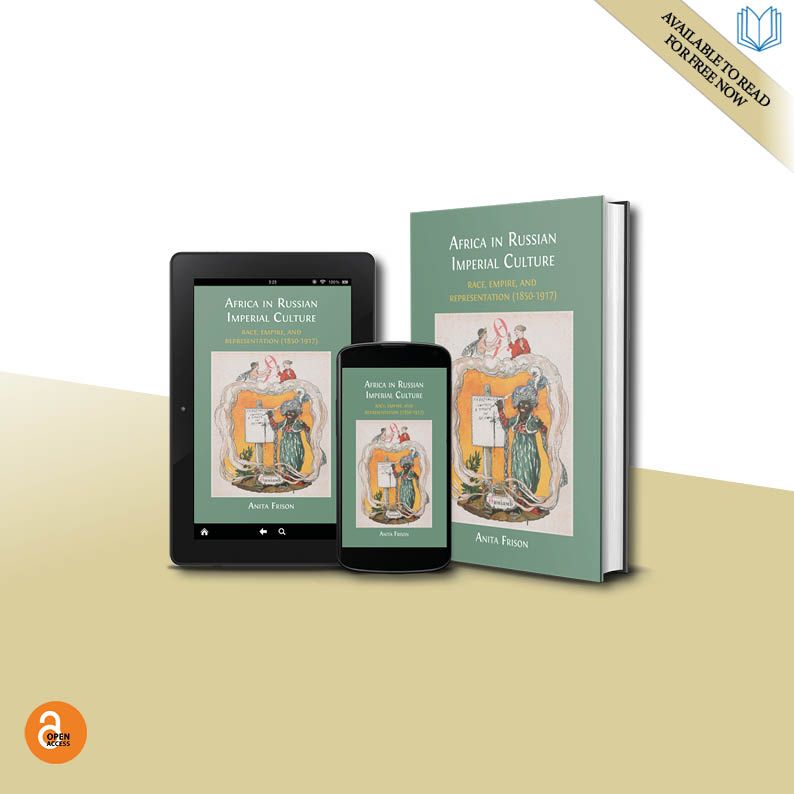
On Colonial Knowledge, Africa, and Imperial Russia

On Colonial Knowledge, Africa, and Imperial Russia

By Anita Frison

When I started working on Africa in Russian Imperial Culture: Race, Empire, and Representation (1850-1917), I only had a general understanding of a phenomenon – that of the (re-)construction and reshaping of sub-Saharan Africa in late tsarist culture – which seemed to be largely associated with marginal, peripheral individuals united by scientific curiosity and a penchant for exoticism. Even the poet Nikolai Gumilev, arguably the most famous Russian writer commonly associated with Africa, seemed an anomaly in his extensive and layered work on this continent.

However, I quickly realised that their efforts were by no means marginal, either in the context of fin-de-siècle Russia or within the parameters of European colonial knowledge production. In fact, the discourses, rhetoric and practices of Russian subjects in relation to Africa were deeply embedded in Western colonial culture, not least because, as emerges most vividly in the fourth chapter (Collectors), there was a direct and fruitful collaboration between them. In this regard, examining imperial Russia’s cultural and political attitudes towards Africa supports the ‘colonialism without colonies’ paradigm, as it vividly illustrates how colonial discourse transcended actual colonial ties and was adopted, perpetuated, and promoted by nations lacking colonies (in this case, African ones). Consequently, the notion of Russian exceptionalism, which was most prominent in Soviet anti-colonial rhetoric but was actually rooted in late 19th-century writings, is largely subverted.

The second most notable feature to emerge was that the construction of knowledge about Africa in late imperial Russia was relevant to both highbrow and lowbrow circles. This is reflected throughout the volume, from the first chapter, which introduces figures from various social backgrounds who were associated with Africa, to the subsequent analysis of their works, including travelogues, maps, anthropological studies, encyclopaedia entries, museum collections, and literary efforts. Sub-Saharan Africa was shaped for a wide audience which included highly educated people such as scholars and highbrow artists, as well as commoners. Indeed, it featured prominently in cultural products aimed at the lower classes and played a significant role in the late 19th-century effort to democratise knowledge for the masses. Thus, through dubious literary works, second-rate essays and social novelties such as the opening of museums to the public, a certain rhetoric of race – mirroring its no less unfounded highbrow counterpart – began to permeate the people’s understanding of Africa, indelibly shaping their perception of the continent.

The five chapters of the book, presenting an array of figures and analysing their work, all convey these two perspectives, which act as a red thread throughout: Russia’s participation in the Western system of knowledge about Africa, and the pervasiveness of the ensuing racial discourse in various media and social classes. In this respect, I believe it is important (and even crucial) to always put cultural and political phenomena occurring in Russia – often victim of the exceptionalist rhetoric (on the Russian side) or of othering (on the Western side) – into a wider, global context. As we live in an interconnected and complex world, it is essential to remember that discourses and practices are largely shared and developed in unison – for better or worse.

Africa in Russian Imperial Culture: Race, Empire, and Representation (1850-1917) by Anita Frison can be freely read or bought on the Open Book Publishers website.

Digital Tribulations 11: The Hamster Wheel. On the Platformization of the Colombia Media System

Interview with Diego García Ramírez

The introduction of Digital Tribulations, a series of intellectual interviews on the developments of digital sovereignty in Latin America, can be read here. 

I left the Brazilian Amazon in mid-December 2025 to continue my journey into Colombia, a country I still knew little about. My arrival in Manizales was the culmination of an exhausting, multi-modal odyssey: a taxi from Alter do Chão to Santarém, a sixteen-hour lancha rápida (fast boat) upriver to Manaus, a flight to Panama, a connection to Bogotá, another hop to Pereira in the heart of the Eje Cafetero, and finally, a winding bus ride up the Andean slopes.

I had been invited there by Mateo, a Colombian friend and doctoral candidate I met in New York. Manizales is a city that grows vertically; looking out from my B&B window, the steep, dense neighborhoods mirrored the aesthetic of Rio’s favelas, yet the atmosphere was worlds apart. Voted the most livable city in Latin America, it felt remarkably peaceful. I spent the following days with Mateo visiting the cathedral—resiliently rebuilt after three fires—and gliding over the terrain on the cable, the Italian-built cable car system that serves as the city’s primary pulse.

It was the Christmas season, and Mateo’s family observed the traditional Novena. In a practice that felt increasingly rare among my peers, we gathered to recite Gospel passages and share buñuelos, the quintessential Colombian holiday treat: golden, fried dough balls made with corn flour and a salty white cheese. With Mateo, I began to delve into the complexities of the peace accords and the fascinating topic of transitional justice, a field in which he is an expert.

The buñuelo.

Between these quiet family moments, I explored the neighboring towns of Pereira and Armenia, and I eventually reached Salento and the Cocora Valley. There, amidst the world’s tallest wax palms, I hiked for hours with two Italian expats—one a psychonaut living in Portland and the other an UNICEF specialist from Mexico City—crossing small rivers and documenting the local birdlife. 

After this immersion into Colombian traditions, I was ready to face Bogotá and its brisk mountain climate. At 2,640 meters above sea level, it is the highest capital in the world. Coming from the sweltering Amazonian rivers, the transition to sleeping under thick blankets felt almost tragic – though the crisp air grew pleasant during the day—and it felt like a luxury to be able to drink tap water again. I initially stayed in Rosales, a hip and rich neighborhood, where I was hosted by Jose, a kind furniture designer I had hosted in Italy months prior.

What I did not anticipate was how the city empties during Christmas. As many rolos (people from Bogotà) head to their hometowns or family fincas (country farms), the usually frantic metropolis becomes somehow quiet. I filled this time visiting the Gold Museum, with its collection of pre-Hispanic goldwork, and the Botero Museum, before climbing up to Monserrate—the mountain lookout that serves as both a religious pilgrimage site and a panoramic window into the city’s massive scale.

Once the New Year passed, the city hummed back to life, and I could begin my work. Diego, professor of journalism at the University of Rosario, kindly agreed to meet. After lunch in Rosales, we sat in a café sipping Colombian espressos, blessed by the sun, to discuss a phenomenon he has witnessed firsthand: the platformization of the media and how it is reshaping the very fabric of Latin American democracy.

The palm trees at the Cocora Valley.

***

What do you do, and what has been your career path?

I am a journalism professor at the Universidad del Rosario here in Bogotá. Additionally, I coordinate a Master’s program in Digital Political Communication at the same university. I am an anthropologist from the Universidad de Antioquia in Medellín; I completed my Master’s in Communication and my PhD in Communication and Culture at the Federal University of Rio de Janeiro. I have been dedicated to communication and journalism studies at the Universidad del Rosario for eight years.

Since I’ve been at Rosario—which has a unique program in Colombia because it is one of the few that still trains specifically in journalism rather than social communication, which is the trend in Latin America—we have developed a line of study regarding journalism and all its transformations. Journalism has been undergoing technological changes for about 20 or 25 years, but when I did my doctorate, I approached the political economy of communication. Studying journalism from that perspective, I began to establish relationships between all the powers and interests that have historically been behind the profession and what is happening now with the digital transformation.

And where does your interest in the issue of digital platforms and how they transform media come from?

I came to study the impact of platforms on the journalism industry, the news sector, and the work of journalists. That’s where we started analyzing the dependence on big tech. My hypothesis is that, without much knowledge, the industry and journalists engaged with platforms under the belief—very typical of the enthusiasm of the 90s—that technology was going to empower all sectors. I believe that journalism, education, and other sectors blindly embraced technology and digital platforms under promises of more revenue, more audience, more reach, and more traffic. Media outlets blindly deposited their content onto the platforms, and that’s how I arrived at the concept of “platformization.” The news industry developed an absolute dependence; they deposited all their content into whatever social network appeared.

If Twitter threads became fashionable, they made Twitter threads. When Facebook said “pivot to video” in 2015, media outlets started making videos. They did Facebook Live when they were told it was necessary. When they said short news for Instagram with images was needed, they did it. When they said short videos for TikTok were needed, they did them. When they said podcasts were needed, they made podcasts. When they said you had to be on YouTube, they were there. An author from Columbia called it “the hamster wheel,” and I take up that idea to say that journalism remains on a constant hamster wheel. Seeking a state of adaptation to technological innovations, they run on the wheel and get nowhere. I think that happened to journalism, and that is why it is in its current crisis: because it doesn’t know how to navigate a digital environment dominated by platforms.

In the Latin American and Colombian case, I think there is much more ignorance and less capacity for action regarding these platforms. The media employed and used them, but the platforms—in the case of Google and Facebook—arrived with great force through philanthropic projects like the Google News Initiative and the Facebook (now Meta) Journalism Project. So, in addition to platforms already controlling content distribution, data and consumption metrics began to directly influence journalistic production. I believe it is an industry that is today totally captured by platforms. That was my approach to understanding what was happening with journalism in the digital world from the perspective of political economy.

In this context, do you think it makes sense to talk about Latin America as a block, or are there more differences than commonalities between countries? And how do you see the specific situation of journalism and media in the region?

I like that question because, although one might generalize and say “Latin America,” framing all countries from Mexico to Argentina, I think speaking of Latin America is useful at certain times, but many nuances must be applied. The reality of a country like Brazil or Mexico—which are large economies with historically strong political projects in the region—is not the same as that of Central American countries or even South American ones like Bolivia, Ecuador, or Peru. And Colombia has its particularity. One can encompass Latin America, but inside there are many differences; it cannot be worked as a single, homogeneous, and equal block. There are many dynamics that prevent speaking in that way, and one must be very careful when treating the region as a uniform entity.

Generalizing, in most countries—both large and medium-sized—media have always been linked to political and economic powers. Therefore, journalism did not have the independence that would allow it to act against a global power. The concentration of media ownership made them very close allies to local and national powers, so they did not have the autonomy to face a global power much larger than themselves. They aligned blindly with the platforms. Except for some organizations in Brazil and Argentina, such as journalists’ associations or unions that have posed opposition, the rest do not have journalistic brands that stand up to the platforms. This also happens because the resources, tools, and funds provided by these companies were, and continue to be, very attractive to Latin American media.

An industry in crisis, with a loss of credibility and falling sales, welcomes platforms when they say: “We have training so you can improve your traffic, make better videos and digital content, and we also give you $50,000.” That was very well received by the industry in Latin America, with states that also did not protect their industry, with exceptions like Brazil, where the government has tried to regulate platform remuneration to journalism. In general, we do not have the technical capacity or political power to confront the platforms. If a country like Colombia proposes a regulation, Google or Facebook will say: “Who is Colombia and where is it? Why are they making those proposals?”

What have been the consequences of this platformization in Latin America for news consumers and for journalists? At first, there was talk of a disintermediation movement, which seemed like a promise of freedom, but it ended in centralization.

I think that, as you say, the rhetoric of technological advances and platforms was very powerful, especially in journalism, because it was said that social networks were going to democratize access, distribution, and production. The idea sold was that the only beneficiaries would be the citizenry, audiences, and democracy. But many of those promises remained just that.

I focus more on the impact on the industry and journalists. For the media worker, this led to a much stronger and more visible precariousness. Today journalists are evaluated and valued by their metrics in the digital environment: how many views, how much reach, how many shares their product has. I know that journalists today are asked to produce ten news items daily that must be published on all networks and reach certain metric levels. It is precarious because, apart from the fact that salaries were already bad, now they are worse, and they do much more with less. Sometimes media outlets don’t even provide the tools for this work. Journalistic success became limited to success on platforms. It doesn’t matter if you do the deepest investigation or uncover the most relevant corruption case; what counts is how many “likes” or “views” it had on social networks. It is a central part of the dependence and platformization of the sector.

If you change the word “journalist” to “academic,” the situation is almost identical because we are also super-quantified. And artificial intelligence seems to increase this, forcing us to publish constantly. Is there a relationship between digital sovereignty and these changes in digital media?

Exactly, it is slavery because even when a journalist or a public figure publishes something on a social network, they lose control over the content; it is the algorithm that decides who sees it and what reach it has. And there is the problem of shadow banning.

Regarding sovereignty, many people are starting to talk about it, but I don’t think digital sovereignty can be understood without what sovereignty originally is in political, economic, social, and cultural terms. It depends on who says it and from where. Some say the State should be more sovereign in the treatment of data and the infrastructure of its citizens, or that companies should have greater sovereignty.

Relating it to journalism, it is impossible for digital sovereignty to exist in a country and in a sector where prior sovereignty has never existed. Within Latin American geopolitics, Colombia has a particular history of political and economic dependence on the United States, not only because of its strategic position but because of the history of the conflict and interests in the fight against drugs and terrorism. Colombia has been the United States’ strategic ally in the region. For example, one can analyze why Colombia did not have a dictatorship in the 60s and 70s when a good part of the continent did; that is due to the strong influence of the United States in national life.

When you relate that to the digital project, you see how technological development projects are aligned with ideological interests. Despite being a US ally, Colombia was an underdeveloped country, and they were told: “What your country lacks is technology.” The development and progress projects that politics failed to fulfill were going to be done through technology. We call that technical ideology. Countries like Colombia bought that discourse easily: with more internet access, more data, and more mobile phones, we were going to achieve development. Today’s snapshot is that we have more access and internet, but the country remains just as inequitable and unequal. If we weren’t sovereign before, we will be even less so in the digital world when platforms have captured almost everyone. There are no resistance projects in journalism or politics. In Colombia, anyone who opposes seems to be opposing the country’s development.

Although there is some discourse about digital sovereignty in Latin America, only countries like Brazil or Uruguay take practical measures. Is there no national strategy in Colombia to take advantage of these opportunities?

I believe that this topic doesn’t even enter the political agenda and very little in the academic one. Colombia has so many other problems to prioritize—crime, drug trafficking, inequality, violence, insecurity, labor precariousness—that when one suggests that the problem is technological dependence on large corporations, they say that is the least of the problems. Since social movements have historically been concerned with access to land or labor, the issue of technology does not enter the agenda. I also have the hypothesis that it is an issue of a lack of technical knowledge among our legislators and politicians; they do not have the capacity to put it on the agenda. The European Union has a critical mass thinking about these issues; in Colombia, there are fewer people, and academic discussions do not reach the political sphere. Here there have been politicians who have attempted regulations, but when regulating Uber or delivery platforms is proposed, they say: “How are you going to regulate that if it gives people jobs?”. Regulation is understood as opposition to progress and people’s development.

It’s just that platforms have captured everything: infrastructure, tools, services, sectors, and even regulation. The public policy proposal and the very concept of sovereignty are captured. That is why we speak of technical ideology, because it is a capture of all discussions regarding the technical. If you raise a criticism, you are branded a technological pessimist or Luddite. In our countries, platforms capture political lobbying very easily.

There was a very powerful work by CLIP (Latin American Center for Investigative Journalism) called “The Hand of Big Tech in Latin America,” which shows how they have captured political and academic discourse. You have people researching regulation funded by Big Tech. Even in academia: if Microsoft arrives and gives dollars to a university to research digital sovereignty, the university does it because it is a lot of money, but that marks a research agenda funded by a company. The same happens in investigative journalism events funded by the Google News Initiative. It is not bad in itself, but to what extent can you be critical or apply for an award given by the very company you should be monitoring?

Do you think this technological imaginary is something people assume consciously? Because every mayor or president always includes technological promises in their plans.

I haven’t sat down to study all the projects, but I know that the National Planning Department uses algorithms and data processing to allocate resources to the poor, for example. The imaginary that progress lies in technology is very strong. That discourse stuck all over the world, but it was more powerful in poor countries because it promised that, with technology, you would achieve what politics could not. In Medellín, it was said that it was the Colombian Silicon Valley. We have startups like Rappi, which is our model to show off, or Nubank, which belongs to a Colombian and is one of the largest digital banks. There is also Platzi. Those success stories show that with technology you can be a successful capitalist by reproducing the American model of innovation.

I think the progressive movement of the beginning of the century had much more regional articulation and coherence. Now left-wing governments are trying to survive their own internal problems, and it is more difficult for them to have a strong regional project. While Lula and Petro share some ideas, the right and the extreme right have co-opted important countries like Argentina or Chile. In Colombia, furthermore, the State is very devalued and reduced; everything was privatized very quickly: education, health, public services. The Colombian State is much weaker.

Looking toward the coming years, what measures do you think could be taken to protect journalism?

It is always difficult to predict, but out of optimism and rationality, I say that the first step is to put the issue on the public agenda. It is a small but vital step: that more people discuss this and that it does not remain only in the academic sphere. It happens with artificial intelligence: it is everywhere, but there is no one congregating the discussion about its consequences on human rights, the economy, or autonomy. The debate must include social movements, academia, politicians, and the economic sector, listening to everyone equally. In Colombia, civil society is usually disqualified on technical issues by saying “you don’t know about this.”

We would also have to think about a regional block. It is impossible for a single country to face the platforms; Colombia is an insignificant market for them. Acting as a block is difficult because we have never done it and each country pulls for its own side. Mercosur could be a space, but it depends a lot on the ideological affinities of the moment. My experience is in the media sector and, from my perspective, if journalism is captured, the consequences affect public opinion and democracy. Liberating the media from technological dependence is a priority.

The view of Bogotà from Monserrate.

Choose Your Own Adventure

Choose Your Own Adventure

By Anna Beresin

Choose Your Own Adventure

As an ethnographer, psychologist, and folklorist, I have spent forty years studying children’s play and childlore, often the only adult outsider on a children’s playground, paper or sound recorder in hand. The field of play and culture studies places the objects and motifs of childhood within their own contexts, balancing at the intersection of the social sciences and the humanities. I have written about play after the Rodney King Case, and after 9/11 in the United States, and with Julia Bishop edited a global volume about play during the Covid-19 pandemic. These books include songs sung, games crafted, and objects and drawings made. Thanks to this gracious publisher, Play in a Covid Frame is available for purchase and free download.

My new book Make/Unmake: Play at the Centre of Culture Change examines what UNICEF calls the three greatest challenges currently facing children globally, now and into the future: migration, the climate crisis, and changing forms of work.  Make/Unmakeoffers what I hope to be two different poetic paths of engaging with the material presented as three different communities wrestled with immigration, recycled materials, and their own future work ambivalence. The physical book and free download offer images, original photographs of children’s sculptural play with those children’s identities masked. There is also an audio book, but that has no images, yet it reflects the rhythm of the poetic narration offered by the adults who cared for these children and for their creations. Both the written book and the audiobook honor the verbatim words of named adults in the communities studied: The Pitsmoor Adventure Playground and the Maker{Futures} Mobile Makerspace of Sheffield, England, and the GLUE Collective of nearby Birmingham. As is traditional in ethnographic practice, the author gives equal weight to the words of living participants in these communities as it does to respected scholars in the field of play. Both the audiobook and the physical book can be found here (the audiobook is available as a free MP3 download).

Why mask the children’s identities, but not the adults’ identities in this book, you might ask? These three programs serve children in vulnerable communities, and masking children’s identities keeps them safe.  All of the children in the study gave verbal and written permission to be photographed and filmed, as did their parents, and each child’s face was covered in a variety of methods ranging from blurring the children’s faces to just photographing the children’s hands. In order to honor the poetry of children’s physicality connected to their object play, I experimented with placing images of children’s homemade objects on their faces as digital masks- both in the still photography and in the short research film made. The adults agreed that the methods sufficiently protected the children, and this assured the research review boards that the priority of protection came first. The adults in the three communities studied rightly wished to get credit for their hard work, for their roles as leaders in their communities and so, they are proudly named. Each program has read drafts of the book before publication, satisfied with their work and mine, a multi-layered process of editing, revoicing, and reclaiming. I imagine further discussions emerging about the social sciences’ desire to protect people’s identities as the humanities holler to give people credit where credit is due for their creations.

I was influenced by the field of ethnopoetics in folklore and conversation analysis, and also by the work in sociolinguistics about the poetry of everyday speech. One of my practices is to repeat powerful excerpts from the chapters as a form of book summary, and to link them by theme at the book’s end, a natural found poem, a printed form of spontaneous spoken word as spoken by the people studied. Listen for the rhythm, the rhyme, the subtle repetition in this excerpt from the conclusion:

That much freedom? Really? Really?
Sometimes parents say, ‘Where’s the activity?’
I just point to the all the materials.
Don’t they see?

‘Well, they’re just playing’.
But you’ve not watched.
You may have observed,
But you’ve just not seen what other people are seeing. . .

The words are poetry. The objects are poetry. Will you be led by your ears or by your eyes?

Make/Unmake: Play at the Centre of Culture Change by Anna Beresin can be freely read or bought online.

On Corporate Aesthetics and Post-Internet Art

Of all things I’ve seen on the internet lately, I can’t recall any image being so aesthetically pleasing as Julia Fox posing as a real estate agent on a billboard  in Manhattan. This was not because of its situationist appearance, plastered without context to the side of a vape shop on Mott Street, but for the uncanny feeling induced by her clean face framed by corporate-style typographies and logos. Her traits, previously adapted to countless It Girl styles, conform now with a glowy Office Siren look: infused by a frontal white light, framed by a formal blue suit. Spotting a recognizable face where you’d expect to find an unfamiliar stock-image face is paradoxical: stock imagery is made to feel generic, to evoke a popularly shared feeling. But NEON, the marketing team fresh off iconic campaigns for Longlegs and Anora, capture our current obsession for corporate aesthetics in visual culture for Stephen Soderbergh’s Presence in a way that transcends a catchy troll campaign. From PowerPoint slides and muted blue and gray palettes to office uniforms, slogans and business infographics, the internet is currently being flooded with variations of early late 90s/2000s corporate visual elements and stock imagery aesthetics. But why is this happening now?

Julia Fox posing as a real estate agent in a billboard spawned in Manhattan

Single Cover for EQ’s Boytoy. Credits: @estratosfera___

In the 2010s wave of post-internet art, corporate aesthetics were of extreme interest for artists investigating what the internet had become in so little time. Following the brief illusion of the online as an open and free space. The internet, on the cusp of the ‘10s, was facing two possible directions: that of a free zone independent from corporate capitalism, and that of a space owned by a few companies monopolizing online life. Post-internet artists were extremely sensitive to these signs. In 2013 DIS Magazine, a collaborative project between a group of artists and theorists including Lauren Boyle, Solomon Chase, Marco Roso and David Toro, affiliated with other artists like Brad Troemel, Ryan Trecartin and Ian Cheng, launched DISimages, a call to action for artists to create their own series of stock images. Dedicated to “manipulating the codes and trends in stock photography,” DISimages invited artists to create new unexpected compositions that broadened the spectrum of stereotypical stock portraiture. In Mer-life, DIS itself shot a bunch of lifestyle vignettes of people performing casual actions — drinking a Starbucks coffee, fixing a hole in the wall, writing on a laptop — while wearing a mermaid tail. In another series called Future Growth Approximation, Estonian artist Katja Novitskova situated cut outs of animals and stock arrows in white cubes as indicators of economic growth, while Anne de Vries mixed objects of different textures in dadaist compositions, somehow similar to the haptic nature of some AI-images that flood Instagram’s Explore page.

Mer-Life, DIS

Future Growth Approximation, Katja Novitskova

All these pictures were — and are — up for sale on the DIS official website for whoever wants to use them. In the spirit of DISimages, the socially constructed patterns in advertising can be revolutionized by scattering touches of strangeness here and there. With the goal of appealing to the broadest possible market, stock imagery “sanitizes” humanity to the lowest common denominator, packaging what’s only a faded impression of daily human rituals. Because it’s impossible to stage any “risky” variation, it’s often very easy to trace the biases behind these portrayals. Women in their early 30s will be the only ones laughing at their salads, software developers will wear thick glasses and hardly ever look Caucasian, and so on. There’s an uncanny feeling in being able to track which elements originate from which beliefs, an uncanniness resonant within a lot of AI generated imagery. In this sense, DISimages’ attempt to sow chaos feels like an experimental machine learning model being trained on a bespoke database of weird images. Theorist Silvio Lorusso, author of Enterprecariat and What Design Can’t Do, coined the term “Normie Weird” to refer to a certain kind of weirdness pursued by people experimenting with GANs. The images generated by AIs “are weird, sure, but normie-weird” he writes, “they are what you would expect a weird image to look like. Somehow, they reassure us of our notion of weirdness. When everything is weird, nothing truly is.”

The role of stock pictures in the market has been replaced by AI-generated images. You can spot them in the streets and in store windows more and more, retaining a certain strangeness made up of smiles far too white, skins too smooth, unhuman expressions and unnatural colors. Post-internet artist and DIS magazine contributor Daniel Keller calls the increasingly lighthearted incorporation of this kind of aesthetic into everyday life “sloptimism” a tongue-in-cheek repositioning of the content poured for us into the feed. Keller’s term has its roots in other theories like the Dark Forest and the Dead Internet: both basically stating that the online world is a wasteland of bots and AI-generated content, where human gestures have nearly disappeared or driven away by the fear of algorithmic echo chambers. What Keller has observed is that, in the times of attention economy, the rules of advertising have bled into all other aspects of life. He sees sloptimism as the symptom of culture and corporate collapsing into each other. This draws a sharp connection between this era and the one in which early post-internet artists, including him, first operated.

In 2008, Kevin Bewersdorf, co-creator of Spirit Surfers – one of the most popular surf clubs of the early web — inaugurated Maximum Sorrow, a personalised corporate identity, complete with its own website, logo, merch and uniform. The idea for it came from the same experience of web surfing: the practice of blogging about internet ephemera that spread around post-internet artists just before the launch of Web 2.0. In an interview with Rhizome.org, the artist stated that he came up with the idea for the website after seeing how these artists were progressively mastering self-branding practices online. “Many net artists may not be willing to admit it, but what they are really trying to do is to build an empire, to be a brand that offers it all. There is an absurdity to that. Having your own website is like building an unnecessary shrine to yourself. […] I use my signature and various logos to point out the absurdity of this vanity. […] Whether a net artist brands themself with a sparse list of links […] or with logos in a bland grid, they are constructing their own web persona for all to see” he says.

Kevin Bewersdorf’s Maximum Sorrow (2008-2009)

Maximum Sorrow tapped into what Kevin called “corporate spiritualism”, a philosophy he materialized in two projects: an image and text based work called Stock Photography Watermarks As the Presence of God, where he imagines watermarks on stock pictures as divine apparitions of a superior entity, and the text The Four Sacred Logos, where he lists the basic principles of a new online world he describes as The Marketplace. Mirroring Kevin’s practice, 2024 was the year of internet spiritualism and the comeback of medieval iconography: at Sónar, the music and multimedia festival held in Barcelona every year, artistic duo ¥€$Si PERSE and dance company LASADCUM will present CYBERMEDIEVAL, a performance where the terms and conditions of Big Tech companies meet the feudal contracts of medieval times.

Stock Photography Watermarks As the Presence of God (2008), Kevin Bewersdorf

Other artists from the same generation engaged with the “sublime ordinariness” of non-places, the name anthropologist Marc Auge gave to anonymous transitory places, stock imagery and company logos by linking them to a crippling sense of nostalgia where the intimate and the impersonal meet. The artistic practices of DISmag friends Amalia Ulman and Jasper Spicero have been extremely influential for this current second wave of corp-core. Less ironic, their research taps into a specific kind of corporate sincerity. In her 2014 immersive installation The Destruction of Experience, Ulman invited visitors into a space somewhere between a hospital clinic, a church and an office: a maze of white walls, where pharmacy calendars and leftovers from a corporate party stand beside a large company name made of a blue circle and the Nirvana logo. In the background, the humming of Zara Home’s in-store playlist.

The Destruction of Experience (2014), Amalia Ulman

Despite recreating a cold, corporate environment, Ulman’s installation suggests the familiarity of a personal tale. The detachment of the decor blends with the strange feeling of having already visited that space, recalling intimate experiences and the melancholy of a time that will never return: the walls are dull as those of primary school buildings, filled with 70s aseptic decor pieces as a grandparents’ house, and covered in glitter paraphernalia like a preteen secret diary. Jasper Spicero’s films, sculptures and installations work in the same way. His blueish industrial mise-en-scene winks at the intersection of corporate and childhood aesthetics, demonstrating the existence of a visual purity that unites the two. His sculptures of toy birds and mechanical arms merge surgery room furniture and kid’s room decor, evoking family trauma, a hospital visited once, a bleak shopping mall you liked when you were a child. This representation of corporate aesthetics as an aseptic but emotionally charged visual alphabet serves as a bridging experience between the experiences of early internet users and the feelings of the 2020s. Ulman and Spicero were both inspired by the ever-increasing presence of corporations in their intimate worlds, mainly because of platform society’s business model creeping into affective interpersonal relations. Almost 10 years before the first wave of post-internet art, these artists reflected on how interface design was maneuvering the way people related to one another.

Only Starrling Conference Call (2017), Jasper Spicero. Credits: Culture Magazine

Sunset Work Station (2017) Jasper Spicero. Credits: Living Content

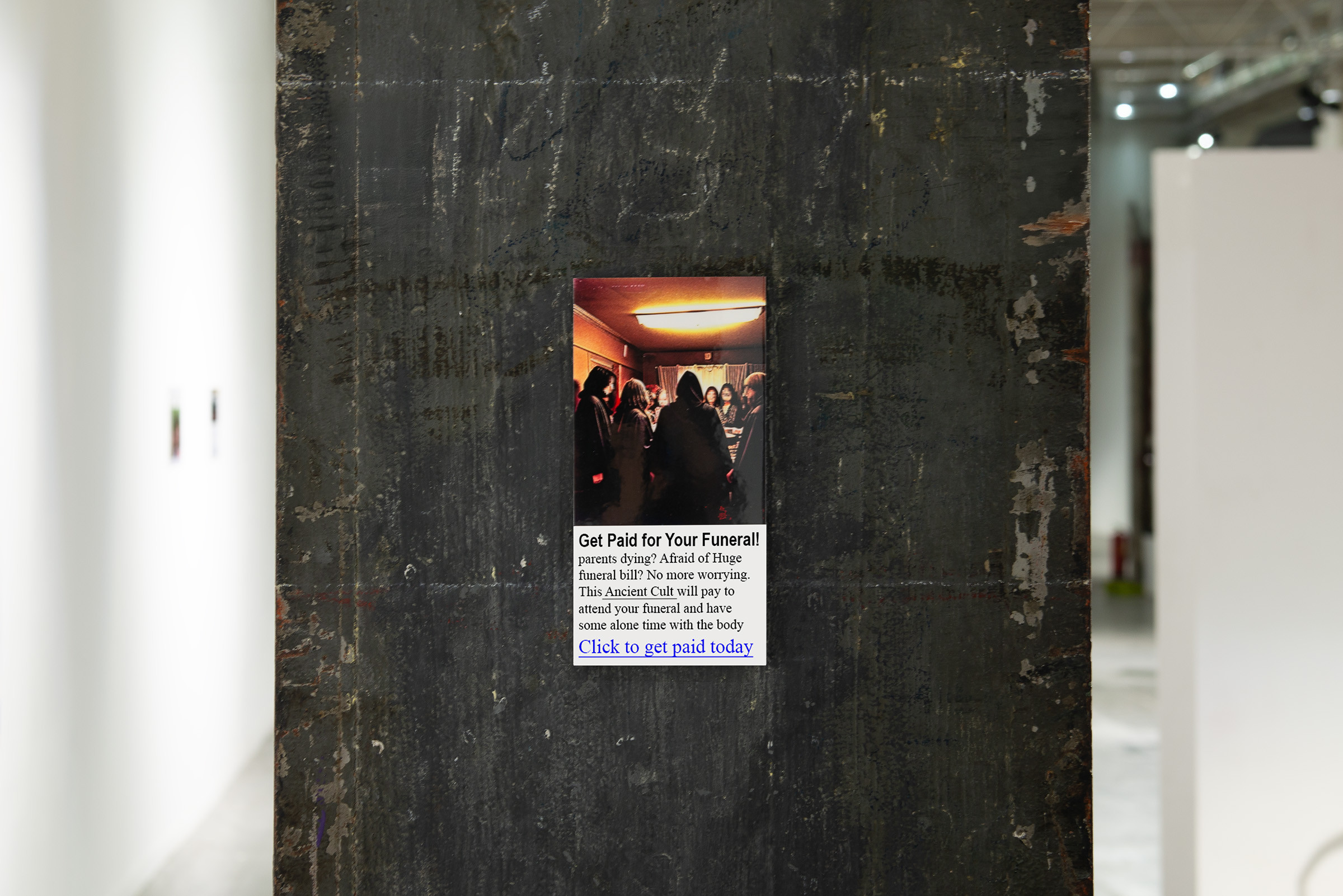
The real difference is that Gen Z were already born within a digital landscape ruled by corporations. Placing all the memories of the early years of their life on the internet, they cannot help but feel nostalgic towards a past that was already compromised. For a new generation of digital native artists, Web 2.0 is filled with innocence and nostalgia in a similar way that Web 1.0 was for post-internet artists. Learning by their practice, emerging artists are sympathizing with the feeling of loss towards their past lives online. Dutch artist Melle Nieling represents this feeling by recreating common tropes in old fashioned spam advertising. His works devirtualizes pop-up banners, emphasizing promises of evading taxes, age-reversal serums or making billions by clicking on a link. In works like Soul (2023) and Funeral (2023), some of these statements take a spiritual turn, presenting clickbait stories of people selling their soul in exchange of points on their credit score, or ancient cults paying for funeral bills. Recalling the terrain of online flash games websites and pirate websites that Gen Z spent its pre-adolescent years, Nieling stages a time when scams online looked like annoying spam banners. When the internet was still naive, digital traps to collect and sell your data had the look of stretched images, funky fonts, hot singles to meet in your surroundings and shiny sports cars to win with a single click.

Gwynethat (2024), Mielle Nieling at Loods 6 during Post Fascism, photo by Vex Noir

London-based artist Gordon Hack also investigates the bond he sees between figurative art and corporate imagery, with his paintings recreating the text overload in security signs, real estate advertising and commercial billboards. By asking an industrial sign making company to produce these ads, Hack fuses his practice with that of an industrial manufacturer, inhabiting the role of a corporate worker having to deal with traditional printing processes, materials, typographies, and colour-matching techniques. In a Warholian act of self-automation, Hack’s works look at manual industrial procedures of image-making, opposed to the way AI is used in advertisement today to create a hyperreal world that looks like ours. By choosing industrial processes like silk-screen printing and stenciling, Hack becomes a man-machine, carefully crafting compositions from existing elements: his gestures uncover advertisement processes, opposed to what happens inside the mysterious black box of an AI.

For early post-internet artists, one of the main spaces to experiment the connection between art and  marketplace was the fashion landscape. In 2024, DIS launched the pop-up store DISown in New York, presenting a series of garments that mocked commodity activism – the kind of activism carried out through slogans on mugs, t-shirts, and visor hats – and the meaning of merchandising itself. Still active as an e-commerce platform, DISown produced pieces such as the Coupon Tee: a T-shirt that functions as a real coupon, with a design inspired by the slack aesthetic of promo code  finder websites. The Utility Shirt 2-Pack in collaboration with Lizzie Fitch – part of an artistic duo with Ryan Trecartin –  draws inspiration from vectorized corporate icons to create a pack of tees that “are ideal for team-building sessions, human resources staff, and barefoot CEO’s”. For the perfect stock photoshoot, the Classics Salad Bowl pairs ideally with a fork, a lighthearted woman in her 30s, and an empty kitchen.

Coupon Tee by DISown. Credits: www.disown.dismagazine.com

Utility Shirt 2-Pack by Lizzie Fitch for DISown (credits)

For digital natives, the relationship between fashion and corporate culture is much more linked to a melancholic look at the idealized work spaces they’ve seen on the screen but never experienced, environments that look so unobtainable in these times of precariousness and work/life imbalance. The tendency toward self-branding, skewered in its infancy by early post-internet artists, has resulted in a perpetual state of presenting oneself as an ever-evolving start-up. Never having worked in a corporate environment, Gen Z loves cosplaying formal work wear that winks at adulthood and power. Office Sirens interpret fashion through the lens of movies like Secretary (2003) and American Psycho (2000), with thick black glasses, blazers, knee-length skirts and classy updos. In the first part of 2023, this trend morphed into a new, slightly more status affirming, form: the Boom Boom Aesthetic, or the desire to look like a flashy company CEO. If post-internet artists used fashion as an undisguised critical tool, Gen Z engages with it by applying numerous layers of post-irony and detachment. Inside the entanglements of the algorithm, it’s difficult to discern a critical action from a viral trend.

Singer AMORE in Office Siren. Credits: @tqamore

singer/model Gabbriette in Office Siren. Credits: @gabbriette          

LinkedIn Graphic of “Boom Boom Aesthetic”. Credits: Max Niederhofer

Office nostalgia creeps out, making us longing for a stable income and a cubicle, LinkedIn profiles become the indispensable tool of every artist and theorist to emerge. To find the roots of today’s obsession with corporate aesthetics, there’s a need to look back at the previous generation and the same angst they felt towards losing a space they considered to be salvific. More than being just a visual trend, there’s a precise reason why corporate aesthetics that captivate Gen Z so closely resemble the works of early post-internet art and artists, who keep leading the way over a decade after their emergence. It’s a cross-generational embrace of the feeling that the online world could be eroded, divided up by corporations in order to build sloptimistic, non-human space for bots to profit off themselves. Post-internet art’s observation of how the internet and the marketplace are entangled has shifted from a critique of self-branding practices to nostalgia for a time when online advertising was much less sophisticated. The real question is whether these attempts to critique reality will stand out within the rules of algorithmic culture. Like a creature with sharp teeth, the algorithm devours every cultural symptom by repetition and commodification: a critique becomes a trend, its origins get blurred until they’re harder and harder to catch. The relationship between the internet and corporations will evolve, but will always remain a part of its core structure, and one of the main interests for artists and researchers investigating online ecology. Can we ever go back to a less corporative online life, and will art uncover how?


Canada Theory – Geo-Political Debates at INC

This internal INC email exchange from early February began with a posting of Max Haiven on his Substack: Is Canada’s premier Carney a warlord? Three fellow Canadians responded: Henry Warwick, Marc Tuters and David Gauthier.

Canada theory has been high on the INC agenda from day one—and well before. After all, INC stands on the shoulders of both German and Canadian media theory. A record number of Canadians and non-Canadian based there are involved in INC projects, either live and work here in NL and in Europe or work and study there, such as a few of our INC former interns. Canada as angle and method  has multiple personal, cultural and intellectual backgrounds (beyond the infamous Grant-Innes-McLuhan-Kroker-Chun lineage).

Please have a look at the Canadas Semiotexte reader from 1994, if you can find it. Michael Freeman classified the book as such: “This anthology redraws Canada as a complex terraincognita of desire and dismay. “Eco-feminism, censorship, and the ‘queerness’ of the True North. Richly eclectic in tone and material, unrelentingly controversial, and very difficult to ignore. It is likely the most novel take on our state of affairs in quite some time.”

A direct reason for this exchange is Trump’s plan to annex Canada as United States’ 51st state and Carney’s speech at the World Economic Forum in Davos on January 20, 2026. Let’s define Canada Theory. /Geert

INC author Henry Warwick, who became a Canadian citizen himself recently, has been based in Toronto for a long time and is teaching there. His response to Max Haiven:

  1. One year ago, there was an upcoming election. At the end of December 2024, going into January 2025, the Conservatives led by Pierre Poilievre were leading Trudeau and the Liberals 45% to 16%, nearly a 30% deficit. This would have led to a MASSIVE Conservative majority.
  2. Trump took office in February and immediately started with his “Canada is the 51st state” and “Governor Trudeau” bullshit. This made Canadians pretty upset.
    3. while Trump is raging on about the 51st State, Poilievre went gushing over how he looks forward to dealing with Trump, and Trump recommends his election. This was “not a good idea”.
  3. Carney comes into the picture – the Liberals decide they have to ditch Trudeau if they have any hope of winning. So they elect Carney as leader and he becomes PM in March 2025. The election happens about a month later and the Liberals win it, but not with a majority govt – they were 3 seats short.
  4. Carney immediately tells Trump to, basically, shut the fuck up and act like an adult, and begins playing hardball, which he has all the skills and background to do.

Poilievre’s collapse was SPECTACULAR. I was convinced we were going to have our own Trump running the place, instead not only did Carney win the election, Poilievre lost his seat in suburban Ottawa. Poilievre went to Alberta (Canada’s version of Texas) and had a guy who had just won his seat that election to resign so he could have it and stay in government. The guy quit and Poilievre won the by election. Canada dodged a bullet.

Is Carney an optimal PM? Hell no. He’s what we call a “Red Tory” – a fiscal conservative, social liberal. I do not align with his ideas or designs.

HOWEVER: we didn’t have a choice of “optimal” candidates – we had the Red Tory/Liberal Carney, the junior league fascist Poilievre, and Jagmeet Singh, the hapless bland and not very popular leader of the NDP. What Happened? A huge portion of the NDP vote went to Carney. The other Red Tories that were looking to vote against Trudeau suddenly didn’t have Trudeau to hate, and recognised Carney as someone they could deal with. Bang: Carney got elected.

Canada is teetering – the American psyop campaign of Alberta separatism is up to 17% in Alberta. Stellantis, GM, and Ford just removed about 8,000 jobs from Ontario (mostly because of tariffs from the USA). Canada is on its own and is desperately looking for allies, as the USA is no longer trustworthy and in many ways is openly hostile to Canadian sovereignty. So, there’s that pressure to deal with as well. (also, the fucking separatists are even stupider than Poilievre. There are 3 major land treaties with first nations that will still apply whether they are separate or not. Ooops.) It’s a total shitshow.

“Carney presents himself as the liberal alternative to Trump’s fascism, but also as a straight-shooting realist from a “middle power” who can’t afford the illusions of the erstwhile “international rules-based order.”

Carney is in office because it was him or Poilievre, i.e. Canadian Trump, only stupider. THAT is why he is PM. Carney is no prize, but he’s light years better than Poilievre – a fool who won’t even get a security clearance. Seriously. He wants to be PM, but doesn’t want to submit to background checks for a security clearance.

The writer in his ideas about Warlordarchy, should read Chinese history and their theory of The Mandate From Heaven.

The mandate creates a predictable dynastic cycle – first there is chaos, and out of chaos come warlords. The warlords or “regional leaders” fight for control, effectively competing to see who would receive the new Mandate of Heaven. Someone does and establishes a new Dynasty. The Dynasty flourishes and then becomes decadent, falling back into chaos, creating new warlords – rinse repeat.

I learned about this in the early 2000s. https://www.files.ethz.ch/isn/104682/2000-01_China_Debates_Future.pdf

China has been anticipating a multipolar geopolitics since the mid 1980s. None of them anticipated Xi consolidating power and walling himself off from criticism. Also, at the time, the demographic bomb had yet to go off, so that didn’t play into their war gaming theory, either. In anycase, Haiven’s crude theory of “Warlordarchy” is simply a weak recapitulation of the Mandate of Heaven.

This doesn’t mean he’s wrong.

Carney is not the problem right now. Yes, Carney is suboptimal. But we’re dealing with actual fascism, and for all his faults he is antifascist, so when it came to choosing a PM in April 2025, Carney was the obvious choice. Right now he’s at 60% approval, and he won with 40%. So, he’s fairly popular with the average Canadian. Stopping Carney from being a neoliberal curse will be the product of the next election, on the one hand, and consistent opposition to his bad policies for the duration.

A number of people are discussing the new economic order as a kind of neofeudalism. I discussed that in my Dissertation esp. with my references to Drahos’s book Information Feudalism: Who Owns the Knowledge Economy? from 2003. Also, his book A Philosophy of Intellectual Property, which was really important to my Diss. Lately a number of people seem to be thinking “Oh, this internet bullshit is all driving to feudalism!” Duh. Drahos was on it over 20 years ago.

Doctorow and Scott and others singing that tune are, with Drahos, more accurate than Haiven – the feudalism we’re skipping into is not land based – it’s information based. The Enclosures ended centuries ago. Deleuze talked about Endocolonialism – that’s much more on point.

At the same time, I am very much in agreement with Haiven’s critical points – they are correct.  The Neoliberal order set us up for the fascism that is following on. I just think he misses important context about Carney. Carney’s not my preferred choice, but given what was happening, he’ll do for now.

Also: Churchill was out of office months after VE day.

best, Henry

===========================
https://kether-music.bandcamp.com
http://www.kether.com

MoneyLab participant Max Haiven responded:

I don’t disagree about the immediate reason why Carney was elected, but I think there’s much more to say here about longer term trends and Canadian political economy and politics. Carney is Bay Street’s man through and through. I don’t think my argument suggests that he is the worst thing in the world. It was intended as a somewhat provocative antidote too the strange and very Canadian euphoria about him.

When faced with the lesser of two evils I refuse to choose, and at risk of being unpopular I’m always going to try and recall that we can and should have leaders and systems that serve the commons and the common good, rather than the rich and powerful. I think when faced with the kind of murderous “realism” that all politicians today cite (both Trump and Carney), it’s more important than ever to show them contempt and insist that we have the capacity to produce a world that meets everyone’s needs and allows us to live in peace and abundance. I refuse the blackmail of realism or pragmatism. Let us build grassroots power to refuse and rebel, and then negotiate, not capitulate to their false spectrum of options in advance! Regrettably the state of movements in Canada and many other places is very weak at the present moment but I don’t think that capacity will improve if we accept their terms.

Canada is indeed in a moment of profound and very dangerous crisis. But I think a crisis is the most important time to fundamentally rethink the purpose of society the economy and the state. The opportunity will not come again for a generation at least. I’m not optimistic that such a rethinking will happen but I feel if I have any responsibility in this mess, it is to try and help provoke it!

This is an interesting point on warlords although I don’t think my admittedly hastily sketched theory is only a warmed over rehashing of the Mandate from Heaven, other way I’m very interested in that. I actually think that the CPC right now looks at the world as precisely the Warlordarchy I am proposing, and in continuity with these older Chinese imperial philosophies. I’m working on something that tries to move us beyond both this Chinese framework and the typical liberal framework that would insist on an antinomy between the warlord and the emperor or  the warlord and the modern state. That theory isn’t exactly ready yet as it still baking in the oven!

All the best, MH

Henry’s response:

I don’t think Trump will invade Taiwan, Greenland, or Canada. I think his next target is Cuba. Many Cubans in the USA are rather right wing (in a kind of knee jerk antipathy to the Cuban govt seen as communist/left wing).  So, a defeat of the Cuban regime would (in Trump et al’s blinkered reality) shore up support in Florida. So, there are possible benefits for the Regime to invading Cuba. Also, Cuba already has an American base on it (Guantanamo Bay) and the east end of Cuba is only 145km from Florida. So, an invasion of Cuba would be comparatively easy. My guess is that Trump is holding back on this, as it is a tall order of military effort, and he uses these adventures to distract / dilute news of the Epstein files.

This particular brand of fascism from the Trump Regime is as embedded in media theory of the attention economy as political economy and psychology, making belligerence a tool of message control and attentional focus.

Taiwan is, from what I’ve been able to gather, not under direct threat, however, it is under more threat in the short term than the long term. This is due to China’s demographic collapse. China is WAY below replacement (IIRC something like 0.9, replacement is 2.1) and its aging population is starting to strain healthcare, pensions, and social safety nets. It’s economic growth plans are kind of cooked by a shrinking workforce. Xi’s govt has made efforts to encourage higher birth rates through two- and three-child policies, but these have largely failed, and China is very much in a population death spiral, like Korea, Japan, Italy, and Germany. I attribute this to shortsighted urbanisation policies combined with an export centred economy. They have to keep wages low to be competitive, so the people of China aren’t as wealthy or well paid as say Norway or USA. The space in urban high rise buildings is limited and expensive, so children became an economic burden. So, if China was to take Taiwan, they would have to do it soon while they still have a surplus of young men.

However, I don’t see an invasion anytime soon for a variety of reasons.

  1. It would take time and it’s too easy to see troop build ups.
  2. Taiwan is 180km from China mainland. China has built some large landing craft/barges, but they are very slow. Let’s say 30kmph. Which is 6 hours from mainland to Taiwan. the moment said barges got half way, Taiwan would send fleets of drones and missiles after them. They would never arrive. And if they did, you’re going to have to deal with #3
  3. China hasn’t been in a proper full scale war in DECADES (vs Vietnam, which ended in 1991). Their leadership has little more battle experience than the kids they’re going to have to draft into dying in this mess.
  4. The core value of Taiwan is chip manufacture. Otherwise, it’s just a largish island full of people. The moment the invasion seems to be succeeding, they will simply evacuate the factories and blow them to smithereens (and probably fly the expensive core components out of the country.)
  5. The moment the Chinese set off to invade Taiwan, ASEAN and similar orgs would get involved. The lifeline of China, oil from the middle east, would be cut off and blockaded. Their economy would collapse, and without the energy they need their war machine would fail, and the country would collapse.

So, I’m not really worried about Taiwan.

 Trump is not going to invade Greenland. He doesn’t have to. The present arrangements are that the USA can put as many bases there as it wants anyway, so security isn’t the issue. The minerals underground are also not an issue. Sure, they are undoubtedly there, but they are also under a couple km of ice. It’s going to take a few centuries for that to melt out. So, no. Trump will declare “a new page in the history of USA/Greenland/Denmark” and say that the USA will multiply the number of bases in a “New accord” with Denmark. Of course there’s no new accord – the USA can already do that under present treaties with Denmark. He comes off looking strong and gets to dodge the bullet of having NATO declare war on the USA.

Same with Canada. If he invades Canada, that will bring NATO against him, and the economy would completely collapse. Sure – M1 tanks would cover Toronto – he would easily win the battle – but he would lose the war.

Frankly, I think the Republicans will have Trump removed from office. Hopefully next month (ides of March) but certainly by Solstice – otherwise it will be an absolute bloodbath at the election in November.

If the Dems sweep House and Senate in November, which is entirely possible, Vance will get impeached and convicted, and then whoever is his VP will become president, and will be on a very short neoliberal leash from the worthless Dem Leadership (Schumer et al – useless bunch of dopes).

more later!

H

Marc Tuters, a Canadian media theorist based in Amsterdam, writes:

Hi Geert,

what I find interesting is less a question of whether Carney is right or wrong, and more how global politics is now being articulated, and where. As an IR diagnosis, Carney’s Davos speech strikes me as quite compelling: weaponized interdependence, the end of comfortable assumptions about a US-led order, and the strategic predicament of middle powers. This was the speech that Europe needed to make and Canada made it.

From what I could see in the thread I don’t really read Max as disputing that analysis so much as reacting to what he fears follows from it — a narrowing of political imagination under the banner of realism.

Where my own ambivalence comes in is precisely Davos as a venue. It’s a space of elite coordination that is structurally anti-democratic, where business and politics collude under the language of “stakeholder capitalism,” a concept that remains dubious even when dressed up in green garments. That makes Carney’s speech important, but also symptomatic: global governance increasingly articulated outside democratic institutions.

I was also struck by Carney’s use of Havel. The point about hollow ideals functioning as rituals of compliance is sharp, but there’s a slippage worth noting. The slogan being mocked (“Workers of the world, unite”) names worker solidarity, not just elite hypocrisy — and Trumpism, in any case, doesn’t really operate through high ideals at all, but through coercion, resentment, and transactional loyalty. That makes the analogy illuminating, but also incomplete.

I’m less interested in judging the characters than in watching the stage shift. Politics is moving out of parliaments and into places like Davos, where it seems like ideas of solidarity and democratic agency are the first things left outside the door.

Best, Marc

David Gauthier, also based in The Netherlands, teaches at the Media & Culture department of Utrecht University:

One small thing that is missing from Henry’s analysis of how Carney got elected is: Québec. The vote in la belle province is what got the guy elected and there are a bunch of people that usually vote Bloc Québécois that voted Liberal, which is really weird. The Parti Québécois (sovereignty  party) is on the rise now (also weird, because they were technically dead) and I wonder what kind of reaction the Québec electorate will have if a new election comes around.

Henry Warwick adds:

Oh, my, for certain – the Bloc voting Liberal was instrumental, for sure – every vote mattered! However, from my research, while the shift in the Bloc toward Carney was crucial, it doesn’t compare with the nearly complete self-immolation of the NDP.

In 2021, the previous election, saw Trudeau’s re-election and the following results in seats:

2021
Liberal 160
Conservative 119
Bloc Québécois 32
New Democratic 25
Green 2

These are the results of the 2025 election that saw Carney win:

2025
Liberal 169
Conservative 144
Bloc Québécois 22
New Democratic 7
Green 1

Clearly, the Bloc lost 10 seats that went to the Liberals – about a 32% shrinkage, which was harsh. The Greens lost 50% (1 seat). The NDP? They lost 18 seats – 72%! Their leader, Jagmeet Singh, lost his seat. They even lost official party status! Yikes! Talk abou taking one for the team. The NDP is in a serious pickle right now. Singh resigned, obviously, and the party is rudderless. However – I think that might all change very soon. Avi Lewis (husband of Naomi Klein) tossed his hat into the ring, and the possibility of his winning NDP leadership has a number of people pretty jazzed – having Naomi Klein in orbit of the PM is a serious asset. That would make things… Very Interesting. We will know in 29 MAR 2026 after the NDP Convention in Winnepeg.

Re: Taiwan, the Dutch INC affiliated researcher  (born in Taiwan), Conny Tzu Lin writes:

China’s best strategy atm is to sabotage within the island. Namely disinformation war, cyber attacks and the manipulation of politicians. The best way is to make a 50+ % of Taiwanese population come to the term that it’s better to ‘keep peace’ and not resist an invasion. The whole effort of the civil movement is not to make this happen.

Marc Tuters responds:

What interests me in this exchange is less a moral sorting of figures (Carney vs. Poilievre, realism vs. resistance) than a shift in where politics is being articulated and legitimized. Read as an IR diagnosis, Carney’s Davos speech is persuasive: weaponized interdependence, the erosion of trust in a US-led order, and the predicament of middle powers. In that sense, it felt like the speech Europe could not quite make for itself — and Canada did.

At the same time, Davos matters here not just as a backdrop but as a symptom. It is a space of elite coordination that is structurally anti-democratic, where politics is reframed as necessity, risk management, and “realism,” often under the language of stakeholder capitalism — a concept that remains dubious even when dressed up in green terms. This raises a different question than whether Carney is right or wrong: what happens to democratic contestation when global governance is increasingly articulated outside democratic institutions?

Carney’s invocation of Václav Havel is telling in this regard. The critique of hollow ideals functioning as rituals of compliance is sharp, but there is a slippage worth noting. The slogan being mocked — “Workers of the world, unite” — names worker solidarity, not merely elite hypocrisy. Moreover, Trumpism does not operate through high ideals at all, but through coercion, resentment, and transactional loyalty. The analogy is illuminating, but incomplete.

David Gauthier responds:

I don’t see Havel’s problematising the shop owner’s putting the slogan “Workers of the world, unite” in front of his window dissing/mocking workers solidarity, but showing that it became an empty / automatic slogan that lost its meaning and that merely functions as a signal of compliance with the regime (which in a sense is exactly not what the slogan means). My reading of Carney’s reference to Havel’s shop owner is that liberal democracies running on financial infrastructures have their empty / automatic slogans (“liberal democracy” perhaps being one? — “we’re open for business” maybe? — how about “we love freetrade” ?!)] that are loosing their meaning and merely function as a (empty) signal of compliance with the USA regime and, perhaps more importantly, its historical ideology (the “beacon of light” of “liberal democracy”, the “we’re open for BIG business,” the “come spend you pension money: we are the number one financial and bond market”, etc.), not just Trump’s non-sense (he is only a small blimp in the USA’s historical ideology).

Easy to see that even here in Europe, people are still going through those rituals reciting these empty slogans, hoping it has the desired effects. Perhaps in Canada, the reaction to the tariffs was so strong that people are at least aware of the sign / slogan and how it became an empty signifier very fast? I can ask my mom, lol. For me, Carney is saying there is no way back when you take the sign off your window. Trump in power or not.]

 

Abolishing Capitalist Totality

Abolishing Capitalist Totality: What Is to Be Done under Real Subsumption? Edited by Anthony Iles & Mattin When capitalism feels inescapable, theory becomes a weapon to challenge fatalistic totalities. This book explores the limits of the colonization of everyday life by economic logic gone mad.  Wherever we are we find ourselves choking, trapped in a […]

Identity, Mimesis, and the Escape from the Self: An Interview with Alexander Douglas

On 10 February 2026, I participated in an event at Spui25 where Alexander Douglas gave a talk about the digital self in relation to his latest book, Against Identity: The Wisdom of Escaping the Self. In the book, Douglas draws on three distinct sources—the Zhuangzi, the philosophy of Spinoza, and the theory of René Girard—to argue that the human quest for a fixed and definitive identity can be seen as the fall of humanity. Driven by the ‘romantic lie’ that there is a stable self to be found, we are drawn into rivalry, anxiety, and various pathologies. The path away from this identity regime, Douglas suggests, lies in embracing indeterminacy, ambiguity, uncertainty, and difference.

Thinking through processes of becoming is necessary in our current culture of stasis. On the one hand, we are constantly fed identities, commodities, trends, and viral moments; on the other hand, it is increasingly difficult to attain any of them. There is more choice but less room for human agency. Desires are reproduced at an ever-accelerating pace, yet they are never allowed to run their course, keeping us hooked to their constant flow. Mechanisms that spark transformation—processes of breakdowns and build-ups that chart paths toward unknown horizons—are necessary to explore. This environment underscores the urgency of Douglas’ research into escaping the self.

Intrigued by the book and its quest against identity, I invited Douglas for a written interview. In our exchange, we discuss identity, language, mimesis, affect, and transformation.

Mela Miekus: I would first like to ask you where and how this research began for you. Why did you choose to work with (and against) identity? What is your identity?

Alexander Douglas: My identity, like everyone’s, is a cacophony of echoes of all the figures around me, whom I’ve taken as models to imitate, often unconsciously. The three figures I try to think with in Against Identity—Zhuangzi, Spinoza, and Girard—could be seen as models for various features of myself, although I wasn’t thinking about this while writing. These features are all quite incompatible with each other. Girard exemplifies the sort of dignified scholar I aspired to become when I went into academia. Spinoza echoes a certain intemperate rebellious streak, which I usually regret recognising in myself but sometimes invite. Zhuangzi expresses a bit of gentle chaos and a carefreeness that I occasionally manage successfully to summon. Beyond this, the figures are perhaps screens upon which I project my ancestry. Zhuangzi and Spinoza reflect the Luso-Asian heritage I inherited from my mother, while Girard, although I have no French ancestry, cuts the same sort of suave and erudite figure that my father embodied. Of course, it seems silly to suggest that I was engaged in self-discovery in writing a book called Against Identity: The Wisdom of Escaping the Self, but that isn’t quite what I mean. In the conclusion I propose that we might benefit from converting our search for ourselves into a discovery of the other. I think I went through a bit of that conversion, although there is still a long way to go, and that’s what I was trying to report on in the book. But there is also a story of facing a peculiar kind of loss and grief, which drove much of the thought in this book. I think that through grief I discovered a deeper joy, and I used this book to share some of it.

Mela Miekus: In the first section of the book, you discuss Zhuangzi, the ancient Chinese philosopher to whom we ascribe a compilation of canonical texts within the philosophical tradition of Daoism. Within this section, you pay a lot of attention to language in developing your arguments. I enjoyed how you conceptualise wo versus wu and guide the reader through additional terms such as sang, which beautifully illustrate the different modes of selfing and unselfing. Can you talk me through your process here and the role of language in theorising this section of the book?

Alexander Douglas: The Zhuangzi uses language in a very rich way, and not just to convey what my analytic philosopher colleagues would call “propositional content”. This is made quite explicit, for example in the second chapter where a series of deep questions about language and meaning are asked but not answered:

“But human speech is not just a blowing of air. Speech has something of which it speaks, something it refers to”. Yes, but what it refers to is peculiarly unfixed. So is there really anything it refers to? Or has nothing ever been referred to? You take it to be different from the chirping of baby birds. But is there really any difference between them? Or is there no difference? Is there any dispute, or is there no dispute? Anything demonstrated, or nothing demonstrated? (Brook Ziporyn’s translation)

Clearly it cannot be as simple as looking past the symbols themselves to the meaning—the Zhuangzi leaves it quite mysterious what precisely there is behind the symbols and whether it can really be captured by us. This means that if we want to enter into the spirit of Zhuangzi we have to look carefully at the way it plays with the surface features of language—the part of language that resembles the “chirping of baby birds”—that is, the sounds and the shapes of the symbols. This is extremely difficult with such an ancient text, since we have only partial knowledge of how the original authors would have used the symbols in question and what sounds they might have been associated with. The Pinyin romanisations I use (following convention) spell out the sounds of modern Mandarin, not the language that would have been spoken by the authors of Zhuangzi. I depend entirely on the work of scholars to try to grasp this dimension of Zhuangzi. One thing that can’t be ignored is the number of ways there are to refer to “I” or the self—ji 己, wo 我, wu 吾, zi 自, etc. Meanwhile the characters sometimes placed with these, to indicate an absence or a losing of self—wu 無, sang 喪—have rich philosophical meanings of their own, which mere one-to-one translation can’t convey. It’s not only the words that are different but the way that language is used—for example how one and the same character can be noun, verb, or adjective, or somewhere in between. The whole text appears to be a sort of dance of words. I’m far from understanding this dance, but I wanted to try to get across a little of its sense, even though this meant challenging the reader a bit (and setting myself an extreme challenge when it came to recording the audio version!).

Mela Miekus: Throughout the book, you explore the concept of ‘identitylessness’ through the perspectives of three different philosophers: Zhuangzi, Spinoza, and Girard. While we learn much about how they view identitylessness, I would be curious to hear your own understanding of what our ‘communion in a shared identitylessness’ could look like.

Alexander Douglas: It’s hard to imagine what it would really look like, but we can put away one fear that holds us back. People are often afraid that if we relax our constant activity of self-definition and categorisation then things will melt into a kind of undifferentiated sludge—that we’ll “make a sop of all this solid globe”, as Ulysses warns in Troilus and Cressida. In fact, the purity that people worry about protecting is a myth to begin with. When people become more integrated and open to each other’s influence—more willing to be transformed through their encounters with each other—they don’t lose their unique characteristics at all. The less we all strive to develop our own distinct character and protect it from dilution by foreign influences, the more individually characterful and idiosyncratic we become. We can see this in common experience. The people I’ve found to be most charmingly and recognisably themselves are not those who curate, protect, and insulate their personality. Rather, it’s the people who are most open to changing and learning from others. This is for the same reason that the most cosmopolitan and multicultural places are often the most unmistakably distinctive. So, when trying to visualise what I called “communion in a shared identitylessness”, I think we should expect the unexpected: such a communion might bring out our individuality and all the differences that make us interesting, in a way that individualism could never have done. Uniqueness might be one of those things that vanish when you pursue them directly but emerge in full splendour when you allow yourself to be distracted by something else. So while I can’t say what communion in shared identitylessness would be like, I’d like to suggest that it won’t be homogenous or uniform or bland, which seems to be what those who don’t like this idea fear in it. I would also add that if, as the thinkers I examined suggest, identity gets in the way of love—erecting distinctions as barriers among us and obscuring us behind definite concepts that leave out a great deal—then a condition of shared identitylessness could also be one of pure love.

Mela Miekus: Throughout the book, you show that identity is never born of a true self but of an unconscious mimesis of the models around us. You note that imitation itself is not necessarily the problem, but rather the fact that it happens unconsciously. What about a conscious mimesis? Do you think we are capable of creating space (or a shield) between the identity we imitate in public and the personal “self” that does not have to be led by it?

Alexander Douglas: Yes, I think that it’s better to imitate consciously than unconsciously. One important theme in the book, which I find in all three central figures, is that there is no option of simply withdrawing from mimesis. Imitation—mimesis—is just how our identity forms. Heroic ideas of authenticity and self-determination are just dust we throw up to hide from our fundamentally mimetic, unoriginal nature. Mimesis naturally leads us towards self-deception: the figure we imitate appears to us as a model, not an imitator. Wanting to be like that figure, we are tempted to tell ourselves a story in which we are the original: the genuine article whom others wish to imitate. Realising that everyone is thoroughly mimetic, even our models, can help us to overcome the impulse to tell ourselves these wishful stories. Nevertheless, even if we imitate consciously, fixed models trap us into fixed ways of being and seeing the world. What the book suggests is that we should escape, not from imitation as such, but from the imitation of fixed models—that we should learn to imitate and be influenced in a more fluid, flexible, even fickle way. We should be open to as many mimetic models as possible and always ready to discover new ones—to listen to voices we never thought to listen to before. Nor, as I said, do we need to worry that we’ll lose our unique and distinctive character in doing so. Again, being unique and distinctive is somehow much deeper and richer than being definite or definable by some fixed concept. This is something I learned from watching my father going through the stages of Alzheimer’s disease, learning at every stage that none of the things I took to define him actually defined him and accepting in the end that love reaches deeper than identity. We remain ourselves by transforming; our essence is wandering. This is a truth revealed not by thought but by love, and philosophy, as Raimon Panikkar said, is much more the wisdom of love than the love of wisdom.

Mela Miekus: The third section of the book is committed to the philosophies of twentieth-century French theorist René Girard. Within it, there is a subsection on “Limits of Political Liberation”, and I’m curious about how you navigate Girard’s opinions here. What about the need for political liberation stemming from a direct threat to one’s life or one’s community’s life? Is this a point that surpasses identity?

Alexander Douglas: Yes, definitely. Girard is responding to a particular species of fantasy to which intellectuals are particularly susceptible: the fantasy that liberating us from certain structures, institutions, and prohibitions will remove our deepest sources of frustration and anxiety. Girard warns us that there is no such saving utopia—that the problem lies in what we are, not what we have built. None of that is to say that there is no point in trying to escape from directly harmful oppression. For example, when I discussed Girard’s observation that abolishing private property would not bring about an end to human competitiveness and envy, I noted that it might nevertheless (for all I know) rescue a great many people from material deprivation, and that would be reason enough to pursue it. I wasn’t trying to make a point about private property as such but rather to note that even if liberation from our deepest troubles is impossible, liberation from certain oppressions certainly is possible. We might not be able to escape the frustrations of mimesis, but many people could escape being brutalised, controlled, and exploited to the extent that they currently are. That is very much, as you put it, a point that surpasses identity, except that I think identity-thinking can often get in the way of liberation. For one thing, of course, certain notions of identity are often part of the motivation or at least the justification for brutalisation, control, and exploitation. Moreover, once people define themselves in terms of these notions, moving to a situation in which they make less sense becomes unthinkable: people feel that allowing this would mean ceasing to be what they are. So things don’t change, even when they are horrible. And finally, it is surprisingly easy for a well-meaning project like overthrowing a system of oppression to become a new way for people to identify themselves, and for preserving this identity to become their priority rather than the original motivation. People can even get into the position of avoiding any actual solution to a problem because they have defined themselves in terms of a struggle against that problem. So the situation is difficult but not hopeless: our commitment to our identities makes it hard for us to really help each other, but if we weaken that commitment then many possibilities for social reform open up, even if Girard is right that the image of total liberation is a mirage.

Mela Miekus: Let’s talk about affect as a driver of the self. Your work emphasises the problem with imitation, external models, and the idea of an empty self; empty in the sense that it lacks a stable, inherent core. But for the self to appear “empty”, we would first have to imagine it as autonomous and sovereign; as something with borders that needs to be filled.

Judith Butler, in Precarious Life, argues that the self is always relational and fundamentally precarious, constituted through ties to others that can be undone. An “I” cannot lose a “you” and return unchanged, because that “you” was part of the “I”, Butler explains. Have you considered this precarious, affective dimension of the self, particularly the body, its boundaries, and experiences (like mourning) that disrupt the myth of sovereignty? How does this relational and affective vulnerability fit into the model of the self from Against Identity?

Alexander Douglas: You’re right that the standard Western notion of emptiness requires fixed boundaries, but this is not true of the notion of emptiness or wu 無 in Zhuangzi. Wu 無 seems instead to be a kind of teeming chaos of partial beings—Ellen Marie Chen refers to a “fertile nothingness”. I’m told that there is a similar way of thinking about the “quantum vacuum” in physics, and in some Indian thought (e.g. the “net of Indra”) you have the idea that things are empty precisely because they are so interdependent and interdefined. That is the sense of emptiness I meant in discussing the idea that we are essentially empty: what mimetic models allow us to do is select from the chaos of overlapping and contradictory possible selves that constitutes our essential “fertile” emptiness. Indeed, as I mentioned, my own experience of mourning was part of the thinking that went into Against Identity. What I learned about grief was that it is mixed up with terror: when you lose somebody you’ve always known, you are struck by the terror of also losing yourself, because you can form no notion of yourself independent of that fixed point of reference. I think Butler’s point is absolutely fundamental. It is the other who makes me myself, but not in the trivial sense that I need a contrast to bring out my character, nor in the philosophical sense that what I am doesn’t truly exist until it is recognised by somebody else. It is much deeper than that: the part of the other that I don’t know and don’t control—the part that is entirely beyond me is somehow also part of me. Everything that I am and do is a partial function of something entirely hidden from me and alien to me. Indefiniteness, embodied in the wild crowd of selves beyond my comprehension, is an ingredient in my definiteness. When I fully embrace this, I become open to the other, and a harmony between indefiniteness and definiteness is achieved. If, on the other hand, I try in my pursuit of definiteness to escape from indefiniteness then I will experience disharmony, and I will have to hide the other away behind an idea I form of the other—an idea that is controlled by me and designed for maximum consistency with my self-definition. I will never really see the other. I will not, in fact, really see anyone or anything; all things will become sets and props in the autobiographical play I perform to myself. This is what I meant when I wrote in my conclusion: “I believe that we have barely begun to live in the world together”. I hope to write another book elaborating on this rather cryptic statement.


Alexander Douglas was born in Canberra, Australia where he studied music and philosophy. He now teaches the history of philosophy and the philosophy of economics at the University of St Andrews. In addition to Against Identity: The Wisdom of Escaping the Self (Penguin, 2025), he is the author of The Philosophy of Hope: Beatitude in Spinoza (Routledge, 2023) and The Philosophy of Debt (Routledge, 2016). He has grown increasingly interested in combining ideas from Western and East Asian philosophy. He loves music, literature, history, and engineering. He lives with his wife in Edinburgh.

Mela Miekus is an Amsterdam-based writer and researcher with a background in art theory and curating. Her research practice centers around contemporary art and internet cultures with a focus on mediated figure design, the politics of aesthetics, and online girlhood. She is currently a researcher at the Institute of Network Cultures.

Jazz is My Religion, Ted Joans is My Perspective

Minor Compositions Podcast Season 2 Episode 2 Jazz is My Religion, Ted Joans is My Perspective  In this episode of the Minor Compositions, we are joined by Steven Belletto and Grégory Pierrot, in order to discuss Steven’s book Black Surrealist. The Legend of Ted Joans. Together we explore Joans as Beat Generation insider, jazz trumpeter, […]

The EU Energy Transition: Doing More with More

The EU Energy Transition: Doing More with More

By Floriana Cerniglia and Francesco Saraceno

In a context marked by economic and geopolitical tensions, the European Union is called upon to make energy a pillar of its strategic autonomy. Accelerating on the adoption of renewables is essential not only to meet environmental commitments, but also to address the productivity gap with the United States and reduce dependence on fossil fuels, which exposes the EU to supply shocks and geopolitical blackmailing. Lower reliance on fossil fuel means lower energy costs and less import dependency, with positive effects not only on the environment but also on productivity and economic security: the transition is not just an environmental choice, but a lever for economic sovereignty and strategic autonomy.

According to this perspective, energy policy cannot be separated from the new industrial policy invoked by the Draghi Report. Leaving the structural transformation of the EU economy to markets alone is not enough: it is necessary to facilitate it by reshaping and shortening supply chains, eliminating bottlenecks in strategic sectors, shifting resources toward high-value-added activities, and developing active labor market policies.

These themes are the focus of the sixth Outlook on Public Investment in Europe (More with More: Investing in the Energy Transition. 2025 European Public Investment Outlook). The Outlook highlights, on the one hand, how the EU continues to move in a scattered way; on the other hand, more fundamentally, both public and private investment is insufficient. EU Member states have different sources of energy and often have divergent interests, stemming from specific industrial histories and unequal resource endowments. Consequently – as noted in the first part of the Outlook – the decarbonization is certainly progressing in France, Germany, Italy, and Spain, but with strong differences in industrial policies, regulatory frameworks, and incentives. The difficulty of building a truly common and adequately financed energy policy emerges, for example, in the chapter written by our colleagues from the EIB.

In the few years since the introduction of the Green Deal in 2019, the context has become significantly more complicated. The Green Deal's main objective was reducing emissions, with an eye on the consequences for distribution and welfare. Today, the EU must juggle several, at times competing, objectives: decarbonizing; reviving an industry that has moved late and is now under pressure from the green transition and from competition from the United States and China; ensuring supply- and value-chain security in an unstable geopolitical environment; and mitigating the distributional impact of industrial restructuring. The second part of the Outlook links the energy transition to horizontal themes such as mission-orientedpolicies for industrial competitiveness, research and innovation, and vertical policies on green hydrogen, grid infrastructure, and access to critical raw materials. In a situation of tighter budget constraints and new spending priorities (particularly defence), and without proactive policies for fair distribution of costs and benefits, public consensus for the transition risks weakening; to avoid this, focus on local energy communities and equitable use of carbon resources are of paramount importance.

The Outlook's chapters are written by authors from different backgrounds and institutions, but the thread that links them is clear: without strong European coordination and stable public investment, the energy transition risks slowing down and weighing on the economy precisely when it should instead accelerate and act as a driver for sustained and sustainable growth.

European institutions do not seem equipped to support a genuine common energy and industrial policy. Following the short COVID-19-related parenthesis of Next Generation EU, the return to "frugal" positions by several EU actors and the limited ambition of the new Multiannual Financial Framework make an EU-wide push for industrial and energy policy unlikely. The necessary investments will therefore have to be carried out by Member States, which, however, are constrained by the Stability and Growth Pact.

For this reason, in our introduction, we propose an Augmented Golden Rule that would exclude investment, both tangible and intangible, from the 3% deficit limit of the Stability Pact. The logic would not be very different from the recent decision to exempt defence spending from the Pact's limits, in the framework of the SAFE initiative. However, unlike that measure, it would be institutionalized, to become the outcome of a democratic process regarding the EU’s investment priorities: the Council and Parliament would periodically (for example when approving the EU budget) reach an agreement on priority sectors in which there is the need to increase the stock of (tangible and/or intangible) capital; national governments could then finance these priorities through debt, in exemption from the Pact.

To prevent market pressure on individual countries, the Augmented Golden Rule should be accompanied by a European Debt Agency that would issue Eurobonds and lend to national countries to finance the commonly agreed investment priorities. The modulation of interest rates on these loans would ensure fiscal discipline, while protecting governments from undue market pressure.

Without a rethinking of the EU economic governance, a strategy that integrates the energy transition, competitiveness, and security will inevitably remain incomplete.

Access this book and others in the series.