Impaulsive: Bro-casting Trump, Part I

But first. . .

An Introduction to Bro-casting Trump: A Year-long SO! Series by Andrew Salvati

“The Manosphere Won.”

That is how Wired succinctly described the results of the 2024 election the day after Americans went to the polls.

Among the several explanations offered for Donald Trump’s stunning victory over Kamala Harris, the magazine’s executive editor Brian Barrett argued, one surely had to acknowledge the crucial role played by that “amorphous assortment of influencers who are mostly young, exclusively male, and increasingly the drivers of the remaining online monoculture.”

Sure, there might be some validity in saying that Trump’s election had to do with inflation, with immigration policy, or with Joe Biden’s “doomed determination to have one last rodeo.” But his appearance on several popular male-centered podcasts in the months and weeks leading up to November 5 likely did much to mobilize support for his candidacy among their millions of viewers and listeners. Talking to Theo Von, the Nelk Boys, Andrew Schulz, and Shawn Ryan “cement[ed Turmp’s] status as one of them, a sigma, a guy with clout, and the apex of a model of masculinity that prioritizes fame as a virtue unto itself,” Barrett wrote.

Indeed, during the president-elect’s victory speech, given in the early morning hours of the 6th, his longtime friend and ally Dana White, president of the UFC, took to the speaker’s lectern to acknowledge the contributions that these podcasters and their audiences had evidently made in elevating Trump to the presidency for the second time. “I want to thank the Nelk Boys, Adin Ross, Theo Von, Bussin’ with the Boys, and last but not least, the mighty and powerful Joe Rogan,” he said.
Spraypainted lips on a brick wall

As a media strategy, this was something of an evolution of Trump’s approach in 2016, in which the former reality TV star had used Twitter to such great effect to bypass legacy media institutions and bring his unfiltered message directly to voters. This time around, and reportedly at the direction of his 18-year-old son Barron, Trump again leveraged the massive reach of new media platforms to speak directly to his target demographic of Gen-Z men.

But the strategy was also of a piece with Trump’s frequent assaults on the press, which he typically characterizes as the “enemy of the people.” Appearing in some of the friendlier precincts of the podosphere allowed Trump to skirt around mainstream journalists with their “nasty” questions and cumbersome norms of neutrality and objectivity, and to bask in the mutual admiration society that some of these interviews became. Indeed, as Maxwell Modell wrote in The Conversation not long after the election, podcasters, in contrast to professional journalists, “tend to opt for more of a friendly chat than aggressive questioning, using what research calls supportive interactional behavior … this ‘softball’ questioning can result in the host becoming an accomplice to the politicians’ positive self-presentation rather than an interrogator.”

Podcasts, in other words, provided Trump with a congenial space to self-mythologize, to ramble, and whitewash some of his more extreme views.

In total, Trump appeared on fourteen podcasts or video streams during his 2024 campaign (Forbes compiled a full list, including viewership numbers, which can be found here), which together earned a combined 90.9 million views on YouTube and on other video streaming platforms (it should be noted, first, that these are not unique views – there is likely an overlap between audiences; second, that these numbers do not include audio podcast listens, which, because of the decentralized nature of RSS, are notoriously difficult to pin down).  

For her part, meanwhile, Kamala Harris also made the rounds on podcasts popular with women and Black listeners – key demographics for her campaign – including Alex Cooper’s Call Her Daddy, former NBA players Matt Barnes and Stephen Jackson’s All the Smoke, and Shannon Sharpe’s Club Shay Shay. It has been suggested, however, that the Harris camp’s failure (or perhaps unwillingness) to secure an appearance on The Joe Rogan Experience was a significant setback, and could have provided an opportunity to reach the young male demographic with whom she was struggling. In any event, while the counterfactual “what-if-she-had-done-the-show” will likely be debated for years to come, Rogan eventually endorsed Trump on November 4, throwing his considerable clout behind the once and future president.

While a comparison between Trump and Harris’s podcast strategy during the 2024 campaign would make for an interesting academic study, in the following series of posts, I will be particularly concerned with Trump’s success with the so-called podcast bros – partially because my own research interests are in the area of mediated masculinities, but also because they may have put him over the edge with a key demographic – with Gen-Z men.

Over the next few posts, I will examine several of Trump’s appearances on largely apolitical “bro” podcasts during the 2024 campaign season, including his interviews with Logan Paul, Theo Von, Shawn Ryan, Andrew Schulz, the Nelk Boys, and Joe Rogan. In the course of this examination, I will pay attention not only to what Trump said on these shows, but also to the way in which they established a sense of intimacy, and how that intimacy worked to underscore Trump’s reputation for authenticity. Along the way, I will also discuss the podcasts and podcasters themselves and attempt to locate them within the broader scope of the manosphere. Finally, given the passage of time since Trump’s appearances, I will consider to what extent, if any, individual hosts have become critical of his administration’s policies and actions – as Joe Rogan famously has.

Before I begin, however, I want to make a quick note about the sources: Following what is quickly becoming standard practice in the field, each of the “podcasts” that I analyze in this series has a video component, and in fact, may very well have been conceived of as a video-first project with audio-only feeds added as a supplement, or afterthought. For this series, though, my interest has centered on podcasting as a listening experience, and so the reader may assume that when I discuss this or that episode of Theo Von’s or Andrew Schulz’s podcast, I am referring specifically to the audio version of their shows. This is also why Trump’s interview with Adin Ross will not appear in this series – it was livestreamed on the video sharing platform Kick, and was subsequently posted to Ross’s YouTube channel (and thus is it technically not a podcast).

With that being said, let’s dig in. I will proceed chronologically, with Trump’s first podcast appearance on the boxer/professional wrestler Logan Paul’s show, Impaulsive, which dropped on June 13, 2024.

****

With about 13 minutes remaining in Logan Paul’s roughly hour-long interview with Donald Trump, the conversation turned to aliens. “UFOs, UAPs, the disclosure we’ve seen in Congress recently,” Paul explained, “it’s confusing and it’s upsetting to a lot of Americans, because something’s going, there’s something happening. There are unidentified aerial phenomena in the sky, we don’t know what they are. Do you?”

For his part, Trump responded gamely, and after respectfully listening to Paul, proceeded to tell a story about how, as president, he had spoken with Air Force pilots, “perfect people,” who weren’t “conspiratorial or crazy,” who claim that “they’ve seen things that you wouldn’t believe.” Still, Trump admitted that he had “never been convinced.”

still of an angry white man with overcombed reddish hair and a superimposed UFO on his right shoulder
SO! Screencap of IMPAULSIVE EP. 418

I start with this turn in the conversation not necessarily to dismiss the 29-year-old Paul as a conspiratorial thinker or an unserious interviewer, but rather to highlight the overall tone of the Trump episode, which was overwhelmingly chummy and fawning. It was clear from their deferential posture that Paul and his co-host Mike Majlak were in awe of the former president, and asking such questions was a way of keeping it light and easy.

Logan Paul, after all, is not known for his incisive political commentary. Indeed, in the 17 episodes of Impaulsive that were released in the six months preceding the Trump interview (all of which I have listened to for this piece), political issues hardly featured at all. One exception came during the December 19, 2023 episode with his brother Jake Paul (also a professional boxer, who was recently knocked out in a fight against Anthony Joshua), in which Logan and Majlak discussed the prevalence of right-wing or MAGA content and signifiers as the inevitable backlash to the excesses of the left and the “woke mind disorder,” as Majlak put it. Another example was the January 31, 2024 episode with former co-hosts Mac Gallagher and Spencer Taylor, in which Majlak went on a self-described “rampage” about the problems at the U.S. southern border (in particular, he referenced the Shelby Park standoff, though without naming it), and in which Paul’s father, Greg Paul, got on the mic to declare his support for “Trump 2024.” But other than these incidental moments and superficial takes, the show is not really the place for nuanced discussions of public policy or electoral politics. (Indeed, in the January 31 episode, Paul even attempted to stop Majlak’s rant by noting that listeners didn’t really tune into the show for political discussion).

Nor does Impaulsive, despite all its testosterone-fueled bro-iness, seem to fit comfortably within the manosphere, as I understand that term and what it signifies. Indeed, though Paul and Majlak seem to have fixed ideas about gender and about the differences between men and women, absent from their discussions (at least during the six month sampling of episodes that I listened to) is the kind of misogynistic and reactionary “Red Pill” rhetoric that characterizes manosphere discourses.

This isn’t Andrew Tate, after all, and it’s important that we keep track of the distinction.

young bearded blonde white man in a black suit and white shirt sitting to the left of a young brown haired bearded white man in a navy suit and white shirt, both talking into microphones
SO! Screencap of Paul and Majlak, IMPAULSIVE EP. 418

Impaulsive, rather, serves as a venue for Paul and Majlak to have informal, free-wheeling conversations with their guests – which have included fellow wrestlers, sports stars, internet personalities, rappers, pastors, and even Chris Hansen – on a range of other topics of interest to the hosts. If there is a throughline in all of this (aside from Paul and Majlak’s interest in how guests navigate their social media presence), it is certainly the relationship between the two co-hosts, their similar immature (we might more charitably say “goofy”) sense of humor, their mutual interest in combat sports, and their past history of online and offline hijinks all providing the basic framework for much of their conversation. It also gives Impaulsive listeners a sense of intimate connection with the pair, a sense that they are in the room as a silent participant in the hang.

And Paul has had a decade’s worth of experience in making comedic content. Having first earned a following by posting short videos on Vine as a college freshman in 2013, he dropped out of school and moved to Los Angeles to pursue a full-time career as a social media content creator. Fortunately for him, the gambit worked, and his content was soon reaching hundreds of thousands of followers across Twitter, Instagram, and Facebook in addition to Vine, and a compilation of his videos posted to YouTube amassed more than 4 million viewers in its first week. A number of TV and movie appearances followed, and in 2018, Paul began what would eventually become a professional boxing career with a white-collar match against the British influencer KSI.

Blonde white male teenager holding a blue and white bullhorn
SO! Screencap of Logan Paul Vine Comp 1

Paul’s rise to notoriety wasn’t unmarked by controversy, however. In late December 2017, at a time when he had something like 15 million YouTube subscribers, Paul earned widespread condemnation for his insensitivity after he posted a video to the site showing the body of an apparent suicide victim in Japan’s infamous Aokigahara Forest, and making light of the situation. As a result of the backlash on social media – which included a Change.org petition urging YouTube to deplatform the creator that garnered over 700,000 signatures – Paul removed the video and issued an apology for his actions (this apology was itself criticized for being disingenuous and self-serving, and Paul was later compelled to issue another). For their part, YouTube took disciplinary measures against Paul, which included removing the creator’s channel from the Google Preferred advertising program, and removing him from the YouTube Red series Foursome, among other things.

But that wasn’t all. About a month later, YouTube announced that it would temporarily suspend advertisements on Paul’s channels (the revenue was estimated to be about a million dollars per month) due to a “recent pattern of behavior,” which, in addition to the Aokigahara Forest controversy, now included a tweet in which he claimed that he would swallow one Tide Pod for every retweet he received, and a video in which he tasered a dead rat. The suspension seemed to be little more than a slap on the wrist, however, and two weeks later, in late February of 2018, ads were restored on Paul’s channels.

The controversies continued after the launch of Impaulsive in November 2018. In an episode released the following January, as Paul and Majlak and their guest, Kelvin Peña (aka “Brother Nature”) were discussing their resolutions to have a “sober, vegan January” followed by a “Fatal February” (vodka and steaks), Paul chimed in and suggested that he and Majlak might do a “male only March.” “We’re going to go gay for just one month,” he announced. “For one month, and then swing … and then go back,” Majlak concurred. The implication that being gay was a choice drew sharp criticism online, including a tweet from the LGBTQ+ organization GLAAD, which pointed out, “That’s not how it works @LoganPaul.”

We could continue. But it’s also worth mentioning that in early 2019, Paul underwent a brain scan administered by Dr. Daniel G. Amen, which revealed that a history of repetitive head trauma from playing football in high school had damaged the part of his brain that is responsible for focus, planning, and empathy. Such a revelation may explain some of Paul’s poor decision-making. But it has also been suggested that this may be an excuse for the creator to not own up to his shortcomings. And the diagnosis hardly stopped him from starting a boxing career, which he freely admitted “is a sport that goes hand-to-hand with brain damage.”

But even while Paul’s head injuries may have, to some extent, affected his ability to form human connections, it hasn’t completely severed the possibility. On Impaulisve, Paul often shows a genuine curiosity about his guests, a desire to understand their perspectives, and displays a sense of esteem for those, like the WWE superstars Randy Orton and John Cena, whom he knows personally and professionally outside of the context of the podcast. Even amid the raucous Morning Zoo atmosphere of the show, Paul’s tone when speaking to his guests is usually deferential and flattering, and creates a space not only for sharing intimate revelations about, say, the challenges creators face while living so much of their lives in public (a common topic), but also allows guests an opportunity to present themselves and their work in the best possible light.

SO! Screencap of IMPAULSIVE EP. 407 with (l-r) John Cena, Logan Paul, and Mike Majlak

This kind of dynamic was at play during the Donald Trump interview, in which Paul and Majlak offered the former president plenty of opportunities to boast about the historic accomplishments of his first term and of his 2024 campaign, and to air his many grievances – against Joe Biden, the media, the Democratic Party, and the lawyers prosecuting the many cases against him. Impaulsive, in other words, became a platform for Trump to remediate his typical campaign rhetoric, a means of delivering familiar content in a way that privileged quiet intimacy rather than grandstanding performances.   

This sense of intimacy derived, in large part, from the setting in which the episode was recorded: Paul and Majlak were sat close to Trump in a wood-paneled room at his Mar-a-Lago estate. But it also stemmed from the kinds of questions that the co-hosts asked Trump. At one point in particular, the conversation turned, as it often does on Impaulsive, to combat sports, and to Trump’s love of the UFC. Opening up on this non-political and heavily masculinized subject – and casually mentioning the cheers he receives when he attends UFC events in person – likely increased the former president’s appeal among Impaulisve listeners, who, according to Paul and Majlak, are mostly wrestling and UFC fans themselves. 

SO! Screen Capture of IMPAULSIVE EP. 418

Other questions about combat sports – like whether Paul’s brother Jake could win an upcoming fight with Mike Tyson – further cemented the sense that Trump was a fan among fans, and thus created conditions for what podcast researcher Alyn Euritt calls “recognition,” moments in which listeners may feel a sense of intimate connection with a speaker/host and with the larger listening audience.

But what stuck out to me when listening to the episode and thinking about intimacy and podcasting, was the way in which the calm and deliberate pacing of the conversation, with help from the co-host’s gentle guidance, largely prevented the former president from straying into the kind of stream-of-consciousness delivery that characterizes much of his public discourse, and which has come to be known as the Trump “weave.” Kept on course by a friendly interlocutor pitching softball questions, Trump can sound lucid, even rational – and one can see how, in listening to this, his supporters, and even those apolitical listeners in the Impaulsive audience, can get swept up and taken along for the ride.

This is perhaps true for those moments, which occur often, where Trump touts his own successes and popularity. At the beginning of the episode, for instance, after Trump gave Paul a shirt emblazoned with his famous mugshot (which Paul called “gangster” and said “it happened, and might as well monetize it”), the former president launched into a string of familiar complaints about how his prosecution in that case had been an “unfair” miscarriage of justice, and how it had nevertheless resulted in a fundraising boon for his campaign. “I don’t think there’s ever been that much money raised that quickly,” he declared. Uncritically accepted by the co-hosts – and even encouraged by their muffled chortling – such defiant but matter-of-fact posturing may have seemed reasonable to Impaulsive listeners, an understandable response to what was presented as a blatant act of political persecution.

But the apparent honesty and reasonableness of Trump’s views even seemed to extend to his inevitable criticisms of Joe Biden and the American news media, criticisms which were likewise encouraged by Paul and Majlak’s laughter. When Majlak, for instance, asked Trump whether he was “starting to come around or soften your views on some of the networks that you may have not gotten along with in the past?” Trump’s blunt response, “no, they’re fake news,” was met with legitimating chuckles, and with Paul’s concurring statement, “yeah, fake news.” It was Trump’s follow-up, however, in which he put special emphasis on his May 2023 town hall with CNN’s Kaitlan Collins, that he elaborated his position, revealing that though he had thought the network had turned a corner in terms of its friendliness, or at least neutrality, toward him, they were instead “playing hardball.” Delivered almost in a tone of resignation, Trump seemed to give the impression that his poor (in his eyes) treatment by the press was a given, that their hostility, though unfair, was something that simply had to be endured. Again, this explanation, communicated in such an intimate conversational setting, seemed to suggest a cool and reasonable assessment of the situation and prepared listeners to later accept his more extreme view, expressed less than a minute later, that CNN was “the enemy.”

Overall, then, the episode, which ended with Paul, Majlak, and Trump filming a TikTok video in which the podcaster and presidential candidate squared off face-to-face as if shooting a fight promo, offered Trump a platform to connect with other combat sports fans, to burnish his reputation for authenticity, and to legitimize his many grievances. And while the number of new MAGA converts his appearance earned is an open question, what is clear is that Impaulsive afforded Trump an opportunity to directly speak to a demographic that was increasingly important to both campaigns.  

Series Icon Image Adapted from Flickr User loSonoUnaFotoCamera CC BY-SA 2.0

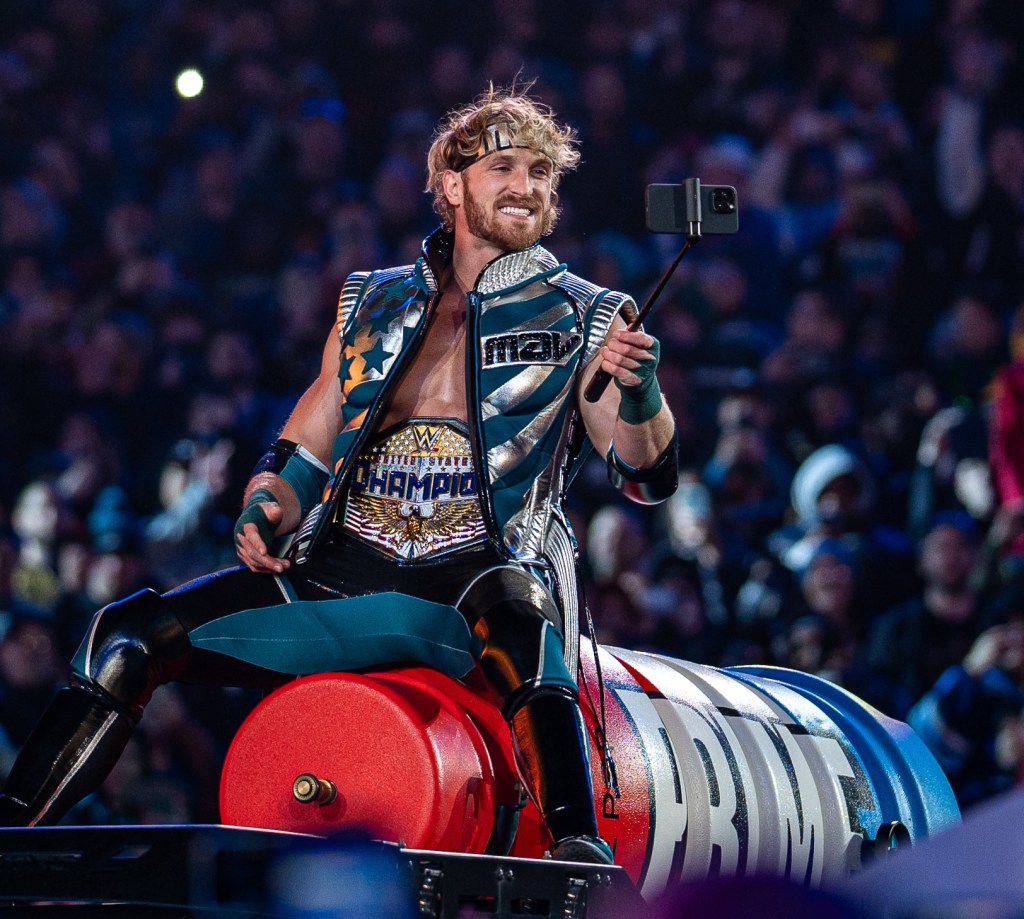
Featured Image: Paul making his entrance as the WWE United States Champion at WrestleMania XL, CC BY-SA 2.0

Andrew J. Salvati is an adjunct professor in the Media and Communications program at Drew University, where he teaches courses on podcasting and television studies. His research interests include media and cultural memory, television history, and mediated masculinity. He is the co-founder and occasional co-host of Inside the Box: The TV History Podcast, and Drew Archives in 10.

REWIND! . . .If you liked this post, you may also dig:

Taters Gonna Tate. . .But Do Platforms Have to Platform?: Listening to the ManosphereAndrew Salvati

Robin Williams and the Shazbot Over the First Podcast–Andrew Salvati

“I am Thinking Of Your Voice”: Gender, Audio Compression, and a Cyberfeminist Theory of Oppression: Robin James

DIY Histories: Podcasting the Past: Andrew Salvati

Listening to MAGA Politics within US/Mexico’s Lucha Libre –Esther Díaz Martín and Rebeca Rivas

Gendered Sonic Violence, from the Waiting Room to the Locker Room–Rebecca Lentjes

Impaulsive: Bro-casting Trump, Part I

But first. . .

An Introduction to Bro-casting Trump: A Year-long SO! Series by Andrew Salvati

“The Manosphere Won.”

That is how Wired succinctly described the results of the 2024 election the day after Americans went to the polls.

Among the several explanations offered for Donald Trump’s stunning victory over Kamala Harris, the magazine’s executive editor Brian Barrett argued, one surely had to acknowledge the crucial role played by that “amorphous assortment of influencers who are mostly young, exclusively male, and increasingly the drivers of the remaining online monoculture.”

Sure, there might be some validity in saying that Trump’s election had to do with inflation, with immigration policy, or with Joe Biden’s “doomed determination to have one last rodeo.” But his appearance on several popular male-centered podcasts in the months and weeks leading up to November 5 likely did much to mobilize support for his candidacy among their millions of viewers and listeners. Talking to Theo Von, the Nelk Boys, Andrew Schulz, and Shawn Ryan “cement[ed Turmp’s] status as one of them, a sigma, a guy with clout, and the apex of a model of masculinity that prioritizes fame as a virtue unto itself,” Barrett wrote.

Indeed, during the president-elect’s victory speech, given in the early morning hours of the 6th, his longtime friend and ally Dana White, president of the UFC, took to the speaker’s lectern to acknowledge the contributions that these podcasters and their audiences had evidently made in elevating Trump to the presidency for the second time. “I want to thank the Nelk Boys, Adin Ross, Theo Von, Bussin’ with the Boys, and last but not least, the mighty and powerful Joe Rogan,” he said.

Spraypainted lips on a brick wall

As a media strategy, this was something of an evolution of Trump’s approach in 2016, in which the former reality TV star had used Twitter to such great effect to bypass legacy media institutions and bring his unfiltered message directly to voters. This time around, and reportedly at the direction of his 18-year-old son Barron, Trump again leveraged the massive reach of new media platforms to speak directly to his target demographic of Gen-Z men.

But the strategy was also of a piece with Trump’s frequent assaults on the press, which he typically characterizes as the “enemy of the people.” Appearing in some of the friendlier precincts of the podosphere allowed Trump to skirt around mainstream journalists with their “nasty” questions and cumbersome norms of neutrality and objectivity, and to bask in the mutual admiration society that some of these interviews became. Indeed, as Maxwell Modell wrote in The Conversation not long after the election, podcasters, in contrast to professional journalists, “tend to opt for more of a friendly chat than aggressive questioning, using what research calls supportive interactional behavior … this ‘softball’ questioning can result in the host becoming an accomplice to the politicians’ positive self-presentation rather than an interrogator.”

Podcasts, in other words, provided Trump with a congenial space to self-mythologize, to ramble, and whitewash some of his more extreme views.

In total, Trump appeared on fourteen podcasts or video streams during his 2024 campaign (Forbes compiled a full list, including viewership numbers, which can be found here), which together earned a combined 90.9 million views on YouTube and on other video streaming platforms (it should be noted, first, that these are not unique views – there is likely an overlap between audiences; second, that these numbers do not include audio podcast listens, which, because of the decentralized nature of RSS, are notoriously difficult to pin down).  

For her part, meanwhile, Kamala Harris also made the rounds on podcasts popular with women and Black listeners – key demographics for her campaign – including Alex Cooper’s Call Her Daddy, former NBA players Matt Barnes and Stephen Jackson’s All the Smoke, and Shannon Sharpe’s Club Shay Shay. It has been suggested, however, that the Harris camp’s failure (or perhaps unwillingness) to secure an appearance on The Joe Rogan Experience was a significant setback, and could have provided an opportunity to reach the young male demographic with whom she was struggling. In any event, while the counterfactual “what-if-she-had-done-the-show” will likely be debated for years to come, Rogan eventually endorsed Trump on November 4, throwing his considerable clout behind the once and future president.

While a comparison between Trump and Harris’s podcast strategy during the 2024 campaign would make for an interesting academic study, in the following series of posts, I will be particularly concerned with Trump’s success with the so-called podcast bros – partially because my own research interests are in the area of mediated masculinities, but also because they may have put him over the edge with a key demographic – with Gen-Z men.

Over the next few posts, I will examine several of Trump’s appearances on largely apolitical “bro” podcasts during the 2024 campaign season, including his interviews with Logan Paul, Theo Von, Shawn Ryan, Andrew Schulz, the Nelk Boys, and Joe Rogan. In the course of this examination, I will pay attention not only to what Trump said on these shows, but also to the way in which they established a sense of intimacy, and how that intimacy worked to underscore Trump’s reputation for authenticity. Along the way, I will also discuss the podcasts and podcasters themselves and attempt to locate them within the broader scope of the manosphere. Finally, given the passage of time since Trump’s appearances, I will consider to what extent, if any, individual hosts have become critical of his administration’s policies and actions – as Joe Rogan famously has.

Before I begin, however, I want to make a quick note about the sources: Following what is quickly becoming standard practice in the field, each of the “podcasts” that I analyze in this series has a video component, and in fact, may very well have been conceived of as a video-first project with audio-only feeds added as a supplement, or afterthought. For this series, though, my interest has centered on podcasting as a listening experience, and so the reader may assume that when I discuss this or that episode of Theo Von’s or Andrew Schulz’s podcast, I am referring specifically to the audio version of their shows. This is also why Trump’s interview with Adin Ross will not appear in this series – it was livestreamed on the video sharing platform Kick, and was subsequently posted to Ross’s YouTube channel (and thus is it technically not a podcast).

With that being said, let’s dig in. I will proceed chronologically, with Trump’s first podcast appearance on the boxer/professional wrestler Logan Paul’s show, Impaulsive, which dropped on June 13, 2024.

****

With about 13 minutes remaining in Logan Paul’s roughly hour-long interview with Donald Trump, the conversation turned to aliens. “UFOs, UAPs, the disclosure we’ve seen in Congress recently,” Paul explained, “it’s confusing and it’s upsetting to a lot of Americans, because something’s going, there’s something happening. There are unidentified aerial phenomena in the sky, we don’t know what they are. Do you?”

For his part, Trump responded gamely, and after respectfully listening to Paul, proceeded to tell a story about how, as president, he had spoken with Air Force pilots, “perfect people,” who weren’t “conspiratorial or crazy,” who claim that “they’ve seen things that you wouldn’t believe.” Still, Trump admitted that he had “never been convinced.”

still of an angry white man with overcombed reddish hair and a superimposed UFO on his right shoulder
SO! Screencap of IMPAULSIVE EP. 418

I start with this turn in the conversation not necessarily to dismiss the 29-year-old Paul as a conspiratorial thinker or an unserious interviewer, but rather to highlight the overall tone of the Trump episode, which was overwhelmingly chummy and fawning. It was clear from their deferential posture that Paul and his co-host Mike Majlak were in awe of the former president, and asking such questions was a way of keeping it light and easy.

Logan Paul, after all, is not known for his incisive political commentary. Indeed, in the 17 episodes of Impaulsive that were released in the six months preceding the Trump interview (all of which I have listened to for this piece), political issues hardly featured at all. One exception came during the December 19, 2023 episode with his brother Jake Paul (also a professional boxer, who was recently knocked out in a fight against Anthony Joshua), in which Logan and Majlak discussed the prevalence of right-wing or MAGA content and signifiers as the inevitable backlash to the excesses of the left and the “woke mind disorder,” as Majlak put it. Another example was the January 31, 2024 episode with former co-hosts Mac Gallagher and Spencer Taylor, in which Majlak went on a self-described “rampage” about the problems at the U.S. southern border (in particular, he referenced the Shelby Park standoff, though without naming it), and in which Paul’s father, Greg Paul, got on the mic to declare his support for “Trump 2024.” But other than these incidental moments and superficial takes, the show is not really the place for nuanced discussions of public policy or electoral politics. (Indeed, in the January 31 episode, Paul even attempted to stop Majlak’s rant by noting that listeners didn’t really tune into the show for political discussion).

Nor does Impaulsive, despite all its testosterone-fueled bro-iness, seem to fit comfortably within the manosphere, as I understand that term and what it signifies. Indeed, though Paul and Majlak seem to have fixed ideas about gender and about the differences between men and women, absent from their discussions (at least during the six month sampling of episodes that I listened to) is the kind of misogynistic and reactionary “Red Pill” rhetoric that characterizes manosphere discourses.

This isn’t Andrew Tate, after all, and it’s important that we keep track of the distinction.

young bearded blonde white man in a black suit and white shirt sitting to the left of a young brown haired bearded white man in a navy suit and white shirt, both talking into microphones
SO! Screencap of Paul and Majlak, IMPAULSIVE EP. 418

Impaulsive, rather, serves as a venue for Paul and Majlak to have informal, free-wheeling conversations with their guests – which have included fellow wrestlers, sports stars, internet personalities, rappers, pastors, and even Chris Hansen – on a range of other topics of interest to the hosts. If there is a throughline in all of this (aside from Paul and Majlak’s interest in how guests navigate their social media presence), it is certainly the relationship between the two co-hosts, their similar immature (we might more charitably say “goofy”) sense of humor, their mutual interest in combat sports, and their past history of online and offline hijinks all providing the basic framework for much of their conversation. It also gives Impaulsive listeners a sense of intimate connection with the pair, a sense that they are in the room as a silent participant in the hang.

And Paul has had a decade’s worth of experience in making comedic content. Having first earned a following by posting short videos on Vine as a college freshman in 2013, he dropped out of school and moved to Los Angeles to pursue a full-time career as a social media content creator. Fortunately for him, the gambit worked, and his content was soon reaching hundreds of thousands of followers across Twitter, Instagram, and Facebook in addition to Vine, and a compilation of his videos posted to YouTube amassed more than 4 million viewers in its first week. A number of TV and movie appearances followed, and in 2018, Paul began what would eventually become a professional boxing career with a white-collar match against the British influencer KSI.

Blonde white male teenager holding a blue and white bullhorn
SO! Screencap of Logan Paul Vine Comp 1

Paul’s rise to notoriety wasn’t unmarked by controversy, however. In late December 2017, at a time when he had something like 15 million YouTube subscribers, Paul earned widespread condemnation for his insensitivity after he posted a video to the site showing the body of an apparent suicide victim in Japan’s infamous Aokigahara Forest, and making light of the situation. As a result of the backlash on social media – which included a Change.org petition urging YouTube to deplatform the creator that garnered over 700,000 signatures – Paul removed the video and issued an apology for his actions (this apology was itself criticized for being disingenuous and self-serving, and Paul was later compelled to issue another). For their part, YouTube took disciplinary measures against Paul, which included removing the creator’s channel from the Google Preferred advertising program, and removing him from the YouTube Red series Foursome, among other things.

But that wasn’t all. About a month later, YouTube announced that it would temporarily suspend advertisements on Paul’s channels (the revenue was estimated to be about a million dollars per month) due to a “recent pattern of behavior,” which, in addition to the Aokigahara Forest controversy, now included a tweet in which he claimed that he would swallow one Tide Pod for every retweet he received, and a video in which he tasered a dead rat. The suspension seemed to be little more than a slap on the wrist, however, and two weeks later, in late February of 2018, ads were restored on Paul’s channels.

The controversies continued after the launch of Impaulsive in November 2018. In an episode released the following January, as Paul and Majlak and their guest, Kelvin Peña (aka “Brother Nature”) were discussing their resolutions to have a “sober, vegan January” followed by a “Fatal February” (vodka and steaks), Paul chimed in and suggested that he and Majlak might do a “male only March.” “We’re going to go gay for just one month,” he announced. “For one month, and then swing … and then go back,” Majlak concurred. The implication that being gay was a choice drew sharp criticism online, including a tweet from the LGBTQ+ organization GLAAD, which pointed out, “That’s not how it works @LoganPaul.”

We could continue. But it’s also worth mentioning that in early 2019, Paul underwent a brain scan administered by Dr. Daniel G. Amen, which revealed that a history of repetitive head trauma from playing football in high school had damaged the part of his brain that is responsible for focus, planning, and empathy. Such a revelation may explain some of Paul’s poor decision-making. But it has also been suggested that this may be an excuse for the creator to not own up to his shortcomings. And the diagnosis hardly stopped him from starting a boxing career, which he freely admitted “is a sport that goes hand-to-hand with brain damage.”

But even while Paul’s head injuries may have, to some extent, affected his ability to form human connections, it hasn’t completely severed the possibility. On Impaulisve, Paul often shows a genuine curiosity about his guests, a desire to understand their perspectives, and displays a sense of esteem for those, like the WWE superstars Randy Orton and John Cena, whom he knows personally and professionally outside of the context of the podcast. Even amid the raucous Morning Zoo atmosphere of the show, Paul’s tone when speaking to his guests is usually deferential and flattering, and creates a space not only for sharing intimate revelations about, say, the challenges creators face while living so much of their lives in public (a common topic), but also allows guests an opportunity to present themselves and their work in the best possible light.

SO! Screencap of IMPAULSIVE EP. 407 with (l-r) John Cena, Logan Paul, and Mike Majlak

This kind of dynamic was at play during the Donald Trump interview, in which Paul and Majlak offered the former president plenty of opportunities to boast about the historic accomplishments of his first term and of his 2024 campaign, and to air his many grievances – against Joe Biden, the media, the Democratic Party, and the lawyers prosecuting the many cases against him. Impaulsive, in other words, became a platform for Trump to remediate his typical campaign rhetoric, a means of delivering familiar content in a way that privileged quiet intimacy rather than grandstanding performances.   

This sense of intimacy derived, in large part, from the setting in which the episode was recorded: Paul and Majlak were sat close to Trump in a wood-paneled room at his Mar-a-Lago estate. But it also stemmed from the kinds of questions that the co-hosts asked Trump. At one point in particular, the conversation turned, as it often does on Impaulsive, to combat sports, and to Trump’s love of the UFC. Opening up on this non-political and heavily masculinized subject – and casually mentioning the cheers he receives when he attends UFC events in person – likely increased the former president’s appeal among Impaulisve listeners, who, according to Paul and Majlak, are mostly wrestling and UFC fans themselves. 

SO! Screen Capture of IMPAULSIVE EP. 418

Other questions about combat sports – like whether Paul’s brother Jake could win an upcoming fight with Mike Tyson – further cemented the sense that Trump was a fan among fans, and thus created conditions for what podcast researcher Alyn Euritt calls “recognition,” moments in which listeners may feel a sense of intimate connection with a speaker/host and with the larger listening audience.

But what stuck out to me when listening to the episode and thinking about intimacy and podcasting, was the way in which the calm and deliberate pacing of the conversation, with help from the co-host’s gentle guidance, largely prevented the former president from straying into the kind of stream-of-consciousness delivery that characterizes much of his public discourse, and which has come to be known as the Trump “weave.” Kept on course by a friendly interlocutor pitching softball questions, Trump can sound lucid, even rational – and one can see how, in listening to this, his supporters, and even those apolitical listeners in the Impaulsive audience, can get swept up and taken along for the ride.

This is perhaps true for those moments, which occur often, where Trump touts his own successes and popularity. At the beginning of the episode, for instance, after Trump gave Paul a shirt emblazoned with his famous mugshot (which Paul called “gangster” and said “it happened, and might as well monetize it”), the former president launched into a string of familiar complaints about how his prosecution in that case had been an “unfair” miscarriage of justice, and how it had nevertheless resulted in a fundraising boon for his campaign. “I don’t think there’s ever been that much money raised that quickly,” he declared. Uncritically accepted by the co-hosts – and even encouraged by their muffled chortling – such defiant but matter-of-fact posturing may have seemed reasonable to Impaulsive listeners, an understandable response to what was presented as a blatant act of political persecution.

But the apparent honesty and reasonableness of Trump’s views even seemed to extend to his inevitable criticisms of Joe Biden and the American news media, criticisms which were likewise encouraged by Paul and Majlak’s laughter. When Majlak, for instance, asked Trump whether he was “starting to come around or soften your views on some of the networks that you may have not gotten along with in the past?” Trump’s blunt response, “no, they’re fake news,” was met with legitimating chuckles, and with Paul’s concurring statement, “yeah, fake news.” It was Trump’s follow-up, however, in which he put special emphasis on his May 2023 town hall with CNN’s Kaitlan Collins, that he elaborated his position, revealing that though he had thought the network had turned a corner in terms of its friendliness, or at least neutrality, toward him, they were instead “playing hardball.” Delivered almost in a tone of resignation, Trump seemed to give the impression that his poor (in his eyes) treatment by the press was a given, that their hostility, though unfair, was something that simply had to be endured. Again, this explanation, communicated in such an intimate conversational setting, seemed to suggest a cool and reasonable assessment of the situation and prepared listeners to later accept his more extreme view, expressed less than a minute later, that CNN was “the enemy.”
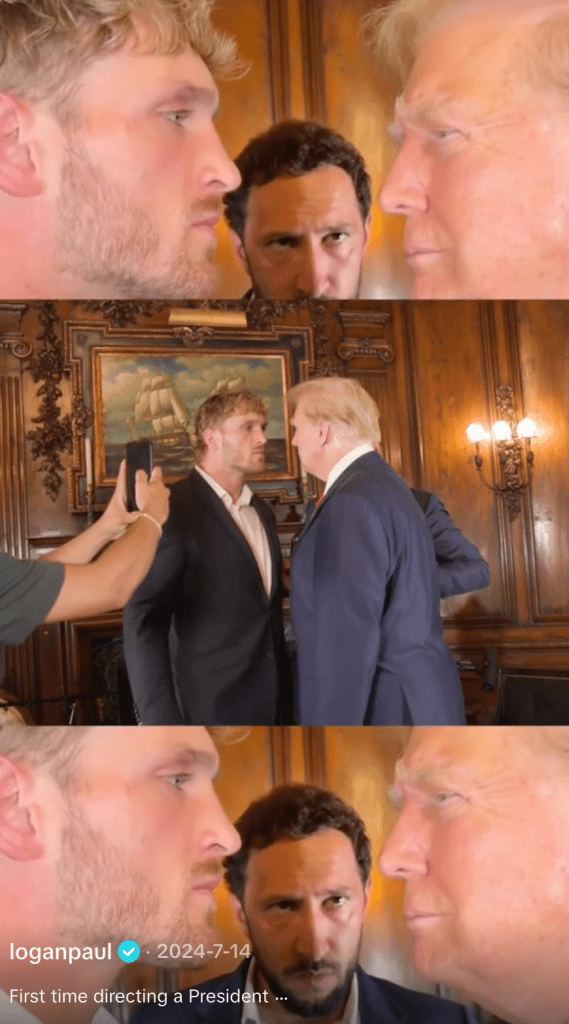
Overall, then, the episode, which ended with Paul, Majlak, and Trump filming a TikTok video in which the podcaster and presidential candidate squared off face-to-face as if shooting a fight promo, offered Trump a platform to connect with other combat sports fans, to burnish his reputation for authenticity, and to legitimize his many grievances. And while the number of new MAGA converts his appearance earned is an open question, what is clear is that Impaulsive afforded Trump an opportunity to directly speak to a demographic that was increasingly important to both campaigns.  

Series Icon Image Adapted from Flickr User loSonoUnaFotoCamera CC BY-SA 2.0

Featured Image: Paul making his entrance as the WWE United States Champion at WrestleMania XL, CC BY-SA 2.0

Andrew J. Salvati is an adjunct professor in the Media and Communications program at Drew University, where he teaches courses on podcasting and television studies. His research interests include media and cultural memory, television history, and mediated masculinity. He is the co-founder and occasional co-host of Inside the Box: The TV History Podcast, and Drew Archives in 10.

REWIND! . . .If you liked this post, you may also dig:

Taters Gonna Tate. . .But Do Platforms Have to Platform?: Listening to the ManosphereAndrew Salvati

Robin Williams and the Shazbot Over the First Podcast–Andrew Salvati

“I am Thinking Of Your Voice”: Gender, Audio Compression, and a Cyberfeminist Theory of Oppression: Robin James

DIY Histories: Podcasting the Past: Andrew Salvati

Listening to MAGA Politics within US/Mexico’s Lucha Libre –Esther Díaz Martín and Rebeca Rivas

Gendered Sonic Violence, from the Waiting Room to the Locker Room–Rebecca Lentjes

The Future Is You: Perception of Y2K Nostalgia Through Hypnospace Outlaw

Portals such as GeoCities, Worlds, The Palace, and Habitat allowed their users to participate in an alternative reality in which, whether through supposedly naive websites, chat rooms, or metaverses, the primary goal was always to share interests and connect with people from different territories. Over time, as has happened with our organic habitat, many of these networks underwent a kind of virtual gentrification, the main consequence of which was forced submission to terms and conditions dictated by the most powerful people in the world: the 1% that began to be fought against on Tumblr and 4chan more than ten years ago. Following this, as a result of the twenty-year nostalgia cycle, a large number of users have recently become interested in a period they experienced only peripherally: the turn of the millennium. And although to a large extent it is a mere superficial and aesthetic issue, its premise of a failed bright future or utopia echoes an enthusiasm numbed by the logic of a world that is increasingly less suited to human rhythm.

This is where the video game Hypnospace Outlaw, produced by No More Robots in 2019, comes in. The game circles around contradictory feelings of nostalgia at the dawn of the internet. Beyond being a virtual tour loaded with popular references, Hypnospace Outlaw functions as a truthful and realistic tribute to an often idealized way of being virtual. Therefore, based on its narrative and formal analysis, parallels will be established with which to rethink the fin-de-siècle period of internet history and how it dialogues with a future situated in the present. Through certain commonplaces of nostalgia that beat tacitly in this work, we will reflect on the need to advocate for a renewed spirit with which to face a virtual everyday life that, despite being beneficial, consumes us as a community into a distracted and gray mass. Therefore, an approach to creations such as Hypnospace Outlaw will allow us to take a step back and rescue a transformative potential from a privileged position, that of the present, which is already filtered by the true lived experience.

You may ask Yourself, ‘Where does that Highway go to?’. Narrative and Formal Notes

Despite being an offline video game, Hypnospace’s portrayal of an internet that has already been buried exudes a deep sense of liveliness. This is why it captivates from the very first moments and why it dialogues with a stagnant and automated present. On the contrary, this work emphasizes the human factor from the outset by pointing to the human-technology symbiosis as the fundamental pillar of a bright future [Fig. 1]. However, the irony of the approach lies in the fact that these premises are endorsed by Merchantsoft, a company that has developed a device called HypnOS that allows its users to connect to the Hypnospace internet network while they sleep (hello Neuralink). The underlying intention of Hypnospace is to integrate technology into people’s daily lives, making it infinitely accessible. The dreamlike hyperbole behind the idea of never disconnecting from technology was evident in commercials such as the one for Windows 95, aimed at a general audience who could use the computer for any task and on any occasion (even in a restaurant!); or in others such as Newcom, in which a teenager physically enters the Information Superhighway, synonymous with the internet, which seemed to reference Nam June Paik’s Electronic Superhighway.

Fig. 1 Screenshot from Hypnospace Outlaw. Frame from the video that welcomes the user and introduces them to Merchansoft technology.

Connecting and sharing with others under the laws of cyberspace were the symbol of a hopeful race toward the future, whose success depended on who had the power of these tools. This reasoning is followed by skeptical manifestos such as Mark Dery’s Culture Jamming, which, as early as 1993, saw the internet as a possible solution to an American society lobotomized by television. For Dery, through the virtual mirages of reality, users could take control of this technology to subvert stagnant cultural codes in an act that draws on détournement, photomontage, samizdat, and ultimately, hacking. The static nature and passivity of television would be replaced by the nomadism and interactivity of virtual communities that would gradually take up more space in our psyche, paving the way for true virtual reality. This narrative, also prophesied by the futurists of the time, is the roadmap for the equally naïve Hypnospace.

Within this sleepwalking internet, its users can create spaces in which to share their concerns with complete freedom, which means that, as in the 1990s, a unit (the player) is needed to moderate the content. This premise is the backbone of the entire work, which is nothing more than a MacGuffin to advance through a non-linear story about a company that led its invention to a fatal end. The enthusiasm radiated by websites such as GeoCities and humor blogs such as Something Awful inspired its developer, Jay Tholen, to create the game’s fictional websites[i], which follow a now-lost structure in which the host introduces themselves to the anonymous visitor and invites them to immerse in their interests in religion, skeletons, or cryptids [Fig. 2].

Fig. 2 Screenshot from Hypnospace Outlaw. Website discussing the cryptid Tall Green.

What is relevant about this artificial internet is how it mediates the feeling of nostalgia beyond postmodern intertextuality, as occurs, for example, in the life and work of Ann Hirsch, whose use of GIFs and vlogs shapes an art that deals with digital identity and hyperfemininity [ii]; while other artists such as Lizzie Klein capture the influence of virtual nostalgia in their work to create photographs that are essentially anachronistic [Fig. 3]. Therefore, the nostalgia that predominates in Hypnospace Outlaw is reflective in nature, aware of the inability and futility of returning to the past but, with a layer of contradictory irony, manages to bring it back [iii]. In this way, the work enters into the same hauntological game that has dominated certain internet phenomena and so seduced Simon Reynolds and Mark Fisher, such as Vaporwave, the music of Leyland Kirby, or the digital crackling of vinyl records [iv]. Here, the slow start-up of the game interface, visually inaccessible websites, cyberbullying, and the emulation of poor bandwidth are details that shake up the present in order to de-idealize an artificially remote past.

Fig. 3 Photograph of Lizzie Klein’s ongoing project Health Freak.

It should be noted that the interest this work aroused at the time is partly a consequence of the proliferation of countless aesthetics and vernacular subcultures, ranging from the fascination with liminal spaces studied by Valentina Tanni and Raquel Luaces to the countless -core subcultures that form the backbone of the current Internet Core. Hence, Hypnospace Outlaw serves as a good example of capturing the nature of the aesthetic to which it belongs, Y2K, since this aesthetic umbrella encompasses all the imagery produced around the dreaded Y2K bug, which ultimately did not cause any problems. Therefore, the contradictory facet of nostalgia emerges in this work to the delight of a player who sees how certain characters gradually go crazy on their blogs with the advent of the year 2000.

As a contextual colophon to this part, it is worth recounting the final spiral of a story that is both emotional and tragic:

In the last setback, fears became reality and, during the turn of the millennium, the HypnOS  bands that all users were using failed at the same time due to a bad system update. This caused thousands of injuries and six deaths. However, the blame was placed on a teenager who created a harmless but eye-catching virus with the intention of getting a girl’s attention, a fact that unjustly condemned him to six years in prison. Despite this, years later, our final task will be to delve into files that prove how the computer cataclysm could have been avoided if the creator of Hypnospace had not succumbed to delusions of grandeur, as his stubborn obsession with improving the system went against numerous medical reports urging him to discontinue the product. After the success of our task, its creator confessed everything and accepted his sentence, but not before revealing that his remorse had been expressed through several letters lamenting the deaths of young and innocent victims [Fig. 4]. In the background, a melody accompanies the final scene with lyrics that continuously repeat the phrase: “Y2K, you let me down”.

Fig. 4 Screenshot from Hypnospace Outlaw. Letter addressed to one of the collateral victims.

Towards Another Path. The Lessons of Hypnospace Outlaw

To create a fictional microcosm of Hypnospace’s caliber, it is necessary to engage in dialogue with the productions of its time through pastiche and self-referential aspects, in addition to the aforementioned intertextuality. This postmodern miscellany, common to our mass of contemporary cultural objects that capitalize on nostalgia, is evident in the zeitgeist that shapes the game to the point of creating something new. The utopia referred to here is the same one that underlies in every feeling of nostalgia, a utopia to strive for or a utopia that could have been but was not. However, what has prevailed in our era is that failed utopia, the one that was glimpsed after the end of history and which, according to Grafton Tanner, was consolidated after the 9/11 attacks [v].

The designers are fully aware of this fact, as behind the façade of references that shape Hypnospace Outlaw, there are other more subtle ones that play with the ironic ambivalence typical of a virtual culture accustomed to playing with masks. Several examples clearly illustrate this. Merchantsoft (Microsoft), the company that designed Hypnospace, is followed by SquisherZ (Pokémon), a game that consists of collecting fluffy creatures; Professor Helper (Clippy), a virtual assistant who is not usually very helpful [Fig. 5]; the free music distribution system FLST (Napster); and websites with interactive hypertext stories that marked the work of net artists such as Olia Lialina, Mark America, and Shu Lea Cheang.

Fig. 5 Screenshot of Hypnospace Outlaw. Professor Helper website.

However, the most interesting ones are those that not only reference but also redefine the notion in question. This is the case with the harmless virus that was nothing more than a covert declaration of love, reminiscent of the famous ILoveYou computer worm; or with Mindcrash, a euphemism for the Y2K problem that caused so many deaths; while other events, such as the one that merged numerous websites into one, thus forcibly displacing many users, seem to allude to the subsequent birth of Web 2.0, the cornerstone of the platforms that now dominate the internet and stoned the virtual flâneur without a destination of his own on a website without hierarchies.[vi]

Although the internet has proven to be a tool capable of distorting time and turning the past and present into a spongy mass, as Simon Reynolds points out [vii], the fact that anyone can access any object under the guise of nostalgia does not necessarily symbolize that we are facing a cultural recession. As with many advances, the significant change lies in the accessibility and speed they bring, not in the new opportunities they offer, as these were often already possible before.

Due to the pace at which phenomena occur on the internet, it is natural for new cultural trends to coexist with outdated ones that manage to pass the novelty filter, a fact that further accelerates contemporary presentism. This is where the aforementioned aesthetics would be situated, which, when referencing the past, always err on the side of translating the selective amnesia of a community that identifies with anachronistic and poeticized codes. That is why Hypnospace Outlaw shows not only how much has been lost (or expired) in recent decades in terms of the internet, but also, as glimpsed earlier, it collects what only a historically blind person would miss, such as finding gore content by chance or being greeted by a shrill MIDI melody on every website. However, what has gradually evolved is the new sense of community to which the work refers so much.

Today, some of the contradictory notions of Gary Cross’s consumed nostalgia are even more noticeable. From his thesis on nostalgia that has been absorbed and regurgitated by the market through objects and passing fads, it is worth mentioning his interest in how it has created micro-identities common to a large number of people who interact with each other from a position of individuality [viii]. This code of conduct is the basis for hegemonic forums such as Reddit or, conversely, 4chan. Therefore, despite the loss brought about by a new vertical and commercialized model of the internet, what is truly desired is a human factor that remains latent beyond the mere consumption of virtual content.

Over time, the internet became completely ingrained in people’s lives, occupying both their work and leisure time. It is the place where you pay your bills. Society, seeing its pace of life and work mediated by the internet, created refuges out of nostalgia, sharing experiences and interests through those same platforms that were built on the ruins of others in the past. We saw how a non-place like the internet, that is, an anonymous, transitory place with no agency, became for different generations of people a landscape of nostalgic escape where everyone could partially recognize themselves and align themselves to ensure a different future. And although this fact may be inexorably conditioned by market and political interests, nostalgically longing for a promised future can always awaken in those who identify with it a sudden interest that brings with it the possibility of change.

The Possible Internet

In essence, part of that promised future portrayed by Hypnospace Outlaw has actually been realized in our reality, only based on the same socioeconomic dynamics that sustain the network. Aesthetically, the informational and visual anarchy that prevailed on the internet at the turn of the century has been replaced by more accessible, intuitive, and concrete interfaces, which has brought with it an oversimplification that advocates for easier navigation of different websites at the expense of a flatter appearance. Hence the artistic interest in recovering that spirit of “anything goes” that was lost in pursuit of a corporate aesthetic that, for the moment, still predominates in all spaces. Those who, beyond its aesthetic value, revere bastions of that era such as the green head of the Windows Player [Fig. 6a/6b], are not only indulging in nostalgia, but are also seeking, through these lost remnants of craftsmanship, an agency within an internet that is inseparable from everyday life.

Fig. 6a “Green Head.” Skin for the Windows Millenium Edition operating system music player, 2000.

Fig. 6b “Green Head.” Skin for the Hypnospace Outlaw music player.

The denial of the future, which has been exacerbated by an essentially retrograde technology such as the algorithm, could be mitigated if the mercantilist factor that brings with it the rebirth of past eras were removed. In order to avoid superficial gestures that feed back into communities as commodities, which Byung-Chul Han refers to as the “end of all community”,[ix] we must turn in a direction that escapes the nihilism of eras such as the one described here, whose non-collapse after the year 2000 condemned it to having to “fulfill” its promises. This fact, however, is what certifies that another path is possible despite the development that the internet and its culture may have undergone.

Although currently taking a step forward and opposing the hegemonic internet through the use of decentralized networks or free software applications is equivalent to the attitude of a contemporary Thoreau, the truth is that their mere existence shows how the flame lit by collectives and artists such as Monochrom, Critical Art Ensemble, and Sadie Plant through manifestos is still alive and becoming more necessary than ever. Works such as Hypnospace Outlaw, which require careful attention and special dedication to immerse oneself in the reflection of a world that once was, possess a transformative spirit, hidden behind the veil of nostalgia that is not always properly glimpsed. If we dissociate the consumerist and viral aspects of these works and aesthetics with echoes of the past, we can turn to transgressive creations that use the abject, the queer, dreams, the kitsch, glitches, or ecology as banners to shake the foundations of present-day culture. Although immaterial, it is essential to take a stand against what dissipates our agency in what remains of cyberspace. After all, even though it has been reviled and misrepresented, the continuum that pursues nostalgia as an engine of change still feeds back into culture; what remains, therefore, is to cautiously position ourselves behind the lights of a feeling capable of imagining new presents.

Author bio

Francisco Villalobos is currently developing his thesis on internet culture at the Autonomous University of Madrid. Based on the theoretical framework of post-internet and digital folklore, his PhD research investigates how internet culture has created a vernacular language about digital daily life and the consequences of living conditioned by internet technology. He is also interested in the role played by video games on the internet and in other audiovisual manifestations that shape today’s cyberspace.

References

[i] Richardson, L., (2023). “The influences and surprising origins of Hypnospace Outlaw” RockPaperShotgun. https://www.rockpapershotgun.com/the-influences-and-surprising-origins-of-hypnospace-outlaw.

[ii] Chan, J., (2012). “The Real Ann Hirsch: The Power of Performative Fiction” Illuminati Girl Gang Vol. II, Oct 29. https://htmlgiant.com/web-hype/illuminati-girl-gang-vol-2/.

[iii] Boym, S., (2001). The Future of Nostalgia. New York: Basic Books: 18.

[iv] Fisher, M., (2014). Ghosts of my Life. Writings on Depression, Hauntology and Lost Futures. Winchester: zero books: 74 – 76.

[v] Tanner, G., (2022). Las horas han perdido su reloj. Las políticas de la nostalgia. Barcelona: Alpha Decay: 47 – 49.

[vi] Darling, J., (2015). “Arcades, Mall Rats, and Tumblr Thugs” in Lauren Cornell, Ed Halter (eds) Mass Effect. Art and the Internet in the Twenty-First Century. Massachusetts: MIT Press: 325 – 328.

[vii] Reynolds, S., (2011). Retromania. Pop Culture’s Addiction to Its Own Past. New York: Faber and Faber: 62.

[viii] Cross, G., (2015). Consumed Nostalgia. Memory in the Age of Fast Capitalism. New York: Columbia University Press: 14 – 18.

[ix] Han, B.-C., (2021). No-cosas. Quiebras del mundo de hoy. Barcelona: Taurus: 31.

Introducing FACEBOOK MUSEUM: Bringing the End Closer Together

A Project by the Dutch Media Art Collective SETUP

The networking site Facebook, founded in 2003, was once the beating heart of our online social world—the place where we felt connected, friendships were formed, and self-discovery developed. These days, the platform has become a symbol of everything that can go wrong with social media: polarization, hate, disinformation, data extraction, and AI slop. When Facebook is mentioned, a widespread sense of unease is evoked. We should have cancelled our accounts a long time ago, yet many of us still cling on; there are still more than 3 billion active monthly users worldwide. Instead of calling on guilt and pushing alternatives, SETUP asked itself the simple question: why can’t we let it go?

In public debates about social media, our emotional attachment to these platforms is rarely discussed. Facebook isn’t just an app. It’s a digital diary of our lives, full of memories, relationships, and events. To start that conversation, we built the Facebook Museum: a place where we collectively can say goodbye to Facebook, where we both celebrate and question this platform’s beautiful and ugly sides. Before we can let go of Facebook, we first need to understand how and why we’re attached and what role Facebook played in our lives.

In July 2025, the Dutch Media Art Collective SETUP opened the world’s first temporary Facebook Museum in the main hall of Utrecht Central Station, the Netherlands’ busiest railway station. A pop-up museum where visitors could donate their own Facebook data, relive memories, and discuss their digital identity. The project attracted over 5,000 visitors and received widespread national media attention. The response illustrated the heartfelt need to reflect not only critically, but also emotionally and collectively on our digital past – and with it our digital future.

In December 2025, SETUP received financial support from the Dutch SIDN Fund to scale up and diversify the Facebook Museum in 2026.

Please visit www.facebook.museum (at the moment only in Dutch) to get an impression of the experience, the press coverage and visual material. This introductory posting gives an overview of the different elements of the museum and what SETUP imagines are possible directions the project can take.

What’s there to experience? Visitors can participate in the curation of what should be remembered about our joint time on Facebook, score keepsakes in the museum shop and vote on a suitable location for the permanent Facebook Museum. In addition, they can donate their Facebook data, reflect on their favorite Facebook moments and leave a card for this on a remembrance wall.

Existing Museum Sections:  

Pedestals with Objects and Stories

Multiple pedestals feature objects symbolising the experiences of six people who have had a startling, or sometimes exemplary, experience with Facebook. The objects appeal to the imagination, such as a cat collar, a pile of pubic hair, or a squash racket. Each pedestal reads the opening of the said story, accompanied by a QR code that the audience can scan with their phone to explore the story further. The stories alternate between positive and negative experiences about, on, and around Facebook. From testimonials of cosy crochet Facebook group members, to traumatised content moderators or victims of online doxing. The individual stories can be read here (in Dutch).

Preservation Wall

The preservation wall is a large blue wall holding three screens on which typical Facebook content passes by: cat pictures, illustrious Facebook groups, and memes. Visitors can vote on what content to preserve as Facebook’s cultural heritage by pressing the corresponding buttons below the screens.

Remembrance Wall

Like the preservation wall, the remembrance wall is a place of memories and nostalgia. Visitors can leave their personal (both beautiful and unpleasant) experiences with Facebook on the wall. Other visitors can browse through these testimonials and reflect on everything we have experienced together on this platform.

Data Donation Box

As the text on the Museum facade indicates (“Don’t delete your Facebook profile yet!”), we do not advise people to remove their Facebook profile indiscriminately. In addition to a trip down memory lane and insight into how culture-defining Facebook is (and has been), visitors also have the opportunity to donate their own Facebook data. They can put their downloaded Facebook data on a USB stick and submit it to the museum, to ensure that this valuable digital cultural heritage is not lost. We have made a clear step-by-step plan for the visitor on how to export your data from Facebook, archive it, and donate it to the museum if desired:  https://www.setup.nl/app/uploads/2025/12/a5large-fbdata-wikkelvouw-1mmbleed-fogra39.pdf

Scale Model of the Proposed Permanent Museum

Halfway through the exhibition space, you will come across a scale model of the permanent museum in the shape of a huge F. Next to the model, there’s a map of the Netherlands. Here, visitors can vote where the future permanent museum should be located, by pasting a blue sticker on their desired city, village or place.

Merchandise

An exit through the gift shop. At the moment available are: In Memoriam candles, t-shirts, postcards, wooden USB ‘coffins’, tote bags, booklets (a DIY guide to Facebook scrapbooking), and (tracking) cookies.

Future Exhibition Options:

1. The Complete Museum Setup (unmanned)

A setup which we can show for a month or more, and tell our full story. In essence, it’s the collection of all museum components as we used them during the pilot at Utrecht Central Station, yet adapted to the context where visitors can look around independently. No crew or museum hosts from SETUP are required for this. The Utrecht Central setup was focused on luring passers-by, selling merchandise and talking to visitors.

2. Small Museum Setup (unmanned)

A setup that we can place at a desired location for at least a week or a month. It is a more compact and focused version of the exhibition at Utrecht Central Station.

3. The Festival Experience (manned)

A setup for a few days or a long weekend, in which visitors quickly get a compact but strong impression. During Betweter Festival 2025 (a science festival in Utrecht with 2,500 visitors), we have already carried out a successful pilot. Here, visitors can share memories and craft mourning cards for their favourite Facebook moments using content from their own Facebook profile. For this, we provide photo printers, scrapbook materials, and other decoration materials. This activity results in spontaneous conversations about digital memories. If desired, we can adjust this experience to the context of your event.

Talks, Keynotes and Panels that SETUP Offers

Polarisation, screen addiction, brain rot. Our conscience speaks increasingly stronger to leave Facebook. However, this is easier said than done. How do we find emotional closure from this platform? And how do we preserve all the digital cultural heritage we have collectively created on it?

A talk of your preferred duration about our research findings on our attachment to big tech’s social media platforms in launching the Facebook Museum, and why it is so difficult to break free from these. We also provide insight into the design process of the Facebook Museum. Depending on the request, we can focus the talk on one or multiple of the themes and topics below. Additionally, it is possible for one or more of our colleagues to take part in a panel on the themes and topics below. If desired, we can also assemble and/or moderate a panel.

Themes that can be discussed:

  • Influence and dependence on big tech platforms (both individual and societal)
  • Collective attachment to big tech platforms
  • Detachment of big tech’s social media (both rational and emotional), and what alternative strategies and language to develop for it
  • Moving away from big tech’s social media on a business / professional level
  • Design fiction, future fiction, speculative design methods:how to explore alternative future scenarios by means of artistic research
  • Digital cultural heritage and how to curate, archive, and make it sustainably available

If you are interested in one or more of our Facebook Museum components, we can send a quote tailored to preferences and adjustments. For this, please contact Jiska Koenders – jiska@setup.nl

This first overview of the Facebook Museum project was written by SETUP’s staff member Marissa Memelink, together with Geert Lovink@INC.

About SETUP

The Utrecht-based Dutch cultural organization SETUP, founded in 2010, researches the impact of technology on society. Our focus isn’t investigating technology as a technical object (“how does it work?”) or as an expressive medium (“how can I make art with it?”) but as a force field within our community. SETUP creates accessible designs to make these power dynamics and their abstract effects tangible for a large audience. In doing so, we focus on the everyday future of technology. Because stories about new technology still often revolve around science fiction themes: a distant future where either everything is possible – or everything goes wrong. AI, for example, in 100 years will either “solve all our problems” or “take all our jobs.” But these scenarios omit important questions. Who pays the price for this new technology? What power does it create, and where is this situated? What interests are at play, and what ideologies constitute the design of these systems? That’s why we explore near-future scenarios in our artistic research, for which we look ahead a maximum of 5 to 10 years.

SETUP’s mission is to create a technology-critical society. A society in which everyone can participate in discussions and reflections on the development and deployment of new technology. Eventually, this will lead to other hardware, platforms, and power structures. But it all starts with a critical community surrounding these systems, actively exploring what a healthy relationship with technology means for them. Our philosophy is that in order to move towards an alternative future with technology, one first has to be able to imagine it. We believe the arts provide the free space necessary to question and investigate these alternative scenarios. Artists play a crucial role in this: creating images and agendas, offering a broader perspective, and posing critical questions. Not just as a mirror, but also as a crowbar. www.setup.nl

Previous Projects by SETUP

Since its foundation in 2010, SETUP’s projects have been focused on the Dutch-speaking community and have always had a critical yet cheeky-hilarious approach. Some examples of previous projects:

The pottery-robot Man and machine are often portrayed in the media as competitors. But can we explore a complementary relationship? Forget all the robots that ‘catch up’, ‘beat’ or ‘replace’ us. Come and merge into a beautiful symbiosis with our pottery robot. – https://www.setup.nl/projecten/de-pottenbakrobot/

Nude prompting workshop Does the advent of AI image generators make nude model drawing more accessible than ever? We put it to the test and bumped into more interesting hiccups than initially expected… https://www.setup.nl/projecten/naaktprompten-naaktmodel-tekenen-met-ai/

Project dodo – an exoskeleton for the dodo Through advanced biogenetic engineering, scientists are currently de-extincting the long-lost dodo bird. But once returned to earth, how do we make the dodo 21st-century proof? A project exploring human techno-solutionist tendencies. https://www.setup.nl/projecten/an-exoskeleton-for-the-dodo/

Alternative stock photography for technology Shiny humanoid robots, green Matrix code or brains full of zeros and ones. Photos accompanying tech news leave a lot to be desired. They maintain a mystified impression of what the technology is and what it means for us. Could it be done differently? https://www.setup.nl/projecten/nieuwe-stockfotos-voor-technologie/

Audio-visual material about the Facebook Museum:

Photos (credits: Bas de Meijer): https://www.flickr.com/photos/setuputrecht/albums/72177720327588487/with/54659546529
Video: https://www.setup.nl/video/het-facebook-museum/

Articles by SETUP about the Facebook Museum (in Dutch):

We richten een Facebook Museum op
Stichting Facebook Museum is officieel – dit is ons bestuur
Na het Facebook Museum willen we sociale media niet meer verslavend noemen
Sociale media zijn massaal toxisch verklaard, tijd voor een waardig afscheid

Press publications (in Dutch):

Item op Radi0 1
https://www.nporadio1.nl/nieuws/wetenschap-techniek/ac2ab72e-c957-44e4-82a7-e92e2d0a9c02/afscheid-nemen-van-facebook-makkelijker-gezegd-dan-gedaan
Item op BNR nieuwsradio
https://www.bnr.nl/nieuws/tech-innovatie/10577510/eerste-facebookmuseum-ter-wereld-in-utrecht-digitaal-cultureel-erfgoed
Artikel op NOS online
https://nos.nl/regio/utrecht/artikel/654177-waarom-we-facebook-niet-gebruiken-maar-ook-niet-kunnen-loslaten
Artikel in Telegraaf
https://www.telegraaf.nl/video/uniek-facebook-museum-opent-doneer-jouw-data/77742247.html
Artikel in Trouw
https://www.trouw.nl/binnenland/in-utrecht-kun-je-al-rouwen-om-facebook-het-platform-werd-steeds-vijandiger~b8625de7/
Item in uitzending en online Hart van Nederland
https://www.hartvannederland.nl/het-beste-van-hart/panel/artikelen/facebook-sociale-media-social-hyves-panel-gebruikers-missen
Artikel in AD
https://www.ad.nl/utrecht/facebook-museum-op-utrecht-cs-we-hebben-er-jarenlang-lief-en-leed-gedeeld-die-data-is-waardevol~a439aaf5/
Item in Oranjezomer
https://www.kijk.nl/programmas/de-oranjezomer/SyLYboBPFSs


A Review of a Sexual History of the Internet & the Influencer Theorist

 Part One:

The Cyberfeminism Index 

In the past three years, we saw the Cyberfeminism Index on every hot, internet-pilled girl’s bedside table. Mindy Seu’s newest publication, A Sexual History of the Internet, is sure to follow in its lead.

The first time I saw the green book was in its birthplace, or at least across the river from Cambridge, in a Boston bookstore. It’s a thoroughly academic, transient city. The winters are long and cold, and the summers are hot and virtually desolate. 

While studying at the Harvard Graduate School of Design (GSD), Seu created a viral spreadsheet where contributors were invited to submit to an anti-canon, cyberfeminist, internet history. She would later win the 2019 Design Studies Thesis Prize for Cyberfeminist Catalog 1990-2019. The project became the webpage cyberfeminism.com. In 2023, the Cyberfeminism Index was traditionally published by Inventory Press. It functions as an encyclopedia and archive. Seu reframes the author not only as a producer, but as a curator.

Attending a nontraditional graduate program is in line with Seu’s overarching narrative. The GSD’s Master of Design supports alternative practices by facilitating concentrations in publics, narratives, ecologies, and mediums. This is her first divergence from the canon of the graphic designer, which is stereotypically marked by a BFA from an art school and an advertising adjacent practice.

A Sexual History of the Internet Lecture Performance

A Sexual History of the Internet is a lecture performance and an artist book that is the size of a phone. A phone is the vessel, or as artist Melanie Hoff calls it, a “sex toy”[1], that each attendee will experience the performance through. 

I went to the Hamburg performance on November 6th, 2025. If Seu’s Cyberfeminism Index tour had an air of production, this is the lecture performance in its final form. It begins academically, with stilettos echoing on hard floor. This brought me back to 6th grade when I had a pumpkin-haired teacher who enjoyed shopping for high heels during class. The event’s crowd was well dressed, mostly in black, and English was the overwhelmingly spoken language. 

I arrived on time and was late as a result. I had forgotten about German punctuality. I settled on the back stairs overlooking the main floor. It felt like watching the trailers play before the movie came on. When the lights went red, and Seu entered the room, it only took a second for the chatter to still. She is undoubtedly a gravitational personality. 

In a phone-based lecture, your device is no longer your own. It becomes a projector, a green screen, and a whiteboard for the lecturer to disseminate their research. Ideally, you would never even touch your screen. Due to the internet connection, the lecture vehicle (Instagram Stories) experienced continuous lag. This resulted in a disjointed collective voice during the audience participation portion. The moments in which Seu recited the script herself, unwavering and professor-like, were the best of the night.

The book was born out of necessity. Early Instagram accounts featuring the lecture were taken down due to violations of Meta’s content guidelines. Adult nudity is prohibited, real or computer-generated. Nudity is allowed in the case of art or medical imagery, which is likely the reason that the account is live today.

In Seu’s 2023 MFA course at Yale School of Art, graduate student Julio Correra was experimenting with “Instagram Stories as a vehicle for publishing”[2]. She credits Correra as the originator of this concept, which speaks to her ethos to “aggregate, together with collaborators, disparate pieces from an ecosystem, and develop the appropriate container”[3]. Attributing this early concept to Correra is valuable and mutually beneficial. He is cited as 1 of 30 creators of the book on Metalabel.

The Gatherer

This publication makes use of a new model of profit distribution. In traditional publishing, the author will earn around 10% of the royalties, and the publisher 90%. In this case, the profits are divided: 10% Metalabel, 60% team, and 30% contributors. If the print run of 4000 sells out, each contributor will earn $850 USD.

Yancey Strickler founded Metalabel, a “collaborative publishing and releasing tool” where “A group of authors collectively releasing a work becomes practically very possible”[4]. On the platform, he created the group, The Dark Forest Collective, which A Sexual History of the Internet is a part of. Its members include Yancey Strickler, Joshua Citerella, Mindy Seu, and more. There are also contributors who have played a role in a project. 

Through the act of gathering information, Seu brings it into her metaphorical pile. Her role is in taking abstract knowledge and resources and centralizing them. A pitfall of this model is that the discourse can surround the person at the forefront of the conversation rather than the individual contributors.

Part Two:

The Graphic Designer to Literally-Anything-Else Pipeline

The graphic designer to literally-anything-else pipeline is a phenomenon where one studied design as an undergraduate, but has a career in anything and everything else. It’s a type of figure or character [5]. Seu is an example of this. She has a BA in Design Media Arts from UCLA, but outsources the design of her books to her collaborator, Laura Coombs.

Silvio Lorusso, designer, professor, and author of What Design Can’t Do and Entreprecariat, “writes and talks about design, though [does] very little of it, and [believes] in it less and less” [6]. My own undergraduate professors were not disillusioned by what design is in the world. One of them, a Yale MFA graduate, remarked that “the purpose of design is just to make the world a more beautiful place”.

In creative circles, everyone has a friend who studied graphic design but pivoted to social media, film, big tech, fashion production, or accounting. As a design graduate myself, I have lived experience working alongside designers and their evolved form: the artist influencer. Famous examples are Maya Man, Harriet Richardson, and Molly Soda. They have roots in graphic design, but have become artists, period, with projects like A Realistic Day in My Life Living in New York City and (The Angels Wanna Wear My) Red Shoes.

At the Institute of Network Cultures, In conversation about the Internet Theorist, a colleague proposed that “Joshua Citarella has to be buff, and Alex Quicho has to post her selfies”. They perform what they practice. In that sense, Mindy Seu has to model for Jaquemus, host events for Pornhub & Pillow Talk, and lecture at UCLA the next morning. It’s part of her character design; her projected image has become her lived performance. Seu has become synonymous with her LA apartment. Her bachelor pad is so #2016 core LA pink wall coded. It’s aspirational. I would have reblogged it on Tumblr. Being an artist is a performance, as is being a lecturer.

Mindy Seu’s Los Angeles apartment. IG @mindyseu.

In November of 2025, a TikTok user filmed a series of videos praising the meandering and nonlinear career, amassing over one million views. Joining the conversation, another user made a video with Mindy Seu’s CV as the background, dubbing her the patron saint of career breadth. The discussion contained praise and curiosity, “Commenting to stay on multi-passionate tok”, and “Who is Mindy Seu and why do we have her spreadsheet anyway?”. The instability of the current job market is reflected in the popularization of job related discourse and memes: jobs girls want, handing you a job application, and jobs people, jobs.

The existence of the Influencer Theorist is a result of the shift to project-based work in the gig economy. The Americanism of worshipping fame, money, and success above all else reinforces this. In the States, it’s a cultural belief that notoriety and success are one in the same. The viral theorist has both #normcore social currency (job) and digital social currency (loyal followers).

A Day in the Life of a Graphic Designer Turned Wannabe Influencer Theorist

To propose this particular wannabe Influencer Theorist, I first had to attend four years of art school. My favorite professor at Boston University wore Ganni and Tabis. A former BFA student got hired at Baggu, so my classmates and I worshipped Baggu. Halfway through my degree, I started admiring graphic designers who publish. I happened to join the design department around the same time as Kathleen and Christopher Sleboda of Draw Down Books. In 2022, they began hosting the Multiple Formats Art Book Fair, where I attended panels featuring Printed Matter, Queer.Archive.Work, Genderfail, and Catalog Press. The most memorable lecture was Brendan Page’s on The Villa, a publication made from feeding thousands of Love Island stills into 3D scanning software. My interest in alternative design practices rooted in theory and research led me to the publication, The Lazy Art of Screenshot, and eventually to work at the Institute of Network Cultures. 


· ─ ·★· ─ · ·⋆⁺₊⋆ ☀︎ ⋆⁺₊⋆⋆˙⟡⋆˙⟡˚₊· ͟͟͞͞➳❥⋆˚✿˖°⋆˚࿔╰┈⋆༺𓆩☠︎︎𓆪༻⋆ᯓ★༺☆༻ ☀︎⋆⁺₊⋆· · ─ ·★· ─ · ·

POV: You wake up in Sandy Liang bow socks with a slit cut for Margiela Tabis. God, they were expensive, but they sure are chic. Time for your morning routine: flipping through Instagram Stories. You’re captivated by an Influencer Theorist modeling for Helmut Lang at 9, and guest lecturing by 11. How do they do it?! Time to post on main: Subletting Bushwick apartment December 21st-26th, $200 per day. Includes a laser printer, many design books, and Gustaf Westman tableware. Friends, or friends of friends only!!! 

Your bio says bi-coastal, so to keep up appearances, you book a Spirit flight to LAX. Can’t be too expensive, we have #Eurosummer to think about. You’re planning on crashing the Venice Film Fest and staying at your study abroad host mom’s. It’s a long bus ride to the island, but you’ll be out partying all night with Timothee Chalamet look-alikes anyway. 

Today calls for a full GANNI sweat set. You’re tired from country line dancing at Buck Wild with New York’s laptop class. Before Stud Country closed, you used to see Kaia Gerber there. You’re winded from the six flights of stairs down to the lobby. There’s no elevator, duh, this building is pre-war. You stop into a Blank Street Coffee. You need to grind on crossposting for your Are.na and Substack presences. Wait, the guy ordering a cortado looks so familiar. Isn’t he the hot line cook from Addison Rae’s music video?! He’s, like, really TikTok famous. You should ask him to come on your podcast. You haven’t filmed an episode yet, but at least you have a name… something with ‘Famemaxxing’. It’s pretty theoretical. 

You order a sugar-free double iced vanilla latte with oat milk. This week, your calendar is full. You have to choose between a Chamberlain Coffee nighttime matcha rave at The Box or a Feeld x 818 Tequila arthouse film event in Dime Square. #Indecisive. You dig around your Baggu Colinda Strada Bag for a pen. Oh! So that’s where your cotton candy vape went. (You’ve been trying to get into cigarettes).

*ding*

An email from a publication you admire sends you right up out of your seat. Could it be!? Finally, a clouted opportunity at the correct intersection of arts and academia, not mainstream but not underground. You forget all about Famemaxxing, Gio the line cook, and your forthcoming Substack essay. Time to drop everything, hyperfocus on this opportunity, and rule out all possibilities of not being chosen. It’s called manifestation. You’ve got this, and you didn’t even need to niche-down.

· ─ ·★· ─ · ·⋆⁺₊⋆ ☀︎ ⋆⁺₊⋆⋆˙⟡⋆˙⟡˚₊· ͟͟͞͞➳❥⋆˚✿˖°⋆˚࿔╰┈⋆༺𓆩☠︎︎𓆪༻⋆ᯓ★༺☆༻ ☀︎⋆⁺₊⋆· · ─ ·★· ─ · ·

The wannabe Influencer Theorist looks up to Mindy Seu. They can only become enlightened when person and persona are indistinguishable, when their projected image becomes their lived performance. Authenticity becomes a finite, mineable resource in the performance of existing online. Is the influencification of these roles: theorist, designer, dentist, harmful? No, not necessarily. Is it spiritually American? Yes. The practice is rooted in the culture of fame-worshipping. Sure, Utah’s early Mormon mommy bloggers weren’t initially in it for the money, but look at the Secret Lives of Mormon Wives now. In American-derivative work, everything increases in size, fame, and cost.

· ─ ·★· ─ · ·⋆⁺₊⋆ ☀︎ ⋆⁺₊⋆⋆˙⟡⋆˙⟡˚₊· ͟͟͞͞➳❥⋆˚✿˖°⋆˚࿔╰┈⋆༺𓆩☠︎︎𓆪༻⋆ᯓ★༺☆༻ ☀︎⋆⁺₊⋆· · ─ ·★· ─ · ·


Eva Brown is a Graphic Design graduate of Boston University’s College of Fine Arts and Intern at the Institute of Network Cultures. She is interested in expanded publishing, digital futures, internet aesthetics, and The Book as an object.


[1] Mindy Seu, A Sexual History of the Internet, 00:45. https://asexualhistoryoftheinternet.com/.

[2] Mindy Seu, A Sexual History of the Internet, 19. https://asexualhistoryoftheinternet.com/.

[3] Mindy Seu, “On Gathering”, Shift Space, 2023. https://issue1.shiftspace.pub/on-gathering-mindy-seu.

[4] The Institute of Network Cultures, .expub, Exploring Expanded Publishing, 180. https://expandedpublishing.net/.

[5] Geert Lovink, Platform Brutality, Chapter: The Principles of Figure Design. https://valiz.nl/en/publications/platform-brutality.

[6] Silvio Lorusso, What Design Can’t Do, biography. https://www.setmargins.press/books/what-design-cant-do/.


Digital Tribulations 4: Interview with Pedro Burity on Popular Digital Sovereignty and Social Movements in Latin America

The following interview needs a longer introduction to properly contextualize the Brazilian social movements background. I first met Pedro Burity, a graduate student and researcher at the University of Brasilia, at the Association of internet Research conference, this October in Rio de Janeiro. Pedro researches sociot-echnical arrangements and imaginaries for social movements in Brazil. He works with civic tech, designing digital participatory processes and public services for governments. 

In Sao Paolo, we attended the launch of a book of the Movimento dos Trabalhadores Sem Teto (MTST), the Homeless Workers’ Movement, who projected the figure of Guilherme Boulos (a former activist, today a minister of Lula’s government). The MTST derived from the Movimento dos Trabalhadores Rurais Sem Terra (MST), Brazil’s Landless Rural Workers’ Movement founded in 1984, is, which successfully organizes landless peasants through direct action (land occupations) and long-term organization, helping hundreds of thousands of families gain land access, establish cooperatives, and influence agrarian reform policies.

After the interview, which took place in Sao Paolo in a extremely crowded parque Ibirapuera, we quickly became friends, and I ended up spending a week at his house in Brasilia, where we continued our conversation and visited the various places of resistance of the city, such as Casa Comun – a shared space in Brasília dedicated to civil society organizations, movements and collectives that want to do political advocacy and incidency – the Ocupa Mercado Sul, and the University of Brasilia.

I enjoyed Brasilia’s campus, big and sunny, with brutalist architecture, many plants, a tragic history of brutal murders during the military dictatorship, which includes a designed place for socialization, conversation, and petting name beijódromo. The university, which welcomed us with students dancing to a concert of forrò on the roof during the lunch break on a Friday, seemed to me the best part of the city which otherwise is the result of a poor high-modernist architecture and planning ideal, one that signed a Faustian pact, trading legibility for good conditions of living (see for instance J.C. Scott’s masterful critique of the shortcomings of centralized planning, which uses the city as a case study). A city built for cars that still has a lot of traffic; where human activities are zoned – there is a pharmacy neighbour, a hospital neighboor, etc; a city that, how Pedro explains, has ended up internalizing the bureaucracy in the way of thinking of people. 

We also visited Ocupa Mercado Sul (Mercado Sul Vive), a concrete experiment in popular digital sovereignty in Brazil: an occupation and a lively space of popular culture, with music, theatre, cinema, popular education and the monthly Ecofeira in the old public market of Taguatinga. The Ocupa, which emerged as a response to real estate speculation and to reclaim an empty, degraded area based on the right to the city and the social function of property, is shown to use by Angel, a formidable activist and free software advocate. When we arrived, he welcomed us in space by counter-recording my interview with its own Iphone, narrating that the Ocupa is part of a larger network, the Rede Mocambos, a solidarity network connecting quilombolas, the AfroBrazilian communities formed by descendants of enslaved Africans who escaped captivity, with Indigenous and popular communities, artists, and artisans to build a “world shaped by their own territories, memories and struggles”. Most relevantly, he continued, Rede Mocambos combines cultural and political organisation with the development of communitycontrolled digital infrastructure, with tools like Baobáxia, and community data centres that enables communities to store, manage and share their own audiovisual archives and documents without depending on Big Tech or constant internet access. The network seeks to build autonomous “digital territories” that mirror and protect physical territories. 

After that, together with another friend, Rafael, we visited the Chapada dos Veadeiros, a national park with long hikes and stunning waterfalls, and during those days I learned the word gambiarra, which would prove useful for the rest of my trip, that refers to a clever, often makeshift, improvised solution or repair using limited resources, something like a “juryrig”. A bolsonarista hairdresser in Salvador later confirmed the concept in practice: in Brazil, everything is gambiarra.

In the interview, Pedro discusses the concept of popular digital sovereignty and the centrality of social movements in political change. Brazil may not be a utopia realized, but it has impressive base of popular self-organization that came to elect Boulos – the ministro do povo (ministry of the people) as someone screamed at the samba after the book launch – which highlight the link between popular movements, political imagination and statelevel change. It also has Central Bank which developed the first successful public Fintech in the world, o PIX, a public payment infrastructure that quickly and radically transformed daily life of millions of Brasilians, especially poor. As Pedro once told me: “Pix saved us from WhatsApp.”

***

I’d like to start with a terminological clarification. What are we talking about when we talk about digital sovereignty, and what do social movements mean by popular digital sovereignty? 

When we talk about digital sovereignty, we can refer to different traditions and different strands of thought. In my research, when we speak of sovereignty, we try to bring the perspective of people’s selfdetermination within a given territory. I try to think of this idea in a way that is not only tied to the State, which is usually what happens when we talk about sovereignty. We try to bring in more of a popular perspective, linked to autonomy. And, when we talk about Latin America, we have a long tradition of struggles for sovereignty and autonomy, from different perspectives. It’s in this sense that we try to work with sovereignty as a form of selfdetermination.

From there, we move into the digital dimension. The digital part is a bit more complex because we are talking about a structure, about a reality that involves very powerful actors. It’s hard to even imagine what digital sovereignty would actually be. We have been facing this difficulty of imagination, of the imaginary, of the ability to create different worlds. Digital sovereignty comes in precisely in this sense: how a people, how a society, manages to selfdetermine in different ways, to create its own alternative worlds within the technology we already know and within what we don’t yet know, what remains to be invented.

The entrance to the university of Brasilia.

Don’t the weaknesses of the concept of “the people” in the democratic tradition risk being repeated when we talk about popular digital sovereignty?

The notion of “the people” really does come a lot from Rousseau’s perspective, from the general will, but it has also been heavily transformed over time, not only in theory but also in practice, especially when we talk about “popular” and all the contradictions that the popular brings with it. A perspective that seems very interesting to me is that of Antonio Negri. It’s a perspective that has inspired many revolutionary movements in Latin America. Hugo Chávez himself used to say that the entire Venezuelan revolution draws its theoretical inspiration from Negri’s idea of constituent power, and that it is from this constituent power that sovereignty is born.

The difference from the Rousseauian perspective is that this general will becomes much more a matter of emancipation of people, not in the sense of a general will of single, homogeneous people, but of a diverse, diffuse people, povos, in which the general will means the inclusion of all these peopl within an emancipatory horizon. It is a much more classbased perspective, which fuels several movements and revolutions in Latin America and helps to build what the people actually are, with all their contradictions, difficulties, and problems, but from a place that is different from the rest of the world. The Global South, or at least Latin America, has a different perspective on what “the people”, el pueblo, is. If we look at the many union leaders and revolutionary leaders we have had, that fits into this logic.

How does this history of struggle and colonialism help us understand what you’re calling popular digital sovereignty?

The history of Latin America is a history of struggle. Since the very beginning of colonisation, we’ve been dealing with different technologies and tools of oppression against our peoples. Digital colonialism is just one more form of this. Big Tech is bringing in ever more sophisticated technologies of oppression, surveillance, and colonialism. But we, as Latin Americans, have always managed to find a way out. It’s very striking how creative Latin American people are. There are similarities in the ways different peoples have dealt with colonisation historically, but it’s interesting to see that all of them managed to build their own tools of struggle from their own territories, cultures, and specificities.

It’s no different when it comes to digital technology. The Brazilian example is very powerful as a real possibility of building other worlds. And, within Latin America, we also have equally transformative initiatives, like FACTTIC, a large organization of autonomous cooperatives very closely tied to the feminist and autonomous tradition. If we look back, we can remember the Zapatista uprisings and revolutions: already back then, they were building liberating radios, community radios. In Brazil, we had hijackings of radio frequencies to broadcast communist messages during the military dictatorship. Latin America, with all its different people, each has its own way of building its digital sovereignty. And of course we will always stand together, as neighboring and solidaritybased countries, in building the possibility of new technology that is more independent and emancipated from the technologies of the Global North, especially Silicon Valley.

Let’s move to the Brazilian case. What do you see as the interesting developments in the last few years? What has changed compared to some years ago?

I’m going to go back a bit to the idea of the State and talk a bit more about the difficulties of theorizing this “people” and of how we actually talk about digital sovereignty in practice. Today, digital sovereignty is a very hot topic, addressed by many countries, leaders, States and companies. It’s a contested concept. Part of that dispute comes from the companies, from Big Tech. On one side you have the States. On the other, this diffuse, confused, hardtopindown people we’ve been talking about.  In the Brazilian context, the issue of digital sovereignty has become a crucial point. Under Lula’s government, it appears in the way the government has been positioning itself ideologically on what sovereignty is, what it means to have control over one’s own resources, over one’s data. From there, we begin to talk about data, and this has become a very strong narrative, especially in the debate around regulating Big Tech, which is one of Lula’s major priorities today: regulation of Meta, of social media in general.

There are many contradictions in this discourse coming from the State, because the State is made up of many players, many figures and interests. The same contradictions that exist in the concept of sovereignty are present within state institutions. Today we have very important actors whose discourse is not very aligned with what actually happens in government. While digital sovereignty is being defended at the level of discourse, the government follows a different logic in practice, bringing large foreign data centres here, offering every kind of tax exemption. The systems the government uses today are Microsoft systems, Big Tech systems. So today, if these companies wanted to, Brazil would grind to a halt. That’s a very serious contradiction we face at the level of the State.

You mentioned that you think digital sovereignty on different levels. What do you mean? 

That’s where the popular perspective comes in. What is actually in the interest of these people? I tend to think from a more classbased perspective. Is it in the people’s interest to have their data controlled by a large corporation, or to have the possibility of determining what will be done with the data they produce? Is it in their interest to be able to understand what they’re doing on their phone, to understand their smartphone, how their data are being used and what technology actually is? Part of what I understand as popular digital sovereignty is trying to break with this technical alienation we live with today, simply accepting what we use, of having an uncritical view of the tools we rely on. It’s about building the possibility of understanding and having autonomy—bringing these two concepts together—to choose the technologies we would like to use as Brazilians and as Latin Americans.

I usually think of sovereignty on three levels. On a more individual level, it’s about having the autonomy to choose whether you’re going to use WhatsApp, or another means of communication, whether you’re going to join certain platforms or not, and doing so with awareness of what’s at stake. On the community level, it’s about having control within a territory, within a community: running a small database, an infrastructure that enables independent communication, that allows that territory to have its own technological means. At the level of the State, it is above all about ensuring, through public policy, support for everything I’ve been talking about: support for this possibility of selfdetermination. The importance of the State, in this role, is precisely to provide backing for these bottomup initiatives, to provide infrastructure and financial resources via public policy. That, for me, is the State’s main function in promoting sovereignty in the digital realm.

The entrance to the Ocupa Mercado Sul.

I tend to think that Big Tech platforms are, above all, infrastructures, with a few novelties. For example, they change more quickly, they allow thirdparty services to be built on top of their infrastructure. But the history of infrastructures shows that there is little room for autonomy and selfdetermination once these infrastructures – think of roads, or electricity – are already in place. How was PIX possible?

In terms of infrastructure, we’re talking about Brazil, a country of continental proportions. Brazil has a public highereducation infrastructure that is free and of very high quality. Being a country in the Global South, Brazil built Petrobras, a company that operates in oil exploration, production, refining, sale and transport, which today competes with big multinationals like Shell, among others. All of this was built here, with local technology, labour and brains—sovereign technology. Today we’re in a complicated scenario, in which Big Tech’s dominance in technological terms is so strong that it’s hard for us to picture other scenarios. But we do have the conditions—in terms of education, people, territory and, I believe, imagination—to build an infrastructure that allows us to achieve this sovereignty, this selfdetermination over how we’re going to develop our technology, as happened with PIX. 

PIX was born out of efforts to think a technology that would be unimaginable in the United States, for example. The way the US treats PIX shows this: they often see it as an unfair competitor to their credit card companies. But the key point is that PIX is not a commercial competitor in that sense. PIX is a public payment infrastructure. This perspective of the commons, of the public, is something we built and that today threatens the hegemony of US payment systems, for example. And here the popular aspect appears again. PIX is the result of the work of public servants. Where did these public servants come from? From public universities. Today, public universities are, for the most part, made up of women and, increasingly, of Black, brown and Indigenous people. These are increasingly diverse communities of students and researchers who embody Brazil’s cultural and technological richness. And when I talk about technology, I don’t mean only in the narrow sense of highend digital tech, but also in terms of social technologies, of how we organise ourselves as a community. From these social technologies, mixed with technique, with scientific and technological development, we are able to create marvels like PIX.

This ranges from small platforms for specific communities all the way up to the level at which these popular sectors manage to reach the State, influence public policy, bring in diversity. Even with all the difficulties and in what is often a catastrophiclooking scenario, we manage to imagine a new world in which we can truly be digitally sovereign. 

Angel and a local film maker at the Ocupa.

 What are the specific conditions in Brazil that allow the transition from social movements to the government, and what does this tell us about the current relevance of social movements in transforming reality?

There’s a very powerful phrase that comes from social movements: “Only struggle changes life.” I think social movements are responsible for radical changes in how we largely see and build the world. These are movements that position themselves as actors who really imagine new scenarios, who are there in pursuit of social change. It’s from social movements that ideas and possibilities for different worlds are born. The case of the MTST is emblematic. One of the movement’s initiatives—outside the strictly digital universe but squarely in the realm of social technologies—is the Cozinhas Solidárias , “Solidarity Kitchens”, created to feed unhoused people in the cold nights of São Paulo. It started as an initiative feeding about 200 people a day in a public square and, little by little, with organization, work and these social technologies, it gained momentum and became an increasingly popular idea, a good idea. Today, roughly four years after the initiative began, the Cozinhas Solidárias have become public policy, and there are already thousands of kitchens around Brazil, feeding thousands of people every day. This is born from a small initiative within a social movement. We often underestimate the potential of a small, transformative idea. When we talk about the technology hub, we’re talking about Ocupa Lab, a social laboratory for technological innovation. It starts as a small lab, a 10squaremetre room in an occupation on the outskirts of São Paulo. There, people who often don’t have basic reading and textcomprehension skills are taught how to use a mobile phone, how to deal with basic technological functionalities, placing people from these communities into the job market as programmers and software developers, and bringing a new worldview into this tech universe, which today is so skewed by the ideals propagated by Silicon Valley.

The potential of this initiative is enormous. By bringing in people with a different mindset, who think about technology in terms of how it can and should be, the sky is the limit. The movement’s idea is that these initiatives—from the tech school, which offers free courses, to “Contrate Quem Luta” (“Hire Those Who Struggle”), a digital solidarityeconomy platform that connects workers from the movement to people interested in hiring them, to clients—will become public policies, involving public infrastructure, public resources provided by the State, evergrowing participation and evergreater technological development of these platforms, so that we can envisage an emancipatory, different, sovereign technology.

Popular digital sovereignty really is born from below, from those at the bottom. It’s initiatives are like those of the MTST itself, with its struggle for housing and territory, which today necessarily runs through technology. We have the MTST; we have initiatives that follow more autonomous currents, like MariaLab, which seeks to build secure infrastructures to protect the privacy of social movements, of individuals, of feminist groups. We have initiatives like data_labe (Datalab), which creates everyday tools to make life easier for people living in the peripheries, which is where the people are. 

In Latin America, we have networks like FACTTIC, an organization of independent, autonomous cooperatives, very closely connected to the feminist and autonomous tradition, which shows that it is possible to build technologicalproduction networks outside the traditional corporate logic. It’s these initiatives that will provide the possibility of building a new kind of technology, of imagining a world without Big Techs, a world in which we can truly have autonomy over what kind of technology we’re going to use and can determine ourselves as a technological power capable, above all, of caring for its own population. 

Pedro and Rafael at the faculty of political sciences in Brasilia.

Do you think there are some practical steps that, over the next five years, Brazil or other Latin American countries can take to curb or at least reshape the penetration of Big Techs?

Absolutely. We’ve talked a lot about the popular, but I believe the State has a fundamental role here. Popular initiatives already exist; they need support. From the State’s point of view, there are a number of challenges in terms of platform regulation. Brazil has been experimenting with innovative and important initiatives in this field, but at the same time there are constant struggles in domestic politics, because the lobbying efforts of these companies are very strong. Regulation is, in my view, the first step: regulation of social media and, now, of artificial intelligence as well, built with the participation of social movements, civil society and the broader third sector.

Then comes investment. We have a large public highereducation structure that is free and of high quality. It needs investment, labs—including social labs—resources. It needs state incentives to create new things. There is also the issue of creating our own data centres, rather than simply importing Amazon data centres because we have clean, abundant energy. We are capable of building our own data infrastructures, without importing infrastructures from abroad or bringing in foreign data centres that pollute what we have and keep our data under the control of US companies. We need to have our own data infrastructure so we can have greater control, hold the key to that vault which is currently in US hands. Today, a large part of our government data and citizens’ data is stored in databases abroad. Changing that is a fundamental step.

In the end, you speak not only of technological sovereignty but also of epistemic sovereignty. What does that mean concretely, for instance in the debate on artificial intelligence?

It’s not enough to try to compete in this technological landscape purely within the logic of the “artificial intelligence race”. That’s not sufficient. I don’t think we should enter this race in the same way it is framed today. Our role, as the Global South, as Brazil, as a people, is to think about the possibility of actually building new technologies, to imagine an artificial intelligence different from what we have today, or even to rethink what “artificial intelligence” means to us. Sovereignty is also about that: sovereignty of thought, of episteme. Technological sovereignty is deeply tied to epistemic sovereignty, to the production of knowledge and of meanings attached to that knowledge.

To think about epistemic sovereignty is to ask who defines what “intelligence” is, which data matter, which problems deserve to be prioritised by these technologies. It is to be able to say, starting from our Latin American experience, what the urgencies are that we want technology to address: hunger, housing, transport, police violence, environmental destruction. And, from there, to produce knowledge, data, methods and tools that respond to these issues, without simply importing readymade models from the Global North. In short, it’s not only about saying “we’re going to build our own technology,” but also about asserting: we are going to decide what counts as relevant technology, what counts as intelligence, what counts as progress, on the basis of our own criteria and needs.

The entrance to the Casa Comum.

The book launch of at the MTST in Sao Paulo.


A Contemporary Tribute Website: Checkpoints, Digital Grieving and Collective Memory

https://19-1-22-5-4.neocities.org/ 

Raquel Luaces & Oriol Diaz, 2025


.sav, produced in 2025, is conceived as a contemporary reinterpretation of early memorial and tribute websites from the late 90s and early 2000s, revisited through current online behaviors surrounding death, grief, mental health, and nostalgia. The project establishes parallels with early digital memorialization platforms such as muchloved.com or rememori.com, which offered collective spaces for grieving and remembrance and which today appear, at least to younger generations, obsolete. Drawing on these references, the work reorganizes such practices, proposing an updated form of the tribute website that reflects how collective memory and vulnerability currently circulate online through anonymity. Through brief phrases and longer reflections, online voices generate a diffuse yet recognizable sense of accompaniment and emotional resonance.

The project is based on a real archive of comments that emerged around so-called Internet Checkpoint videos uploaded to YouTube by the user taia777. The notion of the Internet Checkpoint appears within online communities to describe videos that function as symbolic stopping points within the continuous flow of the web. Often encountered by chance through recommendation systems, these videos become spaces where users pause momentarily and leave a minimal trace of their passage: a comment about how life is going, a reflection, or a confession, before moving on. Frequently described as a kind of “end of the internet”, these spaces operate similarly to a global guestbook, in which individual experiences accumulate without direct interaction, forming an archive of shared affect. These comments, written between 2012 and 2021, were collected by another user, rebane2001, and later shared on Reddit, resulting in an extensive record of intimate expressions deposited anonymously in a public digital environment while producing a sense of community.  From this archive, containing more than 20000 comments, around 3000 were extracted for .sav, filtering for those that reflect topics of mental health, grief, and also hope for continuing to live.

Although this phenomenon often goes unnoticed, sociologist and researcher Richy Srirachanikorn proposed in 2025 the concept of the Internet Pitstops as a way of understanding these YouTube videos as places where people collectively stop, revisit older content, and momentarily align through shared memories and digital nostalgia. There is also an artistic work by Ruby Thelot from 2023, A Cyberarchaeology of Checkpoints, that engages with this issue, in which the artist printed ninety-nine checkpoints as a way of translating the digital into a physical archive, implicitly responding to the power held by large platforms and their capacity to remove content at will.

Hosted on the website of the Institute of Network Cultures, the work acquires an additional layer of meaning. At a moment when the INC itself is transitioning from a physical presence to an entirely online activity, questions of digital memory, continuity, and disappearance become a reality in the very context in which the piece is presented. In this way, the work does not only position itself as an archive of the past, but as an active reflection on how the web languages of tribute and memory can be rethought within contemporary digital culture.

December 2025 Newsletter

December 2025 Newsletter
Road lined by winter trees on the Swabian Alb near Bartholomä. Image by Kreuzschnabel/Wikimedia Commons, License: artlibre

Welcome to our December Newsletter!

December 2025 Newsletter

We hope this newsletter finds you well as the festive month of December begins. We write with a big announcement about our new individual membership programme, news of recent publications, and a review of some of the highlights of our year.


December 2025 Newsletter

Support OBP: new membership programme!

We’re excited to share that our new individual membership programme is now live on Patreon—and we’d love for you to join us! Making high-quality, peer-reviewed academic research freely available has never mattered more. This year alone, we’ve released more than sixty open access books without charging authors mandatory fees.

If you’d like to support our work, you can now join one of our five new monthly membership tiers—ranging from £1 to £50. Members enjoy great perks: including free EPUBs of our latest books, discounts on print editions, access to our annual online conference, updates on open access developments, and invitations to exclusive conversations with our publishing team.

Most importantly, you’ll be helping to fuel our open access mission—just like the libraries in our library membership programme—making high-quality scholarly research freely available to readers everywhere.

Find out more and join our individual membership programme.


Here's what happened this year:

December 2025 Newsletter

Sixty-four new books this year, including TEN in November:

Grammar of Etulo: A Niger-Congo (Idomoid) Language by Chikelu I. Ezenwafor-Afuecheta (the first title in our new series in partnership with the Philological Society).

Hylo Narrans: Echoes of Material Marronage by Kevin Toksöz Fairbairn.

Performance Research Methods: Interdisciplinary Methods for Theatre, Dance and Performance Studies by Liesbeth Groot Nibbelink & Laura Karreman.

Xouth, The Ape: A Tale of Manners by Iakovos Pitsipios & Neo G. Christodoulides.

Allocation, Distribution, and Policy: Notes, Problems, and Solutions in Microeconomics by Samuel Bowles & Weikai Chen.

The Intertwined World of the Oral and Written Transmission of Sacred Traditions in the Middle East by Alba Fedeli, Geoffrey Khan & Johan Lundberg.

A Portrait of Samuel Hartlib: In Search of Universal Betterment by Charles Webster.

A Place of Dreams: Desire, Deception and a Wartime Coming of Age by Alison Twells.

Joyce’s Choices: New Textual Parallels in James Joyce’s ‘Dubliners’, ‘A Portrait of the Artist as a Young Man’, and ‘Ulysses' by R. H. Winnick.

Education 2.0: Chronicles of Technological and Cultural Change in Egypt by Linda Herrera.

And we have continued this activity in December, publishing several new titles:

Solidarity in Contingency: Rorty's Constructive Project edited by Elin D. Huckerby and Marianne Janack

More with More: Investing in the Energy Transition ― 2025 European Public Investment Outlook edited by Floriana Cerniglia and Francesco Saraceno.

Broken: Illness and Disability in Antônio Francisco Lisboa, Camilo Castelo Branco, Clarice Lispector, Victor Willing, Paula Rego and Ana Palma by Maria Manuel Lisboa.

All of our titles are free to read and download; we invite you to explore our complete catalogue.


December 2025 Newsletter

Thank you: to our peer reviewers and our volunteers

Every year, our publications are made possible thanks to the committed and generous work of the referees who review the manuscripts we receive. This includes those manuscripts we ultimately do not publish, as well as those whose release is announced in these newsletters. This year, an incredible 150 experts peer-reviewed our book manuscripts, and we thank all of our referees for their invaluable contributions. Some of our referees choose to be named, and we then share their names with the relevant author and include them in the published book. Since May of this year, we have begun recording their names on our website and you can view them there.

We also sincerely thank the five volunteers who have helped us with a range of editorial, production and marketing tasks in 2025: Hannah Bergin, Sophia Bursey; Tricia De Souza; Lila Fierek; and Elisabeth Pitts. We are very grateful to them for their work. You can view their names on our website along with those of volunteers from previous years.

Warm thanks to them all!


December 2025 Newsletter

Three new series partnerships!

The recently published Grammar of Etulo: A Niger-Congo (Idomoid) Language by Chikelu I. Ezenwafor-Afuecheta is the first book in our Publications of the Philological Society series, published in partnership with the Philological Society (PhilSoc), the oldest learned society in Great Britain devoted to the scholarly study of language and languages.

This is one of three new series partnerships we announced this year: the other two are Papers of the British School at Rome in partnership with the British School at Rome, which will showcase original research and creative work on Italy from prehistory to the present; and Politics & Fiction in partnership with the CAPONEU Consortium, a multilingual series that will explore what ‘politics’ and the ‘political’ mean in relation to fictions as found in literature, theatre, performance, poetry, film and visual art, and cultural production as a whole.

We are immensely proud to begin bringing this work to a global audience via open access. If you want to know more about partnering with us to publish a series, you can find out more on our website or contact our Managing Director, Dr Alessandra Tosi.


December 2025 Newsletter

Prize awards & nominations for our books

Kayvan Tahmasebian and Rebecca Ruth Gould were awarded the 2025 Nineteenth-Century Studies Association Article Prize for their chapter, 'The Translatability of Love: The Romance Genre and the Prismatic Reception of Jane Eyre in Twentieth-Century Iran' in Prismatic Jane Eyre, edited by Matthew Reynolds, which shows how Iranian readers incorporated Bronte's novel into their understandings of love.

This year, three of our authors were shortlisted for the ACLS Open Access Book Prizes and Arcadia Open Access Publishing Awards in the Environmental Humanities and Literary Studies categories. They were:

Kathryn M. Rudy, Image, Knife, and Gluepot: Early Assemblage in Manuscript and Print traces the birth, life and afterlife of a Netherlandish book of hours made in 1500, dismembered in the nineteenth century & now reconstructed via Rudy's research.

Joanna Page, Decolonial Ecologies: The Reinvention of Natural History in Latin American Art shows how contemporary artists in Latin America reinvent older methods of collecting and displaying nature to create new aesthetic and political perspectives.

Jan M. Ziolkowski, The Juggler of Notre Dame and the Medievalizing of Modernity, a 6-volume study exploring a single, electrifying story from its first incarnation in a medieval French poem to its prolific rebirth in the nineteenth and twentieth centuries.

Michael Hughes was shortlisted for the James Tait Black Biography prize for his book, Feliks Volkhovskii: A Revolutionary Life, a biography of a hitherto neglected Russian revolutionary figure.

Luke Clossey received an honourable mention from the judges of the Phyllis Goodheart Gordon book prize for the best book in Renaissance Studies for his work, Jesus and the Making of the Modern Mind, 1380-1520, a sweeping and unconventional investigation of Jesus across one hundred forty years of social, cultural, and intellectual history.

And finally Sandra Abegglen and her co-editors were nominated for an OEGlobal Open Education Award for Stories of Hope: Reimagining Education, a collection of essays that challenge the status quo and offer glimpses of a more humane and inspiring educational future.

Enormous congratulations to these authors for this recognition of their fine research and writing. We are proud to publish and celebrate their work, and we are also delighted that through these awards and nominations we could fly the flag for independent open access presses: we are honoured to represent this growing community.

Photo by Jason Leung on Unsplash


December 2025 Newsletter

Building open access networks & infrastructures in 2025

Highlights from the Open Access Books Network (OABN), which we coordinate in partnership with OAPEN, Sparc Europe and OPERAS, included:

Highlights from the Copim Open Book Futures project, building non-commercial infrastructure to develop open access book publishing, included:

Other highlights:

*Image credit: Photo by John Cameron on Unsplash *


December 2025 Newsletter

Open Book Publishers is now on Instagram! Follow us!

If you are too, please follow us there! We'll be sharing information about new books, conversations with authors, and glimpses 'behind the curtain' at the publishing process...


December 2025 Newsletter

OBP is a 'Top 100 UK social enterprise' for the fifth year in a row!

We are thrilled to announce that we are once again on this year's SE100 list! For more information, and to see the other excellent organisations who have been selected, see this webpage.


That's all for this month ― and year! We wish you a peaceful holiday and a happy and healthy new year when it arrives.

See you in 2026!


Top Ten Sounding Out! Posts of 2025!

16 years in, we’re still here, listening hard for each thump, rasp, and rattle of the drum to amplify for our readers. Keep the pressure coming louder and louder for us to propagate, and look out for our print edition, Power in Listening: The Sounding Out! Reader to drop in August 2026 from NYU Press! –JS, Ed-in-Chief

Here, beginning with number 10, are our Top 10 posts released in 2025 (as of 12/13/25)!

(10). The Sonic Rhetoric of Quincy Jones (feat. Nasir Jones)

By Jaquial Durham

“The passing of Quincy Jones has left a silence that feels almost impossible to fill. Every time I play Thriller at home now, it’s no longer just a celebration of his unparalleled artistry. It’s a ritual to sit with his legacy, listen more closely, and honor how his music shaped the sound of memory itself. With each spin of the record, my family and I find ourselves inside his arrangements, held by their richness, precision, and sense of story as though the music is breathing with us, speaking back across time. Jones’s work was never just production; it was communication. A language of sound connected us to melody and beat and the fuller spectrum of emotion, culture, and memory that lives in Black music.. .”

[Click here to read more]

(9). The Techno-Woman Warrior: K-pop and the Sound of Asian Futurism

By Hoon Lee

“As a ’90s kid, I remember too well us school kids singing and dancing to the songs at the top of the charts on music shows such as Ingigayo (인기가요) and Music Bank (뮤직뱅크). It was what one might call the “pre-K-pop” era: there were a lot of solo artists performing in various genres, and the notion of idol culture as we know it now was only fledgling. Without the mass production system or the global distribution that has come to be the norm in today’s K-pop, first generation idol groups around the new millennium—H.O.T.Fin.K.LgodSechs Kies, S.E.S.—not only set up these business models and standards, but also inspired the music and aesthetics of later generations. The group aespa’s cover of “Dreams Come True” by S.E.S. is an exemplar case, and NewJeans, with their unflinching Y2K aesthetics and sound, take us back to the millennial through and through. . .”

[Click here to read more]

(8).Finding Resonance, Finding María Lugones

By Daimys García

“I am always listening for María: I find her most in the traces of words.

Trained as a literary scholar, I relish in the contours of stories; I savor the nuances found between crevices of language and the shades of implication when those languages are strung together. It is no surprise, then, that since the death of my friend and mentor María Lugones, I have turned to many books, particularly her book, Pilgrimages/Peregrinajes: Theorizing Coalition Against Multiple Oppression,  to feel connected to her. I have struggled, though, to write about her, talk about her, even think about her for many years. It wasn’t until I found a passage about spirits and hauntings in Cuban-American writer and artist Ana Menéndez’s novel The Apartment  that I found language to describe a way through the grief of the last five years. . .”

[Click here to read more]

(7). The Sounds of Equality: Reciting Resilience, Singing Revolutions

by Mukesh Kulriya 

“When the pandemic hit the world in late 2019, the concept of lockdown ceased the social life of the  people and their communities. In these unprecedented circumstances, a video from Italy took the internet. People in Italian towns such as Siena, Benevento, Turin, and Rome were singing from their windows and balconies, which raised morale. The song “Bella Ciao,” an old partisan Italian song, became an anthem of hope against adversity. This anti-fascist song was popularized during the mid-20th century across the globe as a part of progressive movements. Following this, people in many countries around the world created their renditions of “Bella Ciao” in Turkish, Arabic, Kurdish, Persian, French, Spanish, Armenian, German, Portuguese, Russian, and within India in languages such as Punjabi, Marathi, Bangla, and even in sign language renditions. It was such an apt moment that captured the idea of empathy, solidarity, and the human need for community.   This moment was still resonating with me when I was approached by Goethe Institut, New Delhi, to work on music and protest, and create The Music Library. I knew what I needed to do.     . . .” 

[Click here to read more]

(6).SO! Reads: Zeynep Bulut’s Building a Voice: Sound, Surface, Skin 

by Enikő Deptuch Vághy

“Voice and sound theorist Zeynep Bulut’s Building a Voice: Sound, Surface, Skin (Goldsmiths Press, 2025) is a remarkable work that reconfigures the ways we define “voice.” The text is organized into three sections—Part 1: Plastic (Emergence of Voice as Skin), Part 2: Electric (Embodiment of Voice as Skin), and Part 3: Haptic (Mediation of Voice as Skin)—each articulating Bulut’s exploration of the simultaneously personal and collaborative ways voice evolves among various sonic entities and environments. Through analyses of several artistic works that experiment with sound, Bulut successfully highlights the social effects of these pieces and how they alter our expectations of what it means to communicate and be understood.”

[Click here to read more]

(5). Clapping Back: Responses from Sound Studies to Censorship & Silencing

by MLA Sound Studies Executive Forum

“The MS Sound Forum invites papers for a guaranteed session at the Modern Language Association’s annual conference in Toronto, Canada in January 2026. The session responds in part to the MLA Executive Council’s refusal to allow debate or a vote on Resolution 2025-1, which supported the international “Boycott, Divest, and Sanction” (BDS) Movement for Palestinian rights against the ongoing genocide in Gaza. In light of the Council’s suppression of debate, some of the Sound Forum Executive Committee members decided to resign in protest while others remained to hold the MLA accountable for its undemocratic procedures. To acknowledge and respect the decision of those who left, the remaining members chose not to immediately fill the vacancies to let the parting members’ silence speak.. . .”

[Click here to read more]

(4). “Just for a Few Hours, We Was Free”: The Blues and Mapping Freedom in Sinners (2025)

by Juston Burton

“In the 2025 blockbuster SinnersRyan Coogler has a vampire story to tell. But before he can begin, he needs to tell another story—a blues one. Sinners opens with a voiceover thesis statement performed by Wunmi Mosaku (who plays Annie in the film—more on her below) about the work the blues can do, then rambles the narrative through and around 1932 Clarksdale, eventually settling into a juke joint outside of town. Here, the blues story builds to a frenzied climax, ultimately conjuring the vampires propelling the film’s second half. It’s those vampires that most immediately register as cinematic spectacle, but Coogler’s impetus to film in IMAX and leverage all of his professional relationships for the movie wasn’t the monsters—it was to showcase the blues at a scale the music deserves. In Sinners, the blues takes center stage as a generative sonic practice, sound that creates space to be and to know in the crevices of the material world, providing passage between oppression and freedom, life and death, past and future, and good and evil. . .”

[Click here to read more]

(3). “Keep it Weird”: Listening with Jonathan Sterne (1970-2025)

by Benjamin Tausig

“Dr. Jonathan Sterne passed away earlier this year. He was, in many ways, a model scholar and colleague.

The intellectual ferment of the field now called “sound studies” is often traced to the sonic ecologists of the 1960s, but the theoretical energy of the early 2000s, generated by figures such as Ana Maria OchoaAlexander WeheliyeEmily ThompsonTrevor Pinch (1952-2021), and of course Jonathan Sterne, was necessary for the field to gain interdisciplinary traction in the twenty-first century. Sterne’s The Audible Past: Cultural Origins of Sound Reproduction (Duke University Press: 2003) was perhaps the single-most important book in this regard.

Trained in communications, and working in departments of communication, first at Pitt and later McGill, Sterne oriented his work toward media studies, and indeed, The Audible Past is principally about mediation. It poses questions about the role of sound in the history of mediation that earlier generations of sound studies had tended to elide, especially regarding the contingent and often cultural role of the human ear in reception.  These questions opened the door for anthropologists, historians, communications scholars and ethnomusicologists in particular to think and even identify with sound studies, and many of us who were trained in the 2000s did so enthusiastically, with Sterne’s writing a lodestar.. . .”

[Click here to read more]

(2). Faithful Listening:  Notes Toward a Latinx Listening Methodology

by Wanda Alarcón, Dolores Inés Casillas, Esther Díaz Martín, Sara Veronica Hinojos, Cloe Gentile Reyes

“For weeks, we have been inundated with executive orders (220 at last count), alarming budget cuts (from science and the arts to our national parks), stupendous tariff hikes, the defunding of DEI-anything, the banning of transgender troops, a Congressional renaming of the Gulf of Mexico, terrifying ICE raids, and sadly, a refreshed MAGA constituency with a reinvigorated anti-immigrant public sentiment. Worse, the handlers for the White House’s social media publish sinister MAGA-directed memes, GIFs across their social channels. These reputed Public Service Announcements (PSAs), under President Trump’s second term, ruthlessly go after immigrants. 

It’s difficult to refuse to listen despite our best attempts..  . .”

[Click here to read more]

(1). SO! Podcast #82: Living Sounds: Rhythms of Belonging

CLICK HERE TO DOWNLOADSO! Podcast #82: Living Sounds: Rhythms of Belonging

SUBSCRIBE TO THE SERIES VIA APPLE PODCASTS

FOR TRANSCRIPT: ACCESS EPISODE THROUGH APPLE PODCASTS , locate the episode and click on the three dots to the far right. Click on “view transcript.”

It’s been a minute for the SO! podcast but we are glad to be back–however intermittently–with a podcast episode that shares a discussion between women sound studies artists and scholars. The panel “Living Sounds: Rhythms of Belonging,” was held on September 19 at 6-7pm EDT at The Soil Factory arts space in Ithaca, New York. Moderator Jennifer Lynn Stoever, sound studies scholar and our Ed. in Chief, talks with four women sound artists about their praxis: Marlo de LaraBonnie Han JonesSarah Nance and Paulina Velazquez Solis.. . .”

[Click here to read more]

Featured Image: “microphone on the bass drum of the drummer for No Age” by Flickr User Dan MacHold CC BY-NC-SA 2.0

tape reel

REWIND! . . .If you liked this post, you may also dig:

The Top Ten Sounding Out! Posts of 2024

The Top Ten Sounding Out! Posts of 2023!

The Top Ten Sounding Out! Posts of 2020-2022!

The Top Ten Sounding Out! Posts of 2019!

The Top Ten Sounding Out! Posts of 2018!

The Top Ten Sounding Out! Posts of 2017!

The Top Ten Sounding Out! Posts of 2016!

The Top Ten Sounding Out! Posts of 2015!

Top Ten Sounding Out! Posts of 2025!

16 years in, we’re still here, listening hard for each thump, rasp, and rattle of the drum to amplify for our readers. Keep the pressure coming louder and louder for us to propagate, and look out for our print edition, Power in Listening: The Sounding Out! Reader to drop in August 2026 from NYU Press! –JS, Ed-in-Chief

Here, beginning with number 10, are our Top 10 posts released in 2025 (as of 12/13/25)!

(10). The Sonic Rhetoric of Quincy Jones (feat. Nasir Jones)

By Jaquial Durham

“The passing of Quincy Jones has left a silence that feels almost impossible to fill. Every time I play Thriller at home now, it’s no longer just a celebration of his unparalleled artistry. It’s a ritual to sit with his legacy, listen more closely, and honor how his music shaped the sound of memory itself. With each spin of the record, my family and I find ourselves inside his arrangements, held by their richness, precision, and sense of story as though the music is breathing with us, speaking back across time. Jones’s work was never just production; it was communication. A language of sound connected us to melody and beat and the fuller spectrum of emotion, culture, and memory that lives in Black music.. .”

[Click here to read more]

(9). The Techno-Woman Warrior: K-pop and the Sound of Asian Futurism

By Hoon Lee

“As a ’90s kid, I remember too well us school kids singing and dancing to the songs at the top of the charts on music shows such as Ingigayo (인기가요) and Music Bank (뮤직뱅크). It was what one might call the “pre-K-pop” era: there were a lot of solo artists performing in various genres, and the notion of idol culture as we know it now was only fledgling. Without the mass production system or the global distribution that has come to be the norm in today’s K-pop, first generation idol groups around the new millennium—H.O.T.Fin.K.LgodSechs Kies, S.E.S.—not only set up these business models and standards, but also inspired the music and aesthetics of later generations. The group aespa’s cover of “Dreams Come True” by S.E.S. is an exemplar case, and NewJeans, with their unflinching Y2K aesthetics and sound, take us back to the millennial through and through. . .”

[Click here to read more]

(8).Finding Resonance, Finding María Lugones

By Daimys García

“I am always listening for María: I find her most in the traces of words.

Trained as a literary scholar, I relish in the contours of stories; I savor the nuances found between crevices of language and the shades of implication when those languages are strung together. It is no surprise, then, that since the death of my friend and mentor María Lugones, I have turned to many books, particularly her book, Pilgrimages/Peregrinajes: Theorizing Coalition Against Multiple Oppression,  to feel connected to her. I have struggled, though, to write about her, talk about her, even think about her for many years. It wasn’t until I found a passage about spirits and hauntings in Cuban-American writer and artist Ana Menéndez’s novel The Apartment  that I found language to describe a way through the grief of the last five years. . .”

[Click here to read more]

(7). The Sounds of Equality: Reciting Resilience, Singing Revolutions

by Mukesh Kulriya 

“When the pandemic hit the world in late 2019, the concept of lockdown ceased the social life of the  people and their communities. In these unprecedented circumstances, a video from Italy took the internet. People in Italian towns such as Siena, Benevento, Turin, and Rome were singing from their windows and balconies, which raised morale. The song “Bella Ciao,” an old partisan Italian song, became an anthem of hope against adversity. This anti-fascist song was popularized during the mid-20th century across the globe as a part of progressive movements. Following this, people in many countries around the world created their renditions of “Bella Ciao” in Turkish, Arabic, Kurdish, Persian, French, Spanish, Armenian, German, Portuguese, Russian, and within India in languages such as Punjabi, Marathi, Bangla, and even in sign language renditions. It was such an apt moment that captured the idea of empathy, solidarity, and the human need for community.   This moment was still resonating with me when I was approached by Goethe Institut, New Delhi, to work on music and protest, and create The Music Library. I knew what I needed to do.     . . .” 

[Click here to read more]

(6).SO! Reads: Zeynep Bulut’s Building a Voice: Sound, Surface, Skin 

by Enikő Deptuch Vághy

“Voice and sound theorist Zeynep Bulut’s Building a Voice: Sound, Surface, Skin (Goldsmiths Press, 2025) is a remarkable work that reconfigures the ways we define “voice.” The text is organized into three sections—Part 1: Plastic (Emergence of Voice as Skin), Part 2: Electric (Embodiment of Voice as Skin), and Part 3: Haptic (Mediation of Voice as Skin)—each articulating Bulut’s exploration of the simultaneously personal and collaborative ways voice evolves among various sonic entities and environments. Through analyses of several artistic works that experiment with sound, Bulut successfully highlights the social effects of these pieces and how they alter our expectations of what it means to communicate and be understood.”

[Click here to read more]

(5). Clapping Back: Responses from Sound Studies to Censorship & Silencing

by MLA Sound Studies Executive Forum

“The MS Sound Forum invites papers for a guaranteed session at the Modern Language Association’s annual conference in Toronto, Canada in January 2026. The session responds in part to the MLA Executive Council’s refusal to allow debate or a vote on Resolution 2025-1, which supported the international “Boycott, Divest, and Sanction” (BDS) Movement for Palestinian rights against the ongoing genocide in Gaza. In light of the Council’s suppression of debate, some of the Sound Forum Executive Committee members decided to resign in protest while others remained to hold the MLA accountable for its undemocratic procedures. To acknowledge and respect the decision of those who left, the remaining members chose not to immediately fill the vacancies to let the parting members’ silence speak.. . .”

[Click here to read more]

(4). “Just for a Few Hours, We Was Free”: The Blues and Mapping Freedom in Sinners (2025)

by Juston Burton

“In the 2025 blockbuster SinnersRyan Coogler has a vampire story to tell. But before he can begin, he needs to tell another story—a blues one. Sinners opens with a voiceover thesis statement performed by Wunmi Mosaku (who plays Annie in the film—more on her below) about the work the blues can do, then rambles the narrative through and around 1932 Clarksdale, eventually settling into a juke joint outside of town. Here, the blues story builds to a frenzied climax, ultimately conjuring the vampires propelling the film’s second half. It’s those vampires that most immediately register as cinematic spectacle, but Coogler’s impetus to film in IMAX and leverage all of his professional relationships for the movie wasn’t the monsters—it was to showcase the blues at a scale the music deserves. In Sinners, the blues takes center stage as a generative sonic practice, sound that creates space to be and to know in the crevices of the material world, providing passage between oppression and freedom, life and death, past and future, and good and evil. . .”

[Click here to read more]

(3). “Keep it Weird”: Listening with Jonathan Sterne (1970-2025)

by Benjamin Tausig

“Dr. Jonathan Sterne passed away earlier this year. He was, in many ways, a model scholar and colleague.

The intellectual ferment of the field now called “sound studies” is often traced to the sonic ecologists of the 1960s, but the theoretical energy of the early 2000s, generated by figures such as Ana Maria OchoaAlexander WeheliyeEmily ThompsonTrevor Pinch (1952-2021), and of course Jonathan Sterne, was necessary for the field to gain interdisciplinary traction in the twenty-first century. Sterne’s The Audible Past: Cultural Origins of Sound Reproduction (Duke University Press: 2003) was perhaps the single-most important book in this regard.

Trained in communications, and working in departments of communication, first at Pitt and later McGill, Sterne oriented his work toward media studies, and indeed, The Audible Past is principally about mediation. It poses questions about the role of sound in the history of mediation that earlier generations of sound studies had tended to elide, especially regarding the contingent and often cultural role of the human ear in reception.  These questions opened the door for anthropologists, historians, communications scholars and ethnomusicologists in particular to think and even identify with sound studies, and many of us who were trained in the 2000s did so enthusiastically, with Sterne’s writing a lodestar.. . .”

[Click here to read more]

(2). Faithful Listening:  Notes Toward a Latinx Listening Methodology

by Wanda Alarcón, Dolores Inés Casillas, Esther Díaz Martín, Sara Veronica Hinojos, Cloe Gentile Reyes

“For weeks, we have been inundated with executive orders (220 at last count), alarming budget cuts (from science and the arts to our national parks), stupendous tariff hikes, the defunding of DEI-anything, the banning of transgender troops, a Congressional renaming of the Gulf of Mexico, terrifying ICE raids, and sadly, a refreshed MAGA constituency with a reinvigorated anti-immigrant public sentiment. Worse, the handlers for the White House’s social media publish sinister MAGA-directed memes, GIFs across their social channels. These reputed Public Service Announcements (PSAs), under President Trump’s second term, ruthlessly go after immigrants. 

It’s difficult to refuse to listen despite our best attempts..  . .”

[Click here to read more]

(1). SO! Podcast #82: Living Sounds: Rhythms of Belonging

CLICK HERE TO DOWNLOADSO! Podcast #82: Living Sounds: Rhythms of Belonging

SUBSCRIBE TO THE SERIES VIA APPLE PODCASTS

FOR TRANSCRIPT: ACCESS EPISODE THROUGH APPLE PODCASTS , locate the episode and click on the three dots to the far right. Click on “view transcript.”

It’s been a minute for the SO! podcast but we are glad to be back–however intermittently–with a podcast episode that shares a discussion between women sound studies artists and scholars. The panel “Living Sounds: Rhythms of Belonging,” was held on September 19 at 6-7pm EDT at The Soil Factory arts space in Ithaca, New York. Moderator Jennifer Lynn Stoever, sound studies scholar and our Ed. in Chief, talks with four women sound artists about their praxis: Marlo de LaraBonnie Han JonesSarah Nance and Paulina Velazquez Solis.. . .”

[Click here to read more]

Featured Image: “microphone on the bass drum of the drummer for No Age” by Flickr User Dan MacHold CC BY-NC-SA 2.0

tape reel

REWIND! . . .If you liked this post, you may also dig:

The Top Ten Sounding Out! Posts of 2024

The Top Ten Sounding Out! Posts of 2023!

The Top Ten Sounding Out! Posts of 2020-2022!

The Top Ten Sounding Out! Posts of 2019!

The Top Ten Sounding Out! Posts of 2018!

The Top Ten Sounding Out! Posts of 2017!

The Top Ten Sounding Out! Posts of 2016!

The Top Ten Sounding Out! Posts of 2015!