The context of this paper is an analysis of three emerging models for developing a global knowledge commons. The concept of a ‘global knowledge commons’ builds on the vision of the original Budapest Open Access Initiative (2002) for the potential of combining academic tradition and the internet to remove various access barriers to the scholarly literature, thus laying the foundation for an unprecedented public good, uniting humanity in a common quest for knowledge. The global knowledge commons is a universal sharing of the knowledge of humankind, free for all to access (recognizing reasons for limiting sharing in some circumstances such as to protect individual privacy), and free for everyone qualified to contribute to. The three models are Plan S / cOAlition S, an EU-led initiative to transition all of scholarly publishing to an open access model on a short timeline; the Global Sustainability Coalition for Open Science Services (SCOSS), a recent initiative that builds on Ostrom’s study of the commons; and PubMedCentral (PMC) International, building on the preservation and access to the medical research literature provided by the U.S. National Institutes of Health to support other national repositories of funded research and exchange of materials between regions. The research will involve analysis of official policy and background briefing documents on the three initiatives and relevant historical projects, such as the Research Council U.K.’s block grants for article processing charges, the EU-led OA2020 initiative, Europe PMC and the short-lived PMC-Canada. Theoretical analysis will draw on Ostrom’s work on the commons, theories of development, under-development, epistemic / knowledge inequity and the concepts of Chan and colleagues (2011) on the importance of moving beyond north-to-south access to knowledge (charity model) to include south-to-south and south-to-north (equity model). This model analysis contributes to build a comparative view of transcontinental efforts for a global knowledge commons building with shared values of open access, sharing and collaboration, in contrast to the growing trend of commodification of scholarly knowledge evident in both traditional subscriptions / purchase-based scholarly publishing and in commercial open access publishing. We anticipate that our findings will indicate that a digital world of inclusiveness and reciprocity is possible, but cannot be taken for granted, and policy support is crucial. Global communication and information policy have much to contribute towards the development of a sustainable global knowledge commons.
Cite as: Morrison, H. & Rahman, R. (2020). Knowledge and equity: analysis of three models. International Association of Communication and Media Researchers (IAMCR) annual conference, July 2020.
The Lexicon of Medieval Nordic Law – a project created within the department of Swedish Language and Multilingualism at Stockholm University, and which is part of the wider ‘Medieval Nordic Laws (MNL)’ project based at the University of Aberdeen – is an ambitious, vibrant and indispensable resource for scholars and students of medieval Scandinavia. The dictionary correlates and juxtaposes legal terminologies that span the various languages and geographies of medieval Scandinavia (drawing on material composed in Old Swedish, Old Icelandic, Old Norwegian, Old Danish, Old Gutnish and Old Faroese), thereby offering its reader a fascinating, comprehensive window into the legal milieu of medieval Scandinavia as a unified whole.
Here, we encounter such vivid and idiosyncratic lexical constructions as the ‘slímusetr’ (Old Norse) (literally, a ‘slime-sitter’) – a term found in Old Icelandic and Old Norwegian texts, applied to somebody who overstayed their welcome as a guest in another’s house. This abuse of hospitality could be dealt with through forcible ejection of the slime-sitter, and the ejector would be immune to any legal penalties for the assault. Elsewhere in Iceland, you might be liable to pay a ‘snápsgjald’ (Old Norse) (literally, a ‘snob-fine’) if you were convicted of being a ‘snápr’ – someone who has falsely boasted of having slept with a woman. The negative term ‘snápr’ has no direct English translation, although it is cognate with our term ‘snob’. The term appears to be a distinctly Icelandic concept (with no attestations in texts from the other Scandinavian areas), and features not only in legal texts but also in poetic contexts: it appears in the anonymous collection of Norse-Icelandic mythological and heroic poetry known as the Poetic Edda, where it is listed as a poetic synonym for an ‘unwise man’.
The lexicon also affords us somewhat darker glimpses into the quotidian realities of crime in medieval Scandinavia, as well as the laws which sought to regulate such crime. For example, in medieval Sweden, you would have to pay a ‘torvogæld’ (Old Swedish) (literally, ‘turf payment’) if you had buried someone alive between stone and turf – that is, if they were discovered and rescued alive. Meanwhile, in Denmark, a thief might receive a ‘thjuvsmærke’ (Old Danish) (literally, ‘thief’s mark’) for his theft – the loss of his nose or an ear, or being branded or flogged – a physical marking which would allow for the identification of repeat offenders. While the word is unique to Old Danish, the concept appears in other Old Icelandic, Old Norwegian and Old Swedish laws.
Furthermore, the semantic analysis of certain legal terms in the Lexicon yields insight into not only the practical and social dimensions of legal processes in medieval Scandinavia, but also certain ontological dimensions: the term ‘vargher’ (Old Swedish) or ‘vargr’ (Old Norse) – etymologically ‘strangler’ – is used of both wolves and humans in Old Swedish legal texts, while in Old Icelandic it applies specifically to outlawed criminals. This double valency suggests how a human’s violent actions might compromise their status as a human being, moving them out of the category of the human and into that of the animal, at least lexically. This potential correlation between animality and crime in the medieval Scandinavian mentality is further supported by the appearance of ‘vargr’ in a number of other compounded legal terms: an arsonist might be dubbed a ‘brennuvargr’ (Old Norse) (literally, ‘fire-wolf’) in Old Icelandic and Old Norwegian, a ‘kasnavargher’ in Old Swedish (literally, ‘tinder-wolf’) or the cognate ‘kasnavargr’ in Old Gutnish. A murderer might be called a ‘morðvargr’ (Old Norse) (literally, ‘murder-wolf’) in Old Norwegian and Old Icelandic, while in Iceland, ‘vargdropi’ (Old Norse) (literally, ‘wolf-droppings’) constituted a derogatory term for a child conceived during the father’s outlawry. Such children would be excluded from any inheritance. This is striking, since it suggests that the legacy of outlawry – which at times frames an outlaw in bestial terms – could be passed on to such children congenitally.
Legal texts constitute an unparalleled – and often untapped – source of information for those studying Old Norse literature and linguistics, and medieval and Viking Age Scandinavian history, society and culture. This polyglot dictionary makes accessible a wealth of historical documents for an English-speaking audience. It contains over 6000 Nordic headwords, and, for around a quarter of these, provides detailed information and analysis on the textual and/or historical contexts within which a term might appear (including common expressions and idioms), often providing cross-references to aid readers in locating synonyms or cognate terms within the lexicon.
It is thus designed to provide its readers not only with succinct single definitions of Norse legal terms and the concepts underlying these terms, but with a sense of the wider Scandinavian legal landscape and worldview within which these concepts were used and developed. It is in this respect that the Lexicon of Medieval Nordic Law differs from the other major lexica that came before it (e.g. the Norse-English dictionaries produced by Geir Zoega; and Richard Cleasby and Gúðbrandur Vigfússon): where relevant, it gathers closely related terms from multiple languages beneath single headwords within single entries. This approach illuminates the differences (and similarities) in usage of specific lexical items and legal concepts across geographic areas and through time.
The Lexicon is laid out as a standard reference work, and is easily navigable, with a clear and consistent structure to each entry that provides headword forms across the relevant languages; explanatory text describing and defining terms and their contexts (where relevant); English equivalents; textual references (divided by language grouping); phrases in which headwords frequently appear; a ‘See also’ section in which cross-references are provided; and references to published works discussing the headword. The print version of the lexicon also has a digital counterpart , developed as a collaboration between the lexicon’s editors and the ‘Digital Humanities Institute’ at the University of Sheffield. This digital version is searchable by Nordic headword and through an English > Nordic section, which enables readers to peruse the range of medieval terms encompassed by an individual English equivalent.
This dictionaryconstitutes an important contribution to the study of medieval Scandinavia, not only as a user-friendly reference book which makes medieval Nordic legal terminology accessible to a wider English-speaking audience, but in the further academic research and discussion it will no doubt stimulate and inform.
A Lexicon of Medieval Nordic Law is a new open access title available to read and download for free here.
Liminal Spaces: Migration and Women of the Guyanese Diaspora, offers the reader an intimate and insightful experience. In the Introduction to her edited volume, Grace Aneiza Ali asks, “when we have more Guyanese living outside the country than within its borders, what becomes of our homeland?” This question and much more is addressed in this selection of thought-provoking essays, poems, photography, and artwork from fifteen women of Guyanese ethnicity. This book examines the implications and experiences of migration: from the separation of family (and friends), and the great hardships faced in a different country (including anti-immigrant hate), to the mindset of those women that left Guyana (as well as the impact their movements had on their children). Personal narratives are explored against the backdrop of wider issues—Guyana's poverty, corruption, racial violence, and the potential impacts of offshore oil. The age-range of the contributors is wide, and the stories cover seven decades (1950s to present) of Guyana's history; as Ali states in the Introduction, “Liminal Spaces centers the narratives of grandmothers, mothers and daughters, immigrants, and citizens—women who have labored for their country, women who are in service to a vision of what Guyanese women can and ought to be in the world.” Their emotional journeys are explored, and their relationships with Guyana dissected: as Ali puts it, “remaining connected to a homeland is at once beautiful, fraught, disruptive, and evolving.”
Beginning with affecting epigraphs and informative “curatorial notes,” the four parts of this book are all-encompassing: (I) Mothering Lands, (II) The Ones Who Leave. . . The Ones Who Are Left, (III) Transitions, and (IV) Returns, Reunions, and Rituals. In Part I, Ali states:
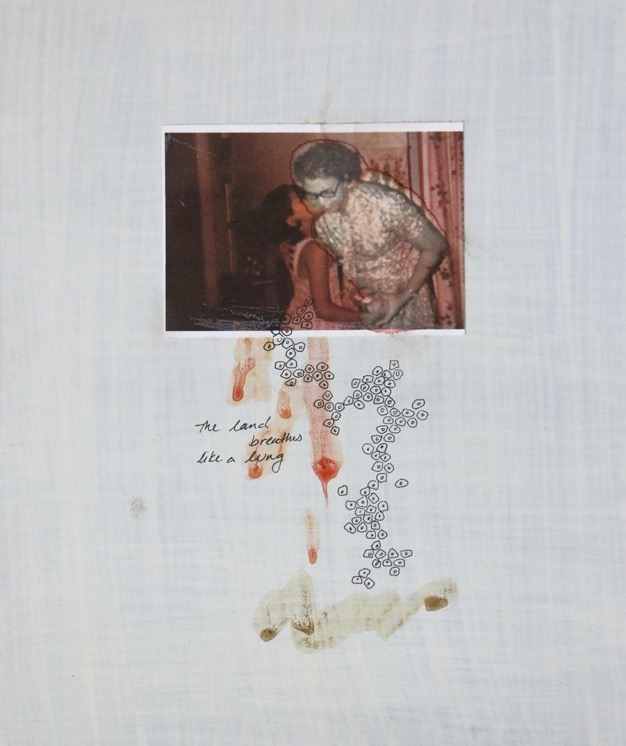
Mothering Lands engages the tensions between our place of birth (motherland) and the space of othering (otherland). For artists Keisha Scarville (United States), Erika DeFreitas (Canada), and journalist Natalie Hopkinson (Canada/United States), all first-generation daughters, their relationships with their Guyanese-born mothers serve as a metaphor for their relationship with Guyana—a space frequently wrestled with as a mythical motherland.
The importance of photography, documentation, and memory is clear, as is the pain of loss: as DeFreitas notes, “when I look at that photograph, I see my grandmother as my mother as myself.” In “Surrogate Skin: Portrait of Mother (Land),” Keisha Scarville states, “the death of my mother left me with a sense of displacement and an internal fracturing.” By photographing herself in her mother's clothes (from the series: Mama's Clothes, 2015), Scarville pays homage to her and eases “the anxiety of separation by conjuring her presence within the photographic realm.” Along with the moving photographs, Scarville brings powerful description: “beneath the weight of her clothes, I exist as beneath a veil. I breathe my mother into me and feel her presence in my body.” This first part of the book also includes engrossing letters between Natalie and her mother Serena Hopkinson.
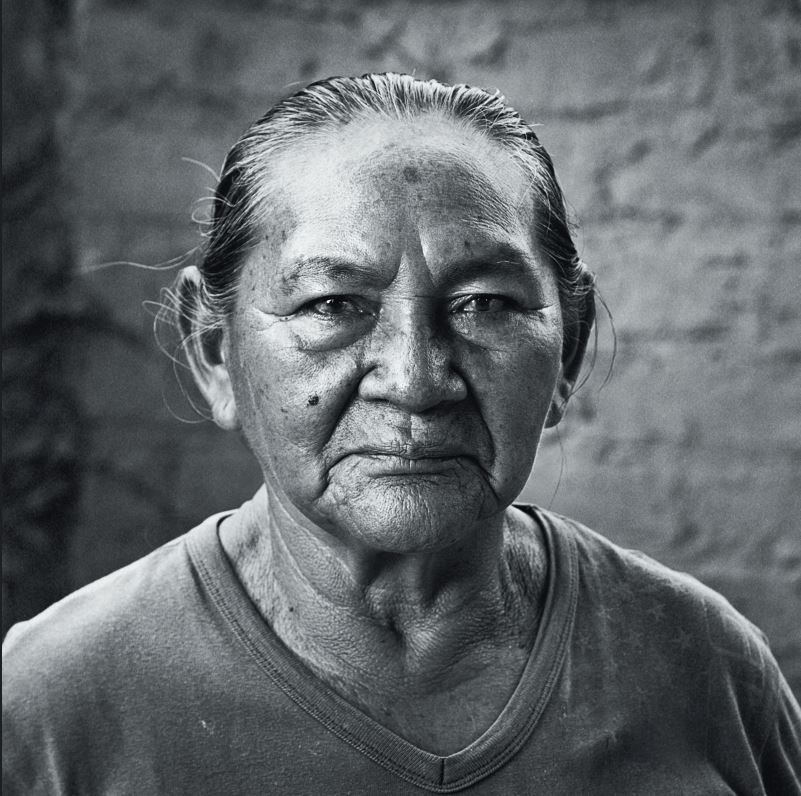
Part II deals with those leaving (including their feelings of guilt)—and especially those left behind. Ali's “The Geography of Separation” is a travelogue of four vignettes, each focused on a woman or girl encountered in distinct geographic spaces, and as Ali notes, “I find myself weaving the stories of these places and the people I’ve encountered with those of Guyana.” The generations-old karahi is special; it carries memories of Ali's grandmother, as we see in Ali's description of her mother's packing: “in her suitcase bound for America, there was no prized jewelry, no priceless antiques, no precious silk saris. There was only the karahi—the sole possession she had after her mother died. It was not going to be left behind.” Objects like the karahi connect the past with the present, homeland with new land. Dominique Hunter speaks of each of us [immigrants] as being, “a body and a tree, flexible and fixed,” shapeshifting, uprooting and transplanting, and, in this vein, provides an insightful, “guide to surviving transplantation and other traumas.” Khadija Benn provides impressive black-and-white photography of elder Amerindian women living in Guyana's remote villages; in interviewing these women, Benn shows that they are essential to Guyana's history and its migration stories. In their stories we hear the negative consequences of migration: loss of traditional cultures, languages, and communal ways of life; we also see the important role of matriarchs, as well as the pride and resilience of those who stay. Ingrid Griffith reveals the pain for those leaving: “my mother tilted her head up at us; tears filled her eyes. ‘Mammy loves you,’ she said.” We are shown the feelings of a child left behind, including Ingrid's heartbreaking letter to her parents, that was never sent.
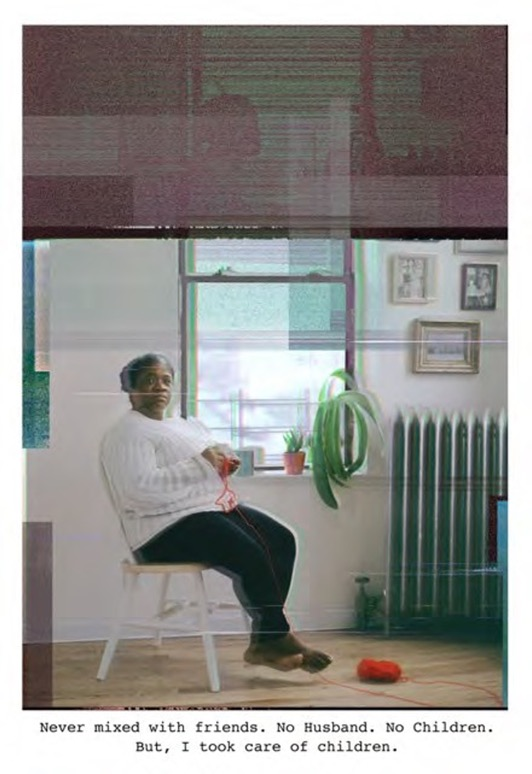
Part III focuses on the space between departure and arrival—the acts of processing life in a past land and constructing life in a new land. We see how women leaving their homeland is a matter of necessity, not desire—as expressed by poet Grace Nichols. Artist Suchitra Mattai targets colonial power and its consequences, producing artistic acts of “appropriation.” Landscapes and symbolism are also central to her work; as Ali observes, “Mattai’s landscapes, used to explore her relationship to the idea of homelands in transition, teem with texture, materiality and laborious detail.” Christie Neptune's art essay deals with memories of her mother and crocheting (popular among Guyanese women): as Ali points out, “for Neptune, the art of crocheting becomes a metaphor for the necessary acts of unfurling a life in a past land to construct a new life in a new land.” We see the heartbreaking impact of migration for Ebora Calder, an elder who, like Neptune's mother, migrated to New York in the late 1950s. Artist Sandra Brewster brings to the forefront the voices of the matriarchs in her family, with memories, telling photographs, key questions, and stories: Brewster observes, “they want us to experience what they experienced by flying us there, on the backs of their words.” Brewster records the process of migration and shows, as Ali states, “it takes the driving force of women to get to a place of not merely surviving and adapting but thriving.”
Part IV deals with returning to Guyana, reuniting with relatives, and learning deeply about their homeland—as well as keeping a strong connection to it. As Ali explains, “collectively, the essays in Returns, Reunions, and Rituals explore how daughters of immigrants like Michelle Joan Wilkinson, Maria del Pilar Kaladeen, and Maya Mackrandilal have rekindled, restored, and repaired frayed bonds. They illuminate, for those in the diaspora still estranged from Guyana, how to rediscover a place once lost.” Michelle Joan Wilkinson's curatorial essay discusses the objects bound up in migration; she explores two very personal, contrasting objects (a concrete house; and filigree jewelry), one left behind and one taken. Wilkinson also speaks of lost language and lost space. In her memoir-essay, Maria del Pilar Kaladeen focuses on the relationship between father and daughter, and unpacks the complexities surrounding cultural identity and migration: “this was a time when every institution that carried authority attempted to convince immigrant parents that a sense of cultural identity was an obstacle, rather than a lifeline and a necessity.” Maya Mackrandilal deals with loss and death in her art essay, “Keeping Wake.” Here, water is an important symbol; as Ali notes, “Mackrandilal connects generations of those who ventured into the kal pani two centuries ago with those who embark on symbolic crossings of their own twenty-first century dark waters.” This book concludes with, “A Brief History of Migration from Guyana.”
The rich variety of contributors, methods, and styles that coalesces in this book brings a powerful experience for the reader. These fifteen talented women of Guyanese ethnicity express themselves in their own unique and authentic ways, giving us a genuine look at their stories. In Liminal Spaces, we encounter visual storytelling and multimodal creativity in the photography; great depth and symbolism in the artwork; and stimulating essays and poems. In addition, there are telling official documents, expressive memoirs, as well as family letters and snatches of dialogue. This deeply personal and sensitive look at the full migratory experience of generations of women from Guyana is truly revealing. For those interested in the migration of women, Guyanese diaspora, or diaspora in general, this creative and informative book is a must-read.
Baddour, Dylan. "Massive Guyana Oil Find Continues to Grow with Fresh Exxon Discovery." Forbes, Jan 27, 2020, forbes.com/sites/dylanbaddour/2020/01/27/massive-guyana-oil-find-continues-to-grow-with-fresh-exxon-discovery/#54d2ba272781. Accessed 11 June 2020.
* Cover image: Grace Aneiza Ali, The SeaWall, Georgetown, Guyana (2014). Digital photo by Candace Ali-Lindsay. Courtesy of the artist, CC BY-NC-ND. Cover design: Anna Gatti
About the Editor
Grace Aneiza Ali is Curator and an Assistant Professor and Provost Fellow in the Department of Art & Public Policy at the Tisch School of the Arts at New York University in New York City. Ali’s curatorial research practice centers on socially engaged art practices, global contemporary art, and art of the Caribbean Diaspora, with a focus on her homeland Guyana. She serves as Curator-at-Large for the Caribbean Cultural Center African Diaspora Institute in New York. She is Founder and Curator of Guyana Modern, an online platform for contemporary arts and culture of Guyana and founder and editorial director of OF NOTE Magazine—an award-winning nonprofit arts journalism initiative reporting on the intersection of art and activism. Her awards and fellowships include NYU Provost Faculty Fellow, Andy Warhol Foundation Curatorial Fellow, and Fulbright Scholar. She has been named a World Economic Forum ‘Global Shaper.’ Ali was born in Guyana and migrated to the Unites States with her family when she was fourteen years old.
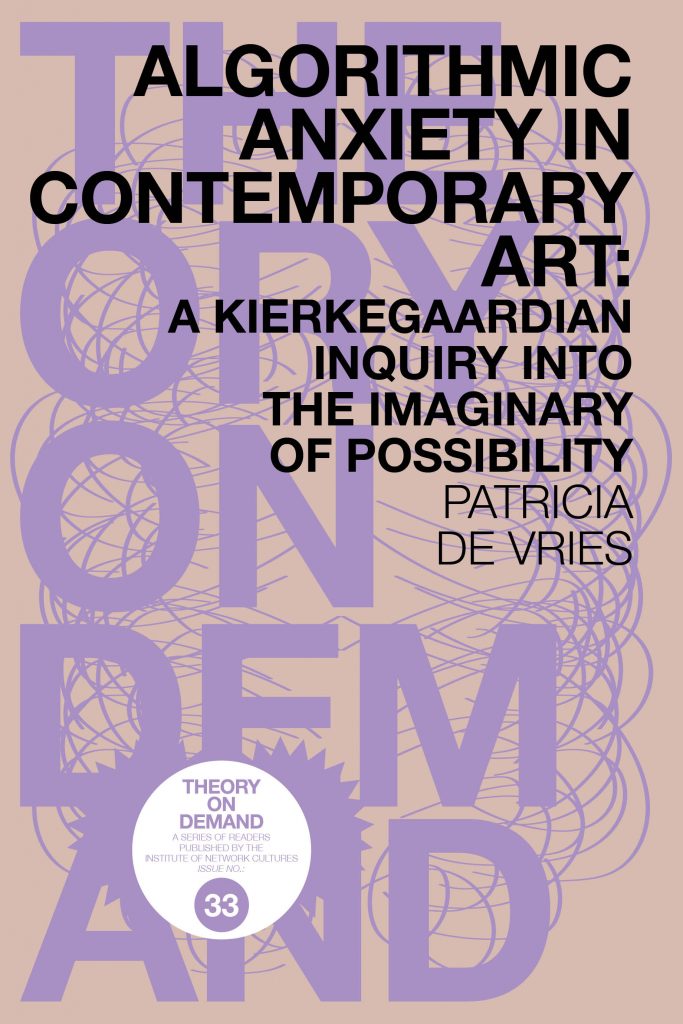
Over the past decade, a growing number of artists and critical practitioners have become engaged with algorithms. This artistic engagement has resulted in algorithmic theatre, bot art, and algorithmic media and performance art of various kinds that thematise the dissemination and deployment of algorithms in everyday life. Especially striking is the high volume of artistic engagements with facial recognition algorithms, trading algorithms and search engine algorithms over the past few years.
The fact that these three types of algorithms have garnered more responses than other types of algorithms suggests that they form a popular subject of artistic critique. This critique addresses several significant, supra-individual anxieties of our decade: socio- political uncertainty and polarisation, the global economic crisis and cycles of recession, and the centralisation and corporatisation of access to online information. However, the constituents of these anxieties — which seem to be central to our experience of algorithmic culture — are rarely interrogated. They, therefore, merit closer attention.
This book uses prominent artistic representations of facial recognition algorithms, trading algorithms, and search algorithms as the entry point into an exploration of the constituents of the anxieties braided around these algorithms. It proposes that the work of Søren Kierkegaard—one of the first theorists of anxiety—helps us to investigate and critically analyse the constituents of ‘algorithmic anxiety’.
Author: Patricia de Vries
Cover design: Katja van Stiphout Production: Sepp Eckenhaussen
Institute of Network Cultures, Amsterdam, 2020
ISBN: 978-94-92302-52-6
This publication is licensed under the Creative Commons
Attribution-NonCommercial-NoDerivatives 4.0 International.
What is online video today, fifteen years into its exponential growth? What started with amateur work of YouTube prosumers has spread to virtually all communication apps: an explosion in the culture of mobile sound and vision. Now, in the age of the smart phone, video accompanies, informs, moves, and distracts us. Are you addicted yet? Look into that tiny camera, talk, move the phone, show us around — prove to others that you exist!
Founded in 2007, Video Vortex is a lively network of artists, activists, coders, curators, critics, and researchers linked by the exchange of ideas, materials, and discussions both online and offline. Video Vortex has produced two anthologies, a website, a mailing list, 12 international conferences, several art exhibitions, and more to come as the internet and video continue to merge and miniaturize.
The first Video Vortex reader came out in 2008, followed by a second in 2011. This third anthology covers the turbulent period from Video Vortex #7 (2013) in Yogyakarta, across the meetings that followed in Zagreb, Lüneburg, Istanbul, Kochi, and finally Malta in 2019, where the foundations for this publication where laid before its production began in the midst of the corona crisis.
The contributions herein respond to a broad range of emerging and urgent topics, from bias in YouTube’s algorithms, to the use of video in messaging, image theory, the rise of deepfakes, a reconsideration of the history of video art, a reflection on the continuing role and influence of music video, indy servers, synthetic intimacies, love and sadness, artist videos, online video theory in the age of platform capitalism, video as online activism, and the rise of streaming. Click, browse, swipe, like, share, save, and enjoy!
Contributors: Annie Abrahams, Ina Blom, Natalie Bookchin, Pablo deSoto, Ben Grosser, Adnan Hadzi, Judit Kis, Patricia G. Lange, Hang Li, Patrick Lichty, Geert Lovink, Gabriel Menotti, Sabine Niederer, Dan Oki, Aras Ozgun, Daniel Pinheiro, Rahee Punyashloka, Oliver Lerone Schultz, Alberto Figurt, Ana Peraica, Peter Snowdon, Andreas Treske, Colette Tron, Florian Schneider, Jack Wilson, Dino Ge Zhang.
We hope to be able to offer a (free) printed edition soon!
Sounding Out! stands with the RaceB4Race Executive Board and their recent public statement published via the Arizona Center for Medieval and Renaissance Studies at Arizona State University regarding racism and the institutional structures of peer review in academia. Here is an excerpt of their clarion call for deep, systemic change but please read their entire statement here.
All academic journals and presses need to think about what structures are limiting access and hindering the full participation of scholars of color. After all, how academic journals structure their practices reflects their values. Here are a few outdated structures and systems that deserve to be interrogated:
Editorial boards: How diverse is the journal/press’s editorial board? How inclusive is the journal/press’s editorial structure? How are board members selected? Are the qualifications for serving on the board made public? Can people apply to serve on the board? Can people be nominated to serve on the board? Are board members used equally (i.e., do they all review the same amount of submissions)? Who determines when they are used, and what is the criteria for that decision? In other words, how can the journal/press ward against tokenistic practices?
Double-blind review: Who or what is the journal/press protecting in the process of review? Why are the reviewers’ identities concealed? Who does this benefit? Why? What might be gained if reviewers had to reveal their identities? Can reviewers see each other’s reviews? Are reviewers notified of the final outcome of the review? In other words, how can the journal/press create a more ethical and informed review process?
Evaluative criteria: How does the journal/press articulate for its reviewers the qualities of “strong” scholarship for emerging fields? What assumptions underlie the definitions in that respect? And what politics inform those assumptions? In other words, how can the journal/press actively promote paradigm shifts?
We know that an overwhelming majority enthusiastically supports the development of premodern critical race studies. We know first-hand that our colleagues want to engage with more resources, more insights, and more cutting-edge scholarship from our field in their own research and teaching. But the current editorial practices of most academic journals hinder the production of the intellectual resources that are needed now more than ever: the publishing gatekeeping is hurting us all. —“It’s Time to End the Publishing Gatekeeping!,” Letter from RaceB4Race Executive Board, 2020.
This is precisely the atmosphere Sounding Out! formed within and against–for a PDF of our “origin story” click SO! Eds. The Pleasure (is) Principle–and over the last decade we have shown that different way is not only possible, but it is powerful. Join RaceB4Race to end academic gatekeeping practices that “disproportionately affect fields like critical race studies and BIPOC scholars.”
307 SpringerOpen titles for which we have data on journals that were fully open at some point from 2010 to the present were studied, with a primary focus on pricing and status changes from 2019 – 2020 and a secondary focus on longitudinal status changes. Of the 307 titles, 226 are active, fully open access and are still published by SpringerOpen, 40 have ceased publication, 19 were transferred to another publisher, and 18 formerly open access journals are now hybrid. 6 of these journals transitioned from free to hybrid in the past year. An additional 2 journals were not found. An additional 2 journals were not found. Of the 226 active journals published by SpringerOpen, 51% charge APCs. The average APC is 1,233 EUR, an increase of 3% over the 2019 average. 46.5% of the 101 journals for which we have 2019 and 2020 data did not change in price; 13.9% decreased in price; and 39.6% increased in price. The extent of change in price was substantial, ranging from a 50% price drop to a 94% price increase.
Photographs (banner and image above) courtesy of Eric Hart Jr., all rights reserved. Click here to visit Love Hart.
I find it difficult to look at these photographs without flinching from the memories and from the anger they invoke. But I must look. I must remember, as you must. For this was history in the making. Like it or not, you cannot hide from the camera’s eye. - Myrlie Evers-Williams
As I reflect on photography and protest, I see it as my life in America from a lived experience to an act of memory. I am troubled by the images I’ve seen this week, and I have been asked—by various people—what these images mean to me. Black death has been photographed, broadcasted, painted, recorded, tweeted, and exhibited for the past 90 days. It has been one week since a teenager posted footage of George Floyd’s murder. It has been one week of collectively watching George Floyd’s last moments of life, seeing a man struggling and crying while a white police officer digs his knee deeper into Floyd’s neck, the officer’s left hand slipped casually into his pocket. I watched in horror as the other police officer stood guard protecting his fellow officer while the person behind the camera screamed and pleaded with the officers to stop. I heard others begging for his life as George Floyd pleaded “I can’t breathe” over and over again.
The video went viral! Each time I watched the news my heart cried — it is recorded thanks to cell phone imaging and surveillance cameras; and, because of the camera we see history repeating itself. Just this past March Breonna Taylor was killed in Kentucky; in February Ahmaud Arbery’s death was recorded in Georgia and not until weeks later did the national news media report his tragic death. Covid 19 killed 100,000 Americans and their names appeared on the local news and some of their portraits were published in the newspapers. Activists, community members, students, first responders, essential workers, government and city officials, family members and others have used the images to make change happen because of a history of injustices.
I started thinking about Black death well before the global pandemic and global lockdowns and measures of combating and coping that have become our everyday reality. I will never forget the photograph of the brutally beaten and swollen body of the young Emmett Till published in Jet magazine in 1955. Many young people experienced episodes of hostile confrontation with the police that intensified over the years because of social protests. Blacks were being killed, hosed, jailed, and subjected to unjust laws throughout the American landscape. Photographers witnessing both brutal and social assaults created a new visual consciousness for the American public, establishing a visual language of ‘testifying’ about their individual and collective experience. On April 27, 1962, there was a shootout between the Los Angeles police and members of the Nation of Islam; Ronald Stokes, a member of the Nation of Islam, was killed. Fourteen Muslims were arrested; one was charged with assault with intent to kill and the others with assault and interference with police officers. A year later, Malcolm X investigated the incident and the trial. Noted photographer Gordon Parks remembered his photograph of Malcolm X holding the brutally beaten NOI member in this way:
I recall the night Malcolm spoke after this brother Stokes was killed in Los Angeles, and he was holding up a huge photo showing the autopsy with a bullet hole at [the] back of the head. He was angry then; he was dead angry. It was a huge rally. But he was never out of control. The press tried to project his militancy as wild, unthoughtful, and out of control. But Malcolm was always controlled, always thinking what to do in political arenas.
I share this history as I am always mindful of the past because of visual culture. I value, even though distressed by this history and even more so because the Gordon Parks High School was destroyed by fire in St. Paul this week. History!!
James Baldwin said, "One's past, one's history is not the same thing as value. It's learning how to use it." The last few months have confounded me for a variety of reasons but perhaps most because Baldwin was meticulous as a writer, and did not spare words, thus his use of the verbs "learn" and "use" in the above are clear iterations of this, of functionality. Learn to use art (image). And make history right. In 1989, Toni Morrison wrote in Beloved “. . . And O my people, out yonder, hear me they do not love your neck unnoosed and straight. So love your neck; put a hand on it, grace it, stroke it and hold it up.”
Collectively we must continue to remember that photography and images can be both empowering and ominous; and they can help us make changes to the laws as we struggle to find words for this painful moment. I am encouraged by our students’ activism as they photograph this charged moment and at the same time make photographs of the causes of inequities. I urge everyone to use this incredible energy to vote; to document injustices and be encouraged by the voices of the people around this country telling this story globally and depicting the faces of Breonna Taylor, Ahmaud Arbery and George Floyd on their face masks, t-shirts, signs and murals to ensure that this will be the last time.
Deborah Willis is Chair of Photography & Imaging, Tisch New York University. Her research examines photography’s multifaceted histories, visual culture, the photographic history of Slavery and Emancipation, contemporary women photographers and beauty. She received the John D. and Catherine T. MacArthur Fellowship and was a Richard D. Cohen Fellow in African and African American Art, Hutchins Center, Harvard University and a John Simon Guggenheim Fellow. Professor Willis received the NAACP Image Award in 2014 for her co-authored book Envisioning Emancipation. Other notable projects include Reflections in Black: A History of Black Photographers – 1840 to the Present, Posing Beauty: African American Images from the 1890s to the Present, Michelle Obama: The First Lady in Photographs, an NAACP Image Award Literature Winner. Deborah Willis is co-editor ofWomen and Migration: Responses in Art and History, an Open Access title published by Open Book Publishers which is available to read and download for free here.
Open access commercial publishing pioneer BMC is now wholly owned by a private company with a portfolio including lines of business that derive revenue from journal subscriptions, book sales, and textbook sales and rentals
Two former BMC fully OA journals, listed in DOAJ from 2014 – 2018 as having CC-BY licenses, are now hybrid and listed on the Springer website and have disappeared from the BMC website
67% of BMC journals with APCs in 2019 and 2020 increased in price and 11% decreased in price.
Journals with price increases had a higher average APC in 2019, i.e. more expensive journals appear to be more likely to increase in price
Abstract
Founded in 2000, BioMedCentral (BMC) was one of the first commercial (OA) publishers and a pioneer of the article processing charges (APC) business model. BMC was acquired by Springer in 2008. In 2015, Springer was acquired by the Holtzbrinck Publishing Group in 2015 and became part of SpringerNature. In other words, BMC began as an OA publisher and is now one of the imprints or business lines of a company whose other lines of business include sales of journal subscriptions and scholarly books and textbook sales and rentals. Of the 328 journals actively published by BMC in 2020, 91% charge APCs. The average APC was 2,271 USD, an increase of 3% over 2019. An overall small increase in average APC masks substantial changes at the individual journal level. As first noted by Wheatley (2016), BMC price changes from one year to the next are a mix of increases, decreases, and retention of the same price. In 2020, 67% of the 287 journals for which we have pricing in USD for both 2019 and 2020 increased in price; 11% decreased in price, and 22% did not change price. It appears that it is the more expensive journals that are more likely to increase in price. The average 2019 price of the journals that increased in 2020 was 2,307 USD, 18% higher than the 2019 average of 1,948 USD for journals that decreased in price. 173 journals increased in price by 4% or more, well above the inflation rate. 39 journals increased in price by 10% or more; 13 journals increased in price by 20% or more. Also in 2020, there are 11 new journals, 11 journals ceased publication, 5 titles were transferred to other publishers, 2 journals changed from no publication fee to having an APC, and 3 journals dropped their APCs. Two journals formerly published fully OA by BMC are no longer listed on the BMC website, but are now listed as hybrid on the Springer website. This is a small portion of the total but is worth noting as the opposite direction of the transformative (from subscriptions to OA) officially embraced by SpringerNature.
While we’re publishing a lot, here at the Institute of Network Cultures, trying to facilitate critical reflection on the corona crisis with diaries and essays from around the world, we’re also planning a restart of INC so that we’ll have space and resources for new urgent projects and research networks in this corona period/economic crisis.
As you may have noticed, we’ve just wrapped up our two-year publishing Making Public research project with Here and Now?
Digital publishing research (and output) will continue, as will the MoneyLab network that just got a board. The board can be rearched here: moneylab-board@networkcultures.org. As MoneyLab #8 Ljubjana was cancelled because of the corona crisis it turned into a weekly online lecture series. The program you can find here.
However, with a considerable legacy of projects, networks, publications and a heavy website aka archive, we noticed that we had to spend more and more time just on the maintenance work. It became harder to start new things (also due to changes in the Dutch funding structures). Finally, we’re about to do something about this.
As a start, five mailinglists (MoneyLab, Video Vortex, re-search, Unlike Us and CPOV) have been discontinued and have been replaced by one INC list called synthesis (also responding to the widespread idea of email being a ‘dead medium’).
1. To inform the wider net community about INC projects and activities.
2. To foster debates about net criticism, tactical media, hacktivism and research into critical network cultures from multiple perspectives such as design and the arts, activism and research.
3. To create links between different INC research fields that were previous running as different projects about online video, crypto currencies, search, social media, future of art criticism etc.
The name ‘synthesis’ expresses a desire to overcome different disciplines, fields and scenes in order to strengthen the critical forces in arts, tech and society.
Soon we will see what other new channels will work to debate, maintain communities, inform and support each other. Please approach us if you have ideas and suggestions, also for common projects, grants, publications, campaigns and other forms of poetry.