
“Recorder of Dublin”: Ulysses’ FX in 1982

For many, the audiobook is a source of pleasure and distraction, a way to get through the To Read Pile while washing dishes or commuting. Audiobooks have a stealthy way of rendering invisible the labor of creating this aural experience: the writer, the narrator, the producer, the technology…here at Sounding Out! we want to render that labor visible and, moreover, think of the sound as a focus of analysis in itself.

Over the next few weeks, we will host several authors who will make all of us think differently about the audiobook selections on our phone, in our car, and in our radios. Today we start things off with a close listen of the 1982 audiobook edition of James Joyce’s Ulysses. Watch out for the hoooooooooooooonk of the SO! train pulling into the station!

—Managing Editor Liana Silva


To think about James Joyce’s Ulysses is to think about the first instant when it truly seized your ears. Accordingly, my Ulysses begins in its final episode, “Penelope”: Molly Bloom is lying down or sitting up next to a passed-out Leopold Bloom when she hears the “frseeeeeeeefronnnng train somewhere whistling.” Her train does not go chug, choo, or chuff, but it rhymes with her “Loves old sweeeetsonnnng” (1669) with an infectious insouciance for the codes of language. Let us call this the Ulysses of 1922 (though the definitive edition of James Joyce’s book whose page numbers are cited here was produced in 1984 by Hans Walter Gabler).

The Ulysses of 1922 is what Jacques Derrida called gramophonic. It plays back to us something recorded without filtering out the noise and is to be heard more than it is to be read. We listen to the book, but we are second-in-line. The first listener is the book itself, which listens to Dublin and records everything with an odd sonic democracy, discriminating little amid its recording of all sounds vivid or vapid, giving equal importance to cats, carts, bells, machines, laughter, coughs, and language. The book saunters about the city, listening and recording, and we listen to the book like we would to a scratchy, static-filled recording of a concert the morning-after. It is a reminder of something Michel Serres once said in The Five Senses: “Meaning trails this long comet tail behind it. A certain kind of æsthetics… take as their object this brilliant trail” (120). Ulysses’ elusive modern city glows in this comet tail of noise and background static more than it pivots around conventionally meaningful language content. Eventually, industrial and technological modernity catches up with artistic modernism and in 1924, Joyce reads and records parts of the “Aeolus” episode of Ulysses, and later in 1929 he records a section of Finnegans Wake. Many years after, in 1982 – the centenary year of Joyce’s birth – Ulysses comes home to Dublin and is recorded in full by Irish national radio.
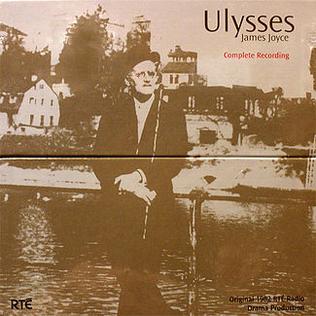
Ulysses 1982 broadcast CD cover, under fair use

The 1982 Ulysses Broadcast was an uninterrupted twenty-nine-and-a-half-hour reading of the entire unabridged text on Ireland’s RTÉ Radio on 16th June – Bloomsday – produced by Micheál Ó hAodha. Among this and the two film versions, one from 1967 and the other from 2003, and other recordings such as the ones by LibriVox volunteers and a more recent one by BBC Radio 4, the 1982 Ulysses Broadcast was the first complete recording of the text. Director William Styles called upon voice actors from the Radio Éireann Players to dramatize and act Ulysses out.

My Ulysses of 1982 seizes me differently from the book. From the first seconds of the 1982 Broadcast, I reacted to Buck Mulligan stepping down the stairs inside the Martello Tower with surprise, because the reading is somewhat copiously accompanied; the sounds of loud waves outside of the walls of the seaside tower were part of the soundscape I was thrown into:

Immersion was of the essence. Not that the Ulysses of 1922 is by any means a silent text, but this accompaniment was a simultaneous roar. Sounds in the written text take up space, and as these sounds are being “played” in the book, there is a length of text where nothing else is happening. Think, for instance, of the machinery in the “Aeolus” episode: “Almost human the way it sllt to call attention” (251). As the “sllt” is recorded by the book, it is not over or behind any other sound or voice. It takes up its own space, unlike in the Broadcast

The layering of Buck Mulligan’s voice over the sounds of the sea becomes possible in the move from the spatial-visual of the page to the temporal-aural of a recording. However, listening to the Broadcast prompts me to ask: Is the sonic democracy of recording the soundscape still there?

Most critical work on the audiobook focuses on readerly reception and pleasure, almost indicating that we can hear the Ulysses of 1922 but we must read the Broadcast of 1982; the book provides for more direct sensory engagement while with the Broadcast, we must focus on analyzing the mechanics of our reception. We also get terms like Reinhart Meyer-Kalkus’ “hear-reading” (179) or Matthew Rubery’s “ear contact” (72) which are concerned with the link between the playback of the recorded text and the reading ear. We hear-read when we listen to the voice in our heads recite aloud to us what we are reading, and we establish ear contact, much like eye contact, when we find our ears bound to voices instead of people. Both these concepts are concerned with reception. If we steer clear of our listening of the Broadcast and turn the focus to the Broadcast’s listening of Ulysses, what we find is a rich sonic world, but it is one which takes us away from the linguistic play of the text.

For instance, the book gives cues for the ambient sounds of Dublin clamor surrounding any voice which might be speaking at that moment. “Stream of life” (327) signals in the Broadcast the coming alive of the city soundscape. What is described as a “sudden screech of laughter” (255) in the book is layered upon loud laughter in the Broadcast, as is “a loud cough” (281) upon a loud cough, and a telephone which “whirred” (283) upon the sound of an actual ringing telephone. Later, in the “Circe” episode, a mention of whistling (1169) is also whistled out.

Trams, the clatter of plates and glasses, desks being rapped, coins and bells ringing and jingling, cannon-firing, all these sounds are played as accompaniments again and again as their descriptions are being voiced in the Broadcast. Like in bedtime storytelling, says Brigette Ouvry-Vial, sound effects as uncomplicated accompaniments are never in conflict with the voiced text. Think of pictures and illustrations alongside words in children’s literature (185). The background sound effects of the broadcast add nothing to the sonic democracy of the book even if they do not detract from it.

The Ulysses of 1922 is also rife with non-lexical, unpronounceable sounds, like the one’s Bloom’s cat makes. The many different cat sounds, for example “Mkgnao!” and “Mrkgnao!” and “Mrkrgnao!” (107-8), are not voiced at all in the broadcast, and are instead replaced by the mimicked sounds of a cat meowing, almost exactly the same each time:

“Miaow!” (133) and “Prr” (107), which are Bloom’s responses to his cat, are voiced by him. When the “door of Ruttledge’s office whispered: ee: cree” (243), there is no voicing – only the sound of a creaking door. Yet, when we are in Bloom’s thoughts, like when he remembers a glorious gust of wind which blew up Molly’s skirt, he voices the gust of wind in the Broadcast going “Brrfoo!” (329), pronouncing the non-lexical word with a close-approximation. Would not the non-lexical sounds in his head suggest that he is thinking in sound rather than in language, much like many of us who can hear sounds in our heads? Often but not always, environmental sounds are retained as actual sounds while the sounds in Bloom’s head are sublimated into pronounceable, phonetic language. But mostly there is an insistence on adding sound effects wherever possible.
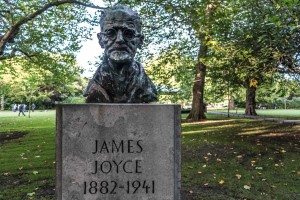
“JAMES JOYCE [ST. STEPHEN’S GREEN] REF-1085622” by Flickr user William Murphy, CC BY-SA 2.0

Whether the book describes the sound or sounds it with a non-lexical string of words, the Broadcast attaches its effects. If we look at the book as a recorder, its movements are staggeringly complex as it moves in and out of multiple spaces. When it is in Bloom’s head, the environment is muted, and when it is inside a carriage, unless it is poked out an open window, it does not record the street. Ssave for a few instances, the Broadcast’s insistence on effects attests to its rich production, but not to its vitality. It therefore stands as an accompaniment to the book, not as a text in its own right given its compositional inconsistencies. So, the several variations on Bloom’s flatulence with “Rrrrrr” (625), “Fff. Oo. Rrpr,” and “Pprrpffrrppfff” are all erased and instead fart sounds are recorded.

On the same page, when Bloom tries to mask his own sounds of bodily release under the din of the passing tram, the “Krandlkrakran” (629) is both voiced by Bloom and recorded as the sound of a noisily ringing tram in the background. But only an actual train whistles in “Penelope,” with no voice in the Broadcast attempting to say “frseeeeeeeefronnnng” (1669).

For Charles Bernstein, the sound of a work of literature, much like the shape of poetry on the page, might be an element which is “extralexical but… not extrasemantic” (5). It is different from the written word but it is not a meaningless ornament. For the Broadcast, however, it might as well be the case that sound is made irrelevant to meaning. Or, we can argue that the meaning being made is in the realm of performance studies and not literature. The pure temporality of the Broadcast helps. We can stop reading the book to look, but we cannot stop the Broadcast and still listen. Moreover, when the Broadcast records, it is listening to the book’s listening of Dublin, removed by another degree from the soundscape of Dublin.

The Broadcast is not however without value. Bernstein echoes Serres when he aggrandizes the “sheer noise of language” (22) which must take precedence over the impulse to decode everything. The Broadcast answers this need to not immediately rationalize and sublimate in analysis everything that is heard, but to rather hear without listening. Cue the poet Robert Carleton Brown who once said that writing since the very beginning has been “bottled up” inside of books (23). And in 1982, the stopper on Joyce’s spuming prose was popped.

Featured Image: “telemachus: the tower, 8 a.m., theology, white/gold, heir, narrative (young)” by Flickr user brad lindert, CC-BY-2.0

Shantam Goyal studies English Literature at the State University of New York at Buffalo for his PhD. He completed his M.Phil in 2018 from the University of Delhi with a dissertation titled “Listen Ulysses: Joyce and Sound.” He hopes to continue this thread for his doctoral research on Finnegans Wake and mishearing. Besides Joyce Studies and Sound Studies, he works on Poetics and Jazz Studies, and is also attempting to translate parts of Ulysses into Hindi as a personal project. His reviews, articles, and creative work have appeared in The Print, The Hindu Business Line, Vayavya, ColdNoon, Daath Voyage, and Café Dissensus among other publications. He prefers that any appellations for him such as academic, poet, or person be prefaced with “Delhi-based.”

tape reelREWIND! . . .If you liked this post, you may also dig:

This Is How You Listen: Reading Critically Junot Diaz’s Audiobook-Liana Silva

“‘HOW YOU SOUND??’: The Poet’s Voice, Aura, and the Challenge of Listening to Poetry”-John Hyland

“This Is Not A Sound”: The Treachery Of Sound in Comic Books-Osvaldo Oyola

Enseigner les objets complexes en interdisciplinarité. Approches novatrices

Sous la direction de Sivane Hirsch et Audrey Groleau, Université du Québec à Trois-Rivières

Pour accéder au livre en version html, cliquez ici.
Pour télécharger le PDF sur Zenodo : à venir
Pour commander le livre en version imprimée, cliquez sur le bouton Paypal ci-dessous.

Acheter un livre, c’est nous soutenir et permettre à ceux et celles qui ne peuvent l’acheter de le lire en libre accès.

Comment enseigner les objets complexes en classe? Utiliser l’interdisciplinarité permettrait de les aborder de façon globale et approfondie en faisant dialoguer une pluralité de points de vue et d’expertises à leur sujet. Mais comment faire? Quelle approche pédagogique choisir pour réaliser l’interdisciplinarité en classe? Cet ouvrage collectif, né d’un cours de didactique à l’Université du Québec à Trois-Rivières, présente plusieurs approches novatrices, du préscolaire à l’université et dans diverses disciplines. Les chapitres décrivent les défis à la fois pratiques et épistémologiques associés à chaque approche, dans l’espoir d’encourager les enseignants et les enseignantes à les adopter avec enthousiasme.

ISBN version imprimée : 978-2-924661-35-2
ISBN ePub : 978-2-924661-36-9
DOI :
139 pages
Couverture réalisée par Kate McDonnell, illustration de etiamos@123rf
Date de publication : décembre 2019

Table des matières

Les autrices et auteurs

Remerciements

Introduction

הקדמה

1. Enseigner la consommation responsable en milieu scolaire… et pourquoi pas?

2. Les légendes, l’apprentissage d’une langue étrangère et l’interdisciplinarité

3. Favoriser l’interdisciplinarité et l’abord d’objets complexes en classe par une approche subjective de la spectature

4. L’approche par problème, une porte ouverte à l’interdisciplinarité

5. L’approche culturelle de l’enseignement : une passerelle entre culture et interdisciplinarité

6. La littérature jeunesse, porte d’entrée de l’interdisciplinarité

7. Conceptualiser un objet scolaire interdisciplinaire grâce à la controverse constructive

8. Entre image et interdisciplinarité : l’analyse iconographique comme approche pédagogique interdisciplinaire

9. Les protocoles de verbalisation interdisciplinaires en traduction

10. La dissection interdisciplinaire

11. Enseigner l’histoire de l’Holocauste

12. L’approche par compétences en classe d’histoire et l’enseignement de l’intégration nationale au Cameroun : une approche novatrice

13. Quand l’interdisciplinarité s’invite dans l’enseignement non formel

14. Guide de soutien aux enseignantes et enseignants de l’éducation préscolaire

À propos de la maison d’édition

Version papier ou ePub


SO! Amplifies: Marginalized Sound—Radio for All

SO! Amplifies. . .a highly-curated, rolling mini-post series by which we editors hip you to cultural makers and organizations doing work we really really dig.  You’re welcome!

Marginalized Sound is an online radio station that will launch in late 2020. The mission of the station is to provide a 24/7 platform for underrepresented sound artists to broadcast their work. Marginalized Sound will host music hours with varying genres, poetry readings, live event broadcasts, and special programs such as “Mental Health and the Artistic Process” (see audio sample below).

The station plans to interview coding musicians, poets, singer/songwriters, and composers from across the globe, as well as commission new works with pending grants. Sound art here is defined quite broadly and the station is very excited to uncover what this means to different people. For now, the breadth of work to be played includes sound plays from the 60s as well as contemporary, Congolese rap (see sample below).

Marginalized Sound will indulge a space outside of whiteness. By using the internet to broadcast to the globe, the station endeavors to reclaim space for underrepresented folk. J Diaz, founder, states, “What I’ve never understood is that diversity is a choice and as a society we continue to choose whiteness.” It is because of this that Marginalized Sound will unapologetically and enthusiastically support underrepresented people only (interested collaborators please click here for the form).

In the coming years, J Diaz hopes to turn this into a full-time job instead of just a hobby. He sees potential for the station to provide paid internships in audio and marketing, collaborations with local and international organizations or festivals, and collaborations with university courses.

The online station is raising funds to pay for initial filing fees to become a non-profit business. Please donate here: https://www.gofundme.com/f/ean89c-becoming-a-nonprofit. Other ways to help are to like the facebook page (www.facebook.com/marginalizedsound) and share it with three friends.

Featured image: logo for Marginalized Sounds 

J Diaz is a Sound Artist currently based in Philadelphia, PA. He designs sound for a variety of mediums—including theatre, dance, and the concert stage. Over the past few years, J has collaborated on numerous projects with theatre and dance companies located across the continental United States and has even worked internationally. J holds a Bachelor of Musical Arts in piano from DePauw University (’13). He studied piano with Dr Phang and composition with Veronica Pejril and Dr Perkins. He holds an MFA in electroacoustic composition from the Vermont College of Fine Arts (’17) where he studied with Dr Mallia, Dr Early, and Dr Holland. In fall of 2018, J completed an MA in composition with distinction at The University of Sheffield under the supervision of Dr Ker.

REWIND!…If you liked this post, you may also dig:tape reel

SO! Amplifies: Feminatronic

SO! Amplifies: Die Jim Crow Record Label

Deep Listening as Philogynoir: Playlists, Black Girl Idiom, and Love–Shakira Holt

My body, my traitor: essay in 10TAL

Last year Swedish magazine 10TAL published an essay of mine about data mining, the body, and self-knowledge. Now, the English translation has been published too! Read the opening below or click through to the whole text: My body, my traitor


We’ve come a long way, baby. From »On the internet nobody knows you’re a dog«, to »On the internet everybody knows I’m a top dog«, to »On the internet we’re all Pavlov’s dogs«. Or: from the homepage, to the social media identity, to the algorithmic profile. From the nerd, to the networked self, to the passive data goldmine (via the influencer).

This evolution can be read as a story of increasing corporality, as counterintuitive as that may seem. Usually, the story is told as if the world and its inhabitants are on their way to shedding all bodily weight, with the end-point on the horizon being a purely computerized humankind, all Mind and no Matter. But the inextricable entanglement of »online« and »offline«, »virtual« and »real«, primarily means that technology is all the time effecting the body (and thus, via the body, the soul). Like Pavlov’s dog, the post-digital condition is no »cloud« in which everything evaporates (and, as we know, what is called the cloud is a very material infrastructure that is using up as much energy as a small country, relying on cables that land on contested shores, demanding ever more precious metals to be mined from unstable regions). Rather, our bodies and the data that can be mined from them, function as the pathways to understanding, predicting and thus controlling or manipulating the world, which in the same gesture means understanding, predicting and thus controlling or manipulating the body, the very body that was mined in the first place.

In a catch-22 situation, you’re always made an accomplice to your own submission.

Continue reading over at 10TAL: My body, my traitor

Column – Take root among the stars: If Octavia Butler wrote design fiction

Authors: Gabriele Ferri, Inte Gloerich

“The Butler Timeline (BT) is a parallel universe where renowned speculative fiction author Octavia E. Butler engaged in a critical dialogue with researchers in human-computer interaction, shaping the genre of design fiction differently from how it unfolded in our timeline. Here we present a meta-speculation, imagining what could have been different if Butler, a prominent African American writer and intellectual, played a key role in establishing speculative design research. We do not want to create a temporal paradox but, if we had a transdimensional portal, we could simply observe how speculative research came to be in the BT. Hopefully, this could suggest another way of doing design fiction in our own reality, with a different ideology and purpose. That is why we volunteer for this interdimensional travel.”

Read the whole column here.

Interactions XXVII.1 (January – February 2020)

Open peer review discussion

Thank you to Heather Staines from MIT’s Knowledge Futures Group for initiating this discussion in response to an invitation to participate in an open peer review process of the OA Main 2019 dataset and its documentation on the SCHOLCOMM list (the invitation was also sent to GOAL and the Radical Open Access List) and for permission to post her e-mails on Sustaining the Knowledge Commons.


Original e-mail (Heather Morrison to SCHOLCOMM, Jan. 7, 2020):

greetings,

** January 15 suggested deadline **

This is a reminder that open peer review is being sought for the Sustaining the Knowledge Common’s project OA main 2019 dataset and its documentation. For those who may not have time for a thorough peer review, a set of 6 questions is provided and responses to any of the questions would be welcome. This is an opportunity to participate in an experimental approach to two innovations in scholarly communication: a particular approach to open peer review, and peer review of a dataset and its documentation. The latter is considered important to encourage and reward researchers for data sharing.

Although full open peer review is the default, if anyone would like to remain anonymous this should be reasonably easy to accommodate by having a friend or colleague forward your comments with an indication of their anonymity.

January 15 is the deadline but if anyone interested would like to participate and needs more time, just let me know. Thank you to those who have already provided comments.

Details and materials can be found here:

https://sustainingknowledgecommons.org/2019/11/20/oa-main-2019-dataset-documentation-and-open-peer-review-invitation/

best,

Dr. Heather Morrison
Associate Professor, School of Information Studies, University of Ottawa
Professeur Agrégé, École des Sciences de l’Information, Université d’Ottawa
Principal Investigator, Sustaining the Knowledge Commons, a SSHRC Insight Project
sustainingknowledgecommons.org
Heather.Morrison at uottawa.ca
https://uniweb.uottawa.ca/?lang=en#/members/706
[On research sabbatical July 1, 2019 – June 30, 2020]


Heather Staines, first response, Jan. 8, 2020:

Hi Heather:

I took a look at your open peer review survey. Very interesting!

I did a blog post during peer review week on collaborative community review. I thought you might find it interesting: https://thecommons.pubpub.org/pub/ek9zpak0/branch/1?access=fsivw788

[image omitted]

Collaborative Community Review on PubPub · The Knowledge Futures Commonplace
thecommons.pubpub.org

I interviewed the authors of three MIT Press books (coming 2020) who used open peer review on our open source platform, PubPub. If this would ever be helpful for you in pursuing future surveys or experiences, please do let me know.

Thanks,

Heather [Staines]
MIT Knowledge Futures Group


Heather Morrison response, Jan. 8, 2020:

Thank you, your blog post is very interesting.

I see tremendous potential for online collaborative writing and annotations. For example, last year I had students write crowdsourced online essays in class; students were asked to find one interesting recent article on privacy, prepare notes, and write a collaborative “current issues in privacy” in class. I have participated in online annotation peer review in the past.

However, I have some concerns about the annotation and collaborative writing approaches to peer review. My reasons, in case this is of interest:

An annotation approach, in my experience, invites and encourages wordsmithing and focus on minor issues and makes it difficult to contribute at a deeper level (e.g. issues of substance, critique of fundamental underlying ideas).

Depending on the project, individual, and group, the optimal approach might be collaborative writing or individual voice. In the area of open access and scholarly communication, I have a unique perspective and consider this my most important contribution. This gets lost in collaborative writing. For this reason, I write as an individual (or co-author as supervisor with students) in this area.

Although in the past I have participated in the online annotation approach to open peer review, I have been disappointed because my comments (well-thought-out comments by an expert in the field) have been ignored, not only dismissed but not even acknowledged in the final version. This is a waste of my time, and I argue that it is not appropriate to present a final version under such circumstances as having passed a peer review process. Also, in recent years I have noticed a tendency to require reviewers to agree to open licensing conditions that I have object to; this for me is sufficient reason not to participate. [A brief explanation of several key lines of argument on this topic can be found here].

One of my reasons and incentives for open peer review is to claim credit for this work; for example, this published peer review is an example of what I would like to gain from open peer review:
[Morrison, H. (2019). Peer review of Pubfair framework. Sustaining the Knowledge Commons. Retrieved from https://sustainingknowledgecommons.org/2019/09/24/peer-review-of-pubfair-framework/]

This is not for everyone, and I would not want to do this with every review, but occasional publication of such reviews opens up possibilities for study of the peer review process and allows me to appropriately claim my careful work in this area.

In the process of transforming scholarly communication I see fundamental questions about why we approach things the way we do, and how we might do things better, that I would like to see opened up for discussion. My blogpost / open invitation approach is deliberate; I consider development of platforms / checklist approaches as premature. This is developing technical solutions when, to me, we should be figuring out what the problems are.

This discussion should be part of the open peer review process. I am thinking of posting this response to my blog. May I post your e-mail as well?

best,

Dr. Heather Morrison
[signature]


Heather Staines, second response, Jan. 8, 2020:

Hi again:

Thank you for the quick and thoughtful response. Given some of your perspectives, you may also be interested in this companion piece, also from Peer Review Week, Making Peer Review More Transparent https://thecommons.pubpub.org/pub/kzujjdx8

I agree with you that there are challenges around an annotation-based approach. Prior to my role here at KFG, I was Head of Partnerships at Hypothesis (so I’m all about the annotation!). I continue to watch the evolution of annotation in the peer review space. Have you seen the Transparent Review in Preprints project: https://www.cshl.edu/transparent-review-in-preprints/?

I’m fine with your posting my previous (and current) emails, along with your responses. I hope we might cross paths sometime to discuss it further.

Thanks,

Heather [Staines]


[square brackets indicates minor changes from original e-mails]

The Queerness of Wham’s “Last Christmas”

Christmas pop songs tend to revolve around just a few basic topics: 1) Jesus, 2) Santa, 3) Did you notice it’s winter?, and 4) Love. These aren’t mutually exclusive categories, of course. For instance, the overlap between the second and fourth category produce a sub-genre I’d call Santa Kink, exemplified by “Santa Baby” and “I Saw Mommy Kissing Santa Claus.” And the overlap between the first and fourth categories—between Jesus songs and Love songs—is, I would argue, complete overlap. The dominance of Christian ideology in the United States means that even when Christmas pop songs don’t explicitly say anything about Christianity, they are reenforcing dominant Christian ideology all the same. That’s how hegemonies work: hegemonic ideas are always already implicit in a variety of discourses whether those discourses are closely or remotely related to that ideology. So while pop stars may shy away from Christmas songs about Jesus because they don’t want to seem too religious, any song with Christmas as its theme will inherently fold back onto Christian ideology regardless of an artist’s intentions.

“Last Christmas” by Flickr user Helgi Halldórsson, CC BY-SA 2.0

So, what does it mean when Love and Jesus overlap in Christmas songs? It’s quintessentially heteronormative: a man, a woman, and a baby who will rescue humanity’s future. But hegemonies aren’t totalizing, so while they dominate discourse, it is possible to craft ontologies that map out other ways of being. Here, I’m going to engage the queerness of “Last Christmas”—the original Wham! version (1984)—and a 2008 Benny Bennasi remix of the original song. What each have in common is a failure to achieve heteronormativity that, in turn, undermines the Love/Jesus trope of Christmas pop songs; this failure orients us toward queer relationalities that plot alternatives to Christian heteronorms.

Looking back at those four categories of Christmas pop songs, three of them make lots of sense for a Christmas song topic: Jesus, Santa, and winter. But why love? In part, it’s because most pop music boils down to love in some way. Beyond that, though, a love song in the context of Christian heteronormative ideology yields what Lee Edelman calls “reproductive futurity”:

terms that impose an ideological limit on political discourse as such, preserving in the process the absolute privilege of heteronormativity by rendering unthinkable, by casting outside the political domain, the possibility of a queer resistance to this organizing principle of communal relations.

In other words, the heteronormative imperative of reproducing and then protecting (white) Children is embedded so deeply in politics that it isn’t even up for debate. It is, instead, the societal framework within which debate happens, and anything outside that framework resonates as queer.

“Traditional Nativity Scene” by Flickr user Leonard J Matthews, CC BY-ND 2.0

Pivoting back to Christmas, it’s instructive to contemplate the nativity scene. It can be built with a variety of details, but at its center every time is Jesus, Mary, and Joseph—baby, mom, and dad. In a reproductive futurist society, recurring images like the nativity scene underscore the normalcy of the nuclear family, regardless of how utterly abnormal the details of the story surrounding the nativity scene might be. The heteronormativity of the nativity scene “impose[s] an ideological limit” on the discourse of Christmas love songs: every cuddle next to the fireplace, each spark under the mistletoe, all coercive “Baby, it’s cold outside”s are a reproduction of the christian Holy Family (baby, mom, and dad). What on the surface is simply Mariah Carey’s confession that all she wants for Christmas is you becomes miraculously pregnant with a dominant religio-political ideology that delimits queerness and manufactures White Children. That’s why pop stars sing Christmas love songs when they don’t want to sing about Jesus or Santa or winter; it’s because the love songs buttress a Christian ideology that squares comfortably with dominant political discourse even when they don’t explicitly mention religion.

The texture of my “Last Christmas” analysis is woven from a few theoretical strands. Jack Halberstam’s queer failure and Sara Ahmed’s queer phenomonology each orient us to queer relationalities that emerge from getting heteronormativity wrong. Hortense Spillers’ vestibular flesh and Jayna Brown’s utopian impulses tune us to the vibrations of alterity buzzing just beyond hegemony’s earshot. Taken together, these theories open space for hearing how a Christmas pop song about love might resonate queerly even in the midst of heteronormative dominance. Instead of rehearsing the nativity scene, a queer Christmas pop song might undo, sidestep, detonate, or otherwise fail to recreate the nativity. A queer analysis of Christmas pop songs looks and listens for moments of potential disruption in the norm.

Screenshot from official video from “Last Christmas”

In a reproductive futurist world, Wham!’s “Last Christmas” is a nightmare: heartbreak, disillusionment, and loneliness. Lyrically, the hook tells us that this year our singer has found someone special, but the verses betray the truth: he’s still hung up on last year’s heartbreak and has already started hoping that, actually, maybe next year will be the one that works out for him. I think we can push deeper than this lyrical message of hope (strained though it is) and find something a little Scroogier in the structure of the song, a denial of fulfilled desire that projects a queer, non-reproductive future:

Intro (8 measures) (0:00)

Chorus (16 measures) (0:15)

Post-Chorus (8 measures) (0:53)

Verse 1 (16 measures) (1:11)

Chorus (1:47)

Post-Chorus (2:23)

Verse 2 (2:41)

Chorus (3:17)

Post-Chorus (with partial lyrics from Verse 2) (3:53)

Post-Chorus (4:11)

There’s a reason we all know the chorus so well: it’s a double chorus that happens three times. That is, from “Last Christmas” to “someone special” is only 8 measures long, but that quatrain is repeated twice for a 16 measure chorus. So that’s six different times we hear George Michael summarize what happened last Christmas, and it becomes easy to recognize that this is less a celebration of having someone special than it is an attempt to convince oneself of something that isn’t true. When we compound the double chorus with the percussion part, which hits a syncopated turnaround every four measures (the turnaround signifies moving on to a new part; by repeating the same one every four measures in the middle of lyrical monotony, the song suggests a failure to really move on), the effect is one of extreme repetition. We rehearse, over and again, the failure of last Christmas, the failure to hetero-love, the failure to reproduce anything but, well, failure.

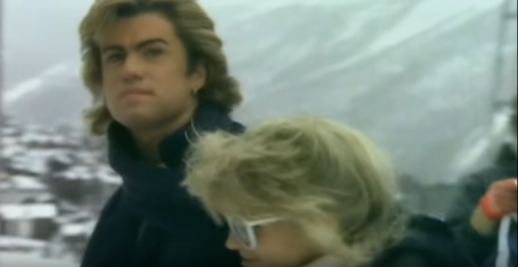
What I’ve labeled the Post-Chorus is a bit of an oddity here, a musical interlude played on festive bells that separates Chorus from Verse. The work it performs is best understood in conjunction with the music video. In the video, a group of friends meet to enjoy a getaway at a ski lodge; the character played by George Michael is here with this year’s girlfriend, and last Christmas’s girlfriend brings this year’s boyfriend. Intrigue! The visual narrative matches the song. In the same way the jolly instrumental seems largely unaware of Michael’s downer lyrics, the group of friends seem oblivious to the furtive, hurt glances between last Christmas’s lovers. This structural oddity, the Post-Chorus, proves key to the visual narrative. There’s a Scrooge in this story, and the Post-Chorus will visit him in the night.

The first Post-Chorus is the ghost of Christmas present. As the friends crowd into a ski lift that will take them to their lodging, the first bell hits right as last year’s girlfriend is center screen (0:53 in the video above), and we watch as the friends arrive at their getaway, the final two measures playing over a wide-angle shot of a ridiculously large cabin. The second Post-Chorus is the ghost of Christmas past. Here, as everyone gathers around a feast, all holly and jolly, the bells (2:23) strike at the moment Michael catches sight of the brooch he gave last Christmas’s girlfriend. He broods. The payoff comes in the second half of Verse 2 (2:59), when we see a flashback to the happy couple the year before, when they frolicked in the snow, lounged by the fire, and exchanged fabulous 80s jewelry. Finally, the third Post-Chorus is the ghost of Christmas future. This time the bells strike as the group is hiking back to the ski lift, returning to the point where they began. We hear the Post-Chorus twice this time, and the first instance (3:53) is accompanied by lyrics pulled from the flashback section of Verse 2, where Michael describes himself and the heartless way he’s been treated. This time, though, instead of finishing the line with “now I’ve found a real love, you’ll never fool me again,” Michael can only offer a breathy “maybe…next year.” In this third Post-Chorus, we have future (maybe next year) overlapping with past (the flashback lyrics) accompanied by visuals that close the narrative circle – a return on the same ski lift we see during the first Post-Chorus. In other words, Michael’s character can sing about someone special all he wants, but the song knows last year’s failure to reproduce will repeat again and again. The fourth Post-Chorus hammers this repetition home: as the friends debark from the lift and the screen fades, we hear this Christmas ghost haunting, lingering at the edges, reproducing heteronormative failure ad infinitum (the fade in the music suggests there’s no definitive ending point).

Screenshot from Wham’s “Last Christmas”

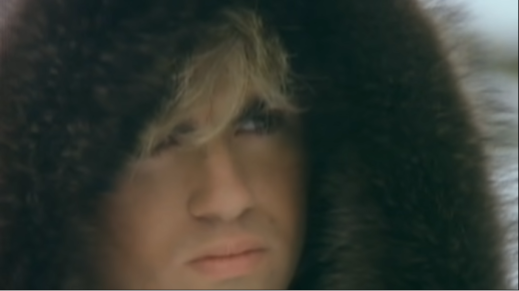
George Michael, of course, was publicly closeted for a long time. It’s unsurprising that we see some horror motifs in this heterofest. The wide-angle shot of the isolated cabin, the close up of a brooding, tortured hero…There may well be a queerness in the absence of gendered pronouns and in the visual aesthetic of the music video. But the real disruption, I think, comes in the structural repetition, the rehearsal of the singer’s failure to reproduce each year at the moment that reproduction is most central. If Christmas love songs circulate in a framework of reproductive futurity, “Last Christmas” Scrooges its way onto the airwaves every year and projects an utter failure of a future.

Most Christmas pop songs come and go. The drive to fill the airwaves with a genre of music that is only functional for 6-8 weeks of the year yields heaps of treacly sonic detritus. Christmas pop songs are, by nature, ephemeral. A few of these songs, though, become classics that artists return to and cover or remix over and again. “Last Christmas” is one of these classics, settling onto November and December playlists in its original form and the myriad cover versions that have piled up over the years. Benny Benassi’s “Last Christmas” remixes the Wham! song in a way that maintains the original’s queerness even as it flips the idea of looping failures.

Benassi’s “Last Christmas” revolves around two main sections: a driving techno beat (A) and a reworking of Wham!’s chorus (B).

A (48 measures)

B (48 measures) (1:25)

A’ (24 measures) (2:22)

B’ (56 measures) (3:04)

A” (32 measures) (4:15)

The A sections include a voiceover from a computerized voice affected so that it sounds like some dystopic transmission. “We would like to know if something does not sound quite right,” the voice starts, and then preps the entry of section B with “to guarantee safety to your perfect celebration, be sure – when playing this tune at maximum volume level – to chant around like everybody else is.” It’s hard to be more on-the-nose than this: an android voice instructing us how to fit in at our reproductive futurist holiday gatherings. “You know, just…I don’t know, just do what the others are doing?”

The B sections are each a sequence of three “Last Christmas” choruses (B’ includes an extra eight measures of the third in the sequence). The first is a sped-up but otherwise unaltered Michael singing about last Christmas. It’s a jarring entry, as the cool machinery of Benassi’s beat suddenly gives way to shimmery 80s pop. The second time through that familiar double chorus, we can hear Benassi’s groove faintly in the background and growing louder and fuller toward the end. It’s a straightforward remix technique: here’s the thing, here’s the thing mixed with my beat, and now here’s what I’m really getting at.

It’s the third sequence (1:53), then, where Benassi really crafts his own “Last Christmas.” Here, the beat we heard when the android told us how to fit in combines with Michael’s chorus as Benassi stutters and clips not only the lyrics but the instrumental, too: nothing is stable. Michael can’t finish a sentence (“La-a-as-a-ast, I gave you my gave you my hear-. Thiii-i-i-i-is year to save me from save me from, I’ll give it to someone, I’ll give it to someo-o-one.”), and the beat can’t get a firm start. While Wham!’s “Last Christmas” uses the Post-Chorus to form a closed loop where past and future circle back around to each other, Benassi’s “Last Christmas” denies reproductive futurity by chopping off the beginnings and ends of phrases. Built on a simple two-measure loop that otherwise motors smoothly through the song, Benassi’s “Last Christmas” can’t loop in the third sequence of the B section because there’s nothing to latch onto.

“last christmas” by Flickr user Dako Huang, CC BY 2.0

While Wham! loops queer failures in their overarching forms, Benassi’s version of the song queerly fails to loop. Both versions of “Last Christmas” bah and humbug at reproductive futurism. They’re Scroogey reminders each year to listen for disruptions of nativity, refusals of politically delimited desires that are queerly vibrating through our earbuds.

_

Featured image: “GOOD BYE and THANK YOU” by Flickr user fernando butcher, CC BY 2.0

_

Justin aDams Burton is Assistant Professor of Music at Rider University. His research revolves around critical race and gender theory in hip hop and pop, and his book, Posthuman Rap, is available now. He is also co-editing the forthcoming (2018) Oxford Handbook of Hip Hop Music Studies. You can catch him at justindburton.com and on Twitter @j_adams_burton. His favorite rapper is one or two of the Fat Boys.

_

tape reelREWIND! . . .If you liked this post, you may also dig:

Benefit Concerts and the Sound of Self-Care in Pop Music–Justin Adams Burton

Audio Culture Studies: Scaffolding a Sequence of Assignments– Jentery Sayers

“Hearing Queerly: NBC’s ‘The Voice’”– Karen Tongson

Out Now: Deep Pockets #3 Scenes of Independence: Cultural Ruptures in Zagreb (1991-2019)


pdf of the Media Do Not Exist book inc_icon_lulu_@2x

By Sepp Eckenhaussen.

After the violent disintegration of Yugoslavia, a flourishing cultural scene was established in Croatia’s capital Zagreb. The scene calls itself: independent culture. In this book, Sepp Eckenhaussen explores the history of Zagreb’s independent culture through three questions: How were independent cultures born? To whom do they belong? And what is the independence in independent culture? The result is a genealogy, a personal travel log, a mapping of cores of criticality, a search for futurologies, and a theory of the scene.

Once again, it turns out that localist perspectives have become urgent to culture. The untranslatability of the local term ‘independent culture’ makes it hard for the outsider to get a thorough understanding of it. But it also makes the term into a crystal of significance and a catalyst of meaning-making towards a theory of independent culture.

Author: Sepp Eckenhaussen

Foreword: Leonida Kovač

Editing: Miriam Rasch and Rosie Underwood
Cover design: Laura Mrkša

Published by the Institute of Network Cultures, Amsterdam, 2019.
ISBN: 978-94-92302-40-3

This publication is licensed under the Creative Commons
Attribution-NonCommercial-NoDerrivatives 4.0 International (CC BY-NC-SA 4.0)

Get the book:
Order a print copy here.
Download PDF here.
Download ePub here.

Dramatic Growth of Open Access 2019

2019 was another great year for open access! Of the 57 macro-level global OA indicators included in The Dramatic Growth of Open Access, 50 (88%) have growth rates that are higher than the long-term trend of background growth of scholarly journals an d articles of 3 – 3.5% (Price, 1963; Mabe & Amin, 2001). More than half had growth rates of 10% or more, approximately triple the background growth rate, and 13 (nearly a quarter) had growth rates of over 20%.

Newer services have an advantage when growth rates are measured by percentage, and this is reflected in the over 20% 2019 growth category. The number of books in the Directory of Open Access Books tops the growth chart by nearly doubling (98% growth); bioRxiv follows with 74% growth. A few services showed remarkable growth on top of already substantial numbers. As usual, Internet Archive stands out with a 68% increase in audio recordings, a 58% increase incollections, and a 48% increase in software. The number of articles searchable through DOAJ grew by over 900,000 in 2019 (25% growth). OpenDOAR is taking off in Asia, the Americas, Africa, and overall, with more than 20% growth in each of these categories, and SCOAP3 also grew by more than 20%.

The only area indicating some cause for concern is PubMedCentral. Although overall growth of free full-text from PubMed is robust. A keyword search for “cancer” yields about 7% – 10% more free full-text than a year ago. However, there was a slight decrease in the number of journals contributing to PMC with “all articles open access”, a drop of 138 journals or a 9% decrease. I have double-checked and the 2018 and 2019 PMC journal lists have been posted in the dataverse in case anyone else would like to check (method: sort the “deposit status” column and delete all Predecessor and No New Content journals, then sort the “Open Access” column and count the number of journals that say “All”. The number of journals submitting NIH portfolio articles only grew by only 1. Could this be backtracking on the part of publishers or perhaps technical work underway at NIH?

Full data is available in excel and csv format from: Morrison, Heather, 2020, “Dramatic Growth of Open Access Dec. 31, 2019”, https://doi.org/10.5683/SP2/CHLOKU, Scholars Portal Dataverse, V1

References

Price, D. J. de S. (1963). Little science, big science. New York: Columbia University Press.

Mabe, M., & Amin, M. (2001). Growth dynamics of scholarly and scientific journals. Scientometrics, 51(1), 147–162.

This post is part of the Dramatic Growth of Open Access Series. It is cross-posted from The Imaginary Journal of Poetic Economics.

Cite as:

Morrison, H. (n.d.). Dramatic Growth of Open Access 2019. The Imaginary Journal of Poetic Economics. Retrieved from https://poeticeconomics.blogspot.com/2020/01/dramatic-growth-of-open-access-2019.html Cross-posted to Sustaining the Knowledge Commons https://sustainingknowledgecommons.org/2020/01/03/dramatic-growth-of-open-access-2019/

Out Now: TOD#32 Networked Content Analysis: The Case of Climate Change

pdf of the Media Do Not Exist book inc_icon_lulu_@2x

TOD#32: Networked Content Analysis: The Case of Climate Change

By Sabine Niederer

With a foreword by Klaus Krippendorff

Description:
Climate change is one of the key societal challenges of our times, and its debate takes place across scientific disciplines and into the public realm, traversing platforms, sources, and fields of study. The analysis of such mediated debates has a strong tradition, which started in communication science and has since then been applied across a wide range of academic disciplines.

So-called ‘content analysis’ provides a means to study (mass) media content in many media shapes and formats to retrieve signs of the zeitgeist, such as cultural phenomena, representation of certain groups, and the resonance of political viewpoints. In the era of big data and digital culture, in which websites and social media platforms produce massive amounts of content and network this through hyperlinks and social media buttons, content analysis needs to become adaptive to the many ways in which digital platforms and engines handle content.

This book introduces Networked Content Analysis as a digital research approach, which offers ways forward for students and researchers who want to work with digital methods and tools to study online content. Besides providing a thorough theoretical framework, the book demonstrates new tools and methods for research through case studies that study the climate change debate with search engines, Twitter, and the encyclopedia project of Wikipedia.

Colophon:
Author: Sabine Niederer

Foreword: Klaus Krippendorff

Editing: Rachel O’Reilly
Visualizations: Carlo de Gaetano
Production: Sepp Eckenhaussen
Cover design: Katja van Stiphout

Supported by the Amsterdam University of Applied Sciences, Faculty of Digital Media and Creative Industries.

Published by the Institute of Network Cultures, Amsterdam, 2019.
ISBN: 978-94-92302-42-7

This publication is licensed under the Creative Commons
Attribution-NonCommercial-NoDerrivatives 4.0 International (CC BY-NC-SA 4.0)

Get the book:
Order a print copy here.
Download PDF here.
Download ePub here.