by Selma K. (‘Sam’) Sonntag Why a book on The Politics of Language Contact in the Himalaya and why now? The title of the book might provide some answers. As the title indicates, the contributions to the book address: 1) … Continue reading →
Pour accéder au livre en version html, cliquez ici.
Pour télécharger le PDF sur Zenodo, cliquez ici (20 octobre)
Pour télécharger le PDF sur le DICAMES, cliquez ici (20 octobre)
Pour commander le livre en version imprimée, cliquez sur le bouton Paypal ci-dessous.
Acheter un livre, c’est nous soutenir et permettre à ceux et celles qui ne peuvent l’acheter de le lire en libre accès.
Le développement des sociétés africaines n’est-il qu’une question économique? La linguistique est-elle condamnée à n’être qu’une science positiviste qui observe sans s’impliquer? Ce livre offre de riches perspectives à ceux et celles qui répondent non à ces deux questions. Il montre qu’il est possible de faire place, dans les sciences du langage, à des préoccupations citoyennes orientées vers la correction d’une précarité communicationnelle nuisible à l’épanouissement des sociétés africaines.
Ce que l’autrice propose de nommer « linguistique du développement » peut, par exemple, aider l’agronome intervenant dans le monde paysan à adopter la langue la plus appropriée. Des travaux linguistiques de codification ou de traduction peuvent contribuer à préserver et valoriser des savoirs locaux d’une pertinence sociale attestée. Les linguistes peuvent aussi mettre au jour les ressorts langagiers des pratiques corruptives. Il s’agit là de quelques-uns des chantiers de la linguistique du développement, nouveau paradigme des sciences du langage au service du bien commun, qui trouve dans ce livre ses fondements théoriques et éthiques.
Léonie Métangmo-Tatou est HDR en sciences du langage (Paris 3). Maîtresse de conférences à l’Université de Ngaoundéré (Cameroun), elle est fondatrice et responsable du laboratoire Langues, Dynamiques & Usages (LADYRUS). Ses travaux de recherche et son engagement social s’articulent autour des dynamiques multilingues et multiculturelles observables en Afrique. Elle s’intéresse particulièrement à la mise en cohérence de ces dynamiques avec la problématique du développement humain et la promotion de la justice cognitive. Pionnière, parmi quelques autres, d’une épistémologie de ce qu’elle a appelé linguistique du développement, elle est coresponsable de la revue Jeynitaare. Son questionnement épistémologique se poursuit dans son engagement en réflexivité (dans le blog Espaces réflexifs) Dernier ouvrage, en collaboration avec Joseph Fometeu et Philippe Briand : La langue et le droit (L’Harmattan, 2018).
In his autobiography, Beneath the Underdog, jazz musician Charles Mingus recounts his hatred of being ignored during his bass solos. When it was finally his turn to enter the foreground, suddenly musicians and audience members alike found drinks, food, conversations, and everything else more important. However, this small, and somewhat ironic, anecdote of Mingus’s relationship with the jazz community has now become a foreshadowing of his current status in sound studies–but no longer! This series–featuring myself (Earl Brooks), Brittnay Proctor, Jessica Teague, and Nichole Rustin-Paschal— re/hears, re/sounds and re/mixes the contributions of Mingus for his ingenious approach to jazz performance and composition as well as his far-reaching theorizations of sound in relation to liberation and social equality, all in honor of the 60th anniversary of Mingus’s sublimely idiosyncratic album Mingus Ah Um this month. The final installment of this series presents Nichole Rustin-Paschal and her gripping reflection on jazz, death, and mourning. Her opening line requires no introduction: “There was a time when I believed that Mingus was haunting me.” You can catch up with the full series by clicking here.–Guest Editor Earl Brooks
Image courtesy of author
There was a time when I believed that Mingus was haunting me. In the small college town where I was then living, I would occasionally see a man with Mingus’s profile, wearing a black hat, leather vest, and sunglasses, in a wheelchair out and about. He was always alone. Mingus had spent the last year of his life increasingly dependent on a wheelchair as the ALS stripped him of his motility. There is a joyous photo of him in his wheelchair, hair in a riot of curls, mouth open in uproarious laughter with Joni Mitchell embracing him from behind, her face aglow with an open-mouthed smile. I can imagine the sound, caught perhaps during a break as they were collaborating on Mingus, his last effort and the album Mitchell said killed her career. Yes, God Must Be a Boogie Man, sending me messages to write and write some more through the sight of this man looking so much like Mingus. Never did I see him with anyone, he was always a solitary figure traveling the main streets. I do not know if he was real.
Listen to Mingus,and you can eavesdrop on his 53rd birthday party (though he thought he was actually 54), his end of life plan (to be buried in India), and his Midas touch, through sound clips from events and interviews happening years earlier, interspersed among the songs. In his quick, low rumbling of voice Mingus proclaimed that he “was lucky, man. Blessed by God.” Mingus was released after his death, the sounds of celebration, funerary plans, and gratitude leading to the final performance, Goodbye Pork Pie Hat.
Mitchell’s lyrics tell both the story of Mingus’s elegy for Lester Young and his own efforts to ward off death among the healers in Cuernavaca, Mexico. It is a story about the black musician as underdog, first reviled, then celebrated with dancing in the street. It is a story about the threat of interracial love and the promise of children. “Love is never easy street,” Mitchell writes, but still, we dance, make music, hope.
The only other time I have felt the dead come to me was some years later while I was rushing through Penn Station to catch my train. The sight of a man sitting cross-legged by one of the columns, surrounded by his belongings, nearly stopped me in my tracks. Surely, that couldn’t be my father, looking at me so calmly and certainly in the crush of Penn Station? A Hoodoo Hollerin’ Ghost he was not, but he was a haint sent to calm me, I’m sure of it. My father had died not too long before. I saw him there and he saw me. Every time I hear Horace Silver’s “Song for My Father,” cliche as it may seem, I think of him, the Mayor of Bum’s Square in Harlem.
Lithe and tall, brown-skinned and handsome, my father loved music and to dance, he dreamed of Egypt and having a son, loved his three daughters and shared his wisdom with them, found a soul mate to get clean with. In a frame by my desk I keep two pictures of us; in both we mirror each other’s expressions. In the first, I may be three and he twenty-two. We are both serious. In the second, he is about the age I am now and we are sitting side by side, smiling, at my baby brother’s first birthday party. They shared a birthday month. I had already given my father is own gift, Francis Paudras’s biography of Bud Powell, his favorite jazz musician. It was the last gift I gave him.
It strikes me that with both these haunting, despite their love of music, I felt closest to them through sightings of them–the clarity with which I could imagine them in settings so seemingly out of character–Mingus in Western Mass., my father south of 125th St.–resonated with me more than any particular piece of music that I could associate with them. For each, death came with physical decline and, for two vibrantly garrulous people, the loss of speech. Each had a way of speaking in tones that were intimate and confiding, even as they reveled in having an audience. For language and voice to fail as they came closer to death, must have been as unbearable for them as it was for we who loved them, and hoped to hear them utter our names, say they loved us, one last time. Buddy Collette speaks of seeing Mingus in his final days and the difficulty of looking at his eyes, which were expressive of pain, despair, and longing. He felt Mingus was imploring him to do something, but he did not know what. Helplessness. My father spent his last weeks in the hospital and with each visit, I could see him turn inward, chasing down memories only he could see. For both, a yearning for a golden age, time past; for we who remain, their absence remolding the shape of things to come.
How do artists teach us to mourn? We are accustomed to thinking about the Second Line, a New Orleans tradition, celebrating the passing on of a loved one. Mourning is public and communal, dancers and musicians moving together to escort the dead to their rest. We think of elegies penned by close friends of other artists, such as Dizzy Gillespie’s “I Remember Clifford,”Miles Davis’ “He Loved Him Madly,” Mingus’s “Goodbye Pork-Pie Hat”—the pain becoming a standard, its changes reimagined, its melody a constant. How do hauntings give color to the music and the memories?
“Ghost in the Machine,” close-up of jazz bass, image by Flickr User RubyT (CC BY-NC-ND 2.0)
The death that looms so heavily over jazz of the postwar era is that of Charlie “Bird” Parker’s in 1955. Shortly after his death, graffiti was seen remarking “Bird Lives.” Parker’s death hit Mingus, like so many others, quite hard. In the liner notes to the album Reincarnation of a Lovebird, Mingus explained how the composition originated. “I wouldn’t say I started out to write a piece about Bird. I knew it was a mournful thing when I was writing it. Suddenly, I realized, it was Bird.”
It is these moments of éclat that make me love Mingus even more. The movement between the conscious and the unconscious, the openness to revelations of the spirit.
In some ways this piece isn’t like him. It’s built on long lines and most of his pieces were short lines. But it’s my feeling about Bird. I felt like crying when I wrote it. If everybody could play it the way I felt it. The altoist (Curtis Porter) did, finally.
Here we see again, Mingus’s insistence that no matter the ostensible subject of the composition, it is he himself, his own feelings that determine his satisfaction with what he has written. Satisfaction, gradually given, with its performance by others, is another story.
Bird, recalls Mingus,
encouraged me about my writing. He never mentioned whether he thought my bass playing was good or bad, but he always thought I was a good writer. In California, in the mid-40s he heard a poem-with-music I’d written, “The Chill of Death.” He heard it in the studio, they never released it. He said that was the sort of thing I should keep on doing, and that I shouldn’t be discouraged.
For Mingus, to mourn Bird was to recognize his life as “a new beginning in jazz not a suspended ending for everyone else to go on copying from.” Jean-Michel Basquiat, born years after Bird’s death, felt haunted by him as well, I think. He memorialized Bird on canvas, recognizing him as a king, Charles the First, a god, an angel, done in by society. To make a visual record of Bird meant that he still lived among us, resurrected in sound; listen, Basquiat implores us to Cherokee.
Jean Michel Basquiat’s “CPRKR” (1982) Image by Author
Long before he died in 1979, Charles Mingus imagined meeting death in his 1939 poem “The Chill of Death.” Mingus depicts Death as a beautiful woman. Like a spurned lover, Death clutches at his hands and throws her arms around him, but he resists, not yet ready to succumb to her fatal embrace. She warns that he will not cheat her this time. Mingus put “The Chill of Death” to music on his Let My Children Hear Music (1974), heard by the public at last, and a debt he still had to pay. Soon, but not yet.
The figure of Death loomed over Mingus throughout his life. He begins Beneath the Underdog with his near death and resurrection as a toddler and ends it with the death of Fats Navarro. The cover of Hal Wilner’s 1992 tribute album, Weird Nightmare, depicts a young child facing down a bull in a ghostly field. It recalls that constant flux Mingus expressed between the conscious and unconscious, his fears and his strengths. The hardback cover of Beneath the Underdog features a picture of Mingus, a Taurus, as a child and one can imagine that the knock-kneed child whom we see from the back confronting the bull is one and the same. Mingus mourned by celebrating the deaths of other musicians in his compositions like the aforementioned “Goodbye Pork Pie Hat” for Lester Young and “So Long Eric” for Eric Dolphy.
He bemoaned the fate of musicians who did not receive accolades during their lifetimes and worried that the same fate would meet him. He understood his body as mortal but his music as evidence of his soul’s immortality. And here we are, celebrating his music, reflecting on the sounds he produced about the world he lived and loved in. Mingus was blessed, man. Mingus lives!
Nichole Rustin-Paschal earned a Ph.D. in American Studies from New York University and a J.D. from the University of Virginia. She is an Assistant Professor at the Rhode Island School of Design. Nichole is working on a new book project exploring how artists use the law as their medium and how law frames art. Her book,The Kind of Man I Am: Jazzmasculinity and the World of Charles Mingus Jr. (Wesleyan 2017) is a gendered cultural history of jazz in the postwar period. She draws on archival records, published memoirs, and previously conducted interviews to explore how Mingus’s ideas about music, racial identity, and masculinity—as well as those of other individuals in his circle, like Celia Mingus, Hazel Scott, and Joni Mitchell—challenged jazz itself as a model of freedom, inclusion, creativity, and emotional expressivity. Nichole is co-editor of Big Ears: Listening for Gender in Jazz Studies(Duke 2008), the first anthology of work in jazz and gender studies. She is co-editor of The Routledge Companion to Jazz Studies (Routledge 2019), an anthology of cross-disciplinary and transnational studies in jazz. In addition, her work has been published inCritical Sociology, JazzDebates/JazzDebatten, Radical History Review, Bill Traylor, William Edmondson, and the Modernist Impulse, William & Mary Bill of Rights Journal, South Atlantic Quarterly,andOrganizing Black America.She has taught at Kansas City Academy, the University of Illinois at Urbana-Champaign, Williams College, and New York University. In addition to her writing and teaching, Nichole is an advocate for the underserved in her education, First Amendment, and privacy law practice.
__
REWIND! . . .If you liked this post, you may also dig:
The Beautiful Warriors. Technofeminist Praxis in the Twenty-First Century Edited by Cornelia Sollfrank The Beautiful Warriors. Technofeminist Practice in the 21stCenturybrings together seven current technofeminist positions from the fields of art and activism. In very different ways, they expand the theories and practices of 1990’s cyberfeminism and thus react to new forms of discrimination and exploitation. Gender politics are negotiated … Continue reading →
Since the event,
I have been asking myself what it means to launch a book in the digital age, in
particular when the entire volume is already—and intentionally—freely available
online for all to read and download. The unveiling of this open access volume has
afforded me an opportunity to reflect on our goals and the choices we made as
editors.
By Mark Turin On an uncharacteristically sunny afternoon in late September, 50 students, staff and faculty gathered at the Peter Wall Institute for Advanced Studies in Vancouver to celebrate the launch of The Politics of Language Contact in the Himalaya. … Continue reading →
In his autobiography, Beneath the Underdog, jazz musician Charles Mingus recounts his hatred of being ignored during his bass solos. When it was finally his turn to enter the foreground, suddenly musicians and audience members alike found drinks, food, conversations, and everything else more important. However, this small, and somewhat ironic, anecdote of Mingus’s relationship with the jazz community has now become a foreshadowing of his current status in sound studies–but no longer! This series re/hears, re/sounds and re/mixes the contributions of Mingus for his ingenious approach to jazz performance and composition as well as his far-reaching theorizations of sound in relation to liberation and social equality, all in honor of the 60th anniversary of Mingus’s sublimely idiosyncratic album Mingus Ah Um this month. In the third piece of this series, Jessica Teague grapples with Mingus’s 1957 Atlantic recording of “The Clown.” Her analysis reveals one of Mingus’s most critical questions: Is the only way to escape exploitation to exploit another, or worse yet, yourself? You can catch up with the full series by clicking here. –Guest Editor Earl Brooks
When jazz bassist and composer Charles Mingus first set out to write his memoirs in the mid-1950s he told his wife Judy that he “wanted a chance to write about the true jazz scene that has made our masters millions and taken the most famed to their penniless graves as the only escape from the invisible chains on black jazz as an art” (Santoro 175). By the time Beneath the Underdog saw publication nearly two decades later in 1971, it was considerably slimmed down from the 800+ page manuscript Mingus had produced. Financially strained and evicted from his downtown loft, Mingus hoped that the book would be a best seller and offer economic freedom from the music industry.
But as many have noted, Beneath the Underdog is not your typical jazz autobiography (see Krin Gabbard, Nichole Rustin-Paschal, Gene Santoro, and Daniel Stein). Here, Mingus rejects standard notions of the self declaring in the first sentence of his book: “In other words, I am three.” By writing in a mode that wavers between the lurid world of popular pulp-heroes and psychological high-modernism, Mingus’s autobiography (like his music) treads a slender line between clowning and critique.
In one of the most infamous scenes from Beneath the Underdog, Mingus hyperbolically describes having intercourse with twenty-three prostitutes over the course of one night in Tijuana, Mexico. The incident follows the breakup of his marriage with his first wife Barbara and his affair with Nesa Morgan, the wife of a club owner. Recounting his superhuman exploits in the language of the comic book, Mingus turns what might have been a display of his sexual prowess into a clowning circus act, complete with zany sound effects and an off-kilter sense of rhythm. It’s a scene that simultaneously reinforces the stereotype of the African American male’s hypersexuality and deflates it with comedy:
There is a certain ambiguity to the poolside scene. Mingus the narrator is notably absent and the action proceeds without any visual clues—he gives the reader only fragments of dialogue that alternate between the prostitutes selling their wares and the side conversation between Mingus and his friend Hickey, who comments upon his sexual performance. What is more, the onomatopoetic sound effects employed are demonstrably silly and absurd. There are no moans or sighs of ecstasy here—each act is punctuated by a “BLAM! BLAM!” (178). Sex is transactional and performative for Mingus, but not pleasurable.
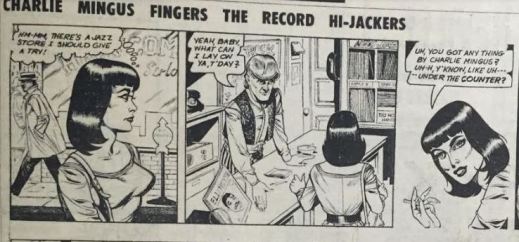
The pulpy, comic book quality of the Tijuana scene makes Mingus a superhuman like a character from The Fantastic Four, but it also makes him into a two-dimensional cartoon. This undercutting of the self and the performative body characterizes Mingus’s concept of the fractured self of the black jazz musician—a theme he takes up in his music as well as his writing (e.g. “Self-Portrait in Three Colors” from Mingus Ah Um). Interestingly, Mingus’s affinity for comics would surface again and in 1966 he collaborated with African American illustrator Gene Bilbrew to create a comic strip-style advertisement for the Charles Mingus Record Club that appeared in the Village Voice.
Biographers have argued that Mingus included these likely fictionalized sex scenes as a way to sell more books and evade the exploitative economics of the music industry. However, the comic book sound effects that render Mingus’s sexuality humorously exaggerated comes at the expense of Latinx women. Despite having grown up in a multi-ethnic community in Los Angeles, his representation of the voices of the Mexican prostitutes flattens their identities and plays upon ethnic stereotypes. With each “Sí señor,” the women are presented as both sexually promiscuous and submissive. Mingus’s relationships with women were fraught, and his anxieties about his own sexuality were inevitably tied up with race. His tendency to treat women as sex-objects is similarly on display in the comic strip above, in which a suggestively-attired white female hipster acts as a narc, exposing a bootleg record dealer. “Uh, you got anything by Charlie Mingus? Uh-h, y’know, like uh… under the counter?” she asks, dripping innuendo.
And yet, these cringe-inducing scenes are often complicated by Mingus’s use of pimping and prostitution as metaphors for exploitation throughout his Beneath the Underdog. At various points he portrays himself as both prostitute and pimp, both masculine and feminine. When his friend Hickey seems to question Mingus’s extreme behavior, he responds: “In this white man’s society what else have I got” (178). Even in moments that indulge in humor, such as the Tijuana scene, Beneath the Underdog darkly implies a pimp or be pimped world.
Mingus would become known for writing music with a political edge—one might think of “Fables of Faubus” from Mingus Ah Um (1959)—but perhaps the closest musical relative to the satirical Tijuana scene is Mingus’s 1957 Atlantic recording of “The Clown.” In the liner notes for the album, penned by Nat Hentoff, Mingus describes that as he wrote the tune, he realized that it had two parts, and started to imagine it as the story of the clown. He then told the story to radio celebrity Jean Shepherd and allowed Shepherd to improvise the telling of the story during the recording. As Mingus described it to Hentoff, the story was
…about a clown, who tried to please people like most jazz musicians do, but whom nobody liked until he was dead. My version of the story ended with his blowing his brains out with the people laughing and finally being pleased because they thought it was part of the act. I liked the way Jean changed the ending; leaves more up to the listener.
Like the Tijuana story, “The Clown” also incorporates sound effects, and it opens with the hollow laughter of men and women in a nightclub. As auditory phenomena, sound effects are especially interesting because of their artificiality—they are performances of sound. In a cinematic or radio context, sound effects typically amplify an action. Even when sounded, rather than written, they seem to act onomatopoetically. Thus, the addition of the laugh track on “The Clown” is both performance and commentary.
But part of the genius of Mingus’s composition is the way he incorporates the logic of the sound effect into the music itself. The vocal quality of his bass, the wah-wahs of the horns, and the rim shots on the drums are but one piece of this totalizing sonic landscape. “The Clown” borrows stylistic elements from other recognizable genres (like, circus music) to evoke the playfully comedic and absurd, but a second, more serious and ironic story of exploitation runs concurrently and undercuts the first narrative’s simplicity. On the one hand, we hear the more jaunty, carnivalesque melody of the trombone (Jimmy Knepper) and the tenor saxophone (Shafi Hadi) that lilts in 6/8, but that melody is punctuated by moments of dissonance and free playing under the narration—stretching the space between comedy and tragedy. The question he seems to ask in both the Tijuana story from Beneath the Underdog and in “The Clown” is essentially the same: Is the only way to escape exploitation to exploit another, or worse yet, yourself?
Close up from the cover of Charles Mingus – The Black Saint and the Sinner Lady (1963)
Black musicians who pushed back were often called “angry,” even as music didn’t always sound that way. One might think of the contrast between seemingly jaunty, upbeat rhythm of Nina Simone’s “Mississippi Goddam” and its devastating lyrics. It is the sound of political and existential crisis. Both “The Clown,” and the Tijuana scene indicate Mingus’s heightened awareness that, as much as he was known for his music, he was also known for his explosive behavior at performances—the “angry man of jazz.” As Eric Porter has pointed out, Mingus’s “irrational behavior appealed to audiences at a moment when many members of American society (of whom Beat writers were emblematic) were looking to the oppositional aspects of black culture for solutions to their dissatisfaction with consumerism, conservative politics, repressed sexuality, constrictive gender roles, and other social ills” (130-131). 1957, the year Mingus recorded The Clown, was the same year that Norman Mailer published his infamous essay “The White Negro” and Jack Kerouac published On the Road. It was also the year that Governor Faubus of Arkansas attempted to halt the integration of Central High School in Little Rock.
Subtle they may be, but the use of comic sound effects in works like Beneath the Underdog and “The Clown” highlight the absurdity of the roles black jazz musicians had come to play within American culture. In worrying the line between the comic and the tragic, the explosive and the reflective, Charles Mingus refused to concede to the identity that had been shaped by the music industry, by the press, and by institutionalized racism.
—
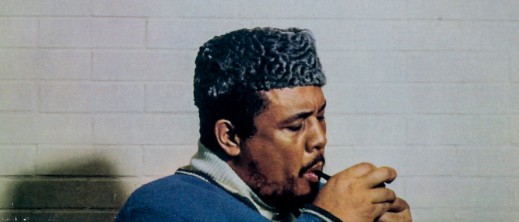
Featured Image: Charles Mingus 1976, Courtesy of the Wikimedia Commons, Colorized by SO!
—
Jessica Teague specializes in 20th and 21st-century American Literature and has taught courses on Jazz and American Literature, Modern American Drama, Modern American Novel, as well as surveys of American Literature, World Literature, and Theory. The intersections between literature, sound, and technology are the focus of her research, and she is currently working on a book titled Ears Taut to Hear: Listening to American Literature after the Phonograph. Her teaching and research is interdisciplinary and engages with modernism, sound studies, jazz, theatre and performance, new media, and African American studies. Her work has been published in American Quarterly and Sound Studies, and she has also been the recipient of research fellowships from the ACLS and the Harrison Institute at the University of Virginia.
—
REWIND! . . .If you liked this post, you may also dig:
I was invited to reflect on and situate The Politics of Language Contact in the Himalaya in the broader multidisciplinary debate on the politics of language. Let me preface my thoughts and comments with two important caveats. The first is that I am a political scientist, particularly a political theorist, whereas most of the authors involved in this book project are anthropologists, linguists and sociolinguists. My training in contemporary political theory and theories of linguistic justice necessarily influences my reading of the broader debates and of the chapters in this edited volume.
The second caveat is that most of my research has
focused on the politics of language in Canada. I have studied the political
claims of linguistic minorities, as well as the language policies enacted by
the federal government and the provinces. To put the matter more directly, I
have never studied the politics of language in the Himalaya region, and I will
not dare in these comments to speak to the specific languages and linguistic
identities that are covered in this edited volume.
I divide my thoughts and comments on The Politics
of Language Contact in the Himalaya into two main parts. The first is about
how, in many ways, the edited volume fits seamlessly into ongoing debates on
the politics of language. The second set of comments will focus on what I have
learned from the project, particularly what I believe it contributes to the
broader debates on the politics of language.
From the perspective of political science, the
politics of language encompasses political action from below, that is,
individuals and groups organizing and mobilizing to demand recognition or
rights or support to ensure that their language survives and even flourishes,
as well as political action from above, which takes the form of laws,
policies, measures and decisions where government seeks to impact language use
and linguistic identities.
I see these two processes at work in this edited
volume. The chapters detail how nation-building efforts, language
standardization efforts, but also a globalized market that promises economic
benefits, have impacted linguistic identities and produced language shifts. These
impacts are unequal across language communities, non-elite communities are
generally the ones who bear the burden of the responsibility to learn a new
language or to switch their register to access public services.
At the same time, the chapters also detail processes
from below, that is, how local actors are working to revitalize their language,
to contest processes of social exclusion and political disenfranchisement, and
to affirm, and, in some cases, redefine their belonging to language and language
community.
In other words, the edited volume participates in
broader conversations about the politics of language and adds exciting cases
from a region that is far too absent in the literature.
Let me turn to a few theories and concepts that are original and that would travel well in the broader debates. First, I see several applications and implications for Tunzhi, Suzuki and Roche’s conceptual distinction between the horizontal and vertical dimensions of language politics. For example, in studies on the French language in Canada, the horizontal dimension could help better theorize the variation in language contact—the contact with English is not the same in BC as it is in Saint-Boniface, Manitoba as it is in Québec City—and the vertical dimension would help problematize the recognition of some language practices (higher status French) and the non- or mis-recognition of other language practices (lower status French).
Second, Bendi Tso and Turin’s theoretical framework founded on linguistic hegemony, coercion and consent has many affinities with Selma Sonntag and Linda Cardinal’s recent work on language regimes and state traditions. One the one hand, the concept of state traditions may help illuminate and explain why some language ideologies become dominant and not others, and on the other hand, Bendi Tso and Turin’s dual concepts of coercion and consent may help further theorize language regimes and their effects on populations and linguistic identities.
Finally, in reading this collection, especially Pradhan’s chapter on the reshaping of the Dangaura Tharu language system and Daurio’s chapter on the Tarali, I could not help but think of a book that was published about 7-8 years ago, one that has been extremely influential in the debates on linguistic justice. This is Philippe Van Parijs’ Linguistic Justice for Europe and for the World. The two basic arguments of that book are first, that English will become the lingua franca of Europe and of the world, and that this is inevitable and desirable, and second, that to survive, language groups must ‘grab a territory’ and impose their language on that territory.
I thought of this book because when confronted with
the rich and localized cases featured in The Politics of Language Contact in
the Himalaya, these two arguments are out of touch, and frankly, absurd.
Many before me have remarked how normative theories of equality and justice, including
theories of linguistic justice, are centered on Global North experiences, and
are inadequate to guide policymakers in the Global South. Reading about
languages and linguistic communities in Tibet, Nepal and Northern India really
hit that point home for me.
In their preface, the editors write: “the detailed introduction and concluding commentary make the collection accessible to all social scientists concerned with questions of language, and we anticipate that the book as a whole will be of interest to scholars in anthropology, sociolinguistics, political science and Asian studies” (xi-xii). I can indeed confirm that this political scientist found the edited volume of great interest, and I hope that many of my colleagues in political science and beyond will read and digest this collection.
Rémi Léger is an Associate Professor in the Department of Political Science at Simon Fraser University, Canada. His research examines the recognition and empowerment of linguistic minorities in comparative perspective. He currently serves as Editor of the journal Francophonies d’Amérique, as well as Chair of the research committee on The Politics of Language at the International Political Science Association. He tweets @ReLeger.
You can now read ‘The Politics of Language Contact in the Himalaya’ by Selma K. Sonntag and Mark Turin here. You can also read the second post of this series ‘The Shifting Politics of Representations of the Himalaya: From Colonial Authority to Open Access’ by Mark Turin here.
by Rémi Léger, Simon Fraser University I was invited to reflect on and situate The Politics of Language Contact in the Himalaya in the broader multidisciplinary debate on the politics of language. Let me preface my thoughts and comments with … Continue reading →
Here at Sounding Out! we think that it’s best to learn from the experts. That’s why we sat in as a fly on a wall for a panel on ethics in podcasting put together by Laura Garbes at Brown University. Please join Laura as she discusses the politics of sound, podcasts, and more with SO! Editor-in-Chief Jennifer Lynn Stoever, storyteller Alex Hanesworth, and radio producer Babette Thomas.
If you want to learn more about Laura’s excellent work, check out
—
Featured image is “Podcast” by Aristocrat @Flickr CC BY-NC-ND.
—
Laura Garbes is a PhD student in sociology at Brown University, where she studies racism, whiteness, and cultural organizations. Her research explores the racialization of sound in public broadcasting. She is also a fellow at Brown University’s Swearer Center for Public Service, and a member of the Du Boisian Scholar Network.
Alex Hanesworth grew up listening to audiobooks in a nook somewhere on Fidalgo Island, WA and now spends her days studying, teaching, and making radio for Now Here This and the RISD Museum. She mostly makes stories about art, history, intimacies, and the intersection of the three.
Babette Thomas is a Black radio producer originally from Oakland, California and is also one of the current managing editors of Now Hear This. Her work is largely concerned with using sound and narrative to bring Black history in conversation with the present.
Jennifer Lynn Stoeverreceived her PhD in American Studies and Ethnicity from USC. She serves on the editorial boards of Sound Studies, Senses and Society, and Social Text. She has published in Social Text, Social Identities, Sound Effects, Modernist Cultures,American Quarterly and Radical History Review among others; her most recent research, “Crate Digging Begins at Home: Black and Latinx Women Collecting and Selecting Records in the 1960s and 1970s Bronx” was published in The Oxford Handbook of Hip Hop Studies (and is FREE to download as of this bio revision in March 2019).
Currently Associate Professor at SUNY Binghamton, Jennifer teaches courses on African American literature and race and gender representation in popular music. During 2011-2012, she was a fellow at The Society for the Humanities at Cornell University, participating in the research group on Sound: Culture, Theory, Politics. In 2016, she published her first book, The Sonic Color Line: Race and the Cultural Politics of Listening (NYU Press).
—
REWIND! . . .If you liked this post, you may also dig:

 In his autobiography, Beneath the Underdog, jazz musician Charles Mingus recounts his hatred of being ignored during his bass solos. When it was finally his turn to enter the foreground, suddenly musicians and audience members alike found drinks, food, conversations, and everything else more important. However, this small, and somewhat ironic, anecdote of Mingus’s relationship with the jazz community has now become a foreshadowing of his current status in sound studies–but no longer! This series–featuring myself (Earl Brooks), Brittnay Proctor, Jessica Teague, and Nichole Rustin-Paschal— re/hears, re/sounds and re/mixes the contributions of Mingus for his ingenious approach to jazz performance and composition as well as his far-reaching theorizations of sound in relation to liberation and social equality, all in honor of the 60th anniversary of Mingus’s sublimely idiosyncratic album Mingus Ah Um this month. The final installment of this series presents Nichole Rustin-Paschal and her gripping reflection on jazz, death, and mourning. Her opening line requires no introduction: “There was a time when I believed that Mingus was haunting me.” You can catch up with the full series by clicking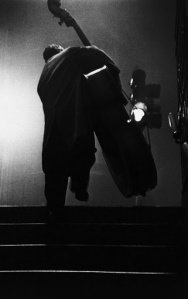


 REWIND! . . .If you liked this post, you may also dig: